Collect

Collect for the Fourth Sunday after Trinity

O God, the protector of all that trust in thee, without whom nothing is strong, nothing is holy: increase and multiply upon us thy mercy; that, thou being our ruler and guide, we may so pass through things temporal, that we finally lose not the things eternal; grant this, O heavenly Father, for the sake of Jesus Christ thy Son our Lord, who liveth and reigneth with thee, in the unity of the Holy Spirit, ever one God, world without end. Amen.

Thursday, April 30, 2015

The Baltimore Spring

A White Bourgeois Pacifist's Thoughts on the Baltimore Riots


Surely this man's opinion will be ... something.

The city hasn't changed as much as I expected it to under the curfew. It's quieter, although there do seem to be a few more sirens than usual in the small hours; then again, maybe it's just easier to pick them out over the lack of background noise. I feel like I've seen a lot more people on foot, too, though that probably has more to do with the improved weather. I went walking around myself on Wednesday morning, and the air smelled like tulips and honeysuckle.

I didn't see that much damage from the riots. A few broken windows and boarded up storefronts, which aren't exactly uncommon in most of Baltimore. But of course, the neighborhood I live in wasn't in the thick of things -- it's in the center of the city, whereas most of the rioting and looting was in the west and southwest.
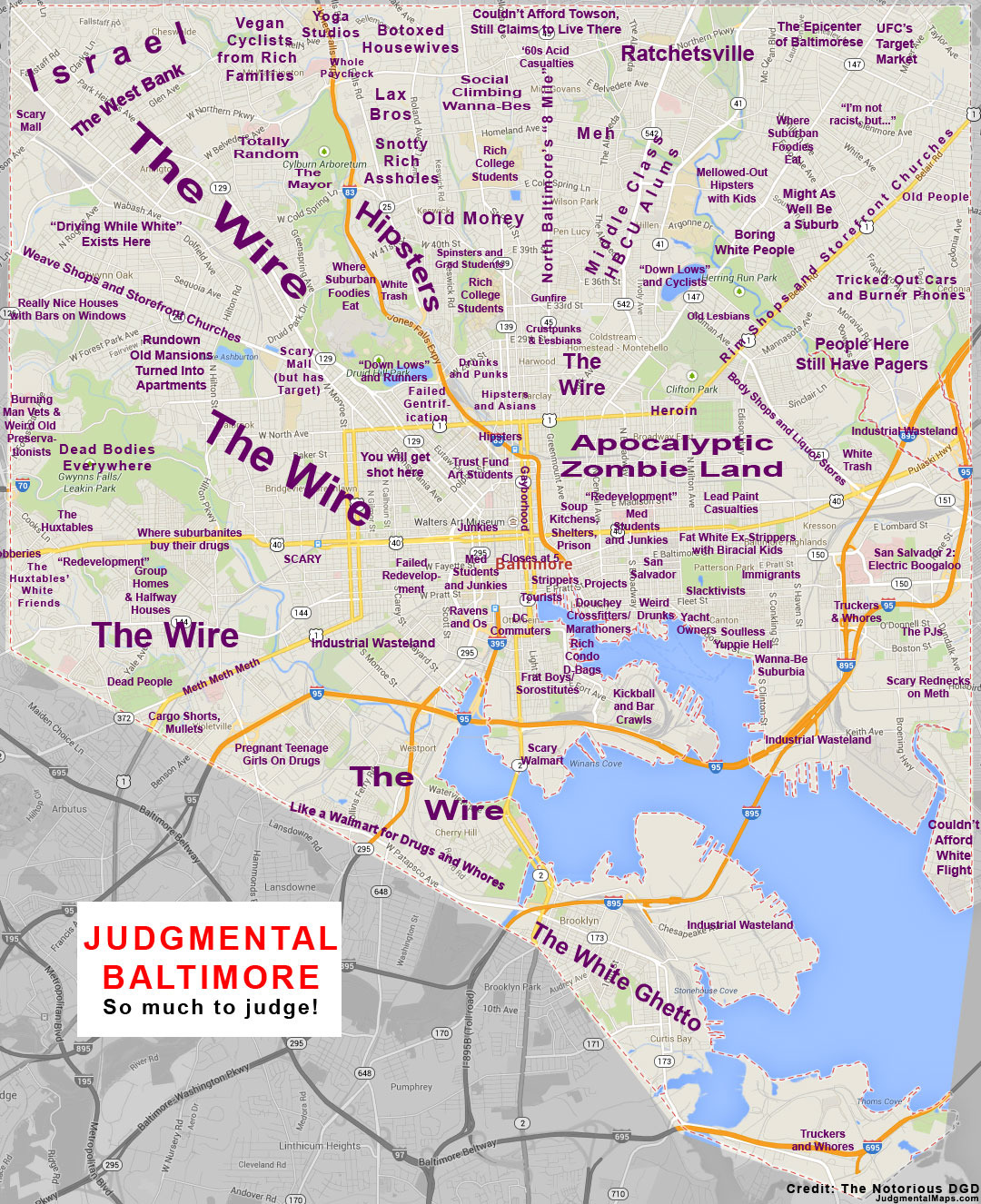

That's me, in between "Trust Fund Art Students," "Junkies," and "The Gayborhood."

The thing I've been most unsettled by has not been the riots. It's been the media reaction (both mass and social media). I try to maintain a healthy skepticism of my own insights on topics like this -- I'm white, I was raised in the middle class, I was out of the city on Monday night, and I've only lived in Baltimore for a bit less than two years, after all. But some of the responses to the events of the last few days seemed, to me, to be so off-base and bizarre that I felt a reply was worth making, for whatever my thoughts are worth.

First, it's important to note that, while the riots got a lot of attention, the vast majority of protesting in the wake of Freddie Gray's sad death has been peaceable. It started that way, and most of it stayed that way. I've seen it suggested that the looting and arson happened at the hands of crooks and delinquents who merely took advantage of the moment, rather than at the hands of any protesters at all; I'm not sanguine that that's completely true, but I'd be willing to bet that the overlap was a lot smaller than you'd think from watching the news. What's more, the cleanup seems to have gone swimmingly; I met a dude on Tuesday, the day after the worst of it, while looking to help with repair work and the like, and we couldn't find anything to do. (My suspicion is that what work was still left was in the areas where the roads were still shut down, which were too far out for either of us to walk, but still.) People have been coming out of the woodwork to put their city back together, and I gotta say, I'm kind of amazed. This place is more resilient than I gave it credit for.

And I believe it's that renewal that is going to triumph in Baltimore in the end, because that is the force of life, God's creation. And that creative energy isn't just a pleasanter thing than the anti-energies of destruction, oppression, and decay; it's a stronger thing. Rampage and violence cannot make, and they begin to collapse from within as soon as they come into being; they can only continue as long as the host in which they are burrowing parasites remains vital. Life, in God, is self-regenerating. That's why it's going to win.

Secondly, the riots may have been sparked by the Freddie Gray case, which is bad enough in itself -- a nearly-severed spine is no joke, especially after being stopped and searched for, um, running away from police (who weren't detaining him, or even talking to him), who took this as a reason to chase him. I feel like the Fourth Amendment got lost somewhere in here, since running away from police who happen to be around, as opposed to police who are actively detaining you, is not to my knowledge unlawful,* and seems to me more like plausible cause than probable cause, given the whole presumption of innocence thing and the "seriously, butt the hell out of private citizens' business" thing that the American law system is sort of based on ...

Hey, it's one of those fancy napkins people use for eating Irish babies.

Anyway, the riots may have been sparked by the Freddie Gray case. But they aren't, simply, about his death. Neither are they simply about the string of highly-publicized deaths of black persons at the hands of police over the last year, although I feel sure that's relevant. Nor can we simply say "Racism" and be done, though there is plenty of that to go around so no one has to feel left out.

The occasional remarks about "black protesters" and "black rioters" that I've seen on social media have kind of creeped me out, to say the least. It's not clear to me that looting the mall or setting fire to CVS would be somehow different if white people were doing it, or Latinos, or Asians. On the other hand, I've seen one or two people more or less excusing the violence as an expression of frustration on the part of the black populace, and even referring to it as some sort of just reprisal against the white, capitalist establishment.**

The problems with all this armchair activism are manifold. Does anyone seriously propose the belief that the only people who were out looting were all black? Or that, even if every single one of them was, their skin color was somehow gremlinizing their brains to make them do it? And conversely, if this was revenge against wealthy whitey, why is it that, of the damaged stores close to my neighborhood at least, all except one were owned, operated, and frequented by local African-American folks? Or, if we propose that the class element had more to do with it, why did they loot Mondawmin Mall (i.e., scary-yet-Target-having mall as above), as opposed to the banks or restaurants or businesses close to the Inner Harbor? It's questions like these that make me think that, though there was very possibly some overlap between protesters and purgers, the latter were for the most part taking advantage of the moment.

But besides that, this has prodded me to start trying to understand racism in America better. I think it's worth pointing out that it's this power to understand which is one of the great difficulties, but maybe not for the reasons that a lot of people think. Most conservatives seem to think that liberals just enjoy being moral indignant, while most liberals seem to think that conservatives are at least a little bit supremacist. I don't think either hypothesis is necessary -- or, insofar as we kind of need everybody working on this problem, productive.

A few years ago, I was having a conversation with a friend of mine, Nazim, a guy I knew from college, whose mother was white and whose father was Algerian; he looked pretty much Caucasian if he shaved, but when he grew his beard out he looked Arabic -- handsome dude. Now, I had always thought of racism as a belief, held consciously or (I could allow this) unconsciously, that one race was superior to others -- generally one's own.


With, uh, certain odd exceptions.

Nazim, however, talking about a class he'd had where they had been discussing the phenomenon of white privilege, and about his own experience of getting white privilege if he was clean-shaven, until people learned his name (after which he'd be treated as Arabic instead of white -- i.e., not necessarily worse, but perceptibly differently). As the conversation progressed, it came out that when Nazim's professor had spoken about racism, the point had not been about any beliefs at all, conscious or submerged, but about the systemic facts of who holds the power.

In other words, an imaginary city in which two-thirds of the people are black and also happen to be largely disadvantaged, while one-third of the people are white and also happen to be largely well-off, is still (by this definition) a racist city even if none of the white folks are intentionally being dicks about it. And honestly, while I think that a person's principles and intentions are even more important than what happens, what happens is still pretty damn important.

As far as white people intentionally being dicks goes, though, I think we have to allow that there's a great deal of that. I've kept fairly quiet on most of the recent, highly publicized cases in which a racist element has been proposed*** -- Trayvon Martin, Michael Brown, Eric Garner -- because I haven't known many of the facts, and I don't want to be a bandwagoneer, to say nothing of wishing to believe in the innocence of the cops in question until their guilt is proven (partly due to my aforesaid ignorance, and partly because these deaths were bad enough even if they were the result of horrible misunderstandings, let alone if they were callous murders). But. While I don't propose to decide on any of these things individually, the Ian Fleming rule of thumb remains: Once is happenstance, twice is coincidence, three times is enemy action. Further examination -- of facts, and of consciences -- is warranted.

And what then? I haven't got a fucking clue. I can try to do right by my neighbor in a given situation; how to help with systemic racism, even in my immediate neighborhood, I simply don't know. I will, therefore, conclude with the following excerpts from Mahatma Gandhi's Non-Violent Resistance, asking my readers -- if there are any who have committed violence, approved of violence, or excused violence as a black reaction to white oppression, and also all my other readers -- to consider them carefully.

Reader: Why should we not obtain our goal, which is good, by any means whatsoever, even by using violence? Shall I think of the means when I have to deal with a thief in the house? ... You seem to admit that we have received nothing, and that we shall receive nothing by petitioning. Why, then, may we not do so by using brute force? ...
Editor [Gandhi]: ... I have used similar arguments before now. But I think I know better now, and I shall endeavor to undeceive you. Let us first take the argument that we are justified in gaining our end by using brute force because the English gained theirs by using similar means. ... [B]y using similar means we can only get the same thing that they got. You will admit that we do not want that. Your belief that there is no connection between the means and the end is a great mistake. Through that mistake even men who have been considered religious have committed grievous crimes. ... [T]here is just the same inviolable connection between the means and the end as there is between the seed and the tree. I am not likely to obtain the result flowing from the worship of God by laying myself prostrate before Satan. If, therefore, anyone were to say: "I want to worship God; it does not matter that I do so by means of Satan," it would be set down as ignorant folly. We reap exactly as we sow. ... If I want to deprive you of your watch, I shall certainly have to fight for it; if I want to buy your watch, I shall have to pay for it; and if I want a gift, I shall have to plead for it; and, according to the means I employ, the watch is stolen property, my own property, or a donation. ... Will you still say that means do not matter? 
Passive resistance is a method of securing rights by personal suffering; it is the reverse of resistance by arms. When I refuse to do a thing that is repugnant to my conscience, I use soul-force.**** For instance, the Government of the day has passed a law ... I do not like it. If by using violence I force the Government to repeal the law, I am employing what may be termed body-force. If I do not obey the law and accept the penalty for its breach, I use soul-force. It involves sacrifice of self. Everybody admits that sacrifice of self is infinitely superior to sacrifice of others. Moreover, if this kind of force is used in a cause that is unjust, only the person using it suffers. He does not make others suffer for his mistakes. ... If man will only realize that it is unmanly to obey laws that are unjust, no man's tyranny will enslave him. 
Reader: I deduce that passive resistance is a splendid weapon of the weak, but that when they are strong they may take up arms.
Editor [Gandhi]: This is gross ignorance. Passive resistance, that is, soul-force, is matchless. ... What do you think? Wherein is courage required -- in blowing others to pieces from behind a cannon, or with a smiling face to approach a cannon and be blown to pieces? ... Believe me that a man devoid of courage and manhood can never be a passive resister. This, however, I will admit: that even a man weak in body is capable of offering this resistance. One man can offer it just as well as millions. Both men and women can indulge in it. ... Control over the mind is alone necessary, and when that is attained, man is free like the king of the forest and his very glance withers the enemy. Passive resistance is an all-sided sword, it can be used anyhow; it blesses him who uses it and him against whom it is used. ... It never rusts and cannot be stolen. ... It is strange indeed that you should consider such a weapon to be a weapon merely of the weak. 
-- Non-Violent Resistance (Satyagraha), pp. 9-11, 17-18, 51-52


*It's true that Freddie Gray was found to have a switchblade in his pocket, which Maryland law only permits to be carried openly. Then again, it was his spine that got almost severed, not the cops'. And, again, the only reason they found the switchblade (which he shouldn't have been carrying) was because they searched him, and they were searching him without probable cause -- on the grounds that he ran away when he saw them, which is not proof or even very sound evidence of anything.

**I've been especially puzzled by the vitriol I've seen directed at Mayor Rawlings-Blake. Being an anarchist, I have no special attachment to the Mayor, but the hate she's gotten for her handling of the situation baffles me, especially for her remark that the violent looters were "thugs" -- a statement that one person I know literally equated with calling them niggers. We did all notice at some point, I hope, that Stephanie Rawlings-Blake is black, and therefore likely wasn't making a euphemistic racial slur? And as for thuggery, if smashing windows, stealing stuff, and setting buildings on fire doesn't count, I'd be both interested and a little scared to learn what does.

***I don't for one moment believe that the recent spate of cases that the media have latched onto are the only ones; and in fact I have difficulty believing that this string of putatively racist cop cases is even a new phenomenon. My personal hunch is that, for whatever reason, it's become sexy to report on these things, and so they found a trend that already existed and started to make a media sensation out of it.

****This translates the Sanskrit term satyagraha, a difficult word to render in English -- truth force or insistence on truth would be alternates to the translation used by Gandhi here. It is arguably the key concept in all of his thought, and was a major influence on the anti-racist and civil rights activism of Nelson Mandela and Martin Luther King Jr. A more extensive treatment of it can be found here.

Saturday, April 25, 2015

Five Quick Takes

I.

I am sick as a dog right now; I've got one of those awful, blitzkrieg colds that abruptly sets up shop in your nasal passages and won't go away. My head feels like Keith Richards has been living in it: my throat is sore, my nose is running, my eyes are burning, and my sneezes have become that wretched hot-breath kind that build up beforehand and sort of linger afterward. On top of which, my roommate has already turned the heat off, but the cold snap Baltimore's gotten means my room feels like a broken fridge, so I'm slowly accumulating a sort of nest in my bed where the blanket is, with orange juice and bottled water beside me, as well as a rapidly increasing plateful of kleenex (stop judging me, I was having dinner and then when I finished the trash can was far away). I've also discovered that Safeway-brand generic Mucinex tastes like grape-flavored candy. Related: fuck you, twenty milliliters every four hours, I'm a grown-ass man, and I'm going to do what it takes to make this virus take a dirt nap.

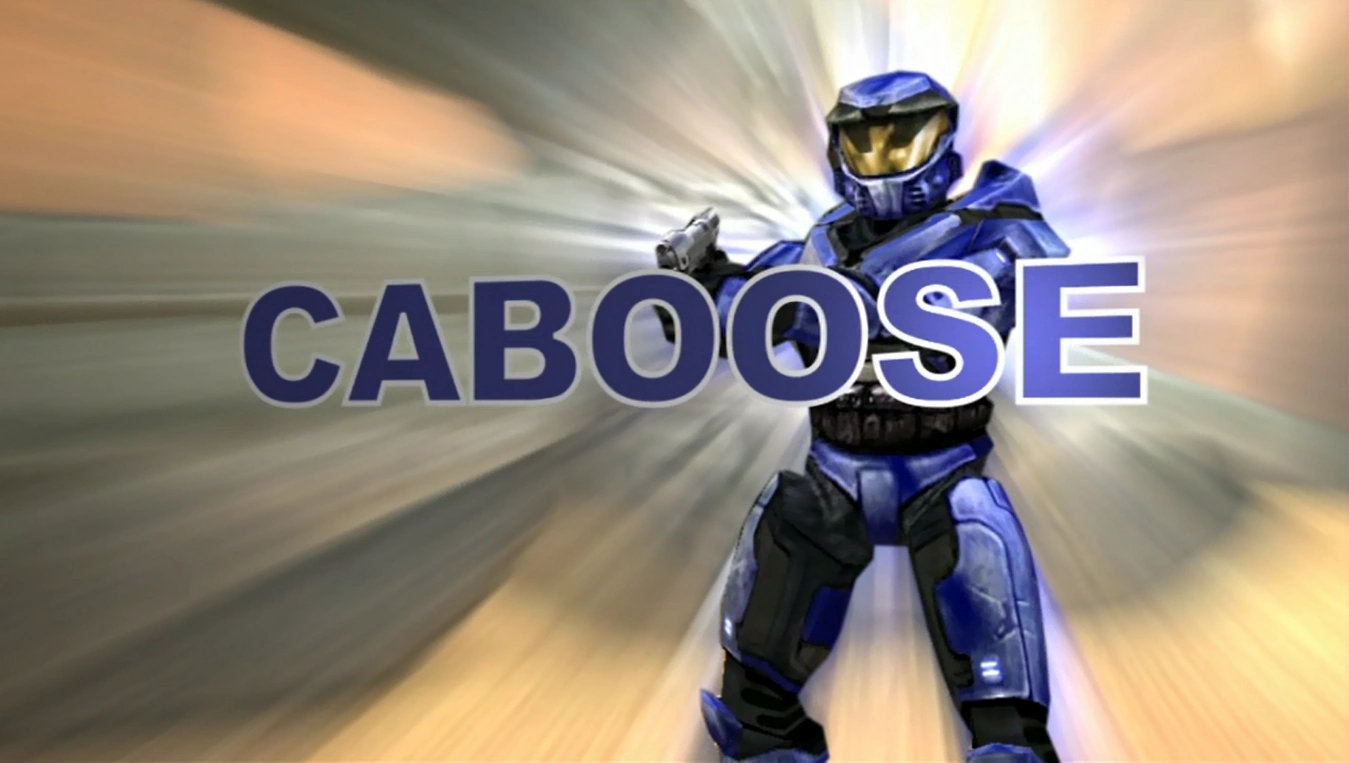
I've also been marathoning Red vs Blue, which I never saw start to finish back in the Before time, and is now on Netflix. Watching Caboose and Donut and Grif kind of makes me feel smart, butch, and industrious.


"That guy Tex is really a robot ... and you're his boyfriend! So that makes you ... a gay robot."

Life is glorious.

Anyway, if you'd pray for me, I'd be grateful. Maybe give a shout out to St Blaise, if you're into that.

+     +     +

II.

You may already have seen in the news that a sizable earthquake struck Nepal near Kathmandu this morning. An avalanche also occurred, and the death toll currently stands at something like 1400 people, I understand. Prayers for them are earnestly solicited; UNICEF and Oxfam are already setting up relief efforts, as are Catholic Charities and a number of other humanitarian organizations.

+     +     +

III.

There have been some fairly good articles on the gay marriage controversy of late. Two that stand out, because of their fair-minded and courteous approach from one side to the other, are Frederica Mathewes-Green's post on why she hasn't been culture-warring against gay marriage (though she is an Orthodox Christian), and Damon Linker's piece at The Week in defense of Ryan T. Anderson and of respect for differing convictions generally (though he supports gay marriage). Reading thoughtful, even-handed essays like these makes me miss Andrew Sullivan being at The Dish again.

+     +     +

IV.


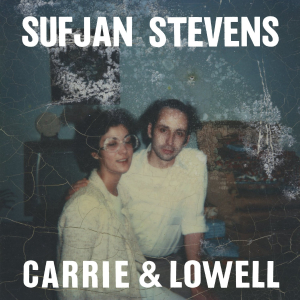
Sufjan Stevens and Florence + the Machine both have new albums out -- Carrie & Lowell and How Big, How Blue, How Beautiful, respectively -- and I've fallen in love with them both all over again.

Florence Welch's sound is as magnificent as it was on Lungs and Ceremonials, and has a new, rock-like energy infused into it, notably on "What Kind of Man," whose music video incorporates her characteristically enchanting religious imagery and gripping violence. She's one of the few artists I've ever heard do justice to the ferocity that erotic love can have; many are content to write and sing merely of the joys and sorrows it imparts, and God knows there are enough of those. But romance would, in the end, be insipid if there were no sense of danger in the beloved, and Florence + the Machine's music is full of danger, and of the quasi-mystical exaltation that is so often connected with both danger and romance (the music video for "No Light, No Light" is a splendid example of this).


Carrie & Lowell, meanwhile, features a return to the indie folk of Sufjan Stevens' work before the experimental electronica of The Age of Adz, sounding almost like a throwback to Seven Swans, but with a buoyancy of its own, faintly reminiscent of Illinoise. The sheer volume of music he has put out in so short a span of time -- his first studio album came out in 2000, and since then he has released six more, plus two Christmas albums, a multimedia album, and a B-side album -- would suffice another musician for an entire career, and his craftsmanship is incomparable. His complicatedly Christian themes (which always remind me a little of Flannery O'Connor for their combination of devout faith with honest, gritty grappling with the anguish and mysteries of living) persist here, particularly in "No Shade In the Shadow of the Cross," "Drawn to the Blood," and "John My Beloved." I'm swimming in it.


+     +     +

V.

... Bleh. I can't think of a fifth thing. I just thought of four things. Isn't there any end to the things? It's like -- ehrmagehrd, there is a "Donut: The Musical" video!


I said stop judging me!

Thursday, April 16, 2015

Lost In the Comsos, Part II: The Matter of the Ultimate Turtle

In order for any treatment of Catholic belief to make sense, we must begin with its most fundamental elements. The existence of the world as we know it, the thing that batters us about through our five-windowed senses, does not as a rule require a great deal of argument, unless one is talking to a sophomore philosophy major, and so I shall leave that aside. However, the existence of God -- i.e., of a Supreme Being, both self-existent and in some fashion the cause of all other existence, and in most religions believed to be in some sense a personal being -- does call for demonstration of some type, since most people don't find the existence of God to be self-evident.*

Bertrand Russell, contemporary of C. S. Lewis and author of the famous essay Why I Am Not a Christian, selected the classical cosmological argument or argument from causality for special censure. His rebuttal, I gather, has been taken up since by the New Atheists (Richard Dawkins, Sam Harris, etc.; but not all contemporary atheists fall into this group, such as Camille Paglia.)
Perhaps the simplest and easiest to understand is the argument of the First Cause. (It is maintained that everything we see in this world has a cause, and as you go back in the chain of causes further and further you must come to a First Cause, and to that First Cause you give the name of God.) That argument, I suppose, does not carry much weight nowadays, because, in the first place, cause is not quite what it used to be. The philosophers and the men of science have got going on cause, and it has not anything like the vitality it used to have; but apart from that, you can see that the argument that there must be a First Cause is not one that can have any validity. ... If everything must have a cause, then God must have a cause. If there can be anything without a cause, it may just as well be the world as God, so that there cannot be any validity in that argument. It is exactly of the same nature as the Hindu's view, that the world rested upon an elephant and the elephant upon a tortoise; and when they said "How about the tortoise?" the Indian said, "Suppose we change the subject."
Now, in deference to Mr Russell, I must admit that I'm not altogether clear what "the philosophers and the men of science" were doing about causality at that time, though I venture to suggest that whatever it was, it didn't succeed in eliminating the nature or fact of causes.


But the meat of the argument, of course, lies elsewhere. And it's quite true that, if everything requires a cause, the idea of a First Cause is -- well, in direct contradiction to the claim that everything requires a cause, QED. And not a few would-be apologists, when confronted with this terribly obvious fact, have indeed tried merely to change the subject, often by resorting to fideism. I make no secret of the fact that I have very little respect for this kind of philosophical legerdemain, and feel that it borders on dishonesty and intellectual cowardice even at its best.

However, it must be noted that Mr Russell apparently didn't grasp the real nature of the cosmological argument. As stated by St Thomas Aquinas, and maintained by his disciples (among others), the argument is most definitely not that everything has to have a cause; and that is not the form that Russell at first gives the syllogism, even in his own essay. What the argument states is that "everything we see in this world has a cause"; a crucial distinction. The idea is that there are two possible kinds of things: those whose existence is contigent, i.e. calls for some sort of explanation about its origin, and those whose existence is necessary, i.e. a self-existent being or class of beings. The Catholic contention is that the existence of contigent things -- "everything we see in this world" -- requires some necessary being to explain its existence, not that all things must have a cause, which would be a hopelessly self-defeating argument for the reality of God.

In brief, Catholics, and most monotheists, assert that if reality as we know it is to make any sense, there must be a minimum of one necessary being in order to cause contingent things to be.

Now, it's quite true that an Uncaused Cause, while consistent with the Abrahamic notion of the God, is a great deal less specific than the Mosaic thundercloud upon Sinai, the Crucified and Resurrected Logos, or the Exalted One who assumed Muhammad from al-Aqsa in Jerusalem. However, at the moment, we are dealing only with what the cosmological argument professes to demonstrate: not what it makes no claims of demonstrating, or how much more we were expecting it to demonstrate.

The difficulty about the alternatives proposed by Russell is threefold. To begin with, if we admit that a First Cause is necessary but posit that it is the world as a whole, rather than an independent being who made the world,** what we have actually arrived at is a form of pantheism, rather than atheism proper. This form of pantheism need not be of the specifically Hindu or Daoist type that peoples the universe with a plethora of particular deities, but, if "the whole show" is to be considered a self-existent entity, then it is, to that degree, a god, if an impersonal one. (The catch there is how an impersonal god could bring personal consciousnesses -- that is, ourselves -- into existence, since nothing comes from nothing, and correspondingly no agent can bestow what it does not possess; and if we allow the universe to have purposiveness or mind, then we have arrived again at a personal God, if a pantheistic one.)


A wild PANTHEIST DEITY has appeared!
[FIGHT]   [RUN]   [CAPTURE]

Another flaw in the argument is precisely in the contingency of the universe and the things in it. The first premise laid down by St Thomas and co. is that all the things we experience in this world are contingent, i.e. that any of them might not have existed and might cease to exist; and if everything is contingent, then nothing would exist, because, given enough time, everything would eventually "go out" -- and then there would be nothing to bring anything back.

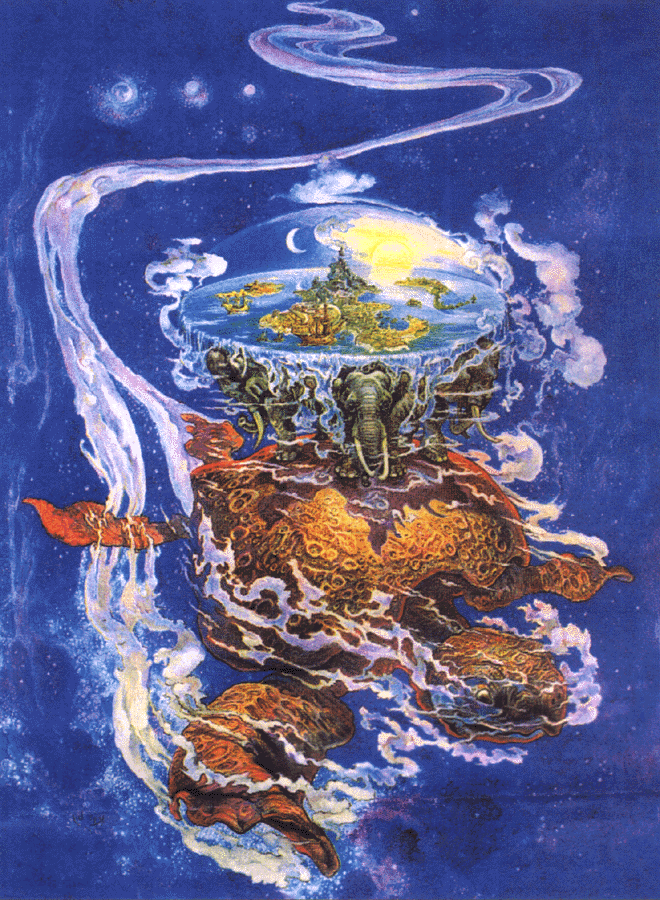
Russell's reply was that he saw no reason why there should not be an infinite succession of contingent things, each caused by a predecessor -- things caused by other things, forever. The difficulty with this, I think, is the "turtles all the way down" problem:
After a lecture on cosmology and the structure of the solar system, William James was accosted by a little old lady. "Your theory that the sun is the center of the solar system, and that the earth is a ball which rotates around it, has a very convincing ring to it, Mr James, but it's wrong. I've got a better theory," said the little old lady. 
"And what is that, madam?" inquired James politely. 
"That we live on a crust of earth which is on the back of a giant turtle." 
... James decided to gently dissuade his opponent by making her see some of the inadequacies of her position. "If your theory is correct, madam," he asked, "what does this turtle stand on?" 
"You're a very clever man, Mr James, and that's a very good question," replied the little old lady, "but I have an answer to it. And it is this: the first turtle stands on the back of a second, far larger, turtle, who stands directly under him." 
"But what does this second turtle stand on?" persisted James patiently. 
To this the little old lady crowed triumphantly, "It's no use, Mr James -- it's turtles all the way down."
I suppose we can only hope that Mack doesn't belch.


Elephants and turtles both seem pretty strong. I don't see what all the fuss is about.

This, of course, is not disproof. The fact that the human mind (or most human minds) will not accept a "turtles all the way down" explanation of existence, since it does not really explain anything, does not in itself show that this un-splanation is untrue. That said, I don't think I'd want to go up as a surety for it, even if I believed it. The thesis that there is something which necessarily exists, on the other hand, has the merit of being obviously rational (whether false or true), even if we don't see why a necessary being should exist; though, when you come to think of it, asking why a necessary being exists is probably a nonsense question.

Finally, there is the pesky little problem of getting something out of nothing. If the only things that exist are contingent, that is, caused (and thus unnecessary), how can "the whole show" be a necessary or uncaused thing?

I've let myself stray a bit into arguing, rather than merely stating Catholic belief, here. It's hard not to; analyzing things is terribly fun. But I hope this has, at least, clarified the difference between the idea of a First Cause and the idea (or failure of idea) that Russell rightly derided.


*Many people claim to find God's existence self-evident, including some saintly individuals; Bl. John Henry Newman, I believe, said so. I can certainly allow that some people have a natural, mystical gift, by which the reality of God is experienced as an immediate fact, rather than arrived at through reasoning or instruction or both; nonetheless, I do suspect that, when most people say that they consider God's existence self-evident, what they tend actually (if unconsciously) to mean is that they do not wish to argue about it.

**There are a few possible meanings for making the world here; the "emanations" of Neo-Platonism and Gnosticism, though wholly distinct from the Judaeo-Christian concept of creation ex nihilo, are still a consistent interpretation of the cosmological argument's implications.

Monday, April 13, 2015

Lost In the Cosmos, Part I: A Map of a Mountain

One of the hardest things in discussing Catholicism with most people, I find, is that they don't usually quite grasp the nature of Catholic belief. I don't mean that they do not know what Catholic doctrine is; that is also true, but is a separate and much simpler problem; I mean that the kind of belief Catholics espouse is unfamiliar to them -- whether in the sense of not having experienced it themselves, or of not expecting it of an institutional Church.


Honestly, by now, everybody expects you, guys.

Dorothy Sayers, who wrote a good deal (if half-incidentally) about Christian belief, ran into the same difficulty, and composed a short catechism indicating much of the problem. Take the following selections, for instance:
Q.: What is the doctrine of the Trinity?
A.: "The Father incomprehensible, the Son incomprehensible, and the whole thing incomprehensible." It's something put in by theologians to make it more difficult -- nothing to do with daily life or ethics.
Q.: What is meant by the Atonement?
A.: God wanted to damn everybody, but His vindictive sadism was sated by the crucifixion of His own Son, who was quite innocent, and, therefore, a particularly attractive victim. He now only damns people who don't follow Christ or who never heard of Him.
Q.: What does the Church think of sex?
A.: God made it necessary to the machinery of the world, and tolerates it, provided the parties (a) are married, and (b) get no pleasure out of it.
Q.: What does the Church call sin?
A.: Sex (otherwise than as excepted above); getting drunk; saying "damn"; murder, and cruelty to dumb animals; not going to church; most kinds of amusement. "Original sin" means that anything we enjoy doing is wrong.
Q.: What is faith?
A.: Resolutely shutting your eyes to scientific fact.
I cannot help feeling that, as a statement of Christian orthodoxy, these replies are inadequate, if not misleading.*
I feel rather as Miss Sayers did, and, while the particularly American difficulties in the early twenty-first aren't exactly the same as those of Great Britain in the middle of the twentieth, they are closely related in both fact and genesis. It is a tragic irony that those nations which were thought to be, and in some ways were, beacons of Christian belief a hundred years ago, should have retained only the most degraded and nonsensical rags of what they once knew -- a more difficult prospect for evangelism than the merely unreached (which is why the dicastery for the New Evangelization was set up).

The difficulty is, people tend to think of Catholic theology, and Christian theology more generally, as a list of things one has to accept to be "part of the club." This misconception isn't helped at all by the massive number of Christians, Catholic and Protestant alike, who also believe it. Indeed, the contemporary debate between evangelical and mainline Protestants, and between traditionalist and progressive Catholics, takes place wholly within this sphere. Evangelicals and traditionalists, legitimately concerned with the meaning and identity of the "club," wish all of the regulations to remain entirely the same; while mainliners and progressives, legitimately concerned with the openness and catholicity of the "club," want the rules relaxed or even dispensed with to expedite the functionality, inclusivity, and retention rate of the club. Both are right in their way, and both are mistaken.**

The rightness of each lies in what it is trying to defend. Conservatives, so-called, are perfectly right to treasure the theology, ethics, and ritual that the Church has maintained for so long. Meanwhile liberals, so-called, are perfectly right to be concerned about the tendency of Christians to be mere sticks-in-the-mud over trivialities or licit cultural differences, and to scandalize those outside by prioritizing rightness over love. (There are other theological debates that cut across and inflame the divide, of course, but these need not detain us.)

Where both sides, and many outside the faith, go wrong is precisely in thinking of the Church as something like a club, and of Christian doctrine as the terms of membership. That isn't it at all. What the Church professes to have is not a list of rubber-stamped ideas, like a political platform or a manifesto; what the Church professes to have is revelation -- that is, personal contact with the Maker of the cosmos, and His own instructions on what reality is and what's to be done about it.


In other words, as a Catholic, I value the Church because she tells me facts I couldn't have found out for myself, and gives me tools for dealing with those facts; I'm not simply accepting anonymous verbal formulas, and insisting that human happiness consists in repeating those formulas after saying "I believe that". For example, part of the reason that I ultimately converted had to do with the Catholic spirituality of the Blessed Virgin Mary. I found, in my own heart, and throughout religious history, a need for a "Great Mother," a spiritually maternal power; this need was, naturally enough, filled in most pagan societies by the worship of goddesses like Isis, Cybele, Hera, or Shakti. But if man is in the image of God, I reasoned, then the basic needs and impulses of the human heart -- however contaminated by sin -- are essentially in accord with reality; they reflect something of reality, even if they do so imperfectly. Evil and the devil cannot create, they can only distort, so that this longing for a "Great Mother" was precisely a reflection of something real and good. Returning my gaze to Christian history, it was precisely the Catholic and Orthodox traditions that did justice to this need, and did so with the only plausible candidate, the Mother of God. I accepted this as a mystery because I had already accepted it as a fact, and I accepted it as a fact because I had discovered it as a fact.

A few writers -- Dorothy Sayers, Ronald Knox, Walker Percy, Flannery O'Connor, Charles Williams -- have succeeded in conveying this corrected approach to Christian belief. The Catholic Church teaches, not "Say such-and-such and you will be saved from hell, because for some reason God is a real stickler about saying such-and-such" but, "Reality is this kind of thing" -- and the necessary way of dealing reality is, therefore, built into its nature, not into any arbitrary divine fiat.***

This, incidentally, is one of the reasons that Catholicism can combine its adamant belief that it possesses the fullness of divine truth, with the thesis that those who are not professing Catholics can nevertheless be received into eternal fellowship with God. It isn't at all a matter of indifference to the truth. It's more like being able to climb a mountain without a map: it isn't a good idea exactly, and you'd do well to get a map and heed it, and if you deliberately go against a map you've got then you're going to hurt yourself; but it is, nonetheless, possible to reach the top without one. The Church's concern with truth -- from the great essential mysteries, like the Trinity and the Atonement, to the minutiae of imperfect contrition and the wording of the liturgy -- is wholly practical.


Now, the importance of any of this to a given person hinges on whether that person does, in fact, trust the Catholic Church. Plenty of people very naturally don't, for a multitude of reasons. However, I don't intend to argue the Church's trustworthiness in this series, not because the subject isn't important, but because I happen to be writing about something else at the moment. What I want to lay out is what the Church does, in point of fact, teach and believe. Her grounds for doing so I propose to leave aside, simply because doing both at once is probably beyond my powers, and has a tendency to muddy explanations. I may pick that thread up again later; we'll see. For the present, I want only to state what Catholic doctrine actually is, not in academic terms, but in terms of the reality that those academic terms were chosen to describe.


*Taken from Creed or Chaos?, "The Dogma Is the Drama," pp. 33-34. It is an outstanding collection of essays, and I warmly recommend it to everyone, particularly to inquirers into Christian beliefs, and to catechists and teachers of religion.

**Fortunately, I see round everyone and never make mistakes of any kind whatever.

***Especially since all the available evidence suggests that God drives a Toyota.
I'm not sorry.

Monday, March 30, 2015

Holy Week 2015

What follows are some suggested meditations for Holy Week, taken from a number of English authors (two Catholics and five Anglicans), as well as some selections from the Litany and the Collects of the 1662 Book of Common Prayer. I'll be trying to reduce my time online this week, and am planning to be entirely off for the Triduum (Maundy Thursday, Good Friday, and Holy Saturday), so this will be my last update until after Easter; for the same reason, I won't be approving comments for a little while, though of course readers are still free to leave them if they don't mind waiting to see them published.

Fig Monday (March 30th)


Named for the famous incident in which Jesus blasted the fig tree -- His sole miracle of destruction -- this is also the date (ritually, at least; the precise chronology of Holy Week in history is notoriously difficult to work out from the Gospels) of the cleansing of the Temple.
At the back of the Christian moral code we find a number of pronouncements about the moral law, which are not regulations at all, but which purport to be statements of fact about man and the universe, and upon which the whole moral code depends for its authority and its validity in practice. These statements do not rest on human consent; they are either true or false. If they are true, man runs counter to them at his own peril. He may, of course, defy them, as he may defy the law of gravitation by jumping off the Eiffel Tower, but he cannot abolish them by edict. Nor yet can God abolish them, except by breaking up the structure of the universe, so that in this sense they are not arbitrary laws. ... There is a difference between saying: "If you hold your finger in the fire you will get burned" and saying, "If you whistle at your work I shall beat you, because the noise gets on my nerves." The God of the Christians is too often looked upon as an old gentleman of irritable nerves who beats people for whistling. This is the result of a confusion between arbitrary "law" and the "laws" which are statements of fact. ... Scattered about the New Testament are other statements concerning the moral law, many of which bear a similar air of being arbitrary, harsh, or paradoxical: "Whosoever will save his life shall lose it"; "to him that hath shall be given, but from him that hath not shall be taken away even that which he hath"; "it must needs be that offenses come, but woe unto that man by whom the offense cometh" ... We may hear a saying such as these a thousand times, and find in it nothing but mystification and unreason; the thousand and first time, it falls into our recollection pat upon some vital experience, and we suddenly know it to be a statement of inexorable fact. ... The cursing of the barren fig-tree looks like an outburst of irrational bad temper, "for it was not yet the time of figs"; till some desperate crisis confronts us with the challenge of that acted parable and we know that we must perform impossibilities or perish. 
-- Dorothy Sayers, The Mind of the Maker pp. 8-10
From all evil and mischief; from sin, from the crafts and assaults of the devil; from thy wrath, and from everlasting damnation,
Good Lord, deliver us.
From all blindness of heart; from pride, vain-glory, and hypocrisy; from envy, hatred, and malice, and all uncharitableness,
Good Lord, deliver us.
From fornication, and all other deadly sin; and from all the deceits of the world, the flesh, and the devil,
Good Lord, deliver us.
From lightning and tempest; from plague, pestilence, and famine; from battle and murder, and from sudden death,
Good Lord, deliver us.
From all sedition, privy conspiracy, and rebellion; from all false doctrine, heresy, and schism; from hardness of heart, and contempt of thy Word and Commandment,
Good Lord, deliver us.
By the mystery of thy holy Incarnation; by thy holy Nativity and Circumcision; by thy Baptism, Fasting, and Temptation,
Good Lord, deliver us.
By thine Agony and bloody Sweat; by thy Cross and Passion; by thy precious Death and Burial; by thy glorious Resurrection and Ascension; and by the coming of the Holy Ghost,
Good Lord, deliver us.
In all time of our tribulation; in all time of our wealth; in the hour of death, and in the day of judgment,
Good Lord, deliver us.

-- From the Litany

Temple Tuesday (March 31st)


Named for the time before Passover that Jesus spent in the Temple court teaching. The many parables of Holy Week, the challenges from and to the Pharisees and Sadducees, and the Seven Woes are associated with this day.
Of all that was done in the past, you eat the fruit, either rotten or ripe.
And the Church must be forever building, and always decaying, and always being restored.
For every ill deed in the past we suffer the consequence:
For sloth, for avarice, gluttony, neglect of the Word of GOD,
For pride, for lechery, treachery, for every act of sin.
And of all that was done that was good, you have the inheritance.
For good and ill deeds belong to a man alone when he stands alone on the other side of death,
But here upon earth you have the reward of the good and ill that was done by those who have gone before you.
And all that is ill you may repair if you walk together in humble repentance, expiating the sins of your fathers;
And all that was good you must fight to keep with hearts as devoted as those of your fathers who fought to gain it.
The Church must be forever building, for it is forever decaying within and attacked from without;
For this is the law of life; and you must remember that while there is time of prosperity
The people will neglect the Temple, and in time of adversity they will decry it. 
-- T. S. Eliot, Choruses from 'The Rock' II.25-37
That it may please thee to succor, help, and comfort all that are in danger, necessity, and tribulation,
We beseech thee to hear us, good Lord.
That it may please thee to preserve all that travel by land or water, all women laboring of child, all sick persons, and young children; and to show thy pity upon all prisoners and captives,
We beseech thee to hear us, good Lord.
That it may please thee to defend, and provide for, the fatherless children, and widows, and all that are desolate and oppressed,
We beseech thee to hear us, good Lord.
That it may please thee to have mercy upon all men,
We beseech thee to hear us, good Lord.
That it may please thee to forgive our enemies, persecutors, and slanderers, and to turn their hearts,
We beseech thee to hear us, good Lord.
That it may please thee to give and preserve to our use the kindly fruits of the earth, so as in due time we may enjoy them,
We beseech thee to hear us, good Lord.
That it may please thee to give us true repentance; to forgive us all our sins, negligences, and ignorances; and to endue us with the grace of thy Holy Spirit, to amend our lives according to thy holy Word,
We beseech thee to hear us, good Lord.

-- From the Litany

Spy Wednesday (April 1st)


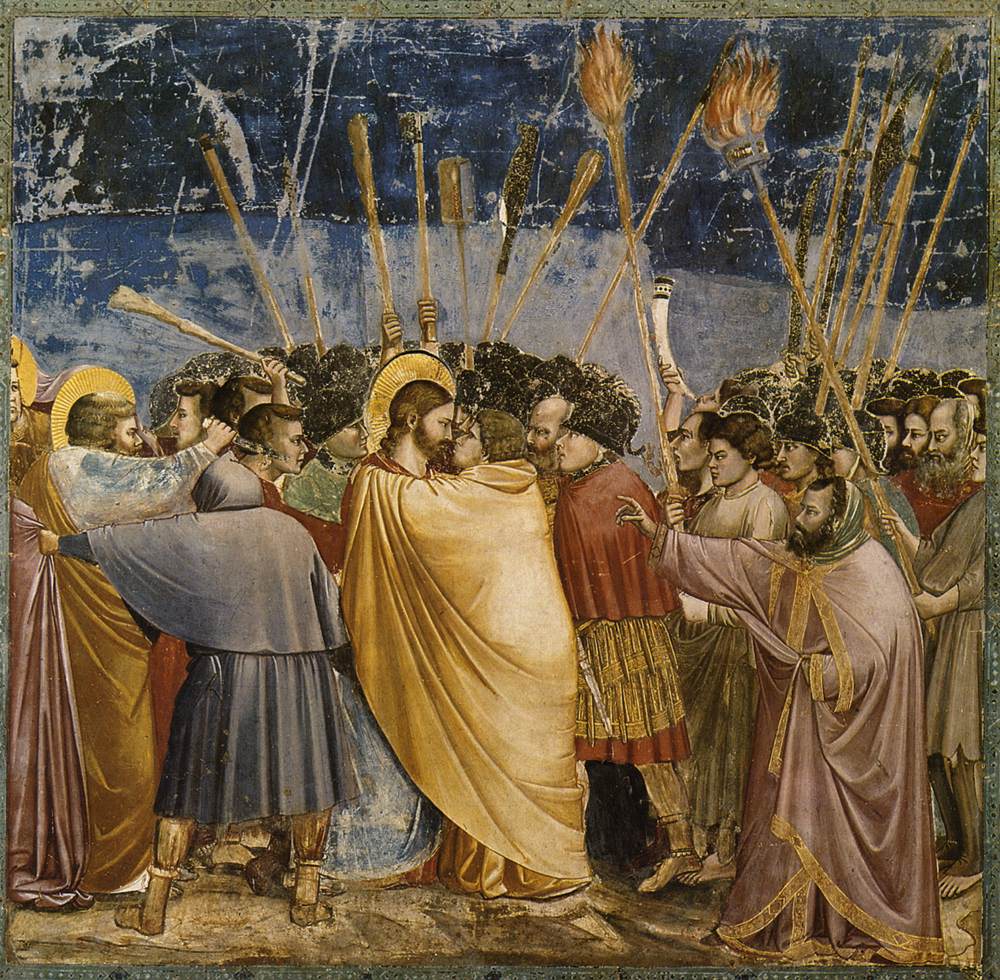
Giotto, The Arrest of Jesus and Kiss of Judas, 1306

This day is named for Judas Iscariot. When exactly he conferred with the Sanhedrin and agreed to betray Jesus to them is not known; Matthew and John seem to imply that the anointing of Christ at Bethany, which seems to have happened before the triumphal entry, spurred his decision.
But presently [Eve] remembers that the fruit may, after all, be deadly. She decides that if she is to die, Adam must die with her; it is intolerable that he should be happy, and (who knows?) with another woman when she is gone. I am not sure that critics always notice the precise sin which Eve is now committing, yet there is no mystery about it. Its name in English is Murder. ... If the precise movement of Eve's mind at this point is not always noticed, that is because Milton's truth to nature is here almost too great, and the reader is involved in the same illusion as Eve herself. ... Thus, and not otherwise, does the mind turn to embrace evil. No man, perhaps, ever at first described to himself the act he was about to do as Murder, or Adultery, or Fraud, or Treachery, or Perversion; and when he hears it so described by other men he is (in a way) sincerely shocked and surprised. Those others 'don't understand.' ... If you or I, reader, ever commit a great crime, be sure we shall feel very much more like Eve than like Iago. 
-- C. S. Lewis, A Preface to 'Paradise Lost', pp. 125-126
Almighty God, we beseech thee graciously to behold this thy family, for which our Lord Jesus Christ was contented to be betrayed, and given up into the hands of wicked men, and to suffer death upon the cross, who now liveth and reigneth with thee and the Holy Ghost, ever one God, world without end. Amen.

-- First Collect for Good Friday

Maundy Thursday (April 2nd)


The name maundy is an English slurring of the Latin mandatum, which means 'command,' and appears in the Vulgate phrase Mandatum novum do vobis, or, in English, 'A new command I give unto you'. The original consecration of the Eucharist, and the subsequent delineation of the New Covenant, took place on this night; it is now the first night of the Triduum, the apex of the liturgical year -- a solemn celebration that takes place over three days, commemorating the institution of the Mass and the priesthood, the Crucifixion, and the Resurrection.
He determined to be incarnate by being born; that is, he determined to have a mother. His mother was to have companions of her own kind; and the mother and her companions were to exist in an order of their own degree, in time and place, in a world. They were to be related to him and to each other by a state of joyous knowledge; they were to derive from him and from each other; and he was to deign to derive his flesh from them. ... But what did happen? The web depended on its exchanged derivation, which itself sprang from the fact not only that all derived from him but that he had ordained that he, in his flesh, would derive from all. The two derivations were, in him, a single act ... Somewhere, somehow, the web loosed itself from its center -- also by its free choice. ... Sin had come into the great co-inherent web of humanity; say rather that all the web burst into sin, and broke or was antagonized within itself; knot against knot, and each filament everywhere countercharged within itself. It broke? alas, no; it could not break unless its maker consented that it should and he would not consent; his good will towards it ... was too great. He loved it; he had loved it in the making and he loved it made ... No; she had turned from him; she had attempted to deracinate her life; but he was still her root, and she should still have at her disposal all that he had given her; she should still have life. Intolerable charity! 
-- Charles Williams, The Forgiveness of Sins, pp. 120-122, 128
Almighty and everlasting God, by whose Spirit the whole body of the Church is governed and sanctified: Receive our supplications and prayers, which we offer before thee for all estates of men in thy holy Church, that every member of the same, in his vocation and ministry, may truly and godly serve thee; through our Lord and Savior Jesus Christ. Amen.

-- Second Collect for Good Friday

Good Friday (April 3rd)


Matthias Grunewald, The Crucifixion, ca. 1501

Words fail me. Chesterton can take over.
In this story of Good Friday it is the best things in the world that are at their worst. ... It was, for instance, the priests of a true monotheism and the soldiers of an international civilization. Rome, the legend, founded upon fallen Troy and triumphant over fallen Carthage, had stood for a heroism which was the nearest that any pagan ever came to chivalry. ... But in the lightning flash of this incident, we see great Rome, the imperial republic, going downward under her Lucretian doom. ... Rome was almost another name for responsibility. Yet [Pilate] stands forever as a sort of rocking statue of the irresponsible. ... There too were the priests of that pure and original truth that was behind all the mythologies ... It was the most important truth in the world; and even that could not save the world. ... The Jewish priests had guarded it jealously in the good and the bad sense. ... They were proud that they alone could look upon the blinding sun of a single deity; and they did not know that they had themselves gone blind. ... And as it was with these powers that were good, or at least had once been good, so it was with the element which was perhaps the best, or which Christ himself seems certainly to have felt as the best. The poor to whom he preached the good news, the common people who heard him gladly ... there was present in this ancient population an evil more peculiar to the ancient world. ... It was the soul of the hive; a heathen thing. The cry of this spirit also was heard in that hour, 'It is well that one man die for the people' ... that the one universal human spirit might suffer a universal condemnation; that there might be one deep, unanimous chorus of approval and harmony when Man was rejected of men. There were solitudes beyond where none shall follow. ... Nor is it easy for any words less stark and single-minded than those of the naked narrative even to hint at the horror of exaltation that lifted itself above the hill. ... [A] cry was driven out of that darkness in words dreadfully distinct and dreadfully unintelligible ... and for one annihilating instant an abyss that is not for our thoughts had opened even in the unity of the absolute; and God had been forsaken of God. 
-- The Everlasting Man, pp. 210-212
O merciful God, who hast made all men, and hatest nothing that thou hast made, nor wouldest the death of a sinner, but rather that he should be converted and live: Have mercy upon all Jews, Turks, Infidels, and Heretics, and take from them all ignorance, hardness of heart, and contempt of thy word; and so fetch them home, blessed Lord, to thy flock, that they may be saved among the remnant of the true Israelites, and be made one fold under one shepherd, Jesus Christ our Lord, who liveth and reigneth with thee and the Holy Spirit, one God, world without end. Amen.

-- Third Collect for Good Friday

Holy Saturday (April 4th)


The only thing we are specifically told happened the day after the Passion is that the surviving disciples and the Holy Family rested on the Sabbath as the Torah required. However, it's also hinted that the Lord did something in the realms of the dead at this time, which the Mediaeval Church developed in speculation and art into the awesomely-named tradition of the Harrowing of Hell. No liturgy celebrates this, however; the only liturgy this day is the Easter Vigil, the glorious climax of the Triduum and the very beginning of the Easter season. (This is the time when adult converts, having been catechized over the preceding months, are normally baptized as Catholics.)
For if all the pains contained in hell, on earth, and in purgatory -- including death and all -- were set before us, we ought rather to choose all that pain than sin itself ... And I was shown no harder hell than sin, for of its very nature, the soul knows no other hell but sin. Yet fixing our intent in love and meekness we are made all fair and clean by the working of mercy and grace. For as mighty and as wise as God is to save us, so is he most willing; it is Christ himself who is the ground of all Christian law, and he taught us to do good as against evil. In this we see that he himself is that love, for he does to us as he bids us do to others ... Inasmuch as his love is never broken toward us when we sin, so does he will that it is never broken within ourselves or toward our fellow Christians; rather we should hate the sin itself but endlessly love every soul as God loves it. 
-- Lady Julian of Norwich, The Revelation of Divine Love, Thirteenth Showing
Grant, O Lord, that as we are baptized into the death of thy blessed Son our Savior Jesus Christ, so by continually mortifying our corrupt affections we may be buried with him; and that, through the grave, and gate of death, we may pass to our joyful resurrection; for his merits, who died, and was buried, and rose again for us, thy Son Jesus Christ our Lord. Amen.

-- Collect for Easter Eve

Easter Sunday (April 5th)


Caravaggio, The Incredulity of Saint Thomas, 1602

The Resurrection, I presume, calls for little explanation. Or more accurately, little that I'm equipped to give. I'll only note that the first eight days of Easter, from this day through the following Sunday, are treated by the liturgy as one: eternity invading time, heaven breaking into the terrestrial plane, in the act of the Resurrection. This is why the number eight -- one step outside the seven-day week that forms the standard measurement of time on earth -- is often a symbol in Christianity of eternity.
Here saies S. Augustine, when the soule considers the things of this world ... She rests upon such things as she is not sure are true, but such as she sees, are ordinarily received and accepted for truth: so that the end of her knowledge is not Truth, but opinion ... But saies he, when she proceeds in this life to search into heavenly things ... The beames of that light are too strong for her, and they sink her, and cast her downe ... and so she returns to her owne darknesse, because she is most familiar, and best acquainted with it; Non electione, not because she loves ignorance, but because she is weary of the trouble of seeking out the truth, and so swallowes even any Religion to escape the paine of debating, and disputing ... But then in her Resurrection, her measure is enlarged, and filled at once; There she reads without spelling, and knowes without thinking, and concludes without arguing ... What a death is this life! what a resurrection is this death! For though this world be a sea, yet (which is most strange) our Harbour is larger than the sea; Heaven infinitely larger than this world. For, though that be not true, which Origen is said to say, That at last all shall be saved, nor that evident, which Cyril of Alexandria saies, That without doubt the number of them that are saved, is far greater than of them that perish, yet surely the number of them, with whom we shall have communion in Heaven, is greater than ever lived at once upon the face of the earth ... In Heaven we shall have Communion of Joy and Glory with all, alwaies; Ubi non intrat inimicus, nec amicus exit, Where never any man shall come in that loves us not, nor go from us that does. 
-- John Donne, Evening Sermon at St. Paul's on Easter Day, March 28, 1624
Almighty God, who through thine only-begotten Son Jesus Christ hast overcome death, and opened unto us the gate of everlasting life: We humbly beseech thee, that as by thy special grace preventing us thou dost put into our minds good desires, so by thy continual help we may bring the same to good effect; through Jesus Christ our Lord, who liveth and reigneth with thee and the Holy Ghost, ever one God, world without end. Amen.

-- Collect for Easter Day