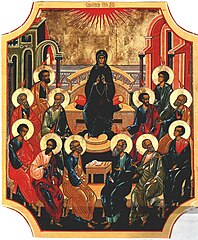
Collect

Collect for the Fourth Sunday after Trinity

O God, the protector of all that trust in thee, without whom nothing is strong, nothing is holy: increase and multiply upon us thy mercy; that, thou being our ruler and guide, we may so pass through things temporal, that we finally lose not the things eternal; grant this, O heavenly Father, for the sake of Jesus Christ thy Son our Lord, who liveth and reigneth with thee, in the unity of the Holy Spirit, ever one God, world without end. Amen.

Sunday, June 19, 2016

Who Is He That Smote Thee?

Ye fathers, provoke not your children to wrath.
—St. Paul


✠     ✠     ✠


I was going to write an open letter to the Catholic bishops of this country, upbraiding them for the paltry response they gave to the massacre in Orlando. But I did see that several bishops, including the president of the USCCB, mourned and condemned the shooting; and of those, a handful expressed sympathy in particular for the LGBT community, particularly Archbishop Cupich of Chicago and Bishop Lynch of St Petersburg. And I wondered whether it was grateful, or fair, to be indignant and angry.


Then I thought, no, it is absolutely fair to be indignant and angry. The number of bishops that have expressed compassion for the wounding and the fear of the queer community can apparently be counted on your fingers. That isn’t okay.


Maybe I am harsh. After all, as a gay man, this happened to my family. But when Dylann Roof murdered nine people a year ago, it never once occurred to me to ask any of my black friends how they felt during the aftermath. I hope I’ll be more reflective and compassionate in future.


The one hundred and two people that Omar Mateen shot were not just targeted at random; they were targeted because of their sexuality, or at any rate because they were in a place that’s specifically designed to be safe and welcoming for LGBT people. Call it terrorism if you like—if shooting up rooms full of people isn’t an act designed to cause terror, I don’t know what is—but terrorism in that sense can’t be spoken of as though it excludes homophobia. And the number of our shepherds who have condemned that homophobic attack for being homophobic is shamefully small.



Are they afraid that, by speaking against hatred for gay people, they’ll risk scandal by seeming to approve of ‘the gay lifestyle’? If that’s the reason, it’s a shite reason. Anyone can see you don’t need to agree with somebody to be horrified by a massacre. If it were a Hindu temple that had been shot up, nobody would worry that the bishops were promoting idolatry by expressing a solidarity of grief with Hindus as Hindus. And it isn’t like the Catholic Church’s teaching is a secret. Well, maybe except this part:


It is deplorable that homosexual persons have been and are the object of violent malice in speech or in action. Such treatment deserves condemnation from the Church’s pastors wherever it occurs. It reveals a kind of disregard for others which endangers the most fundamental principles of a healthy society. The intrinsic dignity of each person must always be respected in word, in action and in law.1


You know what scandal is? It isn’t just giving somebody the impression that you’re okay with gay—though somehow, that seems to be the only context where I’ve ever seen it brought up by Catholics. It’s moving someone away from God by your example. And an example that doesn’t put into practice the instruction that homophobic violence should be condemned whenever it happens, that allows charity to seem less important than chastity—that, Fathers, Excellencies, Eminences, that is scandalous.


Has the LGBT movement treated the Church altogether fairly—about this or anything else? Of course not. I was personally attacked (verbally) within hours of the news breaking just for being a Catholic; and I was bitterly discouraged to see how ready a lot of queer people I know were, Christian and non-Christian, to anticipate and blame the lack of empathy they expected the churches of this country to show, not even giving them the benefit of the doubt; particularly since the news broke on Sunday morning, when many Christians were after all at church rather than watching the news. But that ugly behavior cannot be comfortably dismissed as only the innate distrust and hostility that darkness has for light.


We were attacked, and many of you said nothing. Most of you said nothing about why it happened. Four hundred and forty-nine of you, in a hundred and seventy-seven dioceses across the country, and I can name most of the ones who spoke audibly.
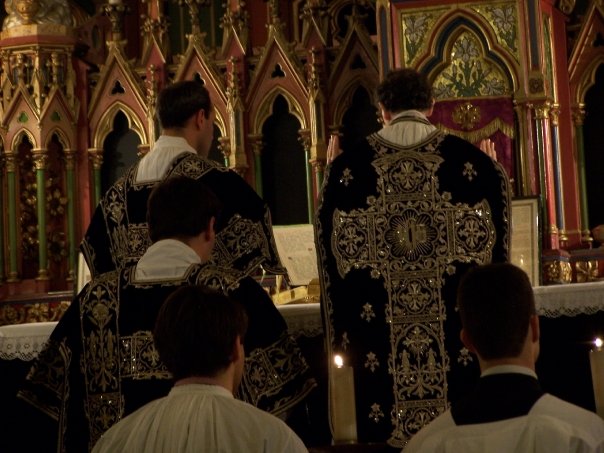


We’re your children. You are our fathers, our shepherds. You’re supposed to take care of us. Step. Up.


✠     ✠     ✠

1On the Pastoral Care of Homosexual Persons, §10. This is an official Vatican translation, so I take no responsibility for the absence of the Oxford comma.

Tuesday, June 14, 2016

"I Am Involved in Mankinde"

I don’t have any words for what happened in Orlando. I’m too tired: by grief, by shock, by fear.


John Donne’s famous No man is an island quotation, and his Never send to know for whom the bell tolls, come from his Devotions upon Emergent Occasions, written during his recovery from a serious illness. I offer a selection here, which has often comforted and uplifted me.


✠     ✠     ✠


There is a story of a Bell in a Monastery which, when any of the house was sicke to death, rung alwaies voluntarily, and they knew the inevitablenesse of the danger by that. It rung once, when no man was sick; but the next day one of the house fell from the steeple, and died, and the Bell held the reputation of a Prophet still. … How many men that stand at an execution, if they would aske, for what dies that man, should heare their owne faults condemned, and see themselves executed, by Atturney? We scarce heare of any man preferred, but wee thinke of our selves, that wee might very well have beene that Man; Why might not I have beene that Man, that is carried to his grave now? Could I fit my selfe, to stand, or sit in any mans place, and not to lie in any mans grave? I may lacke much of the good parts of the meanest, but I lacke nothing of the mortality of the weakest … Perchance hee for whom this Bell tolls, may be so ill, as that he knowes not it tolls for him; And perchance I may thinke my selfe so much better than I am, as that they who are about mee, and see my state, may have caused it to toll for mee, and I know not that.


The Church is Catholike, universall, so are all her Actions; All that she does, belongs to all. When she baptizes a child, that action concernes mee; for that child is thereby connected to that Head which is my Head too, and engraffed into that body, whereof I am a member. And when she buries a Man, that action concernes me: All mankinde is of one Author, and is one volume; when one Man dies, one Chapter is not torne out of the booke, but translated into a better language; and every Chapter must be so translated; God emploies several translators; some peeces are translated by age, some by sicknesse, some by warre, some by justice; but Gods hand is in every translation; and his hand shall binde up all our scattered leaves again, for that Librarie where every booke shall lie open to one another: As therefore the Bell that rings to a Sermon, calls not upon the Preacher onely, but upon the Congregation to come; so this Bell calls us all: but how much more mee, whom am brought so neere the doore by this sicknesse. … If we understand aright the dignitie of this Bell that tolls for our evening prayer, wee would be glad to make it ours, by rising early, in that application, that it might bee ours, as wel as his, whose indeed it is. The Bell doth toll for him that thinkes it doth; and though it intermit againe, yet from that minute that that occasion wrought upon him, hee is united to God. Who casts not up his Eye to the Sunne when it rises? but who takes off his Eye from a Comet when that breakes out? Who bends not his eare to any bell, which upon any occasion rings? but who can remove it from that bell, which is passing a peece of himself out of this world? No man is an Iland, intire of it selfe; every man is a peece of the Continent, a part of the maine; if a Clod bee washed away by the Sea, Europe is the lesse, as well as if a Promontorie were, as well as if a Mannor of thy friends or of thine owne were; any mans death diminishes me, because I am involved in Mankinde; And therefore never send to know for whom the bell tolls; It tolls for thee.


Neither can we call this a begging of Miserie or a borrowing of Miserie, as though we were not miserable enough of our selves, but must fetch in more from the next house, in taking upon us the Miserie of our Neighbours. Truly it were an excusable covetousness if wee did; for affliction is a treasure, and scarce hath any man enough of it. No man hath affliction enough that is not matured, and ripened by it, and made fit for God by that affliction. If a man carry treasure in bullion, or in a wedge of gold, and have none coined into currant Monies, his treasure will not defray him as he travells. Tribulation is Treasure in the nature of it, but it is not currant money in the use of it, except wee get nearer and nearer our home, Heaven, by it. Another man may be sicke too, and sick to death, and this affliction may lie in his bowels, as gold in a Mine, and be of no use to him; but this bell, that tells me of his affliction, digs out, and applies that gold to mee; if by this consideration of anothers danger, I take mine owne into contemplation, and so secure my selfe, by making my recourse to my God, who is our onely securitie.


             At inde                                                                        The Bell rings out, and tells
Mortuus es, Sonitu celeri,                                                           me in him, that I am dead.
     pulsuque agitato.


… This soule, this Bell tells me, is gone out; Whither? Who shall tell mee that? I know not who it is; much less what he was; The condition of the man, and the course of his life, which should tell mee whither hee is gone, I know not. I was not there in his sicknesse, nor at his death; I saw not his way, nor his end, nor can aske them, who did, thereby to conclude, or argue, whither he is gone. But yet I have one neerer mee than all these; mine owne Charity; I aske that; and that tels me, He is gone to everlasting rest, and joy, and glory: I owe him a good opinion; it is but thankfull charity in mee, because I received benefit and instruction from him when his Bell told: and I, being made the fitter to pray, by that disposition, wherein I was assisted by his occasion, did pray for him; and I pray not without faith; so I doe charitably, so I do faithfully beleeve, that that soule is gone to everlasting rest, and joy, and glory.1


✠     ✠     ✠

1From Meditations XVI-XVIII. The spelling and italics are original, but the paragraph breaks are mine, for ease of reading.