Collect

Collect for the Fourth Sunday after Trinity

O God, the protector of all that trust in thee, without whom nothing is strong, nothing is holy: increase and multiply upon us thy mercy; that, thou being our ruler and guide, we may so pass through things temporal, that we finally lose not the things eternal; grant this, O heavenly Father, for the sake of Jesus Christ thy Son our Lord, who liveth and reigneth with thee, in the unity of the Holy Spirit, ever one God, world without end. Amen.

Thursday, March 9, 2017

I, I, I

It is, of course, much easier to demand a prophet than a priest; and it is far, far easier to become a pseudo-prophet than a pseudo-priest. I will not say that almost anyone can be a priest; it would not be true for the priesthood is a vocation. But certainly almost anyone can imagine himself to be a prophet.


Charles Williams, The Forgiveness of Sins

I make no attempt to excuse the feelings which awoke in me when I heard the unhuman sound addressing my friend and my friend answering it in the unhuman language. They are, in fact, inexcusable; but if you think they are improbable at such a juncture, I must tell you plainly that you have read neither human history nor your own heart to much effect. They were feelings of resentment, horror, and jealousy. It was in my mind to shout out, ‘Leave your familiar alone, you damned magician, and attend to Me.’

—C. S. Lewis, Perelandra


✠     ✠     ✠


It’s hard to believe it’s only been Lent for a week. Maybe I noticed Shrovetide more keenly this year, maybe it’s because I adopted a relatively easy discipline this year,1 I don’t know. My mind has certainly been elsewhere—one of my favorite things about a fixed liturgy is that, for somebody like me who has a short attention span and a ‘rich inner life,’ it’s much easier to pick up the thread of devotion if the thread is still there when I suddenly realize I haven’t been attending for the last ten minutes.



Unfortunately, the elsewhere has been me: my sinfulness, my needs, my hurt. One has to attend to those things; part of loving your neighbor as yourself is appropriate self-love, i.e. self-love rather than self-indulgence, loving yourself because you are a self made in God’s image, impartially. Save, perhaps, that as the steward of yourself, you have the liberty of sacrificing pleasures and other goods on your own behalf, whereas sacrificing other people’s goods is against ‘the courtesy of Deep Heaven.’2 But mine has not, I think, been a wholesome self-love. (I think a lot of people assume it must be because I’m nice to people, but sadly, terrestrial good manners are pretty compatible with a reserved yet raging egotism.)


My friend Joey and I seem, as a rule, to wander in similar deserts, and we had this exchange earlier via text:


J: I just want to be right with God, but now it seems like the only way to do that is going to be hurting David, and I’m not ready to do that either.
G: What do you feel/think being right with God would consist in?
J: […] I think being right with God would consist in at least attempting not to sin […] Becauuuusssse I know He still loves me but how can I possibly be a man of any integrity when I don’t even make a pretense of following my own principles?
G: Well, you have the integrity of refusing to make a pretense. That is not something; that’s everything—“without are the dogs and sorcerers and idolators and whoever loves and practices a lie.” […]
J: Maybe. I just feel so much on the Wrong Side Of Things. Sort of shut out. … I’ve always thought of myself as the kind of person who wouldn’t make this sort of compromise. So maybe what’s bothering me is that that self image is not accurate.
G: That can be a terribly painful and humbling experience.
J: Yeah. I mean that’s not a bad thing to happen of course
G: […] The schism between who you want to be and who you perceive yourself to be.
J: Hm. Yeah. When I broke up with Adam, I kind of made it about Doing The Right Thing. But it was also, or maybe even mostly, about preserving my self image.


‘You must learn,’ St Teresa of Ávila said, ‘to bear serenely for God’s sake the trial of being displeasing to yourself.’


I’m cautiously hopeful that God is using my straying to break the idol of dignity in me. Hopeful, because pride attacks us on our strong points rather than our weak ones, which is why self-righteous virtue is among the most hideous and nigh-incurable sins. Cautious, because it is so, so easy to use that line of thinking as a justification for sin.


Pride is certainly my most pervasive and characteristic vice, more even than fornication or self-pity. People don’t always notice it, because my pride is of the highly ethical sort that motivated the Pharisees. It’s pride in justice, obedience, insight, even in generosity and gentleness. Sometimes I act on those virtues for God. But often enough, I act on them for my self-image, the great golden idol in the center of my soul, which may be pleasanter to be around than some idols but is not on that account any less the craftsmanship of hell.


Ideally, I suppose, I’d be pursuing God in the midst of weakness. Acknowledging my failures and flaws, but getting up and beginning again. But I’m so tired. It isn’t so much that it’s embarrassing to go to Confession over and over (I don’t think); but it seems like a slur against my own intelligence to profess a firm purpose of amendment when I don’t, at a heart level, believe that that amendment is possible to me. In brief, I don’t know how I’m supposed to mean to do something I don’t think I’m able to do. I delight in the law of God after the inward man: but I see another law at work in my members—except personally I don’t even delight in the law of God in the inward man. Don’t want to. Don’t know how to.


And when I say it isn’t possible to me, I don’t mean that it isn’t possible to God. He can give me whatever grace He pleases at any moment. But He doesn’t seem to be giving me the grace of chastity, or of the desire for chastity, even. Maybe that’s my fault; or maybe it would strengthen the interior idol; I don’t know.


The most I can do is (so to speak) keep repeating the Creed. I can’t white-knuckle my way through my whole life, but I can white-knuckle my way through that. And most of the time, I don’t even have to white-knuckle it. If I stay here and wait, I don’t know what He’ll do, but He will do something.


✠     ✠     ✠


1I’m reading through the Gospel of Luke, according to this forty day schema. Of the four, it’s the one I know least well (John I know best, then Matthew and then Mark), so I thought it’d be wise to spend some time with it.
2A phrase borrowed from That Hideous Strength by C. S. Lewis, spoken by Elwin Ransom, a man who has been to what we call outer space and what he knows, by experience, to be full of the splendors of angels. ‘This is the courtesy of Deep Heaven: that when you mean well, He always takes you to have meant better than you knew. It will not be enough for always. He is very jealous. He will have you for no one but Himself in the end. But for tonight, it is enough.’

Wednesday, March 1, 2017

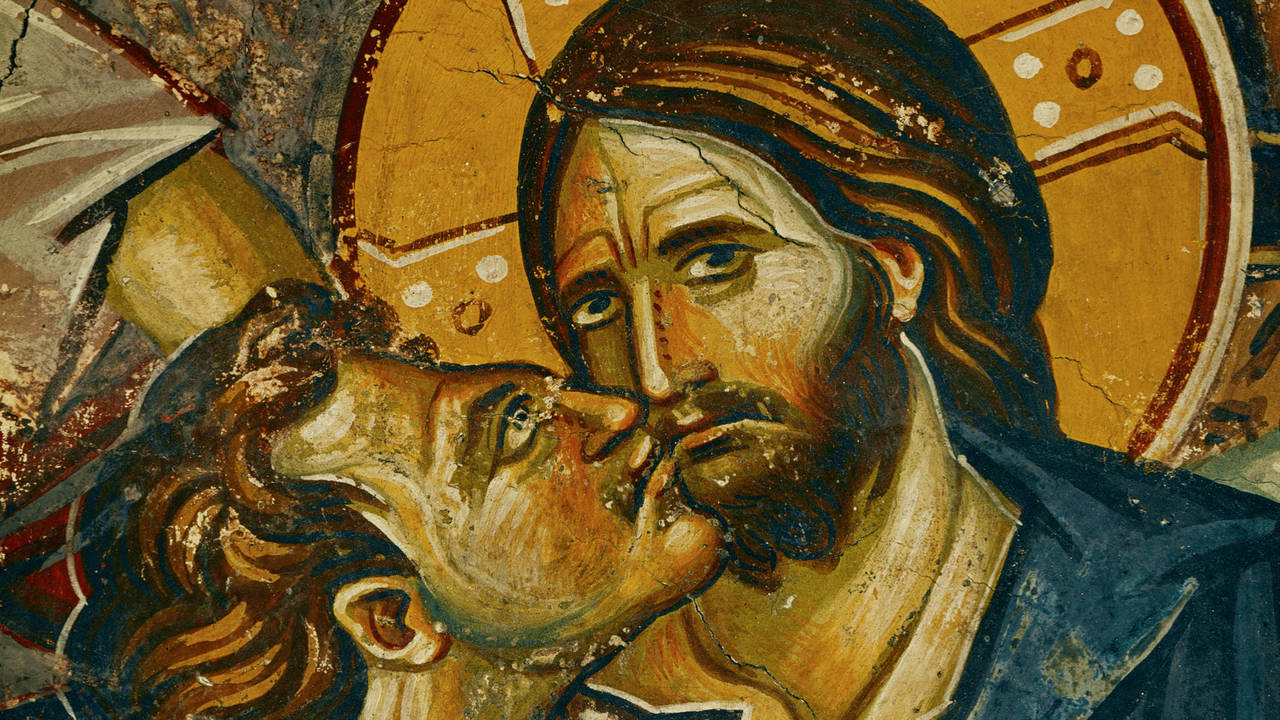
Prayers for Judas

Lilith, checked in her monotonous gabble by the radiant vision who let in the sun’s new light, stared at it with old and blinking eyes. She saw the shape of a woman; and did not know beatitude, however young. She supposed this also to be in need of something other than the Omnipotence. She said, separating with difficulty words hardly distinguishable from gabble: ‘I can help you.
‘That’s kind of you,’ Pauline answered, ‘but I haven’t come to you for myself.’
‘I can help anyone,’ the old woman said, carefully enunciating the lie. … Illusion, more lasting in her than in any of her victims, was in her. At the moment of destruction she still pressed nostrums upon the angelic visitor who confronted her. She broke again into gabble, in which Pauline could dimly make out promises, of health, of money, of life, or their appearances, of good looks and good luck, or a belief in them, of peace and content, or a substitute for them.


—Charles Williams, Descent Into Hell


✠     ✠     ✠


I’ve hit a wall. I would say I’m in despair, but I don’t think that’s quite true. I certainly feel despair; I honestly cannot tell by introspection whether I’ve surrendered to it; I haven’t given up my duties as a man and a Christian—I don’t fulfill them particularly well, but I acknowledge them and make some effort to observe them—so I think I haven’t succumbed.


The sensation of despair comes simply from the fact that I don’t want to be chaste, don’t feel bad when I fuck around, and don’t see why I should do or want otherwise. I don’t love Christ enough to obey him for his own sake, and I don’t fear him enough (or trust him enough, maybe?) to obey him for my own sake. All I have is the bare, cold principle that this ought to be done. And I’ve found out that, at the cost that principle exacts from me, I can’t do it. Or won’t. The strength of sin is the law.


Orthodox Chapel of the Holy Trinity, Mount Sinai


Being without a husband, being bereft of specifically erotic love, is agonizing to me. It isn’t just the depression: I’ve been on Zoloft long enough to know the difference. And I know the arguments about the sacramental meaning of sex like the back of my hand, but when you’re lonely any argument is a whole lot of bullshit, and no friendship can truly substitute for a lover—they’re just not the same thing, they don’t meet the same need, they don’t touch the same wound in the soul. I have yet to hear the Catholic doctrine of sex (which I accept categorically) articulated in a way that made that reality seem important enough to warrant the cost it imposes on me.


I wish I could say ‘me and those like me’ there. But I have a nasty suspicion that, if the shoe were on the other foot, I’d be totally prepared to be merely sympathetic to people who were suffering. To just feel so sad for them, but point out that emotions can’t be allowed to change principles, and leave it at that. In short, to be a complete asshole. So I guess that’s one good thing to come out of this.


But I’m left with the sheer, brutal, staring fact that I don’t want to be chaste, not because it isn’t fun (though, no, it is not fucking fun), but because as far as I know it’s both miserable and pointless. I assent to the thesis that it’s the limits of my knowing that puts that complexion on things. But here I am, and I resent God for asking this of me, because I don’t understand.


There is a demon that the saints, especially the desert fathers, recognized in this vein—the one that comes in the daytime, during our work, to propel us further into nothingness. He was called ‘the noonday devil’ … The name of the state he tempts us to is called acedia, which is a form of despair when life itself is seen as hopeless drudgery, even if it is a necessary drudgery. This again is why the drug addict is our prophet. The drug addict is not ‘idle’—he works diligently, but his work is a slow downward spiral and an accepted and acted upon despair. Acedia also knows and even believes that man was made for great things, but does not have the hope or magnanimity to reach them. He hates that they are reachable and wishes he was called to less.1


Which I recognize as the truth. And yet another part of me snipes back: if God wants me so bad, why does he make things so damn hard? Verily thou art a God that hidest thyself, O God of Israel, the Savior.


The difference between this and despair? I guess I am still waiting for him to answer me, to say something. I keep coming back to him—angrier and unhappier every time, it seems, but again and again. It’s been said that the Church is the cross on which Christ is crucified; I am the nails. It must hurt him horribly, the way I act, or am, but he is the one who refuses the twelve legions of angels in favor of staying close to Gabriel. That thou doest, do quickly, he said to Judas. It doesn’t make rational sense; but poetically, nothing else is possible.


For some reason this feels like a really good way to start Lent. Certainly it’s better to be frank—I mean, it isn’t like God doesn’t know what you’re thinking, so you might as well actually talk to him about it. I don't know how to break out of the illusion, but I know that I am subject to an illusion: we have a place to start.


✠     ✠     ✠


1The Name of the Demon That Steals Rest, Makes You Scroll, And Inspires Overworking’ by Jason Craig at Those Catholic Men. Read this piece thanks to a friend, and it knocked a little sense into me—my original concept for this post was much more bitter and hopeless, if you can imagine.

Wednesday, February 22, 2017

Five Quick Takes

I.


Some friends of mine have been posting unusually good stuff lately. Z Shihab, who lives out in Portland, recently started a blog called Ænigmata where he has this excellent post on the limits we must assign our pride and our impulse to mock, if we want to have any impact on those who don’t already agree with us. Bill Hoard, author of The Dagger and the Rose and co-author (with Ben Y. Faroe) of Hubris Towers, has been doing a series on the Hávamál, an Icelandic collection of old Norse wisdom poetry. And Eve Tushnet’s review of I Am Michael, a biopic with James Franco and Zachary Quinto about a gay activist who converted to Christianity and espoused the ex-gay cause, is, well, just the sort of thing she writes: smart, reflective, patient, and charming. Go forth and read.


✠     ✠     ✠


II.


Today is the normal date for the Feast of the Chair of Peter, though we in the Ordinariate observed it this past Sunday—it is our patronal feast. The gospel for this feast is Matthew 16.13-20, the passage in which the famous Petrine confession is made, Thou art the Christ, the Son of the living God. Our parish priest pointed out some things in his homily that I hadn’t noticed before.


First, Jesus could have simply told them who he was. He didn’t. He chose, instead, to elicit the declaration from them. It is, in a way, the first time the Church defined a dogma.


And we know that this definition was authoritative even if no others were, for flesh and blood hath not revealed it unto thee, but my Father which is in heaven. And it is from this that the parallel declaration on Christ’s part comes: Thou art the Christ; thou art Peter. The office of the Rock is rooted in divine revelation, and it is from this, not its own capacity, that its authority comes—that authority being promptly defined as ‘binding and loosing.’ Binding and loosing were standard terms in rabbinic theology at that time: they described the rabbi’s authority both to declare what was and was not authentic midrash, or teaching and commentary on the Torah, and who was permitted a place in the synagogue, the communion of the faithful. The literary echoes of Isaiah 22, where a new steward is appointed for the house of King David by prophecy, reinforce the significance of the office that Jesus is declaring Peter to have, that of the steward or proxy—in Latin, the vicarius—of Christ.


Some of this I’d known before, but I keep coming back to the fact that Jesus chose to elicit the Petrine confession, instead of revealing himself on his own initiative. He had no problem with teaching at great length, nor even with explaining the meanings of his parables to the disciples in private. Yet here, he chose to have his deity disclosed through our humanity.


✠     ✠     ✠


III.


I know very little about Milo Yiannopoulos, which I’m perfectly fine with. He has given me the impression of being a rather disagreeable figure, and I am not eager to accumulate those in quantity, especially in an age like ours that so thrives on disagreeableness (which is a different and less noble thing than disagreement). But he said some stuff that sounded like support for pædophilia, and people rightly flipped their lids, and apparently now his career is over. Or, at least, on indefinite hiatus.


I listened to enough of his remarks that I am satisfied he hasn’t been misrepresented. I only had the stomach to listen to a minute or so, but the flow of his comments isn’t ambiguous. He does say that he was wrong to say those things, and I’m prepared to believe that he is remorseful. (I admit I’m also not sorry that he’s resigned from Breitbart.)


But I wonder, and worry a little, about the reaction our culture has to pædophilia, because it’s so absolute and instantaneous, and those kinds of reactions are easy to attack once someone gets the nerve. If and when people really start to question it, will we as a culture be ready to defend it? Will we be ready to set forth an intelligent explanation of maturity (sexual, mental, and social) and consent? Will we be ready to explain why, even though people do mature at different rates, there has to be a specific legal age of consent? And if we aren’t, will our—very right—instinctive rejection of pædophilia be enough to prevent a change in cultural standards? I hope it will; but I don’t think it’s to be counted on, if we don’t learn to have, and articulate, something more than instinct upon which to base our revulsion.


✠     ✠     ✠


IV.


Horror is an incredibly odd genre. Even though I enjoy watching and writing and reading it, I can’t tell why. I keep trying to come up with an explanation—e.g., that it gives us a sense of power or safety, to witness and yet survive horrors by proxy—and none of them really seem adequate. There seems, to me, to be almost a spiritual quality in some horror; certainly there are a few characters or atmospheres, like the Un-Man of Perelandra or the final dissolution of Wentworth in Descent Into Hell, that depict mystical realities, and insofar as they do that it makes sense that it would be, not pleasurable exactly, yet satisfying, to read them.


Is all horror a mode of Dante’s Inferno?—which is a curiously inverted example, in that Dante never once makes us shudder before the dreams of the abyss: Arthur Machen, H. P. Lovecraft, Charles Williams, Melinda Selmys, or Edgar Allen Poe can give you a more terrifyingly gothic sublimity in the least of their efforts than he. The mathematical perfection of Dante’s universe prevents any such ‘Crawling Chaos.’ Perhaps, in the philosophical and increasingly violent degradation of the West through the nineteenth and twentieth centuries, horror has at last come to be a more natural voice for us: our sense of having a place in creation has been ripped out, and through horror, we can at least scream without being mocked for it.


✠     ✠     ✠


V.


My spiritual life has been in a rather shabby condition lately. I’m at sea about a number of things; I certainly don’t know what I’m supposed to be doing with my celibacy. I hope you all will pray for me as we enter Lent next week.


I haven’t made up my mind what my Lenten discipline will be. A friend suggested that I make a retreat, and/or pray the Divine Mercy Chaplet regularly; I recently acquired a copy of Richard of St Victor’s seminal Benjamin Minor, a sort of preparatory book for contemplative prayer, which I might set myself to read. I haven’t been able to focus on the subject, somehow. Thankfully, since the Anglican Use observes Shrovetide (or ‘Pre-Lent’ if you like lame names), I’ve at least been reminded of it on the regular. That’s one of the nice things about having a regular liturgy as well as a defined creed: it gives you a touchstone.

Friday, February 10, 2017

See How These Christians Love One Another

The priest was aware of an immense load of responsibility: it was indistinguishable from love. This, he thought, must be what all parents feel: ordinary men go through life like this crossing their fingers, praying against pain, afraid … This is what we escape at no cost at all, sacrificing an unimportant motion of the body. For years, of course, he had been responsible for souls, but that was different … a lighter thing. You could trust God to make allowances, but you couldn’t trust smallpox, starvation, men …

Graham Greene, The Power and the Glory

✠     ✠     ✠

Last week Crisis Magazine came to the defense of Steve Bannon, one of the new appointees to the President’s cabinet. Bannon, like Trump himself and all the members of his administration, has been heavily criticized, especially for alleged racist and anti-Semitic attitudes on the extreme right-wing news forum Breitbart (I don’t know whether these allegations are true or not1). Austin Ruse, a regular contributor at Crisis—and one, among others, who has locked horns with several Side B authors and communities—has written a piece lauding Bannon: not an unqualified acclamation, by any means, but certainly a favorable ‘reading’ of him. And since he’s personally acquainted with Bannon, Ruse is in a position to know what he’s talking about.


It’s a little odd to find a devoted Catholic praising someone who has described himself both as a Leninist and as ‘Thomas Cromwell in the court of Henry VIII’; odder still to find him saying that Bannon is ‘a revolutionary but not a Bolshevik,’ insofar as Lenin was a founding-member Bolshevik; but then, I’m a fan of writers like Camille Paglia and Rick Whitaker, so maybe we can call that a wash. I don’t propose to respond thoroughly to the piece in itself,2 since I know very little about Bannon. What I want to do is set something Ruse said about Bannon in the same context as his criticisms of Side B.3

Breitbart publishes a huge amount of Catholic content. I call it the largest Catholic site on the net. Bannon moved the radio show to Rome to cover the canonization of John Paul II and John XXIII live. He hired former priest Thomas Williams to report from Rome, and Williams files Vatican and other Catholic news constantly. I wrote on Catholic topics all the time, as do many other Catholic writers on Breitbart. Breitbart’s editor-in-chief Alex Marlow is a Catholic who in recent years has reëngaged his faith.

I call Bannon a non-practicing orthodox Catholic. I am not aware that he dissents from any teachings of the Church, still I am not aware that he practices the faith. It could have something to do with the three ex-wives. But it should be understood there is a difference between weakness and dissent. Moreover, he came this close to going on a retreat with me a few years ago. Maybe one day.

Now, to be clear, I firmly agree that there’s a difference between weakness and dissent. I’m a living instantiation of that difference. And, while I don’t share Ruse’s optimism about Bannon, I can certainly allow that he may be correct. As I said, I wouldn’t know.

What I do know is that Ruse and other authors at Crisis have consistently refused to extend a fraction of the same spiritual generosity to my friends and me. On the contrary—they’ve regularly charged us with serious sins, attributed views to us none of us have ever expressed, even intimated that we’re closet heretics. For example:

He accuses the New Homophiles of playing something of a ‘doctrinal shell game’ where ‘just about every time a couple of them write anything “ground-breaking” they seem to be challenged by readers as to their orthodoxy. Subsequently they appear to backtrack … it seems to me the underlying intention is to normalize homosexuality and to declare gay is good.’ This gets to the most serious problem with the New Homophile position, their insistence on maintaining their gay identity. … They want the Church not just to welcome but to celebrate their gayness.4

He says the word ‘gay’ does not accurately describe who or what he is. Those who use it, like the New Homophiles, are not faithful to the theological anthropology of the Church. … [He] says he takes no umbrage at the phrase objectively disordered, something the New Homophiles bristle at … Against the New Homophiles he does not see same-sex attraction as a gift ‘in and of itself.’ … He opposes the New Homophile notion of ‘gay exceptionalism’ …5


The old problems crop up almost immediately in this piece, and also in Eve Tushnet’s new book Gay and Catholic, and that is narcissism. Tushnet told Boorstein that when she ‘came out’ at 20 in 1998 she thought she was the only woman with same-sex desire living chastely in the Catholic Church. Tushnet would blanche at the notion of narcissism since she and the New Homophiles eschew anything that smells of Freud. Still, to think you are the one and only something … Tushnet says everyone she knew back in those days rejected the Church’s teaching on ‘gay’ sexuality. But the thing is, so does Tushnet. Sure, however regrettably, she accepts that she cannot do whatever two naked women do but she also believes the Church has ‘gay’ sexuality wrong. After all, that is one of the main planks of the New Homophile platform.6

This group insists on their gay identity, indeed they put a spotlight on it. That’s kind of the point of their movement. … The Church teaches that there is no ‘gay identity.’ We are children of God—first, last, and always, and the Church frowns on anything else. … The New Homophiles insist that God made them gay, though the Church does not teach that. They insist that they have special gifts given to them through their same-sex attraction. That is certainly not in Church teaching. And they want Church teaching to reflect these assertions, which would amount to a change in Church teaching.7

In reply to which it’s vital to point out, first of all, we don’t really have a platform—it’s more of a gaudy parade float with go-go boys in unicorn costumes gyrating to ABBA.


YOU KNEW HE'D BE BACK

And secondarily that, in these selections,8 every view and attitude attributed to us is either heavily distorted or flat-out false.

Every one of us have recited our total fidelity to the Church, and all her doctrines, including those about sexuality, until we are blue in the face; moreover, the majority of us (excluding myself) are as chaste as driven snow, something the writers at Crisis haven’t disputed. Nothing seems to be enough to satisfy these critics—about us. But set Bannon and his three divorces before Ruse and he says, I am not aware that he dissents from any teachings of the Church. There is a difference between weakness and dissent. Moreover, he came this close to going on a retreat with me a few years ago. The double standard takes the breath away. It seems he is competent to judge someone else’s case, but we are not competent even to state our own.

But the point here is not to pick on Crisis and its authors. (Still less is it to criticize Bannon, since I, unlike him, have not even risen to the prerequisites of adultery.) Nor is it, primarily, to note the alarming standard that Ruse appears to have for what constitutes a Catholic site, since fidelity to the Catechism and the creeds evidently isn't relevant. No. The reason I collect all of this is to show my fellow Catholics who are willing to listen that, Yes, homophobia is a real thing. Yes, it’s present in Catholic circles too. Yes, it can damage people.

I don’t mean me: I am impervious to all forms of unpleasantness except Southern Comfort and the films of Brett Ratner. But imagine the frightened teenage boy, starting to realize that yes, what he’s been feeling in the locker room is arousal, listening to his parents quote these articles with contemptuous laughter. The middle-aged housewife and mother of four who has fallen in love with her best girlfriend, and is wondering if she’s some kind of whore for even thinking about it. The twentysomething gay guy who’s just moved to a new city and is aching with loneliness, and looks to his favorite Catholic magazine for some emotional support because nobody at his new parish has bothered to talk to him yet. Try to imagine something of the anxiety, uncertainty, and sheer, dull, quotidian weariness some of us deal with, especially but not only when we're first discovering this. And try to imagine how this relentless hammering saps our energy and will to continue the often bitter road of chastity.


How many roads must a man walk down? Too damn many.

The point is not that the nature of the human soul (in which the principles of virtue are based) have changed for these people; they haven’t. The point is that unjust treatment of LGBT people does exist among Catholics, and is wrong, and should be recognized for what it is.

✠     ✠     ✠

1I’d look it up, but frankly, I haven’t got the stomach to wade through the Book-of-Sand-worthy results of a Google search for shit on Breitbart that some people say is racist and figure out what to think. Not at this hour, anyway.
2Except to say that his remarks on Matthew Shepard’s murder seriously creeped me out. The evidence that the murderers were motivated by homophobia is admittedly mixed. However, Ruse’s assertion that ‘he … was killed in a deal gone bad by a fellow drug dealer and sometimes gay sex partner’ seems to derive from Stephen Jimenez’s The Book of Matt, a controversial volume to say the least, having attracted criticism from some of the policemen involved in the case as containing ‘factual errors and lies’ and being ‘laughable,’ particularly for representing Shepard as a meth dealer. (Dave O’Malley, the head of investigations in Laramie at the time of Shepard’s death, said in response to Jimenez’s book that he thought at the time, and still thinks, that Shepard’s murder was homophobic in nature.) That Ruse describes the drug-deal narrative as ‘puncturing holes in the Matthew Shepard myth’ is a little nauseating, to say nothing of how misleading it is.
3Side B is a term for LGBT-identifying Christians who hold traditional views about marriage and sex, but accept gayness as a valid part of our sense of self (not something to be denied, excised, or ignored). Ruse’s preferred moniker for us is the New Homophiles, which nearly all of us find rather gross-sounding. In his defense, a unified term is needed; I tend to use Side B because it’s concise and doesn’t sound gross, but unfortunately it does require explaining a lot of the time. I’m still open to suggestions for better terms.
4From The New Homophiles and Their Critics, published in January 2014. The he at the beginning of the paragraph is Terry Nelson, a Mediævalist who disagreed with certain Side B people about the right interpretation of St Aelred’s work.
5Also from The New Homophiles and Their Critics. The he here refers to a member of Courage who has for the most part blogged and written anonymously.
6From Fifteen Minutes for the New Homophiles, published in December 2014.
7From The Church Needs the New Homophiles, published in January 2015.
8I think it can be said without undue severity that this selection is, while not exhaustive, a representative sample of Crisis’ dealings with us. For anyone who wants to judge for themselves, three more of Mr Ruse’s articles can be found here, here, and here, and two of Deacon Russell’s are here and here. (But please remember that reading things to indulge, or magnify, your outrage is neither healthy nor holy.)