Collect

Collect for the Fourth Sunday after Trinity

O God, the protector of all that trust in thee, without whom nothing is strong, nothing is holy: increase and multiply upon us thy mercy; that, thou being our ruler and guide, we may so pass through things temporal, that we finally lose not the things eternal; grant this, O heavenly Father, for the sake of Jesus Christ thy Son our Lord, who liveth and reigneth with thee, in the unity of the Holy Spirit, ever one God, world without end. Amen.
Showing posts with label Lady Julian. Show all posts

Friday, January 29, 2016

Catholic Anarchy, Part III: Sedition

In this same time … our good Lord shewed a ghostlie sight of his homelie loving: I saw that he is to us all thing that is good and comfortable to our help. … And in this he shewed a litle thing, the quantitie of a hasel-nutt, lying in the palme of my hand, as me seemed; and it was as round as a ball. I looked theron with the eie of my understanding, and thought, ‘What may this be?’ and it was answered generallie thus: ‘It is all that is made.’ I marvelled how it might last: for me thought it might sodenlie have fallen to naught for litleness. And I was answered in my understanding, ‘It lasteth, and ever shall: for God loveth it. And so hath all thing being by the love of God.’
—Lady Julian of Norwich, Revelations of Divine Love, ch. 5

✠     ✠     ✠

How, then, is a state to be overthrown? There are two ways of doing so, direct action and indirect action; indirect action (in an ostensibly democratic culture such as ours) tries to elect people who will work to dismantle the structures of power, while direct action simply tries to get on with the dismantling and never mind electing anybody. Of these, only direct action is likely to be any good, because not one man in a thousand is going to dismantle the system that put him in power; he is far likelier to work, as far as in him lies, to render that system hostile to his rivals for power.1


Direct action can again be divided into two kinds: the coercive and the persuasive. Coercive direct action includes all techniques that rest on either violence or the threat of violence, from armed revolt to sabotaging property to holding Cold Stone Creamery executives at gunpoint with demands for socialized ice cream distribution. By contrast, persuasive direct action encompasses the range of tactics that appeal to the opponent’s conscience and intellect, from pamphleteering to strikes to non-coöperation with the law.

As a professed pacifist, I naturally look to persuasive rather than coercive action. But, given that I view my pacifism as a matter of personal calling, not universal obligation, the question remains of whether I prefer persuasion as a matter of liking, or think that it’s simply better strategy than coercion; and I think the latter.

The chief argument in favor of coercive direct action is that it accomplishes radical change in a short period, which persuasion can’t, because some people just won’t be persuaded. The trouble about this argument is that it’s wrong from start to finish.

First of all, let’s talk about radical change. It shouldn’t be confused with merely drastic change. The word radical comes from the Latin radix,2 which means ‘root’; it is change at a root level, a change of heart, that is at stake here. And coercive means can’t effect that. Thinking it could was the error of the Middle Ages at their worst, attempting by force of arms to protect and expand the dominion of the Prince of Peace. Trying to force profound change on a population breeds only hypocrisy; it’s a law of human nature. Radical change has to come from within, and be permitted to flower through patient tending—pulling a plant will not make it grow taller, and the harder you pull, the likelier you are to tear it up.

Persuasion is not the best way of effecting a change of heart: it’s the only way. For many people it may not do its work alone: it may require experiment or experience for them to change their minds. And, yes, there will always be people who can’t be reached. ‘That we should wish to cast [Sauron] down and have no one in his place is not a thought that occurs to his mind.’3 That’s life, and there’s no getting round it.

But the fact is, coercive direct action does accomplish something. It can right certain material injustices, even if it can’t effect radical change as such. Surely that’s better than nothing?


Maybe. Maybe not. It depends on what the coercion brings with it. But we can say this about all coercion, before we know anything else about it: it is, whether implicitly or practically, violent. And if violence is the problem, adding in more violence is doomed to failure. Not all anarchists are pacifists, either personally or philosophically, but the state’s power to compel is something we all object to, and compelling them to cut it out is pure hypocrisy.

The only way it could be justified is to classify the agents of the state as the enemy, an other, not a human neighbor. Both Christianity and democracy forbid such a thing. And anyway, if the problem with the state is the separateness of the state and the people, siding with the people just makes it worse. It doesn’t solve anything. Dehumanizing one’s opponents is always wrong; which is why I describe myself, in the words of Dorothy Day, as a pacifist in the class war.

So what does persuasive direct action actually consist in? It has three primary forms: advocacy; striking; and civil disobedience. Advocacy includes every kind of argument for anarchy, spoken and written, from pamphlets to full-length books. It also encompasses techniques chiefly meant to draw public attention to the cause of anarchism, like protests or artistic displays. The aim here is persuasion in its purest form: gaining a hearing from people, explaining what we mean by anarchy, and trying to convince them to adopt it.

Striking is normally a refusal of work in some way or other.4 A walkout at a company (especially in fields of work with ‘hard’ products, like farming or construction, as opposed to ‘soft’ products like entertainment or research) is the commonest form, and its aim is to bring about negotiation, or to bolster the cause of the strikers in an ongoing dispute; the same is true of rent strikes, culture strikes, and student strikes. I know only little about this, as I’ve never been in a position to participate in one (partly because I’ve been fairly well treated by my employers to date). Abstaining from voting can be considered a form of striking as well; though, given there's no quorum for electing public officials—i.e., no matter how low voter turnout is, the person who gets the most votes out of that turnout will win the election—it’s largely symbolic, and blends a little into the third category.

Lastly, there is civil disobedience: this is peaceful but direct defiance of the law. This may be a symbolic action, like Gandhi’s Salt March, or it may be simply a result of conscience clashing with legislation. There are times when anybody should do this, anarchist or not, as when the resistance movements in Europe in the 1940s concealed Jews. That isn’t so much anarchism as basic human decency. When it comes to specifically anarchist civil disobedience, though, the technique has a more determinate character. Civil disobedience doesn’t require attention-grabbing defiance of every individual law; after all, many laws do codify right behavior no matter who did the codifying, and many more are just less trouble (and no affront to your dignity as a person) to obey than to make a fuss over.

But some laws aren’t like that. Some laws are simply wrong, and should not be obeyed, or should even be specifically disobeyed: for example, not only should you not turn Jews over to the Nazis (not obeying), you should help them get away, however much you can (disobeying). Rosa Parks’ famous refusal to coöperate with the segregationism of the Montgomery bus system, though not a defiance of a law exactly, is of a kind with civil disobedience. A more exact and contemporary example would be Edward Snowden’s disclosure of surveillance information; that the spying was going on in the first place was wrong, and it was also wrong that it was being kept secret; his publication was, therefore, an act of conscience, a symbolic protest, and a kind of advocacy all in one.


Okay, the pic may be a little melodramatic, but the article's good and hefty.

Other laws, while they may not be violations of justice per se, may still be unwarranted, offensive intrusions into the general human right of liberty. Quiet refusal to fall in line with laws that have no right to be instituted are not usually effective as protests, but, from an anarchist point of view, they’re perfectly legitimate choices ethically (for example, in places where selling alcohol is banned on Sundays, an anarchist would see nothing immoral about selling and buying it anyway).

But what does any of this matter? There are never many Parkses, Snowdens, or Gandhis in any generation. What effect can something as small as one person have on an entire political system? What can one woman or man do?

First, break the spell of size. The state may be huge, but it is made of human beings; there’s nothing else in it. If there are many of them, there are many of everybody else, too. And second, it is our submission to coercion that gives it its power. Sedition doesn’t have to mean conspiracy and rebellion, when it is conducted not against the powerful but against their power; sedition can be as simple and clear as the word No. Realize for a moment that every state would crumble to dust in a day if everyone in its simultaneously refused to coöperate with its directives. Only one thing is needed to bring down principalities and powers: namely, the will to do it. From the moment we choose it, we have liberty. All the rest is the flower; the will is the seed.


How can this sort of sedition have victory? That’s what persuasive direct action is for: annoying your friends into agreeing with you. Because with every person you convince, the number of free people expands. Maybe, one day, the state will crumble; in the meantime, anarchy has already begun.

✠     ✠     ✠

1There have been exceptions: Cincinnatus, the first dictator of republican Rome, was famous for being a dictator that actually followed Roman law and retired when the emergency was over; similarly, King Juan Carlos of Spain, who quietly blended in with the totalitarian regime of Francisco Franco, emerged after the tyrant’s death as a democratic reformer, transforming his own office into a constitutional monarchy. But these men are precisely exceptional. Rulers like Julius Cæsar, William of Orange, Napoleon Bonaparte, Vladimir Lenin, and Augusto Pinochet are the rule. Being trapped in the spider’s web of power politics is a far commoner fate even among would-be reformers, men being what we are.
2From which we also get the word radish, which is why radishes have long been a symbol of political unrest [citation needed].
3Said by Gandalf in The Lord of the Rings: The Two Towers, Book III.
4Hunger strikes are the only exception to this that I’m aware of, but, like the other forms of strike, they are often used as a negotiating tactic, or sometimes for publicity.

Monday, March 30, 2015

Holy Week 2015

What follows are some suggested meditations for Holy Week, taken from a number of English authors (two Catholics and five Anglicans), as well as some selections from the Litany and the Collects of the 1662 Book of Common Prayer. I'll be trying to reduce my time online this week, and am planning to be entirely off for the Triduum (Maundy Thursday, Good Friday, and Holy Saturday), so this will be my last update until after Easter; for the same reason, I won't be approving comments for a little while, though of course readers are still free to leave them if they don't mind waiting to see them published.

Fig Monday (March 30th)


Named for the famous incident in which Jesus blasted the fig tree -- His sole miracle of destruction -- this is also the date (ritually, at least; the precise chronology of Holy Week in history is notoriously difficult to work out from the Gospels) of the cleansing of the Temple.
At the back of the Christian moral code we find a number of pronouncements about the moral law, which are not regulations at all, but which purport to be statements of fact about man and the universe, and upon which the whole moral code depends for its authority and its validity in practice. These statements do not rest on human consent; they are either true or false. If they are true, man runs counter to them at his own peril. He may, of course, defy them, as he may defy the law of gravitation by jumping off the Eiffel Tower, but he cannot abolish them by edict. Nor yet can God abolish them, except by breaking up the structure of the universe, so that in this sense they are not arbitrary laws. ... There is a difference between saying: "If you hold your finger in the fire you will get burned" and saying, "If you whistle at your work I shall beat you, because the noise gets on my nerves." The God of the Christians is too often looked upon as an old gentleman of irritable nerves who beats people for whistling. This is the result of a confusion between arbitrary "law" and the "laws" which are statements of fact. ... Scattered about the New Testament are other statements concerning the moral law, many of which bear a similar air of being arbitrary, harsh, or paradoxical: "Whosoever will save his life shall lose it"; "to him that hath shall be given, but from him that hath not shall be taken away even that which he hath"; "it must needs be that offenses come, but woe unto that man by whom the offense cometh" ... We may hear a saying such as these a thousand times, and find in it nothing but mystification and unreason; the thousand and first time, it falls into our recollection pat upon some vital experience, and we suddenly know it to be a statement of inexorable fact. ... The cursing of the barren fig-tree looks like an outburst of irrational bad temper, "for it was not yet the time of figs"; till some desperate crisis confronts us with the challenge of that acted parable and we know that we must perform impossibilities or perish. 
-- Dorothy Sayers, The Mind of the Maker pp. 8-10
From all evil and mischief; from sin, from the crafts and assaults of the devil; from thy wrath, and from everlasting damnation,
Good Lord, deliver us.
From all blindness of heart; from pride, vain-glory, and hypocrisy; from envy, hatred, and malice, and all uncharitableness,
Good Lord, deliver us.
From fornication, and all other deadly sin; and from all the deceits of the world, the flesh, and the devil,
Good Lord, deliver us.
From lightning and tempest; from plague, pestilence, and famine; from battle and murder, and from sudden death,
Good Lord, deliver us.
From all sedition, privy conspiracy, and rebellion; from all false doctrine, heresy, and schism; from hardness of heart, and contempt of thy Word and Commandment,
Good Lord, deliver us.
By the mystery of thy holy Incarnation; by thy holy Nativity and Circumcision; by thy Baptism, Fasting, and Temptation,
Good Lord, deliver us.
By thine Agony and bloody Sweat; by thy Cross and Passion; by thy precious Death and Burial; by thy glorious Resurrection and Ascension; and by the coming of the Holy Ghost,
Good Lord, deliver us.
In all time of our tribulation; in all time of our wealth; in the hour of death, and in the day of judgment,
Good Lord, deliver us.

-- From the Litany

Temple Tuesday (March 31st)


Named for the time before Passover that Jesus spent in the Temple court teaching. The many parables of Holy Week, the challenges from and to the Pharisees and Sadducees, and the Seven Woes are associated with this day.
Of all that was done in the past, you eat the fruit, either rotten or ripe.
And the Church must be forever building, and always decaying, and always being restored.
For every ill deed in the past we suffer the consequence:
For sloth, for avarice, gluttony, neglect of the Word of GOD,
For pride, for lechery, treachery, for every act of sin.
And of all that was done that was good, you have the inheritance.
For good and ill deeds belong to a man alone when he stands alone on the other side of death,
But here upon earth you have the reward of the good and ill that was done by those who have gone before you.
And all that is ill you may repair if you walk together in humble repentance, expiating the sins of your fathers;
And all that was good you must fight to keep with hearts as devoted as those of your fathers who fought to gain it.
The Church must be forever building, for it is forever decaying within and attacked from without;
For this is the law of life; and you must remember that while there is time of prosperity
The people will neglect the Temple, and in time of adversity they will decry it. 
-- T. S. Eliot, Choruses from 'The Rock' II.25-37
That it may please thee to succor, help, and comfort all that are in danger, necessity, and tribulation,
We beseech thee to hear us, good Lord.
That it may please thee to preserve all that travel by land or water, all women laboring of child, all sick persons, and young children; and to show thy pity upon all prisoners and captives,
We beseech thee to hear us, good Lord.
That it may please thee to defend, and provide for, the fatherless children, and widows, and all that are desolate and oppressed,
We beseech thee to hear us, good Lord.
That it may please thee to have mercy upon all men,
We beseech thee to hear us, good Lord.
That it may please thee to forgive our enemies, persecutors, and slanderers, and to turn their hearts,
We beseech thee to hear us, good Lord.
That it may please thee to give and preserve to our use the kindly fruits of the earth, so as in due time we may enjoy them,
We beseech thee to hear us, good Lord.
That it may please thee to give us true repentance; to forgive us all our sins, negligences, and ignorances; and to endue us with the grace of thy Holy Spirit, to amend our lives according to thy holy Word,
We beseech thee to hear us, good Lord.

-- From the Litany

Spy Wednesday (April 1st)


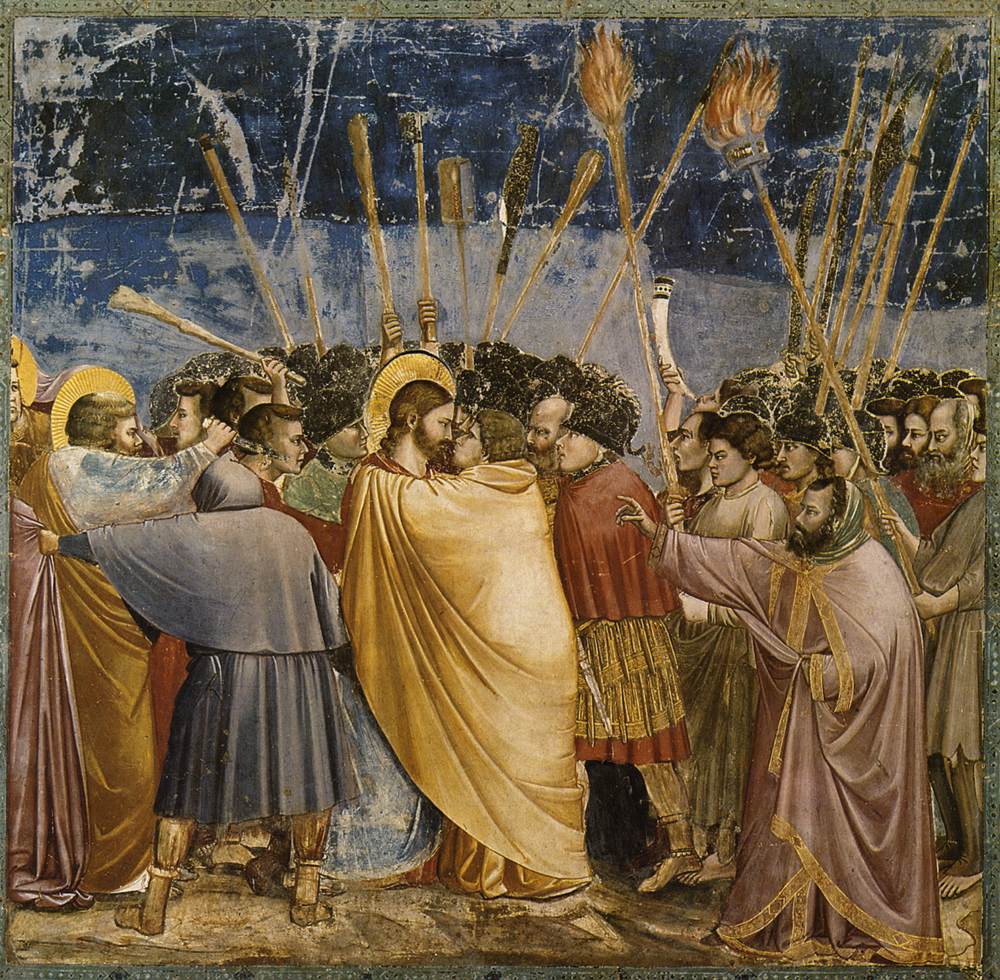
Giotto, The Arrest of Jesus and Kiss of Judas, 1306

This day is named for Judas Iscariot. When exactly he conferred with the Sanhedrin and agreed to betray Jesus to them is not known; Matthew and John seem to imply that the anointing of Christ at Bethany, which seems to have happened before the triumphal entry, spurred his decision.
But presently [Eve] remembers that the fruit may, after all, be deadly. She decides that if she is to die, Adam must die with her; it is intolerable that he should be happy, and (who knows?) with another woman when she is gone. I am not sure that critics always notice the precise sin which Eve is now committing, yet there is no mystery about it. Its name in English is Murder. ... If the precise movement of Eve's mind at this point is not always noticed, that is because Milton's truth to nature is here almost too great, and the reader is involved in the same illusion as Eve herself. ... Thus, and not otherwise, does the mind turn to embrace evil. No man, perhaps, ever at first described to himself the act he was about to do as Murder, or Adultery, or Fraud, or Treachery, or Perversion; and when he hears it so described by other men he is (in a way) sincerely shocked and surprised. Those others 'don't understand.' ... If you or I, reader, ever commit a great crime, be sure we shall feel very much more like Eve than like Iago. 
-- C. S. Lewis, A Preface to 'Paradise Lost', pp. 125-126
Almighty God, we beseech thee graciously to behold this thy family, for which our Lord Jesus Christ was contented to be betrayed, and given up into the hands of wicked men, and to suffer death upon the cross, who now liveth and reigneth with thee and the Holy Ghost, ever one God, world without end. Amen.

-- First Collect for Good Friday

Maundy Thursday (April 2nd)


The name maundy is an English slurring of the Latin mandatum, which means 'command,' and appears in the Vulgate phrase Mandatum novum do vobis, or, in English, 'A new command I give unto you'. The original consecration of the Eucharist, and the subsequent delineation of the New Covenant, took place on this night; it is now the first night of the Triduum, the apex of the liturgical year -- a solemn celebration that takes place over three days, commemorating the institution of the Mass and the priesthood, the Crucifixion, and the Resurrection.
He determined to be incarnate by being born; that is, he determined to have a mother. His mother was to have companions of her own kind; and the mother and her companions were to exist in an order of their own degree, in time and place, in a world. They were to be related to him and to each other by a state of joyous knowledge; they were to derive from him and from each other; and he was to deign to derive his flesh from them. ... But what did happen? The web depended on its exchanged derivation, which itself sprang from the fact not only that all derived from him but that he had ordained that he, in his flesh, would derive from all. The two derivations were, in him, a single act ... Somewhere, somehow, the web loosed itself from its center -- also by its free choice. ... Sin had come into the great co-inherent web of humanity; say rather that all the web burst into sin, and broke or was antagonized within itself; knot against knot, and each filament everywhere countercharged within itself. It broke? alas, no; it could not break unless its maker consented that it should and he would not consent; his good will towards it ... was too great. He loved it; he had loved it in the making and he loved it made ... No; she had turned from him; she had attempted to deracinate her life; but he was still her root, and she should still have at her disposal all that he had given her; she should still have life. Intolerable charity! 
-- Charles Williams, The Forgiveness of Sins, pp. 120-122, 128
Almighty and everlasting God, by whose Spirit the whole body of the Church is governed and sanctified: Receive our supplications and prayers, which we offer before thee for all estates of men in thy holy Church, that every member of the same, in his vocation and ministry, may truly and godly serve thee; through our Lord and Savior Jesus Christ. Amen.

-- Second Collect for Good Friday

Good Friday (April 3rd)


Matthias Grunewald, The Crucifixion, ca. 1501

Words fail me. Chesterton can take over.
In this story of Good Friday it is the best things in the world that are at their worst. ... It was, for instance, the priests of a true monotheism and the soldiers of an international civilization. Rome, the legend, founded upon fallen Troy and triumphant over fallen Carthage, had stood for a heroism which was the nearest that any pagan ever came to chivalry. ... But in the lightning flash of this incident, we see great Rome, the imperial republic, going downward under her Lucretian doom. ... Rome was almost another name for responsibility. Yet [Pilate] stands forever as a sort of rocking statue of the irresponsible. ... There too were the priests of that pure and original truth that was behind all the mythologies ... It was the most important truth in the world; and even that could not save the world. ... The Jewish priests had guarded it jealously in the good and the bad sense. ... They were proud that they alone could look upon the blinding sun of a single deity; and they did not know that they had themselves gone blind. ... And as it was with these powers that were good, or at least had once been good, so it was with the element which was perhaps the best, or which Christ himself seems certainly to have felt as the best. The poor to whom he preached the good news, the common people who heard him gladly ... there was present in this ancient population an evil more peculiar to the ancient world. ... It was the soul of the hive; a heathen thing. The cry of this spirit also was heard in that hour, 'It is well that one man die for the people' ... that the one universal human spirit might suffer a universal condemnation; that there might be one deep, unanimous chorus of approval and harmony when Man was rejected of men. There were solitudes beyond where none shall follow. ... Nor is it easy for any words less stark and single-minded than those of the naked narrative even to hint at the horror of exaltation that lifted itself above the hill. ... [A] cry was driven out of that darkness in words dreadfully distinct and dreadfully unintelligible ... and for one annihilating instant an abyss that is not for our thoughts had opened even in the unity of the absolute; and God had been forsaken of God. 
-- The Everlasting Man, pp. 210-212
O merciful God, who hast made all men, and hatest nothing that thou hast made, nor wouldest the death of a sinner, but rather that he should be converted and live: Have mercy upon all Jews, Turks, Infidels, and Heretics, and take from them all ignorance, hardness of heart, and contempt of thy word; and so fetch them home, blessed Lord, to thy flock, that they may be saved among the remnant of the true Israelites, and be made one fold under one shepherd, Jesus Christ our Lord, who liveth and reigneth with thee and the Holy Spirit, one God, world without end. Amen.

-- Third Collect for Good Friday

Holy Saturday (April 4th)


The only thing we are specifically told happened the day after the Passion is that the surviving disciples and the Holy Family rested on the Sabbath as the Torah required. However, it's also hinted that the Lord did something in the realms of the dead at this time, which the Mediaeval Church developed in speculation and art into the awesomely-named tradition of the Harrowing of Hell. No liturgy celebrates this, however; the only liturgy this day is the Easter Vigil, the glorious climax of the Triduum and the very beginning of the Easter season. (This is the time when adult converts, having been catechized over the preceding months, are normally baptized as Catholics.)
For if all the pains contained in hell, on earth, and in purgatory -- including death and all -- were set before us, we ought rather to choose all that pain than sin itself ... And I was shown no harder hell than sin, for of its very nature, the soul knows no other hell but sin. Yet fixing our intent in love and meekness we are made all fair and clean by the working of mercy and grace. For as mighty and as wise as God is to save us, so is he most willing; it is Christ himself who is the ground of all Christian law, and he taught us to do good as against evil. In this we see that he himself is that love, for he does to us as he bids us do to others ... Inasmuch as his love is never broken toward us when we sin, so does he will that it is never broken within ourselves or toward our fellow Christians; rather we should hate the sin itself but endlessly love every soul as God loves it. 
-- Lady Julian of Norwich, The Revelation of Divine Love, Thirteenth Showing
Grant, O Lord, that as we are baptized into the death of thy blessed Son our Savior Jesus Christ, so by continually mortifying our corrupt affections we may be buried with him; and that, through the grave, and gate of death, we may pass to our joyful resurrection; for his merits, who died, and was buried, and rose again for us, thy Son Jesus Christ our Lord. Amen.

-- Collect for Easter Eve

Easter Sunday (April 5th)


Caravaggio, The Incredulity of Saint Thomas, 1602

The Resurrection, I presume, calls for little explanation. Or more accurately, little that I'm equipped to give. I'll only note that the first eight days of Easter, from this day through the following Sunday, are treated by the liturgy as one: eternity invading time, heaven breaking into the terrestrial plane, in the act of the Resurrection. This is why the number eight -- one step outside the seven-day week that forms the standard measurement of time on earth -- is often a symbol in Christianity of eternity.
Here saies S. Augustine, when the soule considers the things of this world ... She rests upon such things as she is not sure are true, but such as she sees, are ordinarily received and accepted for truth: so that the end of her knowledge is not Truth, but opinion ... But saies he, when she proceeds in this life to search into heavenly things ... The beames of that light are too strong for her, and they sink her, and cast her downe ... and so she returns to her owne darknesse, because she is most familiar, and best acquainted with it; Non electione, not because she loves ignorance, but because she is weary of the trouble of seeking out the truth, and so swallowes even any Religion to escape the paine of debating, and disputing ... But then in her Resurrection, her measure is enlarged, and filled at once; There she reads without spelling, and knowes without thinking, and concludes without arguing ... What a death is this life! what a resurrection is this death! For though this world be a sea, yet (which is most strange) our Harbour is larger than the sea; Heaven infinitely larger than this world. For, though that be not true, which Origen is said to say, That at last all shall be saved, nor that evident, which Cyril of Alexandria saies, That without doubt the number of them that are saved, is far greater than of them that perish, yet surely the number of them, with whom we shall have communion in Heaven, is greater than ever lived at once upon the face of the earth ... In Heaven we shall have Communion of Joy and Glory with all, alwaies; Ubi non intrat inimicus, nec amicus exit, Where never any man shall come in that loves us not, nor go from us that does. 
-- John Donne, Evening Sermon at St. Paul's on Easter Day, March 28, 1624
Almighty God, who through thine only-begotten Son Jesus Christ hast overcome death, and opened unto us the gate of everlasting life: We humbly beseech thee, that as by thy special grace preventing us thou dost put into our minds good desires, so by thy continual help we may bring the same to good effect; through Jesus Christ our Lord, who liveth and reigneth with thee and the Holy Ghost, ever one God, world without end. Amen.

-- Collect for Easter Day

Tuesday, September 16, 2014

Why I Am a Catholic, Part III: Apostate

In my last, I described my sojourn into apostasy. I had been intending to pass on from that and revisit it a few times later, but I feel it'd be better to camp there for a little while instead. (I've also changed the name of this series, accenting the personal angle that I feel must be taken with this -- accenting it for myself as much as anybody else, since I'm bad at that, but I digress.)

The apostate is something very different from the atheist who is sincerely convinced of atheism. I don't mean the person who has committed some concrete act of apostasy -- the burner of incense to the genius of the Roman Emperor, the signer of the Act of Supremacy, the one who treads upon the fumie. The one who does these things need not be surrendering to anything but the frailty of human nature, under torture or the threat of torture. Or conversely, they may do such things as these, or nothing at all, out of a sincere (if, in the Catholic view, mistaken) belief that God does not exist; or that the Absolute is so different from the Christian God that, for all intents and purposes, He does not exist.


Fumie (literally "things to step on") were used in the persecution of the Church in Japan: they depicted
Christ or the Virgin, and people were required to step on them. Those who objected were exposed as Catholics.

But this is not the kind of apostasy that I am writing of here. The apostate in this sense is one who has been abandoned by God, or has felt compelled to abandon Him, and may or may not be an atheist in the rational sense at all. It's expressed, I think, in the song "Dear God" by XTC:
But all the people that you made in your image
See them starving on their feet
'Cause they don't get enough to eat from God
I can't believe in you
Dear God, sorry to disturb you but
I feel that I should be heard loud and clear
We all need a big reduction in amount of tears
And all the people that you made in your image
See them fighting in the street
'Cause they can't make opinions meet about God
...
I won't believe in heaven or hell
No sinners, no saints, no devil as well
No pearly gates, no thorny crown
You're always letting us humans down
The wars you bring, the babes you drown
That is not the voice of a philosopher, delivering his opinion that there does not happen to be a Supreme Being; neither is it the voice of a teenager who's trying to make his parents mad. That is the anguished voice of one betrayed.

St. Paul's mystery of iniquity is the perennial complaint of the apostate. If I may trust my own weird experience, it isn't simply a matter of having an extremely puzzling riddle to crack. That doesn't help, but it also isn't what's at stake -- God knows there is no shortage of nuts-hard-to-crack in the universe (indeed, as Lady Julian and science conspire to tell us, all that is made is a nut). What's at stake is how the nightmare anguish that exists in the world, in our own lives, can possibly be compatible with the reality of a God who is both good enough to object to it and powerful enough to stop it, and of whom it can't plausibly be maintained that it's none of His business. Why did I have to lose this man over a stupid mistake? How could You let this innocent little girl be tormented? Why did you let these people be gunned down at random by a maniac?

The fact that apostates often wrestle with the problem of evil, in public and in private (frequently in their work if they are artists of any kind), for many years after some decisive renunciation of faith, may be an ironic testimony to the doctrine that Baptism imparts an indelible mark upon the soul. Some of my favorite authors are those, like Flannery O'Connor and Shusaku Endo, whose work depicts, not a knock-down argument for regarding the difficulty as having a complete and satisfactory answer, but the difficulty itself as material for faith: as a part of the human experience that must be treated as legitimate and somehow brought to God, if coming to God is going to have any meaning. Not by conversion of the Godhead into flesh, but by the taking of the Manhood into God. And after all, we start with our own experience in a way that we definitely don't start with divine revelation; howbeit that was not first which is spiritual, but the natural, and afterward that which is spiritual.

Translated into more poetic language, the apostate's case might perhaps go something like this:
This is one thing, therefore I said it, He destroyeth the perfect and the wicked.
If the scourge slay suddenly, he will laugh at the trial of the innocent.
The earth is given into the hand of the wicked: he covereth the faces of the judges thereof; if not, where, and who is he?
... Let him take his rod away from me, and let not his fear terrify me:
Then would I speak, and not fear him; but it is not so with me.
My soul is weary of my life; I will leave my complaint upon myself; I will speak in the bitterness of my soul.
I will say unto God, Do not condemn me; shew me wherefore thou contendest with me.
Is it good unto thee that thou shouldst oppress, that thou shouldst despise the work of thine hands, and shine upon the counsel of the wicked?
... Thou knowest that I am not wicked; and there is none that can deliver out of thine hand.
Thine hands have made me and fashioned me together round about; yet thou dost destroy me. 
-- Job 9.22-24, 9.34-10.3, 10.7-8
Job is one of the most neglected books in Scripture -- the majority of allusions to it that I've seen have consisted in the single phrase I know that my Redeemer liveth, ripped from its original context and content, and slapped as a piece of sentimental uplift onto car bumpers and the dust-jackets of inspirational something or other. I can't think of anything more insulting. The fumie at least had actual icons on them. It'd be like taking a picture from Dachau that happened to have a smile in it, and using it to advertise sugarless gum.


But does your soul feel clean?
*ting*

For it is the whole point of the book of Job that God, when He confronts both Job and Job's comforters, offers no answer, no explanation. He gives no account of Himself. As Charles Williams points out in He Came Down From Heaven, God's reply mostly only plagiarizes things Job has already said in his storm of accusation directed upwards. There is no theodicy offered there.

Or rather, there is; it is that offered by Job's friends: Job is suffering because he has, in some manner, sinned, and must repent. Reading Job's outrage, and his abuse of his friends as well as his God, those of us who were raised in the Christian faith might be inclined to agree with them, having been brought up to believe that there are certain things one simply doesn't say to, or about, God. The Almighty's own response to Job's friends is as follows:
And it was so, that after the LORD had spoken these words unto Job, the LORD said to Eliphaz the Temanite, My wrath is kindled against thee, and against thy two friends: for ye have not spoken of me the thing that is right, as my servant Job hath. Therefore take unto you now seven bullocks and seven rams, and go to my servant Job, and offer up for yourselves a burnt offering; and my servant Job shall pray for you: for him I will accept: lest I deal with you after your folly, in that ye have not spoken of me the thing which is right, like my servant Job. 
-- Job 42.7-8

Job, Leon Bonnat, 1880

This is why I cannot and will not despise the apostate, the anti-theist. Those who do despise them have no business with apologetics. I think that no one, however virtuous, can truly grapple with the problem of evil and not understand apostasy. Christ Himself, mounted upon the cross, his face lifted up into heaven, demanded of that heaven, Why hast Thou forsaken Me?

God's effective silence to Job was matched by His absolute silence to His Son. That silence echoes down the corridors of history; it resounds like music in the human heart; deep calleth to deep in the roar of thy cataracts, all thy waves and billows are gone over me; hearts and sufferings coinhere, and at the heart of them all lies the Sacred Heart, still pierced, still bleeding, still burning. The silence was followed by the Resurrection? -- yes, but that was in the macrocosm. We, in the microcosm that we (idly enough) call "real life," cannot see that.

Which means that that referral to the macrocosm, to the Resurrection, cannot really be used as an answer. That reality left its evidences upon history; and I do think that Pascal was right, when he said that there is enough light for those who wish to see as there is enough darkness for those who don't. But to place one's faith in the Resurrection and in the universe that it signifies is precisely an act of faith -- it is not simply the obvious and reasonable thing to do, ever.

That, I think, was my mistake. Not only as a child, but for years afterward, and even in my conversions from atheism to Christianity and from Christianity in general to Catholicism in particular. I never fully grappled with the fact that the act of faith was an act of faith -- that is, trusting a Person, not simply accepting an idea -- not of following a chain of reasoning to its logical end. Following that chain did put me in a position to make an act of faith. I don't regret that. And, while it's impossible to know whether I would have made the same decision if I had grappled with that question during my conversions, I think I might have done. But it has left me to grapple with that same problem now.


Jacob Wrestling with the Angel, Gustave Dore, 1855

I don't believe there is any irreverence in such a struggle; My servant Job hath spoken of Me the thing that is right. Returning to Charles Williams:
No pot -- so far -- has asked questions of the potter in a voice the potter can understand; when it does, it will be time enough to compare pots to men. The criticism is not aimed at Saint Paul, who dropped the phrase in the midst of a great spiritual wrestle, not as a moral instruction. But it has been used to often by the pious to encourage them to say, in love or laziness, 'Our little minds were never meant ...' Fortunately there is the book of Job to make it clear that our little minds were meant. A great curiosity ought to exist concerning divine things. Man was intended to argue with God.*
And how is any of this an answer to apostasy or an argument against atheism? It isn't; that's very largely the point. I believe Christians must accept and respect the fact that, for some people, the problem of evil is an insurmountable objection to God's existence -- the problem of evil as experienced in their own lives. And not accepted and respected as some sort of condescending indulgence of the weakness of others, either. The brute fact is, unless our own heart's been broken the same way theirs has, we don't know what we're talking about.

While, if our own hearts have been broken, we should know better than anybody that faith is a mystery. I don't honestly know why I'm not an atheistic apostate. The brain-breaking problem of how God could allow the suffering that exists in the world, I can't answer; the pain I've suffered, the pain I've caused, in my own twenty-seven years, I don't know what to do with that. Sometimes I understand why I believe, but those times, I couldn't express it in words: I could point at Him, but nothing else, not really. I could pile up arguments this high, putting someone in a position where Catholicism is intellectually possible and even plausible; and without the gift of faith, given mystically, it's not going to matter.

None of which is a reason to waive the rational element in the discussion. It's just a reason to put it in its place.
O LORD, thou hast deceived me, and I was deceived: thou art stronger than I, and hast prevailed: I am in derision daily, every one mocketh me.
For since I spake, I cried out, I cried violence and spoil; because the word of the LORD was made a reproach unto me, and a derision, daily.
Then I said, I will not make mention of him, nor speak any more in his name. But his word was in mine heart as a burning fire shut up in my bones, and I was weary with forbearing, and I could not stay. 
-- Jeremiah 20.7-9

*He Came Down From Heaven, p. 30.

Monday, August 25, 2014

Loneliness and Dunbar's Number

I have, to my lasting regret, not raved much before about David Wong, novelist and esteemed author of many Cracked articles (like this one and this one). I bought his debut book John Dies At the End just shy of a year ago now, and have since read it five or six times, because it's that good. Thanks to my folks, I have now also received and read his second novel, This Book Is Full of Spiders. I'd been slightly nervous to get it, because I liked John Dies so much I was afraid he wouldn't be able to pull off something of the same magnitude again. I had the same fear when I heard that J. K. Rowling had written a second Harry Potter book: "Please," I thought, "everything about Sorcerer's Stone was so great, and so neatly resolved, it doesn't need this -- she's obviously been pressured by the publisher or someone into cashing in on its popularity with a cheap sequel. But just in case, I'll go ahead and read this Chamber of Secrets thing." Which I then liked even better than the original. Now, I'll admit that I still like John Dies better than Spiders, but the latter put up some fierce competition, and I have a feeling that it too might eventually assume a place on the Whiskey Shelf.*


Warning: You may have a huge, invisible spider living in your skull. THIS IS NOT A METAPHOR. -- David Wong

Anyway, the reason I bring it up, aside from urging you all to go buy a copy of This Book Is Full of Spiders (and in all likelihood having some extraordinarily creative nightmares for a while), is that he cited a factoid that fascinated me. The town the book is set is has been quarantined following a zombie outbreak -- and, sidebar, it's worth noting that in a genre as old, popular, and market-saturated as zombie fiction, Wong still manages to produce something actually inventive and pretty scary -- and one of the characters is explaining something to the narrator:
"The restraint that governs human ambition isn't a lack of a unified language. It's Dunbar's number. Named after a British anthropologist named Robin Dunbar. He studied primate brains, and their behavior in groups. And he found something that will change the way you think about the world. He found that the larger the primate's neocortex, the larger the communities it formed. It takes a lot of brain to process all of the relationships in a complex society, you see. When primates find themselves in groups larger than what their brains can handle, the system breaks down. Factions form. Wars break out. Now, and do pay attention, because this is crucial -- you can actually look at a primate brain and, knowing nothing else about what species in came from, you can predict how big their tribes are. 
"... The salient issue here is that every primate has a number." Marconi gestured to the crowd gathering outside the fence. "Including those primates out there. Including you and I. Based on the size of a human's neocortex, that number is about a hundred and fifty. That's how many other humans we can recognize before we max out our connections. With some variability among individuals, of course. That is our maximum capacity for sympathy." 
I stared at him. I said, "Wait, really? Like there's an actual part of our brain that dictates how many people we can tolerate before we start acting like assholes?" 
"Congratulations, now you know the single reason why the world is the way it is. You see the problem right away -- everything we do requires cooperation in groups larger than a hundred and fifty. ... So every moment of the day we urgently try to separate everyone into two groups -- those inside the sphere of sympathy and those outside. Black versus white, liberal versus conservative, Muslim versus Christian, Lakers fan versus Celtics fan. ... 
"And here is the key -- those who lie outside the circle are not human. We lack the capacity to recognize them as such. This is why you feel worse about your girlfriend cutting her finger than you do about an earthquake in Afghanistan that kills a hundred thousand people. This is what makes genocide possible."**
This got me thinking, a bad habit that I've never quite been able to shake. The book of Acts records that, at the Ascension, there were a hundred and twenty disciples (probably a round number -- given for its symbolic significance as a multiple of twelve, that being the number that Scripture typically uses to signify the chosen people of God). This lies neatly within Dunbar's number*** for social groups, as if the primitive Church had been designed to experience itself first as a tightly-knit yet expansive community -- a Church that was catholic.

The narrative thereafter shows the various ways in which the Church expanded beyond its previous boundaries of both size and composition: first her numerical expansion after Pentecost; then the evangelization of the more-or-less (but, in most Judean Jews' opinion, distinctly less) Jewish people of Samaria; then the beginnings of the mission to the Gentiles in Syria; and then, with the conversion of St. Paul, the beginnings of an evangelization of the whole Mediterranean, and the crossing from Asia to Europe, arriving at last at the center of the Empire and what had been the symbol of everything the Jews -- including the Apostles themselves -- wanted to be freed from, both politically and spiritually: Rome. As if the Holy Ghost took the Church and told her, "Alright, we're going to radically change how you relate to literally everyone in the world. So start here, where you can comfortably handle the scale of what's going on. And now a step beyond that. And now, a while later, another kind of step, beyond the previous one. And now another."


We speak the wisdom of God in a mystery, even the hidden wisdom, which God ordained
before the world unto our glory:which none of the princes of this world knew: for had
they known it, they would not have crucified the Lord of glory. -- I Corinthians 2.7-8

From one perspective, of course, the experiment failed; I don't know that Christianity is more divided against itself than any other religion, but it has shown the ill-effects of expansion: that dissolution of empathy and receptivity known, in theological language, as schism. From another perspective, the experiment was a considerable success: it will round its two thousandth year in just about twenty years more, with a continuation not only as a spirit but as a living institution at every point -- a historical fact peculiarly well symbolized (whatever one's theology of it) by the Papacy, which is the oldest continuous institution in the world.**** That the Christian religion has managed to continue to exist, and even to recollect itself from native corruptions several times, is an impressive feat, perhaps an unrivaled one.

It's a funny phenomenon to me to think of simply running out of sympathy based on the size of a group. Running out of time, energy, patience, all of that I understand from within; and I suppose that if Dunbar's number just signifies that, practically speaking, we can only manage to know so many people, it makes sense. But it very much seems as though -- whether for pragmatic reasons or for some darker cause -- what it means is that, after that threshold, we just know too damn many people, and start not merely saying "I haven't got the resources to do you justice" but in fact saying "You don't deserve for me to do you justice."


That's super weird to me. I don't know whether it's just because it's weird to anybody, or because I've dealt so much with loneliness throughout my life, or what. But it's strange, and it's tragic. It's perfectly true that that is what allows genocide to happen, and what allows us to be so callously inattentive to, or contemptuous of, others' sufferings -- particularly if those others are far away, or look or dress or speak or behave in ways that we do not recognize or do not like, or are simply a very large group (it being a curious but, it seems, generally acknowledged phenomenon that it's easier to mourn sixteen people than sixteen million).

I wonder, too, whether there is a reverse to which Dunbar's number is the obverse: whether there is some number of people we need to know intimately, a number of relationships beneath which a person simply can't function without their humanity begin to fracture. Of course, there will always be variability. And there will always be periods when we need solitude: some people need much more solitude than others, and some people even have vocations for the long term to be recluses or hermits, though even they tend to gather visitors and disciples, not infrequently against their will. But I wonder whether there is an opposite to Dunbar's number nonetheless. It'd be entertaining if that number should happen to be three.

Or -- and this is at least as likely, based on the data at my disposal -- loneliness is just A Thing That Happens, like many Things.

Now, I'm fairly fucked up, as a person: to give you the idea, about two weeks ago now, a friend of mine, a guy I've known and respected and liked for years, asked if I was going to be at the writers' group we both go to, and when I told him yes and he said he was glad because he'd been hoping I would be there, my knee-jerk reaction was to think, Did I do something wrong and he wants to talk to me about it? Did I borrow something and he needs it back? Do I owe him money? (I borrow money approximately never.) Not something like, Oh, this person likes spending time with me, how nice. That is a hypothesis that I generally only arrive at after several minutes, though I've learnt to try positing it earlier on, if only out of a spirit of adventurous experiment. So my own way of experiencing and contemplating loneliness may not be typical, or indeed noteworthy for its sanity. But, judging from my own life and what the people I know and trust the most say, loneliness does just kind of come and go in waves, even under the best circumstances, even when all of the affection that we need is being supplied by family and friends.

My suspicion is that this is one of the signs that we were made for something more and other than human company. Loneliness is kind of like being hungry; I wonder whether perhaps it is being hungry, for God. This also is Thou, neither is this Thou, as the saying goes: God is known through every created thing, and yet He is not nor resembles any created thing. And as painful as it often is -- and it's been biting especially deep of late, for whatever reason -- there is also a strangely clean feeling to loneliness sometimes. Something that faintly resembles the feeling you get when you look up at the sky on a day when there isn't a cloud in sight, and just stare into the deserted blue.

I do think it rather interesting that the saints, the great paragons of supernatural love, have made use of both methods -- solitude on the one hand, and society far beyond Dunbar's number on the other. In a woman like Lady Julian of Norwich, we find a recluse, immured from the world as if already buried (neither is this Thou), yet whose overflowing charity and grace still guide and inspire Christians to this day.


"The Holy Ghost never urgeth any thing against charity, for if He were
to do so, He would contradict His own nature; for He is all charity."

At the other extreme, as it were, we have a figure like Blessed Mother Teresa: untiring and unresting, having traveled halfway around the world (from Albania to Ireland to India) for no other purpose than to pour herself out for others, herself secretly brimful of the darkness and pain of the Passion, yet giving every single person a smile, a prayer, a touch, making some gesture of love however small, for the sake of loving every person as Jesus -- loving Jesus in every person (this also is Thou).


"We think sometimes that poverty is only being hungry, naked and homeless. The
poverty of being unwanted, unloved and uncared for is the greatest poverty."

And the extremes meet, as any introvert who's attended a party knows well. (As Joey Prever put it once, "Everybody came over! It was great! That was three hours ago! They won't leave!") Not only can company be solitude, whether said company is in excess of a hundred and fifty people or not. It's also true that solitude can be company: not just that solitude is a relaxing break, but that there is a quality in solitude that can be as enriching and positive as a supportive, affectionate friend. It isn't always there; or, more likely, I'm not always tuned in enough to notice it. But hey. That could mean that -- just as, by training or talent or Divine grace, some people exceed the Dunbar number and care about more than a hundred and fifty people -- so too, maybe, the opposite of the Dunbar number, under the same conditions of nature or of grace, might be zero.

Hmm. This will require some beard-stroking, and possibly a raised eyebrow.


*For those not already acquainted with my personal blend of bibliomania and alcoholism: I was tired of having to get up and walk all three and a half feet from my desk to my bookshelves whenever I needed to reference something while writing, so I took an old wooden whiskey crate that I liked and makeshifted it into a bookcase for the works I use most frequently, whether for use or pleasure. Books on the Whiskey Shelf are accordingly those I most highly esteem. Most of them, other than John Dies At the End, are books that I've been familiar with for several years at least and read many times over. (Because I arranged them alphabetically by author, this means that Assuming the Position: A Memoir of Hustling is sitting right next to The Silmarillion, which I imagine must be a novel experience for both of them.)

**This Book Is Full of Spiders: Seriously, Dude, Don't Touch It, pp. 295-296.

***Dunbar's number has been disputed, with some scholars setting it significantly higher. A generally accepted range, according to infallible Wikipedia, lies between 100 and 250.

****Unless the claims of the Japanese Emperors are true, in which case they predate the Bishops of Rome by about 660 years. Which I admit would be pretty awesome.