Collect

Collect for the Fourth Sunday after Trinity

O God, the protector of all that trust in thee, without whom nothing is strong, nothing is holy: increase and multiply upon us thy mercy; that, thou being our ruler and guide, we may so pass through things temporal, that we finally lose not the things eternal; grant this, O heavenly Father, for the sake of Jesus Christ thy Son our Lord, who liveth and reigneth with thee, in the unity of the Holy Spirit, ever one God, world without end. Amen.
Showing posts with label reason. Show all posts

Wednesday, December 12, 2018

An Image of the City, Part IV: An Enumeration of Rights

At this moment the King, who had for some time been busily writing in his note-book, cackled out ‘Silence!’ and read out from his book, ‘Rule Forty-two. All persons more than a mile high to leave the court.’
Everybody looked at Alice. ‘
I’m not a mile high,’ said Alice. ‘You are,’ said the King. ‘Nearly two miles high,’ added the Queen. ‘Well, I shan’t go, at any rate,’ said Alice: ‘besides, that’s not a regular rule: you invented it just now.’ ‘It’s the oldest rule in the book,’ said the King. ‘Then it ought to be Number One,’ said Alice.
The King turned pale, and shut his note-book hastily. ‘Consider your verdict,’ he said to the jury, in a low, trembling voice.
 
—Lewis Carroll, Alice’s Adventures in Wonderland
✠     ✠ ✠

So then, the most essential rights of man, as outlined in my last, may be termed: the jus agnitioni, the right to be recognized as a human being; the jus vitæ, the right to live; and the jus factioni, the right to normal human activity. On hypothesis, all other rights are implications or outworkings of these three most fundamental truths about humanity. But these three ideas are the skeleton—it’s those other rights that flesh out the shape of right. So what are those other rights?


I. Jus Agnitioni

The right to be recognized is, first of all, a right to acknowledgment of one’s humanity irrespective of any other fact about oneself: age, sex, health, practical independence, intelligence, moral rectitude, criminal guilt, ethnicity, sexuality, politics, creed or lack thereof, class, nationality—all of that is secondary and all of it must be treated as secondary by the law, beside the bare fact that: this is a human being. Every human being is, in dignity, equal.

This carries with it a number of direct implications. The two most obvious, the right to live and the right to conduct a normal human life, form their own ‘families’ of rights; many more fall under the umbrella of equality before the law. We may enumerate:
· The right to liberty of thought, conscience, and expression
· The right to liberty of movement and conduct (as limited by others’ rights and liberties)
· The right to one’s merited good name
· The right to privacy and security against unreasonable interference
· The right to equal access to public goods and services
· The right to political participation in one’s home country
· The right to legal redress for injuries
· The right to an impartial trial when accused

These rights themselves may have further implications: for example, the right to be presumed innocent until proven guilty, the right to an attorney, the right to trial by a jury of one’s peers, the right to be tried publicly, and the right to face one’s accusers, may all be defined as instantiations of the right to an impartial trial (since revoking any one of these secondary rights would imperil the right to an impartial trial); or, the rights to liberty imply a right not to be a slave and a right to emigrate. Additionally, what we mean by some of the terms here could be defined with more precision: what, for instance, constitutes unreasonable interference with privacy and security, as distinct from putatively reasonable interference? Nevertheless, without claiming to have defined the jus agnitioni exhaustively, I dare say that these definitions are enough to move forward from.

With one proviso. The jus agnitioni prompts one definite question: given that lots of regimes, groups, and individuals have tried to delegitimize the humanity of certain groups—slaves, Romani,1 the unborn, the disabled, blacks, Jews—on what grounds is the jus agnitioni to be based?


I see no practicable alternative (in an age that is both scientific and scientistic) but to state that human rights inhere in any being that is, by species, Homo sapiens. This can exclude none of the aforementioned target categories, and applies without respect to capacities, origins, or any other quality. It applies equally to the stay-at-home dad, the Nobel laureate, the unborn fœtus, the autistic teen, the widowed mother of five, the comatose ninety-year-old, the penniless migrant worker, and the death row inmate. In other words, it applies to humans as such, not to a specific kind or condition of humans; just like rights are supposed to do.

This has implications vis-à-vis questions like abortion, capital punishment, and euthanasia, among other things. Even if it doesn’t rule them out (which it very well may), it casts them in a particular light: that of dealing with our obligations to a fellow human being, and not solely of the most convenient solution to a philosophically problematic encounter of wills.


II. Jus Vitæ

The right to live is the next most essential, since no other right can be exercised if this right is not preserved. If it is to be applied to Homo sapiens, then—all else being equal—it applies from the moment of conception until the moment of natural death. All else may not be equal: there are situations in which doctors predict confidently that a woman will die if she gives birth, or a man can only protect himself from a serial murderer by killing him first, or a garishly dressed alien can only rescue his interspecies girlfriend from a criminally insane real estate tycoon by sacrificing a junior colleague given to self-destructive cries for attention. But the existence of hard cases does not abolish the fundamental principles of right and wrong, any more than the existence of best solutions for hard cases turns them into easy cases.

Like the jus agnitioni, the jus vitæ carries additional rights in its train, rights to those things that we need in order to live. These include:
· The right to food, drink, and clothing
· The right to housing
· The right to health care
· The right to safe living and working conditions
· The right to fair wages and prices
· The right to self-defense
· The right to seek asylum from violence


The canny reader will have noticed that, while I mentioned safe working conditions and fair wages, I said nothing about a right to work. The right to work is of course intimately connected with these things, but I don’t think it is primarily derived from the jus vitæ. That is because, somehow, bringing work into discussions of the right to life always seems to smuggle in an idea that this right to live is conditional, upon a person’s pulling their own weight. Rephrased, that would mean if a person doesn’t pull their own weight, they deserve to die. As severe as I often am about moral principles, I am not prepared to espouse that view.

Besides this, working, as such, doesn’t really contribute to life. What it does is one of three things: obtain or create the goods necessary to live (harvesting crops to eat, weaving cloth to wear, bandaging one’s wounds, etc.); obtain or create superfluous goods to sell or barter; or obtain wages (whether in kind or in money). Work therefore falls properly under the jus factioni rather than here, and to that I now turn.


III. Jus Factioni

This is almost the same as what Thomas Jefferson expressed by the phrase the pursuit of Happiness, using a classical and Aristotelian understanding of happiness: i.e., well-being, human flourishing, a secure and contented human life. It is a right to those things we value about being alive: personal fulfillment, cultural activity, and pursuit of a calling or craft.

So what do we mean by human flourishing? I think a sufficiently catholic definition would embrace the following:
· The right to work
· The right to contribute to the common good
· The right to recognition of original inventions, discoveries, or creations
· The right to a family
· The right to fairly-acquired personal property
· The right to peaceable association with others
· The right to education
· The right to enter or refuse legally binding agreements

These rights are, naturally, the most difficult to detail, since—as both the medium and the fruit of human activity—they are wrapped up in the autonomy of everybody involved. Whether and how the right to education produces a personal obligation in an educator is, unavoidably, a tricky question to address. I hope to hammer out the hierarchy of these rights in a later post, which should help.

It’s also worth noting that I have specified personal property, which is different from public, private, or collective property. Public property is that which is owned equally by everybody; private property is that which is owned by an individual, but in excess of what they can actually use or enjoy; collective property is that which is owned by a group, like a company or a club, as distinct from an individual (government property is thus really a type of collective property, not public property). Personal property is approximately equivalent to what we call someone’s effects: property they can personally use or enjoy. I’m confident that there’s a right to personal property, but I’m not sure about the others, so I have left them off until I have more time to think.


But all of these rights are the rights of individuals. And individual people always exist in a context, a web of history and relationships that they didn’t choose (as well as others that they did). No Man is an Iland, intire of it selfe, and no society is a vacuum. Any serious theory of ethics and politics must account for the essentially social nature and origin of man—and therefore of every individual. Hence, before moving forward, we must ask what rights society as a whole has, and how they interlace with the rights of the individual.
✠     ✠ ✠

1A.k.a., Gypsies. Roma or Romani is, in general, the self-appellation and preferred name of the people; Gypsy is sometimes considered a slur.

Friday, November 30, 2018

An Image of the City, Part III: Jures Hominis

Father D’Arcy will forgive me if I take one example from his book, which exactly illustrates what I mean. He, being a trained philosopher, is naturally trained to put up with philosophers. Also, being a trained priest, he is naturally accustomed, not only to suffer fools gladly, but (what is sometimes even harder) to suffer clever people gladly. The consequence is that he can write calmly and even blandly sentences like these. ‘A certain likeness can be detected between the aim and method of St Thomas and those of Hegel. There are, however, also remarkable differences. For St Thomas it is impossible that contradictories should exist together, and … a thing must first be, to be intelligible.’
Let the man in the street be forgiven, if he adds that the ‘remarkable difference’ seems to him to be that St Thomas was sane and Hegel was mad. The moron refuses to admit that Hegel can both exist and not exist; or that it can be possible to understand Hegel, if there is no Hegel to understand.
—G. K. Chesterton, St Thomas Aquinas: The Dumb Ox
✠     ✠ ✠

As I mentioned in my last, I was surprised to learn (years ago) that the notion of a hierarchy of rights is not a standard element of most versions of human rights theory. To me, this seems like a baffling omission, because it’s so obvious that there are cases where one person’s rights clash with another’s. If, for the sake of argument, a severely dehydrated man could only stave off death by stealing a drink from Lady Marchmain’s fountain, which takes precedence: the landowner’s right to property or the dehydrated man’s right to life? If they are equal, there’s literally no right answer.

The common-sense answer is that obviously a man’s right to live outweighs Lady Marchmain’s proprietary use of her fountain. I think the common-sense answer is entirely correct, but it wants to be worked out into a coherent system.


Remember that negative rights are essentially rights against being interfered with, while positive rights incur obligations in others. The right to life is a negative right, and pretty much means the right to not be killed; the right to health care is a positive right, obliging those who can care for others’ health to do so for those who need it (obviously, this is not a thorough explanation). The principles I use to work out the system are these:

1. If exercising right A necessarily requires a person to enjoy right B, then B is the more fundamental of the two—or, to switch metaphors, right B is higher in the hierarchy. Another way of saying this is that B conditions A, i.e. creates the conditions necessary for A’s existence and/or enjoyment.
2. If exercising right A in practice requires some other thing B (which may be another right, a resource, or something else), then this entails a positive right to B. For example, humans need water to live, so if there is a negative right to life, then there is a positive right to adequate water.
3. The more a given right is conditioned by other rights, the lower it will be in the hierarchy; the less conditioned it is, the higher it will be.

So, what are the baseline rights we can plug into this system? What is their hierarchy among themselves? And, with respect to both questions, why?

At first I thought that principle 1 meant the right to life was the most basic of all rights, but as I’ve continued thinking it out, I have revised that belief. The morass of genocides in the twentieth century teach us with crystal clarity that recognition of other human beings as human, tautological though it sounds, is the bulwark upon which the right to life itself depends. It is that mutual recognition that conditions all other rights, including the right to live; for if a given person doesn’t really count as human, then every other right of theirs can be violated; or rather, violating their rights stops being a real thing, because they lack the context of human dignity in which those rights exist. Everything from the three-fifths rule to the Holocaust to ‘eliminating Down Syndrome’ depends on this refusal to deal honestly with the fact that every other human being is, precisely, a human being.

Therefore, I have made bold to classify what I call the right to recognition as elementary. All other rights are related to it, one way or another. If humans are not first of all human, in the long run, nothing else is going to matter.


The more I tried to think about rights in some structured pattern, the more the rights that the Western tradition usually enumerates seemed to coälesce into three groups, one surrounding this right to recognition, and the other two surrounding the right to live and to do things with one’s life; systems or families or rights, as it were. Being a former Classicist and a show-off, I shall give these systems Latin names to distinguish them from the individual rights they imply, and shall use said Latin names both for clarity (kind of) and to avoid having to type the word right over and over and over and over, especially since in some contexts it would be confusing.

The systems of rights are these:

I. Jus Agnitioni, the right to recognition. This means recognizing the fact that a person is a person, and that fact intrinsically means they have the same dignity as every other person. It undergirds the other two rights, and also implies things like a right to equality before the law, a right to autonomy and privacy, and so forth.
II. Jus Vitæ, the right to live. This, since it conditions every right except the jus agnitioni, is the second-nearest to the zenith, and comes from and realizes it.
III. Jus Factioni, the right to activity. This one is easier to express concisely in Latin than in English—though come to think of it, the Jeffersonian phrase ‘pursuit of happiness,’ if you give happiness the Aristotelianized meaning of eudaimonia, isn’t far off. The jus factioni springs from and details the jus agnitioni and jus vitæ; it embraces things like education, work, and marriage, the stuff that we do with the recognition and life at our disposal.

It is not coïncidental that these families of fundamental rights are three in number, nor that the first is rooted in being, the second is ‘the life of men,’ and the third proceeds from the first two. I expected—although I did not foresee this pattern specifically—that the rights proper to humanity would take a trinitarian form, because man is the image of God.

Outlining the further implications of these rights, to the best of my ability, will be the subject of my next.
✠     ✠ ✠

Wednesday, November 21, 2018

An Image of the City, Part II: Little Fredegar

Where there is no temple there shall be no homes,
Though you have shelters and institutions,
Precarious lodgings while the rent is paid,
Subsiding basements where the rat breeds
Or sanitary dwellings with numbered doors
Or a house a little better than your neighbor’s;
When the Stranger says: ‘What is the meaning of this city?
Do you huddle close together because you love each other?’
What will you answer? ‘We all dwell together
To make money from each other’? or ‘This is a community’?
And the Stranger will depart and return to the desert.

—T. S. Eliot, Choruses from ‘The Rock’


✠     ✠ ✠

Before I examine positive rights further, I must make an important prefatory remark. My original intention had been to turn immediately to human sinfulness, and the effects this has on political theory, but I find I need to deal at more length with something else first. This post came largely out of the discussion I had with some friends (a writers’ group called Pints and Prose) about my previous post. In particular, the fact that I used a rights framework was debated, since several of those present don’t subscribe to an ethical or political theory based in rights. The truth is that I use the language of rights because it’s familiar to me, not out of any special philosophical commitment; it’s worth noting that rights language tends to center on individuals at the expense of every other consideration, and while a reasonable person might do that, I don’t think it’s really compatible with a robustly Christian anthropology. I’ll probably go on writing in terms of rights, because it’s familiar, as I said: but other frameworks are not only possible but, I imagine, profitable. Moreover, I expect (I do not know) that the salient points of any given ethical or political system could be ‘translated’ into the terminology of another such system, so I’m not too fussed about adhering to this system or that. Any system is worth using only insofar as it helps us grasp realities that exist independently of what we choose to call them.

Anyway.

Last time I tried to enunciate the difference between: negative rights, or rights against people interfering with each other; and positive rights, or rights to good things that would involve other people’s coöperation. An example of the first would be the right to life, which is the same thing as the right not to be killed. An example of the second would be the right to health care, which (supposing, as the Church does, that it exists) would imply some kind of obligation on those who have the resources and skills to care for health, to use those resources and skills on the sick as people, rather than the sick as customers, for example. This obligation is something that inheres in the sick and is based on their need for it, rather than something established only by voluntary contract. Can obligations of this kind exist?

Well, a Catholic must certainly answer Yes. Indeed, the overwhelming majority of mankind, past and present, does answer Yes: from Cicero’s maxim that ‘Men were brought into existence for the sake of men, that they might do each other good’ or the ancient Hindu saying that ‘The poor and the sick should regarded as lords of the atmosphere,’ all the way down to the famous line from the Spiderman mythos, ‘With great power comes great responsibility.’ There are only two traditions that consistently qualify, minimize, or occasionally reject this idea—what C. S. Lewis described as the positive law of general beneficence—that we have as much moral duty to render good things to others as we have moral right to protect our own. One is the Enlightenment-derived tradition of rights, rooted in thinkers like Locke, Rousseau, and Jefferson, and today represented most by the Libertarian Party; the other is the collection of nationalist, fascist, and racist ideologies that began in the eighteenth and nineteenth centuries [1] and are today largely incarnated in the alt-right. [2] I utterly reject the second of these traditions, and have always had a slightly uneasy relationship with the first, precisely because of its strong tendency to neglect the poor—a deeply anti-Christian sentiment in any ethical or political system.


Even without appealing to ‘the universal opinion of mankind,’ though, we might observe that at least some positive rights are implied, to some extent, by negative rights themselves. If human beings have a right to life, but no right to any of the things by which life exists (such as food and drink, living space, and health care), then what the hell is the point of that right to life? It would be like pointing out that the Second Amendment guarantees us the right to keep and bear arms, but not the right to purchase bullets: yes, the logical distinction is there, but trying to build a moral or political system on that distinction is asinine.

But when trying to articulate positive rights in practice, things get more ticklish. It’s one thing to say that little Fredegar, who suffers from mumps, [3] has a right to health care; it is another to grab a doctor and say, ‘You shall treat little Fredegar’s mumps, because he has a right to health care.’ Aside from the obvious practical issue that this specific doctor may have no expertise in mumps, it does seem like an aggression against personal freedom; in addition, it evokes a particular logical fallacy called superalternation. This fallacy is reasoning from a particular statement to a universal, like: little Fredegar has brown eyes, little Fredegar is a human, therefore all humans have brown eyes. So here, the fact that every given person has a right to health care doesn’t mean that it’s the personal duty of a randomly selected doctor to provide that care to little Fredegar.

Yet doesn’t this land us back in the realm of purely negative rights? If little Fredegar’s right to health care can’t be ‘brought home’ to any particular health care provider, isn’t that open to the same criticism we made a moment ago, that negative rights are no good without some positive rights? Does it follow that positive rights themselves are, in practice, not much good themselves?

Possibly. As I said in my prefatory paragraph, a good deal of the conversation I had with my writers’ group on Monday was about the shortcomings of rights-based theory and language, and alternative approaches were discussed. All the same, rights language is what I’m familiar with, and I think we can express the proper solution to this ethical-political difficulty in that language, if we tweak it a little. [4]

In this rights language, we may affirm the following. When a person has a positive right to something, the duty to provide it impinges on society as a whole, and the duty is graver according to its necessity (health care is more needful than education) and urgency (mumps is more urgent than a cold). Insofar as society can only act through individuals, this duty naturally devolves to the people with (i) the most power to provide it and (ii) the closest relationship to the person in question.


Note, though, that while there are extremely intimate relationships like that between mother and child, and extremely distant ones like that between two complete strangers from opposite sides of the earth, the Christian view of man forbids us from regarding any two human beings as entirely unrelated. We are all, in however remote a degree, linked, and there are times when that impinges on practical decisions; the smaller a society is, the likelier it is that any given individual will have some duty to involve themselves in another person’s welfare. (The hypothetical extreme would be a doctor who specializes in mumps and little Fredegar being the only two people on a deserted island: it would then be the duty of that doctor specifically to treat little Fredegar, since for all intents and purposes the two of them are society in that context.)

Obviously, this would mean we need to have a hierarchy of rights—an idea which I had always found so natural and obvious that I was kind of shocked to discover that it isn’t a standard part of Enlightenment-tradition rights systems. But I think we could sort one out without too much trouble. Assuming I don’t get thrown another curveball, my next post will be about that.

✠     ✠ ✠

[1] To do them justice, the libertarians detest the ethnonationalists as a rule, partly for being racist and partly for being prone to tyranny. To do everyone else justice: libertarian ideas and rhetoric seem, judging from history, much more easily perverted into neglecting or preying upon the disadvantaged in a way that’s quite harmonious with ethnonationalism, than they are used to fight ethnonationalism. The non-interference that the libertarian tradition makes central can be made a weapon against a generalized oppression of everybody, but it is not so easily used against persecution, scapegoating, or oppression of the poor—which are precisely the things that usually happen when a government does become tyrannical, for whatever reason. Oppressing everybody at once is a stupid strategy and is accordingly not often tried.
[2] Contrary to widespread belief, while cultural and ethnic snobbery is probably as old as humanity, racism is (as far as we know) a comparative latecomer to the stage of human shittiness. In Europe and the Americas, it’s quite possible that it developed as a post facto justification for slavery and colonialism, rather than a pretext to start doing those things.
[3] It may be reasonably presumed that any child actually named Fredegar is currently suffering from mumps. Similarly, any child called Cholmondeley may be supposed to be a fair-haired bully at Eton, and any Wilfrid to be delicate, poetic, and never the same since young Master Harrington went away, if you’ll pardon my saying so, mum.
[4] One should never be afraid to tweak the language of a philosophical system. No system is exhaustive or flawless. A given tweak might be unhelpful, pointless, or detrimental, which is a good reason to examine proposed tweaks carefully; but that’s different.

Wednesday, May 3, 2017

Natural Lawyer Jokes, Part IV

‘For every work of creation is threefold, an earthly trinity … First, there is the Creative Idea, passionless, timeless, beholding the whole work complete at once, the end in the beginning: and this is the image of the Father. Second, there is the Creative Energy begotten of that Idea, working in time from the beginning to the end, with sweat and passion, being incarnate in the bonds of matter: and this is the image of the Word.’ …

The writer cannot even be conscious of his Idea except by the working of the Energy which formulates it to himself. That being so, how can we know that the Idea itself has any real existence apart from the Energy? Very strangely: by the fact that the Energy itself is conscious of referring all its acts to an existing and complete whole. In theological terms, the Son does the will of the Father. Quite simply, every choice of an episode, or a phrase, or a word is made to conform to the pattern of the entire book, which is revealed by that choice as already existing. This truth, which is difficult to convey in explanation, is quite clear and obvious in experience. It manifests itself plainly enough when the writer says or thinks: ‘That is, or is not, the right phrase’—meaning that it is a phrase which does or does not correspond to the reality of the Idea.

Dorothy L. Sayers, The Mind of the Maker1

✠     ✠     ✠


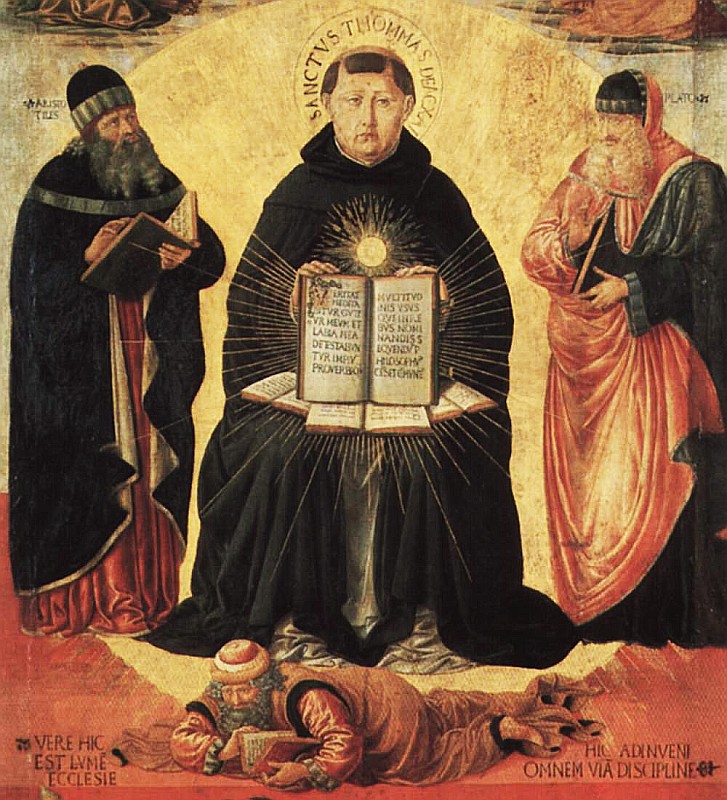
Benozzo Gozzoli, The Triumph of St Thomas Aquinas, 1471

The Thomistic approach to knowledge has, as one of its key axioms, Nihil est in intellectu quod prius non fuerit in sensu: ‘Nothing is in the intellect which was not first in the senses.’ This is part of the reason that Thomists are so confident in their rationalism; they consider their philosophy to be based in an appeal to the universal testimony of everyone’s eyes and ears and brains, and to be constructed by rational steps that practically anyone can understand and accept. But I believe there is a fatal flaw in this epistemology, one that can hamstring not only apologetics but thought as such. This flaw isn’t unique to Thomists—it’s a favorite flaw of modern philosophers from Descartes forward—but it needs correcting wherever it occurs.

The problem is this. All data gathered by the senses is, by definition, sense data: colors, tastes, sounds, textures, temperatures, and so on. The theory of knowledge set forth by Aristotle and championed by St Thomas and his successors avers that, after gathering such data (over a period of years at the beginning of our lives, and more easily later), the intellect abstracts and identifies the essences of things. For example, we see certain arrangements of colors and shapes, and perhaps feel certain textures and smell certain scents, and we’re told by our parents, ‘This is a tree.’ Then we perceive different arrangements of colors, shapes, textures, and scents, and those are trees too; and bit by bit we assemble a general idea of Tree as distinct from the individual trees that exemplify it.

The problem (as Aristotle and St Thomas alike should have seen2) is that you can’t validly move from a particular statement to a universal statement, ever. You can’t truthfully say ‘This X is Y, therefore all X are Y.’ Logically (and logic is one of the governing principles of the mind, as St Thomas insisted), you can’t abstract Tree from trees. And no matter how much sense data you gather, you cannot perceive Tree with any of your senses—you can only perceive trees. On these premises, you can’t know the natures of things, because it can’t ever be in your senses. At most, you can make educated guesses. Which is fine if that’s all you want to do, but if you want to reason out how things ought to be on the basis of what things they are, then that theory of knowledge decisively prevents you from ever doing so. In other words, if you want to practice Natural Law Theory, you have to start by rejecting Thomist epistemology.


This doesn’t bother me, because I am not attached to Thomist epistemology. I’ve preferred something more like Neo-Platonism since I was a child. If the human mind is going to recognize essences and not just appearances, it has to do so by some kind of intuition—recognition, if you will. The intellect must be lit from within as well as from without. There must be something in the human mind that is ready in advance for Tree, if trees are to prepare its way; the senses can, by all means, be the prophets and scribes of Tree, but they cannot be its only means of entry into the mind; the mind must conceive Tree apart from their touch, virginally.

This virginity is an affront to those men who wish all knowledge to enter the mind through the senses, whether they are scientists or theologians. The lust of objectivity—its own kind of objectification—is all but insatiable; less, I think, because of the natural human love of truth, than because we want very badly not only to be right, but to be right in such a way that other people’s wrongness is culpable. We like the idea that either we can persuade others of whatever we think, or else they’re just being stubborn. This is not perhaps our most amiable quality. But it’s better to admit that it’s there, and as rampant among scholars and apologists as anybody else, than to feign a neutrality we do not possess.

What is belief really? … It is a human way of taking up a stand in the totality of reality, a way that cannot be reduced to knowledge and is incommensurable with knowledge; it is the bestowal of meaning without which the totality of man would remain homeless, on which man’s calculations and actions are based, and without which in the last resort he could not calculate and act, because he can only do this in the context of a meaning that bears him up. … Meaning is the bread on which man, in the intrinsically human part of his being, subsists. Without the word, without meaning, without love he falls into the situation of no longer being able to live, even when earthly comfort is present in abundance. … No man can pull himself up out of the bog of uncertainty, of not being able to live, by his own exertions; nor can we pull ourselves up, as Descartes still thought we could, by a cogito ergo sum, by a series of intellectual deductions. … Meaning, that is, the ground on which our existence as a totality can stand and live, cannot be made but only received.3


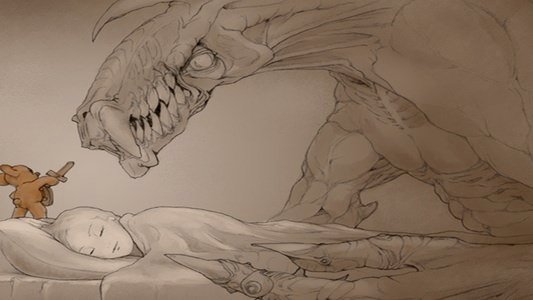
A teddy bear is always a gift.

So what do I mean when I talk about intuition and recognition? I mean that certain things are, in some rudimentary fashion, present in our minds by nature: the basic mathematical-logical laws of thought, the basic principles of right and wrong, and at least some basic ideas of what things are, or what kinds of things are. This isn’t to say we innately know everything, even about the rudiments of ideas that we possess. But it is to say that we must have something to work with if we are to know and reason at all; unto every one that hath shall be given, but from him that hath not shall be taken away even that which he hath. Put more simply, I’m saying ‘Tabula rasa is a load of bull-honkey.’4

I won’t pause here to try and puzzle out what all of these innate ideas are; I don’t have the talent to do so without a lot of assistance, time, and space, but also it isn’t essential to our purpose. But the three categories I mentioned above—those of logic, morality, and beings5—must (I think) be in our minds from the start, as things we just see, or we can’t know or learn anything. Call them knowledge of the possible, knowledge of the good, and knowledge of the factual. Again, I’m not saying we know any of these things exhaustively from birth, even in a latent state; still less am I saying that you never find odd gaps in certain minds, or that every person is able to express the knowledge they possess. I’m saying only that there is a standard outfit, and that it is the only thing that makes both individual knowledge and a communion of minds possible.

The generally shared character of human morals, across ethnicities, eras, and religions, is in my view one of the strongest testimonies for this view. Human moral codes do differ, to be sure, but the commonality is considerable (C. S. Lewis’ summary in the appendix to The Abolition of Man is an excellent source), even on points that are disadvantageous to their practitioners, like courage in battle or kindness to the poor.

This seems to me to be the only way to rescue Natural Law Theory. Many of its devotees may not regard this as much of a salvage, since it would have to be content with more modest claims: since we don’t know what the gaps in someone’s mind may be, including our own, we must be ready both to accept instruction and to allow others the liberty of not seeing something we find obvious. Because maybe they don’t, or maybe we’re missing something they do see. However, that’s a price I’m willing to pay in return for a consistent epistemology.


The difference this makes to NLT is that all the mucking about with averages and proportions and figuring out what counts as what, which I wrote about in my last post, can be swept away—because we do recognize the difference between animals and humans, don’t we? And we do intuit a distinction between the intrinsic purpose of something and its bonus effects. We don’t need to get all of our premises from observation: there are some that are axiomatic. I don’t know whether we intuit that homosexuality, contraception etc., are wrong (I sure don’t); there, I do consider NLT useful and sound. But the basis on which it’s constructed must, must be internally coherent, and as far as I can see, the basis set forth by Thomism just isn’t.

✠     ✠     ✠

1I have been forced (alas) to truncate Miss Sayers’ thought grossly here; I warmly recommend The Mind of the Maker to anybody who will stand still long enough. The first part of the epigraph is a quotation from one of her plays, The Zeal of Thy House, which expresses in dramatic form what Mind expresses in essayistic form.
2And perhaps they did. I don’t know any passages in which either one addresses the matter, but my acquaintance with both sages is amateur.
3Introduction to Christianity, pp. 72-73.
4Tabula rasa (Latin for ‘blank slate’) is the phrase famously used by John Locke, the English Liberal philosopher, to describe the human mind at birth.
5Vaguely put, I know. I haven’t come up with a good word for this category; universals might do. While of course we learn about beings as we go, the notion that there are kinds of things—that John and Jane and Mary are all humans, as opposed to just a bunch of objects—is not an obvious one when you think about it. Or rather, it’s only obvious because our minds are built that way, whether you regard that as accidental or significant.

Wednesday, April 26, 2017

Natural Lawyer Jokes, Part III

‘Give your evidence,’ said the King.
‘Shan’t,’ said the Cook.

Lewis Carroll, Alice’s Adventures in Wonderland


✠     ✠     ✠

Returning to my analysis of Dr Feser’s piece, I’m going to move backward a little from my last post, because the arc of the argument is fairly extended. The first important set of premises begins under the heading General Sexual Ethics, and addresses the new dimension given to human behavior by the fact that, in addition to our animal bodies, we possess rational souls.

Now these latter, higher, rational activities do not merely constitute distinctive goods; they also alter the nature of the lower, animal goods. For example, both a dog and a human being can have a visual perception of a tree. But there is a conceptual element to normal human visual perception that is not present in the dog’s perception. … That perception in our case participates in our rationality makes of it a different and indeed higher sort of good than that of which non-human animals are capable. Other goods we share … with animals similarly participate in our rationality and are radically transformed … Thus, meals have a social and cultural significance that raises them above mere feeding; games have a social import and conceptual content that raises them above the play of which other mammals are capable … Our sexual faculties are no different.1


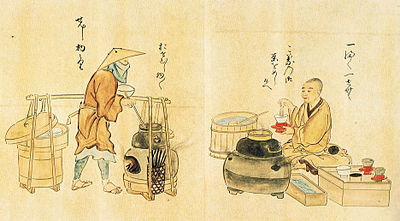
Illustration of tea ceremony from 17th century Japan

So far, so good (and a valuable rejoinder to most anthropologists, who seem to have carefully trained themselves to be unable to recognize the non-animal reasons people do things). He continues his treatment of the merely animal aspect of sex thus:

Giving pleasure is not the end of sex, not that for the sake of which sex exists in animals. Rather, sexual pleasure has as its own natural end the getting of animals to engage in sexual relations, so that they will procreate. … So, sex in animals exists for the sake of procreation, and sexual pleasure exists for the sake of getting them to indulge in sex, so that they will procreate. And we’re built in such a way that sexual arousal is hard to resist and occurs very frequently, and such that it is very difficult to avoid pregnancies resulting from the indulgence of that arousal. The obvious conclusion is that the natural end of sex is (in part) not just procreation, but procreation in large numbers. … Apart from the Aristotelian jargon, everything said so far could be endorsed by the Darwinian naturalist … whether or not such a naturalist would agree with the moral conclusions natural law theorists would draw from it.2

A plausible assertion. But not, I think, quite so certain as Dr Feser believes. Permit me a brief zoölogical detour.

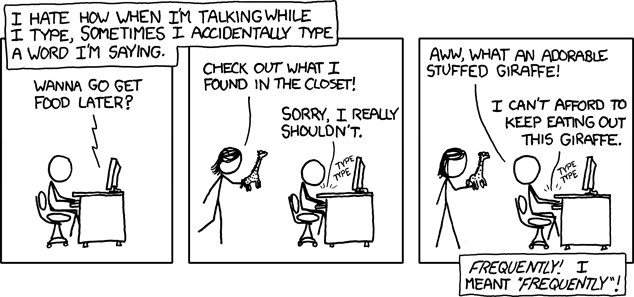
As I mentioned in my first post of this series, homosexual behavior is well-known in the animal kingdom, and in some species, such as giraffes, is far more prevalent than heterosexual behavior. Bonobos form a particularly interesting case, since (along with chimps3) they are the living primates most closely related to humans: 60% of all sexual activity among bonobos is lesbian, and sexual activity, of whatever kind, is frequently used to defuse tension and reconcile after conflict. Now, the mere existence of homosexual behavior among animals really isn’t a threat to Natural Law Theory; the idea is not that whatever happens is natural, but that there is a pattern built into nature by its Creator, and deviations can be measured from that pattern, not just by man-made convention. But—I may be mistaken, and if so I’m sure a Natural Law theorist or six will emerge from the æther to correct me—the normal test proposed for finding out what’s natural is to look at what effect nature usually brings about. And if, in at least some cases, sex appears to have far more to do with social bonding than with procreation even on a strictly animal level, and that among some of our closest animal relatives—well, it rather sounds like the Natural Law theorist has some mansplaining to do.


That said, one of the basic tenets of Catholic Christianity is that we live in a fallen world: i.e., a world that does not wholly fulfill the design of its Maker, not only in being as yet incomplete, but in active distortion and corruption. No Christian, on seeing that something exists, must necessarily approve of it in principle; unlike the pantheist who considers all being a manifestation of divinity, or the Buddhist who considers the world as we know it fundamentally illusory, the Christian insists that imperfection and evil are real, and that they matter. The problem for the Natural Law theorist, then, is to sort out the design that nature (imperfectly) strives for, from the evil that diverts and weakens it, and to set forth a principle by which to do the sorting. But a simple study of what usually happens is not a satisfying technique for such sorting, because you then need another rubric for determining which results count and which don’t. I mean, does the behavior of bonobos demonstrate a legitimately non-procreative purpose of sex even at an animal level, especially given that they so strongly resemble humans, or does that not count? And if not, why not—because most other animals aren’t like that (even if a surprising number are)? Well, which animals count and which don’t, for the purpose of determining what nature usually does? Do bacteria, for whom sex is always non-reproductive?

To at least some degree, Dr Feser recognizes the epistemic4 problem here. In seeking to justify a fully Catholic moral outlook on sex on grounds of Aristotelian-Thomist philosophy, he raises some important distinctions:

Since the natural ends of our sexual capacities are simultaneously procreative and unitive, what is good for human beings vis-à-vis those capacities is to use them only in a way consistent with these ends. … It cannot possibly be good for us to use them in a way contrary to those ends, whether or not an individual person thinks it is … This is true whatever the reason is for someone’s desire to act in a way contrary to nature’s purposes—intellectual error, habituated vice, genetic defect, or whatever—and however strong that desire is. … A clubfoot is still a clubfoot, and thus a defect, even though the person having it is not culpable for this and might not be able to change it. … What has been said so far clearly supports a general commendation of confining sexual activity to marriage and the having of large families, and a general condemnation of fornication, adultery, contraception, homosexual acts, bestiality, masturbation, pornography, and the like. …

But this might still seem to fall short of establishing the absolute moral claims made by Catholic teaching. Consider a devout Mormon couple who have a large family of nine children, but who have occasionally used contraception so as to space their children evenly … It would certainly seem strained and even unjust to accuse them of having a ‘contraceptive mentality’ … insofar as their attitude toward sex is obviously different from those who regard sex as mere recreation and children as an inconvenience to be avoided. … It may also seem to have proved too much. For if it is good for us to pursue the procreative and unitive ends of sex and bad for us to frustrate them, wouldn’t it follow that it is wrong to refrain from marrying if one had the opportunity to do so? [Or that] it is wrong for sterile and aged married couples to have sexual intercourse? … If there is to be an absolute prohibition on contraceptive acts, masturbatory acts, and the like as such, even though there is no such prohibition on merely refraining from sex or on sex between sterile spouses, then there must be something about the nature of the former acts that makes them inherently contrary to the good for us[.]5


To this, modern readers—myself among them—will readily add homosexuality. For even a casual acquaintance with gay culture and people shows that we’re as likely as anybody to want children, and (to some degree) apt to lament the fact that we can’t have biological children with our preferred partner; the prevalence of both adoption and surrogacy suggest how strong the desire can be. In other words, from the point of view of intention alone, plenty of LGBT couples are in exactly the same position as infertile straight couples.

The ‘perverted faculty argument’ into which Dr Feser moves from here seems to be quite well constructed, and when I write about it I may do little more than agree with him. But the epistemic problem of how to evaluate the evidence doesn’t seem soluble to me on the Thomist axiom that Nihil est in intellectu quod prius non fuerit in sensu, ‘Nothing is in the understanding which was not in the senses first.’6 The problem with that is: how the hell do you get a standard for evaluating evidence out of the evidence you’re evaluating? I plan to deal with this problem, as best I can, in my next.

✠     ✠     ✠

1Neo-Scholastic Essays, p. 388.
2Ibid., pp. 389-390.
3Chimpanzees (Pan troglodytes) and bonobos (Pan paniscus) are very closely related to each other; evidence obtained by genetic and anatomical studies suggest that the two species only became distinct from each other about a million years ago, and that the latest common ancestor of the two split off from the hominid line (e.g. Homo habilis, Homo erectus, Homo sapiens) only six or seven million years ago. The commonality is close enough that some scientists assert that the Pan and Homo genera should be treated as one, though this is controversial.
4I.e., a problem of epistemology, the branch of thought that studies how we know things—not in the physiological sense of how information is stored in the brain, but in the philosophical sense of how we can have confidence in our premises and the conclusions we draw from them.
5Ibid., pp. 396-398.
6St Thomas Aquinas, De Veritate II.3.xix.