Collect

Collect for the Fourth Sunday after Trinity

O God, the protector of all that trust in thee, without whom nothing is strong, nothing is holy: increase and multiply upon us thy mercy; that, thou being our ruler and guide, we may so pass through things temporal, that we finally lose not the things eternal; grant this, O heavenly Father, for the sake of Jesus Christ thy Son our Lord, who liveth and reigneth with thee, in the unity of the Holy Spirit, ever one God, world without end. Amen.
Showing posts with label self-injury. Show all posts

Tuesday, May 30, 2017

Five Quick Takes

✠     ✠     ✠

I.

I haven’t forgotten my series on natural law theory and Dr Feser’s essay on the perverted faculty argument. To my surprise, I’ve found still more to disagree with in his last few pages—the range of possible thoughts is huge, isn’t it—and so I’ll be writing one last post to address that.

Chesterton probably didn’t have my sort of (ugh) lifestyle in mind when he said that the walls of Catholic dogma were the walls of a playground, but I very much find it to be true. I feel so much more at ease in a definite world, even one with aspects I definitely dislike, than I ever did as a Protestant; in nine years that delight has never gone away. Some of my optimism, not to say naïveté, about the Church has indeed gone away—heaven and earth shall pass away, but my word shall never pass away.

II.

Four months into Trump’s presidency, and and impeachment has already become something much more than the wishful thinking of the die-hard left. Time flies, doesn’t it.

III.


In my incessant quest to waste as much time as possible on Netflix, I’ve finally branched out a little from ‘Archer’ and started watching a couple of more controversial programs: ‘The Keepers’ and ‘13 Reasons Why.’ I’m only one episode into the former, so I won’t offer a detailed opinion on it except to say that so far it’s pretty good. I still haven’t finished the latter, so I will opine cautiously about it, but I will say a few things.

One is that I’m not totally seeing where the controversy over it is coming from.1 I thought about suicide every six months, at least, when I was in high school—actually pretty much through all my teen years. And so far the depiction of Hannah Baker’s life is pretty convincing. (And it must be said, the acting, script, and directing are all outstanding. The show should get an Emmy.) Both teens and grown-ups do act like that sometimes, up to and including the huge project that forms the framing device of the series. If people are concerned that watching a series about suicide might influence a teenager toward suicide or self-harm of their own, that’s a valid concern; but most works of art are ill-suited to some audience or other. It’s a reason to recommend the work judiciously, not a reason to criticize the art or the artist.

Of course, there is a far less creditable possibility: namely, that the people who feel themselves represented in the show resent the implied criticisms it makes of them. Teachers, counselors, and administrators aren’t portrayed in an altogether flattering light, including failure to respond adequately to allegations of sexual assault or notice signs of suicidal thoughts; but that isn’t exactly unknown. I don’t know if anybody at my school or among my friends or even in my family knew I thought about it. And the brute fact is that authority figures aren’t always appealing as confidantes, not because they can be intimidating but because they can be annoying.
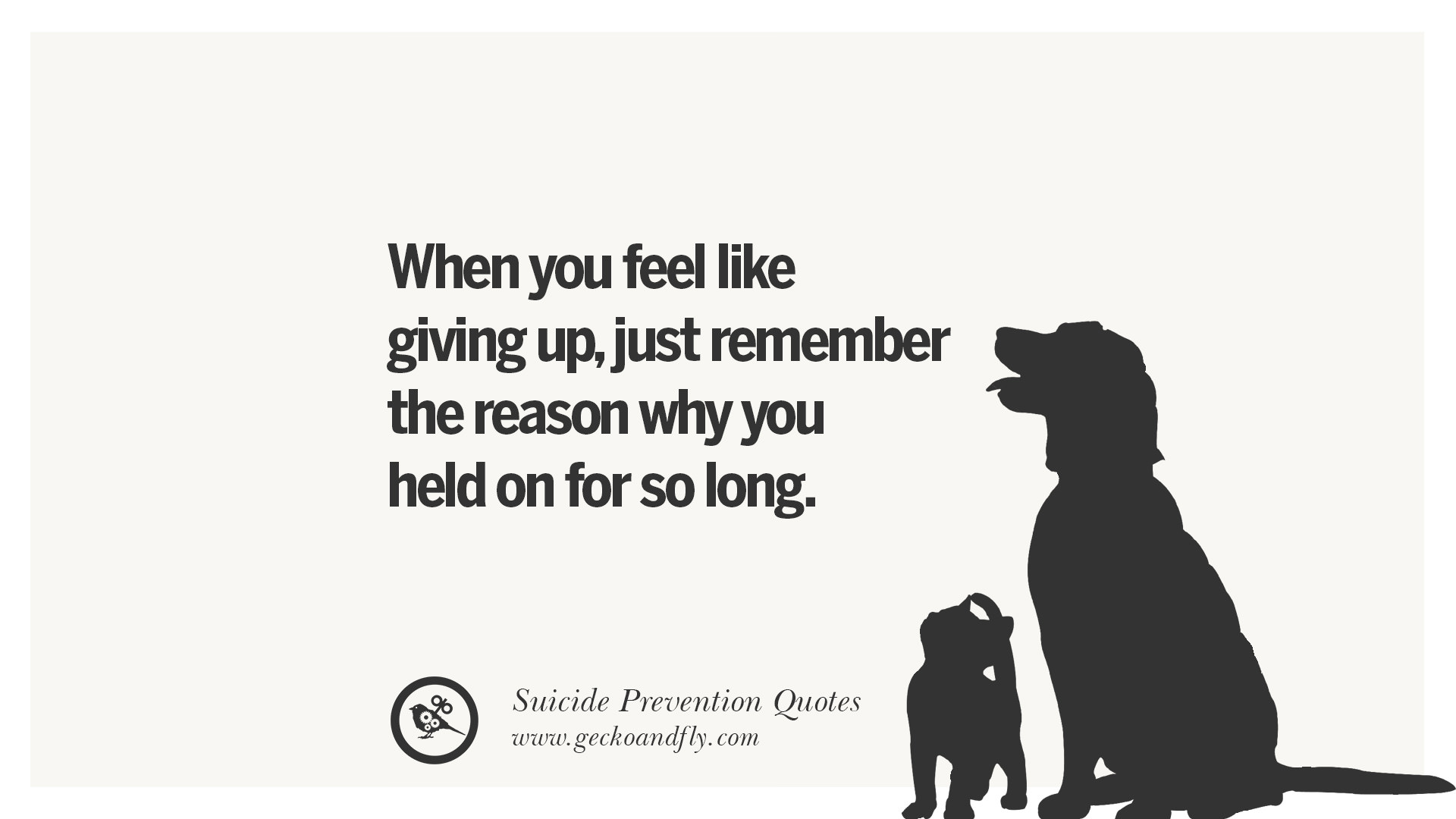

See, saying cutesy stuff like this to someone whose reason was 'I was too scared to do it before 
and now I'm not' or 'Because last time my mom was still alive' is actually a fairly shitty idea.

I know that when I was young, depressed, and contemplating self-slaughter, the ‘suicide prevention’ lectures were certainly no help. From them, I learned the correct way of slitting my wrists, and that my only hope was to traipse off to the guidance office, bare the recesses of my soul to a flaky, middle-aged woman like the one hosting the series, and put myself on happy pills. I recall sitting in the back of the auditorium, with my black skirts swirling around me like a pool, ruminating on the cluelessness of the people who had arranged the lecture series. Their understanding of my psychology, I concluded, was utterly puerile.2

And leaving school personnel aside, not every person is eager to deal with the effects their actions, even the smallest ones, can have upon others. Judging from what I’ve watched thus far, Hannah’s character kills herself over an overwhelming heap of things that crushed her, not over one thing she couldn’t endure—and not over depression or mental illness, which are often but not always linked to suicidal ideation, because people are not machines where everything will go smoothly as long as you get all the default settings right.

IV.

Most of my earliest memories were made on Fort Ord, which was cheek-by-jowl against Monterey, California, and you were never too far from the sound and scent of the ocean there. Ever since, I’ve never felt totally right when I’m too far inland—I’ve got to be near a coast, at least able to drive out and see it if I have a day off. It isn’t the same as watching the sun set, red and gold, in the Pacific, sitting on one of those big, ragged rocks on the coast of Monterey Bay, while the salt wind whips against your face; but I’ll take what I can get.


I kept telling myself last summer that I was going to make a trip to Rehoboth. Or some beach, anyway, and Rehoboth happens to be one of my favorites that’s within a day’s drive: it doesn’t have the trashiness and commercial hugeness of Ocean City, or the face-dissolving pollution of the Chesapeake (and the less said about the putrescent smell of Baltimore’s Inner Harbor the better, though I’m not above going there when I really want a fix of seaside). It’s a cozily built town, and you can find parking before you gnaw your own leg off from ennui. Fingers crossed to get out there some time this summer.

V.

Bacardi white rum sucks. I said it. I’m not sorry. Tastes like margarine. What doesn’t suck is Jameson and Grand Marnier over ice with a few dashes of Angostura bitters (kind of a poor man’s Manhattan, but without the vermouth because I didn’t feel like buying any, and without the twist of lemon because I was too lazy to cut a lemon).

✠     ✠     ✠

1Probably the silliest critique I’ve yet encountered was by a reviewer from the New York Times, who found it unbelievable that somebody would listen to the recordings made by the suicide victim slowly instead of all in one go, saying that ‘It makes no sense as anything but a plot device,’ because people only behave in one way, ever, and would never be reluctant or intimidated to hear a close friend’s explanation of why she killed herself.
2Melinda Selmys, Sexual Authenticity, p. 30.

Thursday, May 25, 2017

Absolved

It is a largesse of spirit—courtesy, generosity, humility, charity—which is seen in the corporal vehicles—say, the carnal vehicles, of the women. They define the doctrine in their gestures; the mind apprehends it. It is the same doctrine which is defined intellectually … by the Christian philosophers. What is Christianity but a doctrine of largesse? The doctrine of the Trinity is a doctrine of largesse; the doctrine of the Incarnation and the creation is a doctrine of largesse; the doctrine of the Redemption is a doctrine of largesse; the doctrine of heaven is in every way a doctrine of largesse.

—Charles Williams, The Figure of Beatrice

✠     ✠     ✠

Had a really great session with my counselor yesterday. So, I’ve done some shit that is just horrifyingly awful. I confessed (as part of my general confession when I first became a Catholic), so I have long known, rationally, that those sins forgiven by God; but letting go of the urge to punish yourself is weirdly hard.


I’ve always been annoyed by the language of forgiving yourself—I mean, forgiveness is a relational act, right? so it sounds dumb to talk about doing that to yourself, except in a sort of allegorical sense, maybe? Then again, we do relate to ourselves, don’t we. Anyway, whether forgive yourself is a silly phrase or not, it certainly expresses a truth, that it’s hard to accept God’s forgiveness. It’s easy to believe that there’s nothing you can do to wipe away what you’ve done, but curiously hard to believe there’s nothing you have to do to try. Maybe it’s our chronic fear of being taken in by something too good to be true … They have chosen cunning instead of belief. Their only prison is in their minds, yet they are in that prison; and so afraid of being taken in that they cannot be taken out.1

Point is, my counselor helped me be taken out. It was scary while it was happening, because I don’t know that I had ever been quite that vulnerable with Christ, and some of the memories I was dealing with are still sore to the touch. Surgery is scary. But I jumped in, because it isn’t like I could avoid it forever, except in hell. Better to get it over with, like vegetables at the dinner table as a child.2

It felt almost exactly like looking Christ in the face. No, in the eyes. And looking someone in the eyes and telling them about some horrible things you’ve done, in plain English, is terrifying.


He forgave. He already had, of course. But I had to tell him specifically instead of generally, because I had to see the forgiveness happening, had to have it re-presented, to credit it for myself. I don’t know if it’s my Calvinist upbringing or my ego or just run-of-the-mill neurosis, but, while it’s easy enough to repress and ignore my faults, it’s very hard indeed to believe that they’re forgiven, pardoned, by the Person whose opinion of me matters the most.

I have a hunch that this clinging to guilt has something to do with why chastity is so frightfully difficult for me. I suspect it’s not quite as simple as using sex as a direct anodyne for guilt or shame; I mean, I think I do that too, but there’s something else going on in here. (Isn’t it funny that we live with ourselves literally all our lives, and yet find our minds and feelings so mysterious? It’s so Lost In the Cosmos.) My impulse toward self-destructiveness does seem almost that simple, an attempt to restore psychic balance through self-punishment.3 Chastity per se, though … there’s an anguish in it that I don’t think can be explained merely by the frustration of a self-destructive impulse. All the same, I think my interior universe got a little more harmonious, which I hope will make things a little easier—at least to understand, and maybe to do as well; though in writing that I can’t help but think of Jesus’ strange saying, If any man do his will, he shall know of the doctrine. Who knows—maybe that comes next.


✠     ✠     ✠

1C. S. Lewis, The Last Battle, cap. XIII: How the Dwarfs Refused To Be Taken In.
2My unofficial motto for the last twenty-five years has been This is gonna hurt. I’m not a super healthy person, if you hadn’t already gathered that from the everything about me.
3That doesn’t work, it turns out.

Monday, August 17, 2015

The Dazzling Web of Homoerotic Desire

Trusting someone is maybe the scariest thing in the world. Getting to know somebody isn't scary, at least not usually, and once we know somebody it's a lot easier to trust them; but that's because trust means, precisely, relying on them for something (whatever it may be) that we don't know about and can't control.


Seems reliable.

Once we know a person, we feel able to predict their behavior, and that makes the step across a dark chasm that trust consists in much easier to take -- it shrinks the chasm, so to speak. But there's always an element of uncertainty and powerlessness involved; you're always vulnerable. It's tempting, on that basis, to trust nobody at all; until you meet someone who's made a serious attempt at living like that. Trusting other people is something we flat out need to do as human beings, or we become psychically sick.

The same, on Christian premises, is true of God, and indeed infinitely truer of Him than of any other being. To trust Him, whom we cannot hear or see or touch save by miraculous intervention (and, as the word miracle implies, such events are rare), is a more threatening and blacker jump than any other; and what's worse, making a decision about Him isn't optional. In deciding not to trust this or that fellow human, you can make an unfair or unwise decision, of course, but refusing to trust one person doesn't necessarily mean you're trusting nobody -- there are always other people you can rely on. But there's only the one reality-as-a-whole, and only one God that keeps it all going. The only alternative to being is nothingness. The only alternative to trusting God is to have nowhere, in all of existence, to flee to.

That's what Catholicism has confronted me with as a gay man, trying to come to terms with what I believe about sex. Because I believe that a God is the best explanation of the universe, that Jesus is the best explanation of God, and that Catholicism is the best explanation of Jesus, I accordingly believe that what the Church teaches about sex -- specifically, that it must never be closed to the possibility of bringing new life into the world, and that acts which can't do that are therefore a wrong use of our sexuality. So my brain, and (to a much lesser extent) my will.

But my heart just isn't there, as I've often written of here before; and I'm left with one foot on either side of an impossibly wide, terribly deep crevasse, with no ground in sight, being pulled into pieces by the tension. I could never deliberately contradict what I'm convinced is true (although I'm quite capable of ignoring it), and so I can't draw the one foot backward over the crevasse; and yet it seems utterly impossible to pick up the other and pull it to the far side -- that if I do, I'll slip and fall and go spinning down into the void, helpless. That God won't catch me.


There are so many things that make this a challenge: it's difficult enough in itself, for fallen creatures like ourselves, to believe that God knows and loves us (sometimes it's far easier to believe one of the two than both together ...), and our lived experience of hurt and confusion only makes it tougher. Dealing with clinical depression, severe loneliness, cutting, and eventually rape, all before I turned fourteen, made it the next thing to impossible to credit the doctrine that God wanted what's best for me and was willing to sacrifice Himself to give it.

I do believe -- partly because my intellect is satisfied, and for somebody like me there's quite simply no way around that; partly because, even on a heart level, I'd sooner believe (as Christianity and especially Catholicism teaches) that my sufferings have a meaning that I don't understand, than that they mean simply nothing.

But on the other hand, emotionally, I can't make sense of Catholic teaching here. I mean, it's not as though it was my idea to be gay, or to make homosexual sex intrinsically infertile, or to link sex with fertility, or ... and at once, my brain retorts, The woman whom thou gavest to be with me, she gave me of the tree, and I did eat. And then, more dimly, Who is this that darkeneth counsel by words without knowledge? Canst thou bind the sweet influences of Pleiades, or loose the bands of Orion? I can't see much of a future in arguing with God about His unfairness in structuring reality as He did, since I can hardly calculate the consequences even of my own actions within that framework -- let alone what would happen if it were altered.


Don't say I didn't warn you.

But it isn't only a question of a rebelling heart -- that, certainly, but there's far more at stake. Seeing a beautiful man doesn't just get me going sexually; it's awe-inspiring, even humbling -- it evokes joy and glory and gratitude, not just arousal, still less objectification. Homosexuality is no more reducible to lust than heterosexuality is reducible to lust. Much of the Western literary tradition, particularly Dante, has been about that moment of love in which a man perceives a woman like a flash of magic; there are, equally, moments in which a man can perceive another man like a flash of magic.

This seems to me to be, for most people, causally connected with sexual desire, though it is certainly not the same thing as sexual desire; it's more like veneration. (This is part of why I'm content to refer to eroticism, and homoeroticism in particular, as capable of sanctification -- I don't think eros is simply about sex, and definitely not simply about sin.) I tend to think of it as seeing, with the eyes of the heart, the archetypal nature that every created, imperfect thing is striving to be; its ideal identity in the mind of God, which it partly reveals and partly falls short of in the reality that we're most familiar with. The erotic vision is a vision of another plane of reality: no more real than the actual beloved, but also no less. Love is blind because it is dazzled by this archetypal light. Love is always Platonic.

And I don't, won't, can't believe that this delight in male beauty is a bad thing. To take joy in something God has made and to say with Him, "Behold, this is very good," is right. It may be entangled with other things that aren't right, as all our love and obedience for God is entangled with self-interest; but this veneration of masculine beauty is a good thing. His glory is not reserved to woman, but seen equally in both sexes.

But it's this disentangling of the bad and good that is so difficult. The web of homoerotic desire doesn't consist in a single thread woven around itself, but in a multitude of threads -- sexual, romantic, affective, maybe even spiritual -- that cross and countercharge one another, morally and mentally. It's like all human sexuality, really: it's complicated.


The Lady of Shalott by William Holman Hunt, 1905.
"And there she weaves by night and day / A magic web, with colors gay ..." -- Alfred, Lord Tennyson

That's the chasm. That's where trust comes in. Do I really believe that God, who knows my heart and loves me -- start again. First, do I believe that God knows me and loves me? And second, do I believe that, for every good thing He asks me to renounce, whether it be companionship or sexual fulfillment or children or whatever else, its crucifixion will be followed by a supernatural resurrection?

The simple answer is, no, I don't believe those things. Not with my heart. I acknowledge that they are true, but that isn't really the same thing. I'm just so scared of the loneliness, the uncertainty, and the feeling of purposelessness that go with my shabby attempt at celibacy. I can't really tell whether all this is why I don't trust Him, or comes from not trusting Him.

Nor do I know my way out. I mean, Jesus is the way out, I know that -- but I don't know how to be with Him or in Him in a way that results in me trusting God. (Not that I haven't been told, a hundred times, mostly by people who so far as I know haven't been in the same difficulties themselves.) I can't think of anything to do but watch and pray; I can't open my heart by myself, and I have no idea when He will. That does call for trust. It's scary, and it's tiring. But where would I go? Back is not an answer for me; it's a non-solution, a shrug, a declining of the problem. And I just can't bring myself to do that. Whether it's stubbornness or divine grace or insatiable curiosity, I just can't. It isn't onward, or stop, or backward. It's just onward -- with no knowing what that will consist in.

Time for a nap.

Monday, November 11, 2013

Defiled

Though I've mentioned it briefly before, this was a really hard post to write. Warning: it contains language and subject matter that may be triggering for people who've experienced traumas. To make myself feel better, and probably alienate my readers in the process, I will be interspersing inappropriately amusing photographs.


It's my defense mechanism.

For forty minutes I've been sitting here, and I've written two sentences. Wow. Okay. There is just no good angle from which to tackle this, is there. This is kind of disjointed.

When I was an adolescent, I was raped four times.

Talking about it doesn't make you feel better, but not talking about it is like living in hell.

The thing about rape is that it shatters your psyche. It isn't just a physical violation, it's a violation of every level of your personhood at once. Emotional, sexual, relational, spiritual.

The first time, I was a thirteen year old boy. He was eighteen or nineteen, I think. It was on a church trip. Nobody knew, for years.

The church didn't do much when they found out, years later, three more rapes later; asked him to leave the congregation. I don't think they did anything else. I'm not sure why: afraid the scandal would hurt the congregation, maybe, or hurt me. Perhaps they wanted him to have a chance to repent. It's a damn shame that forgiveness and indulgence get confused so often. There's no inconsistency in forgiving a man and still demanding that he be disciplined.

For a year after that, I believed there was no such thing as free will. At the time, I thought it was just the logical outworking of my Calvinism, and it was. But it was also a reaction. I didn't want there to be a me that that had happened to; but if it happened to a thing, a puppet, that wasn't so bad. Looking back, I'm stunned at my own callousness.


On the credit side, that is a beard for the ages.

I started thinking about killing myself when I was fourteen. I was too scared to do it, but I fantasized about it for hours at a time. The thought recurred every few months at least, until my conversion to the Catholic faith. I've never seriously entertained the idea since.

The second, third, and fourth times were when I was sixteen. They stopped because we were caught. I got yelled at, twice, the second time by my therapist (not the therapist I have now). I felt I was to blame; no one told me any different.

I started cutting after that. It lasted for maybe a year. I think I only told two people; I gave my pocketknife to one of them. I pretty much quit after that, barring an episode when I was twenty, shortly before converting, where I beat myself against a brick wall, after hearing a talk about chastity at a campus ministry I was involved in.

I still have a very complicated relationship to touch. It's my primary love language; I crave it like I crave water when I'm thirsty. And yet, if I'm touched unexpectedly, I jump as if I've been shocked. I think this, far more than being gay, is also a root of my ambivalence about sex.


I don't know why it's from Star Trek, just go with it.

The thoughts I had about myself -- self-hatred is weirdly addictive -- would be unreadable if they weren't indescribable. Even recollecting some of the words makes me almost dizzy: filthy, ugly, piece of shit, worthless, disgusting, slut. I remember once thinking vindictively of myself, after a cutting session, There, the outside matches the inside.

All this is part of why Victor literally saved my life. Without trying to, and without knowing he was doing it. He actually believed that God loved people, and he showed me love -- and this is important -- without thinking about it. It was just the natural thing to do, as far as he was concerned. The idea that I could be -- was -- an object of love ... I can't describe the change.

The same thing, curiously, has happened again over the past couple of weeks. I'm not sure why, but I've awakened recently to the fact that there are people in my life who, for whatever reason, give a shit about whether I live or die, and are not always secretly waiting for me to get the hell out so that they can have a relieving break from my presence. The thing is -- and this will probably sound strange to my sane readers, if there are any -- that concept blows my mind. The idea that somebody would want me around, me the person, is so alien to my mind that, most of the time, I literally can't believe it.


Please note that, as grateful as I am both for love and the power to accept it, this still applies. Sorry for any mixed signals.

Being raped turns you into a thing in the most degrading sense: sex, which is supposed to be (among other things) perhaps the most intimately personal act of embrace, is made into a vehicle for predation, for using someone like a thing and throwing them away like a thing, treating their very personhood as if it didn't exist. You're wanted exclusively for your physical mechanics.

In a way, this confirms my rejection of ex-gay theory twice over. My homoerotic desires and impulses predate the rapes, for one thing; for another, if this were really the formative influence, then frankly, ex-gay stuff should have worked for me, and it absolutely didn't.

Why talk about it? In my experience, and in that of the handful of other victims I've known, being able to talk about it is a prerequisite for survival. That which is not acknowledged cannot be healed. And seeing someone else talk about proves two things: first, that survival is possible; and second, that it can be talked about -- there are safe people in the world, people who get it.

In addition to that, the responses I've sometimes heard (secondhand -- I've been spared most of these, thank God) leave me flabbergasted by their heartless stupidity. Blaming the victim for being manipulative or provocative? Yeah, because kids are sexually alluring all the time, and they certainly understand the gravity of the situation, which is why it's their responsibility and not that of the adult.


Neil Patrick Harris, on the other hand, I make no apology for.

Saying to just forgive it and move on? Forgive, absolutely, but there is no such thing as just forgiving: Christ didn't just forgive His executioners; He forgave them. That is an act of heroic compassion, powered by Divine grace -- that is, by the life of God, manifest in us. And as for moving on, what the fuck kind of advice is that to give somebody who has to grieve their own innocence? If I can trust my own experience, you don't move on, you pick up the shattered pieces of your psyche and build a new one. And that takes years. And the task defeats some of us.

Talking about it can help restrain some of the idiotic, cruel replies some people make. I tend to think a lot of those replies are fueled more by the fact that the subject makes people uncomfortable than by anything to do with wisdom or charity. If there's one thing everybody seems to hate, it's not knowing what to say; and when it comes to this, a lot of people don't know what to say. Which would be fine, if it were admitted.

Not least because a lot of times what we need is not advice, but just someone there with us, showing that they don't think we're a thing and they don't think we're ugly. That we're wanted, and worth wanting.


And if touch as a love language doesn't come naturally, just pretend that we're in an adaptation of a Stephen King novel that inexplicably doesn't seem to take place in New England, and you need to reassure yourself that reality is still there. But try not to think about the leech thing.

Sunday, September 22, 2013

Music: mewithoutYou

I am now back. But I don't feel like blogging tonight and it's getting late anyway, so I'm going to post some angsty beautiful music instead.

I discovered mewithoutYou through a friend of mine, and listened to their song O, Porcupine about a dozen times asking myself "Do I like this?" and being genuinely uncertain of the answer. Eventually I concluded that I did, and have acquired a slightly broader taste since then in their odd genre of underground indie hardcore alternative folk punk (for lack of a better way of describing it). This particular song, Carousels, from the album Catch For Us the Foxes, is one of my favorites; it exhibits their remarkable lyrical blend of intense, depressive darkness and suffering with an equally intense -- even perhaps mystical -- spirituality. It is, to my mind, head and shoulders above most contemporary Christian music, if only because it doesn't follow the cookie-cutter Shiny Happy People pattern that most Christian music does (which is done well by some groups, like Hillsong, and extremely poorly and/or with insufferable cheese by others who shall remain nameless).


On a bus ride into town
I wondered out loud
"Why am I going to town?"
And as I looked around
At the billboards and the stores
I thought "Why do I look around?"
And I kissed the filthy ground
The first dry spot I found I laid back down
And I didn't have to wonder
Why I was laying down

Before long I was too cold
Took a bus back to the station
And I found a letter left by a payphone
With no return contact
And it read like a horn blown by some sad angel
"Bunny, it was me
It was me who let you down"
It was the shyest attempt
I'd ever seen at conversation

But if I didn't have you as my guide I'd still wander
Lost in Sinai
And counting the plates of cars from out of state
(How I could jump in their path as they hurry along)
You surround me
You're pretty but you're all I can see
Like a thick fog
If there was no way into God
I would never have lain in this grave of a body for so long

And Bonner Fair always came through
The first week of September
But it's already the nineteenth
And there's no sign of it
Yet I have a hard time
Remembering all the things I should remember
And a hard time
Forgetting all the things
That I'm supposed to forget

Christ, when you're ready to come back
I think that I'm ready for you to come back
But if you want to stay
Wherever exactly it is you are
That's okay too
It's -- it's really none of my business

But if I didn't have you as my guide I'd still wander
Lost in Sinai
Or down by the tracks watching trains go by
To remind me there are places that aren't here
And I had a well
But all the water left -- I'll go ask your forgiveness
With every breath
If there was no way into God
I would never have lain in this grave of a body
For so long, dear

Monday, May 13, 2013

All Roads Lead To, Part III: The Monster In the Dungeon

Go here for Part I, and here for Part II.

While my mind went its way through intellectual labyrinths, there was also a horrible secret inside me. I kept it as secret as I could -- notwithstanding a few people's accidental discoveries of it.

I had been anticipating adolescence for years before it arrived. I was excited at the prospect of falling in love, getting married, raising a family; I wanted a lot of kids. The pageantry of the wedding was an exciting thought, too; which might have tipped me off, if I hadn't been so generally odd anyway.* But when adolescence did arrive, my interest in girls was minimal even at its highest ebb, and even then it was emotional, not sexual -- indeed, when I learned about sex, and when I looked at girls as a teenager, I was nonplussed that other guys were apparently so thrilled about this. Good for them, I supposed, though not without twinges of jealousy that they were in on a secret I couldn't understand. What happened to me was a slowly flowering interest, one that abruptly burst into an overpowering, intoxicating bloom, in those other guys. I didn't grasp what it was at first; for a brief period I wondered whether it was a private idiosyncrasy -- perhaps it was rather funny. Perhaps it was quite innocent.

But it wasn't long before I had learned -- without deliberately revealing my quirk to anyone -- that it was a dangerous, horrible, wicked thing. Something to be disgusted at and ashamed of. Something punishable, in the Scriptures, by death.

So I shut that monstrosity in a dungeon, deep in the recesses of my heart. It was very accessible; I visited the monster daily, fascinated as I was by its appearance. Fascinated, too, by why it was a monster, which I didn't understand. But I was the only one with the keys. I unlocked it for visitors, on a very few occasions; but the monster was to be kept out of sight, while I sent my intellect as a knight-errant to find some way of breaking the spell that was, evidently, upon it, to turn it back into a person. God only knows how ferociously I searched for a cure. I was in counseling for that very purpose (among others) for three years; I read every book I could lay my hands on, which wasn't very many, and those were remarkably poor. Once I got to college, I dabbled in Exodus, the famous ex-gay ministry** run by Alan Chambers; I attended seminars at retreats; I immersed myself in prayer and the Scriptures and accountability groups and devotionals.

Changing from gay to straight didn't happen. What did happen was an increasing, devouring hatred of myself. A lot of people told me that the problem was "identifying as gay," but it wasn't. Mere vocabulary was not what was making me scared to be alone, because I might fall; what was making my face hot with shame and self-disgust, whenever I saw a guy who was even moderately attractive; what made me take a knife to my flesh, because I was such a repulsive thing; what made me hope that God would kill me in my sleep.

And then I would wake up, morning after morning. Still me. Still gay. And I'd swallow the bitter disappointment of being alive, and brace myself for the restless anguish that the next eighteen hours were going to be. All that before even getting out of bed.

No, it wasn't because I was using the word gay. It was because of the church.

Note that I say church, not Church: the latter I use specifically of the Catholic Church, and I don't hold her peculiarly responsible. Note also that I say church, not doctrine: I don't know that my difficulties stemmed from the mere belief that gay sex is wrong. But the actual conduct of Christians -- I don't even know what was worst. The universal assumption that everybody either was, or could become, straight, and that the only fate anybody needed preparation for was marriage? The vitriol, repeated in every magazine, every pamphlet, every conversation it sometimes seemed, directed at The Gays And Lesbians? The categorical (and, to me, still baffling) hostility to coming out of the closet, up to and including punishing us when we did -- bizarrely combined with an almost technical pity applied to homosexuals, within or without the church? They're so brave to leave The Lifestyle, someone might say; and then, almost in the same breath, Can't Those People see how disgusting it is? And then the stereotypes of masculinity and effeminacy, the AIDS statistic scare tactics, the arguments linking homosexuality to drug abuse and pedophilia and suicide. Was any of that supposed to be helpful? With all that piled on them -- that's what people like you are like -- who wouldn't daydream about working up the nerve to swallow a bottle of sleeping pills, or cut their flesh because the physical pain was a welcome and relieving distraction from the incessant psychic pain of being a pervert?

Why couldn't You just leave us alone? I thought, over and over; at times I think so still. We aren't hurting anybody. We just want to be left alone.

The church fell down on the job. What should be one of the safest places in the world for a hurting, scared teenager to simply tell the truth, has become the one of the most terrifying, and everyone knows exactly why. Or if they don't, they should.

What has any of this got to do with my conversion to Catholicism -- and not only that, but my predilection for traditionalism? Well, a wise priest I know has pointed out that the superabundance of damask and lace at traditional Masses could hardly be expected only to attract heterosexuals.

Nothing fabulous about this.

Yet there is more to it. As usual, I will go into more detail later. But for the present, the chief thing is that this is the person God is working upon. And, I'm sorry, a person's sexuality is inseparable from who they are. It doesn't constitute their identity, true; but to treat it as though it were an extraneous quality is not just insulting, it's deeply damaging. It implies that their most powerful passions and affections are at once filthy and insignificant. Bad or good or indifferent, the one thing that gayness can't be is unimportant. You can say our hearts need fixing; but this is still how they beat.

*Besides, I dare say a lot more heterosexual men than would care to admit it are excited to have the wedding they've been dreaming about ever since they were little girls.
**Famous, or at any rate notorious. I did not know at that time that Michael Bussee and Gary Cooper, two of the ministry's founding members, had left the group (and their wives) to be with each other only three years after Exodus was founded; nor that John Paulk, another once-prominent member, was caught at a gay bar in 2000. Paulk has recently made a public apology for his involvement in ex-gay programs; Cooper and Bussee have also become decades-long critics of Exodus since their departure. Chambers himself has shown a marked withdrawal from orthodox ex-gay thought in recent years, even drawing fire from other prominent figures in the ex-gay movement, such as Anne Paulk, Joe Dallas, Andy Comiskey, and Dr. Robert Gagnon.