Collect

Collect for the Fourth Sunday after Trinity

O God, the protector of all that trust in thee, without whom nothing is strong, nothing is holy: increase and multiply upon us thy mercy; that, thou being our ruler and guide, we may so pass through things temporal, that we finally lose not the things eternal; grant this, O heavenly Father, for the sake of Jesus Christ thy Son our Lord, who liveth and reigneth with thee, in the unity of the Holy Spirit, ever one God, world without end. Amen.
Showing posts with label heresy. Show all posts

Thursday, May 9, 2019

Antifascism 103: Chinks in Catholic Armor

I had not forgotten my promise to consider whether we should make the patient an extreme patriot or an extreme pacifist. All extremes except extreme devotion to the Enemy are to be encouraged. … Any small coterie, bound together by some interest which other men dislike or ignore, tends to develop inside itself a hothouse mutual admiration, and towards the outer world a great deal of pride and hatred which is entertained without shame because the ‘Cause’ is its sponsor and it is thought to be impersonal. Even when the little group exists originally for the Enemy’s own purposes, this remains true. … The attitude which you want to guard against is that in which temporal affairs are treated primarily as material for obedience. Once you have made the World an end, and faith a means, you have almost won your man, and it makes very little difference what kind of worldly end he is pursuing.
—C. S. Lewis, The Screwtape Letters
✠     ✠ ✠


CW: White ethnonationalist/neo-Nazi ideology and language.

This series hasn't yet addressed a different urgent question: why do Catholics keep falling for authoritarian nationalism?

And I do say keep falling; it's been a historical trend for a hundred years minimum. Mussolini’s Italy, Franco’s Spain, and, yes, Hitler’s Germany were all obtained with either the popular and general support of Catholics, or without effective resistance from them whether grassroots or institutional. Catholics like to cite the strong Catholic presence in the many resistance movements of Europe and the efforts of Bl Pius XII to mediate a peace; and we remember with well-earned pride Catholic heroes of both spiritual and material resistance like St Edith Stein, St Maximilian Kolbe, Hans and Sophie Scholl, Erich Klausener, Charles de Gaulle, St John Paul II, and Colonel Klaus von Stauffenberg. But that pride of resistance was earned by them, not ourselves; and we must also blush for the criminal short-sightedness of Franz von Papen, the ineffectual self-interest of Ernst von Weisäcker, and, yes, the errors and miscalculations of Bl Pius XII and of Catholic bishops throughout Europe.


There are several reasons for this vulnerability, and I expect I don't have a handle on all of them. But I believe the following causes contribute:

1. Catholicism has historically been at odds with political Liberalism. The sixteenth and seventeenth centuries had been plagued with wars over religion; taking the Peasants’ Revolt as the first outbreak, and the final defeat of the Catholic Stuart cause in Britain as the last, we could say that wars over which version of Christianity should triumph in Europe lasted, intermittently, from 1524 through 1746: two hundred and twenty-two years. Small wonder that people would want something other than religion to occupy their minds and their passions alike. As Charles Williams caustically remarked: As a virtue toleration does not yet exist, though we once thought it did. Our fathers became bored and miserable and decadent through their incessant killing, and we, the children of that killing, supposed ourselves to be convinced of charity, when, in truth, we only shuddered still at the memory of blood. [1]

The more tolerant forms of Liberalism took root in America, where pluralism was increasingly the ideal; but in Europe, Liberalism came to be defined principally by the French Revolution, whose Voltairean maxim—Écrasez l’infâme—was aimed at the Church's very existence, or at least her existence as an institution of political, social, and cultural importance. Charles Carroll in the United States, or G. K. Chesterton in Great Britain [2], could afford to be tolerant Liberals: the martyrs of Compiègne enjoyed no such luxury. Given the European situation of the papacy, it is no surprise that their outlook on Liberalism should have been, at warmest, suspicious and defensive.

But one of the results of this suspicion has been that many Catholics (especially traditionalists) are, at most, little interested in protecting the structures of any democratic society. The most romantic would like to thoroughly revive the Mediæval order, complete with not only a territorially sovereign Pope but a Holy Roman Emperor in subservience to His Holiness; others, less idealistic but equally convinced that the state should take responsibility for the moral formation of the populace, are content to advocate for a state that is explicitly and officially Catholic, and therefore prepared to abrogate freedoms of the exercise of religion, of speech and the press, and of assembly—not abolishing such things, exactly, but restricting them to religious, political, and ethnic minorities that already exist (and seeing to it that those minorities don’t get any bigger). This would, to their minds, not only effect a far more just and pious society; it would also effect many conversions—and the fact that many of them would be rather insincere conversions would hardly matter, because the sacraments work of their own power rather than through man’s belief in them [3], and people have a very great tendency to become what they are pretending to be besides, so that a Catholic state would in fact be an instrument for saving souls. Traditional-minded Catholics are by no means all of this mindset, but it does exist.

And white nationalism panders to it. Nationalists don’t care about Catholicism, traddie or otherwise, any more than anti-Liberal Catholics care about democracy [4], but nationalism offers these Catholics a lot: a way to be visibly patriotic (and thus mainstream rather than ghettoized) without subscribing to Liberal ideas about what the state is; a role in a movement that professes traditional, family-centered values (the race needs children and values mothers); a position as members of one of the seminal institutions of Western culture; even, maybe, a chance to convert an authoritarian nationalist government, and thus realize their dream of an officially Catholic state.


2. Catholicism and nationalism both recognize the value of culture and heritage. They qualify this recognition, in differing ways: Catholicism does so by subordinating every culture (at least in theory) to divine revelation, while white nationalism does so by first equating culture with race, and then ranking races from best to worst. But they share something that, to be blunt, neither Liberalism nor its godchild the modern Left are very good at recognizing: the beauty and value of the past. A great proportion of Western past, including a lot of our most magnificent and recognized art, is Catholic, which makes Catholic heritage (if not actual Catholic faith) a nice talking point for ethnonationalists who want to coöpt it. Moreover, legitimately Catholic emphases upon tradition and continuity in institutional authority, and upon the legitimate role of culture in how religion is expressed, along with the teaching that states do have a right to preserve their own existence and heritage, are easily manipulated by white nationalist conspiracy theories—especially since Catholics have a long history of troubled relationship with the Jews, often taking the form of blatant anti-Semitism.

It is certainly true that the past must be considered critically, and that is arguably the special talent of the Left. But nobody likes being criticized, even when their critics are not smugly judgmental about it; and smug judgment is arguably the besetting sin of the Left, as it is frequently the besetting sin of anybody who has good reason to be confident in their convictions. And we are so awash in patriotic myth—accurate and fabricated, innocent and corrupt, subtle and overt—that there are things to critique about America at practically every turn. Which then makes it easy for the contemporary fascist to paint all criticisms of America, or of the West, or of those aspects of Catholicism that are susceptible to an ethnonationalist slant, as nothing more than biased, whiny, ungrateful attacks on our whole culture.

3. In the last fifty years, the Republican Party has made a strong and largely successful effort to siphon the Catholic vote away from the Democratic Party. This would be insignificant in itself; except that the GOP, as the conservative voice in American politics, was inevitably going to be where racists threw their caps when civil rights reforms went through in the 50s and 60s. [5] The siphoning happened, of course, due to Roe vs Wade and the subsequent addition of the abortion rights plank to the Democratic platform—since, before then, while abortion had been a topic of political discourse, it hadn’t been a specially partisan issue (much as, say, neither Democrats nor Republicans in our day have taken up a party-wide stance on the independence of Puerto Rico).

The GOP’s decision to paint itself as the pro-life party was a stroke of cynical brilliance: brilliance, because that alone has kept a large proportion of Catholics loyal to them at any cost due to the Church’s insistence that every human being has the right to life, and despite the fact that Catholics were overwhelmingly Democrats before 1973; and cynical, because, while sincere pro-life politicians really have no option but to coöperate with the Republican cause due to the Democrats’ implacable pro-choice stance, pro-choice Republicans are a commonplace, and they can still win Catholic votes because the GOP is always dangling the carrot of maybe-they’ll-go-pro-life-one-day (or at least, the parsnip of they-won’t-introduce-bills-expanding-abortion-rights) in front of them. Cynical, too, because Republicans are reliably opposed to other aspects of a holistically pro-life approach to issues like the death penalty, and because they widely resist laws supporting access to the things that make life possible, like a living wage and universal health care—causes which the Catholic Church has also supported in no uncertain terms.

But all this just sets the stage. The massive shift of Catholics from a staunchly Democratic bloc to one split about evenly with Republicans, means that Catholics of all stripes and especially conservative Catholics have been rubbing shoulders with the racist and ethnonationalist elements that also cling to that party (GOP, to whom shall we go? thou hast the words of political clout). Which in turn means that the ethnonationalists have far more opportunity to introduce the Catholics to points 1 and 2 above, as well as point 4 here.


4. The sidelining of traditionalist Catholics within the Church. I am not here saying whether sidelining traddies is good or bad. But I do think it can be said that it’s a fact. Liturgical and pastoral reforms, such as the decisions of the Second Vatican Council largely consisted in, always have their sincere opponents, and the hierarchy is generally ill-at-ease even with the most moderate and conciliatory of them. The self-styled conservatives of the Quartodeciman, Montanist, and Donatist movements all threatened (or were held to threaten) the unity of the Church from the earliest centuries of her existence, and liturgical conflicts contributed not only to the Great Schism of 1054, but to several later fissures within Orthodoxy, and at least one major rift that lead thousands of Eastern Catholics to leave full communion with Rome for the Russian Orthodox Church. It is, therefore, understandable that Catholic bishops of the last fifty years should have been wary of all devotees of the Usus Antiquior, however firm their protestations of Catholic fidelity.

And the brute fact is, not all of them have protested Catholic fidelity with much firmness. Schismatics like the Society of St Pius X, or the authors of the damagingly misinformed and insolent letter being shopped around by LifeSite accusing His Holiness of being a heretic, are only the tip of the iceberg. There are fanatical Latin Massers who deny that the Novus Ordo is a valid Mass, sedevacantists [6] who claim that every Pope since Bl Pius XII has been an impostor, and a veritable conclave of traddies who seem determined to not only excuse but canonize Catholic anti-Semitism and the Feeneyite heresy. Keep that sort of company and a lot of people are going to look at you funny.

If I may make an aside. As an Ordinariate member, I don’t know whether I’m quite eligible to be considered a traddie myself. But for what it’s worth, I certainly prefer the austere beauty of the Tridentine liturgy, even when celebrated poorly, to the typical celebration of the Novus Ordo with sloppy ritual, cartoonish music, and a homily that deserves to be slept through. The point is, I say these things about the traddie element of the Church because I think they need saying, not because I have any pleasure in saying them; and it bothers me that some people enjoy dunking on traddies, who, to do them/us justice, have been much exasperated.

Anyway, the point here is, many traditionalist Catholics feel shouldered aside by the Church as a whole and especially by the hierarchy. And the feeling of being at once deserted and betrayed is ideal soil for white supremacists to sow their tares. The people who are supposed to be helping you preserve this precious and beautiful thing have let you down. You’re the only ones who see it, the only ones who recognize the crisis. And we’re the ones who are on your side, who value what you care about. They treat you like the enemy because they don’t care what happens to this precious heritage; no, worse, they’re in cahoots with people who want to destroy it. We’re the ones you can trust. It’s the same temptation that practically always lures zealous Catholics, when they perceive the brokenness and corruption of the Church they have so long been confessing to be one, holy, Catholic, and apostolic: the temptation to re-apply the terms of the Creed, instead of believing it. Clarity is always easier to live with than mystery; and iniquity is a perennial mystery.


Like I said, this is not an exhaustive list. I’m sure there are other important factors at work here. But I dare say this is quite enough to be going on with.

✠     ✠ ✠


[1] The Descent of the Dove, p. 182.
[2] At any rate as of 1829, when Catholics obtained political emancipation in Britain. And though the Tudors (obviously excepting Mary) martyred a great many Catholics, the Stuarts generally preferred to live and let live outside of directly political affairs, as did the Hanovers, so that Catholics were in less danger of losing much by the hands of Liberalism than they otherwise might have done. Moreover, since the established church in England was, well, the Church of England, it was as much in the interest of Catholics as of any other religious minority to support Liberal policies, even if only cynically.
[3] This is actually an extremely ill-formed grasp of how sacraments work, but we can’t stop for a full catechesis in mysteriology right this second. For now, we must be content with this: in six of the sacraments (all but the Eucharist), the disposition of the recipient is one of the determining factors in whether it works: e.g., a person who goes to confession merely to look like a practicing member of the faith, but has no serious belief in Catholic moral or sacramental teaching, may have the words of absolution pronounced over him, but nothing objectively happens.
[4] That is, nationalists as such. There are certainly individual nationalists who care very deeply about Catholicism.
[5] I.e., I am not arguing, and don’t believe, that there’s any intrinsic connection between conservatism (whether as a philosophy or as a habit) and racism, but, in a society with a racist history like ours, people who want to push racist ideology and policy will certain use conservatism to do so. In a society with little or no racist history, people who wanted to push racist ideology and policy would most likely claim to be very modern and fashionable—whatever gets the job done, the job being mainstreaming racism.
[6] From the Latin sedes vacans or ‘empty seat,’ referring to the Holy See. (Incidentally, sedes is also where English gets the ecclesiastical term see for an episcopal seat.)

Monday, September 25, 2017

Thoughts on the Correctio Filialis

But I saw not synne, for I beleve it hath no manner of substance ne no party of being, ne it myght not be knowin, but by the peyne that it is cause of; and thus peyne—it is somethyng, as to my syte, for a tyme, for it purgith and makyth us to knowen our selfe and askyn mercy. For the passion of our Lord is comforte to us agens al this, and so is His blissid will. And for the tender love that our good Lord hath to all that shal be save, He comfortith redyly and swetely, menyng thus: It is sothe that synne is cause of all this peyne, but al shal be wele, and al shall be wele, and all manner of thing shal be wele. These words were seyd full tenderly, shewying no manner of blame to me ne to non that shall be safe. Than it were a gret unkindness to blame or wonder on God for my synne, sythen He blamyth not me for synne. And in these same words I saw a mervelous, hey privitye hid in God, which privity He shall openly make knowen to us in Hevyn, in which knowyng we shal verily see the cause why He suffrid synne to come, in which syte we shall endlesly joyen in our Lord God.1

—Lady Julian of Norwich, Revelation of Love, Thirteenth Shewing

✠     ✠     ✠


As of this past Saturday, sixty-two Catholics have signed the Correctio Filialis de Hæresibus Propagatis address to His Holiness Francis, the Bishop of Rome. In English, the document’s title is A Filial Correction Concerning Propagated Heresies. Among others, the signatories include Bishop Fellay, head of the Society of St Pius X or SSPX—a traditionalist group whose founder, Archbishop Marcel Lefebvre, incurred excommunication upon himself in 1988 for consecrating four bishops without the lawfully required permission, and in fact against the express wish and personal appeal, of the then Pope, St John Paul II. (It’s no secret that I take an extremely dim view of any and all persons who consider themselves to be literally more Catholic than the Pope.)

Nevertheless there can be valid grounds on which to rebuke even a Pope, especially since the conditions of his infallibility are actually fairly restricted. And such rebuke has precedent. Indeed, we have precedent in the first century, when St Paul took St Peter publicly to task for waffling on the discipline of the Judaizers. So it is worthwhile going through the Filialis and judging it on its merits.2

It’s a respectable enough document. It refrains from personal attacks against any person; it distinguishes with appropriate care between consequence and cause; it explicitly states that it makes no judgment about motives and degrees of culpability; and it does, as the title implies, remain filial, stating and restating the Catholic doctrine of the Holy See and asking for the Pope’s blessing at the conclusion. One of my perennial complaints about traditionalists is their readiness to condemn and to place their understanding of dogma ahead of the professed definer of that dogma, i.e. the Church defined by her communion with the Roman Pontiff, and the Filialis (as far as I can tell) avoids these flaws well, which is refreshing and laudable.


The authors assert that Pope Francis, by a combination of acts, words, and omissions, has in effect though not explicitly promoted seven heretical ideas (the text in the Filialis is in Latin, but the authors have also translated them into English):

1. A justified person has not the strength with God’s grace to carry out the objective demands of the divine law; or, God’s grace does not invariably and of its nature produce conversion from all serious sin.
2. Christians who have obtained a civil divorce and have contract a civil marriage with some other person, who live more uxorio3 with their civil partner, and who remain in this state with full knowledge of the nature of their act and full consent of the will, are not necessarily in a state of mortal sin.
3. A Christian can have full knowledge of a divine law and voluntarily choose to break it in a serious matter, but not be in a state of mortal sin as a result.
4. A person is able, while he obeys a divine prohibition, to sin against God by that very act of obedience.
5. Conscience can rightly judge that sexual acts between persons who have contracted a civil marriage, although one or both of them is sacramentally married to another, can sometimes be morally right or even commanded by God.
6. Moral principles contained in divine revelation and natural law do not include negative prohibitions that absolutely forbid particular kinds of action.
7. Our Lord wills that the Church abandon her perennial discipline of refusing the Eucharist and absolution to the divorced and remarried who do not express contrition for their state of life and a firm purpose of amendment.4

Now, as far as 2, 3, 4, and 5 are concerned, I’m bold to say that His Holiness would indeed deny those propositions. Amoris Lætitia emphasizes, repeatedly, that a revision of disciplinary practice is not a question of altering or concealing the Church’s perennial teaching, but of adapting it to particular circumstances, and of realizing that the best a person can manage may not rise to Christian perfection. The phrasing of 2 and 3 illustrates the distinction nicely: if I’m reading Amoris correctly, it’s precisely the ‘full consent of the will’ question that’s at stake, because human frailty interferes with our freedom even after baptism. That’s part of what venial sin means.

Proposition 4 is slightly ticklish, in that, while obeying a divine prohibition is of course not wrong, a person could be so entrenched in sin in some other way that this obedience could be vitiated. I've met people whose commitment to chastity I didn't doubt, but whose bitter, mean-spirited self-righteousness was so unpleasant that I think they'd have sinned less by taking a lover than by being so continually nasty. Given that the great focus of the encyclical was precisely on adapting doctrine to individuals, I think that matters. And that's the whole point of the 'law of gradualness': people can't do everything at once, and Christ does not send people away because of that.

Turning to the rest, I am not altogether sure what denying proposition 1 is supposed to mean, in the light of saints like Augustine and Paul. I don't mean this as a sarcastic remark; I mean I am genuinely unsure.

For that which I do I allow not: for what I would, that I do not; but what I hate, that do I. If then I do that which I would not, I consent unto the law that it is good. Now then it is no more I that do it, but sin that dwelleth in me. For I know that in me (that is, in my flesh) dwelleth no good thing: for to will is present with me; but how to perform that which is good I find not. I find then a law, that, when I would do good, evil is present with me. For I delight in the law of God after the inward man: but I see another law in my members, warring against the law of my mind, and bringing me into captivity to the law of sin which is in my members.5


That is, of course, not the whole story. But it is part of the story, and whenever we speak of grace making us strong to obey, we have to mean it in a way that’s compatible with, well, Scripture. We don’t believe in Calvinist impotence,6 but we don’t believe in Pelagian or Semi-Pelagian mastery, either.7

Similarly, denying propositions 3 and 6 has to be done in a way consistent with Scripture. It’s interesting to me that, when the Pharisees took Jesus to task for not preventing his disciples from picking grain on the Sabbath, rather than pointing out that their rule was kind of made up (a way-past-the-goal-post extension of not working on the Sabbath, since picking grain was like doing the work of a reaper), Our Lord instead appealed to another, more direct transgression of the law:

And he said unto them, Have ye never read what David did, when he had need, and was an hungred, he, and they that were with him? How he went into the house of God in the days of Abiathar the high priest, and did eat the shewbread, which is not lawful to eat but for the priests, and gave also to them which were with him? And he said unto them, The sabbath was made for man, and not man for the sabbath: therefore the Son of man is Lord also of the sabbath.8

An even more shocking example, which I’ve often cited here as one of the hard texts of the Bible, is Elisha’s pardoning Naaman for not only past but future idolatry in II Kings 5. These are not general pretexts to violate the laws regulating sacred things (for which, in differing ways, Uzzah and the eight martyrs of II Maccabees 7 died), nor to worship other gods even in pretense. Still less does this amount to the power to change divine law. The point is that the application of divine law to concrete situations is in the hands of Christ—and, accordingly, of his Vicar.

Which casts its own light on proposition 7. I don’t think that Amoris Lætitia says or implies that absolution and consequent communion should or can be granted to those who aren’t repentant; that would make a nonsense of the former, and a sacrilege of the latter, and would have to operate on the assumption that Amoris be read without the whole prior context of Catholic theology and canon law. But as I pointed out above, full consent can be a subtle question, and it’s no insult to divine grace to say so. Yes, God could dispense maximal grace to everybody; but we know, since only one person was immaculately conceived, that he doesn’t. Presumably he has a reason. Certainly we don’t know what it is. And also certainly we must deal with the flaws and weaknesses of mankind as they—and we—are, not only as we logically could be.


All this being said, I do hope that His Holiness replies to the Filialis. The way the criticisms of Amoris Lætitia, loyal and otherwise, are piling up strains the unity of the Church, and the fundamental task of the Holy See is to guard that unity. Pope Francis may be right, but the authors of the Filialis are correct enough to point out that it doesn’t follow that he is wise, and I admit to some worry: not about his teaching but about how he teaches it, and not because of its effect on those outside the Church (who will take anything and run with it) but about the possible mutiny of those within her (who will also take anything and run with it, even though they have a special reason not to, and far more damage comes of such behavior).

Still, eleven out of twelve apostles fell down on the job when their Master was arrested. And that turned out okay.

✠     ✠     ✠

1‘But I did not see sin, for I believe it has no kind of reality nor any part in existence; nor could it be known except by the pain it causes. And this pain—it is something, as I see, for a while, for it purifies and makes us know ourselves and ask for mercy. For the suffering of our Lord is strength for us against all this, which is His blessed will. And, for the tender love that our good Lord has to all that will be saved, He strengthens us readily and sweetly, saying: It is true that sin causes all this pain; but all will be well, and all will be well, and every kind of thing will be well. These words were said very tenderly, showing no kind of blame to me, nor to anyone that will be saved. So it would be a great ingratitude to blame or be shocked at God for my sin, seeing that He does not blame me for sin. And in these same words, ah, I saw an astonishing secret hid in God, a secret that He will openly make known to us in Heaven; by knowing it, we will truly see the cause for which He allowed sin to come, and by seeing that we will rejoice endlessly in our Lord God.’ Personally I prefer the passage in Middle English, and it is of course mostly comprehensible, but there’s just enough semantic drift to deceive the unwary reader, which makes the modern revision worthwhile.
2For those interested, the full text can be found here.
3A technical phrase in Catholic moral theology, meaning ‘in the manner of husband and wife,’ i.e. engaging in sexual relations. This is contrasted with couples who live ‘as brother and sister.’
4I have edited these propositions slightly for length, though I believe I have preserved their meaning intact.
5Romans 7.15-19, 21-23.
6I.e., Catholics don’t believe that even after being baptized, we can do nothing good: we believe that Christ’s life is infused into us, not merely drawn across us. Whether and to what extent Calvinists really believe in such spiritual impotence is a difficult question to answer, even as a former Calvinist; I never felt I got a very consistent account of it.
7Pelagianism was a fifth-century heresy which asserted that divine grace, while helpful to final salvation, was merely helpful, not absolutely necessary, and that original sin was nothing more than a bad example set by our predecessors (as distinct from a flawed moral outfit we’re born with). After some controversy, it was condemned at the Synod of Carthage in 418, and this condemnation was ratified at the ecumenical Council of Ephesus in 431. Semi-Pelagianism, while agreeing that divine grace was necessary for Christian growth, asserted that men could prepare themselves for and make the initial act of faith on their own resources. This too was condemned at the Synod of Carthage, and again at the Second Council of Orange in 529.
8Mark 2.25-28.

Friday, January 17, 2014

John 1.29-34

The next day he saw Jesus coming toward him and said, "Behold, the Lamb of God, who takes away the sin of the world! This is he of whom I said, 'After me comes a man who ranks before me, because he was before me.' I myself did not know him, but for this purpose I came baptizing with water, that he might be revealed to Israel." And John bore witness: "I saw the Spirit descend from heaven like a dove, and it remained on him. I myself did not know him, but he who sent me to baptize with water said to me, 'He on whom you see the Spirit descend and remain, this is he who baptizes with the Holy Spirit.' And I have seen and have borne witness that this is the Son of God."


But through the water pale and thin
Still shine the unoffending feet
And there above the painter set
The Father and the Paraclete.
-- Mr. Eliot's Sunday Morning Service, ll. 13-16

The mention of the next day here sets up an interesting sequence, extending through the miracle at Cana in the second chapter. Taken with the other mentions of day intervals (vv. 35, 43, 2.1), we get a total of seven days, from the original testimony of St. John the Baptist until the changing of the water into wine. This, like the prologue, suggests the seven days of creation in Genesis 1, and the references here to the Holy Ghost in baptism thus hark back to the mention of the Spirit of God hovering -- or brooding, like a bird -- over the face of the deep. The theme that Jesus is the inaugurator and agent of a new creation is yet another recurring motif in John.

This encounter between Jesus and the Baptist is one of the few events that is addressed in all four Gospels. Unlike the Synoptics, John records a description from the Baptist, rather than describing the event itself. Why this should be so is hard to know for certain. It is possible that the evangelist wanted to focus primarily on outside testimony to Jesus for a little longer, before passing on to those words and actions that would speak for themselves about Him; it is also possible, on analogy with 7.39, the author wanted to emphasize the distinction between Jesus' baptismal anointing and the outpouring of the Spirit upon the Church in general that would succeed it (and, for that matter, the ordination of the Apostles to the ministry of absolution, recorded in 20.21-23).

The phrase "the Lamb of God" is a vital one for understanding not only the Gospel, but the whole Johannine corpus (even if the three letters and the Apocalypse are not by the same author as the Gospel). The lamb was, of course, an eminent sacrificial animal in the Levitical system, though other animals and various vegetable offerings were also employed. Its use in the Passover was older than the Temple or even the Tabernacle, going back to the Exodus itself, the primitive moment of definition for the people of Israel. Saint John the Baptist's use of this phrase, recorded by none of the Synoptics, fits into the evangelist's emphasis upon the significance of the Baptist's ministry: he points beyond himself, and his baptism points beyond itself, to Christ as the one who truly and finally delivers from sin. As we shall see later, the Gospel of John implies that the Crucifixion took place at the very time when the lambs were being slaughtered to provide the meal for the Passover feast.


Man, God is kinda metal sometimes.

The mention that "he was before me," i.e. existed before I did, is rather intriguing. Jesus is never presented as ignorant in the Gospel of John, but most of the other characters are; here, however, we find the only human witness to the eternity of the Son apart from Jesus Himself, or at any rate the only one before the Passion and Resurrection. Every other hint of the Son's Deity comes either from Himself, or from some unwitting double entendre on the part of His disciples, the crowds, or the Pharisees and Sadducees, but this passage suggests that John the Baptist already knew it -- or, rather, recognized it at the descent of the Dove upon Jesus.

The descent of the Spirit here is slightly odd. If Jesus was God, then why did the Spirit need to descend upon Him at all? However, I think this is adequately explained by the same theological fact that explains His decision to be baptized: namely, His deliberate submission to the conditions of full humanity. Saint Paul addresses this in the famous hymn in Philippians 2:

Have this mind among yourselves, which is yours in Christ Jesus [other translations read "which was also in Christ Jesus"], who, though he was in the form of God, did not count equality with God a thing to be grasped, but emptied himself, by taking the form of a servant, being born in the likeness of men. And being found in human form, he humbled himself by becoming obedient to the point of death, even death on a cross.

The Church after Him would be animated and empowered by the Holy Ghost rather than by its native spiritual faculties; or, to put it more exactly, the Holy Ghost would become the driving force both within and above those faculties ("not by conversion of the Godhead into flesh, but by the taking of the Manhood into God"). Therefore, as our pioneer and example, He chose to submit Himself to the same limitations and to make use of the same economy of the Spirit.

To make use of His Divinity "in His own right," so to speak, would, I think, even have frustrated one of the purposes for which He became incarnate in the first place. He might well have had a human soul, but to perform miracles and prophesy and all the rest through His own divine Person, rather than in the Person of the Spirit, would have drawn too close to the Apollinarian or Eutychian heresies -- the beliefs that He had no human soul but that the divine Logos replaced it, or that His Divine and human natures were so fused as to be a third kind of thing. This may sound like a mere abstraction, but it is dead practical. For in that case, His actual experience of humanity, from a spiritual and psychological perspective, would have been effectively destroyed. Dorothy Sayers addresses the practical challenge of these heresies in her essay, Creed or Chaos?:

God and man at the same time, in every respect and completely; God from eternity to eternity and from the womb to the grave, a man also from the womb to the grave and now.

"That," replies John Doe, "is all very well, but it leaves me cold. Because, if He was God all the time, He must have known that His sufferings and death and so on wouldn't last, and He could have stopped them by a miracle if He had liked, so His pretending to be an ordinary man was nothing but playacting." And Jane Doe adds, "You can't call a person 'altogether man' if He was God and didn't want to do anything wrong. It was easy enough for Him to be good, but it's not at all the same thing for me. How about all that temptation stuff? Playacting again. It doesn't help me to live what you call a Christian life."

John and Jane are now on the way to becoming convinced Apollinarians, a fact which, however interesting to theologians, has a distinct relevance also to the lives of those average men, since they propose, on the strength of it, to dismiss Christian principles as impracticable. There is no help for it. We must insist upon Christ's possession of a reasonable soul as well as human flesh; we must admit the human limitations of knowledge and intellect; we must take a hint from Christ Himself and suggest that miracles belong to the Son of Man as well as to the Son of God; we must posit a human will liable to temptation; and we must be quite firm about "equal to the Father as touching His Godhead and inferior to the Father as touching His manhood." Complicated as the theology is, the average man has walked straight into the heart of the Athanasian Creed, and we are bound to follow.


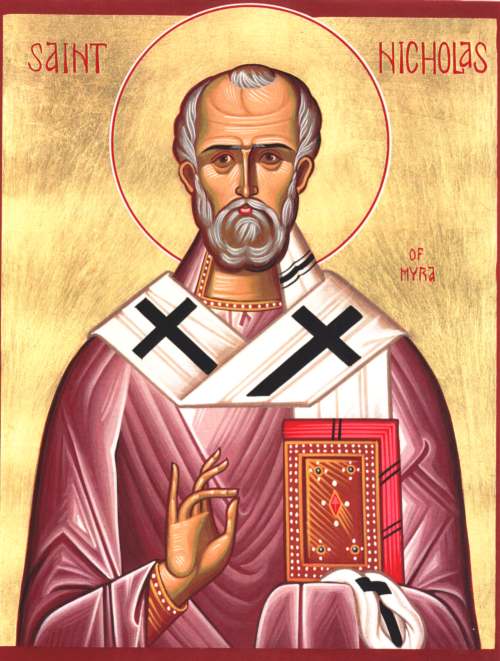
According to legend, Saint Nicholas here straight-up clocked a dude in the face for teaching heresy. Considering 
that he sneaks into your house every year, this also can be regarded as a truth having practical application.

Saturday, July 13, 2013

On Matthew Vines, Heretic

Matthew Vines, whose video on a pro-gay hermeneutic of Scripture recently and surprisingly went viral (despite lasting over an hour!), was interviewed a little while ago by Justin Lee for GCN Radio, the podcast put out by the Gay Christian Network. The interview is about half an hour long; I encourage you to listen to the whole thing, but the bit I want to focus on runs from about the 10 minute mark to just before the 15.

His arguments in favor of a new sexual ethic are (from my reading on both sides of the issue) fairly standard, though better researched and articulated than is often the case. Replies have been made to it from a traditional standpoint, such as this essay on First Things by Joshua Gonnerman, so I won't linger over that for now.

Listening to the GCN interview, however, something did stand out to me, strongly. And that is that he doesn't make any concessions to his maybe being wrong. He is wrong, and I am extremely glad he doesn't even admit the possibility.

This may seem paradoxical; I altogether deny the charge. He believes in absolute truth, and therefore holds his views absolutely. I can't imagine not respecting that. Few things are so false as the notion, so common today, that we can only be on good terms with people whom we agree with; and, as a corollary, that we can only maintain civil relations with those we do disagree with, by watering down what we do believe. It's true that it can be hard to argue and be respectful, but it can be done -- Chesterton and Shaw disagreed with each other about as much as two men can, and were fast friends. I rate respect a damn sight higher than mere tolerance; I admit I prefer tolerance to persecution, but I don't care to settle for tolerance if respect is available.

Chesterton himself put the matter very plainly, in his introductory essay in the collection titled Heretics:

"In the former days the heretic was proud of not being a heretic. It was the kingdoms of the world and the police and the judges who were heretics. He was orthodox. He had no pride in having rebelled against them; they had rebelled against him. The armies with their cruel security, the kings with their cold faces, the decorous processes of State, the reasonable processes of law -- all these like sheep had gone astray. The man was proud of being orthodox, was proud of being right. If he stood alone in a howling wilderness he was more than a man; he was a church. ... For obviously a man ought to confess himself crazy before he confesses himself heretical. The Bohemian, with a red tie, ought to pique himself on his orthodoxy. The dynamiter, laying a bomb, ought to feel that, whatever else he is, at least he is orthodox."

He goes on to say, speaking of Kipling and of Shaw himself, two of the men whom he first addresses:

"I wish to deal with my most distinguished contemporaries, not personally or in a merely literary manner, but in relation to the real body of doctrine which they teach. I am not concerned with Mr. Rudyard Kipling as a vivid artist or as a vigorous personality; I am concerned with him as a Heretic -- that is to say, a man whose view of things has the hardihood to differ from mine. I am not concerned with Mr. Bernard Shaw as one of the most brilliant and one of the most honest men alive -- I am concerned with him as a Heretic -- that is to say, a man whose philosophy is quite solid, quite coherent, and quite wrong."

Now, there is one inevitable misconception that must be cleared up immediately. Eight million percent of readers (in round figures; the actual number may of course be higher) will take this to mean I think Vines is going to Hell. I don't think this; I have less certainty about Matthew Vines' eternal fate than even about my own*, because it's none of my business. Even if we are to judge angels on the Last Day, I hope that we will be excused from the frightful task of judging men; and whether we judge anyone or anything then or no, the Last Day can look after itself -- we have other days meanwhile. To say that someone's opinions are wrong is not the same thing as saying that they are sinning by holding them; nor, even if we knew that, would that be the same thing as knowing their final destiny.

But hang on. Isn't saying that someone is a heretic more than just saying they're wrong? Well, in one sense, no. False doctrine and heresy are synonymous terms, if we are talking simply about the thing being believed. The sense in which heresy can be a sin comes in only when the reasons, or lack of reasons, that a person has for believing something are clarified -- when a person is believing a false doctrine because of a refusal to trust God, for one reason or another. And because only God looks on the heart, that question is in a real sense unanswerable -- except of ourselves, to ourselves. We do not know whether someone else holds their beliefs for bad reasons, but we can realize that we do; we often have to, and in fact Vines makes that very point in the interview I linked to, acknowledging his own bad reasons for the opinions he held before converting to a pro-gay hermeneutic.

That is one of the reasons that I can't join in the tendency, on display among a lot of Catholic bloggers, authors, and apologists, to not simply argue with but despise those who hold beliefs contradictory to the Catholic faith. I find it distasteful and counterproductive, and seriously at risk for being sinful, since no poison is deadlier than pride. But aside from all that, I just can't, and won't, understand the feeling that people who are thoughtful enough to be solid, dogmatic heretics deserve to be mocked.**

Am I grieved when people espouse heretical beliefs? Of course. Just as Vines is grieved when I espouse the traditional doctrines of Catholicism, and he should be, because the truth matters. I very much imagine, expect, and hope that Matthew Vines would regard me simply and categorically as a heretic, for the same reasons I regard him as one; and I don't doubt that he would nevertheless be as capable of respecting me as I respect him.

But is it really respecting someone to call them a heretic -- to call them wrong? I think it, in a way, extremely respectful. It is certainly more respectful than speaking and acting as though their ideas are too unimportant to be wrong or right. To quote my master Chesterton once again:

"... I would ask first and foremost, that men such as these of whom I have spoken should not be insulted by being taken for artists. No man has any right whatever merely to enjoy the work of Mr. Bernard Shaw; he might as well enjoy the invasion of his country by the French. Mr. Shaw writes either to convince or to enrage us. ... If a man convinces us at all, it should be by his convictions. ... If a man comes into Hyde Park to preach it is permissible to hoot him; but it is discourteous to applaud him as a performing bear. And an artist is only a performing bear compared with the meanest man who fancies he has anything to say."

Naturally I have no idea whether Matthew Vines will ever read this. But if ever you do, sir, permit me to close by raising a glass in your honor. (I hope you like whiskey, not least because if you don't, you're wrong about that too.) Slainte.***

*The Catholic doctrine of assurance need not detain us, but can be summed up in a beautiful quote from Saint Joan of Arc, in an answer she gave during her trial for heresy. Asked whether she knew herself to be in a state of grace -- an attempt to trap her, so that she could be accused of either admitting that she was in sin (if she said no) or presuming upon her own holiness (if she said yes), the prophetess replied simply, "If I am not, may God put me there; if I am, may God keep me there."

** This isn't the same as playful banter -- something of which Chesterton dealing with Shaw (and, indeed, Chesterton dealing with basically everybody) is a splendid example. Humor of this sort is founded on respect, on taking the other person and their position seriously; it is humorous in form, precisely because it views the other person as being able to handle the humor. People often assume that all humor about opposing viewpoints is contemptuous, but this seems to me to be based in a subconscious idea that humor is always hostile -- a patently obvious falsehood, once it is stated out loud.

*** In answer to your question, yes I did do the Darth Vader Episode III "Nooooo" when I realized I don't know how to get an accent mark over the 'a' in that word.

Monday, June 3, 2013

Graces Withheld; Or, Sebastian's Fate

I am interrupting my current series to deal with an issue that has been much on my mind in the last several months. I've expressed the thought lately, both here on the blog and in one or two personal conversations, that not everyone receives the graces they need to make them, so to speak, successful at virtue. In response, people have tended to be perturbed and resistant. And it is a strange thing to say. Don't I believe that God wants us to be virtuous, that He is generous, that He sanctifies us because He loves us? Doesn't Scripture itself teach that "God is faithful, and He will not let you be tempted beyond your ability"?

I do believe those things, certainly. But let's parse them a bit, shall we?

First of all, virtue is not the same thing as holiness. Virtue means doing the right thing; holiness means loving God. Be holy, and virtue will come, all else being equal; but in every age there is some group of people who stand as a ghastly testament to the fact that being virtuous does not make you holy. The Jansenists, the Inquisition, the Donatist and Montanist heresies -- all had the common theme, not simply that right conduct is obligatory (which is true), but the implication and even the open claim that God loves less those who conduct themselves wrongly (which is blasphemy). There was a saying about the Jansenist nuns of Port Royale in seventeenth-century France that they were "as pure as angels and as proud as devils"; there is every reason to suppose that the Pharisees themselves were, as they claimed to be, thrifty, patriotic, respectable, unswerving observers of the Torah. And their virtues, unleavened by love, made them literally the enemies of God. We are fools if we suppose ourselves immune to that deadliest sickness of the spirit. T. S. Eliot was right: "The last temptation is the greatest treason: To do the right deed for the wrong reason."

Secondly, I have said that virtue follows on holiness, all else being equal. But that is the catch. In a fallen world, one afflicted with ignorance and moral weakness as well as with sin, all else is frequently not equal. Some people struggle, at times alone, under heavy and bitter crosses the weight of which the rest of us could not conceive. Indeed, I rather think that everyone has some hidden heartache that is known only to themselves and God. The bitter realities of trauma and addiction are their own witness to the fact that not everyone is dealt an equal hand in this life, and that we cannot expect the same unimpeachable correctness of conduct from a heroin addict or battered daughter, that we tend to demand of the happily married mother of two or the well-fed seminarian with his clean-cut hair and clean-kept collar. It is easy to be principled when you are comfortable.

There is a more fundamental error at work here, one that I feel I detect much in the Young Papists. It is the error that holiness will inevitably make you happy.

Of course, from a strictly Aristotelian definition of the term happiness, I tend to agree. But well-being according to the objective good of a rational creature, is really not what people mostly mean by happiness. The Young Papists are a great deal more likely to mean it; but I fancy I detect a certain confusion between the popular and the philosophical meaning of the term. In addition to the (largely true) assumption that virtue will make a man flourish, the ordinary English associations of happiness creep in, to the point that sadness and pain beyond the point of inconvenience begin to seem incredible. To take an example from my own life, that chastity should make someone feel lonely and depressed seems almost like a contradiction in terms -- chastity is a virtue, you shouldn't be unhappy because you're virtuous! There must be something wrong in the way you're doing it, some --

And there it is. The voice of Job's comforters: Somehow, it must be your fault. The supposition, difficult to eradicate from any mind and next-impossible to eradicate from the devout mind,* that if we do not feel happy, it is because we have in some fashion displeased God.

This is a vicious and cruel doctrine. It shifts responsibility for suffering onto the sufferer, rather than doing the one thing Job's friends did rightly: wailing aloud for his griefs, and sitting silently with him in the ashes for seven days before any one of them opened their mouths in disgraceful theodicies. Master, who did sin, this man, or his parents, that he was born blind? No; at the heart of Christianity is the reality of undeserved suffering. Undeserved, not purposeless -- any suffering can be united to the Cross, filling up what is lacking in the pangs of Christ, as St. Paul said.

But that's the point, you may pipe up. Suffering is a chance to grow in grace. Yes; but growth in grace and growth in virtue are not the same thing. The assumption that everybody is given the graces they need to be morally perfect seems obvious -- it even seems generous -- but it isn't. Could God so dispense grace? Certainly. Equally, He could have orchestrated the universe so that every person, not just the Virgin, was immaculately conceived. We don't know why He didn't, though we can conjecture; but we do know that He didn't. Is it so hard to believe that He has withheld far lesser graces than that from this or that soul, and with equally loving purpose?**

Conversely, the text from St. Paul I quoted earlier, which says that He always provides a way out of temptation, is perfectly true; but it can easily be twisted into a rigorist view that savages every sinner because, technically, they could have done better. Only God does or can know how many souls have forsaken Him because despair ravaged their souls, as a direct consequence of such spiritual cruelty. I at any rate didn't convert for that. If anything, I converted to escape that -- converted from the sola fide that compelled me to prove to myself that my faith was real through an upright life, to the Church of the secret confessional and the doctrine of venial sin. Converted, too, to the Church of mystery; the same apostle who penned that text wrote also of a whole people "imprisoned in disobedience, that God might have mercy upon all."

Evelyn Waugh, the deeply Catholic English novelist, understood this clearly. He puts these words into the mouth of the wisest character in Brideshead Revisited, about her alcoholic brother, a hopeless postulant at a monastic house in northern Africa:

"'[Sebastian will] never be able to go into the bush, of course, or join the order, but the Father Superior is going to take charge of him. They had an idea of making him a sort of under-porter; there are usually a few odd hangers-on in a religious house, you know; people who can't quite fit in either the world or the monastic rule. ... I've seen others like him, and I believe they are very near and dear to God. He'll live on, half in, half out of, the community, a familiar figure pottering round with his broom and his bunch of keys. He'll be a great favorite with the old fathers, and something of a joke to the novices. Everyone will know about his drinking; he'll disappear for two or three days every month or so, and they'll all nod and smile and say in their various accents, "Old Sebastian's on the spree again," and then he'll come back disheveled and shamefaced and be more devout for a day or two in the chapel. He'll probably have little hiding places about the garden where he keeps a bottle and takes a swig now and then on the sly. ... He'll develop little eccentricities of devotion, intense personal cults of his own; he'll be found in the chapel at odd times and missed when he's expected. Then one morning, after one of his drinking bouts, he'll be picked up at the gate dying, and show by a mere flicker of the eyelid that he is conscious when they give him the last sacraments. It's not such a bad way of getting through one's life.'

"I thought of the youth with the teddy bear under the flowering chestnuts. 'It's not what one would have foretold,' I said. 'I suppose he doesn't suffer?'

"'Oh, yes, I think he does. One can have no idea what the suffering may be, to be maimed as he is -- no dignity, no power of will. No one is ever holy without suffering.'"

I've written before of my wondering whether I will ever be chaste, and to what extent I ought to treaty with my powerlessness here. In one sense, of course, anyone is chaste, considered spiritually, provided only that they go to Confession when they do fall; and I have not the slightest intention of abandoning that. But when a person is really powerless -- when no moral effort, short of effectively ending their ordinary life by becoming a literal recluse, will enable them to leave off from a given sin -- what is to be done? How is the damage done to the soul, and to the people with whom they interact, to be ameliorated? I for one utterly discountenance the "scorched earth" approach that many Catholics, particularly traditionalists, tend to advocate: if I were to cut off every relationship that was an occasion of lust -- let alone anything more -- to me, I would have no male friends. (Sorry if that makes any of my male friends uncomfortable.) And I am speaking in cold prose when I say that I have done everything I've been told to be chaste, and persistently lost ground; intimate friendships, physical touch, therapy, spiritual direction, daily Mass, the Rosary, all these things together were not enough; I have suffered many things of physicians, and spent all that I had, and was nothing bettered. How shall I then live?

Of course, I am not unique: there are plenty of people out there in this kind of situation, and it isn't necessarily about sexual love. The point is that the Church has to be a place that welcomes sinners who are still sinners -- not just ex-sinners. And not just people who "fall sometimes," either. Sincere love of God, a virtuous life, and happiness in the popular sense, are all discrete things that may or may not coincide in any given life. That is a painful paradox, but it is one we must learn to live with, if we are to escape spiritual arrogance. It is not ours to say among whom or to what extent grace is at work, save the objective graces of the sacraments. Let Sebastian potter about with his broom and his keys; he may not be a monk, but turn him away, and it may be at your hand that his blood is required.

*There have been religious minds who have really transcended it -- Boethius' for example. But the tug to pass from "God has a reason for this" to "I know God's reason for this" is an exceedingly strong one; and, especially when we enjoy good fortune, it flatters our moral as well as our intellectual self-regard to suppose that other people's bad fortune is in some fashion their own fault. Atheism is not necessarily a safeguard against this sort of superstition, but the self-righteousness that characterizes atheists (when it appears) tends, in my experience, to be of a different cast.

**Speaking of conjectures, I have heard -- though I wasn't able to verify the reference -- that God leaves unchastity as a struggle for some, in order that they may not be swollen by pride.