Collect

Collect for the Fourth Sunday after Trinity

O God, the protector of all that trust in thee, without whom nothing is strong, nothing is holy: increase and multiply upon us thy mercy; that, thou being our ruler and guide, we may so pass through things temporal, that we finally lose not the things eternal; grant this, O heavenly Father, for the sake of Jesus Christ thy Son our Lord, who liveth and reigneth with thee, in the unity of the Holy Spirit, ever one God, world without end. Amen.
Showing posts with label religious liberty. Show all posts

Wednesday, January 17, 2018

Christendom and Christianity, Part II

There is certainly a sense in which execution might be done [1]; we might turn vengeance into sacrifice. It is dangerous, but it could be done. … We should say, in effect: ‘We have no right to punish you for what you have done in the past. But we are determined that we shall make it dangerous for men to do as you have done; we shall make it a matter of death. We shall sacrifice you to that new thing …’ The shedding of that blood would be a pronunciation of sentence against us and our children if we denied or disobeyed the law we had newly made. ‘It is good,’ said Caiaphas, and spoke a truth all civil governments have been compelled to maintain—and ecclesiastical also; why else were heretics condemned?—‘that one man should die for the people.’ … Whether it is conceded outside the Church is another matter. But she herself must not tamper with it. Those who sincerely reject the Single Sacrifice may perhaps be driven back on the many types of it, even if—no, because the centrality of all the types is unacknowledged. But belief in the Single must refuse the multiplicity.


—Charles Williams, The Forgiveness of Sins

✠ ✠ ✠

It may sound oxymoronic to assert that Christian principles are necessarily in tension with any society built upon Christian principles. But then, the very word oxymoron literally means ‘a sharp foolishness’—as in something that seems stupid at first glance but is actually quite practical or profound. For instance: tungsten has one of the highest melting points of any element, and due to this very little is known about liquid tungsten, for the terribly silly-sounding reason that nobody’s figured out how to make a container to hold it in.

Building a society on Christian principles is, I expect, possible, as it’s probably possible in principle to make a container that will hold liquid tungsten. [2] But history and theory alike suggest that both operations are insanely difficult, and apt to result in a lot of people getting burnt.

I do want to do full justice to Christendom. Our forefathers from Constantine to Chesterton were trying to build, maintain, and defend something that they were deeply convinced was good and right; and not a few among them were saints and heroes, some displaying the kind of grace that puts modern liberals like myself to shame. If they failed—or even if they succeeded and yet it would have been better otherwise—it was not for want of sincere goodwill. I make no secret of the fact that I, personally, think that the attempt to construct Christendom was a fatal mistake; but it was a very natural, plausible, persuasive mistake to make, and it did good as well as harm.

This paradox of Christendom-against-Christianity springs from what society, as such, consists in. Civil society is built on the persons, families, conventions, laws, and governments of the commonwealth in question. Its ‘economy’ is primarily the economy of justice: obligations are distinguished from liberties by enforcement—e.g., paying one’s taxes is an obligation, whereas making charitable donations (even those that may be relevant to taxes) is not. And where obligations end, the state’s power of enforcement ends. Cultural expectations, personal convictions, or individual relationships, may introduce other kinds of pressure, but law and the enforcement of law are ultimately synonymous. [3]

This is quite pointedly not the economy of the Church operates on. She accepts its existence, obviously, as she continues to accept the existence of gravity when celebrating the Ascension; indeed, the economy she does operate on is comprehensible only when the economy of justice has first been grasped, as the Ascension can only be recognized as something remarkable once we’ve noticed gravity. But the essential character of the Church is the economy of grace; of gift; of that which transcends, eludes, and defies obligation. Grace—that is, being filled with the life of God—is not only far past the just deserts of such selfish and flawed beings as ourselves, it’s past what any creature, however, good, could deserve from its creator. We could no more merit grace than a perfect sculpture could merit a sincere proposal of marriage from the sculpture; but our God has proposed to be not only Pygmalion, but Aphrodite to our Galatea.

This is part of which the relationship between St John the Baptist and Christ was, and remains, so important. Among them that are born of women there hath not risen a greater than John the Baptist: notwithstanding he that is least in the kingdom of heaven is greater than he. All the virtues of the ancient world were becoming parodies of themselves, from the stubborn piety of the Jews to the vigilant equity of the Romans. The reëstablishment of the visible ideal of justice was necessary, if the grace that transcends justice was to be seen for what it was by anybody. But when once that ideal of justice had been re-manifested, it was promptly transcended by the gospel. Where the Baptist commanded tax farmers not to defraud anyone, Christ told his listeners to chase after those who had requisitioned their property in order to give the thieves more; where the Baptist forbade soldiers to bully and harass the populace, Christ told those who were humiliatingly struck to peaceably invite a fresh blow. Free, wild, irresponsible self-gift, not to fellow Christians but to fellow men as such, friend or foe or stranger, is the ethic of the gospel.

And it is probably pretty obvious why you cannot build a civil society on that sort of principle. Generosity and forgiveness and pacifism and mercy—in a word, grace—can be lived out within a society built on justice. But you cannot build an economy of justice out of the elements of grace. The attempt to do so corrupts both: either justice will be treated as a gift, as though we did not owe it to our fellow man to respect his humanity by not murdering him or robbing him or lying to him; or grace will be treated as an obligation, not only in supernatural but in civil terms, and things that ought to be accepted as gifts will be demanded as payment.


I think, however, that the difference here is that all exclusion from the economy of grace is self-exclusion. Refusal to forgive is not punished by refusal of forgiveness, in the sense that refusal to pay a debt is punished by imprisonment. [4] Rather, refusal to forgive inevitably entails a rejection of the economy of grace, in the sense that refusal to eat and drink inevitably entails death. The refusal of grace places us squarely back in the economy of justice—where everything must be earned if we are to obtain it. And, considering that we depend on God to sustain every aspect of our existence, dealing with him in the economy of justice is a Sisyphean prospect.

Hence, no matter how good the intentions of those who wish to build Christendom, and even no matter how good their results, I think the project of building it is flawed as a matter of first premises. I don’t believe there can be any kingdom of heaven except the kingdom of heaven; I don’t believe that we can erect any Christian society except that which is in fact ruled by Christ. And that will come—but when it does, it’s the end of the world. Nonetheless there are other problems I have with Christendom, which I propose to go into in my next.

✠ ✠ ✠

[1] Williams wrote this during the Second World War, and was addressing what was to be done with, or to, or about Germany by the Allies.

[2] I mean, one that will hold it and not immediately melt and/or catch fire.
[3] This is, in my opinion, substantially the same as what Dante wrote in On Monarchy, that non enim jus extenditur ultra posse (‘law does not extend beyond power,’ i.e. you can only really have laws as far as you can enforce them).
[4] At least, I think this analogy is misleading, in our specific cultural context; but I could be wrong even about that, and whether I am or not, it is an analogy that our Lord did not hesitate to use in his cultural context.

Tuesday, July 8, 2014

Confession and the Law


Objections to the inviolability of the confessional, in cases of the abuse of minors at least (and perhaps more), have been broached here and there since the original scandal broke in the early years of this century. This is hardly surprising, though, in my view, it is most definitely ominous. This constitutes a breach of religious liberty of the first order -- far more profound than the HHS policy on contraception, in my view: for, while the latter insists on what theologians call in technical language material cooperation with evil, this is a demand that the sacred ministers of a religion violate their oaths as priests, interfering directly with their religious duties as such. Essentially, it gives them a choice between being imprisoned and being excommunicated -- for violating the seal of Confession is one of the few sins upon which the Church imposes an automatic ban of excommunication.


The fact that the issue has been raised in this specific case is a little stupid, to my mind, given that:

1) there was certainly inappropriate conduct towards a twelve-year-old girl from an adult parishioner, but not, apparently, sexual contact as such;

2) the priest is not the accused party;

3) the victim is testifying freely;

4) the accused happens to be five years dead.

If one were trying to argue that trampling on the sanctity of religious rites and Catholic consciences were necessary in extreme cases to bring criminals to justice -- a tenable position, though I don't accept it -- one could hardly have chosen a less compelling example.

But arguments about violating the seal of Confession really and truly don't work even from a purely utilitarian perspective, to the point that I cannot understand why people suggest it in the first instance. What criminal would avail himself of the sacrament of Confession, knowing that his deeds would thereafter be brought to light? -- unless it were a criminal capable of turning himself in anyway. Moreover, in this case, the victim is testifying of her own free will, but the right of the victim to privacy must be respected as well (and in this case the demand is to know about the victim's Confessions).

One point that is often lost in these discussions is that this prevents priests from defending themselves quite as much as it prevents the law from catching penitents who have spoken of crimes in the confessional. Coincidentally, this is just such a case: the only person who stands to lose by keeping silent is the priest himself; for it must be admitted that the counsel he is reported to have given the young victim looks bad, and the only witness who can bear testimony is the girl herself. If the priest wanted to challenge her testimony or give further information or nuance, he can't. That SNAP's Director has spoken of this as "deliberately and deceptively exploit[ing] confessional confidentiality" is utterly ridiculous in that light.


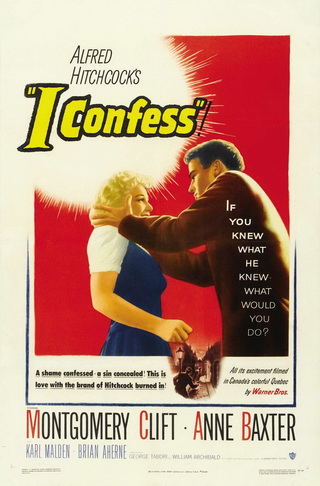
This is what comes of the decline of classic cinema.

All this is on the civil and merely practical plane. But when we turn to the specifically religious dimension, the impossibility is yet more emphatic. The priest himself, in a sense, does not forgive in this sacrament: he is, by virtue of his office, a minister of the forgiveness of God, not of his own native powers. The seal exists, and has existed for centuries, because the sins of the penitent are not the priest's own business -- he must be told them in order to give guidance, comfort, and a suitable penance, and (in extreme cases) to help him judge whether it is within his authority to administer the Divine absolution*; but none of that is his own personal affair. It is a secret even from him; even, in a sense, from God, who drowns forgiven sins in the deeps of mercy.

This is part of what the separation of church and state means. Interfering with a religious ritual on state grounds is a breach of the First Amendment of the first order. The only real recourse here is to say that the Founding Fathers, and correspondingly the Constitution, were wrong about this, and that religious liberty is neither a natural right nor appropriately a legal privilege.

To address my fellow Catholics specifically, however, I think we must be prepared -- terrible though the phrase may sound -- to get used to this. Protest and legal action in response to such attempts at violating the rights of the Church are appropriate; but I think we have gotten too cozy in the assumption that all will be well and manner of thing will be well for Christianity in the purely political sphere. We may have to acclimatize to the idea, and even the fact, of priests being jailed for refusing to divulge the existence or contents of Confessions. I say this not because we ought to apathetically resign ourselves; not even, like Job, because The Lord giveth and the Lord taketh away: blessed be the name of the Lord.


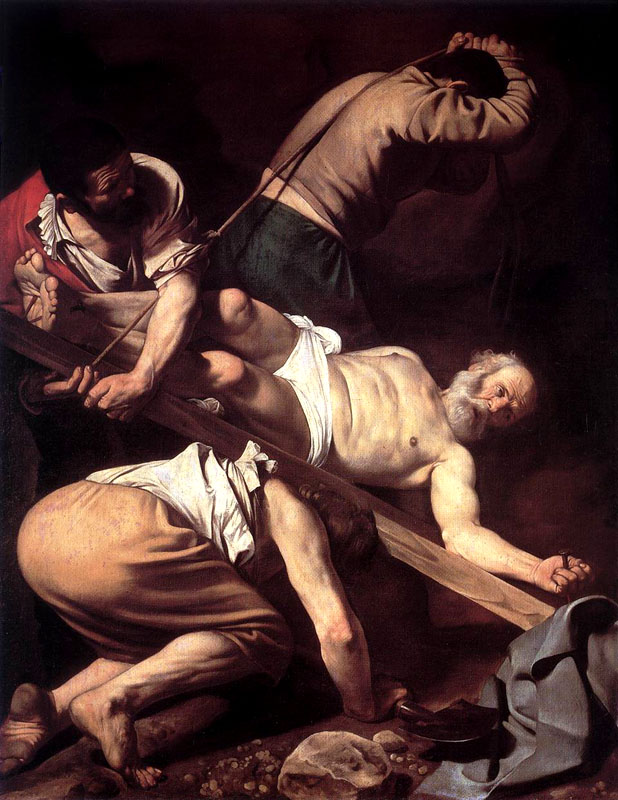
Caravaggio's Crucifixion of Peter

I say this because persecution is the natural habitat of the Church. I expect it to come around, not because our nation is specially depraved, but because it always comes around. The Church was born into persecution; nay she was conceived in the midst of it. There is nothing more persecuting that the cross. Even if we go further back, to the Incarnation itself, we find the holy Theotokos fleeing from a dangerous disgrace in her native village, with a song of joy and glory flowing from her lips; we find the Holy Child brought into the world only to escape, under St. Joseph's vigilance, into Egypt, as the shadow of Herod's soldiers fell upon the Holy  Innocents. And when the Holy Ghost had fallen on the Apostles, persecution began almost immediately at the hands of the Jewish council of elders: And they departed from the presence of the council, rejoicing that they were counted worthy to suffer shame for his name. If we are persecuted for our vices, we have no legitimate complaint to make; and if we are persecuted for our virtues, then we are blessed. We must learn to expect and accept suffering, whether at the hands of the state or not; and we must pray for those who spitefully use us and persecute us, so that, as our Master said, we might be sons of our Father who is in heaven.


*The Catholic Church teaches that, as the Mystical Body of Christ animated by the Holy Ghost, she has the authority to forgive every sin. But of course, the Church is not summed up in any one person, and no one person possesses her fullness independently -- we belong to her, she does not belong to us. An example of this in the realm of administering sacramental forgiveness is that the pardon of a few sins, in the Roman Rite, is reserved to the Pope alone; breaking the seal of Confession is one such sin. (I don't know how this works in Eastern Churches, whether Catholic or Orthodox. I would suppose, on analogy, that the Patriarchs -- e.g. the Patriarch of Constantinople for Greeks or that of Alexandria for Egyptians -- probably possess something like the authority in difficult cases, but I know next to nothing about Eastern canon law.)

Friday, July 4, 2014

Forgotten Keys of the Liberal Experiment

Well, first things first: happy Fourth of July, the day we declared our independence as a nation.


As commemorated in the documentary of the same name.

The recent SCOTUS declaration on the Hobby Lobby case, and its ensuing controversy, have strengthened my conviction that the American experiment has decisively failed.

Classical Liberalism, the philosophy that gave our nation birth, could be summed up without disastrous oversimplification as a belief in self-rule. This is more than just democracy as opposed to monarchy. Liberalism emerged out of the statist, absolutist governments that became popular during the Renaissance (themselves heirs of the gradual centralization of governments during the High and Late Middle Ages), which enjoined -- or, more precisely, took for granted -- a strictly hierarchical view of society and a supremacy of the state over its own laws that allowed it to meddle in nearly every aspect of life, just like it does today. The Enlightenment saw many political and economic philosophers reacting against what they declared to be tyranny, insisting by contrast on freedom of religion, freedom of speech and press, freedom of trade, and the equality of all men before the law.*

The turning of the tide against these ideals did not begin with the song SexyBack, though I dare say Mr. Timberlake did nothing to stem it. If you talk to a Leftist (or what most Americans think of as a Leftist), the Patriot Act may well be cited; if you talk to someone on the Right, the New Deal may be weighed and found wanting. I don't propose here to try and get to the bottom of that discussion. I would, however, point to a few essential elements of classical Liberalism that I think are simple statements of justice, whether Liberalism as a whole is right or not, and that I think our culture has lost touch with -- and must recover as central components of an American identity, if being an American is to be a noble thing.


1. The presumption of innocence. The crumbling of this belief at a popular level, within my own short lifetime, is a shock that I still haven't gotten over. It was, I feel, exemplified with a startling and unpleasant clarity in several recent instances, such as the Secretary of State's recent appallingly stupid remarks about Edward Snowden, or the employment of drone strikes against American citizens who, however criminal, were in that act deprived, by state fiat, of the right to trial by a jury of their peers. The trials of Casey Anthony and George Zimmerman displayed it, too: popular sentiment against the defendants was so high, people seemed somehow to forget that they were not being tried by the media -- or by a lynch mob -- and that the law which makes any reasonable doubt grounds for a verdict of Not Guilty is an integral, an indispensable, assumption of the American spirit. Whether they were in fact guilty is, in a sense, neither here nor there: what mattered was that there was not adequate evidence to prove their guilt beyond reasonable doubt, and therefore, the court was obligated to release them, and acted rightly in so doing.**

One would think (or hope) that a nation whose memory includes the disgraceful hysteria of the witchcraft trials of Salem, among the shabbiest collections of judicial mob-murders in history, would be a little more scrupulous about the presumption of innocence. Nor is the parallel of the witch-finder out of place; especially when we consider our country's disposition toward evils like pedophilia or terrorism, for, like the witch, the pedophile and the terrorist sleeper agent look like everybody else, allowing the most versatile phantasmagoria to project itself onto the screen of our half-conscious imagination. It may perhaps be said in defense of the witch-finder that, if we thought as he did that there were men and women vowing themselves to the Devil and using powers granted by him to wreck the economic infrastructure and kill those who displeased us, we'd probably behave no better than he.


The title page of Wonders of the Invisible World, a work on witchcraft and particularly on the Salem Witch Trials, by the execrable and impenitent Reverend Cotton Mather, who facilitated the ridiculous admission of spectral "evidence."

This belief, like most beliefs that are worth bothering with, cannot be derived from an examination of what is expedient; the presumption of innocence does not get results. It is a belief which elevates the protection of the innocent over the punishment of the guilty, and it therefore necessarily involves letting the likely, yet not manifestly, guilty person go free, not infrequently. A frightened or vindictive society will have no truck with that. But I do not care to live in a frightened or vindictive society. I assert that it is better to live and to die with a noble and a free soul, than to try to salvage one's bodily life for a while at the cost of such a soul. It is of course open to anybody to maintain that trying to salvage one's bodily life is worth sacrificing the bodily lives of others for, so long as they might possibly be guilty; but I for one am unwilling to countenance such a price.
It may be that, as imperial adviser, my friend Marsilius is better than I, but as inquisitor I am better. Even better than Bernard Gui, God forgive me. Because Bernard is interested, not in discovering the guilty, but in burning the accused. 
-- Umberto Eco, The Name of the Rose, p. 394
2. The equality of men. It may sound odd to describe this belief as having deteriorated, in an age when equality is a universal rallying cry, especially equality between the sexes and equality of marriage rights. Be all that as it may, I feel I sense this most of all with the wealthy and the politically powerful.

This will appear first of all to mean CEOs and Senators, and that isn't untrue. The fact that we not only tolerate but expect special treatment for such people (to say nothing of the bizarre cult of celebrities) is a far cry from the more fully democratic attitude of the First French Republic, in which, for all their other faults, statesmen like Robespierre (as Chesterton pointed out) were poor when they might easily have been rich. That was a bold statement of the real equality of rulers with ruled, and I don't know that it has been seen since.
A little while ago certain doctors and other persons permitted by modern law to dictate to their shabbier fellow-citizens, sent out an order that all little girls should have their hair cut short [to prevent lice]. I mean, of course, all little girls whose parents were poor. Many very unhealthy habits are common among rich little girls, but it will be long before any doctors interfere forcibly with them. ... As is common in most modern discussions the unmentionable thing is the pivot of the whole discussion. It is obvious to any Christian man (that is, to any man with a free soul) that any coercion applied to a cabman's daughter ought, if possible, to be applied to a Cabinet Minister's daughter. I will not ask why the doctors do not, as a matter of fact, apply their rule to a Cabinet Minister's daughter. I will not ask, because I know. They do not because they dare not. 
-- G. K. Chesterton, What's Wrong With the World, pp. 191-192
But the wealthy and politically powerful also means, more simply, America. That is, ourselves. We are not the only wealthy and politically powerful country in the world, obviously, but we're up there. And, while you could tell that we're rich and powerful from our immigration policies, you sure couldn't tell that we're a nation composed of more than ninety-nine percent immigrants from them. Or, if we were trying to discern the costs of war from (say) the media and popular objections to war, we could easily tell that war kills Americans, but I don't know whether it would be equally clear that war kills everybody else, too. Nor would it be clear whether we care about the latter, especially given our now persistent tradition, since the close of the Second World War and exemplified in both the Bush and Obama administrations, of not only excusing but defending war crimes.


Every act of war directed to the indiscriminate destruction of whole cities or vast areas with
their inhabitants is a crime against God and man, which merits firm and unequivocal condemnation.
-- Gaudium et Spes, The Pastoral Constitution on the Church in the Modern World, para. 80

3. The primacy of conscience. The poutrage over the Supreme Court's really extremely narrow ruling in the Hobby Lobby case -- I say narrow because it excused only a certain class of business owners from paying for contraceptive coverage, and excused them only over certain contraceptives -- has been very intelligently analyzed by Ross Douthat of The American Conservative.*** The thing that I find disappointing and alarming about it is the contempt of conscience it has manifested.

Advocates of the HHS mandate as originally drafted have proclaimed, loudly and quite correctly, that an employer's religious views have no place in an employee's bedroom. It has been drily pointed out that it seems a little unfair in that case to insist that an employer's wallet does have a place in an employee's bedroom; and, little love though I have for employers' wallets, I tend to agree. Insofar as, moral or immoral, boning is generally a freely chosen behavior, and it is for the sake of that freely chosen behavior that contraceptives are mostly used, insisting on contraception as not only a right but something that somebody else ought to be compelled by law to pay for seems to me to be rather tasteless (and not solely because I entertain no great hopes of the quality of state- or business-funded orgasms, based largely on my experience of other state- and business-funded services).


What leaves me baffled is the idea that the state not forcing people to act against their consciences is somehow tyrannical. I admit that my own views on the subject are, on our current spectrum, fairly extreme -- as that, for instance, I would strongly resist the idea of compelling a business owned by Jehovah's Witnesses to cover medical procedures that require blood transfusions, not because I think their beliefs at all reasonable, but because they do in fact hold those beliefs; and I don't think anyone should be compelled to violate their own conscience on someone else's behalf. But even if that view is refused as being too radical, contraception as such is not a vital good or service -- i.e., people do not need contraceptives for their physical well-being**** -- and it therefore still seems to me to be inappropriate to force an employer to pay for it.

Given that there is a state-funded option for health insurance, one might have supposed that, you know, having people sign up for that instead of employer-provided health insurance was a neat and obvious way of allowing for unusual convictions. But who wants that.

And the point is not simply about health insurance: it's about the conscience as set against the concerted mass of the state. Except for a rare few individuals, like Gandhi or Solzhenitsyn or Dorothy Day, the pressure even of an ostensibly liberal and enlightened state will be more terrible than the pangs of conscience. The First Amendment was not written simply to ensure that religious or political minorities did not wake up in prison while their houses of worship or printing presses were torched. It was written to assert that the conscience itself is the foundation of all law, and that it is the state which must kowtow to us, not the other way around. As Blessed Cardinal Newman said, conscience is the aboriginal Vicar of Christ; and every human person is a throne to that invisible apostle, which the state should not dare to desecrate. It may be answered, and truly, that some of these aboriginal Vicars bear upon their heads a blasphemous name, but by the same token, the angels themselves do not take it on themselves to rebuke one another.
And the servants of the master of the house came to him and said, "Master, did you not sow good seed in your field? How then does it have weeds?" He said to them, "An enemy has done this." So the servants said to him, "Then do you want us to go and gather them?" But he said, "No, lest in gathering the weeds you root up the wheat along with them." 
-- The Gospel according to Saint Matthew, 13.27-29
H. L. Mencken (a glib and quotable misanthrope of the last century) said that "We must respect the other fellow's opinion, but only in the sense and to the extent that we respect his theory that his wife is beautiful and his children smart." He meant it in its negative application, of course, but I feel that its positive application ought to be observed as well: we need not respect, in the sense of agreeing with, the other fellow's opinion; but we must absolutely respect his opinion in the sense of not forcing him to say or do things that involve him in the premise that his wife is ugly and his children stupid. Not even if they are.


Don't weed out the ugly and stupid yourself; let raptors do it.


*The pesky little problem of slavery did not at first deter them, given that they had conveniently defined humanity in such a way as to exclude the enslaved. Christianity is well-known to have cooperated in this bitter wrong -- although three significant facts tend to be left out of treatments of that problem today: first, that some communions, notably the Catholic Church, rather tolerated slavery as an evil that they could see no practical hope of eradicating and attempted to ameliorate, than enthusiastically supported it (though still falling short of the heroic Abolitionism of the Quakers); second, that while the pro-slavery movement did shamefully contain Christians as well as non-Christians, Abolitionism, so far as I understand, was an overwhelmingly Christian movement; and thirdly, that slavery does still exist today, and indeed exists in this country -- we just call it "illegal immigration," and not only underpay our slaves but occasionally kick them out of the country after they do the manual work that we are too busy or too lazy to do for ourselves.

**The presumption of innocence may be best, if indirectly, explained by the TVtropes page on Genre Savviness -- especially on the point that a genre savvy character is more likely than others to allow that things aren't always as they seem. I should think anybody who has lived through adolescence must know that things aren't always as they seem, even if things are as they seem with uncomfortable frequency.

***My anti-statist tendencies, to say nothing of my pacifism and my opposition to capitalism, prevent me from fitting in nicely with conservatives on the whole, but I've found TAC in general and Douthat in particular to be quite winsome. Of course, my anti-statist tendencies are equally out of place among liberals, as are my trenchantly pro-life views.

****I failed to be quite clear on this point in my last: I realize of course that some medicines that are in fact contraceptive have important health applications. Insofar as they are being used for those purposes, their contraceptive effects are (in my judgment) neither here nor there, and should indeed be covered by health plans, because if they're being used as medicine on the grounds that they, um, are medicine, then that's what a health plan is for. But this is not what anyone is even claiming the discussion of contraceptives is about. It is, explicitly, about contraceptive availability as a dimension of sexual liberation -- otherwise they wouldn't be bringing up the objection that their employer has no business in their bedroom (unless the boss is banging his secretary, I guess) in the first place.

Monday, June 30, 2014

A Blog on the Hobby Lobby Law Bomb


I'll just leave this here, shall I.

The internets are abuzz with Hobby Lobby hate. And Hobby Lobby pride. And Hobby Lobby what the hell are they on about this time. And so forth.

The contraception provisions of the HHS coverage mandate provoked a number of lawsuits, primarily of course from employers such as the Hobby Lobby who object to paying for contraception on religious or moral grounds. The Supreme Court ruled today that the state could not compel employers to provide coverage for contraceptive services.

Christians are to be found on both sides, vehemently decrying and vociferously supporting the ruling, and making remarks about the qualities of a Christian business, on this subject and others. A few thoughts:

1. The women's rights/reproductive health angle doesn't really work as an argument in favor of the original HHS requirements. It is perfectly possible to maintain that the government has no business dictating what does or doesn't happen in people's bedrooms, provided nobody winds up dead or unleashing Gozer the Gozerian. Both of which phenomena, strictly speaking, are as undesirable outside the bedroom as inside it.


Despite vaguely resembling Justin Timberlake, this entity is not bringing sexy back.

Where the argument becomes sticky is when we start saying that the state, or an employer, has an obligation to subsidize things that happen in the bedroom or to eliminate their consequences. And the brute fact is, whether we think it wrong or right, that's what contraception is: making sure that the normal consequences of sex won't happen.

Even referring to this as a matter of reproductive health is at best ambiguous. The issue of sexually transmitted diseases is an issue of health, of course; but treatments and vaccinations for those aren't, so far as I know, what's at stake here -- it's contraceptives that are at stake, i.e. things whose express purpose is to prevent pregnancy. And pregnancy, even if it is unwanted or objectively a terrible idea right now, is not a disease.*

If this were, for instance, a question of people wanting anti-pregnancy measures to be available to rape victims, the conversation would be pretty different, but so far as I'm aware that too is on the list of "not the main topic" stuff here. What's being demanded is employer-covered access to contraceptives so that people can engage in an elected behavior free of consequence, not a necessity to the normal functioning of the body -- indeed, its whole purpose lies in preventing the normal functioning of one system of the body. And, while I don't propose to criticize that elected behavior here, I would point out that it seems inappropriate to make other people (whether we speak of the employer or the taxpayer) fiscally responsible for one's own free choices in pursuit of non-essentials.

The comparison of cosmetic surgery, which has been raised by some writers on the subject,** seems to me a good one. No one need cavil at the idea that some people could, for lack of a better way of putting it, need cosmetic surgery; say, the veteran who comes back from war with half his face missing from a grenade explosion. But cases like this are clearly distinguishable from a general insistence that cosmetic surgery ought to be available to everyone as a right.

2. All the same, the brute fact is also that there is an inevitable inequality between men and women on this subject. To sum it up in a crude oversimplification, if people have sex and one of them gets pregnant (I'm going to assume for the purposes of discussion that this is more or less the old-fashioned sort of sex, in which at least one person of each gender is involved), the man can run away. The woman can't. And that is, by definition, unfair.

That it's inevitable is, I feel, a reply that rises a little too easily to Christian lips. That she should have been more responsible is a reply that rises altogether too easily to the lips of Pharisees everywhere.


God litters our lives with indulgences, letting us off the consequences of our sins; when He chooses not to do that, it isn't because the person who experiences consequences was worse than ourselves -- that is the chief point of the book of Job -- but is, in all likelihood, for reasons that we can barely guess and certainly not state with certainty. In any event, male irresponsibility is a lot easier to get away with, living as we do after both the Sexual Revolution and the demise of chivalry, and a lot of the insistence on a woman's right to contraceptives, or even to abortion, seems to be an attempt to level the playing field.

I would insist that these are, in fact, false solutions to the problem; but, whether I am wrong or right in thinking so, the problem of such inequality in our culture is a real one, and ought to be recognized and sympathized with, not just moralized at. A solution to the problem cannot stop there, but it must start there, because if it doesn't then I think it will not start at all.

3. Whether the Hobby Lobby and co. are jerks or not, this is, in fact, a religious liberty issue. No sensible person, I am sure, would want to deny that religious people can be incredible assholes. This is also an elected behavior, and one just as open to non-religious or irreligious people, but one does see it with depressing regularity. Even if we take the comforting view that this is largely a consequence of the media manipulating the facts at their disposal and presenting the worst face of Christianity, or religion in general, with unjust persistence, it is nonetheless depressing that they've got that much material to work with.

Nevertheless. Whether the plaintiffs in this case are generally unpleasant people, or even raving misogynists, is not actually relevant to the case. What is relevant to the case is the assertion that being made to pay for non-vital goods or services that violate their religious beliefs is unconstitutional, and it is. If we were talking about a vital good or service, like vaccination or blood transfusions, then sure, it'd be a different conversation; but we're not, and it isn't.*** Nor is this conversations even about whether contraceptives are or ought to be available: it is about who ought to bear the responsibility of paying for them; and the contention of the Hobby Lobby et al. is that those whose convictions do not forbid them to do so should be making the payments. Insofar as contraceptives aren't necessary to a person's well-being, I tend to agree.

4. That being said, critics of the ruling are kind of right when they point out other fairly non-Christian behavior on the part of companies and organizations that object to contraceptive coverage on religious grounds. It is a little bit unfair to make this solely a Christian question: there are other faiths whose practitioners are wholly or widely resistant to contraception. But of course it is predominantly a question of Christians -- even, very likely, predominantly a question of Catholics -- and I believe I write chiefly to a Catholic audience. So an examination of our conscience is not altogether out of place.


Do we support businesses whose practices are thoroughly Christian? And are our criteria for what constitutes thoroughly Christian practice dictated by hot-button issues of our own place and time, or by the person of Christ, the tradition of the Church, the exercise of reason, and the voice of the Scriptures?

The Bible says, at most, extremely little about contraception,**** but you know what it does say a great deal about? Avarice. Its warnings to the rich are repeated, they are stern, and they give not the slightest hint of "But you're American, so ignore this." The parable of the camel and the needle's eye is typical not just of Jesus, but of the whole Bible. (It is telling, and typical of our own society, that this is so often explained away today by referring to the Needle's Eye Gate in Jerusalem, which camels had to kneel in order to pass through, making it possible but difficult for a camel to pass through the "eye of the needle"; a charming explanation, were there any evidence that such a gate ever existed.) The howls of resentment that meet any suggestion of legally requiring companies to pay a living wage -- accompanied by the argument that companies won't be able to hire as many workers on account of such a pay hike, because it is in fact physically impossible for upper management to take pay cuts -- are a bad sign. So too, for that matter, is the commonplace close-fistedness of many Christians when approached by beggars on the street, refusing to give anything and even handing out insults instead, on the grounds that the homeless are lazy, probably drug addicts, will misuse the money, and so forth. Evidently that hadn't occurred to God when He lavished His gifts upon us.


You say you need air, light, warmth, and moisture to live? I can do that, but it'll cost you.

This is not only a question of consistency, though I feel that ought to be enough to make us care. Part of the reason that the churches in this country are as discredited as they are in the public mind, especially among the younger generation, is their refusal to apply Christian principles when these are embarrassing or inconvenient to our political allies -- specifically, the GOP, which I don't think really cares very much about Christian principles per se, but does care deeply about Christian votes. This is a failure of the prophetic function of the Church, which is called to denounce all evils, and especially its own, because the purpose of prophecy is not merely to condemn but to summon to repentance, purification, and healing. Charles Williams put the matter so well:
It is at least arguable that the Christian Church will have to return to a pre-Constantine state before she can properly recover the ground she too quickly won. Her victories, among other disadvantages, produced in her children a great tendency to be aware of evil rather than sin, meaning by evil the wickedness done by others, by sin the wickedness done by oneself. The actuality of evil does not altogether excuse the hectic and hysterical attention paid to it; especially to those who appear to be deriving benefit from it; especially to benefits which the Christian spectator strongly disapproves or strongly desires. Even contrition for sin is apt to encourage a not quite charitable wish that other people should exhibit a similar contrition. To grow into the vibrant web of universal and supernatural co-inherence is as difficult as to invite the direct and particular co-inherence of Almighty God. The natural mass is not the supernatural web -- not even when it calls itself Christendom. 
-- The Descent of the Dove, pp. 86-87
So, while I welcome the SCOTUS ruling on the subject, I remain concerned for the position of the Church; concerned rather for her spiritual position than her social position; concerned more, perhaps, in the wake of this political victory than I would be in the face of a political defeat. For defeats are to be expected: the Cross is the pattern of the life of Christ, and of His saints also. When I see an ostensible temporal triumph, I get the uneasy feeling that I'm being had.


Pietro Lorenzetti's fresco Entry Into Jerusalem in the Upper Basilica of St. Francis.


*Condoms are in a somewhat greyer area: however much many religious groups protest of their limitations, they do help to prevent the spread of sexually transmitted diseases when used correctly, though naturally they are no guarantee. On the other hand, that was something of a happy accident, as both the modern condom and its predecessors were designed to prevent pregnancy, not disease. On the third hand, they are neither scarce nor particularly costly, unlike prescription medications, and can be found free in a lot of places.

**I forget who these writers were and where I came across them, but I didn't like to take credit for the comparison as though I'd been clever enough to come up with it myself.

***If we were talking even about the specific health applications that, I understand, certain contraceptives have or can have -- for instance, I'm told that the pill can help regulate a woman's cycle, though the very little information I've even heard on that is conflicting -- then, yes, that specific application would qualify as a health concern. But, see point 1; the narrative has not even professed to be framed substantially in those terms.

****Most readers will maintain that it says nothing about contraception. I would allow that one or two verses whose exact meaning is disputed may be talking about contraception, though I'd resist making them the basis of an argument, precisely because their meaning is disputed.

Wednesday, February 26, 2014

Arizona Versus Uganda: Which Is Worse?

I wrote a rant yesterday about the ghastly bill signed into law in Uganda recently. I hadn't really finished letting off steam, so I got in touch with a pastor friend of mine and cantankered* at him for twenty minutes or so. As I was finishing off, I said, "It just feels like nobody's listening."

"Can I tell you something?" he asked me.

"Sure."

"Nobody's listening."


How awkward was it, you ask? Look no further.

He went on to give a nod to the controversy surrounding the Arizona bill that Governor Brewer recently vetoed, and similar stories (look at the collective "meh" our society gave to Ellen Page's coming out last week), and the way they saturate so much of our current media. People are sick of hearing about it, he said, and the LGBT community reacts with such ferocity to such minor affronts, it's no wonder that something like the Ugandan situation should hardly merit a blip on their radar.**

Frankly, I kind of agree with him. From what little I can discern of what the Arizona bill actually says, as opposed to what people say about it (and even the link I've provided is partisan -- though, it seems, sound enough -- and doesn't help you find the bill's text easily), I honestly agree with Matt Walsh's view. It may well be that the language of the proposed bill was too broad, but the principle that people should be free to operate their businesses according to their consciences surely stands: private businesses are by definition not departments or extensions of the government, and the First Amendment applies to them as much as to anybody else. You don't charge a Jewish deli with religious bigotry because they won't cater Saturday's pork roast. Likewise, if, say, a gay couple want wedding pictures from a Christian (or Moslem, or Jewish) photographer, and he declines to provide this non-vital good or service, the photographer is within his rights, and the gay couple is perfectly free to find another photographer. The photographer may well also be a jerk about it, either forthrightly or in the privacy of his mind, but there are no laws against jerkdom, nor should there be.

That is the price of a free society. Some people believe that gay marriage, for example, is wrong, and therefore decline to imply otherwise by providing for its trappings; I don't know that I consider such a stand necessary, but other people's consciences are not my business (thanks be to God). However, I am fairly certain that no one's conscience binds them to receive non-vital goods and services from any specific person or business; and I have absolutely no sympathy with the perspective that being inconvenienced by having to find another business to patronize, is an evil commensurate with legally forcing someone else to choose between their principles and their livelihood.

You may, if you like, argue that the price of a free society is not worth paying. But let us at least be clear who is arguing in favor of what.

The fact that this bill, or the off-the-cuff words of the star of Duck Dynasty (who is of no importance whatsoever and never claimed to be), can cause a media sensation, while there has been approximately no reporting on the Ugandan tragedy -- except, as far as I can see, from a small handful of gay Christian blogs like this one, whose interest is topical and long-standing -- is an appalling commentary on the narcissism and frivolity of our nation. It would be pathetic if it weren't so ridiculous, and ridiculous if it weren't so pathetic. That Jim Crow laws have even been brought up in the same context as the Arizona bill is an outrageous insult to the plight that has afflicted blacks in this country, and should have shamed those who mentioned it into silence. Kidnapping, torture, slavery, and disfranchisement are in a different category from even the most intense distress that faces a wedding planner.


Slightly worse than checking the second page of Google search results.

My pastor friend (as I knew, and as he took the trouble of saying for clarity's sake) didn't mean by his remarks that the cruelty of the Ugandan bill was genuinely unimportant; his point was that the childish caterwauling over the Arizona bill, et al., was one of the things that made people, Christians included, unresponsive. The LGBT community has had a hand in making people sick of hearing about this through its own lack of perspective: not the only hand, and it's happened for understandable reasons, but a hand nonetheless. All the more reason to be intellectually and morally rigorous with ourselves first, and only after that start being rigorous with other people.

As for the Christian response, or rather, the lack of it -- I don't know that I can trust myself to write rationally. But I will say that no matter how tired one is of hearing of the afflictions of others, they are important in and of themselves. We are not omnipotent, and must accept that we cannot fix everything or help everyone. But what we must not do is be complacent. What we must not do is regard Uganda, or anything, as merely somebody else's problem.


Pictured: a real place that is not in America.

For Christians, there is no "somebody else." We know all others only through Christ, the Second Adam; we all coinhere with one another in Him, and He is the principle and the Person who interanimates us, all and each; for as in Adam all die, even so in Christ shall all be made alive. John Donne said it well, in his Meditation XVII, which I have been intoxicated with today:
Perchance hee for whom this Bell tolls, may be so ill, as that he knowes not it tolls for him; And perchance I may thinke my selfe so much better than I am, as that they who are about mee, and see my state, may have caused it to toll for me, and I know not that. The Church is Catholike, universall, so are all her Actions; All that she does, belongs to all. When she baptizes a child, that action concernes mee; for that child is thereby connected to that Head which is my Head too, and engraffed into that body, whereof I am a member. And when she buries a Man, that action concernes me: All mankinde is of one Author, and is one volume; when one Man dies, one Chapter is not torne out of the booke, but translated into a better language; and every Chapter must be so translated; God emploies several translators; some peeces are translated by age, some by sicknesse, some by warre, some by justice; but Gods hand is in every translation; and his hand shall binde up all our scattered leaves againe, for that Librarie where every booke shall lie open to one another ...  
If we understand aright the dignitie of this Bell that tolls for our evening prayer, wee would be glad to make it ours, by rising early, in that application, that it might bee ours, as wel as his, whose indeed it is. The Bell doth toll for him that thinkes it doth; and though it intermit againe, yet from that minute that that occasion wrought upon him, hee is united to God. ...  
No man is an Iland, intire of it selfe; every man is a peece of the Continent, a part of the maine; if a Clod bee washed away by the Sea, Europe is the lesse, as well as if a Promontorie were, as well as if a Mannor of thy friends or of thine owne were; any mans death diminishes me, because I am involved in Mankinde; and therefore never send to know for whom the bell tolls; It tolls for thee. ... [I]f by this consideration of anothers danger, I take mine owne into contemplation, and so secure my selfe, by making my recourse to God, who is our onely securitie. 
            At inde                                                         The Bell rings out, and tells
Mortuus es, Sonitu celeri,                                            me in him, that I am dead.
    pulsuque agitato.***


*A verb form of cantankerous that I made up today.

**Go ahead, make the joke, get it out of your system.

***From Devotions Upon Emergent Occasions, a series of reflections Donne wrote while seriously ill. I've preserved the spelling and use of italics according to the collection I own (which has followed the manuscripts very closely) -- I object to emending authors' work when it isn't strictly necessary, though I have gone as far as to introduce paragraph breaks for the sake of readability. The second paragraph I've quoted, which is perhaps a somewhat dense "Metaphysical" conceit, is using the imagery of a bell summoning us to evening prayers as a symbol of death and of the life beyond death; it is something like, and unlike, Keats' famous lines: Now more than ever seems it rich to die, To cease upon the midnight with no pain. The likeness is plain enough; the unlikeness is that Keats was referring to a purely aesthetic experience (total aesthetic satiation upon hearing a nightingale sing), whereas Donne was looking to the coinherence with God and with mankind-in-God that awaits on the other side. The English lines at the bottom right are a very loose translation of the Latin epigram at the bottom left.

Wednesday, June 26, 2013

A Gay Catholic's Thoughts on the DOMA Ruling

Love your enemies, bless those who curse you, do good to those who hate you, and pray for those who spitefully use you and persecute you. -- Jesus of Nazareth

Ugh, fine, I'll talk about it. I had originally determined to say as little as possible on the DOMA/Prop. 8 ruling, but my Twitter and Facebook are awash in triumphalism from my gay friends, paranoia from traditionalist Christians, and mutual hatred from all. My views are not a secret, yet I don't relish them, and discussing them now will convince nobody. But I'd like to address both my progressive and my traditional readers, gay and straight, Christian and secularist, and beg for a better mode of discourse.

First of all, fellow Christians:

1. This ruling has not in fact removed any of your liberties. The Supreme Court has not declared not supporting gay marriage illegal; it has not even declared not supporting gay marriage unhip. Could it eventually introduce legal penalties for those who decline to recognize same-sex unions? Yes. But let's keep our hair on and take things one at a time. In particular, let's wait until we've actually, you know, suffered something, before crying out that we are a persecuted minority: Nazi America (only this time with The Gays) is not sending Christians to concentration camps. The only person who stands to be embarrassed by you losing your temper is you.

2. The Supreme Court has not ruled on, cannot rule on, and has no interest in ruling on, the sacrament of marriage. What it has ruled on is marriage as a civil institution. Now, you might argue, as the Catholic Church does, that marriage as a civil institution predates any state and that no state has the authority to recognize same-sex unions as marriages per se, on the basis of natural law. Go ahead and argue that by all means; call the ruling wrong if that is what you think; but don't make the DOMA ruling out to be some sort of persecution -- not even if it makes persecution in the future more possible; distinctions are important.

3. Keep in mind that whatever you say in public -- and the Internet does count -- can be heard by gay people. This is partly because it's public. It is also partly because your church has gay people in it. Even if you don't know them, even if you don't know who they are, they're there. This is not a reason to pretend that you don't hold the convictions you hold, but it is a reason to stop and think about how you say things, and where your heart is in saying them.

4. Many of the rights secured by marriage -- such as the right to visit loved ones in the hospital, the right to stay in the country, and a host of others -- are things that Christians really have no need to oppose for gay couples. I certainly don't, and I see no reason to; indeed, opposition to them seems pretty cruel. On the other hand, a lot of opponents of gay marriage have not thought the matter through, and don't realize these obstructions are in place; but it's the sort of thing you ought to realize before opening your mouth. If you oppose gay marriage but support those rights being extended to gay couples, say so out loud. It won't go without saying, not even if you think it should.

5. Realize that, historically, the churches have connived in the redefinition of marriage. The understanding of marriage as a solemnization of two people's love for one another, rather than for procreation -- which is the basis of the case in favor of gay marriage -- is something originally introduced, promoted, and believed by Christians, and that without Biblical backing. Jesus never addressed gay marriage, since it wasn't a current issue then and there, but He had some choice remarks to make about divorce which plenty of Catholics and Protestants prefer not to think about, or try to establish as legal norms. Blaming the redefinition of marriage on the LGBT movement is shabby scapegoating.

6. There is a scene in the movie A Man For All Seasons, about the martyrdom of St. Thomas More, in which a witness recounts a conversation he had with the saint while he was imprisoned in the Tower:
"I said, 'Suppose there were an Act of Parliament that I, Richard Rich, were to be king. Would you then take me for king?' 'That I would,' he said, 'for then you would be king.' Then he said, 'But I will put you a higher case. Suppose there were an Act of Parliament that God should not be God.'"
God is still God. And He will continue to be even if the evil American police state makes you gay marry on your lawn tomorrow.

7. If your politics, or, God forbid, your faith, make you despise someone for not sharing them, you're Jesus-ing wrong.

Equally, fellow LGBTQs:

1. You won; a mazeltov is in order. Unless you are, uh, one of the many LGBTQ people who doesn't support gay marriage. You should know better than anybody else that ideology does not always line up with personal disposition as we'd expect; keep in mind that there is diversity within the gay world on this topic -- as there is diversity in the Christian world. It is a disservice to everyone concerned, and, I'd argue, especially to those who are in the sometimes awkward position of being queer Christians, to turn this into a war between Christendom and glistendom.

2. Calling people bigots for the views they hold is not worth your energy. It isn't an argument, for one thing; for another, if you're right, the only result it has upon a bigot is to make them mad or disdainful (or both). Since the fight on this subject is supposed to be to defend love, that doesn't seem like a very consistent tack. And if they actually have a reason for what they think, it just makes you look bad.

3. If you are having a serious discussion with someone who opposes gay marriage, you have every right to demand that they examine both their own hearts and your arguments; but it's not fair to make such a demand if you aren't willing to do the same. Arguments that amount to "But gay stuff is icky!" can of course be treated with the contempt they deserve -- though I'd add that treating an argument with contempt is not the same as treating a person with contempt -- but there are arguments, notably those of natural law, that are not based on homophobia, and even not based necessarily on the premise that queer sex and relationships are wrong. (There are also arguments that, while perhaps not intrinsically irrational, rely on a confusion of the authorities of the state and the church; I am fiercely opposed to any such confusion, but that is a debate that has to be had on its own grounds, and has a wider application than this.)

4. For those of you who are also Christians: if your politics, or, God forbid, your faith, make you despise someone who doesn't share them -- especially if that person is a fellow believer -- you're Jesus-ing wrong.

Tuesday, January 22, 2013

News: Stanford Law School Opens Religious Liberty Clinic

I don't usually read the New York Times -- partly because I trust very few media outlets, out of a mixture of apathy, good training in logic, and anarchist sympathies; partly because its hostility to the Catholic Church makes me cranky (I've checked its headlines for nearly six years now, and can recollect perhaps two occasions on which articles on the Church, which are legion, were anything but negative). However, a blurb caught my eye in today's issue, and I actually read it. The article was rather poor, glaring with oversimplifications and false dichotomies, but the event it described was interesting: Stanford Law, which already houses a number of clinics devoted to particular fields of legal study and practice (such as environmental law and immigrant's rights), has just opened one devoted to cases on religious liberty. A few cases already taken up were mentioned in the Times, including those of some Seventh-Day Adventists fired by FedEx for refusing to work on Saturdays, a convert to Judaism in prison who was refused circumcision, and a Moslem group having difficulties in building a mosque due to land-use laws.

I don't hail this as the dawn of a new era, or even as a group of manifest national, cultural, and religious heroes; but I am cautiously optimistic, and interested to see where this goes. I am particularly encouraged that the group (founded by a Catholic lawyer and including students from divergent Christian traditions) has taken up a case involving the rights of Moslems, a less-than-popular cause among many Christians and among many conservatives, even those who profess great concern for religious liberty. Fingers crossed.