Collect

Collect for the Fourth Sunday after Trinity

O God, the protector of all that trust in thee, without whom nothing is strong, nothing is holy: increase and multiply upon us thy mercy; that, thou being our ruler and guide, we may so pass through things temporal, that we finally lose not the things eternal; grant this, O heavenly Father, for the sake of Jesus Christ thy Son our Lord, who liveth and reigneth with thee, in the unity of the Holy Spirit, ever one God, world without end. Amen.
Showing posts with label TOB. Show all posts

Thursday, July 11, 2019

Gender Jamboree, Part Two

I heard the squeak of the questing beast,
where it scratched itself in the blank between
the queen’s substance and the queen.


—Charles Williams, ‘The Coming of Palomides’


✠     ✠ ✠


CW: genital injury, suicide


The Rebuke of Adam and Eve, Domenico Zampieri, 1646 (source).
Gotta love Adam's 'What?' shrug.

So! God made mankind in his image, male and female, and that’s normally pretty straightforward, but in a small minority of cases we find male and female characteristics mixed; we call this physiology intersex. Accurate estimates of how many people are intersex are difficult to find, as the subject isn’t well-studied, but an estimate of about 1% seems to be a safe generalization from studies that have been done to date, making it only a little less common than red hair.1


Ironically, this knowledge was actually a little more common until a hundred or so years ago. The twentieth century saw an extensive use of surgery on intersex newborns, modifying or eliminating their unusual characteristics; when these surgeries had yet to be developed, and most babies were delivered at home and by midwives, it was familiar enough to them to deliver the occasional intersex baby. Legal cases right down to the eighteenth century make occasional mention of intersex people.


Nor has intersexuality been wholly unknown to the Church. Although there are few references to the phenomenon in Catholic history, they are mentioned in passing (under the title androgynes) by St Augustine, and Gratian, the foremost canon lawyer of the Middle Ages, discusses them briefly. Those canonists who addressed the subject stated that if one sex could be determined to be predominant in an intersex person, that person should be treated as being of that sex (up to and including that a principally male intersex person could be validly ordained2), while allowing that there might be cases in which it was impossible to judge for certain which sex predominated in a person’s body. At least one cleric at that time gave the opinion that, in cases where someone’s physiology was evenly mixed, they were to be given the choice, under irrevocable oath (no pressure), of which was their sex.


However, to the best of my knowledge, only canon law has directly addressed intersexuality to date, and it’s done so rarely. Theological reflection on what defines male and female is not the same thing, though the two are related. St John Paul II’s extensive meditation on male and female in Theology of the Body may, after adequate unpacking, speak to the question; but even understanding, let alone unpacking, that tome is going to be the work of generations. And in the meantime, the sciences do have something more to say, which theology needs to operate upon. (Like any science, theology operates upon facts: the differentia of theology is that some, though not all, of those facts are provided by God’s revelation. The rest are derived from observation and inference, the same place we get most facts.)


The surgical ‘correction’ of intersexuality has come under fire. Initially developed in the 1950s, it was thought at the time that it would be easier for the child to develop as whichever gender they were raised, and that a confused identity would be avoided if the confusing body were adjusted. Nor was the practice even limited to intersex children. Anatomically typical male children who exhibited a micropenis,3 or whose genitals were irreparably damaged in infancy, in some cases received vaginoplasty and were raised as girls.


One notorious and particularly tragic case was that of David Reimer, born in 1965. His penis was destroyed in a botched circumcision4 a little before the age of two. His parents took the advice of Dr John Money (I swear I did not make his name up), a pioneer and advocate of performing sex reassignment in infancy, on the grounds that infants healed much more easily and completely and that surgeries of this kind would be less traumatic if they could not be remembered. Their son was surgically reconstructed as a girl, and raised in a thoroughly female environment. The much-crowed-over success of the procedure, accompanied by some very weird follow-up creepiness from Dr Money, lasted until he was 13. Reimer had never felt like a girl, he had become suicidally depressed, and he told his parents he would kill himself if forced to see Money again. The next year his parents told him the truth about his history, on the advice of his psychiatrist. Reimer then shed his feminine identity and began living as a boy again, seeking multiple medical interventions to restore his physical masculinity, including hormone treatment, a double mastectomy, and phalloplasty. He went public with his story late in 1997.


That story came to an end just over six years later. His relationship with his parents, naturally enough, remained difficult, and he struggled with unemployment; his twin brother died of an overdose in 2002; and in 2004, his wife of over thirteen years asked for a separation. Two days later Reimer shot himself in the head.


A superficially similar, if somewhat happier, case is that of Christiane Völling, born in 1959, who in 2011 became the first intersex person to win a suit for damages over non-consensual sex reassignment surgery. Born with XX chromosomes, her phenotype was unclear at birth: she had ambiguous genitals but was assigned and raised male (an unusual decision at the time, since, to use a very crude phrase, it was considered ‘easier to dig a hole than build a pole’), and experienced a relatively early, vigorous, masculine puberty. Völling was found to have an undeveloped but complete set of female reproductive organs during an appendectomy at age 14; she was told only that she was ‘60% female,’ which caused her severe psychological distress. Her female reproductive organs were removed four years later, despite the fact that the full details of her diagnosis had been withheld from her in the name of protecting her mental health. She continued for some time after that to live as a man, but eventually transitioned into life as a woman. She was awarded €100,000, nearly forty years later, for receiving an unnecessary surgery without being able to give informed consent.


So cases like these are clear-cut evidence of original biology over imposed sociology, right? Proof that no matter what you do to a person’s body through surgery, you can’t make a man into a woman or vice versa, and that trying to only makes them miserable. Right? Well … hang on. Before we can address that, we need to talk about gender dysphoria.5


Gender dysphoria is the distress a person feels due to their physical sex characteristics not matching their inner sense of gender identity. Most people who identify as transgender experience gender dysphoria, and vice versa, but the two aren’t the same thing. Reimer and Völling exemplify both the experience itself, and the therapeutic and medical steps generally taken to address it; the difference is that they were identifying with sexual characteristics that had been excised from them, whereas gender dysphoria is generally used to talk about people whose bodies have developed normally but whose identity or sense of self is in conflict with their bodies. And the thing is, both transgender identity and the dysphoria that typically accompanies it appear to be just as persistent—just as deeply rooted and intractable to all psychotherapy and socialization—as the gender identities that Reimer and Völling display.


This doesn’t mean that trans identities are therefore automatically valid and unquestionable, no. What it does mean is that our analysis isn’t finished yet. I'll discuss dysphoria and identity further in my next.


✠     ✠ ✠


1That the intersex minority is a small one is not, philosophically speaking, significant. What makes intersex bodies important to the discussion is that they exist at all, not how common they are.
2The canonists did say that intersex men could not be licitly ordained, due to canonical requirements forbidding the ordination of men with physical deformities. However, requirements of this kind could in principle be changed (as, e.g., the Church can and occasionally does relax the Roman ban on ordaining married men).
3A micropenis is a penis that is at least 2.5 standard deviations smaller than the mean. It is not a health risk, although it can be caused by growth hormone deficiency, androgen insensitivity, and certain other conditions, as well as by intersexuality.
4The late circumcision was an attempt to treat phimosis, a condition in which the foreskin is too constricting and impedes penile function. Treating phimosis is not generally considered necessary until after the age of three.
5Though it appears in current DSM manuals, this term is controversial in some circles, as some people consider it pathologizing and stigmatory. I can’t really get into that discussion right now; the thing that the term ‘gender dysphoria’ is talking about does exist, and the term is already in use, so, with apologies to any readers who are bothered by it, it’s the term I’ll use for the present.

Friday, July 5, 2019

Gender Jamboree, Part One

Now I know your heart, I know your mind
You don’t even know you’re being unkind
So much for all your highbrow Marxist ways
Just use me up and then you walk away
Boy you can’t play me that way

Well I guess what you say is true
I could never be the right kind of girl for you
I could never be your woman

—White Town, Your Woman (lyrics by Jyoti Prakash Mishra)

✠     ✠ ✠

Edit: Now that Mudblood Catholic is up and running on Patheos, I've re-written this post. You can find the new version here.

Due to Reasons™, the new hot-button issue of the kulturkampf seems to have moved to trans issues rather than gay issues. Due to most Catholics understanding trans issues even more poorly than they understand gay issues—an unenviable accomplishment—I feel it’s worthwhile to do some mansplaining here at Mudblood Catholic. However, before I begin, I wish to make two disclaimers. One, which technically is a disclaimer appended to this entire blog (see the ‘About the Mudblood’ box at the bottom of the page), is that I submit everything I say to the final judgment of the Catholic Church. I contend pretty strongly that the Church has not in fact defined her final judgment in these matters, but if and when she does so, by ecumenical council or pontifical definition, I will accept that.

The other is that I write this primarily because I know a lot of Catholics will listen to a cis1 person more willingly than they’ll listen to a trans person. I am not writing this because I’m any kind of expert on trans issues. I’m very much an amateur, and I urge anyone who’s willing to do so to go to trans sources rather than me. Natalie Wynn of the Contrapoints channel on YouTube, though she wouldn’t suit everyone’s taste stylistically, is an intelligent and engaging exponent of trans theory whom I recommend; Daniel Ortberg, a columnist for Slate, is another prominent source on trans issues2; and though I haven’t read their work, I understand that Thomas Page McBee, Imogen Binnie, Raquel Willis, and Akwaeke Emezi are generally well-regarded by the trans community.


Right, now that those are out of the way, what’s up with this left-wing genderist stuff anyway?

A review complete revision of high school biology is in order to start with.3 The format we were taught was that, at conception, XX chromosomes make a girl and XY chromosomes make a boy. This is roughly true, but it is an oversimplification because it was high school biology. Without touching the other aspects of gender (social, psychological, and spiritual), we may consider at least three on a strictly biological basis: chromosomes, gonads, and phenotype. This is going to get kind of technical, so bear with me.

There are two basic sex chromosomes in Homo sapiens, codified as X and Y. Most humans have two sex chromosomes in their cells, of which one is always X: thus, a vast majority of people have either XX chromosomes or XY chromosomes. XX people are female, XY people are male. Clear, but not quite accurate to all human biology.


The other two biological components of sex are gonads, or reproductive organs (either ovaries or testes), and phenotype, or the shape and appearance of the body (including the external genitals, the breasts, and secondary sex characteristics such as body hair and voice). Most of the time, these three things develop straightforwardly and together, but occasionally they do not.

There are several ways and reasons that chromosomes, gonads, and phenotype can diverge from each other. Sometimes the divergence comes in the reproductive cells themselves. For instance, there are a tiny number of XX males: the sex-determining SRY protein, which is normally attached to the Y chromosome, in rare instances gets exchanged to an X chromosome during the production of sperm, thus producing persons who are genetically female (XX chromosomes) but who frequently appear entirely male (male phenotype) and have testes rather than ovaries (male gonads). This is one of many intersex conditions,4 biological states in which male and female characteristics are mixed. Sometimes intersex conditions produce visible ambiguities, sometimes not.

Another example of intersex biology is CAIS, complete androgen insensitivity syndrome. People who have CAIS have XY chromosomes and testes, but their cells do not respond to androgens at all (androgens are the hormones responsible for masculine sexual development and characteristics; testosterone is the best-known androgen). Hence, their phenotype is wholly female: the testes don’t descend, but remain where the ovaries would be in the abdomen; a vagina rather than a penis forms—often the passage is shallower than in cissex1 women, but it’s there; the breasts develop in feminine form; body hair and voice are typically female. CAIS typically isn’t discovered until puberty, at which point the absence of menstruation generally prompts a visit to the doctor.5

There are other intersex or otherwise unusual biologies in human beings, and I won’t linger over them, interesting though the subject is. The point I’m making here is not that gender is a social construct because biology is a confusing science—we’ll get to that discussion—but simply to point out that, even though it covers a majority of people, the black-and-white idea that male and female are totally obvious in every case just isn’t true. That doesn’t mean that male and female don’t exist, any more than the phenomena of dawn and dusk mean that day and night don’t exist. But it is a very good reason to be patient and cautious and ready to learn, before we make snap judgments about other people. It certainly calls for theological examination and reflection, as distinct from simply quoting Genesis 2 and calling trans people Satan.

As a matter of fact, Genesis 2, and the rare passing reflections on it made by St Paul, seem to hint at the coïnherence as well as the distinction of the sexes. Adam is caused by God essentially to give birth to Eve6; he is male, and yet he is maternal, as is artistically proper to a person formed out of the earth (which is always Mother Earth in myth). And the Apostle says frankly, in the very act of confirming the distinction between women and men in the symbolism of liturgical dress, that nevertheless woman and man depend upon each other and each comes from the other, and both from God—harking back, maybe, to his earlier7 letter to the churches in Galatia, in which he said rapturously that there is no male or female in Christ. Indeed, the Virgin Birth itself, re-rooting the human race and the Second Adam in a sinless woman, reverses the pattern of the creation narrative: again birth takes place by the direct intervention of God, but this time it is a woman who is given the role then appointed for the male, and the flesh of her flesh, whom she also names, is the male—the same Man who, once again in sleep, gives birth from his side to the Church.


Again, none of this is to say that sex or gender don’t really exist. It is to say that we may not always understand them perfectly, and that God is apparently prepared to do surprising things with them sometimes. There’s a great deal more to be said—we haven’t even gotten to trans identities as such yet. But I think this forms a good period for the moment.

Go here for Part Two.

✠     ✠     ✠

1For those not familiar, the prefix cis- is simply the opposite of the prefix trans-; both are derived from Latin: the former means approximately ‘on this side of,’ while the latter means ‘on the far side of, beyond.’ (For example, when a part of the Gaulish people settled in northern Italy, the Romans referred to that region as Cisalpine Gaul, i.e. ‘Gaul on this side of the Alps,’ and to the area of modern France as Transalpine Gaul.) Cisgender, or cis for short, is thus simply the contrary of transgender.
2Because qualifiers are necessary for friggin everything: I’m not saying I agree with everything these people have written (e.g., both are firmly pro-choice, and Wynn at least is an atheist). But it’s always better to learn about a human experience from the horse’s mouth.
3In starting here I am not saying that biology is the only thing to consider, nor the most important thing. But I do think biology is moderately accessible to people of all political and religious views, and it is something that (to be blunt) some churchmen do not seem adequately acquainted with, so it seems like a decent starting point.
4Intersex people used to be called hermaphrodites; the word comes from a myth about Hermes and Aphrodite having a child together, who had male genitalia, feminine breasts, and long hair, whom they uncreatively named Hermaphroditus. However, the word never really signified all intersex conditions in the first place, and is found insulting by some intersex people.
5There’s an incredibly problematic House episode about CAIS, if incredibly problematic House episodes are your thing.
6Perhaps we see here the faintest of hints from the Holy Ghost of our own future scientific discoveries, a sort of Easter egg. Adam has XY chromosomes, and Eve is made from Adam but is not simply a copy of Adam; she is made from his X side alone, which is then doubled, forming a person who is reflective and yet different. Thus man, in meeting his fellow, meets himself and becomes fully human by relationship. (Whether and to what extent Genesis 2 represents historical as well as mythical realities is for our purposes immaterial.)

Tuesday, November 29, 2016

The Poems of Charles Williams, Part One: Substantial Instruments of Being

And the city had no need of the sun, neither of the moon, to shine in it: for the glory of God did lighten it, and the Lamb is the light thereof. And the nations of them which are saved shall walk in the light of it … For without are dogs, and sorcerers, and whoremongers, and murderers, and whosoever loveth and maketh a lie.

—Revelation XXI.xxiii-xxiv, XXII.xv

✠     ✠     ✠

I’d like to return to Charles Williams and his poetry: specifically, his version of the Arthurian cycle, expressed in the collections Taliessin Through Logres and The Region of the Summer Stars. His thought is eclectically Platonic, charged with a brightness that dazzles the mind at first—especially since he knew a good deal more about magic1 than most people, and explains Christ and the faith and the world in magical terms quite as freely as St Thomas explained them in Aristotelian terms. His poems about Arthur’s realm of Logres2 are just that, poems about the kingdom and the people in it; but, precisely because of that, their meaning also ranges throughout creation, like the multiple levels on which Dante wrote the Divine Comedy.

First, in Williams’ conception, Logres is a province of the Roman Empire seated at Byzantium, and the Empire is an image of human nature both physical and spiritual. Man, in his thought, is a microcosm of the universe’s macrocosm, and the Empire itself is the medial world, the mesocosm. The Empire is drawn in the shape of a woman, half-reclining on the Mediterranean: her womb is in Jerusalem, her buttocks in Caucasia, her hands in Rome, her breasts in Gaul, and her brain in Logres; and the Emperor himself, residing in Byzantium, symbolizes God, expressing in his office the union of divinity and humanity in Christ.


Lynton Lamb's map of Williams' version of the Empire

The organic body sang together;
dialects of the world sprang in Byzantium;
back they rang to sing in Byzantium;
the streets repeat the sound of the Throne.

The Acts issue from the Throne.
Under it, translating the Greek minuscula
to minds of the tribes, the identities of creation
phenomenally abating to kinds and kindreds,
the household inscribes the Acts of the Emperor;
the logothetes run down the porphyry stair
bearing the missives through the area of empire. …

The morn rose on the Golden Horn.
I saw the identities imaged in a sapphire sea:
beyond Sinai Ararat, beyond Ararat Elburz—
light-sprinkling, flaked-snow-sparkling,
chastities of ranged peaks of Caucasus,
snow’s glow on the world’s brows
changed with deep vales of verdure.
… The Empire’s sun shone on each round mound,
double fortalices defending dales of fertility.
The bright blades shone in the craft of the dancing war;
the stripped maids laughed for joy of the province,
bearing in themselves the shape of the province
founded in the base of space,
in the rounded bottom of the Emperor’s glory.
… the lost name, the fool’s shame,
fame and frame of lovers in lowlands of Caucasia,
rang round snowy Elburz.
The organic body sang together.4


Each of these parts of the body is significant to Williams—that is, not just important, but signifying a reality. The buttocks, which he frequently refers to as the mounds or rondures of Caucasia, symbolize the body as a whole: their work seems merely grotesque to the airy spiritualizer, but (as Williams pointed out in an essay) the balance of any upright figure reposes on nothing else. Macrocosmically, the buttocks and Caucasia are reflected in Libra, the zodiacal sign of balance. The hands, which for Williams symbolize prayer and the sacraments, naturally rest in Rome, and the two hands correspond to the sign of Gemini3; the brain is in Britain, protected by the rocky Hebrides as a skull, and it is in the brain, the mind, that the quest of the Graal must take place, which is the quest of integrating the corporeal with the spiritual and the temporal with the celestial. That quest must pass through the watery wood of Broceliande in the southwest of Britain, which represents the unconscious mind; and in the macrocosm, the eyes in Logres are associated with Aquarius, whose waters (both murky and clear) metaphorically run all around the British Isles.

The word ‘sacramental’ has perhaps here served us a little less than well; it has, in popular usage, suggested rather the spiritual using the physical than a common—say, a single—operation. Eyes then are compacted power; they are an index of vision; they see and refer us to greater seeing. … So even with those poor despised things, the buttocks. There is no seated figure … which does not rely on them for its strength and balance. They are at the bottom of the sober dignity of judges; the grace of a throned woman; the hierarchical session of the Pope himself reposes on them … The Sacred Body is the plan upon which physical human creation was built, for it is the center of physical human creation. The great dreams of the human form containing the whole universe are in this less than the truth.5

But there are other powers in the world. Anachronistically, Williams makes the Islamic caliphate a contemporary force,6 using Islam as a stand-in for all the noble and restrained religion that draws back from the glorious vulgarity of the Incarnation—if you will, all that calls upon God but refuses the Mother of God. But this, though formally opposed to God-in-Byzantium, is not the primary evil of the world. There is an anti-Emperor: headless, muttering, a mockery of all human dignity and the divine image that that dignity is; he walks ceaselessly backward in undefined waters ‘beyond P’o-lu,’8 referred to as ‘antipodean Byzantium.’ And the waters of P’o-lu run right around the earth, mingling with the aquarian waters of Britain in the sea-forest of Broceliande, as darkness and the possibility of darkness mingle with the possibilities of light in the unconscious mind.


All this is a poetic expression of the doctrine (drawn from Patristic sources I think, though I don’t know which ones) that the Fall—the eating of the Tree of the Knowledge of Good and Evil—was a specific kind of intellectual corruption. God knows all things, and all being, which Williams loved to call substance,7 is good; evil is not only parasitic on good, it is literally nothing more than the dissolution of goodness into incoherence, and finally, if the evil is not corrected, into nonbeing. Evil, having no substantial existence, therefore cannot be known by the human mind; and so for us, the only way of being ‘like God, knowing good and evil,’ was to know substantial good as if it were evil—to try and imagine what the good would be like if a contradiction were introduced into it, what being would be like if it were mixed with nonbeing.

The Adam in the hollow of Jerusalem respired:
softly their thought twined to its end,
crying: O parent, O forkèd friend,
am I not too long meanly retired
in the poor space of joy’s single dimension?
Does not God vision the principles at war?
Let us grow to the height of God and the Emperor:
Let us gaze, son of man, on the Acts in contention.

The Adam climbed the tree; the boughs
rustled, withered, behind them; they saw
the secluded vision of battle in the law;
they found the terror in the Emperor’s house.

The tree about them died undying,
the good lusted against the good,
the Acts in conflict envenomed the blood,
on the twisted tree hung their body wrying.

Joints cramped: a double entity
spewed and struggled, good against good;
they saw the mind of the Emperor as they could,
his imagination of the wars of identity. …


Phosphorescent on the stagnant level
a headless figure walks in a crimson cope,
volcanic dust blown under the moon.

A brainless form, as of the Emperor,
walks, indecent hands hidden under the cope,
dishallowing in that crimson the flush on the mounds of Caucasia.

His guard heaves round him; heaven-sweeping tentacles
stretch, dragging octopus bodies over the level;
his cope is lifted by two from his body,
where it walks on the sinking floor of antipodean Byzantium.
Let us gaze, son of man, on the Acts in contention.

Phosphorescent gleams the point of the penis:
rudiments or relics, disappearing, appearing,
live in the forlorn focus of the intellect,
eyes and and ears, turmoil of the mind of sensation.

Inarticulate always on an inarticulate sea
beyond P’o-lu the headless Emperor moves,
the octopuses round him; lost are the Roman hands;
lost are the substantial instruments of being.9

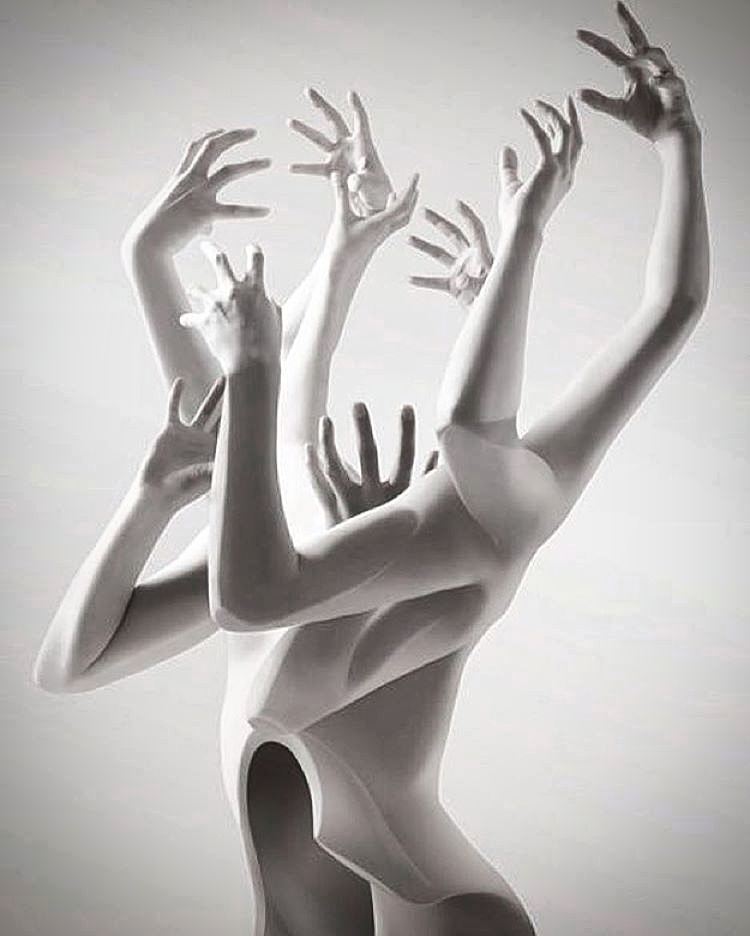
And by summoning the lie, we lent it as much insubstantial existence as it could possess. They had their will; they saw; they were torn in the terror. The significance of the Headless Emperor is not merely moral corruption. It is there that headlessness begins: but in him, evil has reached the last perfection of corruption, the final stage before dissolution—the only thing that is still there to decay further is the plain fact of being. That is why his body is so disgustingly distorted, with the acuity of the brain, the fertility of the sexual organs, the purposive activity of the hands, and the foundational dignity of the buttocks, all destroyed.


Hands Up by Stephane Benedett

✠     ✠     ✠

1When I say magic here, I mean the term quite seriously and simply: I’m not paying his verse a flowery compliment. Magic, i.e. the belief that the human will—either directly, or by commanding or entreating spiritual entities—can effect paranormal results, has existed since antiquity and continues to exist, in both noble and debased forms. Note that nobility and baseness here have nothing to do with virtue; the crudest cunning woman may at least mean well, while the gracious and sophisticated lady may be a murderess. Nor have either vulgarity or virtue anything to do with whether magic works, which is again irrelevant to its usefulness as a language by which to express truth; e.g., you could say that somebody’s ‘a textbook Virgo’ to describe their personality without assenting to, or even understanding, astrology as a discipline.
I believe there are innocent forms of the acceptance of magic (perhaps this was what let the Magi interpret the star correctly?), and that Williams was an exponent of that tradition; nonetheless, power corrupts, spiritual power corrupts more terribly than any other, and nearly every technique associated with the history of magic is perilous at best—often profoundly evil. The temptation to spiritual pride, the worst of all possible vices, is more aggressively present in the study of magic, I think, than in any other study except mystical theology.
2Logres (pronounced log-ress), related to the Welsh Lloegyr for England, is the name used by Williams, among others, for Arthurian Britain.
3The Twins evoke Romulus and Remus of imperial Rome and Peter and Paul of pontifical Rome. Sometimes Williams’ cosmos seems to exploit itself, as if eager to shower meaning on any attending mind.
4The Vision of the Empire α.1-11, β.1-7, 11-17, 20-23.
5From The Index of the Body, originally published in the Dublin Review and later anthologized in The Image of the City.
6If there was a historical Arthur, he probably lived in the late fifth or early sixth century, and it is certainly in this period that the tradition places him. The Prophet did not arise until the early seventh.
7I believe he drew this habit from Lady Julian, who, in her famous Revelation of Divine Love, frequently speaks of sensuality and substance, terms which partly correspond to the corporeal and the spiritual elements of human nature (though her usage is more complicated, and often obscure). It’s also likely he had the Scholastic use of substance in mind. Lady Julian herself may well have drawn her own wording, directly or indirectly, from the Schoolmen.
8The name P’o-lu (which Williams spelled several different ways) seems to be taken from a historical city in China, Po-lu-pao; that the Headless Emperor lives beyond P’o-lu is almost certainly significant, since Williams was very exact in his imagery. The description of the antipodes, in this poem and elsewhere, is also reminiscent of Chesterton’s words in The Everlasting Man about ‘Where Asia trails away into the southern archipelagoes of the savages … it is all the same story; sometimes perhaps later chapters of the same story. It is men entangled in the forest of their own mythology; it is men drowned in the sea of their own metaphysics.’
9The Vision of the Empire η.1-20, θ.17-35.