Collect

Collect for the Fourth Sunday after Trinity

O God, the protector of all that trust in thee, without whom nothing is strong, nothing is holy: increase and multiply upon us thy mercy; that, thou being our ruler and guide, we may so pass through things temporal, that we finally lose not the things eternal; grant this, O heavenly Father, for the sake of Jesus Christ thy Son our Lord, who liveth and reigneth with thee, in the unity of the Holy Spirit, ever one God, world without end. Amen.
Showing posts with label gay marriage. Show all posts

Wednesday, July 3, 2019

Brebeuf Jesuit vs Indianapolis Archdiocese: Electric Boogaloo

All extremes except extreme devotion to the Enemy are to be encouraged. Not always, of course, but at the present period. Some ages, of which the present is one, are unbalanced and prone to faction, and it is our business to inflame them. Any small coterie, bound together by some interest which other men dislike or ignore, tends to develop towards the outer world a great deal of pride and hatred which is entertained without shame because the ‘Cause’ is its sponsor and it is thought to be impersonal. Even when the little group exists originally for the Enemy’s own purposes, this remains true. We want the Church to be small not only that fewer men may know the Enemy but also that those who do may acquire the uneasy intensity and the defensive self-righteousness of a secret society or a clique. 
—C. S. Lewis, The Screwtape Letters
✠     ✠ ✠


You’ve likely heard of the clash between the Archdiocese of Indianapolis and the Jesuit-run Brebeuf Jesuit Preparatory School over the latter’s refusal to fire a gay teacher for entering a same-sex marriage. Cathedral High School, run by the Holy Cross brothers, did fire a gay teacher for similar reasons at the request of Archbishop Thompson, shortly after the Archbishop declared that Brebeuf would no longer be permitted to describe itself as Catholic. Given the ticklish situation, a.k.a. utter shitshow, that is Catholic-LGBTQ relations, evaluating this stuff is a delicate business, and this piece turns on a dime more than once in trying to sort out the details. I hope you’ll bear with me.

I waited a bit to weigh in on this because I wanted to have more facts at my disposal. Stories are easy to twist; I’m not an expert in canon law; I haven’t met any of these people; and certain relevant details to making a judgment have been, quite reasonably, kept private—even the names of the teachers in question, I believe, have gone unreleased, probably to protect them from harassment. The hate mail or even the loathsome ‘charity’ doled out by some Catholics even to avowed celibates who come out as gay is revolting enough.

For instance, one very pertinent detail that has gone unexamined (as far as I know) in the assorted hot takes on the dispute is: how do the two men in the civil same-sex marriage understand their union? I know more than one Side B couple, committed to chastely celibate lives, who are married in order to be able to extend legal benefits to their partner (insurance, hospital visiting rights, etc.) and who don’t consider this arrangement equivalent to the sacrament of matrimony. If the teachers at Brebeuf and Cathedral were in partnerships of that kind, surely there can be no objection to that? except, possibly, that it risks scandal, but that is easily addressed by just explaining the situation to the people whose business it is. I don’t consider this a likely description of the teachers in question—not because it’s intrinsically implausible, but because the Side B community is in fact fairly small; small enough that I might have heard about this through the grapevine instead of the news, if the teacher in question were connected with one of our groups—but it isn’t something that either the Jesuits or the Archdiocese seem to have considered.

The takes I’ve seen from Fr James Martin and co. have mostly focused on primacy of conscience, which, yes, is a vitally important Catholic moral doctrine. But conscience does not entitle people to their jobs, and disagreeing with Catholic moral teaching (as we may probably, though not certainly, suppose the teachers do) seems like a good enough reason to resign from teaching at a Catholic school. On the other hand, that is a reason to resign, which is not the same thing as cause to be fired. [1]


On the third hand, well, it isn’t intrinsically unreasonable for a Catholic school to ask its teachers to exemplify Catholic beliefs and values, about marriage as much as anything else. This last has, in substance, been the line of argument taken by the Archdiocese of Indianapolis. And canon law itself states that ‘teachers must be outstanding in … uprightness of life’—so the argument goes that since homosexuality is held by the Church to be contrary to natural law, i.e. that sphere of conscience which can be discerned by human reason without the special assistance of revelation [2], entering a gay marriage is ipso facto disqualifying to the ‘uprightness of life’ clause, even for a non-Catholic or non-Christian.

Here’s why I don’t buy that. For background, the text of the canons about Catholic schools, in a little more context, reads thus:
Canon 803 §2. Formation and education in a Catholic school must be based on the principles of Catholic doctrine, and the teachers must be outstanding in true doctrine and uprightness of life.
Canon 804 §2. The local Ordinary [normally a bishop] is to be careful that those who are appointed teachers of religion in schools, even non-Catholic ones, are outstanding in true doctrine, in the witness of their Christian life, and in their teaching ability.
Canon 806 §1. The diocesan Bishop has the right to watch over and inspect the Catholic schools situated in his territory, even those established or directed by religious institutes. He also has the right to issue directives concerning the general regulation of Catholic schools: these directives apply also to schools conducted by members of a religious institute, although they retain their autonomy in the internal management of their schools.
The thing is, Catholic schools habitually hire non-Catholic and even non-Christian employees, up to and including teachers, and the Archdiocese of Indianapolis hasn’t make a peep about that, to my knowledge. I’d be surprised if they had, given that it’s a longstanding practice of Catholic schools, hospitals, charities, and even parish offices. Yet if beliefs that are, you know, Catholic are key to being ‘outstanding in true doctrine’—and I’d hope most Catholic bishops would feel that they are—then how in the name of Elvis is it okay to violate one aspect of Canon 802, but then trot it out as a reason to fire someone for transgressing a different aspect of the exact same canon? How come having a teacher who denies Catholic doctrine as a Protestant or an observant Jew or even an atheist is fine, but having a teacher who denies Catholic doctrine [4] as a gay man is not?

Someone could argue that, e.g., Jews and Protestants are of different faith traditions, and faith is a supernatural gift rather than a matter of natural law, so it isn’t fair to hold them to the same standard. Fine. But why do the beliefs of a gay man (perhaps devoutly religious; look at Pete Buttigieg) count for nothing in this equation? If his religious tradition and convictions inform him that gay sex is intrinsically innocent, then of course we as Catholics disagree, but are we also saying that his religion has somehow ceased to be a religion for that reason? Are we saying that it’s okay to hire Jews and Protestants as long as they’re Catholics? And what about the agnostic or the atheist employee, whose absence of belief or positive disbelief are also described by the Church as being contrary to natural reason? If there are any (and it’s not unlikely), has Archbishop Thompson come down on them?

Maybe canons can be applied with prudent, pastoral consideration by bishops; maybe they can even bent as long as they’re not broken; I don’t know, I’m not a canonist. If they can, I think the Archbishop has in fact acted with great imprudence and in a profoundly unpastoral manner. Applying canons strictly only when it targets LGBTQ people is homophobic, even in the very restrictive definition I gave to it in this post from a few years ago (dating to before I’d lost all moral confidence in the hierarchy). The Catholic tendency to scapegoat gay men is unjust and unreasonable, contrary to the explicit teaching of the Church, and damaging to LGBTQ people in general, especially young people.

Moreover, it causes the exact thing it’s typically framed to avoid: scandal. The world at large already knows the Catholic Church thinks gay sex is wrong. It’s often one of the few Catholic doctrines they do know, in contrast to little things like the Real Presence. Accenting the teaching on homosexuality is not nearly such an urgent necessity as people who are extremely comfortable with that teaching tend to insist. But what a great mass of those outside the Catholic Church do think, is that the Church hates gay people, and that that’s where the teaching comes from. The latter is, I believe, false. Is the former false too?


Think about it. When an archbishop singles out gay people who live out of line with Catholic beliefs and ignores straight people who do the same thing, what message does that send? Not just to gay people and to the world at large, but to the very students they are trying to form as Catholics? Doesn’t it matter that they’re being presented with a decision that, at the absolute best, is going to look like a homophobic double standard? and in the exact, perfect situation where they could have been given a beautiful example of how to respect and embrace people whom we deeply disagree with?

It’s been said that when the Vandals invaded Africa, St Augustine remarked, ‘God has called us to evangelize the nations, and he has just brought the nations to our door.’ How much more is that true of people who aren’t marauding through the countryside in full Conan-mode?

✠     ✠ ✠


[1] Kindly don’t come to me with any ‘He wasn’t going to be fired, they just wouldn’t have renewed his contract!’ nonsense. When you’re relying on a job, losing it is losing it, and the pedantic reasons offered by your ex-boss for why it isn’t his fault do not matter.
[2] For instance, the obligation not to murder people is an obligation we know by natural law [3], an extension of the morally intuitive Silver Rule (do not do unto others what you would not have them do unto you); it comes from God like all right and wrong does, but it didn’t need to be specifically revealed to us by supernatural means: the natural witness of conscience and intellect are enough. By contrast, the obligation to get baptized is something we could never get to just by thinking it out. It was revealed by the personal command of Christ, and has since been passed on from one person to another. The Church claims not only that having gay sex is wrong, but that we can know it’s wrong apart from revelation, by natural conscience and reasoning.
[3] I don’t actually subscribe to natural law theory myself, but I’m trying to articulate the argument as well and fairly as I can.
[4] Always supposing the teachers in question do deny Catholic doctrine. Again, that’s plausible and statistically likely, not certain.

Thursday, May 12, 2016

Gay and Catholic, Part VI: Making a Case for Side A

On their part, all men are bound to seek the truth, especially in what concerns God and His Church, and to embrace the truth they come to know, and to hold fast to it. This Vatican Council likewise professes its belief that it is upon the human conscience that these obligations fall and exert their binding force. The truth cannot impose itself except by virtue of its own truth, as it makes its entrance into the mind at once quietly and with power.
Dignitatis Humanæ (Declaration on Religious Freedom), Second Vatican Council, §1


✠     ✠     ✠


A newly baptized Malachi Selmys being held by his godmother, with his fairy godfather on the right
(hence my trip to Canada). This has nothing to do with this post, but I'm still kinda bubbling.


My series up to this point has been primarily aimed at building up a positive case for why I am a Side B gay Christian. I hinted at why I’m Side B rather than Side Y1 here; I've written more than once about why I left the ex-gay movement, so here I'll just say briefly that I’ve found both from my own experience and the testimony of others that ex-gay theory is intellectually unsatisfying, its practice is almost entirely ineffective, and its history is stained with psychological abuse. One thing I’ve written about very little is why I’m not Side A—except in my post on the clobber passages, and even there I said in so many words that those aren’t the primary reason I’m a traditionalist.


The positive case is of course more important. No one has a vocation of ‘No,’ and no one can have a theology of ‘No,’ either. Trying to pursue celibate chastity on that basis won’t work, and it’s a great recipe for hurting yourself to boot.2 But the positive case is not enough, for a few reasons, one of which is that the positive case for Side A is an attractive one.


Others, notably Matthew Vines in the popular sphere and James Brownson in the academic, have made that case more extensively than I propose to (since their work is easy to find). Now, there is variety among Side A believers, naturally. However, the argument for Side A that I find most convincing and appealing runs roughly as follows.


Thomas Cole, The Garden of Eden, 1828


God made mankind, and declared that it is not good for man to be alone: man is made for communion. There are multiple ways in which that human need is fulfilled, and God does call some people to celibacy. But for most people, the kind of communion that we find most powerful and fulfilling is being united to another person whom we love in marriage—a permanent, self-giving bond by which two people agree to share their hearts and even their bodies with one another. For gay men and lesbians, that kind of love is experienced for members of the same sex, rather than the opposite sex; and, especially since involuntarily infertile heterosexual couples have long been blessed by the Church, there is no obvious reason why homosexual couples should be excluded from enjoying the same blessing, by the Church or by her God. It is understandable that this should have been an unfamiliar idea to the authors of Scripture, for several reasons: most people are straight; categories of sexual orientation didn’t exist in the ancient world; and the brute fact is, there were cultural institutions like slavery that we unhesitatingly reject, which the Scriptures simply accept3—it doesn’t seem hard to believe that here, as there, Christian understanding has made an advance under the influence of the Holy Ghost.


Like I said, it’s an appealing case, not only emotionally but intellectually. I don’t for one moment assert that Side A Christians are dishonest, ignorant, or overwhelmed by wishful thinking. I assert that they’re incorrect, but that’s as far as I need to go and as far as I care to go. But, I do assert that they’re incorrect, and I wouldn’t feel that I’d done justice to this subject if I avoided explaining why I think so.


The first point is that, in the Catholic view—which was the universal Christian view until quite recently—marriage involves something more and other than a lifelong commitment to mutually sharing life with another person: it involves being open to life, that is, to childbearing. If God does not see fit to bestow life, that’s okay. But this can’t be excluded or altered, and it abides in the character of the sexual act. We believe that God cares not only about why we do things, but also about what things we do. If a couple can’t be open to life, even their wishing that they could be can’t change the facts; and, on Catholic premises, this means that while that couple may have a profound and, perhaps, deeply holy love for one another, that doesn’t make it the same thing as a marriage.


The Church has been teaching this, in so many words, for a long time. Support for this view is rarely, if ever, made explicit in Scripture, probably because it was taken for granted from time immemorial down to the nineteenth century.4 If you had told them that marriage existed to make people happy, they’d have laughed in your faces. And while I’m an incurable romantic by temperament, I’ve also inherited enough of my dad’s dry and cynical wit to say that the observable facts of human marriages and human romances line up better with our ancestors’ laughter than with our cult of matrimony.


Meanwhile the negative argument from Side A—that the Christian track record on things like slavery is a pretty mixed one (to put it generously), and that therefore this could be another instance of positive change in doctrine—has never been satisfying to me. That the Church has made such-and-such a mistake is a very good argument for her to repent of that mistake; it is not a good argument for anything else. It’s a good reason to analyze a belief carefully, especially if the only argument that’s being advanced in favor of that belief is that it’s traditional, but I don’t think I’ve ever encountered a traditional Christian, B, X, or Y, whose only stated reason for their views is tradition. And, speaking for myself, I’ve re-analyzed and found the belief at least as strong as it was before.


It also seems to me to fail to fully grasp the character of Christian tradition. It’s true that there have been slave-holding Christians since the beginning of the Church, and that the Church failed to oppose slavery firmly until the nineteenth century. But it’s also true that there has always been a kind of counterweight to this, in the form of Christians who have fought to improve the lives of slaves, limit the trade, and even abolish the institution: St Patrick, himself a former slave, was a major force against the trade in fifth-century Ireland, and similar criticisms can be found in the writings of Fathers like Augustine of Hippo, Gregory of Nyssa, and John Chrysostom. Or, to take a quite different example, the belief that babies who died without baptism would be sent to Limbo,5 rather than being taken into heaven, was a normal Catholic view for many centuries; but at the same time, since at least the fifth century, the Feast of the Holy Innocents presents the Church’s conviction that the pre-rational young can be not only innocents but martyrs. Or to take still another example, the Church’s dirtied hands in wars, especially religious wars: at the same time, there were always counterweights, like St Francis, who traveled personally to the Sultan in Egypt during the Fifth Crusade, not only to preach the gospel but, reportedly, to apologize for the sins and violence of Christians against Muslims.


The point is, when there is an apparent shift in the Church’s teaching, or at the least in her emphases, we generally find that the shift is from one strand of Christian thought to another that already existed. I don’t find that to be true about gay sex. There’s a variety of views in Christian history, to be sure: some harsh and some gentle, some sternly diabolical and some placidly medical. But they’re united in one thing, which is that none of them approve of it. The only context that the Church has ever recognized for righteous sexual intimacy is that of the marriage of one man to one woman, for life and open to life. There’s no counterweight.


And that makes it impossible for me personally to take any other view; at least, impossible to do so and remain a Catholic. I can’t truly convince myself that the modern view of homosexuality has been implicitly or subtly present in the Church’s teaching since the beginning. Other people may be able to believe this honestly, and I don’t begrudge them their convictions, but I just can’t.


Which leaves us with only the strongest and most tragic argument for Side A: how could God do this to us?


✠     ✠     ✠


1As I’ve dubbed it. For readers who are familiar with the Courage Apostolate, Harvest USA, or Regeneration Ministries, these are more or less what I mean by the phrase Side Y: not ex-gay, but generally resistant to gay identities and cultures, unlike Side B, which is more comfortable with them (though not giving them carte blanche).
2Not that pursuing celibate chastity in a positively constructed form is guaranteed to work; only that (in my opinion) pursuing it on a negative basis is virtually guaranteed to fail. Nothing is guaranteed to work—a fact which apologists for the Catholic view seem to have great difficulty accepting, and say too rarely. My hunch is that they are (perhaps unconsciously) afraid that admitting that chastity is not merely difficult but, for some people, a bitterly lonely, excruciatingly painful road to walk, constitutes a philosophical weakness in Catholicism. I don’t know whether it’s a weakness, but I’m quite sure that trying to avoid this truth is a scandal: people like me, who heard such glowing ‘reviews’ of chastity and then found out that it can mean enduring literal years of heartbreak, are apt to feel we’ve been lied to. Stephen Long has written with scathing accuracy on the casualties of this kind of moral triumphalism.
3When I say accept here, I don’t necessarily mean that the Scriptures approve of slavery. Plenty of people would argue, especially in the context of the Old Testament, that they do just that. I don’t take that view, personally; I consider it analogous to divorce, of which Jesus said that Moses permitted it because of the hardness of your hearts—or, as Msgr Ronald Knox put it in an Oxford lecture, that the Torah allowed men to divorce their wives out of fear that otherwise they might strangle them. But this can be set aside. The point is, even those Christians with a high view of the authority of the Bible are not bound in all cases to apply its teaching the same way as its original audience. I mean, in reading Philemon or I Peter or Ephesians, I’ve never heard of a Christian who felt obliged to go and buy slaves, or sell himself into slavery, or both at the same time, in order to observe the prescriptions of the text as the ancients would have.
4In saying this, I’m oversimplifying slightly. Our most distant ancestors, in the pre-Christian world, tended to accept both polygamy and divorce on grounds of barrenness, and the Church had a difficult time for a while in getting people to accept that a marriage which did not produce children was just as permanent as one which did; something along these lines seems to have been in Henry VIII’s mind. But of course, this is leaning in the opposite direction from the Side A view and its intellectual relatives.
5For those unfamiliar, the Limbo of Infants is a realm where, without being actively punished, a soul continues in its natural immortality without the special, supernatural joy of union with God that those in heaven enjoy. This would be the fate of those who died without baptism (whose souls are therefore not infused with sanctifying grace), but who also died without reaching the age of reason, at which deliberate sin becomes possible. Contrary to popular belief, Limbo is still a licit belief among Catholics, but the general opinion now tends to favor the idea that God extends grace to unbaptized children who die before the age of reason, in a way known only to Himself, instead of through the normal instrument, baptism.

Monday, September 7, 2015

Contempt of Conscience

You've probably heard of the Kim Davis case by now. And, if you haven't, congratulations on being the first person to reach Mars.


Who's a geek now, Steve?

Anyway, in case you do happen to be reading from the red planet, Kim Davis is a county clerk from Kentucky who has been jailed for contempt of court, after refusing to issue marriage licenses to gay couples. Since the Obergefell vs Hodges ruling in June, a number of counties have entirely stopped issuing marriage licenses in order to avoid issuing them to same-sex couples; Rowan County, where Davis worked, among them. Last month a federal court ordered that marriage licenses must be issued; when Davis continued to refuse, she was imprisoned. (The plaintiffs -- two gay couples, two straight couples, and the ACLU -- had asked only that she be fined, but the judge in question dismissed this as ineffectual, on the grounds that the fine would be paid for her by supporters.)

Most of the people that I've seen talk about the case on social media have been on the side of the courts: admittedly, when she originally took the job, she had no way of knowing that it would later come to require of her that she transgress her conscience; but that's what the law does require now, and if she refuses to do that then she ought to resign. It's easy to see the strength of such an argument. Nor is it without precedent; St Thomas More chose to resign in silent protest when Henry VIII defied the Church by repudiating Catherine of Aragon and marrying Anne Boleyn.

And Davis' own defense -- that she has divine and biblical sanction for her actions -- is a dubious one. That is, there is no reason to suppose that her beliefs are insincere in any way, but one can hardly maintain that those religious beliefs are relevant to civil law; the separation of church and state is enshrined in the First Amendment (not phrased in those words precisely, but it really doesn't matter; what's at stake is the substance of it), and to obtrude a solely religious basis for a political act is, in consequence, dodgy, especially as a state official.


The Catholic Church takes a slightly different angle in its objections to gay marriage. Its contention is not that gay marriage contravenes the Bible's definition of marriage, but that the natural character of marriage, apart from any question of divine revelation, is directed toward bringing children into the world. And this is certainly how most societies in most places and times have viewed marriage, which is partly why polygamy, divorce on grounds of barrenness, and the keeping of concubines have so often been culturally acceptable. (We may, of course, regard this general witness of humanity as inadequate to change our own minds, but whatever that witness is worth, this is its testimony.) Hence, a gay union, because it can't produce children, is regarded as not being a marriage ipso facto. It certainly doesn't follow from this that no legal recognition could or should be given to gay unions; only that the specific kind of recognition accorded to marriage should be unique.

If this, rather than marriage as found in Scripture, were Davis' position, she'd be in a much stronger position -- for in that case, she would be not refusing to obey a law because it conflicted with her religious faith, but refusing to obey a law because she thought it was unjust. As things are, she does seem (in my view) to be blurring the categories of civil and religious obligations, and resignation would probably have been a neater and more conscientious solution. It's partly for this reason that, though I am a fervent defender of religious liberty, I don't see this as essentially a question of religious liberty, because I don't think the nature of marriage is a specially religious question in the first place.

But, though I disagree strongly with the grounds on which she made her decision, I'm not writing this to criticize Kim Davis' actions. I'm writing to praise her.

By obeying her conscience and peaceably accepting imprisonment, Davis has entered the high tradition of civil disobedience. Indeed, refusal to comply with a law and accepting the penalty for your refusal is civil disobedience in a nutshell. Gandhi, one of the great sages of that tradition, taught with great care and emphasis that the thing that makes passive or civil resistance righteous is precisely this decision to accept the consequences, to suffer in oneself rather than inflicting suffering on others by violence -- and, incidentally, pointed out also that if a person is mistaken in their views, civil disobedience has the advantage of causing only themselves to suffer for the mistake. Martin Luther King followed the same teaching, influenced by students of Gandhi and Christian pacifists.

I would, also, pose a question to those who criticize her for failing to do her job. Without wishing to cast any doubt on the sincerity of your beliefs, have you ever gone as far as she has in standing up for what you believe? Could you go to prison in defense of gay marriage? What, in fact, did you do for gay marriage, aside from some Facebook likes and a drunken rant to a friend after your poli-sci midterm?


Kim Davis (probably)

And the members of this tradition are frequently found guilty of contempt of court, because they consider themselves answerable to something else: their consciences.* I have nothing but respect and support for that. I for one would far rather be found in contempt of court, than know within myself that I am guilty of contempt of conscience. To carry that knowledge with you, sleeping and waking -- no. And while an individual may be mistaken about right and wrong, that's true of courts too. Unjust laws, and for that matter unjust judges, have existed at least as long as history -- that was kind of the point of the gay rights movement, wasn't it? Law itself is worthless unless it embodies justice; justice is superior to all law; and justice is known, not by legal fact or precedent, but by the inner witness of the soul as tutored by the intellect. A person can be persuaded that their beliefs are incorrect, and therefore change them. But as long as they do hold those beliefs, obedience to them is what makes for a clear or a guilty conscience.

People will say that Kim Davis is no MLK. Certainly not. And, yes, her own track record on marriage is by no means a perfect one.** But we do not earn the right to obey our consciences by being saints already, or even mere heroes. Obeying your conscience is what raises you to heroism. I think that Davis' decision to follow the path of civil disobedience in this case, even though I disagree with her grounds for doing so, ennobles her.


*All of the civil resisters that I know of have also been religious; their obedience to their consciences has been inviolable to them because they believe that conscience is, in Newman's phrase, the aboriginal Vicar of Christ. While this trend is certainly present, I don't know that it's necessary to civil disobedience. I see no reason why an atheist or an agnostic couldn't make a good civil resister. Furthermore, insofar as these acts are a testimony to conscience and an urge to others to heed their own consciences, I don't believe that civil disobedience involves us in the mixed-up premises that Kim Davis has espoused.

**She has been married four times (twice to the same man). A good deal of chaff has been blown up over this fact. I'd point out a few things in response: first, that her experience of religious conversion only took place in 2011, so that her zeal on matters marital may well be a recent and comparatively unsoiled thing; second, that we are not privy to the nature and circumstances of her marriages (or not that I'm aware), which could possibly be innocent or at least very pardonable, and that presuming the worst of others is an ugly way to behave; and third, that having a poor moral history oneself is not a good reason to transgress one's principles further merely because it would be consistent.

Saturday, April 25, 2015

Five Quick Takes

I.

I am sick as a dog right now; I've got one of those awful, blitzkrieg colds that abruptly sets up shop in your nasal passages and won't go away. My head feels like Keith Richards has been living in it: my throat is sore, my nose is running, my eyes are burning, and my sneezes have become that wretched hot-breath kind that build up beforehand and sort of linger afterward. On top of which, my roommate has already turned the heat off, but the cold snap Baltimore's gotten means my room feels like a broken fridge, so I'm slowly accumulating a sort of nest in my bed where the blanket is, with orange juice and bottled water beside me, as well as a rapidly increasing plateful of kleenex (stop judging me, I was having dinner and then when I finished the trash can was far away). I've also discovered that Safeway-brand generic Mucinex tastes like grape-flavored candy. Related: fuck you, twenty milliliters every four hours, I'm a grown-ass man, and I'm going to do what it takes to make this virus take a dirt nap.

I've also been marathoning Red vs Blue, which I never saw start to finish back in the Before time, and is now on Netflix. Watching Caboose and Donut and Grif kind of makes me feel smart, butch, and industrious.


"That guy Tex is really a robot ... and you're his boyfriend! So that makes you ... a gay robot."

Life is glorious.

Anyway, if you'd pray for me, I'd be grateful. Maybe give a shout out to St Blaise, if you're into that.

+     +     +

II.

You may already have seen in the news that a sizable earthquake struck Nepal near Kathmandu this morning. An avalanche also occurred, and the death toll currently stands at something like 1400 people, I understand. Prayers for them are earnestly solicited; UNICEF and Oxfam are already setting up relief efforts, as are Catholic Charities and a number of other humanitarian organizations.

+     +     +

III.

There have been some fairly good articles on the gay marriage controversy of late. Two that stand out, because of their fair-minded and courteous approach from one side to the other, are Frederica Mathewes-Green's post on why she hasn't been culture-warring against gay marriage (though she is an Orthodox Christian), and Damon Linker's piece at The Week in defense of Ryan T. Anderson and of respect for differing convictions generally (though he supports gay marriage). Reading thoughtful, even-handed essays like these makes me miss Andrew Sullivan being at The Dish again.

+     +     +

IV.


Sufjan Stevens and Florence + the Machine both have new albums out -- Carrie & Lowell and How Big, How Blue, How Beautiful, respectively -- and I've fallen in love with them both all over again.

Florence Welch's sound is as magnificent as it was on Lungs and Ceremonials, and has a new, rock-like energy infused into it, notably on "What Kind of Man," whose music video incorporates her characteristically enchanting religious imagery and gripping violence. She's one of the few artists I've ever heard do justice to the ferocity that erotic love can have; many are content to write and sing merely of the joys and sorrows it imparts, and God knows there are enough of those. But romance would, in the end, be insipid if there were no sense of danger in the beloved, and Florence + the Machine's music is full of danger, and of the quasi-mystical exaltation that is so often connected with both danger and romance (the music video for "No Light, No Light" is a splendid example of this).


Carrie & Lowell, meanwhile, features a return to the indie folk of Sufjan Stevens' work before the experimental electronica of The Age of Adz, sounding almost like a throwback to Seven Swans, but with a buoyancy of its own, faintly reminiscent of Illinoise. The sheer volume of music he has put out in so short a span of time -- his first studio album came out in 2000, and since then he has released six more, plus two Christmas albums, a multimedia album, and a B-side album -- would suffice another musician for an entire career, and his craftsmanship is incomparable. His complicatedly Christian themes (which always remind me a little of Flannery O'Connor for their combination of devout faith with honest, gritty grappling with the anguish and mysteries of living) persist here, particularly in "No Shade In the Shadow of the Cross," "Drawn to the Blood," and "John My Beloved." I'm swimming in it.


+     +     +

V.

... Bleh. I can't think of a fifth thing. I just thought of four things. Isn't there any end to the things? It's like -- ehrmagehrd, there is a "Donut: The Musical" video!


I said stop judging me!

Thursday, January 15, 2015

Requiem

It seems that the culture war has outdone itself. According to these articles, a church in Colorado recently canceled a lesbian woman's funeral on the day it was supposed to be performed, leaving her loved ones to find a new venue.


The church reportedly objected to the presence, in the memorial video, of footage of the deceased (Vanessa Collier) proposing to her wife and kissing her.* The deceased's family wouldn't alter the video, and, fifteen minutes after the memorial service was scheduled to start, the church announced that the funeral would have to be moved owing to technical difficulties. I suppose that might be true, though I admit I'm finding it extremely difficult to give New Hope Ministries the benefit of the doubt here. To try and do so, I'm going to observe here that this may or may not be exactly what it looks like, and proceed to talk about what it seems to be, while acknowledging that I can't read hearts and know only what I've read about it online.

This, fellow Christians, this is what we're talking about when we talk about Christian homophobia. There are certainly queer-identifying people who will brand any and all disagreement with themselves as homophobic,** and that isn't fair. But refusing to bury someone? The Pharisees didn't pull that shit with Jesus. A funeral is not an endorsement of a person's whole life, nor even of all their beliefs. It's a funeral; that is, one of the classical works of mercy.

The Catholic Church has for centuries used the teaching device of the Corporal and Spiritual Works of Mercy. They are derived partly from the terrifying parable of the sheep and the goats in Matthew 25. They are:

Corporal
1. To feed the hungry
2. To give drink to the thirsty
3. To clothe the naked
4. To harbor the harborless (or to shelter the homeless)
5. To visit the sick
6. To ransom the captive (or to visit the imprisoned)
7. To bury the dead

Spiritual
1. To instruct the ignorant
2. To counsel the doubtful
3. To rebuke the sinner
4. To bear wrongs patiently
5. To forgive offenses willingly
6. To comfort the afflicted
7. To pray for the living and the dead

Now obviously some of these are rather specialized. It isn't everyone who has, or can raise, the resources to ransom the captive; to instruct the ignorant requires that we ourselves not be among said ignorant; to comfort the afflicted may depend on personal intimacy with them, and even at times on a kind of pastoral expertise that we may not possess; and to rebuke the sinner is perhaps the most difficult of all these -- most difficult, that is, to do with a genuine spirit of mercy -- and I personally think that it demands of us a sense that the rebuke is also for ourselves if it is to avoid corruption.

But burying the dead is not one of these. If it comes to it, all it requires is good will and a shovel. And churches, in the western world anyway, are not generally reduced to such bitter and wholesome circumstances.

I'm not saying that everyone has a right to be buried by any church they approach, either. But on the pastor's own showing, he knew Mrs Collier personally, and knew that she was not only a lesbian but a partnered one, with children no less. That he and his church don't approve of homosexual relations is perfectly within their rights, but performing a funeral for a lesbian, as far as I can see, doesn't imply anything about that one way or the other. If the memorial video had contained, say, lesbian porn, I could understand the objection, but so far as I've read it didn't; and it seems to me that both charity and decency should have moved New Hope to keep the commitment they had already made (and had already accepted money for -- though the ministry says that that has since been returned).


Bisexual author Eliel Cruz tweeted about this, asking friends and allies to process this with him, and challenging us all to ask ourselves what we can do about this. Some responses to the first, which show a side of the problem of scandal rarely acknowledged by some Christians, included:
This story makes me feel like a second class citizen with no safe place outside an explicitly affirming congregation/church. -- Anonymous 
Even in the grave, they'd rather we stayed in the closet. -- Lindsey and Sarah 
I feel worthless. That's it. I feel worthless ... Dehumanized. The image comes to mind of HIV/AIDS patients being put into trash bags for fear of contagion. -- Eliel Cruz
And, saddest of all:
It reassures me that I made the right decision in leaving the church. -- Kelsey Lela
This is the cost of this kind of behavior. Christian brethren, my queer brethren and I (believing, unbelieving, anti-believing, incapable any longer of believing) are the cost. And my queer brethren and I are human beings, not a cost-benefit ratio.

And what is it that we can do? Well, let's begin by hopping back to those works of mercy above. First we can bear wrongs patiently and forgive offenses willingly. To what purpose? Well, first of all:
I say more: the just man justices;
Keeps grace: that keeps all his goings graces;
Acts in God's eye what in God's eye he is:
Christ. For Christ plays in ten thousand places,
Lovely in limbs, and lovely in eyes not his,
To the Father through the features of men's faces.***
To be the love of Christ that we want the world to possess is an admirable and adequate reason to be possessed by the love of Christ. And if we really want the world to be fully of love and compassion, we must be consistent and begin with offering our own hearts and wills up to God.


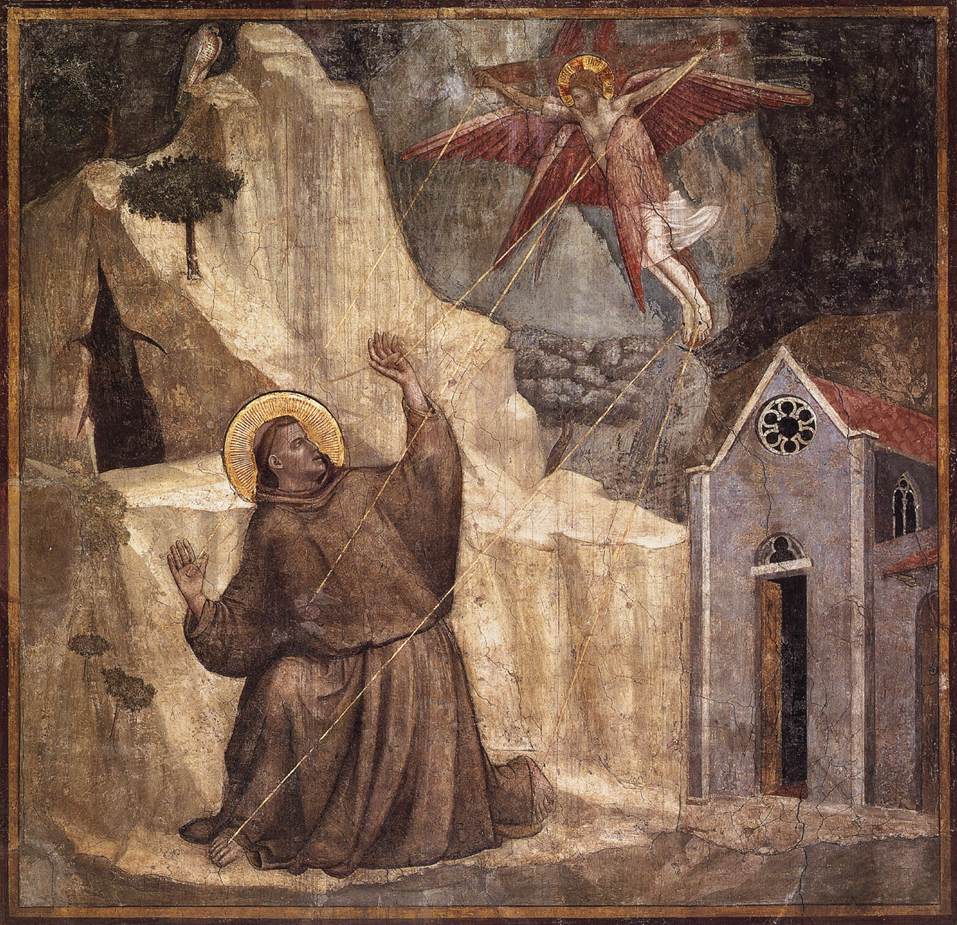
Saint Francis Receiving the Stigmata, Giotto, ca. 1320

If it be answered that the people concerned don't deserve forgiveness, well, I would point out as I did above that even now, I don't think we technically know what or how much they did wrong. And that does matter. But it isn't the point, because the brute fact is that nobody deserves forgiveness. That is what forgiveness means.**** And if it be pointed out that the command Love thy enemy applies to our own enemies rather than other people's, then it is worth asking on what basis we propose to hate anybody. For we only hate people when we regard them either as our own enemies in point of fact, or as our own enemies by proxy through identifying with someone we love. And whether in the normal way or by proxy -- that is, through the Coinherence -- they are made proper objects of forgiveness by our decision to regard them as enemies.

And what then? Well, for the vast majority of us, living outside Colorado, there is little we can do from a pragmatic point of view. But we can practice the seventh of the spiritual works of mercy. We can pray for the living (for the repentance of the offending ministers, and for the consolation of those whose grief was thus outraged) and the dead (for the repose of Vanessa Collier's soul).


Requiem aeternam dona eae, Domine: et lux perpetua luceat eae.
Rest eternal grant unto her, O Lord: and let light perpetual shine upon her.

I've got to say, one thing that has impressed me about the LGBT community since I became, however ambiguously, a part of it, was the astonishing number of us for whom patience, compassion, and forgiveness, even towards bitter enemies, is a normal and natural thing. There are loud, obnoxious, and deeply hateful specimens among us -- the reverse side of Westboro Baptist Church, if you will -- and that is to be expected; it's to be expected, too, that they should get more media attention (both mainstream and specifically Christian) than their holier counterparts. But time and time again, I have seen queer people, some of them Christian and some not, rise to the occasion of mercy magnificently. I hope we see that again here -- I think I've seen bits of it already. And I hope it bears fruit.


* In saying "her wife," I am not disclaiming the Catholic teaching about marriage. If my protestation, derived from St. Teresa, is held an inadequate profession of orthodoxy, then I specifically affirm here that I receive the Church's teaching about the sacrament of Marriage in all docility and affirm it entirely, up to and including the political belief that natural, and therefore civil, marriage is properly between one man and one woman only. However, neither charity nor good manners seems to me to smile on putting scare quotes on the relational identifiers of a deceased woman and her grieving loved ones; and in any case, I've never heard of anybody being persuaded of orthodoxy by someone else's terminological pedantry.

**Indeed, the first of the two articles I've linked appears to be guilty of this, conflating the disruption of funeral observances in this case, and in Tampa last year, with the rather different difficulty of a woman being refused Communion at her mother's funeral in 2012 in the D.C. area. I call this a rather different difficulty because, on the one hand, nobody has the right to receive Communion -- even to those who are eligible to receive it, it comes as a gift, by nature, and not something that can be demanded on the ground of any justice, and a gift that the Church which stewards it is occasionally obligated to refuse to people -- but on the other hand, Cardinal Wuerl appears to have said that the priest acted out of accord with the disciplinary policies of the Archdiocese.

***From Gerard Manley Hopkins' sonnet As Kingfishers Catch Fire.

****The clip, unfortunately, does not contain a correct understanding of what the word Purgatory means; but since Joss Whedon's theology is not particularly technical I think we can leave that to one side for the moment.

Tuesday, August 6, 2013

Raw Tact, Part II: The Brother of Beatrice

In keeping with my last, I want to continue from a highly subjective point of view. I consider objective truth infinitely more important than subjective truth; but subjective truth is still, in its fashion, true, and all truth must be communicated in a personal -- that is, a subjective -- context, because people are not objects but subjects. (If you happen to be squeamish about descriptions of homoerotic affections, even without any question of overt acts, you may want to skip this post.)

I fell in love for the first time when I was seventeen years old. I had just started college (long story), and that's where I met Victor.* He was a year older than me -- well, I suppose he still is a year older than me, but anyway. He was uncommonly good-looking, in that sort of rough-around-the-edges way that outdoorsy guys so often have: scruff, callused hands, a hilariously graceless dance step. But the things that really captivated me were his intense devotion to Jesus and his friendliness to me. I told him, trembling and ashamed, that I was gay while we were on a retreat with one of the campus ministries we were both involved in, and the first words out of his mouth were grace and acceptance. He radiated grace; meeting him was for me what meeting Beatrice was for Dante: Hic incipit vita nova, "Here beginneth the new life."

I don't think I'm overstating this. Falling in love is, of course, a very ordinary experience in one way, and does not have any intrinsic spiritual significance. Yet for many people, it is in fact a means through which God makes Himself manifest, and my enchantment with Victor was -- and remains -- one of those: thinking of him always calls me to a higher level of focus upon and surrender to God, irrespective of the cost. (That isn't to say I always heed the call by any means, but the calling remains.)

But of course there was conflict too. Not conflict with him, although we did disagree about some things, but conflict within myself. I knew already that gay sex was wrong; did it follow that gay affections were wrong? Must I abandon my romantic feelings? Could I even if I had to? That question was easily answered: I was powerless to feel otherwise than as I did. I spent two years pining in agony, wishing for the impossible requiting of my affections from a man who was not only a serious, not to say scrupulous, Christian, but quite possibly the most emphatically heterosexual guy I knew. (Not that he was a homophobe; I never once had a harsh or disdainful word from him about that.) His very holiness made me love him more -- was that better? Worse?

I came out of those two years an emotional wreck, tired and desperate. In retrospect, I don't think it's a coincidence that it was after Victor and I more or less parted ways (since we transferred to different colleges) that I tried to persuade myself that pro-gay theology was correct.** I was spiritually, intellectually, emotionally, even physically exhausted.

I did recover, largely through my conversion to the Catholic faith, which gave me nearly all the tools I needed -- Confession, spiritual direction, the writings of the saints and mystics, the Rosary, a ritual language with which to process my turbulent and often mysterious emotions, and, above all else, Christ in the Eucharist. But I could not have come to those very things -- not, at any rate, as I did -- if I had not fallen in love with Victor first. It broke me down in the way I needed to be broken down to be able to accept the Catholic faith, not as the conclusion of my own triumphant reasoning, but as salvation.

It is largely this which forbids me to regard homoerotic affections as being wrong or bad. There are other reasons -- as, for instance, that I don't think of romance as exclusively or chiefly a by-product of sexual desire, and so to make the jump from the wrongness of gay sex to a hypothetical wrongness of gay romantic love is an invalid inference, at any rate on the premises I hold. But my love for Victor so transfigured me -- saved my life, in fact -- and pulled me so consistently closer to Christ, and does even now, that I just can't react to it as something dirty.

Why talk about all of this? For two reasons: one is that everything has to be put in a personal context, as I have carved into the table before me and keep hammering with my shoe.

The other is that this is the matrix in which the discussion of homosexuality really has to take place. Whether or no a person falls in love, or, in doing so, experiences the affection sacramentally, this is one of the chief places where straight and gay experience both intersect and prove themselves alien to one another. The passionate sense of worth, beauty, and meaning -- hardly to be expressed save by the word glory -- that attends erotic love is something that lovers of every kind are acquainted with. There's a reason that Brokeback Mountain works about as well as Romeo and Juliet (and it isn't only that Jack and Ennis are less annoying than a pair of Veronese teenagers with no sense of proportion). But the divergence shows itself already in the dawning experience of first love: for a straight person, the first time your heart stops, it's thrilling and beautiful and you suddenly know what everyone was talking about all this time. For a man like me, that element is there in first love; but with it -- guilt, confusion, fear. The swoop in the stomach that one adolescent boy feels for a girl is matched by the swoop in the stomach that another boy feels for a boy; but the one has a public tradition of sexuality, including romance and theology as well as pop culture, to guide him, while the other may well be rudderless.

This is also part of why gay marriage is such a sensitive topic, and why the commonplace polemical attitude adopted by so many Catholics has been far worse than useless, speaking from an evangelistic perspective. The heterosexual traditionalist Christian has a sacrament by which romantic love, a perception of glory in an individual creature, is made a formal vehicle of Divine grace, as well as a respected institution in society, and among one's Christian friends and one's family in particular. That, as related specifically to erotic love, is something that the gay traditionalist Christian normally does not have.*** When that experience of loneliness crowned with loneliness is met by lectures about disordered inclinations, and left at that, it is idle to protest that accusations of homophobia are a conspiracy to silence the Church -- because even if Catholics aren't homophobes, their actual behavior is so clumsy that it seems a more economical explanation than otherwise.

Of course, rather than trying to imagine what it would be like to feel what I felt for Victor, a much simpler expedient can be used. Imagine for a moment (if you are straight) that the shoe was on the other foot, and that the person whom you loved was out of the question -- not because they were claimed by someone else, but because it was wrong to act on your heterosexual impulses. How would you feel? How would you propose to live? How would you relate to God?

*For his privacy, I have of course used a pseudonym and changed a few personal details. Everything else is accurate to the best of my recollection.

**I do not for one instant suggest that this is true of pro-gay theologians in general. Of some, it is doubtless true, but only because every belief has adherents who cling to it for bad reasons, Catholicism included; conversely, there are Christians who differ with the Catholic Church on this point, as on others, of whose sincerity and devotion I am quite confident. In this essay I am talking about my own bad motives, and do not consider the possibility of others' bad motives my business.

***Gay Christians who espouse the traditional doctrine of sexuality can, and sometimes do, still contract valid and sacramental marriages with people of the opposite sex, and I'm not decrying this -- two of my favorite authors are in mixed-orientation marriages to straight spouses. I am talking specifically here about the link between the subjective experience of eros and the objective institution of the sacrament of marriage, which isn't in my view the most important element of marriage by any means, but is one of the most profound human experiences and should be treated with profound respect.

Wednesday, June 26, 2013

A Gay Catholic's Thoughts on the DOMA Ruling

Love your enemies, bless those who curse you, do good to those who hate you, and pray for those who spitefully use you and persecute you. -- Jesus of Nazareth

Ugh, fine, I'll talk about it. I had originally determined to say as little as possible on the DOMA/Prop. 8 ruling, but my Twitter and Facebook are awash in triumphalism from my gay friends, paranoia from traditionalist Christians, and mutual hatred from all. My views are not a secret, yet I don't relish them, and discussing them now will convince nobody. But I'd like to address both my progressive and my traditional readers, gay and straight, Christian and secularist, and beg for a better mode of discourse.

First of all, fellow Christians:

1. This ruling has not in fact removed any of your liberties. The Supreme Court has not declared not supporting gay marriage illegal; it has not even declared not supporting gay marriage unhip. Could it eventually introduce legal penalties for those who decline to recognize same-sex unions? Yes. But let's keep our hair on and take things one at a time. In particular, let's wait until we've actually, you know, suffered something, before crying out that we are a persecuted minority: Nazi America (only this time with The Gays) is not sending Christians to concentration camps. The only person who stands to be embarrassed by you losing your temper is you.

2. The Supreme Court has not ruled on, cannot rule on, and has no interest in ruling on, the sacrament of marriage. What it has ruled on is marriage as a civil institution. Now, you might argue, as the Catholic Church does, that marriage as a civil institution predates any state and that no state has the authority to recognize same-sex unions as marriages per se, on the basis of natural law. Go ahead and argue that by all means; call the ruling wrong if that is what you think; but don't make the DOMA ruling out to be some sort of persecution -- not even if it makes persecution in the future more possible; distinctions are important.

3. Keep in mind that whatever you say in public -- and the Internet does count -- can be heard by gay people. This is partly because it's public. It is also partly because your church has gay people in it. Even if you don't know them, even if you don't know who they are, they're there. This is not a reason to pretend that you don't hold the convictions you hold, but it is a reason to stop and think about how you say things, and where your heart is in saying them.

4. Many of the rights secured by marriage -- such as the right to visit loved ones in the hospital, the right to stay in the country, and a host of others -- are things that Christians really have no need to oppose for gay couples. I certainly don't, and I see no reason to; indeed, opposition to them seems pretty cruel. On the other hand, a lot of opponents of gay marriage have not thought the matter through, and don't realize these obstructions are in place; but it's the sort of thing you ought to realize before opening your mouth. If you oppose gay marriage but support those rights being extended to gay couples, say so out loud. It won't go without saying, not even if you think it should.

5. Realize that, historically, the churches have connived in the redefinition of marriage. The understanding of marriage as a solemnization of two people's love for one another, rather than for procreation -- which is the basis of the case in favor of gay marriage -- is something originally introduced, promoted, and believed by Christians, and that without Biblical backing. Jesus never addressed gay marriage, since it wasn't a current issue then and there, but He had some choice remarks to make about divorce which plenty of Catholics and Protestants prefer not to think about, or try to establish as legal norms. Blaming the redefinition of marriage on the LGBT movement is shabby scapegoating.

6. There is a scene in the movie A Man For All Seasons, about the martyrdom of St. Thomas More, in which a witness recounts a conversation he had with the saint while he was imprisoned in the Tower:
"I said, 'Suppose there were an Act of Parliament that I, Richard Rich, were to be king. Would you then take me for king?' 'That I would,' he said, 'for then you would be king.' Then he said, 'But I will put you a higher case. Suppose there were an Act of Parliament that God should not be God.'"
God is still God. And He will continue to be even if the evil American police state makes you gay marry on your lawn tomorrow.

7. If your politics, or, God forbid, your faith, make you despise someone for not sharing them, you're Jesus-ing wrong.

Equally, fellow LGBTQs:

1. You won; a mazeltov is in order. Unless you are, uh, one of the many LGBTQ people who doesn't support gay marriage. You should know better than anybody else that ideology does not always line up with personal disposition as we'd expect; keep in mind that there is diversity within the gay world on this topic -- as there is diversity in the Christian world. It is a disservice to everyone concerned, and, I'd argue, especially to those who are in the sometimes awkward position of being queer Christians, to turn this into a war between Christendom and glistendom.

2. Calling people bigots for the views they hold is not worth your energy. It isn't an argument, for one thing; for another, if you're right, the only result it has upon a bigot is to make them mad or disdainful (or both). Since the fight on this subject is supposed to be to defend love, that doesn't seem like a very consistent tack. And if they actually have a reason for what they think, it just makes you look bad.

3. If you are having a serious discussion with someone who opposes gay marriage, you have every right to demand that they examine both their own hearts and your arguments; but it's not fair to make such a demand if you aren't willing to do the same. Arguments that amount to "But gay stuff is icky!" can of course be treated with the contempt they deserve -- though I'd add that treating an argument with contempt is not the same as treating a person with contempt -- but there are arguments, notably those of natural law, that are not based on homophobia, and even not based necessarily on the premise that queer sex and relationships are wrong. (There are also arguments that, while perhaps not intrinsically irrational, rely on a confusion of the authorities of the state and the church; I am fiercely opposed to any such confusion, but that is a debate that has to be had on its own grounds, and has a wider application than this.)

4. For those of you who are also Christians: if your politics, or, God forbid, your faith, make you despise someone who doesn't share them -- especially if that person is a fellow believer -- you're Jesus-ing wrong.