Collect

Collect for the Fourth Sunday after Trinity

O God, the protector of all that trust in thee, without whom nothing is strong, nothing is holy: increase and multiply upon us thy mercy; that, thou being our ruler and guide, we may so pass through things temporal, that we finally lose not the things eternal; grant this, O heavenly Father, for the sake of Jesus Christ thy Son our Lord, who liveth and reigneth with thee, in the unity of the Holy Spirit, ever one God, world without end. Amen.

Saturday, October 5, 2013

Christianity and Anarchism, Part II: Crown of Thorns

All right, so being a Catholic anarchist is possible. Is there an actual case for it? I would set forth the following points:

1. In one sense, every Christian (in my opinion) must inevitably be at least a sympathizer with anarchism -- not in the sense of accepting its theory, but in the sense of considering every state in a relative light. No government does, or can, have the ultimate authority for a believer; in the last analysis, authority belongs to God, and government of whatever kind can go hang if it conflicts with our loyalty to Him. However patriotic a Christian may be, the state is not our purpose, and in fact every state will cease to exist, but no human being will: we are made in the image of God, but the state is not.

The refusal of the primitive Church to say that "Caesar is Lord" may be significant here. Given that Jesus is Lord, that He is our King, the idea of a competing king could never (for a believer) be more than a pragmatic concession in how we live, or so it seems to me. We believe in a monarchical cosmos, and the Throne of that cosmos is occupied. Hence, an earthly approximation of the celestial government will not necessarily be hierarchical the same way Heaven is hierarchical, precisely because Heaven is hierarchical. Humanity, having its rung on the ladder of being, may all be on basically the same level, from at least one perspective.
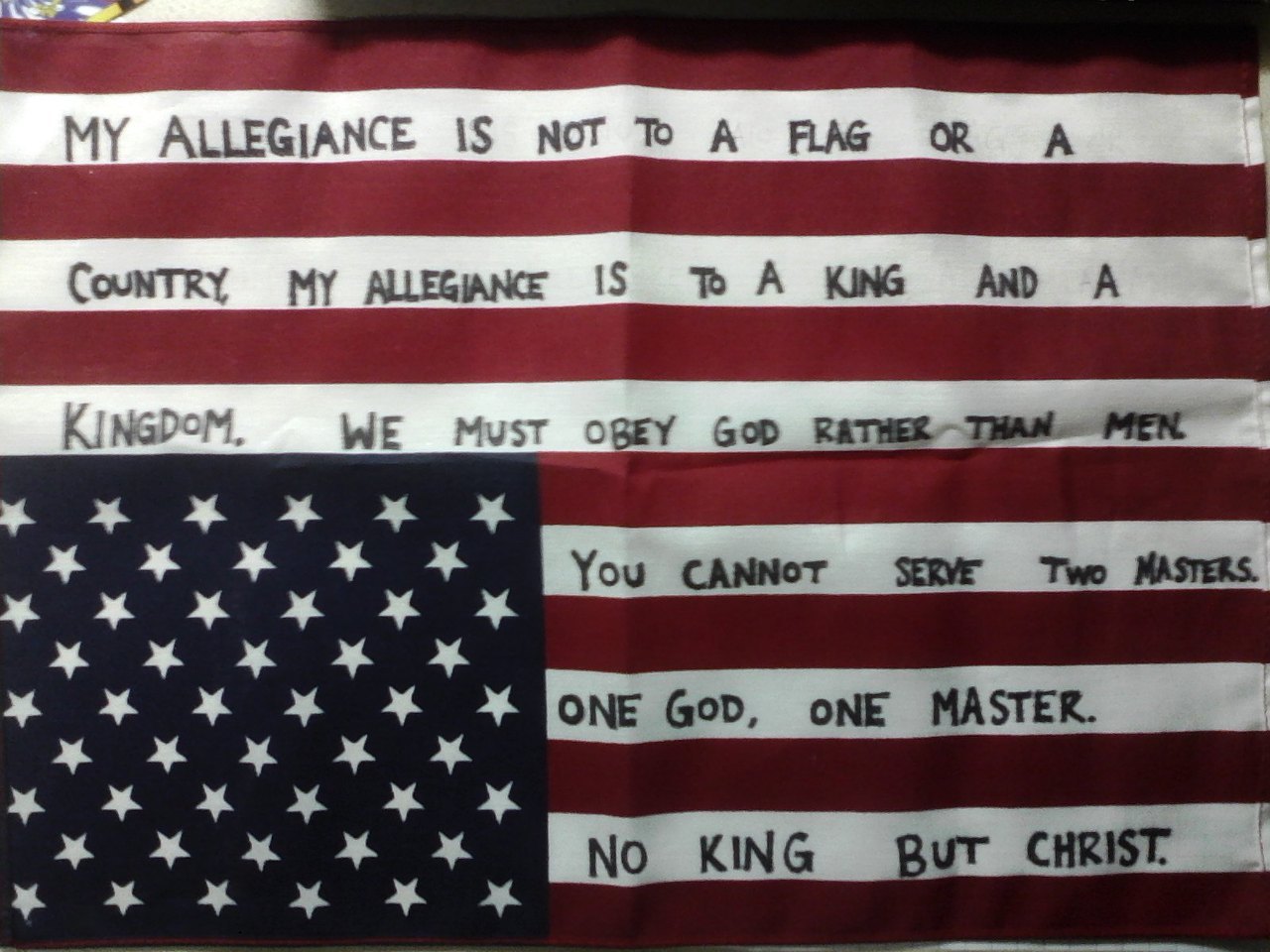

2. Related to this, I would point out that -- while, insofar as politics is based on a philosophy of man (particularly morals), and the Church does speak directly to that basis of politics, as she has a right and a duty to do -- the Church does not identify any political system as the correct one. She was born under an empire, continued through the collapse of the ancient world, helped build and survived the Medieval monarchies, and has weathered every modern form of governance from democracy to totalitarianism, without ever giving her unqualified approval to any specific setup of society.*

3. The most basic case for anarchy, in my opinion, was put by G. K. Chesterton (though he repudiated the term with contempt, and understandably, considering the character and arguments of much anarchism):

"This is the first principle of democracy: that the essential things in men are the things they hold in common, not the things they hold separately. And the second principle is merely this: that the political instinct or desire is one of these things which they hold in common. ... It is not something analogous to playing the church organ, painting on vellum, discovering the North Pole (that insidious habit), looping the loop, being Astronomer Royal, and so on. For these things we do not wish a man to do at all unless he does them well. It is, on the contrary, a thing analogous to writing one's own love-letters or blowing one's own nose. These things we want a man to do for himself, even if he does them badly. ... In short, the democratic faith is this: that the most terribly important things must be left to ordinary men themselves -- the mating of the sexes, the rearing of the young, the laws of the state."**

Taken with full rigor, this notion of self-governance is what anarchism proposes, at least in certain forms, and certainly in the form that I espouse. Philosophically, I ground this in the belief that all men, whatever their differences, are rational animals,*** and therefore have in principle something to contribute to the society of which they are a part, meaning that they must have a voice with which to make their contribution; this is strengthened by my Catholic conviction that all men are made in the image of God, and that it is this that is the final source of his political rights, rather than such rights springing from political expertise, or from some intrinsic superiority of one sort of person over another -- still less that they are conferred by the generosity of the state.

4. Jesus' own attitude toward the state in the Gospels seems to be one of marked indifference. Now, I will not make of His teaching an anarchist manifesto: He is my Lord, not my flag. In drawing out what I take to be anarchist implications in certain of His sayings, I am not making this a necessary part of my religion -- let alone refusing to be shown that I'm wrong.

Our Lord does not deny the existence of the state, or preach against it; yet He does seem to ignore it to the point of oblivion. In the narratives of the Passion, there is only one figure to whom Christ never utters a word: Herod. Pilate was the real political power, and He speaks to Pilate; the Sanhedrin were the motive force of the conviction, and He speaks to them. The people with power, the ones who can do something, He engages; for power, whether held by right or without it, is a reality of life. But the head of state, the theoretical authority, He ignores. The saying about rendering unto Caesar seems to sum the matter up neatly. Give Caesar what is his, and God what is His; but what isn't God's? Caesar wants money -- well, it has his image stamped on it, let him have it for all the good it'll do him. And human beings have the Divine image stamped on us: let Him have us, for all the good He would do to us. Christ seems, in every way, to regard the state and its operations as unworthy of the attention that the people were paying it; quite a disappointment to the hope of many Jews at that time for a successor to the Maccabees.


Pictured: The King of the universe, and also some dude wearing a crown.
(Christ Before Herod, Duccio di Buoninsegna, ca. 1310)

This attitude can be reconciled to many approaches to government, statist and non-statist; it is not a strong argument for anarchy. Yet -- Let this mind be in you, which was also in Christ Jesus ... Our vocation is, obviously, different from His; yet it is His outlook, His priorities, His values, which must shape ours. Whatever our calling and whatever our views, we must interpret them in the light of what He said was important, if we are to mean anything whatever by calling ourselves His disciples. And Jesus' whole attention lay upon the kingdom of God, not the kingdom of man. Even rebelling against the kingdom of man, even supposing it were a good end in itself, would have been a distraction from the task at hand. Whether anarchist politics are correct or not, the shift of focus that anarchism implies -- upon actual people, and not temporary abstractions like nations -- is right.

For heathen heart that puts her trust
In reeking tube and iron shard,
All valiant dust that builds on dust,
And guarding calls, not Thee to guard,
For frantic boast and foolish word --
Thy mercy on Thy People, Lord!

-- Rudyard Kipling, Recessional ll. 25-30


*The Catholic Church has straightforwardly rejected certain approaches to civil society, such as Communism -- partly on the basis of its outrages of religious liberty, and partly owing to its philosophically flawed theory of man. But a rejection of some specific idea as wrong does not in itself constitute patronage of any other idea.

**Orthodoxy, ch. IV: The Ethics of Elfland, pp. 43-44.

***Admittedly an optimistic theory. But men are at any rate rational or at worst irrational animals -- they are not beneath reason (in the Aristotelian/Thomist sense) as most animals are.

Wednesday, October 2, 2013

Christianity and Anarchism, Part I: What Is Anarchy?

I'm pausing the Raw Tact series again in order to discuss what I mean in calling myself an anarchist. This seems specially appropriate in the wake of the government shutdown, but I've also been getting a lot of inquisitiveness on the subject of late, so I thought I'd try and satisfy the curiosity. Some people are puzzled that a Catholic should be an anarchist; the Catholic faith is, after all, the most hierarchical of all incarnations of Christianity -- surely it is a contradiction in terms to be a Catholic anarchist?

The definition of anarchism is one of the ticklish problems here, not least because there are so many varieties, some of which are mutually incompatible, while others often overlap. Anarchism is chiefly a leftist (or post-leftist*) system of thought, as with anarcho-communism or anarcho-syndicalism; but there are some descendants of the classical liberal and capitalist school of thought, while others eschew the whole business in favor of a totally primitive outlook.


Yeah, I'm this guy. I'm a little disappointed in me too.

The defining trait of anarchism would be rejection of the state. The socialistic anarchist who wishes to replace the state with self-governing, egalitarian economic communes, the anarcho-capitalist who wishes to replace the state and its operations entirely with private contracts, the anarcho-primitivist who wishes to replace the state with a return to prehistorical conditions of life -- all agree in considering the state an undesirable and unnecessary thing.

This doubtless sounds preposterous. And it must be admitted that many of the forefathers of anarchy were, to speak frankly, surprisingly bad reasoners. I've been reading some of the essays of Emma Goldman, one of the most important anarchist theorists of the early twentieth century, and was a little put out when, after page upon page of righteous railing against the injustice of the state and of the class system, she then spoke of the very concept of free will as a ridiculous idea. How anybody proposes to have human responsibility without free will, or any idea of justice apart from human responsibility, I don't claim to know. But I do not consider anarchism as such to be beholden to its prominent theorists (and I am confident that they would agree with me; they were as consistent as that in any case).

In her autobiographical book The Long Loneliness, Venerable Dorothy Day, herself a Catholic anarchist, quotes at length from Bob Ludlow, a fellow Catholic anarchist and a significant early contributor to the Catholic Worker, whose words are a more or less ideal expression of the views I've come to hold:

"Both among Catholics and anarchists ... a great deal of misunderstanding comes about by a confusion of the terms State, government and society. Father Luigi Sturzo's book Inner Laws of Society is the best Catholic treatment of the subject I have read. He brings out the point that the State is only one form of government. When you analyze what anarchists advocate (particularly the anarcho-syndicalists) it really boils down to the advocacy of decentralized self-governing bodies. It is a form of government.

"The confusion results because some anarchist writers use the term government as synonymous with the term State and make the categorical statement that they do not believe in government, meaning by that the State.

"The State is government by representation (when it is a democracy) but there is no reason why a Catholic must believe that people must be governed by representatives -- the Catholic is free to believe one way or the other as is evident from St. Thomas' treatment of law ... St. Thomas states: A law, properly speaking, regards first and foremost the order to the common good. Now to order anything to the common good belongs either to the whole people, or to someone who is the viceregent of the whole people. Hence the making of law belongs either to the whole people or a public personage who has care of the whole people ...

"Anarchists believe that the whole people composing a community should take care of what governing is to be done rather than have a distant and centralized State do it. You can see from the quotation from St. Thomas there is nothing heretical about such a belief. It certainly is possible for a Christian to be an anarchist. ...

"Our Lord taught us to pray 'Thy kingdom come on earth as it is in heaven' -- in other words the nearer earthly government approximates what things are in heaven the more Christian it is. I do believe -- whether it can be realized or not -- that the anarchist society approaches nearer to this ideal than do other forms of government. As the Christian lives in hope so may we set this as the idea, towards which we work even if it seems as impractical as Calvary." -- The Long Loneliness, pp. 268-269

Thursday, September 26, 2013

Raw Tact, Part VIII: The Lavender Menace

To say that homophobia is a touchy subject among Catholics is a little like saying that Hurricance Katrina got New Orleans quite unusually wet. Many Catholics, including the leadership of Courage, imply or even state categorically that there is no such thing as homophobia: the idea is dismissed as a campaign to silence the Church's voice in the public square.

I must say from the start that I have a difficult time maintaining objectivity about this, and especially about Courage. I've never been to a meeting, or had more than the most cursory interactions with any members; but its language on its website is so repugnant and hurtful that I can barely contain my conflicting desires to yell at my computer screen or else burst into tears. This is admittedly not a very good place from which to approach anything objectively. But I don't think this series can do without discussing the subject, and so I'm going to try my level best to be as fair-minded and honest as I can. If I fail in that object, I apologize in advance.


I'm sure he's yelling a heartfelt "Mea maxima culpa" at the 
blog commenter who finally showed him the error of his ways.

Now, I will say first that the claim that homophobia doesn't exist is a true one, in exactly one sense: the DSM-IV, the standard diagnostic manual used by mental health professionals, doesn't list it. And I will say further that plenty of things are called homophobic by people in the LGBT movement that are, quite simply, moral or philosophical opposition to a particular political idea or set of ideas, and aren't based on hatred or irrationality. I will add that Romaphobia is as real, and as pervasive, as homophobia -- I've experienced more bigotry about my religion than about my sexuality, and I've heard people who wouldn't dream of doing something as relatively harmless as making a tasteless gay joke, say in so many words that they hate Catholics. The double standard of American culture here is an active and unhappy reality, not just Catholic paranoia.

But I am talking predominantly (so I gather) to a Christian audience, and we cannot repent of other people's sins. For that matter, when it comes to being treated with flagrant injustice by the World, the majority of the teaching and examples we are given in the New Testament move us toward a posture of acceptance of such suffering, grateful that we are being conformed to Christ by it. What we can repent of, and should be more concerned with, is our own sins and flaws, both as individuals and as a body, and it is to these that I now turn.

The word homophobia in itself is not, in my opinion, very significant. It's true that the DSM-IV doesn't list it, but so what? It's a colloquial coinage, and besides, insofar as a properly psychological phobia is an irrational, disproportionate fear of something,* there can in principle be such a fear of homosexuality, simply because there can in principle be a phobia of anything. I doubt that the listing in the DSM-IV was meant to be absolutely exhaustive in any case. The point is, such irrational fear and hatred of homosexuality does exist (just ask a queer-identified person from Russia or Uganda or Iran), and the assertion that homophobia is just a conspiracy to silence Christians ignores that grave fact.

This would be bad enough by itself. What complicates it yet further is that, in a culture in which queer issues are among the most discussed ideas of the day, the claim that there is no such thing as homophobia (warning: the linked article contains language which may trigger those who have experienced anti-gay traumas) does not even come across just as petty pedantry: it comes across as an assertion that no kind of vile treatment of gays is actually wrong. When groups like Courage proceed to spend a vast tract of their time** insisting that certain kinds of discrimination are acceptable, that those who even use such terms as "gay" or "lesbian" are doing so in order to introduce politically motivated heresy into the Church, and that all homosexual behavior is predatory and self-marginalizing, it tends to leave an outside observer (one who hasn't closed the browser in disgust) wondering what they would consider an unjust way to treat queer-identified people.


Refusing us tickets to "Wicked"?

Courage spends several paragraphs of multiple articles on ambiguous and disingenuous language. I can't help but feel that it is a bit hypocritical to be (as it seems to be) unwilling, or unable, to realize what other people mean in what they say, and the dissonance between normal Catholic terminology and normal normal terminology.

It is, I suspect, tempting to reply with something along the lines of, "Christians shouldn't have to change our terminology! We're right!"

First of all, no, you're not right. Christianity is right. And you are a Christian. But you are not Christianity. You are a sinner; that's how you got in in the first place.***

Second, yes, Christianity -- and, I would say further, the Catholic Church specifically -- is right. But so what? Being right does nobody any good when it's accompanied by being too stubborn to communicate clearly, and defining your terms is only one side of clear communication; the other side is listening to how the other side defines their terms. Otherwise, all the being right in the world will amount to jack shit when it comes to mutual comprehension. What's more, being right doesn't mean the other side has nothing to offer you: you may well be talking past each other, or have an incomplete picture that they can help you fill out, if you're humble enough to listen. This is nothing new. Learning to speak a new language is one of the chief duties of any apostolate: or, to put it another way, you don't go to China and start preaching in English, and you especially don't then get angry with the Chinese for not speaking English.****

Third, the brute fact is that Christians have frequently treated homosexuals horribly, and still do to this day. The extent of that horrible treatment, and the reasons for it, have been confused, exaggerated, and manipulated, of course. But the horrible treatment was and is there, and requires apologizing and asking forgiveness, and few convincing apologies open with phrases like, "You know, you shouldn't have made such a big deal out of what I did to you, but ..." Asking forgiveness is, by definition, a decision to swallow one's pride, and there's nearly always at least as much ego in any defensive reply as there is simple desire for accuracy.

So what am I saying needs to be changed, or repented of?

I am not saying that the Church's teaching needs to change. I don't believe that. I am, in that way, a walking contradiction to the claim that people like me, who speak the language of the queer movement, are always and necessarily opposed to traditional orthodoxy.

I am saying that homophobic treatment of queer people is wrong and needs to stop. I use the word homophobia in its colloquial, popular sense: an attitude that presumes that gay people are problematic in other ways that that attraction: assuming that they are promiscuous, for instance, or unprincipled, or likely to be pedophiles, or emotionally stunted. This would be wrong and need to stop anyway, for the sake of justice and charity. But it is even more crucial that it stop in our own era, because it has the power to seriously damage the Church's credibility. The Church professes to love gay people, but that love needs to consist in more than telling them about the wrongness of gay sex: it has to consist in actively asserting (not just admitting, with a tone of concession) the dignity of LGBT people, and actively opposing what many of us have experienced: the bullying, the being thrown out of our homes, the outright violence.

Melinda Selmys said recently that "Preaching to gay folks starting with the 'truth about homosexuality' is like proposing to a woman by offering to correct her faults." My thoughts exactly.

*Thanks, Wikipedia!

**I mean, of their time explaining themselves online. Obviously their actual practice will be different, and I've heard much more positive accounts of that from several authors whom I respect, such as Eve Tushnet, Joshua Gonnerman, and Melinda Selmys. But I am dealing with self-representation here.

***The pastor of my old church said once in a sermon that, in membership interviews, he often said that "One of the requirements to join this church, or any church, is that you have to be a sinner. And sometimes I'll add, maybe under my breath, 'And to join a Presbyterian church, you have to be totally depraved.'"

****Sorry, Bill O'Reilly. ZING!

Sunday, September 22, 2013

Music: mewithoutYou

I am now back. But I don't feel like blogging tonight and it's getting late anyway, so I'm going to post some angsty beautiful music instead.

I discovered mewithoutYou through a friend of mine, and listened to their song O, Porcupine about a dozen times asking myself "Do I like this?" and being genuinely uncertain of the answer. Eventually I concluded that I did, and have acquired a slightly broader taste since then in their odd genre of underground indie hardcore alternative folk punk (for lack of a better way of describing it). This particular song, Carousels, from the album Catch For Us the Foxes, is one of my favorites; it exhibits their remarkable lyrical blend of intense, depressive darkness and suffering with an equally intense -- even perhaps mystical -- spirituality. It is, to my mind, head and shoulders above most contemporary Christian music, if only because it doesn't follow the cookie-cutter Shiny Happy People pattern that most Christian music does (which is done well by some groups, like Hillsong, and extremely poorly and/or with insufferable cheese by others who shall remain nameless).


On a bus ride into town
I wondered out loud
"Why am I going to town?"
And as I looked around
At the billboards and the stores
I thought "Why do I look around?"
And I kissed the filthy ground
The first dry spot I found I laid back down
And I didn't have to wonder
Why I was laying down

Before long I was too cold
Took a bus back to the station
And I found a letter left by a payphone
With no return contact
And it read like a horn blown by some sad angel
"Bunny, it was me
It was me who let you down"
It was the shyest attempt
I'd ever seen at conversation

But if I didn't have you as my guide I'd still wander
Lost in Sinai
And counting the plates of cars from out of state
(How I could jump in their path as they hurry along)
You surround me
You're pretty but you're all I can see
Like a thick fog
If there was no way into God
I would never have lain in this grave of a body for so long

And Bonner Fair always came through
The first week of September
But it's already the nineteenth
And there's no sign of it
Yet I have a hard time
Remembering all the things I should remember
And a hard time
Forgetting all the things
That I'm supposed to forget

Christ, when you're ready to come back
I think that I'm ready for you to come back
But if you want to stay
Wherever exactly it is you are
That's okay too
It's -- it's really none of my business

But if I didn't have you as my guide I'd still wander
Lost in Sinai
Or down by the tracks watching trains go by
To remind me there are places that aren't here
And I had a well
But all the water left -- I'll go ask your forgiveness
With every breath
If there was no way into God
I would never have lain in this grave of a body
For so long, dear

Sunday, September 15, 2013

Five Quick Takes

I.

I'm spending a week away from the blog; I need to not be on the webnet all the gorram time (yes, that was a Firefly reference, and you're welcome), if only because not disciplining myself to sometimes not get on the webnet has resulted in my having the attention span of a coked-up squirrel -- and also in the belief, which I have found by experiment is not generally true but have not yet successfully ceased to believe, that if I just refresh cracked.com's cover page enough times, there will be new articles there that were not there forty seconds ago. This week, being an Ember Week, seemed peculiarly appropriate to observe such a fast, as it were. I hope these quick takes tide you all over, so that you don't despair of all wisdom and start coking yourselves up in my absence.

+     +     +

II.

I've been rereading some of the Hitchhiker's books lately. I was raised on Douglas Adams, whom I associate vaguely with the nonsense tradition in English literature -- the seminal example is, of course, Alice, but touches of the same thing can be found in Peter Pan, the Seuss books, Kafka, and some of Roald Dahl's stories. (Wikipedia claims that Joyce is also regarded as a nonsense author, but, since I like nonsense while detesting Joyce, I try not to think about that.) Anyway, I've been mulling over the sort of agnostic/atheist scientific materialism that seems increasingly popular in the twenty-first century, of which Adams was an exponent. However, he had a good deal more sense, both as a man and as a philosopher, than many of that crowd enjoy,* and I was arrested by the following passage from So Long, And Thanks for All the Fish:

"I'm afraid I can't comment on the name of the Rain God at this present time, and we are calling him an example of a Spontaneous Para-Causal Meteorological Phenomenon."

"Can you tell us what that means?"

"I'm not altogether sure. Let's be straight here. If we find something we can't understand we like to call it something you can't understand, or indeed pronounce. I mean if we just let you go around calling him a Rain God, then that suggests that you know something we don't, and I'm afraid we couldn't have that.

"No, first we have to call it something which says it's ours, not yours, then we set about finding some way of proving it's not what you said it is, but something we say it is.

"And if it turns out that you're right, you'll still be wrong, because we will simply call him a ... er, 'Supernormal' -- not paranormal or supernatural because you think you know what those mean now, no, a 'Supernormal Incremental Precipitation Inducer.' We'll probably want to shove a 'Quasi' in there somewhere to protect ourselves. Rain God! Huh, never heard such nonsense in my life."

+     +     +

III.

I've never been able to settle with myself whether I actually want to get married, quite apart from any question of having a vocation to it. I know I did. I wanted a big family, actually. But I don't know how to sort out the sorts of desires that are just the baseline of being an ordinary human being, so to speak, and the sort that God is using to tell you something about what He wants for you. I know that the desire to be a father, and even a husband, has not faded the way my desire to be a priest has faded; but then, my desire to be a religious brother hasn't faded either, even though that's probably out of the question. Not knowing is becoming much more familiar territory than it was when I was younger and the world, and God, were so much smaller.

+     +     +

IV.

I've been toying lately with the idea of writing a little book, and I already have a title: Anarchist Aphorisms. A few afternoons ago, it came to me, after -- I don't know how -- I suddenly thought up, "Ask not what your country can do for you, but why it's gotten handsier than a drunk frat boy."

+     +     +

V.

I did tell Victor, once, that I loved him. I had been half-hoping that he would respond with a profession of love himself, even though I was sure he wouldn't. He didn't, of course. I can't remember exactly how the conversation went after that, except that at one point I said something about perhaps becoming a teacher.

"Are you sure that's a good idea?" he asked gently.

I stared at him for a second or two, putting the pieces together in my head, and then replied angrily, "I'm not a pedophile, if that's what you mean."

It was. Victor apologized and backed off, and the conversation went elsewhere.

It wasn't until years later that I realized that -- incredibly wrong though his conflation of homosexuality and pedophilia was -- he showed, in that moment, that he cared for me as a friend and a brother so unconditionally that he would have gone on caring for me even if I had been a pedophile.

*For the record, my own interactions with atheists and agnostics, whether they were scientific materialists or not, have been almost entirely pleasant, and indeed I've not infrequently found them to be better company than some of my fellow Christians. Nor have I often found them to be anything other than intelligent, honest thinkers. The trouble is that every crowd, whatever its creed, has its share of stupid people who are also loud, and I feel that there has been an abundance of loud, stupid atheists in the public square of late.