Collect

Collect for the Fourth Sunday after Trinity

O God, the protector of all that trust in thee, without whom nothing is strong, nothing is holy: increase and multiply upon us thy mercy; that, thou being our ruler and guide, we may so pass through things temporal, that we finally lose not the things eternal; grant this, O heavenly Father, for the sake of Jesus Christ thy Son our Lord, who liveth and reigneth with thee, in the unity of the Holy Spirit, ever one God, world without end. Amen.

Friday, October 25, 2013

Raw Tact, Part IX: Gay and Gospel

Throughout the Raw Tact series, I've been trying to go over the actual, lived experience of being gay -- from interior desolations and uncertainties, to the experiences of falling in love and coming out of the closet, to the real social problems of homophobia and mere incomprehension or clumsiness. But of course the fundamental question is: why bother? After all, homosexuals (and co.) are only a small percentage of the population, and -- between the intrinsic difficulties of living as a queer Christian, and being caught in the crossfire of a kulturkampf -- the number of believers who are lesbians, gay, bisexual, or transgendered is presumably even smaller.


'There are dozens of us.'

I cannot take such a view -- and not only because I happen to be a gay Catholic, as are many of my friends. However small the number of people at stake, I consider a right approach to this matter to be indispensable if the Church is to be effective in the New Evangelization. Here are some reasons why.

1. The individual, not the merely the collective, is primary.

One of the treasures of Christianity and especially of Catholicism -- a treasure that seems, somewhat paradoxically, to be more and more specifically Christian, as the globalization of modernity carries on -- is a profound sense of the primary importance of the individual. The individual is not separated from society, but he is distinct from society, and it is only through individuals that anything ever happens. Pope Benedict XVI, in his Introduction to Christianity, had this to say on the subject:

'Christianity lives from the individual and for the individual, because only by the action of the individual can the transformation of history, the destruction of the dictatorship of the milieu come to pass. It seems to me that this is the reason for what to the other world religions and to the man of today is always completely incomprehensible, namely, that in Christianity everything in the last resort hangs on one individual, on the man Jesus of Nazareth, who was crucified by the milieu -- public opinion -- and who on this Cross broke this very power of the conventional "everyone," the power of anonymity, which holds man captive. ... Precisely because Christianity wants history as a whole, its challenge is directed fundamentally at the individual ...'*

That there are only a handful of gays and lesbians in the world, and that only a fraction of these are believers -- I attach no importance to these facts. God, since His mind is infinite, can pay total attention to every creature that there is -- as totally as if it were the only thing that He had created. We can't do that, of course; but we can keep in mind that His perspective is the accurate one -- we generalize and gloss over things and 'look at the big picture' because our minds are smaller than His, not because they are larger. Paying complete attention to every minuscule detail of every thing, and specially of every human being, is not only appropriate, but exactly what God does all the time. To treat a human problem as unimportant because it only affects a minority of people may sometimes be permissible, as a desperate remedy to a desperate shortage of time and resources; never otherwise.

Fundamentally, this idea of the supreme importance of persons finds its roots in the doctrine of the Trinity: the Divine Persons are as real and as distinct as the Divine Substance; the Glory equal, the Majesty co-eternal; none is afore, or after other: none is greater, or less than another. But I have neither time nor space to treat that Mystery anything like adequately -- nor the wisdom.

2. Connected to this, we -- that is, gay Christians -- need things we're not getting.

I have written of this before, and I don't claim to have a solution. I am not even totally certain what a solution would look like, except in the most general sense that living as a gay Catholic would not have the appearance (I believe, giving full force to the word believe,** that it is a false appearance) of being asked to do the impossible.

That's the thing, though: as things now are, to nearly everyone outside the Church and to a lot of people within it, telling LGBT believers that they must either enter heterosexual, cisgender marriages, or else abstain totally, sounds like a sentence to living death.


Of course, to many readers, this may seem preposterous. After all, it's exactly the same duty exacted of every believer. That is quite true; but frankly, the people who gasp in disbelief that the Christian faith could propose to exact the same duty of people who are, in this respect, dissimilar, have grasped the issue far more clearly than those whose orthodoxy is uncomprehending or uncompassionate. The equal duty here is not unlike the equal duty of, say, escaping from a flaming house: somebody without legs is inevitably going to have a far harder time with it than a legged man.

So what could the answer possibly be? A greater integration of LGBT Christians into the life of the Church? Possibly; but in that case, we need to be actively included by others -- we can't include ourselves. That is something a whole community does; a kind of conspiracy, if you will. And I know from experience that young Catholic couples can be peculiarly bad at including people who are not other young Catholic couples. The Young Papists have many virtues, truly, but imaginative sympathy with those unlike themselves is frequently not among them.

Well, alright -- what about a lay institute? That could work. The potential problems involved in getting a group of gay dudes living together probably need little explanation, however; I doubt the solution would be a universal one.


Did somebody say 'flaming house'?

The essential problem is one that Eve Tushnet noted on her blog some time ago: a man who had posed her a question while she was on a speaking tour made the poignant remark, quoting a gay friend of his, 'I just want to come first for someone.' It is this -- the profound human need to know that one is loved, worthwhile, not an intrusion, not simply put up with but actively wanted -- that many single believers (straight as well as gay) find ourselves at a loss to experience. Because, in the life of a married person, there's always someone else: the spouse, and often children, who take precedence. To be shunted toward the back of everyone's list is a bitterly disappointing experience, to the point that some of us give up entirely, and either adopt a promiscuous double-life to numb the pain, or seek out a sexually active relationship like (so it seems) everyone else has -- for even a clear conscience is very cold comfort in the face of the ultimate human pain, which is loneliness.

The actual needs of this class of human beings whom I am content to call gay Christians would, therefore, be sufficient for me to consider the intelligent, sympathetic conducting of Christian-LGBT dialogue worth doing. It is a microcosm, with its own peculiar qualities, of the basic human need for love -- something that those who aren't caught in this particular crossfire often fail to see, being caught up in the moral and the political aspects.*** As though any political stand, or even any moral one, had the smallest power to transform the human heart. Only unconditional love, that may care about, but does not define itself according to, the beliefs and conduct of the loved one, can provide the soil in which a seed may be sown and sprout.


But there is another reason why I consider this issue so vitally important.

3. This is going to dictate -- no, it already is dictating -- the course of the New Evangelization for this generation in America.

In terms of popular opinion, the tide has decidedly turned, throughout most of the West, in favor of homosexuality. The Church's stance has become incredible and even incomprehensible, and its philosophical underpinnings (to say nothing of its Biblical roots) make no difference -- not in the sense that they do not matter objectively; rather, in the sense that even those who know of and understand, say, natural law theory, are frequently more disposed to object to natural law theory as having the unacceptable consequence of condemning homosexual conduct, than to espouse the theory and thus also its logical results.

The fundamental problem is not, I think, one of relativism: it is one of a competing ethical theory, one that is gradually forming its own somewhat cohesive system, on the basis of certain -- usually quite legitimate -- moral intuitions (e.g., the equal worth of all human beings), and that partly overlaps and partly conflicts with the belief of the Catholic Church. The situation presented for the New Evangelization today is not at all like that which faced, say, European and North American societies in the mid-nineteenth century, when the question was one of recalling people from spiritual lethargy to the active practice of a Christianity into which they had already been initiated, however dispassionately. It is one of a genuine rival to Christianity -- a scientistic, typically liberal (in several senses of the word), often utopian, outlook, one that is not altogether unlike a religion though it is very unlike a church. And one of the tenets of this quasi-religion is that homosexuality is as legitimate as heterosexuality. The teaching of Scripture and of holy Tradition on the subject is not being merely ignored as a truth the World does not wish to pay attention to; the problem is not one of laxity. It is, increasingly, one of serious philosophical dispute about the real nature of sexuality, of right and wrong, and of authority. That must be respected if the Church's voice is going to be heard. There is no use whatever in telling people to listen to the Church without giving them a reason to listen to the Church; and unless they are Christians already, they don't have one.

This is why I speak so much here about dialogue rather than preaching. Most of what I hear, and have heard since childhood, from Christian sources (both Protestant and Catholic) about our nation's culture, has consisted in a sort of angry shock that non-Christians do not think and behave like Christians. I feel that we ought perhaps to have expected that. The World is not the Church. That is what 'the World' means. And being shocked at people does not, as a rule, win hearts.
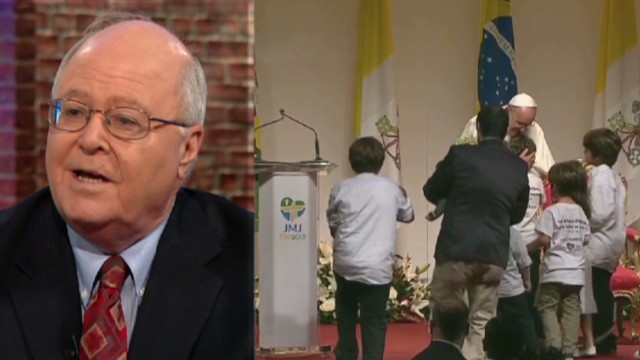

Can you spot the person who has made people feel like Christianity 
is something they might be willing to touch with a ten-foot pole?

To re-evangelize countries like our own that have not merely grown slack, but actually abandoned their heritage of faith, we need something more than it's-my-ball-I'm-going-home arguments about what phrases should be in the Pledge of Allegiance or whether the Ten Commandments should be displayed in courtrooms. On gay issues, and on every issue, the fundamental thing is how to allow ourselves to be transparent windows to God, letting the light in. (And all these things shall be added unto you.) 

And among the reasons we aren't succeeding much at that right now, is the fact that the Church -- that is, Christians -- have not done a good job of understanding the other side. How many believers are conversant with the real lives of gay people? And how can we expect to have any credibility with those outside if we're not? That the Church is right about the moral issue at stake, is of very little consequence; being right doesn't mean you know what you're talking about -- it doesn't give you any intrinsic insight into the lives of the people who will actually have to bear the effects of the doctrines, and those doctrines only have real existence in that personal context. There is no abstract member of 'the homosexual movement'; there are only people -- that is, images of God. Just as the Trinity is a doctrine of relationship, so chastity is a doctrine of relationship, and evangelism takes place only as a function of relationship. And relationship requires genuine understanding of the person we are relating to; treating someone simply as an example of a trend is profoundly insulting, and represents a refusal or incapacity to relate. And genuine understanding has, as one of its first prerequisites, listening to that other.

Or, to sum the matter up far more succinctly and Biblically: God is love.

*Pp. 249-250, italics original.

**The differing ways in which this clarification can be read struck me while I was writing it, and it's rather fascinating. To one sort of reader, "giving full force to the word believe" would consist chiefly in asserting that I don't actually know; to another sort of reader, it would suggest rather having complete subjective confidence in the belief I've stated. I mean both at once -- I'm quite fond of playing on words -- but it's hard to convey the distinction without a long, digressive footnote, and nobody wants that.

***Admittedly, plenty of us who are caught in precisely this conflict see little aside from the morals and politics, too.

Sunday, October 20, 2013

Christianity and Anarchism, Part IV: Problemata

As I hinted at in my last, I do not regard the practical difficulties of Anarchy as necessarily upsetting the theory; for the theory is precisely one of a society ordered on completely different principles -- and so its impracticability according to the principles we now employ is, in a sense, wholly irrelevant. And it should be said that organically arranged, truly self-governing societies have in fact existed in history, that being what most anarchists mean by Anarchy. (The society of the Guarani people in central South America during the era of the Jesuit reductions is a tolerably good example of an effectively self-governing society; you can watch The Mission if you like your history with a side of Jeremy Irons, as I do.)

However, those practical difficulties are there, and hence have to be dealt with. I will handle a few of the basic problems here, whose ramifications are more complicated than I really have the expertise for.


1. What Sort of Anarchy?

This might seem like a weird question; how many kinds of chaos can there be? Well, to begin with, Anarchy isn't synonymous with chaos, as I've discussed: it means organically developed order, as opposed to an order impressed upon society from without, by compulsion.

This leads naturally to the question of what that organically developed order will look like -- what principles it will develop according to. Obviously, that's going to depend upon one's philosophy of man; and that's where it all comes to pieces. Not in the sense that Anarchy, as a theory, becomes unsustainable, but in the sense that there are lots of different philosophies of man than can get plugged into an Anarchist framework.

So, for instance, most forms of Anarchy are descended, ultimately, from the French Revolution and the varying reactions to it, from every class and political perspective (just as many forms of the classical Liberal movement owe something to the same event, to say nothing of conservatism in its specifically European form). But two of my closest Anarchist friends are Anarcho-Capitalists, more closely related to the Minarchist movement or the thought of Ayn Rand than to any other school of Anarchy, and having developed from completely different premises and largely, if not entirely, unconnected to the mainstream Anarchist movement -- the majority of which utterly repudiates Capitalism.

Well, alright, let's limit ourselves to the mainstream, to the extent that a movement like Anarchism has a mainstream. Do we repudiate civilization as such, like the Anarcho-Primitivists do, or is that unworkable? Is it worth sacrificing our artistic and technological advances for the sake of that kind of liberty -- did we, perhaps, make a mistake in the first place by becoming civilized at all? If not, can Anarchy and civilization be reconciled at all? And if they can -- well, for the purpose of the discussion, we've set Capitalism aside, so are we going to go fully collectivist and become Anarcho-Communists or join the IWW*? Or might the Anarcho-Syndicalist perspective, which seeks to obtain self-government through unionization, be more effective? For that matter, if we're already Anarchists, can we even have a discussion about sub-genres, or is that buying into a historical metanarrative that allows people to write like this for hours?


These questions may well be answerable. But, without a clear philosophy of man, especially of man as a political being -- that is, man as a being who relates to other men in society, and not on an exclusively personal basis -- the answers will be perpetually disputable. The Church has been at pains to prevent wrong understandings of the nature of man from gaining acceptance, most notably in the social encyclicals of the late nineteenth, twentieth, and early twenty-first centuries; but even if her philosophy of man and his rights were wholly explicit, the prudential question of what system best respects those rights remains a question we will have to work out for ourselves, for the Church has not been invested with temporal power.

The same difficulty, of course, can be raised about any and every general approach to society -- including democracy.

2. How is an Anarchist society supposed to work? Spontaneous order sounds great and all, but come on, criminals aren't going to go along with that, and with no government there's no one to stop them.

Whether the government stops criminals is an interesting question, with regard to which I'd be interested to know the views of those who were governed by Rod Blagojevich, or those who were sentenced by the court of Mark Ciavarella.


At least cops are always good, although I'm kind of puzzled why this 
one is spraying what I assume is orange Fanta on these student protesters.

However. Strictly speaking, that is a reason not to trust the government to be perfect, and not necessarily an argument against government as such. I actually regard all arguments for Anarchism on the basis of actual state corruption as intrinsically flawed and useless, because they violate the basic logical principle abusus non tollit usum (the abuse of something does not abolish its proper use).

My own view, which owes something to Anarcho-Syndicalism, is that a community that is small enough to be genuinely Anarchist (i.e., self-governing) will correspondingly be small enough to deal with its own criminals as it sees fit -- probably by either restitution or exile.**


"Help! Help! I'm bein' repressed!"

Which leads into another difficulty ...

3. What about wars?

I'm against them.

4. But what if another country that isn't Anarchist declares war on your tiny one?

Well, life will probably suck for us in that event. Self-defense may not, practically speaking, be possible. I am not as pessimistic about this actually happening as I might be; some extremely small countries that have declared themselves perpetually neutral have, thus far, done okay. But, unless Anarchy were to become a world-wide phenomenon, there would be a risk inherent here.

That being said -- having a government is no security against being attacked, or conquered for that matter, as we in America have occasion to know.


For example, this happened.

Every society is temporary; every arrangement of society is flawed or, at best, vulnerable; all will eventually perish before the King of kings and Lord of lords. Looking for a society that can sustain itself forever is a waste of energy.

5. On that "King of kings" subject -- what about Scripture? For instance: "There is no authority except from God, and those that exist have been instituted by God. Therefore whoever resists the authorities resists what God has appointed, and those who resist will incur judgment."

Romans 13, and several other passages in the Epistles (not to mention the Gospels, where Jesus' attitude toward the government seems to consist chiefly in indifference but with a curious fondness for Roman soldiers), are most certainly an embarrassment to any attempt to synthesize Christianity and Anarchy. I've thought a great deal about these passages, and about how I can hold the political beliefs I do and at the same time profess the Catholic religion.

A few points deserve making, though: first, that one can scarcely suppose that this is a categorical acceptance of literally everything the state does. Even apart from the insane implications of such a view, St. Paul can hardly be supposed to have meant that Christians ought to sacrifice to the Emperor simply because the state ordered them to; it was precisely such refusal that lost him his head.

Second, in its original context, this was written to a Church that was just coming into existence. The Crucifixion had only happened about thirty years earlier when this was penned, at the outside. Getting embroiled in mutiny and sedition would have destroyed the Church before she even got started. It is possible -- I do not insist that it is the case, but it is possible -- that this and similar passages of Scripture were written with a partly provisional outlook, giving the Church the tools she needed to survive the period of official oppression; rather as her active opposition to slavery took some time to develop, even though the primitive Christians did treat slavery as a basically bad thing from the very beginning.

Third, these passages deal with the authorities that do in fact exist. They say nothing of how authorities ought to come into being; and if that question has any meaning at all, then the possibility of Christian resistance to a so-called authority that has erected itself on an unjust basis opens up again. Taken with full rigor, the interpretation of these passages that destroys Anarchism would equally destroy any and every kind of resistance to the state, no matter the cause, to the point of actually believing in cold prose that might makes right.

Lastly, this is part of the reason that I am also a pacifist (part, not the whole). I am as opposed to sedition as I am to the state it revolts against. I don't think that any rebellion against the state is worth carrying out except the rebellion of conscience, which, if it is both authentic and well-reasoned, must (in my view) be non-violent. That, however, gets us into questions of means that I haven't the space to do justice to here.

6. Okay. Let's say we've figured everything out and it's totally workable: self-governing societies where men live peaceably and don't attack each other, so small and so amiable that there is no need for government. Will people ever actually do that?

Ah ... and here the sole real objection to Anarchy is manifest. Not that men cannot make it work, but that they will not. All the other objections were to this or that circumstance or difficulty; this is to whether Anarchy can succeed in incarnating itself at all.

And you know what? It probably can't, because people probably won't.

This, however, puts Anarchy in a very curious position, to my mind. I don't think that it destroys Anarchy. For, like Communism, it is one of those things which people often fall over themselves to say would be lovely if only it could be made to work. And that itself puts me in mind of something else, something that people often lightly love and lightly break, something that has always been declared utterly impracticable:

"Now in truth while it has always seemed natural to explain St. Francis in the light of Christ, it has not occurred to many people to explain Christ in the light of St. Francis. ... Nobody would be surprised to read that Brother Juniper did run then after the thief that had stolen his hood, beseeching him to take his gown also; for so St. Francis had commanded him. Nobody would be surprised if St. Francis told a young noble, about to be admitted to his company, that so far from pursuing a brigand to recover his shoes, he ought to pursue him to make a present of his stockings. We may like or not the atmosphere these things imply; but we know what atmosphere they do imply. ... There is in it something of a gentle mockery of the very idea of possessions; something of a hope of disarming the enemy by generosity; something of a humorous sense of bewildering the worldly with the unexpected; something of the joy of carrying an enthusiastic conviction to a logical extreme. ... It seems reasonable to infer that if it was this spirit that made such strange things possible in Umbria, it was the same spirit that made them possible in Palestine."***

I think the same attitude that St Francis applied to possessions can equally be applied to power. Such a lightheartedly mystical approach to something as practical as politics can easily be dismissed as naive idealism, wishful thinking, unable to effect any real change. I hope I may be excused for observing that this same naive idealism is the only thing that has ever effected real change. Idealists are the only people who get anything done; practical people are too busy compromising with one another, until all their aims are frustrated, so that, while none of them have gotten what they want, they may at least take comfort in the fact that nobody else did either.

But if we bring up practicality, I can't help noticing in my study of history that all the most enduring movements, political movements included, have sprung precisely from some idea or other that was totally unrealistic, and not infrequently concerned with another world altogether than the present one. The slave trade was ended by men whose eyes were fixed on God, not those whose eyes were fixed on the earth. The French Revolution was accomplished by the mass of the people upon one of the most illustrious, ancient, and rooted institutions of all time: the French monarchy. Even the explicitly and dogmatically materialist ideology of Marxism was victorious, where and while it was victorious, because its sensibilities were millenarian; its compromises with practicality, like glasnost, led to its final crumbling.

And it is not too extreme to cite the example of the single oldest continuous institution on the face of the earth: the Papacy. The very idea of a single head of a universal Church, a mere man appointed to be the Vicar of Christ, is preposterously impractical -- knowing what men are, it should have broken down a hundred times over; indeed, in the wicked and stupid Popes of the early Middle Ages or the Renaissance, it did break down, utterly. And there it is, still, seated upon the glory of two thousand years, having survived the wreck of Rome and the Black Death, the Protestant Reformation and the violence of Napoleon and Cadorna, the reigns of Boniface VIII and Alexander VI: as mystically continuous as the phoenix.

What's the point of all this? That there is nothing -- nothing -- less practical than pragmatism. Only by fixing our eyes on an ideal can anything be accomplished. And, in the political sphere, you don't get more idealistic than Anarchy. That, far from seeming to me a disadvantage, is the thing that crowns my supposition with conviction.**** If I may quote Chesterton again, applying his words to a different purpose, the idea "has not been tried and found wanting. It has been found difficult; and left untried."


*Easily possessed of the best nickname in politics: the Wobblies. The International Workers of the World, with whom Ven. Dorothy Day was for a time associated, were founded by a Catholic priest (in good standing at the time, though his later record was rather depressing), and somehow -- no one knows how for certain -- got called the Wobblies; the name stuck.

**I'm oldschool. Also I oppose the death penalty, and imprisonment isn't likely to be feasible in a society small enough to be authentically self-governing -- the problem of whether prison is an intrinsically good idea, considering that its solution to crime is to put a bunch of criminals together for long periods of time, is outside the scope of this piece.

***G. K. Chesterton, Saint Francis of Assisi, ch. VIII: The Mirror of Christ, pp. 109, 111.

****This may seem inconsistent with my repeated claims that my Anarchism is tentative. It is in one sense -- namely, that I am willing to be talked out of it, if someone can find me a more persuasive theory, or if someone can show me that it is categorically incompatible with Catholicism. Naturally I cannot rule either of those possibilities out; I don't know enough, for one, and I can't predict the future for another -- I don't know what doctrines the Church may some day have to define that might prove me wrong.

Friday, October 18, 2013

Reblog: Aaron Taylor

This is a more scholarly piece than I typically put here -- a real doozy. Aaron Taylor (who has been published in First Things as well as on Spiritual Friendship, not to mention Ethika Politika) has a mind like a steel trap, and is as conversant with queer theory as he is with Catholicism, making him in many ways an ideal commentator on the subject of being a gay Christian. This essay touches on one of my linguistic pet peeves, and does so with great erudition and insight.

Monday, October 14, 2013

Christianity and Anarchism, Part III: The Collapse of the American Experiment

I'm advancing a rather more controversial theory in this piece than usual, so I'd like, correspondingly, to take more trouble to emphasize that I do so as an amateur. I learn rather slowly, but I am open to learning, and I ask readers and commenters to have both facts in mind.

Now then, on to offending people.


That oughta do it.

The Pledge of Allegiance, the Constitution, and the high school civics class that none of us paid attention to, set forth for our belief that our country is a democratic republic. Our essential concept of governance is self-governance; our mode of governance, rather than direct democracy, is through elected representatives. We thus combine liberty with order and individuality with stability. This was really the whole point of the Founding Fathers' endeavor in declaring us an independent nation: to create, for perhaps the first time in history, a country that really ruled itself.

It was a noble experiment. I posit that that experiment has ended, and that it has ended in failure.

It would be easy, if time consuming, to run through the petty, face-saving dishonesty of literally everything that every politician and press agent says; it would be even easier to merely list the number of unelected and unwanted governmental agencies, even without going into the ways they meddle incessantly with our daily lives and, for some people, make them effectively unlivable; easiest of all, maybe, to point out the current hypocrisy and destructive self-regard of both the White House and Congress* in refusing to arrive at any type of compromise, while collecting the paychecks they have very effectively blocked others from receiving, because they are too stubborn to concede anything at all, even provisionally and for the sake of the American people -- especially those who depend upon the government for their livelihoods and even their health. But I don't really have the expertise to treat that in detail; and besides, it is the special vice of the state to make corruption and incompetence dull as well as destructive. At least other kinds of evil make a bit of a bang with it.

The point doesn't lie in any one instance of corruption or stupidity, though. It doesn't even lie in the trend. Many anarchists espouse anarchism because of the actual corruption of governments, without stopping to consider that states are made of people, and behave that way -- a stateless society would not solve the problem of the human heart.

No: the problem lies in what we consider the state to be. It's a problem of Us versus Them. Them should be Us, but they're not. Take it from an extremely, a seemingly inordinately personal perspective for a moment. Do you actually know the President? How about your Senators? Your Representatives? The members who represent you in your state's own government? Local government? Do you even know their names?**

Self-government means self-government. When it starts meaning something else, when it starts meaning "This person I don't know can have free rein to handle my affairs," self-government has ceased to exist. This has not only happened in America, it has happened so totally as to be, in all likelihood, irrevocable. When once it has become not only acceptable, but natural and even expected, that a minority of voters shall actually vote, and that an even smaller proportion shall dictate the outcome of an election (regardless of office), self-government is dead. The mass of people have handed over their crowns, to be watched by the public guardsmen while they slumber. (Who put them to sleep is a different question, which need not for the moment detain us.)

The experiment of classical Liberalism has failed; we do not govern ourselves any more than our seventeenth-century ancestors did. One difference is that our ancestors knew quite clearly that they didn't govern themselves, and could tell you who did govern them; another is that their governors, amid all their own corruption and incompetence, at least had style.


A statist and a womanizer, but damn the man had class.

There are, at this juncture, two directions we can go in. 

One, which is the direction I think Liberalism logically leads into, is the Anarchist approach properly so-called. Unlike the other schools of thought (such as Communism) that formed largely in response to the French Revolution and its consequents, Anarchy puts no more trust in a supposedly revolutionary state than in its monarchic or republican*** predecessor. Well, let us suppose that, whether by violence or through a massive withdrawal of obedience on the part of the people -- non-violent civil resistance, which Gandhi practiced to such great effect in India -- the state has ceased to exist. What then replaces it? Strictly speaking, nothing. Actual communities -- not arbitrarily created districts, but organic communities -- govern themselves, according to their own needs and choices.


Okay, maybe "needs" was a strong word.

The difficulties with such a scheme are many, and I intend to deal with them at greater length in my next. The only difficulty I will cite here is that nobody will do this. Everybody will say, "Oh, wouldn't that be nice," and then dismiss it as completely impracticable. To that particular critique, Emma Goldman made a very intelligent reply:

"What, then are the objections? First, Anarchism is impractical, though a beautiful ideal. ... A practical scheme, says Oscar Wilde, is either one already in existence, or a scheme that could be carried out under the existing conditions; but it is exactly the existing conditions that one objects to, and any scheme that could accept these conditions is wrong and foolish. The true criterion of the practical, therefore, is not whether the latter can keep intact the wrong or foolish; rather it is whether the scheme has vitality enough to leave the stagnant waters of the old, and build, as well as sustain, new life." -- Anarchism: What It Really Stands For, p. 49

That is not in itself an argument for Anarchy, as opposed to either Despotism or (ostensible) Democracy. But it is, in my opinion, a proper framing of what the argument is about.

The alternative to Anarchy, in the aftermath of the American experiment, is Monarchy. And that is what we will almost certainly adopt. Over and over again, and without necessarily losing their enthusiasm for individual liberty as a way of life, human societies return to one form or another of Monarchy. (Most likely, as post-Republican Rome did in the years leading into the Empire, we shall do so with a full facade of continuing institutions whose real powers and purposes change completely -- as, some would argue, all the major branches of our government already have done.)

Dozens of reasons could be cited for this perennial monarchic tendency: revisiting Oscar Wilde, who said that the trouble with Socialism was that it left you with no free evenings, the same comment could be made about all forms of self-government, whether direct or indirect. Monarchy allows ordinary people to get on with their ordinary lives, rather than bothering about the fiddly needs of the commonwealth -- and that is a good thing as well as a bad thing. Monarchy, as I have touched on, characteristically displays patronage of the arts and sciences, and is in general a more beautiful and romantic thing than unmodified republican government, allowing loyalty and courtesy to flourish in a way democracies rarely manage. Monarchy, contrary to popular American belief, does not actually display itself to be reliably worse than any other form of government. Indeed, G. K. Chesterton pointed out in What's Wrong With the World that Monarchism is very democratic in sentiment, at least where it has not been infected with the notion of Divine Right: Democracy is the notion that every man can rule, he says, while Monarchy is the notion that any man can rule.

But even from a strictly revolutionary -- nay, from an entirely Anarchist -- point of view, the Monarchist state has one decided advantage over the state run by an elected committee. A committee is harder to catch than a king.

*I decline categorically to play the blame game as to the Democratic Party and the GOP. I consider both bodies equally reprehensible in this matter; and in any case, my approach to them is to wish a pox on both their houses.

**To those of you who have your hands up, put them down. First of all, you are filthy liars, and second, local government is marginally less important to daily life than the return policy at the supermarket.

***Republican, not in the sense of resembling the GOP in some way, but in the sense of operating on principles of representation, election, and official power, in contrast to the principles of suzerainty, inheritance, and personal power that may be loosely said to characterize monarchies and aristocracies.

Saturday, October 12, 2013

Reblog: Gweenbrick

Thanks to Joey Prever (a.k.a. Steve Gershom), I have been introduced to the majesty that is Gweenbrick. I am very happy now. I spend a lot of time thinking about introversion, masculinity, how opaque sports are to me, and how other dudes must be better and happier than I am for understanding and sharing in this mystery. Here I can identify with someone as lost as I generally am.