Aaron Taylor, a regular contributor to Spiritual Friendship (which you can find among the Sites That Rock Reasonably Hard on the right hand side of your computer screen) and Ethika Politika (which you can find wherever internets provide it), has recently published an excellent article, suggesting a possible direction for -- well, I can only think to call it "sanctified homoerotic love" -- a highly misleading title, but everything else seems even more misleading in one way or another. I think a perusal of that article, Christianity and Same-Sex Eros, will clarify it. And anyway he's a good writer and you should read his stuff.
Also, I have recently received an advance copy of Matthew Vines' book, God and the Gay Christian: The Biblical Case in Support of Same-Sex Relationships. Vines, whom I have touched on before here at Mudblood Catholic, is one of the more prominent figures in what's sometimes called "Side A" theology, i.e. the belief that God blesses same-sex marriages just like opposite-sex ones. I'm planning to write a review of it, hopefully before Easter, and I ask for your prayers, both to get off my duff and do it, and to read and write with a just and attentive mind.
Also also, you should listen to the podcast Welcome to Night Vale. I just started listening to it two days ago, and I have fallen in love with it, carnally.
Also also also, happy Solemnity of Saint Joseph.

A conscientious objector in the culture war.
Wednesday, March 19, 2014

Friday, March 14, 2014
Five Quick Takes
I.
I am intending to blog somewhat less this month: between Lent (turns out the Anglican Use customs are rather stricter than the Roman proper, and are kind of whooping me) and work and a number of other things, I have been finding myself bone-weary a surprising amount of the time for weeks. Among that number of other things was going up to Newark last month to help in creating a resource thingy for chastity, of which some of the finished videos can be viewed here. It's a very cool crowd of people, including Melinda Selmys, Joey Prever, Eve Tushnet, Joshua Gonnerman, and Ron Belgau (both of the latter are contributors to Spiritual Friendship, which Mr. Belgau helped to found). I'm looking forward to the finished product.
+ + +
II.
The decision to work on the internet is, always, a decision to deal with the ignorance and irrationality of the human race. I don't recommend it to anyone who does not either have, or wish by great pains to develop, vast resources of patient, loving courtesy. I work for a cafe, and I find it hard enough there not to burst out in angry, scathing comments more or less continuously -- listening to the same foolish or insulting or merely pointless remarks, over and over again, for hours; and there, you at least have a human face confronting you, reminding you (hopefully) of the sanctity of the image of God that you are dealing with.

I admit that I actually find it easier to be charitable online, because you can take however much time you need to instead of reacting in the heat of the moment; but it's never simply easy. Love is a lifelong project, and longer.
Of course, we're all insufferable sometimes and to someone. I think it was C. S. Lewis who speculated that one of the disciplinary aspects of Purgatory might well be perceiving ourselves as others perceived us while on earth. Trying to see ourselves from the perspective of someone who dislikes us intensely -- and perhaps not altogether unfairly -- can be a salutary experience. Though it is admittedly an acquired taste.
+ + +
III.
On the subject of losing faith in humanity, this is a terrible, stupid thing that exists. I apologize for enlightening you. But I couldn't stand being along in knowing. I stared at the opening sentence of that article for a solid minute, shouting, "What!? What do those words mean!?"
+ + +
IV.
To revive your spirits after that ghastly revelation, here is one of my favorite Latin renderings of a psalm (specifically, Psalm 115, known by its first line in the Vulgate translation, Non Nobis Domine). It was composed by Perotin, one of the few Mediaeval musicians whose name has come down to us -- Saint Hildegaard of Bingen is another. Dating to the very end of the twelfth century and the opening decades of the thirteenth, Perotin was one of the earliest composers of polyphonic music, a highly significant artistic advance upon the beautiful but spare Gregorian chant. This piece in particular is among my favorites; I'd love to hear it sung in person. (The artwork used in the video is drawn from the Pre-Raphaelites, a nineteenth-century school of painters and poets, whom I am also extremely fond of but who are quite unrelated.)
+ + +
V.
Theology of the Body is going surprisingly well for me so far, and I had a good conversation about it with a friend of mine last night. There's something a little intimidating about it -- not the length, I always knew that was intimidating; something more like a clearer, or maybe it would be better to say a deeper, vision of the truth than I've hitherto had. And the truth can be an unsettling thing, especially when we are attached to an incomplete version of it. Humbling myself to be receptive to that is, well, hard work. Please be praying for me.
I am intending to blog somewhat less this month: between Lent (turns out the Anglican Use customs are rather stricter than the Roman proper, and are kind of whooping me) and work and a number of other things, I have been finding myself bone-weary a surprising amount of the time for weeks. Among that number of other things was going up to Newark last month to help in creating a resource thingy for chastity, of which some of the finished videos can be viewed here. It's a very cool crowd of people, including Melinda Selmys, Joey Prever, Eve Tushnet, Joshua Gonnerman, and Ron Belgau (both of the latter are contributors to Spiritual Friendship, which Mr. Belgau helped to found). I'm looking forward to the finished product.
+ + +
II.
The decision to work on the internet is, always, a decision to deal with the ignorance and irrationality of the human race. I don't recommend it to anyone who does not either have, or wish by great pains to develop, vast resources of patient, loving courtesy. I work for a cafe, and I find it hard enough there not to burst out in angry, scathing comments more or less continuously -- listening to the same foolish or insulting or merely pointless remarks, over and over again, for hours; and there, you at least have a human face confronting you, reminding you (hopefully) of the sanctity of the image of God that you are dealing with.

Okay, most of them are human faces.
I admit that I actually find it easier to be charitable online, because you can take however much time you need to instead of reacting in the heat of the moment; but it's never simply easy. Love is a lifelong project, and longer.
Of course, we're all insufferable sometimes and to someone. I think it was C. S. Lewis who speculated that one of the disciplinary aspects of Purgatory might well be perceiving ourselves as others perceived us while on earth. Trying to see ourselves from the perspective of someone who dislikes us intensely -- and perhaps not altogether unfairly -- can be a salutary experience. Though it is admittedly an acquired taste.
+ + +
III.
On the subject of losing faith in humanity, this is a terrible, stupid thing that exists. I apologize for enlightening you. But I couldn't stand being along in knowing. I stared at the opening sentence of that article for a solid minute, shouting, "What!? What do those words mean!?"
+ + +
IV.
To revive your spirits after that ghastly revelation, here is one of my favorite Latin renderings of a psalm (specifically, Psalm 115, known by its first line in the Vulgate translation, Non Nobis Domine). It was composed by Perotin, one of the few Mediaeval musicians whose name has come down to us -- Saint Hildegaard of Bingen is another. Dating to the very end of the twelfth century and the opening decades of the thirteenth, Perotin was one of the earliest composers of polyphonic music, a highly significant artistic advance upon the beautiful but spare Gregorian chant. This piece in particular is among my favorites; I'd love to hear it sung in person. (The artwork used in the video is drawn from the Pre-Raphaelites, a nineteenth-century school of painters and poets, whom I am also extremely fond of but who are quite unrelated.)
+ + +
V.
Theology of the Body is going surprisingly well for me so far, and I had a good conversation about it with a friend of mine last night. There's something a little intimidating about it -- not the length, I always knew that was intimidating; something more like a clearer, or maybe it would be better to say a deeper, vision of the truth than I've hitherto had. And the truth can be an unsettling thing, especially when we are attached to an incomplete version of it. Humbling myself to be receptive to that is, well, hard work. Please be praying for me.
Monday, March 10, 2014
Quotation: The Original Hitchhiker Radio Scripts
This is taken from an introduction-like essay written by Douglas Adams for the printed scripts of the radio series The Hitch-Hiker's Guide to the Galaxy. The radio show is in fact the most primitive form of Hitch-Hiker's. It predated the terrible movie by a good twenty-seven years, and the earliest of the novels by a good one years. It doesn't have anything in particular to do with being gay or Catholic, but it's all about writing and is highly entertaining in its own right. It is, ostensibly, written in answer to the question -- which, in fact, few if any authors are capable of answering quite truthfully -- "Where do you get your ideas?"

The story goes that I first had the idea for The Hitch-Hiker's Guide to the Galaxy while lying drunk in a field in Innsbruck (or 'Spain' as the BBC TV publicity department authoritatively has it, probably because it's easier to spell).
Apparently I was hitch-hiking around Europe at the time, and had a copy of The Hitch-Hiker's Guide to Europe ... with me at the time. I didn't have Europe On (as it was then) Five Dollars A Day because I simply wasn't in that kind of financial league.
My condition was brought on not so much by having had too much to drink, as much as having had a bit to drink and nothing to eat for two days. So as I lay there in this field, the stars spun lazily around my head, and just before I nodded off, it occurred to me that someone ought to write a Hitch-Hiker's Guide to the Galaxy as well.
... However, I wouldn't like to create the impression that all a writer has to do is sit in a field cramming himself with a couple of Stella Artoises whereupon a passing idea will instantly pounce on him, and then it's all over the bar typing. An idea is only an idea.
An actual script, on the other hand, is hundreds of ideas bashed around, screwed up, thrown into the bin, fished out of the bin an hour later and folded up into thick wads and put under the leg of the table to stop it wobbling. And then the same again for the next line, and the next, and so on, until you have a whole page or the table finally keels over.
The problem is you can't go and rave it up in a field every time you need an idea, so you just have to sit there and think of the little bastards. And if you can't think of them you just have to sit there. Or think of an excuse for doing something else. That's quite easy. I'm very good at thinking of reasons for suddenly having a quick bath or a Bovril sandwich. Which is why truthful explanations of how writers get ideas tend to be rather dull:

The story goes that I first had the idea for The Hitch-Hiker's Guide to the Galaxy while lying drunk in a field in Innsbruck (or 'Spain' as the BBC TV publicity department authoritatively has it, probably because it's easier to spell).
Apparently I was hitch-hiking around Europe at the time, and had a copy of The Hitch-Hiker's Guide to Europe ... with me at the time. I didn't have Europe On (as it was then) Five Dollars A Day because I simply wasn't in that kind of financial league.
My condition was brought on not so much by having had too much to drink, as much as having had a bit to drink and nothing to eat for two days. So as I lay there in this field, the stars spun lazily around my head, and just before I nodded off, it occurred to me that someone ought to write a Hitch-Hiker's Guide to the Galaxy as well.
... However, I wouldn't like to create the impression that all a writer has to do is sit in a field cramming himself with a couple of Stella Artoises whereupon a passing idea will instantly pounce on him, and then it's all over the bar typing. An idea is only an idea.
An actual script, on the other hand, is hundreds of ideas bashed around, screwed up, thrown into the bin, fished out of the bin an hour later and folded up into thick wads and put under the leg of the table to stop it wobbling. And then the same again for the next line, and the next, and so on, until you have a whole page or the table finally keels over.
The problem is you can't go and rave it up in a field every time you need an idea, so you just have to sit there and think of the little bastards. And if you can't think of them you just have to sit there. Or think of an excuse for doing something else. That's quite easy. I'm very good at thinking of reasons for suddenly having a quick bath or a Bovril sandwich. Which is why truthful explanations of how writers get ideas tend to be rather dull:
I sat and stared out of the window for a while, trying to think of a good name for a character. I told myself that, as a reward, I would let myself go and make a Bovril sandwich once I'd thought of it.... Reading through what I've written so far, I feel I must correct the impression that it's all done with sandwiches, because there's also a lot of playing the guitar very loudly involved as well.
I stared out of the window some more and thought that probably what I really needed to help get the creative juices going was to have a Bovril sandwich now, which presented me with a problem that I could only successfully resolve by thinking it over in the bath.
An hour, a bath, three Bovril sandwiches, another bath and a cup of coffee later, I realized that I still hadn't thought of a good name for a character, and decided that I would try calling him Zaphod Beeblebrox and see if that worked.
I sat and stared out of the window for a while, trying to think of something for him to say ...
Friday, March 7, 2014
Queer Identity, Part IV: Betterosexuality
"First of all," began the priest on the other side of the grille, "you're not gay."
I knew what he meant (and he went on to say it): that no one is reducible to their sexual orientation. Not that he would have been fond of the phrase sexual orientation. Still the way he put it just wasn't helpful. I'd had the lecture before, so I wasn't shocked, but I was -- well, bored.
Until recently, most of the language about language that I'd come across on the subject, from Catholics anyway, was about how no one should identify as gay, or even use the word, or even think the word, or even be caught dead in a field with someone who had once thought the word.

"Then I spoke the Deplorable Word. A moment later I was the only living thing beneath the sun."
Speaking of oneself as straight, however, seemed to get a pass, at least until just recently. Marc Barnes, author of the Bad Catholic blog on Patheos, wrote a post last year in which he attacked the very idea of heterosexuality:
Heterosexuality, understood as a sexual attraction for the opposite sex (as an attraction for women or men in general) makes the object of my attraction unreal. Woman as such does not exist ... In reality, there are only particular women, just as there are only particular men, and every instance of sexual attraction is attraction to a particular person. ... The idea of an attraction to "women in general" trades the particular person for the thought-construct of "women in general" ... This is not to say that it is impossible to be attracted to the opposite sex as such. We may be, and in varying degrees. Indeed, I would argue that attraction to the opposite sex as such is the very modus operandi of pornography, which works to reduce a person to their sexual attributes. No, this is to say that to be attracted to the opposite sex as such is inadequate, immature and perverse.*
It's refreshing to encounter someone being so consistent; and he deserves credit, too, for pointing out the ways in which a heteronormative approach to Christian morals has a tendency to falsely exempt straight people from blame -- a little further on, he remarks, "I have experienced the particularly odd phenomenon that Christian men who watch pornography find some justification in watching heterosexual pornography, as if to say 'my attraction to a pixelated reduction of a person is more normal than your gay attraction to a pixelated reduction of a human person.'" Michael W. Hannon wrote a column for First Things last month in which he advanced a similar argument, calling for the total dismantling of the idea of sexual orientation, and that Christians should ally ourselves in this respect to the elite among queer theorists like Michel Foucault, who have long considered all sexual orientations nothing more than mental constructs. Similarly, at Crisis Magazine, Deacon Jim Russell has criticized the inadequacy of sexual orientation as divided from loving a particular person.
There are definitely problems with the straight-gay essentialist dichotomy, whether espoused as an attack on traditional morals or as a defense of them. In my experience, people on all sides see the limitations of it: on becoming a Catholic in college, I found among fellow Catholics a great dislike for reducing people to nothing but their sexual orientation; in fact, they disliked such reductionism almost as much as the lesbians and gay men I'd known in the Pride Alliance disliked such reductionism. And the ranking of people that such thinking can lead to, as though there were some intrinsic inferiority -- rather than plain hard luck -- in being gay, is unchristian and a little bit silly. After all, there is no command in Scripture, "Thou shalt be heterosexual"; and I've yet to hear anybody claim that being straight was their own clever idea.**
However, I think the sort of dismantling that Barnes et al. have proposed is kind of impractical, and that it too lightly dismisses the reason that such language was created in the first place. For instance, both seem to claim that the very existence of the words, and their use, springs from and necessarily involves an essentialist understanding of sexual orientation. Hannon in particular goes further, saying that such ideas were totally foreign to (and implies that they would certainly have been rejected by) our ancestors.
I'm not so sure of any of these claims. It's true that modern ideas of sexual orientation didn't exist until the nineteenth century; but that does not bind all ideas that involve the concept of sexual orientation to the same network of theories in which the concept first arose. Psychotherapy does not require Freudian premises in order to exist, just because Freud was a dominant pioneer of psychotherapy.

And after all, while our ancestors might have been readier than much of contemporary culture to concede that nearly anybody might dabble in same-sex activity, they would surely have recognized that there were still general tendencies and tastes among human beings, about sexuality as much as about anything else -- whether they bothered to name them or not. (Dante's treatment of the penance of the Lustful in Purgatorio XXVI certainly suggests that such a recognition was there, in his own time and place at the least.) I don't think it either wrong or useless to have a word for such tastes, and heterosexual and homosexual will do as well as any other. They have, too, the advantage of already being common currency.
I also feel that the perspective these authors have set forth is a little too hard on heterosexuality. Yes, mere attraction to the opposite sex is inadequate as a basis for sexual ethics. Now, it does carry with it the advantages of normalcy, in the sense that most people are in fact attracted to the opposite sex, so that most of what people say about it will (probably) make sense to you without any weird conversion factors -- applying sexual teachings aimed at a predominantly straight audience to a queer experience can feel kind of like converting between Farenheit and Celsius in your head -- and you don't (probably) have to endure the trial of feeling like a freak, or at least not because of your sexual orientation. But that of course does not make heterosexuals better than other people.

Picture offered without comment.
Nonetheless, I think it is going too far and risking too much misunderstanding to refer to heterosexuality as a perversion. It's true that merely being "attracted to women" is, so to speak, an incomplete experience: a man cannot form a relationship with "women" in general, not even the most ardent polygamist. And it is only in the context of relationship that sexuality becomes fully human, by the integration of the animal and the spiritual elements of human nature.
All the same, the simple fact that he has a general disposition to be attracted to the opposite sex, and that this disposition should manifest itself outside the existence of a specifically marital relationship -- to put it bluntly, the fact that a dude can and will get horny whether he's married or not -- is not in itself perverse. It's part of the animal element of us, and manifests itself quite apart from our voluntary choice (as men who are or have been teenagers can readily attest). This needs to be taken up into the virtue of chastity, whether by disciplining and sublimating it for a celibate renunciation of sexual pleasure, or by disciplining and sacramentalizing it for the passion of the marriage bed; but the fact that it exists beforehand in an undisciplined state isn't immoral. It's part of the raw material of the human person: that it is precisely raw rather than finished material doesn't make it bad, just incomplete.
Of course, indulging it in its raw state is bad, and (here I join with Barnes particularly) there are those -- especially in entertainment and porn -- who have it in their economic interest to train us to look no further, and even to actively resist the full humanization of our sexuality: to think of sex primarily in terms of a pleasure, a thing, rather than as a uniquely pleasurable (and, in a way, mystical) mode of relating to a particular person. But we all know what they say about the oldest profession. Objectification and the chattelizing of human persons for sexual pleasure have been around since the fall of man; the invention of the categories of sexual orientation can't be blamed for that.
I am, as many of my enemies and friends alike will probably tell you, a bit of a drama queen. But for once, I actually think the solution here is to chill out. People experience the world in this or that way, and that's fine. Probably the idea of sexual orientation does have an expiration date; and that's quite irrelevant to Catholic theology, which concerns itself with actions rather than with dispositions when discussing right and wrong.*** But as long as it is around, I don't think we need to bother to deconstruct it. We may; it isn't sacrosanct. Yet while it is around it has its uses, not least in providing us with convenient terms to sum up individual persons' experiences of sexuality. And insofar as sexuality is, as the above authors have all insisted, personal, I think the usefulness of such terms outweighs their artificiality.
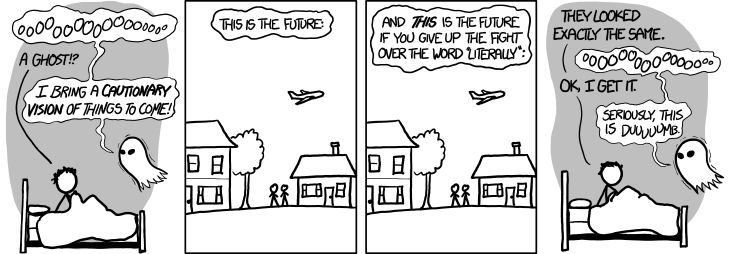
But then the Ghost of Subjunctive Past showed up and told me to stay strong on 'if it were.' ****
*Personally I find the omission of the Oxford comma more perverse than any amount of heterosexuality (little taste though I have for the latter), but if I were to divert myself into linguistic and orthographical channels now, the flood would never be dammed.
**I am not here addressing the ex-gay movement, whose claims about orientation are slightly different. I am highly distrustful of those claims, for a number of reasons that I have outlined before; but it's a separate conversation.
***This isn't to say that considering individual moral cases in their individuality (what is technically called casuistry) is unimportant, or that a person's motives aren't relevant to morality -- of course they are. It is to say that the general tenor of a person's desires, while they are important to a person's own individual spiritual state, don't effect the intrinsic rightness or wrongness of an action, whether in sexuality or elsewhere. Or, to grossly oversimplify, wanting or not wanting something isn't what makes it okay or not okay.
Monday, March 3, 2014
A Suggestion for Lent
Ash Wednesday is just the day after tomorrow. If you haven't yet decided what to do for a Lenten discipline (and remember, you don't necessarily have to give something up -- the point is to do something that fosters spiritual growth, and fasting is one highly appropriate means for that, not the sole means), I'd invite you to consider reading Theology of the Body with me. I have tried to read the tome before, and it has defeated me -- it is a colossus, both in subtlety and in sheer size. However, I couldn't help noticing all the same that any time I would read part of it, even if I barely understood what Blessed John Paul II was talking about, I just sort of felt better after reading it. That seems like a good sign.
I'm too lazy and/or ADHD to do it alone, though I have one of my tweeple joining me for it. I'm using the Waldstein translation, which is the only one I'm familiar with -- if you want that one specifically and are shopping offline, look for a big honking volume with Michelangelo's Creation of Adam on the front. If you would like to read along, I've made the following schedule for myself, leaving out Sundays (partly because Lenten disciplines aren't required on Sundays, and partly because, given the size and difficulty of the material, catch-up days will probably be necessary):
March 5th (Ash Wednesday): pp. 131-146 (audiences 1-4)
March 6th: pp. 146-156 (audiences 5-7)
March 7th: pp. 156-169 (audiences 8-10)
March 8th: pp. 169-183 (audiences 11-14.4)
First Sunday in Lent
March 10th: pp. 183-196 (audiences 14.5-17.3)
March 11th: pp. 196-210 (audiences 17.4-21.1)
March 12th: pp. 210-223 (audiences 21.2-23)
March 13th: pp. 225-238 (audiences 24-26)
March 14th: pp. 238-251 (audiences 27-30.4)
March 15th: pp. 251-263 (audiences 30.5-33)
Second Sunday in Lent
March 17th: pp. 264-278 (audiences 34-37)
March 18th: pp. 278-297 (audiences 38-42)
March 19th (Solemnity of St. Joseph): pp. 297-309 (audiences 43-45)
March 20th: pp. 309-325 (audiences 46-49)
March 21st: pp. 326-338 (audiences 50-52)
March 22nd: pp. 339-353 (audiences 53-57.3)
Third Sunday in Lent
March 24th: pp. 354-364 (audiences 57.4-59)
March 25th (Solemnity of the Annunciation): pp. 364-378 (audiences 60-63)
March 26th: pp. 379-394 (audiences 64-67)
March 27th: pp. 394-408 (audiences 68-71)
March 28th: pp. 409-422 (audiences 72-75)
March 29th: pp. 422-436 (audiences 76-79)
Laetare Sunday
March 31st: pp. 436-453 (audiences 80-84.7)
April 1st: pp. 453-462 (audiences 84.8-86)
April 2nd: pp. 465-478 (audiences 87-90)
April 3rd: pp. 479-491 (audiences 91-93)
April 4th: pp. 491-507 (audiences 94-96)
April 5th: pp. 507-518 (audiences 97-100.4)
Passiontide Sunday
April 7th: pp. 519-529 (audiences 100.5-102)
April 8th: pp. 531-547 (audiences 103-107)
April 9th: pp. 548-558 (audience 108)
April 10th: pp. 558-573 (audiences 109-110)
April 11th: pp. 574-587 (audiences 111-112)
April 12th: pp. 586-598 (audiences 113-114)
Palm Sunday
April 14th: pp. 598-615 (audiences 115-117)
April 15th: pp. 617-630 (audiences 118-122)
April 16th: pp. 630-647 (audiences 123-128)
April 17th (Maundy Thursday): pp. 647-663 (audiences 129-133)
I'm too lazy and/or ADHD to do it alone, though I have one of my tweeple joining me for it. I'm using the Waldstein translation, which is the only one I'm familiar with -- if you want that one specifically and are shopping offline, look for a big honking volume with Michelangelo's Creation of Adam on the front. If you would like to read along, I've made the following schedule for myself, leaving out Sundays (partly because Lenten disciplines aren't required on Sundays, and partly because, given the size and difficulty of the material, catch-up days will probably be necessary):
March 5th (Ash Wednesday): pp. 131-146 (audiences 1-4)
March 6th: pp. 146-156 (audiences 5-7)
March 7th: pp. 156-169 (audiences 8-10)
March 8th: pp. 169-183 (audiences 11-14.4)
First Sunday in Lent
March 10th: pp. 183-196 (audiences 14.5-17.3)
March 11th: pp. 196-210 (audiences 17.4-21.1)
March 12th: pp. 210-223 (audiences 21.2-23)
March 13th: pp. 225-238 (audiences 24-26)
March 14th: pp. 238-251 (audiences 27-30.4)
March 15th: pp. 251-263 (audiences 30.5-33)
Second Sunday in Lent
March 17th: pp. 264-278 (audiences 34-37)
March 18th: pp. 278-297 (audiences 38-42)
March 19th (Solemnity of St. Joseph): pp. 297-309 (audiences 43-45)
March 20th: pp. 309-325 (audiences 46-49)
March 21st: pp. 326-338 (audiences 50-52)
March 22nd: pp. 339-353 (audiences 53-57.3)
Third Sunday in Lent
March 24th: pp. 354-364 (audiences 57.4-59)
March 25th (Solemnity of the Annunciation): pp. 364-378 (audiences 60-63)
March 26th: pp. 379-394 (audiences 64-67)
March 27th: pp. 394-408 (audiences 68-71)
March 28th: pp. 409-422 (audiences 72-75)
March 29th: pp. 422-436 (audiences 76-79)
Laetare Sunday
March 31st: pp. 436-453 (audiences 80-84.7)
April 1st: pp. 453-462 (audiences 84.8-86)
April 2nd: pp. 465-478 (audiences 87-90)
April 3rd: pp. 479-491 (audiences 91-93)
April 4th: pp. 491-507 (audiences 94-96)
April 5th: pp. 507-518 (audiences 97-100.4)
Passiontide Sunday
April 7th: pp. 519-529 (audiences 100.5-102)
April 8th: pp. 531-547 (audiences 103-107)
April 9th: pp. 548-558 (audience 108)
April 10th: pp. 558-573 (audiences 109-110)
April 11th: pp. 574-587 (audiences 111-112)
April 12th: pp. 586-598 (audiences 113-114)
Palm Sunday
April 14th: pp. 598-615 (audiences 115-117)
April 15th: pp. 617-630 (audiences 118-122)
April 16th: pp. 630-647 (audiences 123-128)
April 17th (Maundy Thursday): pp. 647-663 (audiences 129-133)
Subscribe to:
Posts (Atom)