Collect

Collect for the Fourth Sunday after Trinity

O God, the protector of all that trust in thee, without whom nothing is strong, nothing is holy: increase and multiply upon us thy mercy; that, thou being our ruler and guide, we may so pass through things temporal, that we finally lose not the things eternal; grant this, O heavenly Father, for the sake of Jesus Christ thy Son our Lord, who liveth and reigneth with thee, in the unity of the Holy Spirit, ever one God, world without end. Amen.

Thursday, June 18, 2015

A Pacifist Manifesto


I've written before, especially in the wake of the report to Congress on the outcome of state-sanctioned torture under Bush and Obama, of my pacifist convictions. I've wanted for some time to outline them more clearly; they express and govern, not simply an attitude to war, but an attitude to all interpersonal interactions, that I believe is badly needed in this country. St John Paul II's words about a culture of death hovering over the world apply just as much to the money-worshippers, war criminals, abortion advocates, and racist bigots of America and western Europe as they do to the fanatical religious terrorists, child-conscripting warlords, police state oppressors, and drug-trafficking butcher mafiosi of the rest of the world.

Violence is an abhorrent thing. This is the principle from which all pacifist conviction proceeds; and it is a principle that, though simple and obvious enough, is worth stating, because an awful lot of the time, debates over things like Just War Theory or gun control start at the wrong end -- with practicalities. I have nothing against being practical, but starting with the practical is the wrong way to do it, because in order for something to be practical, we need first to know what it is we are practicing and why. The inherent flaw of all mere pragmatism is its breezy uselessness; action, especially revolution, comes only from idealists.

Violence is abhorrent because life is precious. Life; that is, the lives of all human persons. (Though a legitimate and interesting inquiry, I won't be touching on animal rights here.) Any ethic that does not accept the sanctity of human life cannot be pacifistic, which is one of the reasons that the American Left has not succeeded in being consistently anti-war for a long time. It has opposed the Right, certainly; but mere opposition to the Right is of no importance in itself. But the support the Left gives to abortion*, assisted suicide, and euthanasia makes it impossible for it to be really pacifistic, because the essential quality that makes violence wrong has already been dispensed with. It is of course equally impossible for the Right to be pacifistic (not that it would be), because, for all its co-option of the pro-life cause, its typical endorsement of the death penalty, its military hawkishness, its hostility to immigration and public health services, and its acceptance of torture all defile any claim to regard life as sacred.


Both parties being wrong? Whodathunkit?

Now, one of the corollaries of the sanctity of life is the duty and right to preserve one's own life. The Church teaches, and I accept, that this makes violent acts to defend oneself or someone else against a violent aggressor morally legitimate. This is the root of the concepts of self-defense, protection of others (especially but not only one's family), law enforcement, and Just War Theory -- all of which I accept in principle. It's impossible to deny that every one of these ideas, as practiced by humans, is subject to human imperfection, and increasingly so the more humans are involved. Nevertheless, the maxim stands that Abuse does not abolish use; and one could hardly demand that, say, a man stand aside and let a home invader rape his wife, on the grounds that US conduct in Vietnam was reprehensible.

So, I acknowledge self-defensive violence -- let us say, chivalry -- to be intrinsically allowable. But I renounce it. Renunciation is a mirror image of denunciation: where denunciation condemns a thing in itself as bad, renunciation (what the doctors and mystics have called the Way of Negation, or apophatic theology) seeks God by forsaking a recognized good. Pacifism, set beside chivalry, is thus like celibacy set beside marriage, fasting set beside feasting, or vowed obedience set beside personal liberty.

But non-violence in itself is not very significant, for the same reason that not having sex isn't very significant unless you use it to refocus your attention and energies toward God. That reverence for life and for one's fellow-man has to be more than merely negating the impulse to injure him for liking Nickelback; more, even, than choosing, difficult and worthwhile though it is, to forsake one's right to defend oneself, out of respect for the image of God even in an aggressor. I identify the following principles as a fully pacifist ethos, the body of non-violence animated by the soul of charity.


1. Magnanimity. It's difficult to get this idea into a single word; magnanimity in the Aristotelian sense, which my Thomist readers may think of, is a somewhat different thing: generally it means being above revengefulness, or more generally, the opposite of being petty. That is included here. But more than that, the idea I'm going for as an outworking of pacifism is the deliberate choice to think as well of other people as the evidence allows you to. In other words, taking their words and actions in the kindest, most generous sense you know how; considering whether they may not be right, not least because it's hard to be unbiased towards oneself; remembering that even if what they say or do is truly unfair, or worse, they may have all sorts of extenuating circumstances of which we can have no knowledge, and extending them the benefit of the doubt, because for all we know they are doing as rightly as they know how -- and perhaps a lot better than we would in their shoes.

This is a hard virtue to master, because of course it's (usually) easy to think well of people who are nice to you, so that magnanimity is mostly called for when dealing with jerks. This, too, is why I speak of a deliberate choice, and not a sunny disposition. Having a sunny disposition is a capital thing, but it's also easily dispelled in most people, and when things get rough, a pleasant temper is no substitute for a will firm in the habit of love.


2. Restraint. This virtue could be flippantly summed up as "the opposite of comboxes." It's funny and sad that patience, which is theoretically so easy to practice at a keyboard (if only for the mechanical reason that it takes longer to type something than it does to say it), should be so nearly absent from the internet. Of course, it isn't only on the internet that we need patience; it's easy to see the chinks in a Christian's practice of moderation and long-suffering at Starbucks or in traffic.

It's more than just patience, though; restraint involves recognizing the limits of what we can and can't know. We can guess that, say, the defendant in such-and-such a case is guilty/a racist/likes Nickelback, but we can't know it. And we shouldn't pretend that we do. We can suspect that so-and-so who wrote that nasty article about us is a closeted and self-hating homophobe, or anti-Catholic, or a crypto-Marxist, but we can't know it. And we shouldn't claim to. It isn't merely that such behavior is rude and unloving, though it certainly is. It's that this lack of reverence for the image of God in one's brother, this refusal to extend the grace and charity and generosity that are the stuff of life (for all life is lived as a gift from others), is precisely the root of violence. Restraining your violent hands is mere repression if you don't do so by opening your heart to love and compassion, begging the grace to do so.


Matthias Gruenewald, The Small Crucifixion, 1510

3. Forgiveness. It's startling to me, and tragic, to see how little this virtue is practiced among Christians in this country. There's no shortage of bitterness, wrath, and rage-porn (thanks, HuffPost!), especially when it comes to horrible things like child abuse in the Church. There is also a great deal of the opposite problem of invalid indulgence: i.e., waving things away, pretending that they don't matter. This is lousy ethics, because it's lousy theology. An indulgence (roughly, letting someone off from a punishment) can only be granted to someone who has been forgiven already, and forgiving a sin requires confession and contrition -- i.e., acknowledging sin for what it is, and being sorry and saying so -- to come first. (The sickening behavior of Archbishop Nienstedt and the officials of the Archdiocese of Minneapolis-St Paul is an example of utter failure to confess or to be contrite, and of attempting to acquire indulgences and apply them to others to ameliorate the penalties of unabsolved sins.)

And mark this: of its very nature, forgiveness is a gift; and gifts cannot be demanded. It's excluded by the nature of what a gift is -- something unearned, an act of generosity on the part of the giver. No justice can bind any person to forgive. Of course, if we refuse to forgive, then we will not be forgiven, but that seems to have more to do with the cosmic laws of spiritual causality than with a rule imposed arbitrarily from without.

Nor, however fashionable it may be to point out the psychological and even physiological benefits of forgiveness, is it really possible to forgive in order to benefit oneself by forgiving. That, too, is contrary to the nature of forgiveness. It turns the gift into a kind of purchase, making the words of absolution a price for one's own peace of mind. No. Forgiveness is about the other person, not ourselves. Joss Whedon, though an atheist, knows far better: "To forgive is an act of compassion, Buffy. It isn't given because it's deserved, it's given because it's needed." Or, in Pauline language, While we were yet sinners, Christ died for the ungodly.

You can't, of course, compel repentance in another soul. If you could, we'd be living in a world of robots; the fact that the robots were made of flesh and bone would make no difference to that. But you can be ready to extend forgiveness at any moment, hoping for it, praying for it, opening one's heart to it. And that means ...


4. Bearing the Cost. This is not different in substance from forgiveness; in Hannah Hurnard's beautiful allegory Hind's Feet on High Places, the central character encounters a little speaking flower which says to her, "My name is 'Bearing-the-Cost,' but some call me 'Forgiveness.'" But the two do differ in expression. Forgiveness, insofar as it involves repentance and reconciliation, is the perfection of bearing the cost; bearing the cost is the decision to open oneself to forgiveness. And this decision is, metaphysically, the embrace of martyrdom.

Make no mistake: it is far easier (for most of us) to face forgiving someone than to face death, especially death by torture, as so many martyrs did. And forgiveness can be approached, though not completed, with pretty mixed motives.** But there is a continuum between the two decisions. Both involve the deliberate choice to open oneself to injury, to accept the anguish of being victimized by another person's sin, rather than retaliating. The Crucifixion is the model of this decision: Jesus did not run away; He did not resist; He didn't even ask them to stop torturing Him. He received the sins of Gentile and Jew, state and church, crowd and elite, stranger and friend, into Himself, and returned only love.

Very few of us will be called to that kind of self-sacrifice in the body. Most if not all of us, I suspect, will get the chance to make that kind of self-sacrifice of the soul; will suffer some injury or injustice so far from any justification as to leave open to us the possibility of a vicarious offering of ourselves to God for the sake of the offenders, praying with our Master, Father, forgive them, for they know not what they do.


*I'd add that contraception, in my opinion, fails to fully acknowledge the sanctity of life. However, this, though important, is a related issue rather than a directly relevant one, and -- with certain exceptions -- contraceptives are generally concerned to prevent conception, rather than to procure the death of an embryonic human being, so that referring to contraceptives as a form of violence is at best misleading. Hence, I won't go further into the matter than to acknowledge here that it is a related and important topic of its own.

**Not that mixed here should be taken to mean false or thoroughly self-centered. Self-interest and even fear can prompt us to try to forgive; but the divine spark of love, however small, must be invested into the action if it is to be forgiveness. Thankfully, God distributes these sparks pretty freely.

Tuesday, June 9, 2015

An Apologia for the Romantic Way

Tell me not (Sweet) I am unkinde
That from the Nunnerie
Of thy chaste breast and quiet minde
To Warre and Armes I flie. 
True; a new Mistresse now I chase,
The first Foe in the Field;
And with a stronger Faith imbrace
A Sword, a Horse, a Shield. 
Yet this inconstancy is such
As you too shall adore;
I could not love thee (Dear) so much
Lov'd I not Honor more. 
-- Richard Lovelace, To Lucasta, Going to the Warres, 1649

+     +     +


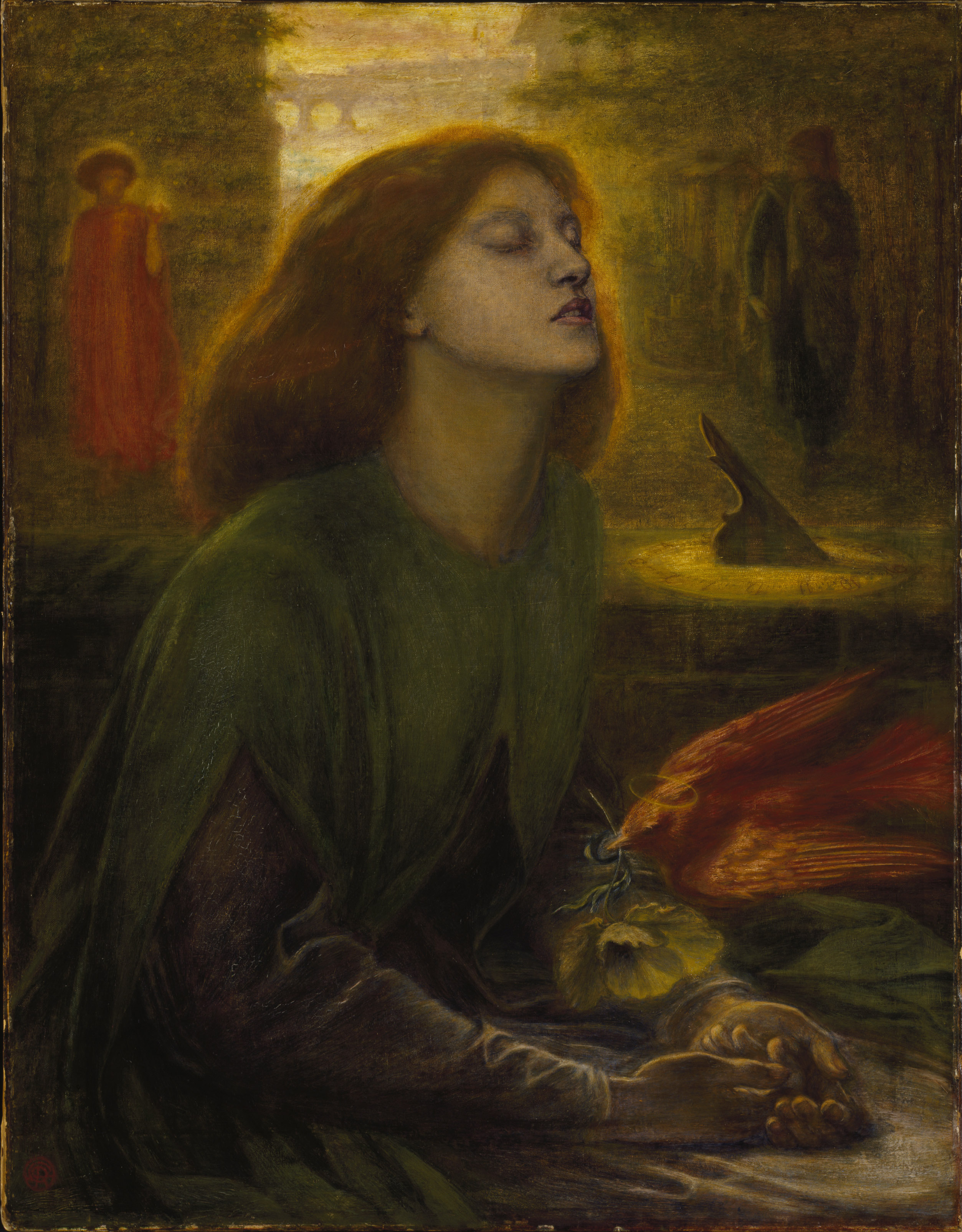
Dante Gabriel Rossetti, Beata Beatrix, 1870

Before I differ from Tyler Blanski's article The Protohomosexual of a few weeks ago, I'd like to note an important agreement between us. He writes movingly in his final subsection ("We Are Oriented") of the intrinsic human impulse toward sexuality-as-procreation. There are other reasons that we are interested in sex, obviously, and other ways in which we display the urge to create; about the only thing we are told in Genesis about God, before being told that we are made in His image, is that He is a maker, and our creative drive is in a sense our most thoroughly human attribute. We share freedom and intellect with the angels, and we share body and social instinct with animals; but creativity appears to be a distinctly human phenomenon, and in sexual reproduction, every level of our being -- spiritual and animal -- is involved at once. No wonder it's so pleasurable, and so complicated.

So, as a philosopher* and as a Catholic, there is important overlap between Blanski's views and mine. And, in the last resort, I hold that that overlap is weightier than our divergence, not only because we are both Catholics (and therefore agree about things beside which even sexuality is almost trivial), but because our views of this topic are, I think, more similar to one another than either is to contemporary secular orthodoxy.

That said, there is a difference, and it is important.

Blanski, in seeking to answer the question of why so many straight people are pro-gay, turns to the Western romantic tradition, and particularly to the revolutionary shift that took place in the movement of Courtly Love. Of course, classical antiquity and the early Mediaevals knew perfectly well that people sometimes fall in love, but it hadn't been customary to admire them for it -- largely because no one can help observing that people make some absolutely terrible decisions under the influence of erotic love. The twelfth-century poets of Courtly Love practically invented a new way of looking at eros, of which the Arthurian tradition (especially the story of Guinevere and Lancelot) is probably the best-known modern survival among English speakers. It became a sort of erotic cult: the devotee considered himself the slave of his lady, and his love for her mixed the romantic with the worshipful. The Church was scandalized more than once by the tradition of Courtly Love; and, for their part, the troubadours were divided among themselves: some counted themselves dutiful sons of the Church, while others preferred to flaunt their dedication to their ladies as against the faith.


Edmund Blair Leighton, The Accolade, 1901

That lovers are inclined to rebel against any limits on their devotion is, of course, human nature, and did not begin with Courtly Love. What those poets did introduce was a quasi-religious attitude in which the service of the beloved became a kind of separate moral dispensation, one that could override other ethical principles. And it is this characteristic of Courtly Love which Blanski fixes his argument upon, citing its tendency toward narcissism, its removal of eros from the realities of daily life, its readiness to deceive and to betray, its dismissal of children from lovers' concerns, its general lawlessness. All of this forms it (Blanski argues) into a proto-homosexual disposition; i.e., it turns sexual love into an end in itself, instead of a means to the creation of the family, and therefore containing in itself the seeds to the modern LGBT rights movement.

Now, these were real traits of Courtly Love, both in its poetic theory and its lived practice. Nor -- though it has decayed considerably over the last century, largely due to the influence of Marxism (which decries the lover's service to his lady) and many forms of feminism (whose criticisms are more diverse) -- have we seen the end of the erotic tradition the troubadours gave birth to. But Courtly Love was not as simple as Blanski implies, nor can it be dismissed as summarily as he seems to want to do. The vigorously Catholic rebuttal to this element of his argument can be summed up in a single word: Beatrice.


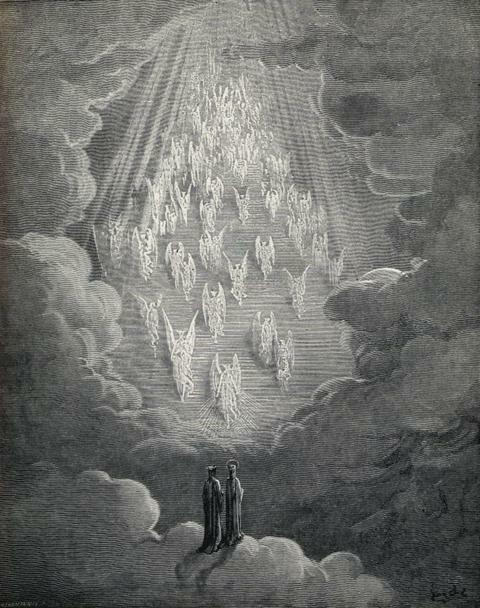
Gustave Dore, Paradiso: Canto I, 1868

Dante, perhaps the greatest poet of Western history, didn't just write the Inferno. It was preceded by La Vita Nuova, which chronicled his earlier acquaintance with and love for Beatrice, and followed by Purgatorio and Paradiso, in which she comes to him after her death and rescues him by grace and illumination. And the common thread that runs through all of them is precisely: Courtly Love, employed by a wholly orthodox Catholic, as a way of the soul to God. Beatrice is Dante's beloved, and she functions to him, from the first moment of their meeting, as an image of Christ. In her, Dante beheld the glory of the Creator; her mere presence is enough to fill him with humility, joy, and love, and he responds neither with rejection nor with idolatry, but with veneration -- that kind of mingled delight and awe that we pay to the angels and the saints. Many lovers have felt it, and it can be used as a way of seeing God; like anything can.

Using erotic love as a way of the soul has its dangers: covert narcissism, overt idolatry, foolishness, lust, impatience. They must be acknowledged, and the professed romantic must be as cognizant of these dangers, as firm in his purpose, and as faithful to the doctrines and the sacraments, as the professed religious brother or sister has to be. But none of this renders it unusable as a way of the soul, nor, I believe, should erotic love be dismissed or hedged off as something that only great souls may attempt. Greatness and sanctity come from devoting oneself to the Way,** not as pre-existing superiorities that justify the use of the Way.

Incidentally, Dante's love for Beatrice illustrates the antidote to what I believe Blanski's error to be. Both Dante and Beatrice were married to other people, yet there is no hint that Dante regarded this as at all relevant. This is not because they were adulterous and simply didn't care: there's no evidence that they had anything but the most casual contact -- he himself reports going into raptures when, after nine years of acquaintance, Beatrice condescended to say hello to him in the street one day. Dorothy Sayers, in her introduction to her translation of the Purgatorio, that this love
is not the febrile anguish of the death-Eros, in which possession forever mocks desire; nor yet the simple and affectionate exchange which does not look beyond possession. It is in fact not concerned with possession one way or the other, though it may survive loss. It is a love whose joy -- and therefore whose fulfillment -- consists in the worshipful contemplation of that which stands over and above the worshipper. True to its origins in courtly love, it finds its entire happiness in being allowed to do homage to its acknowledged superior. ... If earthly love, as such, is but a type and an overflowing of our innate (though it may be unrecognized) desire for God, then it is inevitable that there should always be something in its nature which transcends and eludes possession.***
The troubadours might have said the same; C. S. Lewis notes in The Allegory of Love that there was debate among them as to whether sexual intimacy with one's lady was the pinnacle of eros, or something beside the point. Dante took the latter view.


As ... seen here? Possibly?

The point is, eros, though it's become linked in our minds with marriage, is really an independent phenomenon. It is not incompatible with marriage; but there is nothing in Scripture, and little in history, to make either one the necessary companion or guardian of the other. The idea that eros necessarily leads to marriage or forms a good foundation for it is, in fact, about as young as words like homosexual and heterosexual. Eros is a tradition that may be entered by any loving soul who will, regardless of the object of love -- conditioned, as Dante's love was, by the same orthodox structure of ethics and economy of sacraments that governs all of Christendom. More briefly, the Romantic Way rightly considered is part of the Way as a whole, and operates on the same principles and within the same limits.

These conditions are not foreign to the tradition of erotic love. Nor is Dante a lonely example; the Cavalier and Metaphysical poets of seventeenth century England were exponents of the same in their own milieu of royalism and romanticism. Poets like John Donne and Richard Lovelace knew well how to combine eroticism with religious devotion, and the divided tongues of fire that we call Baroque art exhibit this synthesis magnificently.

Does this open to door to the possibility of a homoerotic devotion? I believe it does, in principle, though -- since marriage exists in its own right, independently of eros, just as eros exists independently of marriage -- marriage is still defined in its own terms, which, as a Catholic, I admit and even insist are oriented toward the family. Homoeroticism of this kind, used as a way of the soul, would be obliged to renounce sexual intimacy with the beloved. But this is no new idea. Its earliest expression in the West may be Plato's depiction of Socrates' erotic mysticism in the Symposium, and, in one form or another, it has continued, all the way down to (admittedly, sadly obscure) examples like Dunstan Thompson and Philip Trower. The notion that a love which cannot lead to marriage is intrinsically perverse, in my opinion, smacks of a baptized Freudianism that I have no truck with.

What of the Catechism's phrase that same-sex sexual desire is "intrinsically disordered," i.e. a misdirected impulse (like all sexual desire that is in itself unable to issue in life)? Well, that's true. But eros can't be reduced to the desire for sex, and, though it seems it generally does, it doesn't always produce the desire for sexual union with the beloved. I've been in love once or twice without any conscious desire to sleep with the person in question. It wasn't any less or otherwise romantic love on that account.

For eros is not primarily a way of craving, but a way of seeing; and the seen beloved is being seen in her or his archetypal goodness through the lens of erotic love. The beloved may not live up to her or his archetype of possible goodness, and the lover may in one way or another be disobedient to the heavenly vision. But the heavenly vision remains, and the heavenly vision isn't really about sex, even when it's connected to sexual desire. It is, on its minor scale, an intimation of the Beatific Vision, in which seeing is receiving and receiving is loving: None is afore, or after other; none is greater, or less than another; but the whole three Persons are coeternal together, and coequal. And the Romantic Way is defined by a maxim from the same creed: One, not by conversion of the Godhead into flesh, but by taking of that manhood into God; one altogether, not by confusion of substance, but by unity of Person. That is, the Way has not been changed in its own nature, so that the beloved is made an idol, but the Way assumes the lowers Ways into Itself, redirecting their natural courses toward a supernatural end -- so that, if we open ourselves by grace to the possibility, all roads lead to that Rome where Christ Himself is Roman.****


From Saint George and the Dragon as told by Margaret Hodges, illustrated by Trina Schart Hyman.


*I don't mean philosopher here in any technical, still less exalted, sense. I just mean a person who likes to think about how reality works and how we ought to live in it, and really that's a much commoner pastime than we sometimes realize; almost everybody does it, at least a little bit.

**I.e., to any of the specific forms of the Way into God which is God, namely Christ. The way of monastic devotion is one of these ways, and one of the most obvious due to the renunciations it involves. But the other ways, those that accent affirming the image of God in His creation (rather than accenting the distinction of substance between God and His creation), are nonetheless the Way.

***Introduction to Sayers' translation of the Purgatorio, p. 43.

****Dante's Purgatorio XXXII.102.

Wednesday, May 27, 2015

I Am Publishing Une Book!

For the last five years, I've been meeting with a group of friends every other week as we hash out things we're writing. We recently set up this website, named for our fellowship, which we dubbed Pints & Prose (although poetry and liquor are also welcomed). It's a combination of our own writing -- mostly light philosophical and social stuff, and literary-critical style analysis -- and things that we find cool.

Bill Hoard, Ben Faroe, and I probably write the most out of the regular participants, and each of us have several projects we've been working on for years. Bill and Ben have finally reached publication: the two of them are collaborating on an episodic work titled Hubris Towers (partly an homage to Fawlty Towers, with touches of P. G. Wodehouse), which has required me to ask them to stop in the middle of a reading more than once because I was laughing so hard. Ben also has a fairy tale, The Stone and the Song, available, which was his first publication and has already done well.

And I am going to be publishing soon, too! For the last five years I've been working on a novel, and I finished it about two weeks ago. It's set in the mid-Victorian era in London; it's a Gothic piece, indeed (if you own a monocle, now is a good time to insert it) a tragical Bildungsroman, complete with vampires, poltergeists, manticores, and Catholics. It's called Death's Dream Kingdom, and follows the progress of one Marie Redglass as she is initiated into the world of vampires in the London of 1874 and 1875. What follows is a selection from its early pages.

The manor and its grounds lay to the north of the city, east of Hampstead Ponds, with Primrose Hill looming to its south out of the greyness. It was, as Lord Ravenhurst had once explained to Marie over sherry and biscuits at one of the little literary salons he held at his house, the ancestral seat of the Fairfax family, of which he was the last surviving member. Not, he noted, to be confused with the Anglo-Scottish Fairfaxes of Roxburgh; it was rather a curious corruption of the Norman fer-face, presumably in reference to a Mediæval helm. As for Mediævalism, Ravenhurst had as much of that as any Pre-Raphaëlite could have wished: the manor was more castle than house, with spires and embattled parapets thrown up against the sky like jagged stone teeth, a weird and gigantic tower looming out of the unseen center of the edifice, and an age-blackened façade that frowned out of a mass of ivy, pierced by thin, pointed windows heavily draped against the daylight.

Marie had only ever seen it by night before, when the curtains were drawn back and the light of lamps and candles and chandeliers made every window look like a magic lantern, the uglier features being concealed or softened by the dark. Now, as the forerunning light of dawn crept through the late autumnal fog, she wondered briefly whether she would ever have gone near the place, had she first seen it in better light. But this was no time for metaphysical speculations. Having already left the road some time ago, she had to pick her path inconveniently over the railway line, and, once she had cleared it, she lifted her skirts and broke into a run.

It did not take her nearly as long as she had expected. It was a furlong or more from the railway to the front door of Ravenhurst Manor, yet she had traversed the distance in less than a minute. Ignoring this puzzle, she turned to the great front door, with its large brass knocker in the shape of a lion’s head with bared fangs. She tapped it and waited, wishing miserably that she could be anywhere else in England. An owl hooted somewhere nearby, and was promptly contradicted by the chirrup of a sparrow.

The door was opened by the tall, grey-mustached butler of the household, Godalming. “Good day to you, Mademoiselle Redglass,” he said colorlessly, as though he had not witnessed the volatile parting of a few hours before.

“Let me in,” she replied urgently, with no pretense at good manners.

“One moment, mademoiselle. I shall ascertain whether his lordship is --”

“Please, Godalming, you know me, you know he knows me --”

“Forgive me,” he said, now becoming a little stiff in his manner. “I have no power to invite you over the threshold. Excuse me.”

He left her on the doorstep. Marie tangled her fingers together nervously and untangled them again a few times, looking out at the grounds (where the fog was turning from grey to pearl at every moment) like a bird scanning the sky for predators.

“Ah, my dear,” interrupted a basso cantante voice. She turned quickly back. There stood the master of the house himself, Augustus Fairfax, wearing an indecently triumphant smile. “This is a thoroughly expected pleasure. Though admittedly, I wondered, when last you left, whether you realized you would be imparting it; I believe you said you never wished to see me again as long as you lived? -- words to that effect.”

Marie lowered her eyes a little from his. “Please, Lord Ravenhurst; I am sorry --”

“I dare say you are.”

“Please shelter me. I beg you.”

He made a scoffing noise and stood back. “Come in.”

She lifted her skirts and stepped over the threshold. “Thank you,” she said to him quietly.

The aristocrat made no reply, but ordered her to follow with a gesture. Goldaming came over and shut and bolted the door; the sound was curiously loud, yet stifled, more like the shutting of a box than of a door. They went to the library, whose windows, like all the others, were thickly curtained, to keep out the lethal sun; Augustus’ pale shirtsleeves flashed on either side of his emerald waistcoat in the semi-darkness as he turned up a few of the gas-lamps at the edges of the room, and then crossed to one of the chairs near its center, a finely carved ebony thing with cushions in Paris green. Standing behind it, resting his elbows on its back, gazing at Marie as she stood still near the door of the room, he was the very image of leonine, indolent contempt. He sniffed ostentatiously.

“Dead?” he asked.

She stared, uncomprehending. “What?”

“Is he dead?” the vampire expanded; and then, with a touch of impatience, he clarified, “The man whose blood you drank. You are positively reeking of him, there is no use prevaricating. Did you kill him? Most fledgling vampires are more reluctant than that at first --”

“I didn’t! Man whose -- how dare you!”

Augustus’ eyes flashed. “Manners, Mademoiselle Redglass. I speak to you thus because I am your sire. My authority over you henceforward is, as it were, paternal. Accustom yourself.”

Outrage choked her. Helpless to act, dependent and bewildered as she was, she took a few aimless steps about her corner of the room and was still again. Her host watched her, making no attempt to hide his malicious amusement. After a few moments, he turned his gaze to the small circular table beside the chair he was leaning upon. On it stood a jade-green glass vase, about two feet tall, minutely adorned with silver filigree.

“I purchased that in Venice, eighty-six years ago, on the centenary of the deposition of King James the Second,” said Augustus, a little dreamily. “Such a dismal summer that was! But once or twice, when the weather did manage to get hot -- then even at night the Adriatic was like a blue oriflamme, billowing out to the southeast. And outdoors or within, the fragrances of the wines, the perfumes, the scents of grapes and rosemary and pomegranate blossoms … Have you ever been to Venice, my dear?”

Marie was stonily silent. The amused look on Augustus’ face increased for a moment, then faded: he was unnaturally still, his eyes fixed on the vase. Suddenly it exploded, shards of costly glass flying outward with violence. She started and cried out. Then she noticed that the vampire’s hand was extended, not in a fist but spread out flat, into the space that had a moment before been where the center of the vase was. He had broken it with a mere flick of his hand. He stared at the fragments silently for a long while, and then turned back to Marie and spoke.

“It was the wrong color,” he explained placidly. “I take my time in deciding.”

Friday, May 22, 2015

Lost In the Cosmos, Part III: The Terrible Perhaps

Returning to my Lost In the Cosmos series (the beginning of which can be found here), I'd like to return to the matter of what faith actually is to a Catholic. I touched on this in my first post of the series, but it was from the perspective of what the Church proposes for our belief; now I'd like to look at it from the viewpoint of the believer, or the possible believer.

When I was a kid, my mother was a fan of Ken Ham, or at any rate we had a lot of stuff by him. I seem vaguely to recollect seeing him give a talk once, but perhaps I was too young to distinguish reality from TV yet.


Some parts of that journey into distinctions were more painful than others.

Anyway, what I absorbed from Ham and those like him was an attitude that many people, both within and outside Christianity (not a few of whom have left Christianity because of this), believe is how Christians are supposed to think: namely, a monomaniac insistence on the inerrancy of the Bible and the complete untrustworthiness of every other source of knowledge, and a rejection of all argument when it comes to establishing the truth of the Christian revelation. Fideism is the technical name for this outlook; blind faith is the vernacular.

Given that the Catholic Church professes to be infallible, and that her history of dealing with those of her children who have come to dissent from her teaching is not a pretty one, a lot of people assume that Catholicism is an officially fideist religion. This, sadly, does not exclude Catholics, some of whom make a positive virtue out of not examining any part of their beliefs, thus shutting themselves out from intelligent sympathy not only with non-Catholics, but even with fellow Catholics who have difficulty with this or that article of the faith -- and there are many difficult articles of Catholic belief, for, even more so than most branches of the Christian tradition, the Roman Church proposes many things for our belief that are, well, pretty hard to believe. That animation should be restored to dead tissue (i.e. the Resurrection); that alien intelligences should operate on the cosmos without any material vehicle (i.e. the activities of angels); that human beings should be invested with the power of disclosing the mind of the Divine Absolute to one another (i.e. the teaching office of the Church and the sacrament of Confession); that this same Divine Absolute should choose under certain circumstances to make Itself objectively and personally present in bread and wine (i.e. transubstantiation): all these things take a good deal of believing; and if the Jesus on whom our faith is based was not to proud to accept the plea, "Lord, I believe; help thou mine unbelief," perhaps we should not be too proud to keep good fellowship with it.

But I digress. The truth is, though the Catholic Church has her share of professing fideists, and of people who are fideists in practice even if they would disown the title, she has gone out of her way to say that, when she speaks of faith, that is neither what she means nor what she desires of the faithful. The First Vatican Council, though most famous for defining papal infallibility as Catholic doctrine, also insisted that some things can be known about the world and even about God apart from any faith.

Faith is not synonymous with uncertainty, but there's a way in which it can't be torn apart from uncertainty -- the two are conjoined without division, without change, without confusion, without separation, as it were. Pope Benedict, quoting to begin with from the works of the great Jewish author Martin Buber, wrote:
'An adherent of the Enlightenment, a very learned man, who had heard of the Rabbi of Berditchev, paid a visit to him in order to argue, as was his custom, with him, too, and to shatter his old-fashioned proofs of the truth of his faith. When he entered the Rabbi's room, he found him walking up and down with a book in his hand, rapt in thought. ... Suddenly he stopped, looked at him fleetingly, and said, "But perhaps it is true after all." The scholar tried in vain to collect himself -- his knees trembled, so terrible was the Rabbi to behold and so terrible and simple his utterance to hear. But Rabbi Levi Yitschak now turned to face him and spoke quite calmly: "My son, the great scholars of the Torah with whom you have argued wasted their words on you; as you departed you laughed at them. They were unable to lay God and his Kingdom on the table before you, and neither can I. But think, my son, perhaps it is true." ...' 
Here we have, I believe -- in however strange a guise -- a very precise description of the situation of man confronted with the question of God. ... [B]oth the believer and the unbeliever share, each in his own way, doubt and belief, if they do not hide from themselves and from the truth of their being. Neither can quite escape either doubt or belief; for the one, faith is present against doubt; for the other, through doubt and in the form of doubt. ... Perhaps in precisely this way doubt, which saves both sides from being shut up in their own worlds, could become the avenue of communication. 
... Can we still believe at all? Or rather -- for the question must be posed in a more radical fashion -- is it still permissible to believe? ... When some theologian explains that 'the resurrection of the dead' simply means that one must set about the work of the future afresh every day, offense is certainly avoided. But are we then really still being honest? Is there not serious dishonesty in seeking to maintain Christianity as a viable proposition by such artifices of interpretation? ... An 'interpreted' Christianity of this kind that has lost all contact with reality implies a lack of sincerity in dealing with the questions of the non-Christian, whose 'perhaps not' should worry us as seriously as we want the Christian 'perhaps' to worry him.*
In other words, as His Holiness says in the same book, faith is not an intellectual rejection of certain possibilities as non-existent. It is, rather, a decision, in the face of myriad possibilities, to trust that one among those possibilities is actually true. Catholic faith in particular is the decision to trust that God is this kind of being (the Trinity), and has behaved in this specific way (the Incarnation and Redemption), and can therefore be known, now and here, by these means (the Church and her Scriptures and Sacraments).


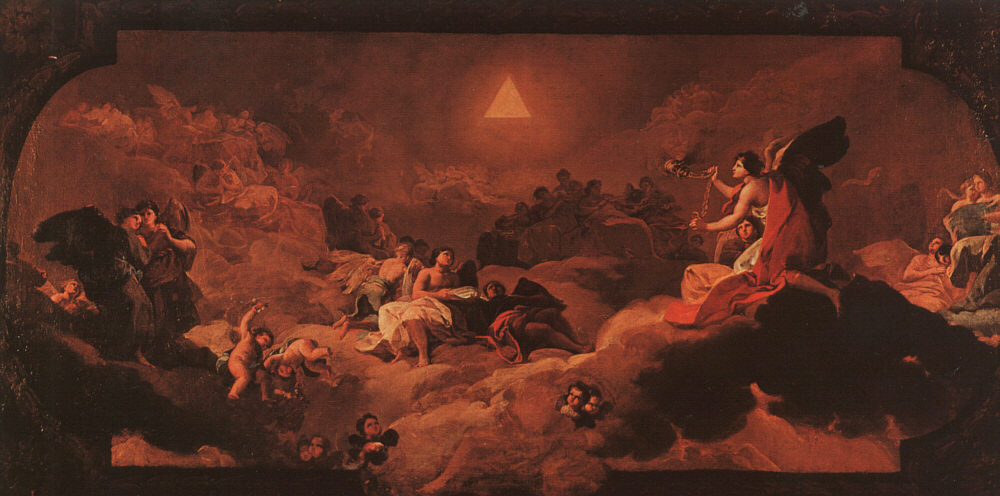
The Adoration of the Name of the Lord
Francisco Goya, 1772

Fideists like Ken Ham display, through their blockheaded refusal to countenance any possibility but one, not faith but the lack of it. The whole point of faith (as an act -- the content of faith is, of course, something else) is to hold fast to something, which isn't necessary if only that one thing even exists. To trust your spouse is one thing; to say that everybody is either lying, stupid, or crazy except your spouse, as a means of perpetuating your trust in your spouse, is ... well, something else.

And this, by the way, is why a Catholic need not and should not fear any of the traditional enemies and rivals of Christian faith. 'Christianity, if true, has nothing to fear from honest inquiry,' said Bishop Kallistos Ware. The advances of the sciences, claimants of supernatural or magical powers (whether false or true) from other religious traditions, corruption of every kind in the Church herself, the mere brute pain of life -- all these things are the perhaps which we, as Christians, ought to allow ourselves to be troubled by; they are the environment in which the word faith has meaning. And we can hardly invite those outside to a faith that we excuse ourselves from entering into, in its twilit glory.

Evil and suffering are here particularly relevant -- especially when they are, or are caused by, the sins of Christians. And Christians have sinned a great deal; we have scandalized the earth; the fact that we are, for some people, a hissing and a byword, cannot be put down merely to the hatred of darkness for light. Shutting one's eyes to evil and suffering, or giving non-answers like 'It's always darkest before dawn' (which didn't work out so neatly for, say, the victims of Auschwitz-Birkenau or the Japanese who survived Nagasaki only to die of radiation poisoning), is a false move -- and, when you come to think of it, an insulting one. For it implies that horrible things do not matter. The militant atheist who refuses to believe in a God who would allow such things to happen, and the hyper-Calvinist devil-worshipper who believes God would cause men to do these things and then damn them for it, both take such offenses more seriously than the cloying, Precious-Moments-y whitewasher who can say God never closes a door without opening my mouth from the comfort of an overstuffed armchair.


Look at these dipshits.

Anyway. The point is, when we speak of faith, we are, obviously, not speaking of reason; nor, as the Church has vehemently argued for centuries, of irrationality. (It has been drily pointed out before now that there is nothing specially rational about dismissing all forms of knowledge except reason, especially since reason does not clearly prompt us to do so.) Neither are we speaking of certainty, of 'blind faith' so-called, any more than we are speaking of a mere 'Well, maybe this whole Christianity thing is true' when we sing the Pange Lingua during the Maundy Thursday procession. What we are speaking of is a personal decision of trust; one that is, necessarily, prefaced by getting to know this Person well enough to decide whether we shall trust Him. And this getting-to-know will naturally take a multitude of forms -- that's to be expected when you are, according to the premise, getting to know the author and fountain of Being -- including reason.

My own reversion to belief was of exactly this kind. I had tensed myself up to maintain the blind fideism I absorbed as a child, afraid to be honest with myself, fearing the consequences of thinking things for no reason except that I thought they were true; and finally, my intellect caught up to me. I just couldn't sustain the covert dishonesty any more. Fideism snapped, and faith now had a chance. And, increasingly, since that time, I've been coming to understanding the tension in which faith exists -- a different kind of tension from the kind I had been using to try and sustain my fideism.

There is no way to prove this: nevertheless, my belief is that, if Christians are willing to experience in ourselves this sacred tension between uncertainty and conviction, our perhaps not can indeed communicate with the perhaps of the non-Christian. It may even be, within the natural exchange and substitution of the coinherence of mankind, the supernatural coinherence can be invoked, and God can make us who know faith to be faithlessness for the unfaithful, and thus communicate faith to those who could not or would not take it for themselves.


*Introduction to Christianity, pp. 46-47, 56-57.

Sunday, May 10, 2015

Novena for Peace

Tomorrow begin the Minor Rogation Days: three days (the Monday, Tuesday, and Wednesday between the Sixth Sunday in Easter and Ascension Thursday) of prayer and fasting for God's mercy and protection, in preparation for the feast of the Ascension of Christ. Then comes Ascension itself, forty days after Easter; the next nine days are spent prayerfully preparing for the feast of Pentecost, which is the origin of  the novena; then comes Pentecost, the birthday of the Church as we know it, ruled by the Holy Ghost in the Apostles.

This sequence has been somewhat disarranged by the more flexible calendar allowed by the Second Vatican Council. The Solemnity of the Ascension (which is a holy day of obligation) is frequently transferred to the following Sunday, so as not to inconvenience the faithful; in that case, while one can of course still pray a novena in preparation for Pentecost, its tie to the Virgin and the Apostles praying in the Cenacle, waiting for the Spirit, is weakened by the Ascension being observed a third of the way in, rather than setting the whole affair off.


"Of course we're not going to call it the 'Gather' book. What kind of lame title is that?"

However, I have the good fortune of being part of a parish that usually celebrates the Ascension on its Thursday date: the Ordinariate of the Chair of Peter, being grafted in from the Anglican Communion, preserves an older calendar -- one descending, not from Trent through Vatican II, but from the Mediaeval Sarum Use* through the Church of England. Our ritual, the fasting particularly, is still a lot more simplified and restrained than it would have been before the Roman-Anglican division; but it's perfectly possible to observe the minor rogations privately, and the pre-Pentecost novena -- which is what I chiefly want to talk about.

The disturbances in Baltimore a couple weeks ago have served to strengthen my pacifist convictions (which I had been questioning as I read the reports of increasingly horrific behavior on the part of ISIS). Every act of violence contains within itself the seed of an act of violence that will take retribution against it. Hatred breeds hatred, injustice breeds injustice, chaos breeds chaos. The quasi-military repression was a response to rioting; the rioting was a response to police brutality; police brutality was a response to crime; crime ... until eventually you reach Abel being killed by Cain, and realize that even they aren't the root of the problem.

But picking who's to blame, or who's at least more to blame, is a fruitless exercise. Not because everybody is equally guilty; that certainly isn't true. If we insist on finding a category of people to blame, rich white people is going to be it, for a multitude of reasons (the slave trade, colonialism, capitalism, Jersey Shore). And while the responses to American supremacy, both here and abroad, have been grossly unjust in many cases -- perhaps nowhere more so than in the evils perpetrated by the Islamic State -- I do think that they are, to an extent, a judgment on us for our sins: i.e., the consequences of our history in a world ruled by cause and effect. Treat people as property, as our ancestors did by the slave trade, and one day they will make havoc of your property; treat people as our rightful subjects, as our forefathers did by the practice of colonial subjugation and the hideous doctrine of Manifest Destiny, and one day they will apply that same heretical reasoning to you. Give, and it shall be given unto you; good measure, pressed down, and shaken together, and running over, shall men give into your bosom. For with the same measure that ye mete withal it shall be measured to you again.

No, the reason the blame game is fruitless is that, while a man can certainly try to prophesy to a valley of dry bones, you can only convert people. I mean, you cannot convert categories, because categories do not have minds or hearts to appeal to. You can't rebuke Whitey, however just it would be to do so; you can only rebuke whiteys, and that must, necessarily, be done by interacting with them as individuals -- individuals who are members of a category, certainly, but that doesn't override their individuality.


And really, would you ever want it to?

Worse, you cannot force any individual to change -- with one exception.

The one person you can work directly upon is yourself. This can only be done in divine grace; or rather, it can absolutely be done outside of grace, and it'll turn you into the sort of self-righteous twat that people wish was a mere stupid racist.

Though their systems differed in many important ways, Gandhi and Jesus have one striking attribute in common: everyone loves Gandhi, until the time comes to actually do anything he suggested. His famous dictum, We must be the change we wish to see in the world, is thrown around on t-shirts and pintergrams, or whatever it is the kids are into these days, and I am sometimes perversely cynical enough to think that people like throwing it around merely to make themselves sound deep, rather than out of a disinterested love of sound ethics. No matter. It's true, even if its truth has been made to wear one of those ridiculous awards-show dresses that porn stars have more self-respect and modesty than to don.

The point is, if we want a just society and a just world, we must begin not by nagging others to change -- although the time for that does come, now and again -- but by choosing to do justly, ourselves, as often as we find such a choice before us. If we want peace, we must practice peace; if we are seized by conscience and want to be forgiven for the sins we have committed, we must forgive. We must choose to end in ourselves the cycle of violence, because someone else might or might not end it, but we can do so right the hell now, and if we don't do it it may not ever be done. That's the freaky thing about free will -- there is no surely predicting it.


Now, what that looks like in practice, I have to admit, I don't really know. I know a few things, like giving money** and food and clothes and stuff to homeless people; but I have no grand schemes that will solve everything from world hunger to getting the kids to listen up when their dad talks to them, come on, we've been over this every day of the week since you were five. Suggestions are welcome; and that's one of the things prayer is for: to get wisdom, to know what to do when the time does come that we can do something. It is a form of watchfulness, and if we aren't trained to watch, we're less likely to notice things.

It's for that reason that I would invite my readership to join me in praying a novena for peace as we advance toward Pentecost this year. The prayers are taken from those said by St John Paul II during his 1982 trip to Great Britain, and Pope Francis' pilgrimage to the Holy Land last year, translated and adapted slightly. (For my Protestant readers, if you want to pray along but don't feel comfortable asking the Blessed Virgin Mary for her intercession, I doubt God will mind if you leave that bit out.)


St John Paul II visiting and forgiving Ali Acga, who tried to assassinate him, in prison.

Daily Prayers

Come, Holy Spirit, send to us from heaven a ray of your light. Reprove us of sin, and of righteousness, and of judgment. Guide us into all truth. Glorify Christ in us, receive of His, and shew it unto us. Bring all things to our remembrance, whatsoever He hath said unto us. Let not our hearts be troubled, neither let them be afraid.

May God convert the violent. May God convert those who have projects of war. May God convert those who manufacture and sell arms, and may He strengthen the hearts and minds of those who work for peace and reward them with every blessing.

Mary, Mother of Mercy and Queen of Peace, we entrust to you our prayers for peace: peace in our hearts, peace in our homes and families, peace in the world, especially in the Middle East. Hail Mary, &c.

Daily Intentions

May 15th: For pardon for all our own sins against justice and peace.
May 16th: For a firm commitment to peace in our daily lives.
May 17th: For the forgiveness and reconciliation of those we dislike.
May 18th: For peace, hope, and happiness for all who have suffered on our account.
May 19th: For an end to racism, and national repentance and harmony.
May 20th: For the repentance and conversion of ISIS and of all religious militants.
May 21st: For relief, strength, and joy for all who suffer religious persecution.
May 22nd: For love and graciousness toward all who treat us unfairly.
May 23rd: For reconciliation and unity among Christians.


*Sarum was the Latin name of the English city of Salisbury, where the Sarum Use developed and from which it spread. This variant of the Roman Rite was used in England by Catholics right through the sixteenth century, even after Queen Elizabeth I banned its use by law in an attempt to suppress Catholicism; thereafter, the underground Catholic Church gradually transitioned to the Tridentine rite, which was formally instituted when the hierarchy was restored. For more info, check this out.

**A lot of people object to the notion of giving money to homeless people. There is no space here for me to go into a full reply for why I am personally fine with it, but I would point out the following things:
- A poor person is a person who has not got much money. They aren't a specialized breed that, on getting fifty cents, immediately runs off to buy all of the crack that crack can crack because crack crack crack crack. Are some of them druggies? Sure. So are lots of well-off people, because there's fuck else to do in the suburbs. Give them money, and they may misuse it; but at least you can be sure you won't.
- If I give someone something, it's a gift. What business is it of mine what they do with it afterwards?
- I'd rather be duped than turn someone away who's legitimately in need. Does that mean you have to give to every person who asks you? Not necessarily, though it might not be a bad thing if you did, according to this neat Roman-era sage from the eastern Mediterranean basin. Regardless, if you give to someone and they didn't really need it, what does that prove? That your compassion glands work, and therefore you're somehow the loser in that transaction?