Collect

Collect for the Fourth Sunday after Trinity

O God, the protector of all that trust in thee, without whom nothing is strong, nothing is holy: increase and multiply upon us thy mercy; that, thou being our ruler and guide, we may so pass through things temporal, that we finally lose not the things eternal; grant this, O heavenly Father, for the sake of Jesus Christ thy Son our Lord, who liveth and reigneth with thee, in the unity of the Holy Spirit, ever one God, world without end. Amen.

Saturday, October 17, 2015

A Response to Dr. Rachel Lu

I was rather refreshed to read Rachel Lu's recent critique at Catholic World Report. I don't share all her views on the subject she addresses (naturally enough, given that I'm loosely associated with the Spiritual Friendship crowd), but her balance and willingness to reflect bespeaks a thoughtful analysis,  for which I am grateful, and I'd like to make some reply to her remarks. My reply is one consisting mostly of disagreement, but I hope I have disagreed respectfully (and apologize if I haven't).


One of her chief concerns is that the Side B* crowd sound a great deal like the surrounding culture, and that our concerns seem very largely to reflect theirs. She writes:
They lobby tirelessly for better support and affirmation for the same-sex attracted. But their advocacy mirrors the mainstream secular narrative in focusing overwhelmingly on broader social attitudes that they regard as defective (because they are insufficiently supportive or accepting), while shying away from any discussion of the defects intrinsic to homosexuality. ... [Helping same-sex attracted believers] is obviously challenging in a culture that is exerting enormous pressure upon religious groups to affirm same-sex desire as normative. It's disconcerting that the Spiritual Friendship group seems remarkably oblivious to this context.
I'd like to parse this a bit. I assume that Dr. Lu's objections are not to our focus on social attitudes just as such, since any kind of culture war is about nothing if not social attitudes. I gather that she reasons that the greater threat to the Church is the hostility of the secular world, as opposed to internal problems the Church has in loving and supporting LGBT people. I agree that I at least spend a great deal more time talking about Christian homophobia and its horrible ramifications in the lives of gay Christians (and ex-Christians), than I do rebuking the gay agenda or the rainbow reich or whatever we want to call it. This is partly because of how my own priorities are arranged, but it's also about the context of my audience. I expect -- and my e-mail and combox seem to bear this out -- that Mudblood Catholic is read chiefly by fellow Christians. I'm therefore far more concerned to urge the duty of charity upon them than I am to urge the duty of repentance upon those outside the Church, because talking about other people's sins to those who aren't committing them, even in the abstract, is at best an unproductive exercise.

If I had any reason to think that I were writing something read primarily by gay-identifying non-Christians, I would no doubt write very differently; but I don't expect that most of them would happen to be interested in a blog like mine -- why should they? -- and even if they were, I've consistently found that lectures on moral theology and natural law tend to fall flat on, well, most people really. It's noteworthy that, in His own ministry, our Lord mostly urged repentance in very general terms, except when talking to religious people, whom He rebuked with great specificity and open anger.

I would also say that, no, we are definitely not oblivious to the context of opposition to Catholic sexual mores in which we find ourselves. The people who believe it are our friends, our co-workers, our relatives, often our fellow parishioners. We carry around the at times heartbreaking reason for that opposition, inside ourselves. And we have been opposed, even at times attacked, by those willing to fight the Catholic beliefs that we hold dear. However much we may resemble secular culture, however much we may even owe to it, we've been told in no uncertain terms that we are self-hating bigots and responsible for homophobic beatings, murders, and suicides. No, we may be -- I certainly am -- many things, but we are not oblivious.


I cannot believe we had a supervillainous Octopope and got rid of him.

Turning to the question of culture war and arrangement of priorities, which I touched on above, Dr. Lu writes the following:
The modern Church is under assault from a secular juggernaut that would use homosexuality as an excuse to criminalize her teachings. This is a serious threat to the spiritual health and integrity of all faithful Christians, and the orthodox are scrambling to respond appropriately. This hardly seems to register with most members of this group. ... [Do they] realize that these bishops are probably scrambling to articulate their formal position in hopes of protecting orthodox priests ... from potential civil or criminal sanction? At such a time, is it reasonable to expect that "pastoral care for sexual minorities" should be a bishop's central concern? ... Any pastoral initiative that captures the media's attention (and that of the lightly catechized) will either be or be presented as a complete repudiation of traditional sexual mores. ... Realistically, then, orthodox pastoral outreach to the same-sex attracted will have to be conducted in the deep shadow of a much larger battle for the life and freedom of the Church. ... [G]iven the urgency of the situation, we really can't mute that message for the comfort of a small number of people.
On reading this last line, I thought instantly of the text in the Catechism which says, "The number of men and women who have deep-seated homosexual tendencies is not negligible." But that is not the meat of the argument.

I am the first to agree that the conflict between the Church and the World is vast -- and perennial; it exists today, as it existed a hundred years ago, and a thousand years ago. And we have always had the assurance of the Lord Jesus to Peter, that the Church was founded upon a Rock, and that the gates of Hell would not prevail against her. In consequence, I can't possibly agree that the life and health of the Church are in any peril from any amount of secular pressure, or even outright persecution. That the Church's freedom -- in the political sense, though certainly not in the spiritual sense -- is at stake, is in my opinion possible, if a bit premature to declare; but I categorically reject the idea that the Church's political freedom is in the least important when compared with the intimacy of one single soul with God, which is what pastoring exists for. The Church existed before she was legal, and will go on living if she is illegalized again (whether openly or covertly). It is only those individual souls who will last into eternity, in Heaven or in hell: but whether there be politics, they shall fail; whether there be blogs, they shall cease; whether there be a kulturkampf, it shall vanish away. 

As to whether it's reasonable to expect pastoral care to be more important to bishops than protecting their priests from civil sanction, I think the answer ought to be a clear, resounding Yes. The Church is not in the business of maintaining her social or political status, however valuable those things may be; she is in the business of giving her children spiritual life, through the ministry of the sacraments, the preaching of the gospel, and, yes, pastoring them. And she is just as present within a jail cell as she is outside of it.

Of course, this is embarrassingly easy for me to write, since I am not personally in danger of being imprisoned for my convictions (that I know of -- though perhaps my posts on Edward Snowden have earned me a "giggles" file on some government watch list or other). Still, it is, I believe, true, and my own dubious character can't alter that.

That the Church's No is louder than her Yes may be an inevitable consequence of a culture war, but in my opinion, so much the worse the culture war. Jesus never ordered us to wage one in the first place. And her No may not be directed at the scared Catholic teenager, struggling to come to terms his feelings for his male best friend, but he's going to hear it all the same. And I speak both from my own experience and from the stories of my friends when I say that, for ninety-nine sheep out of a hundred, whether they wait around for pastoring depends largely on what they think the pastor will say and do to them, and that expectation is formed by the Church's public statements.


Returning to Dr. Lu's argument, she asserts that the adjustment in our perspective that she urges is necessary for an orthodox, adequate ministry to same-sex attracted people:
Of course we should not heap gratuitous burdens on the already-afflicted, but it's essential to be clear about the truth. Is it possible to do this without some hard feelings? ... Personal narrative has its advantages, but it can also undercut discussion insofar as it puts the narrator in a privileged class (which in some cases may mean a privileged victim class), implying that outsiders can have nothing useful to contribute ... In calling for greater solicitude, the Spiritual Friends seem to acknowledge that same-sex attraction is an enormously important, life-defining condition that demands serious attention from the Church. On the other hand, when it comes to the defective aspects of same-sex attraction, they have a tendency to minimize its significance ... protesting any attempt to refer to people as "disordered" simply because they desire disordered acts. ... In short, it seems the Spiritual Friends wish to enjoy simultaneously the solicitude due to the sick, and also the respect that is naturally paid to the (mentally and morally) healthy. This is not an unusual quandary, but it is genuinely problematic, particularly insofar as it ties the hands of those who are genuinely anxious to help.
It's perfectly true that "privileged victims" exist, and also that shutting those who aren't part of a given minority out of conversations about that minority, isn't really helpful or fair. It is, I think, equally true that victims are not simply a privileged class, and that members of a given minority know best where their own shoes pinch, and should be given, not an exclusive, but (as it were) a privileged voice in such conversations.

I will readily plead guilty to the assertion that I at least minimize and downplay the defective aspects of same-sex attraction. My reasons for this are, first, that I don't like thinking about them, since my life largely (though not overwhelmingly) consists in them: my vocation is far more restricted and confusing to me than I had hoped, I expect to be childless, and so on. Along with that, there's the fact that these disadvantages hardly need to be emphasized. But more than that, in both my personal experience and historical study, I haven't found any consistent negative aspects of homosexuality other than itself. It's common in Christian circles to assert that homosexuality is linked to depression and other psychiatric illnesses, a broad trend of moral degeneration, pedophilia, and a laundry list of other personal and societal woes; but I haven't found any reliable evidence (scientific, historical, or even anecdotal) that any of this is true. In consequence, I don't claim to know about the defective aspects of same-sex attraction of which Dr. Lu speaks, and therefore, I don't speak of them.

As far as disorder and sickness are concerned, I would note a couple of things. First, resistance to calling people, as opposed to acts or desires, disordered, does not originate with Spiritual Friendship. It originates with the Church's own documents on the pastoral care of gay people, which go out of their way to say that the person as a whole is not disordered. To call an act disordered, in the technical vocabulary of Catholic theology, means no more than to say that it is misdirected; to call a person disordered is, in the same vocabulary, meaningless, and in the vernacular, means that they are diseased and/or insane. The Church doesn't teach that, and I don't believe it.

Secondly, I take exception to the (apparent) idea that sick people do not need to be accorded respect. I don't think that respect for any person should be based on their conditions or circumstances, but on the mere fact that they are human beings, icons of the Divine Creator. One may of course have to work around someone's conditions or circumstances, but that's nothing to the purpose. (I would, too, say that what I tend to look for, and what I think I read in the authors of Spiritual Friendship, is that care given rather to the injured than to the sick; but perhaps that is only a quibble.) Accordingly, I don't see how asking for respect and care in any way ties the hands of those who wish to help us.

Photo selected from Orthodox-Reformed Bridge.

There is one passage of Dr. Lu's piece that I don't merely disagree with, but seriously object to.
[Some people] view the Spiritual Friends less as a victim class, and more as the fortunate and blessed ones who successfully avoided the more egregious wounds to which the same-sex attracted are vulnerable. ... Noting this see-no-evil approach, I have occasionally wondered whether there might be a strain of "sexual anorexia" in the Spiritual Friendship school, enabling them to enjoy the sense of power that they get from proximity to temptations to which they have not actually succumbed.
This, I find disgusting, less for its ugly speculation on our private sexual qualities than for its ugly speculation on our private spiritual qualities. I've only rarely had to deal with a confessor or a director who was so ready to intrude on the recesses of my soul. That said, I can assert that I am wholly free of this particular fault, since (unlike most of Side B) I'm too slutty to be considered even within spitting distance of not-succumbing to temptation.

Returning to the much pleasanter aspect of mere disagreement, she (nearly) concludes her piece in this way:
Whether or not this is so, it leads us naturally to an important question, which only the Spiritual Friends can answer for themselves: do they genuinely wish to be well? The question is admittedly presumptuous, and may even seem a bit obtuse, but their extensive narrative invites it and of course we already know that attachment to defect is part of our fallen condition. We should properly admire those who are willing to labor under burdens that God has not yet seen fit to remove from them. It's quite another thing, however, to be attached to those burdens ...
A different thing indeed! As great, I am tempted to say, as the difference between duty and joy, justice and love, sober obedience and glorious abandon.
A thorn was given me in the flesh ... Three times I pleaded with the Lord about this, that it should leave me. But he said to me, "My grace is sufficient for you, for my power is made perfect in weakness." Therefore I will boast all the more gladly of my weaknesses, so that the power of Christ may rest upon me. For the sake of Christ, then, I am content with weaknesses, insults, hardships, persecutions, and calamities. For when I am weak, then I am strong.
I am no St. Paul, but I try to take my cue from him in this -- and from the Lord Jesus, who did not heal His sacred wounds in the Resurrection, but preserved and glorified them. I've no doubt that I have a great deal of mere laxity and self-conceit in my attitude toward my sexuality, but, having tried shame for a couple decades, I've found that it doesn't work as a tool to bring me closer to God. As far as wishing to be well -- if wellness is understood as whole union of myself with God, then yes. If it's understood in any other sense, I don't believe that it's truly worth my time.


Caravaggio, The Incredulity of Saint Thomas, 1602.


*For those not already familiar, Side B is a sort of nickname for those of us who regard ourselves as gay, bisexual, trans, or otherwise queer, but affirm the traditional Christian doctrine that sex is rightly reserved to monogamous, heterosexual marriage. The nickname's origins need not detain us for the moment.


Saturday, October 3, 2015

The Economy of the Cross

August and September's extended conflict between certain authors who shall remain nameless and the Side B/Spiritual Friendship community left me feeling extremely hurt, angry, and bewildered. The refusal to heed explanation and argument from people who live directly in the tension between the queer world and the Church, and are thus more or less forced to know what we are talking about, was the source of the bewilderment; the hints at heresy despite our unanimous orthodoxy, and the apparently total and callous disregard for the devastating effects of their language on actual gay-identifying people, especially young people, was the the source of the anger and the hurt. Ron and Beverley Belgau's address at the World Meeting of Families last week helped some -- it felt like a vote of confidence, or at the least a listening ear (which is one of the things we have so largely been crying out for), on the part of the bishops to invite them.

But the fact that there are so many Catholics out there who would rather scold and judge us, not even for our failures, but for whether and how we talk about the mere fact of being gay, is a long-standing bitterness to me. I suppose it makes sense that the devoutly religious should be among those who accuse, rather than those who help to shoulder the cross. "Shut up and carry your cross like the others," a constant refrain of these writers and their commenters, is the language of the soldiers, not of St Veronica or the Mother of Sorrows; and it rightly provokes disgust and indignance in those who encounter it, and has scandalized some to the point of heresy or apostasy.


O Lord, deliver me from the man of excellent intention and impure 
heart: for the heart is deceitful above all things, and desperately wicked.
Sanballat the Horonite and Tobiah the Ammonite and Geshem 
the Arabian: were doubtless men of public spirit and zeal.
Preserve me from the enemy who has something to gain:
and from the friend who has something to lose ...
-- T. S. Eliot, Choruses from "The Rock," V.1-3

But my own self-righteous craving for not only vindication but revenge -- that our, and my, opponents should be not only corrected (which need not be a wholly arrogant desire, though it is usually mixed with arrogance), but embarrassed in the process (which is always an evil desire) -- is certainly no better. Stewing over the faults of others, real or imagined, is wrong; it's what moral theologians call morose delectation, a common flaw of religious people like me, and of many people with an idealistic streak like mine. It's a great way to nurture hatred, sullenness, nasty-mindedness, and self-conceit -- including, interestingly, the decision that we are martyrs. For of course, the mark of a martyr is that he suffers for God, in Himself and in the martyr's fellow-man, and bears these sufferings out of love. But it is perfectly possible to parody the sufferings of the martyr for the sake of our own diabolical ego. Indeed, that sort of spiritual corruption is one of the greatest dangers of the spiritual life, partly because it can be difficult to detect and, correspondingly, difficult to cure.

Thank God for the bottomless wells of grace -- that is, of His Being, of the divine life -- that He shares with us. For that is really and truly the only remedy; no amount of self-examination can assure any improvement, however much it helps.

Trying to find some right, loving way of responding, even if that response were only keeping silence, drew my mind to the whole economy of the Cross on which the Kingdom of Heaven (that is, the Church) operates. In his short book He Came Down from Heaven,* Charles Williams points out the striking contrast between the proclamation of St John the Baptist and the gospel of Christ proper:
What, apart from the expectation of the Redeemer, was the gospel of the Precursor? It was something like complete equality and temporal justice, regarded as the duty of those who expect the Kingdom. What has happened to that duty in the gospel of the Kingdom?

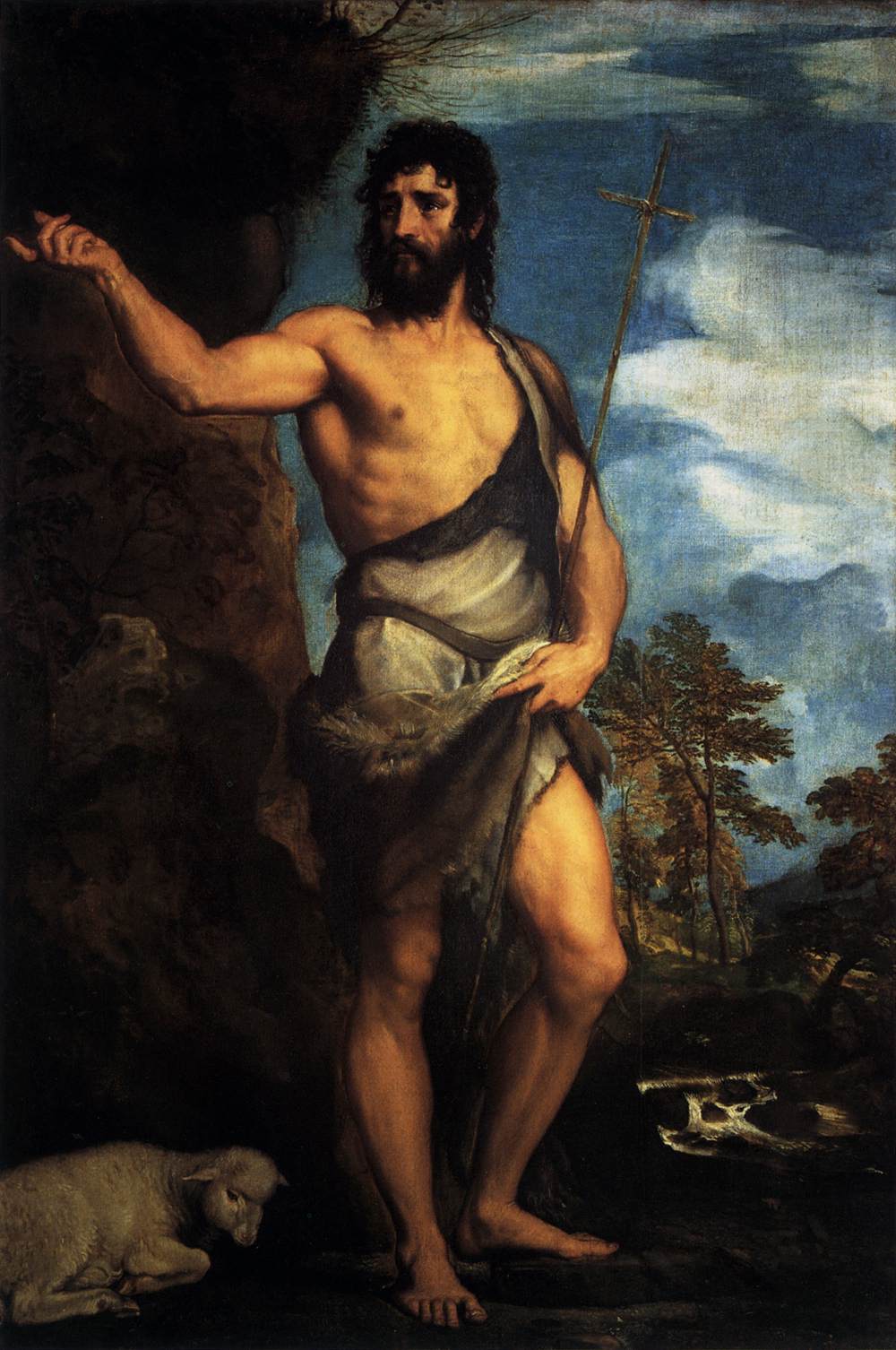
Titian, St John the Baptist in the Desert, ca. 1542
The new gospel does not care much about it. All John's doctrine is less than the least in the Kingdom. It cannot be bothered with telling people not to defraud and not to be violent and to share their superfluities. It tosses all that sort of thing on one side. 
... What then of all the great tradition, the freeing of slaves at the Exodus, the determination of the prophets, the long effort against the monstrous impiety of Cain? The answer is obvious; all that is assumed as a mere preliminary. The rich ... are practically incapable of salvation, at which all the Apostles are exceedingly astonished. Their astonishment is exceedingly funny to our vicariously generous minds. But if riches are not supposed to be confined to money, the astonishment becomes more general.
The long tradition of Christianity as the unofficial but real civil religion of Western society has muddied this a great deal. When the same institution that was premised upon transcending the law must also make itself responsible for first instructing people in the law, and must accordingly develop an intricate body of knowledge and technique for doing so, to say nothing of the rules it has to develop to govern its own worldwide operations -- well, keeping the natural and the supernatural distinct from, yet in contact with, each other is fantastically difficult; as difficult as understanding the simultaneous distinction and union of the human and the divine in Christ. Apollinaris, Nestorius, and the rest didn't fall into heresy out of mere inattentive stupidity. It is horribly easy to suppose that a properly Christian society, or a properly Christian individual, substitutes explicit and pushy religiosity for all other cultural or personal substance, or that the "moral values" of the faith are the thing for which it's chiefly important (as though non-Christians didn't have moral values!).**

An age like our own, in which Christianity has largely but not entirely ceased to be the civil religion, and in which, at the same time, the actual moral standards of society have shifted significantly, is practically begging for believers to confuse natural morality and supernatural grace. But they are as different as they always have been. Natural morality operates on the economy of law, of wrong and right in action and intent; and we cannot do without it, as we cannot do without food. But we can no more treat law as grace than we can treat the Blessed Sacrament as ordinary bread.

Kyri-o's: Intinction never tasted so good.

The economy of law knows justice as its highest virtue, and, when wronged, seeks only recovery and redress; many versions of "forgiveness," like the kind that seeks to forgive because it relieves the stressful distraction of resentment, belong to this economy rather than the other -- i.e., trying to use the golden paving stones of the Heavenly Jerusalem to pay for anti-anxiety meds.

But that is not the economy of the Cross. Its operations are the operations of the Holy Ghost, who cannot be detected, still less caught, by human means. It isn't only that you can't buy grace with money or good looks; you equally can't buy it with intelligence or good character. Truthfulness, patience, kindness, and yes, chastity may all be animated by grace; none of them can earn it.

And that economy, of grace from without, and, with it, of forgiveness and good will towards all others, as universal as that which God showers upon us, is step one of the Christian faith. We don't get to make exceptions based on how horrible somebody was to us. Whether their behavior was, or is, really and truly worse than ours doesn't enter into it; that is a return to the economy of law, of relative goodness and debts owed and just deserts. The first movement of grace is to cancel, not simply our own debts, but debts; currency is made meaningless for the Christian, save insofar as its beauty can furnish decoration to lay beneath our feet. To insist on My Rights and My Wrongs is, simply and to that extent, to excuse oneself from the economy of the Cross. Everything is gift, and so, unrepayable.

What then of our injuries? Well, admittedly, the wind bloweth where it listeth, and we do not all receive the same graces or receive them on the same schedule. We shouldn't presume on our strength, and there are times when we may and must withdraw ourselves from being injured further. But, to return to Charles Williams:
The new way of pardon is to be different from the old, for the evil is still to be known. It is known, in what follows, by the Thing that came down from heaven. ... It remains still exclusive and inclusive; it excludes all consent to the knowledge of evil, but it includes the whole knowledge of evil without its own consent. It is 'made sin,' in St Paul's phrase. 
... Men had determined to know good as evil; there could be but one perfect remedy for that -- to know the evil of the past itself as good, and to be free from the necessity of the knowledge of evil in the future; to find right knowledge and perfect freedom together; to know all things as occasions of love. 
... It was not inappropriate that the condition of such a pardon should be repentance, for repentance is no more than a passionate intention to know all things after the mode of heaven, and you cannot know evil as good if you insist on knowing it as evil. Pardon, as between any two beings, is a reidentification of love ... It is all very well for the Divine Thing of heaven to require some kind of intention of good, not exactly as a condition of pardon but as a means of the existence of its perfection. Men were never meant to be as gods or to know as gods, and for men to make any such intention a part of their pardon is precisely to try to behave as gods. It is the renewal of the first and most dreadful error, the desire to know as gods ... [I]t is precisely the attempt to convert the Godhead into flesh and not the taking of the manhood into God. The intention to do differently may be passionately offered; it must never be required ... The ancient cry of 'Don't do it again' is never a part of pardon.
This is a hard saying. It is, also, hardly more than a commentary on the dictum that we must forgive our brother seventy times seven times. Only Dory and that guy from Memento could do that while also expecting of the offender that he not repeat the offense.


[Image: a devout penitent leaving the confessional]

Grace to others isn't optional. It is the stuff of the life of faith. It is Jesus in action. If we don't know how to show it, or try and can't manage, that's okay; God is not as a rule taken by surprise. We can be weak. We can be one big, gaping, aching need. But what we can't do is refuse grace to others. I admit frankly that I am, for now and probably for a long time yet, avoiding the unnamed authors from my opening paragraph; I have not succeeded in forgiving them, and I can't do it by myself; thankfully God is not bound by my powerlessness. But to forgive, to love, and to want reconciliation -- even if the other party refuses -- is the goal we must have in every conflict. The meanwhile of that, we can offer up to God in unity with the Cross. Every economy has production and consumption; the pain and the hope are our raw material, and love is the refinery.
I say more: the just man justices;
Keeps grace: that keeps all his goings graces;
Acts in God's eye what in God's eye he is --
Christ. For Christ plays in ten thousand places,
Lovely in limbs, and lovely in eyes not His,
To the Father through the features of men's faces.
-- Gerard Manley Hopkins, As Kingfishers Catch Fire, ll. 9-14


*Unfortunately I don't have my copy at hand as I write this, so I can't provide page references.

**The regular recitation of the Athanasian Creed, wisely enjoined upon Anglicans by the Book of Common Prayer in 1662, might -- if it had been rightly used -- have done something to prevent this, with its often dull but soundly detailed definition of the Incarnation. Dorothy Sayers' excellent essay on the subject (and on the general fiercely practical character of theology) can be found here, and in her excellent collection of essays Creed or Chaos?

Monday, September 21, 2015

Five Quick Takes

I.

Readers may have noticed that I haven't updated much this month. It's been a long one. For one reason and another -- especially the attacks that have been launched against my friends at Spiritual Friendship (and, to a lesser extent, against myself) by Deacon Russell -- I've been positively exhausted. I'm hoping to have a chance to convalesce with some friends early next month, but I will probably be largely away until after that time.

On the subject of Spiritual Friendship, however, Ron Belgau -- a founding member of the blog, who has been invited to address the World Meeting of Families during Pope Francis' imminent visit -- has written a really outstanding piece on the relationship and contrasts between them/ourselves and that of Courage Apostolate, whose outlook and methods are rather different. Belgau writes:
In a 1996 interview, a journalist asked then-Cardinal Ratzinger how many ways there are to God. Ratzinger's response was: 
"As many as there are people. For even within the same faith each man's way is an entirely personal one. We have Christ's word: I am the way. In that respect ... everyone who is on the way to God is therefore also in some sense on the way of Jesus Christ. But that does not mean that all the ways are identical ... on the contrary, the one way is so big that it becomes a personal way for each man." 
... [T]he Church has always embraced a variety of approaches to spiritual growth. God gives diverse gifts, and those gifts build up the Body of Christ in diverse ways. The Catholic Church has always recognized this and so welcomed and encouraged different approaches to cultivating our own spiritual growth, sharing the Gospel, and reaching out to those in need.
Read the essay in full here.

+     +     +

II.


I neither know enough, nor have the strength, to write a piece on the ghastly situation confronting refugees from the war in Syria (though they are by no means fleeing only from Syria). I can, however, provide my readers with this link to Catholic Relief Services, which is providing refugees with housing, food, medical care, and trauma counseling. I urge you to offer your prayers and your resources to God for these people. The United States can do more, and that starts with us, personally, deciding to do more.

+     +     +

III.

Joseph Prever of Gay, Catholic, and Feeling Fine is blogging again, if you weren't aware! (Though let's be honest, if you read Mudblood Catholic you were probably a Steve Gershom fan already.)


I am very happy about this: Joseph's a good friend and an extremely funny, smart, devoted man, whom I'm glad and privileged to walk alongside. (Admittedly he's further along than I am, but he's never once made me feel bad about it, which is pretty phenomenal, especially since I'm the sort of person apt to resent being passed by other cars on the highway.) He posted this excerpt from an interview with the Catholic World Report last month, conducted after he spoke to Courage's leadership at their conference in July.

And speaking of interviews with funny and intelligent Catholics, if you're familiar with the Eye of the Tiber (a satirical Catholic e-paper, along the lines of the Onion), this dialogue with its creator, S. C. Naoum, is truly delightful. Well, and if you aren't familiar with the Eye, it's still delightful.

+     +     +

IV.

I couldn't think of a fourth thing, so I suggest reading the Evil Overlord List on TVtropes. It's chock-full of excellent advice for when you, personally, become a megalomaniacal villain, complete with lair and minions. A few of my own favorites:
16. I will never utter the sentence, "But before I kill you, there's just one thing I want to know." 
34. I will not turn into a snake. It never helps. 
47. If I learn that a callow youth has begun a quest to destroy me, I will slay him while he is still a callow youth instead of waiting for him to mature. 
67. No matter how many shorts we have in the system, my guards will be instructed to treat every surveillance camera malfunction as a full-scale emergency. 
85. I will not use any plan in which the final step is horribly complicated, e.g. "Align the 12 Stones of Power on the sacred altar, then activate the medallion at the moment of total eclipse." Instead it will be more along the lines of "Push the button."

Where in this day and age you will find a suitable top hat and mustache wax, dear reader, I leave to you.

+     +     +

V.

Mass this past Sunday was peculiarly consoling. For whatever reason -- maybe because we're back on to our ordinary schedule, in which the liturgy I attend is at 10 in the morning instead of 9 -- the prayers and texts reached me more than they generally have of late. I thought I'd share some of them here.

Introit
I am the saving help of my people, saith the LORD God: out of whatsoever tribulation they shall pray unto me, I will surely help them, and I will be their God for ever and ever. Hear my law, O my people: incline your ears unto the words of my mouth. Glory be to the Father and to the Son and to the Holy Ghost: as it was in the beginning, is now, and ever shall be, world without end. Amen.

Collect
Grant us, O Lord, not to mind earthly things, but to love things heavenly; and even now, while we are placed among things that are passing away, to cleave to those that shall abide; through Jesus Christ our Lord, who liveth and reigneth with thee and the Holy Spirit, one God, for ever and ever. Amen.

Lesson (Wisdom 2.12, 17-20, RSV-CE)
The wicked say: "Let us lie in wait for the righteous man, because he is inconvenient to us and opposes our actions; he reproaches us for sins against the law, and accuses us of sins against our training. Let us see if his words are true, and let us test what will happen at the end of his life; for if the righteous man is God's son, he will help him, and will deliver him from the hand of his adversaries. Let us test him with insult and torture, that we may find out how gentle he is, and make trial of his forbearance. Let us condemn him to a shameful death, for according to what he says, he will be protected."

Epistle (James 3.16-4.3)
Brethren: Where jealousy and selfish ambition exist, there will be disorder and every vile practice. But the wisdom from above is first pure, then peaceable, gentle, open to reason, full of mercy and good fruits, without uncertainty or insincerity. And the harvest of righteousness is sown in peace by those who make peace. What causes wars and dissensions among you? Is it not your passions that are at war in your members? You desire and do not have; so you kill. And you covet and cannot obtain; so you fight and wage war. You do not have because you do not ask. You ask and do not receive, because you ask wrongly, to spend it on your passions.

Postcommunion
Graciously raise up, O Lord, those you renew with this Sacrament, that we may come to possess your redemption both in mystery and in the manner of our life. Through Christ our Lord. Amen.


Monday, September 7, 2015

Contempt of Conscience

You've probably heard of the Kim Davis case by now. And, if you haven't, congratulations on being the first person to reach Mars.


Who's a geek now, Steve?

Anyway, in case you do happen to be reading from the red planet, Kim Davis is a county clerk from Kentucky who has been jailed for contempt of court, after refusing to issue marriage licenses to gay couples. Since the Obergefell vs Hodges ruling in June, a number of counties have entirely stopped issuing marriage licenses in order to avoid issuing them to same-sex couples; Rowan County, where Davis worked, among them. Last month a federal court ordered that marriage licenses must be issued; when Davis continued to refuse, she was imprisoned. (The plaintiffs -- two gay couples, two straight couples, and the ACLU -- had asked only that she be fined, but the judge in question dismissed this as ineffectual, on the grounds that the fine would be paid for her by supporters.)

Most of the people that I've seen talk about the case on social media have been on the side of the courts: admittedly, when she originally took the job, she had no way of knowing that it would later come to require of her that she transgress her conscience; but that's what the law does require now, and if she refuses to do that then she ought to resign. It's easy to see the strength of such an argument. Nor is it without precedent; St Thomas More chose to resign in silent protest when Henry VIII defied the Church by repudiating Catherine of Aragon and marrying Anne Boleyn.

And Davis' own defense -- that she has divine and biblical sanction for her actions -- is a dubious one. That is, there is no reason to suppose that her beliefs are insincere in any way, but one can hardly maintain that those religious beliefs are relevant to civil law; the separation of church and state is enshrined in the First Amendment (not phrased in those words precisely, but it really doesn't matter; what's at stake is the substance of it), and to obtrude a solely religious basis for a political act is, in consequence, dodgy, especially as a state official.


The Catholic Church takes a slightly different angle in its objections to gay marriage. Its contention is not that gay marriage contravenes the Bible's definition of marriage, but that the natural character of marriage, apart from any question of divine revelation, is directed toward bringing children into the world. And this is certainly how most societies in most places and times have viewed marriage, which is partly why polygamy, divorce on grounds of barrenness, and the keeping of concubines have so often been culturally acceptable. (We may, of course, regard this general witness of humanity as inadequate to change our own minds, but whatever that witness is worth, this is its testimony.) Hence, a gay union, because it can't produce children, is regarded as not being a marriage ipso facto. It certainly doesn't follow from this that no legal recognition could or should be given to gay unions; only that the specific kind of recognition accorded to marriage should be unique.

If this, rather than marriage as found in Scripture, were Davis' position, she'd be in a much stronger position -- for in that case, she would be not refusing to obey a law because it conflicted with her religious faith, but refusing to obey a law because she thought it was unjust. As things are, she does seem (in my view) to be blurring the categories of civil and religious obligations, and resignation would probably have been a neater and more conscientious solution. It's partly for this reason that, though I am a fervent defender of religious liberty, I don't see this as essentially a question of religious liberty, because I don't think the nature of marriage is a specially religious question in the first place.

But, though I disagree strongly with the grounds on which she made her decision, I'm not writing this to criticize Kim Davis' actions. I'm writing to praise her.

By obeying her conscience and peaceably accepting imprisonment, Davis has entered the high tradition of civil disobedience. Indeed, refusal to comply with a law and accepting the penalty for your refusal is civil disobedience in a nutshell. Gandhi, one of the great sages of that tradition, taught with great care and emphasis that the thing that makes passive or civil resistance righteous is precisely this decision to accept the consequences, to suffer in oneself rather than inflicting suffering on others by violence -- and, incidentally, pointed out also that if a person is mistaken in their views, civil disobedience has the advantage of causing only themselves to suffer for the mistake. Martin Luther King followed the same teaching, influenced by students of Gandhi and Christian pacifists.

I would, also, pose a question to those who criticize her for failing to do her job. Without wishing to cast any doubt on the sincerity of your beliefs, have you ever gone as far as she has in standing up for what you believe? Could you go to prison in defense of gay marriage? What, in fact, did you do for gay marriage, aside from some Facebook likes and a drunken rant to a friend after your poli-sci midterm?


Kim Davis (probably)

And the members of this tradition are frequently found guilty of contempt of court, because they consider themselves answerable to something else: their consciences.* I have nothing but respect and support for that. I for one would far rather be found in contempt of court, than know within myself that I am guilty of contempt of conscience. To carry that knowledge with you, sleeping and waking -- no. And while an individual may be mistaken about right and wrong, that's true of courts too. Unjust laws, and for that matter unjust judges, have existed at least as long as history -- that was kind of the point of the gay rights movement, wasn't it? Law itself is worthless unless it embodies justice; justice is superior to all law; and justice is known, not by legal fact or precedent, but by the inner witness of the soul as tutored by the intellect. A person can be persuaded that their beliefs are incorrect, and therefore change them. But as long as they do hold those beliefs, obedience to them is what makes for a clear or a guilty conscience.

People will say that Kim Davis is no MLK. Certainly not. And, yes, her own track record on marriage is by no means a perfect one.** But we do not earn the right to obey our consciences by being saints already, or even mere heroes. Obeying your conscience is what raises you to heroism. I think that Davis' decision to follow the path of civil disobedience in this case, even though I disagree with her grounds for doing so, ennobles her.


*All of the civil resisters that I know of have also been religious; their obedience to their consciences has been inviolable to them because they believe that conscience is, in Newman's phrase, the aboriginal Vicar of Christ. While this trend is certainly present, I don't know that it's necessary to civil disobedience. I see no reason why an atheist or an agnostic couldn't make a good civil resister. Furthermore, insofar as these acts are a testimony to conscience and an urge to others to heed their own consciences, I don't believe that civil disobedience involves us in the mixed-up premises that Kim Davis has espoused.

**She has been married four times (twice to the same man). A good deal of chaff has been blown up over this fact. I'd point out a few things in response: first, that her experience of religious conversion only took place in 2011, so that her zeal on matters marital may well be a recent and comparatively unsoiled thing; second, that we are not privy to the nature and circumstances of her marriages (or not that I'm aware), which could possibly be innocent or at least very pardonable, and that presuming the worst of others is an ugly way to behave; and third, that having a poor moral history oneself is not a good reason to transgress one's principles further merely because it would be consistent.

Wednesday, September 2, 2015

The Stranger Within Thy Gates


And if a stranger sojourn with thee in your land, ye shall not vex him. But the stranger that dwelleth with you shall be as one born among you, and thou shalt love him as thyself; for ye were strangers in the land of Egypt: I am the LORD your God.

—Leviticus XIX.xxxiii-xxxiv

But the seventh day is the sabbath of the LORD thy God: in it thou shalt not do any work, thou, nor thy son, nor thy daughter, thy manservant, nor thy maidservant, nor thy cattle, nor the stranger that is within thy gates.

—Exodus XX.xx

✠     ✠     ✠

Watching the charismatic train-wreck that is Trump's campaign for the presidency was funny at first, though its persistence has begun to make it edge into the nauseating. His remarks, both off-the-cuff and considered, about immigration have been peculiarly sickening; and coming from a Caucasian, one cannot help feeling that it is in questionable taste to complain of the ill-effects of foreigners coming into our land and taking our shit.

The ongoing debate over immigration—by which (let us be frank) we mean immigration from Latin America into the United States—seems to me to be both muddled and a little pathetic. I'd like to lay out a few things that seem to me to be essential principles for the Christian to have in mind, in order to arrive at a just, intelligent, and charitable opinion on the subject. Some are perennial ideas; others are based in the facts of American life as it now is.

1. Nations exist to serve people, not people to serve nations. As C. S. Lewis pointed out in The Weight of Glory, on the Christian view, every human person will outlive every nation, culture, class, and ethnicity; and we, unlike the societies we form, are each individually made in the image and likeness of God. Any political policy, of whatever kind, must be grounded in this fact if it is to have any claim to consistency with Christianity. That isn't to say that practical compromises can't ever be made; but they must be compromises starting from this defined point, not a dismissal of the principle as false or unimportant. No law can be justly made that promotes the state's rights at the expense of human rights; and, as St Augustine said, an unjust law has no force -- not even if it is enforced.


2. More specifically, nations exist to serve their own people. No nation has ever been given a charge from God to take care of all other nations and peoples—unless we adopt Dante's view, that the Roman people were divinely chosen to provide for all humanity temporally, as the Jews were chosen to provide the eternal Savior; however, this view is (outside its Mediæval context) not an obvious one, and not one that has successfully recommended itself to the conscience of Christendom.1 That aside, every community, nations included, is only responsible to its own people and their well-being, not to the general welfare of the whole earth. No authority could take on such a task, unless it were an authority that were drawn from the whole earth and had competence to address all its problems. And individual nations, in serving their own people, do also have the right to protect their borders.

3. Every person has the right to life, and accordingly the right to pursue the means of life. The deranged assertions of Donald Trump's page on immigration reform notwithstanding, the truth is that most of the people who come into this country on any kind of permanent basis are doing it to find work. Central and South America have never been as comfortable or prosperous as the United States or Canada (partly perhaps because of their longer history of colonialism). There are criminals who dart back and forth across the border, certainly, but the notion of Latinos creeping over the Rio Grande en masse for rapine and pillage is farcical, and the claim that the Mexican government has been ‘export[ing] the crime and poverty in their own country’ into the US, as if crime and poverty could be shipped north like bananas, is worthy of a bad stand-up comedy routine. The reason that long-term immigrants come north is to find work, resources, safety—in short, a future—that they can't get in their home countries. And historically, America has always been the place for that; most if not all of us are descended, at least partly, from downtrodden Europeans who decided that an unknown future across the Atlantic was better than starving for food and dignity alike at home.


4. Middle- and upper-class American life depends on the abundant and underpaid work of illegal immigrants. It was right and necessary to abolish slavery legally, and we did that a century and a half ago. What we have thus far failed to do is abolish the thing. People can caterwaul about illegal immigrants taking our jobs if they like, but most immigrants are taking jobs that Americans mostly don't want, or consider ourselves too good for; harvesting vegetables and fruit, for example. Like agricultural workers throughout American history—indentured servants in the first century of European settlement, slaves from Africa and the Caribbean in the eighteenth and nineteenth, and migrants legal and illegal since the Civil War—they are a disenfranchised population. They can't vote, becoming a citizen (or even a permanent resident) is stupidly hard, they're paid less than minimum wage2 to do their jobs, the work isn't reliable (varying by season and location), and if they stand up for themselves in any way, they risk being reported to INS3 and kicked out of the country; and all of this is just the ones who work in agriculture. But all of this isn't slavery because we don't call it that.


Don't believe me? Imagine that six, or seven, or eight out of every ten agricultural workers went on strike. That's how many are here without the documentation and interview processes for getting here legally, on account of those processes taking a couple of years and thousands of dollars that they don't have, and can be rejected over utterly Byzantine details. Try putting food on the table—try buying food—when there are only a quarter as many available in the grocery store of everything not Cheez Whiz (which, with a certain generosity of spirit, may be regarded as food).

5. The Scriptures are full of the injunction to love the alien within our gates and treat him as our equal. It may be said, reasonably enough, that this injunction was addressed specially to Israel as God's elect. However, if we propose either to regard America as a Christian nation or to let our politics be formed by our faith, it's an injunction we have to take to heart, because it lays out how God wanted an earthly society to work when it was based directly on His revelation. We cannot dismiss that and then proceed to claim Christian authority for any other political idea we espouse.


Does any of this mean that a believer must approve of breaking the law? Well, I think we have first to inquire whether the law is just and wise. If it is both, then no, we shouldn't approve of lawbreaking; if the law in question fails in either way, or both, pay no further attention to it. What is right ought to be the pattern of life for the Christian, and the pattern of law for the statesman; if, and to the extent that, laws interfere with what is right, it is the laws that are at fault, not rightness.


It's hardly a secret that I think our policies on immigration are both unjust and stupid. Biting the hands that feed us is neither good tactics nor good morals, and will eventually lead to judgment. But I certainly admit that a person of sense and good will, considering the facts, could come to a different conclusion about what the fairest, most practical solution is to the problem. What we must cure ourselves of, however, is the perennial temptation in politics to surrender to mere cynical pragmatism. Doing what's practical is good, if by practical we mean beneficial to the greatest number of people; all too often, we mean only beneficial to our own group's advantage. It would be better that America should be smashed to pieces than that, serving it, a man should damn himself.


O beautiful for pilgrim feet
Whose stern, impassion’d stress
A thoroughfare for freedom beat
Across the wilderness!
America! America!
God mend thine ev’ry flaw,
Confirm thy soul in self-control,
Thy liberty in law!


✠     ✠     ✠


1This is not to say that there is nothing to be said for Dante's view, especially if we add that his conception of Roman election was one of the supremacy of the Roman idea of the rule of law, not a nationalistic (still less a racial) notion. It might be pointed out that one of Dante's own arguments in the De Monarchia—namely, that God Himself chose to be born under the dominion of the Roman Empire, submitting His human nature to its authority, and even offering answers to Pilate as much as to the Sanhedrin while entirely ignoring Herod—may seem frivolous to a modern reader, but is curiously hard to get round when you start thinking about it.
2Minimum wage, remember, not necessarily being even a living wage itself.
3Immigration and Naturalization Services, whose primary occupation is of course to prevent naturalization by deporting immigrants.