Collect

Collect for the Fourth Sunday after Trinity

O God, the protector of all that trust in thee, without whom nothing is strong, nothing is holy: increase and multiply upon us thy mercy; that, thou being our ruler and guide, we may so pass through things temporal, that we finally lose not the things eternal; grant this, O heavenly Father, for the sake of Jesus Christ thy Son our Lord, who liveth and reigneth with thee, in the unity of the Holy Spirit, ever one God, world without end. Amen.

Monday, December 21, 2015

Death's Dream Kingdom

Gentles all:

I have written a book! An actual book that you can buy for money!

I've excerpted it here on the blog before, and now, Death's Dream Kingdom, my first ever novel, is available on Clickworks Press and Amazon. It is about vampires, ghosts, telepathy, murder, macabre art, English Catholicism, the deep abysm of history, and of course, voluminous Victorian gowns.

So far it is only available in e-format, though that will be remedied as soon as you stop screaming. Please stop screaming, it's just lots and lots of blood. Screaming solves nothing. Please lie back.

Friday, December 18, 2015

Serious Business

I'm working on a real post, but I just can't get in the right headspace for it at the moment. So, for your viewing pleasure, I offer you some Eye-of-the-Tiberian/Onionesque Catholic headlines that I jotted down a while back, having been inspired by some exceptionally bad music at a Mass in upstate New York this past summer.


Spirit of Vatican II Cast Out of Jesuit Professor After 57-Hour Exorcism
Fr Gabriele Amorth "Remain[s] Pessimistic" About Ridding Notre Dame of Infestation

Charismatic Catholic Retreat Declared "A Mixed Success" Due to Nonstop Glossolalia

Cardinal Kasper Caught After Harrowing 140mph Chase on Autobahn
German Catholics Report "Deep Sense of Relief" on Rogue Prelate's Capture

Nancy Pelosi Voted Head of US Episcopal Church

Pious Housewife Scandalized by Literally Everything

Local Parish Builds Cry-Room for Musicians

USCCB Releases "Choose Your Own Adventure" Missal

CDF Commissions Investigation of What the Hell a "Maniple" Is
Could It Be a Tropical Fruit? Some Kind of Disease? Who Knows?

Local Parish Replaces Dour Crucifix With Balloon Version

Current Antipopes Nearly as Numerous as Protestant Churches With "United" in Name

GOP Proposes Institution of Index of Prohibited Encyclicals
Rick Santorum: "Anything With Annus in the Title Needs to Go, That's for Sure"
Bill O'Reilly: "If Necessary, We Will to Resort to Reading Them to Decide Which Ones to Ban"

Fart Disguised as Sob of Devotion

Missouri Synod Lutherans Collectively Shrug, Become Catholics
"Eh, Fuck It," Reports Rev. Matthew Harrison

Pope Francis Realizes What a Terrible Influence He Is Thanks to Local Combox Warrior

Archdiocese of Detroit to Release New Flavors of Host to Draw Attendants
"Grace of Guava," "Cherr-ity," "Pecan Possession"; Approval Pending for "Forbidden Fruit Punch"

Sunday, December 6, 2015

A Portrait of Mary

The Solemnity of the Immaculate Conception is this coming Tuesday, and with it comes the Jubilee Year of Mercy* that Pope Francis is promulgating. I haven't followed that very closely in itself; my bad habits make me an unlikely candidate for complete detachment from sin, and anyway I can't afford to visit Rome for the foreseeable future (though I really want to go back some day -- I've only been once, and I was at the height of my Romaphobic fundie phase at the time, so).

But it got me thinking about the Blessed Virgin Mary, not so much as a topic of Catholic doctrine, but as a historical person -- which, after all, is what the doctrine's about. (It's kind of arresting, when you're used to thinking of things as abstractions because you've encountered them intellectually at first, to realize suddenly that they were and are actual things, things you could bump up against if you were in the right place at the right time. Walker Percy is great at provoking this realization.) Devotion to her as the Queen of Heaven and the Mother of God has always been intuitive to me; even before I accepted Catholic beliefs about Mary, Catholic attitudes toward Mary seemed like the natural way to feel toward her, except maybe that reverence came more easily to me than affection. Still does. But I've only rarely thought about her as a living, breathing person. And when you do, you realize that she was kind of a shocking one.

Theotokos of Vladimir, ca. 1130

It's easy to say that. Christians, especially Catholics, love talking about how shocking the heroes of the faith were, usually with mouths that have clearly never said anything more shocking than "Surprise!" at a friend's party. But seriously, think this over:

First, according to St Luke's account of the Annunciation, she was betrothed to St Joseph but not yet living with him (which was normal practice at the time: about a year normally passed between legal betrothal and the marriage proper). Given the customs of the time, this would probably put her at about 13 or 14 years of age. This girl, at the age when most girls today are deciding which of the members of One Direction should dominate their Pinterest collection, responded to the appearance of an archangel -- something that terrified a large group of grown-ass men with heavy club-sticks at their disposal -- with, apparently, little more than a disconcerted expression: no screaming, no prostrations, even a clarifying (not to say challenging) question to test the spirit speaking to her. That, ladies and gentlemen, is some gorram poise.

The Virgin of the Annunciation, Fra Angelico, 1446

Next, as a girl who is now both unmarried and pregnant, which could get her at least disowned by both her parents and her fiancee, she runs off -- alone -- to the suburbs of the capital. Again: a pregnant maybe-fourteen-year-old girl runs off, presumably on foot (since taking an animal would only get her in more trouble), through a wilderness festively decked with criminals, that will probably take her more than a week to traverse. By herself. I can't stress that enough. The girl had serious guts.

After this, and after singing a fierce hymn of her own devising** with an epic guitar solo (probably), she goes back to the town, family, and fiancee that she bolted from three months ago. Also gutsy. And then, in the face of the tiny, gossipy town, she and her fiancee make it known that they are getting married.

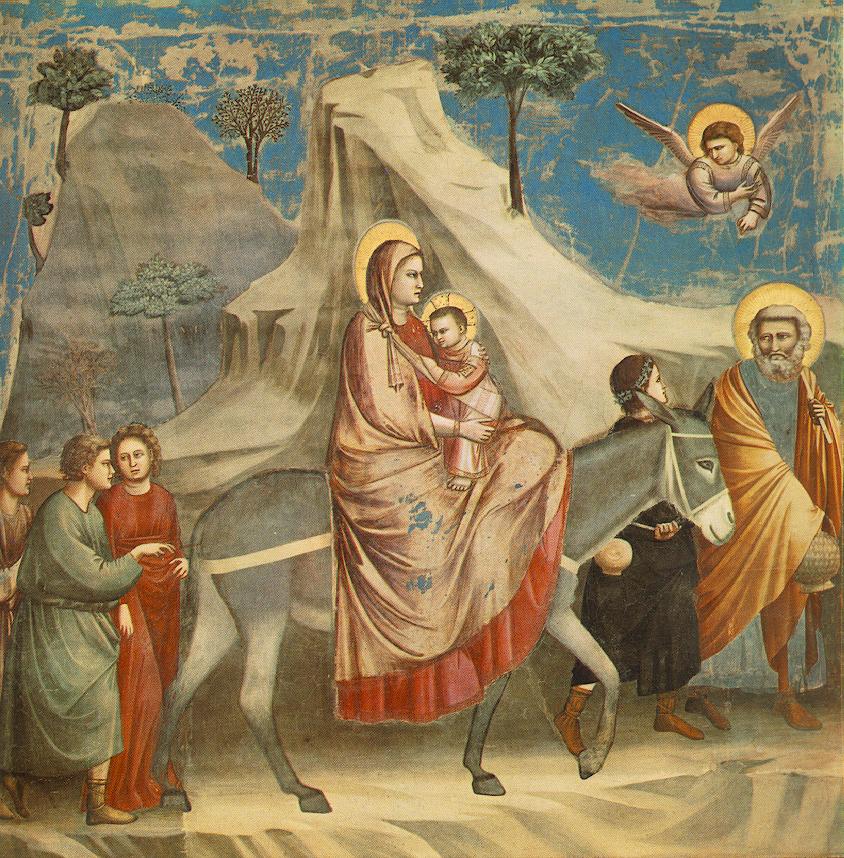
Mary's subsequent history, so far as we know it, leaves the same impression. She receives foreign dignitaries in a carpenter's house, under the nose of Herod the Great of all people -- the same ruler who executed three of his sons, his wife, mother-in-law, and brother-in-law -- in Bethlehem, which was within spitting distance of Jerusalem. She (shortly thereafter) picks up her kid and runs with her husband to Egypt for an indefinite period. Her next recorded visit to Jerusalem, maybe ten years later, portrays her going into the Temple -- how far in exactly we aren't told, but if Jesus was "sitting among the teachers, listening to them and asking questions," it may have taken place in the Court of the Israelites, which women were not allowed to enter*** -- once again to pose a challenging, and very motherly, question, this time not to an archangel but to God. I mean ... what do you even say about that?

The Flight into Egypt, Giotto, 1306

She prompts Jesus to perform His first miracle. She stands beside the gallows onto which her Son has been nailed as a convicted blasphemer and accused nationalist insurgent, watching the execution -- never mind the fact that, as an immediate family member, she could be dealt with too. Less than a couple of months later, she is found right in the middle of the same group of malcontents, prostitutes, illiterates, and scumbags who massed around Jesus in the first place, who have not only stuck together despite the very public and horrible judicial murder of their leader, but have started talking loudly about the whole affair in no uncertain terms and doing the same sort of frightfully dramatic things that alarmed the Sanhedrin in the first place.

I mean, say what you want about Catholic Mariology, but you can't deny the woman had style.

The Coronation of the Virgin, Diego Velazquez, 1636
Style LIKE A BOSS.


*For those not familiar, a jubilee year is a year in which plenary indulgences are given to the faithful who 1) fulfill the normal conditions of an indulgence and 2) make a pilgrimage to four specified basilicas in Rome. An indulgence itself, as I've written a bit about before, is basically a grace obtained by the Church that lets us off from the unpleasant spiritual consequences of our sins (which is why they shorten one's stay in Purgatory, since Purgatory is basically the place where you sort through unfinished business). If you'd like a little more technical detail about jubilees, feel free to read this, and if you summon the patience to figure out what it means then feel free to tell me.

**Many New Testament scholars think that the Magnificat was composed by someone else and inserted later as "decoration" to the original story. I don't think this hypothesis at all necessary. The Blessed Virgin would presumably, like most of Nazareth, have been illiterate, living in a culture with a strong oral tradition, and one steeped in the language of the Torah, the Psalms, and the whole history of the Jewish people; both reciting and composing poetry probably came far more naturally to them than it does to us, especially since they didn't make a fetish out of being original. The amount of "stock" material in the Magnificat is high, and I see no reason to suppose that Mary could not have composed it herself, even on the fly.

***The Temple of that time consisted in: the Court of the Gentiles, which anyone could enter, and which was largely turned over to commercial purposes (this being the part of the Temple that Jesus cleansed during Holy Week); the Court of the Women, which all Jews were allowed to enter; the Court of the Israelites, in which only Jewish men were permitted, and from which one could see the next court, where most sacrifices were performed; the Court of the Priests; the Holy Place, which contained the menorah and the table of the showbread; and the Holy of Holies, which had once contained the Ark of the Covenant.

Saturday, November 28, 2015

The Facts About Islam

There's a lot of misinformation about Islam available, and a lot of it has gotten mixed into the controversy over Syrian refugees in the wake of the terrible attacks in Paris earlier this month. These attacks themselves, and the debate surrounding them, are part of the larger uncertainty and disputation over Islam and its relations with the West since September 11th, and arguably longer still, reaching back to the First Gulf War or even the Iranian hostage crisis.

It is, as always, much easier to find partisan arrangements of facts, factoids, and unfacts than it is to get at the truth -- whether we're talking about the truth about Islam generally, or about specific things that hit the news. I'd like to share some of what I've picked up in my studies (partly academic, mostly idle and incidental) of history, religion, and food.


1. Is Islam is a Religion of Peace or a Religion of Violence?

No; or, if you prefer, yes.

The first difficulty -- which Christians, especially Catholics, ought to appreciate (but often don't) -- is in establishing what we mean by Islam: are we talking about the creed or about its followers? For once the question is raised at all, it's obvious that these need not be the same at all.

There is no denying that Islam was spread by the sword from its earliest days. This is awful. That said, it must also be pointed out that these were wars of conquest, not extermination, and did not involve eliminating Jews and Christians -- which is more than can be said of the wars of Christendom, which regularly strove to eliminate not only Moslems, but also Jews and whatever Christians were believed (however correctly) to be the wrong kind. The Reconquista and unification of Spain, followed by the Inquisition and the forcible conversion or expulsion of the Jewish and Moorish populace, are an extreme example, but they are an extreme example of a phenomenon that was commonplace enough.

So am I saying that Christian sins legitimize Moslem sins? Not in the least. I'm not even saying that Christian sins revoke our right to rebuke Moslems for sinning, whether we speak as Christians ourselves or as the Western heirs of Christendom -- though there's plenty to be said for that. My only point here is that, if Christianity can make any valid claim to be a religion of peace in the face of our own history, then it is at least possible that Islam can make the same claim.

No one could claim that peace is central to Islam as many claim that peace is central to Christianity. I would point out, though, that telling other people what their religion does and doesn't consist in is a little rude, a little pompous, and a little ridiculous. If anybody is going to tell us what sort of religion Islam is, it ought to be Moslems, for much the same reasons that our source for what Catholicism is ought to be Ronald Knox or Peter Kreeft as opposed to, say, Lorraine Boettner or Norman Geisler.


2. Was Muhammad a Saintly Hero or a Cruel Lunatic?

Well, was Martin Luther King Jr. a pioneer of minority rights and pacifism, or a serial adulterer?

Muhammad is a difficult figure to evaluate, and not just because the sources about him are confusing and sometimes incompatible. He's a difficult figure to evaluate because he was complicated. This is natural; religious founders, who do such exceptional things, tend likewise to be very exceptional people, whatever our opinion of the religious traditions they found. Joseph Smith, Confucius, Martin Luther, Aleister Crowley, Pythagoras, St Paul -- it's tricky to get to the bottom of any one of them.

Muhammad was certainly not perfect, even by the standards of his own time, to say nothing of the criticisms of his behavior we would launch today (with regards to his marital rape of Aisha, for instance).* Neither, of course, was St Peter, as St Paul so tactlessly pointed out. But on Christian premises this point, when you get right down to it, really only matters to Muhammad at this point -- and, on materialist premises, can't really matter to anybody, since he is both wrong and dead. Meanwhile, if we accept the view that we are judged by God after death, he's passed that gate, and what we have to decide about his legacy is not whether he was a sinner -- he was -- but whether he was also right, and how far. Bringing in "But he was a total jerk!" isn't relevant to that inquiry even if it's true.

And, for what it's worth, it isn't true, or it isn't the whole truth. He could be cruel, utilitarian, and lascivious at times; probably no more so than the European leaders of Christendom in the Renaissance and the Reformation (on both sides), men and women whom we readily and rightly admire. Admission of flaws does not cheapen greatness; but we can cheat ourselves out of admiring and imitating the great by admitting only their flaws. As for Muhammad's greatness, he elevated the status of women and slaves from where it had been; he was generous and kind to the poor; he opposed racism; and -- this is something that Christians often fail to appreciate -- he converted an entire people from one of the cruder varieties of paganism to complete monotheism. That alone is a massive religious advance, and the Catechism goes out of its way to affirm that it is the true God whom he worshiped and proclaimed, with whatever imperfections of understanding.


3. Are Most Moslems Supportive of Terrorism or Opposed to It?

Here, there is for once a simple answer: most Moslems are opposed to terrorism, whether as a means of spreading Islam or for any other reason. This is in part because most Moslems are not crazy people. It is, also, because most victims of Moslem terrorism are fellow Moslems.

One of the chief inspirations of terrorists in general is a puritan or fundamentalist approach to religion, and one of the characteristic targets of all fundamentalists is, not those outside, but those whom they regard as fifth columnists -- traitors in the house. It's noteworthy that the Inquisition was primarily concerned with heretics, not with Jews, witches, or Orthodox Christians in Catholic territories. Likewise, the main victims of al Qaeda, the Taliban, ISIS, and the rest have been Moslems whom they consider lax or heretical, not Christians, Jews, or Westerners.** Indeed, this is one of the many reasons that so many people are fleeing the Levant -- being Moslem doesn't protect them.

It's also worth pointing out that a lot of radicalization happens, not in the Middle East or other places where Islam is a dominant cultural presence, but right here in the West. The terrorists in Paris, for instance, were French and Belgian nationals, and it's been suggested -- not implausibly -- that the attacks were aimed at terrifying the West, not into submitting to Islam, but into turning refugees away and forcing them to stay under the hand of ISIS. Or Dzhokhar and Tamerlan Tsarnaev, who came to this country as the children of asylum seekers and were radicalized under the influence of Anwar al-Awlaki, an American native who graduated from Colorado State. Which makes them rather like Scott Roeder, who shot abortionist Dr. George Tiller through the eye while the latter was serving as an usher at his church; or Timothy McVeigh, who, scarred by his experiences in the Gulf War, murdered 168 people in the Oklahoma City bombing in an effort to make a point about American hypocrisy about Dresden, Hiroshima, Baghdad, and countless other devastated cities and populations. America is a great place to breed terrorists, apparently -- though I wonder whether bringing in a few thousand refugees who are specifically trying to get away from terrorism might not dilute that quality.

4. Are Moslems Refugees Dangerous?

No. The hypothesis that they're dangerous doesn't make sense, and the statistics about them don't back up the idea, either.

Now, to begin with, plenty of refugees from predominantly Moslem countries, such as the Syrians fleeing ISIS, aren't Moslems in the first place. Christians, Jews, Zoroastrians, Yezidis, and atheists have as much reason to get out of the Middle East as Moslems do. But equally, many Moslems have as much reason to get out as these other believers and non-believers do, for the reasons cited above. Most of them aren't crazy, and the ones that are would presumably prefer to stay in a place where crazy is the order of the day.

Turning to the statistics proper, the U.S. has admitted well over 750,00 refugees since September 11th. Of those, a whopping three have been connected to terrorist campaigns and conspiracies, which I think can be safely classified as an insignificant percentage if we're grading on a curve. For contrast, over sixty times that many American nationals have left this country to join ISIS. Or hey, just compare it to something as exotic and suspicious as cars; something like 1.3 million people are killed in car accidents every year, whether chauffered by terrorists or otherwise.

Hail, Queen of Heaven, the Ocean Star,
Guide of the wanderer here below,
Thrown on life's surge, we claim thy care,
Save us from peril and from woe.
Mother of Christ, Star of the sea,
Pray for the wanderer, pray for me.

In fine, there are few simple answers to be had, few facts about Islam that can be categorically asserted. That's life. That doesn't mean there's no truth to be had, or no way of making decisions; what it does mean is that in this situation, like all the other ones, we have to be guided by patient thought and gathering as many facts we can, not by violent political rhetoric that panders to our fear and pride.


*I'm well aware that Muhammad's marriage to Aisha, and indeed the consummation of that marriage, would not have been considered wrong or even odd at the time. I think this lessens his responsibility -- recognizing right and wrong in the particular ways one's own culture has obscured them really is hard. I don't think that it changes the nature of the act; and I also don't think that Muhammad's virtue or lack thereof says anything, one way or the other, about the legitimacy of his prophecies.

**Fun fact: al Qaeda and the Taliban have both denounced ISIS for being too crazy. (Think of your send-'em-back-to-Africa uncle ranting about how awful Hitler was.) This has also apparently prompted some in our own government to propose using al Qaeda to fight ISIS, because Americans never learn anything, ever, whether from history or from the past five minutes.

Tuesday, November 24, 2015

Five Quick Takes

I.

A new liturgical year is upon us, beginning in just under a week: November 29 is the First Sunday of Advent. I always get excited about Advent, ever since I was a little kid. And 2016 is set to be an important year for the Ordinariate: we're getting the final revision of our missal this coming Sunday, and, on Candlemas, our first-ever bishop is to be consecrated! Monsignor Steenson, who has guided us thus far, will be retiring from headship, and Monsignor Steven Lopes will be ordained our bishop (and our mother church down in Houston, Our Lady of Walsingham, will accordingly become a cathedral) -- I think he will be the first, not only for the American Ordinariate, but in the whole quasi-rite.


I always get excited about churchly events, but this is specially encouraging to me. The notion of an Anglican church reunified to its Catholic root, under the mantle of Peter, is very precious to me; much of my own conversion to Catholicism came through Anglican sources, particularly C. S. Lewis and Dorothy Sayers and the pre-Catholic works of G. K. Chesterton, and I've continued to be nourished by Anglican sources since I swam the Tiber myself, above all Charles Williams and John Donne. For a while, especially at the beginning, a lot of Anglican and Episcopalian Christians were pessimistic, negative, or even hostile with respect to the idea of the Ordinariates, and it was easy to be discouraged by our smallness and (to be blunt) poverty. Seeing the progress we've made is really wonderful, and receiving the fullness of Holy Orders within our community is a lovely milestone.

+     +     +

II.

The continued popularity of Donald Trump (on any level) remains baffling and is gradually becoming kind of scary. On the plus side, if it winds up being him versus ... pretty much any of the Democratic candidates, I won't have to wrestle with my Catholic conscience versus my anarchist one in deciding whether or not to vote at all -- the USCCB states that Catholics normally have the obligation to vote (as an expression of pursuing the common good), though allowing that when all the likely candidates advocate intrinsic evils, not voting can be a valid if unusual recourse; while, as an anarchist, I'd strongly prefer not to participate in a political system I categorically reject. The ongoing cause for Dorothy Day's canonization encourages me that my anarchism, and consequent aversion to voting, is licit within the bounds of the Catholic faith, but I need to give it more thought, and anyway it's nicer not to have to raise the question. Then again, that'll be true almost regardless of who gets the nominations on either side, and if the Republican nominee isn't Trump then there won't be a self-centered, Islamophobic, misogynistic ass who wants to institute a gross violation of the rights to religious liberty and privacy in law. As far as I know.

+     +     +

III.

2013 was the nightmare year, and 2014 was the year of feeling like a fucking superhero because I survived 2013; 2015 seems to have been the year of "Eh, close enough." It doesn't even seem like it's just me: stores put out holiday stuff way too early, as tradition demands, and there was a token nod to the war on the war on on the war on Christmas in the asinine Starbucks red cups snafu; but the militant cheeriness and obnoxious commercialization of everything that can't run away fast enough seem to have been extremely muted. I've yet to see any place drenched in Yulekakke, however capitalist. It's like we're finally getting some perspective or something -- fingers crossed.


It's also been a year, not of disillusionment or exhaustion exactly, but of tiredness, spiritually. Shusaku Endo's Silence, Graham Greene's The Power and the Glory, and Flannery O'Connor's The Violent Bear It Away have been my special literary companions this year; their mysterious insight into the operations of Grace, in the most distressing and unpredictable disguises, has been comforting and strengthening to me in a strange season. I still don't know what to do with myself, as regards my relationship with God (ugh, what an obnoxious phrase, but it does the job). But it's a consolation to see people explore the ways He can work in circumstances, and with people, who seem so unpromising at first, and second, and fifth glance.

And there is a comforting simplicity in the precepts of the Church, too. Not that I follow them well, except for attending Mass on Sundays and holy days and (usually) going to Confession; that whole "Ten Commandments" business I'm kinda sketchy on, especially number six.* But having that touchstone -- though it's certainly not a substitute for devoted love -- is a nice reminder of the way back.

*Or number seven, in knockoff churches.

+     +     +

IV.

I'd be specially appreciative of your prayers for my third nephew, Joseph, and his family. He's two, and has had a tough life already, and been a darling little Rooseveltine trooper: he was seven weeks early and has Down Syndrome (which gives him the most adorable smile on earth!) and Hirschsprung Disease, the latter of which I don't really understand except that it gives him a lot of GI tract problems. He had to go in for an ostomy on Monday, which I think is his third or fourth? Anyway, he's tired of being in the hospital, he's uncomfortable, his mother's tired, his father's tired -- you get the idea. So the sooner he gets better, the happier we'll all be.


Seriously, look at that face!

+     +     +

V.

I can't think of a fifth thing, so here is an adorable video of a fawn that got lost, got inside this dude's house, and doesn't know what tiled floors are.