Collect

Collect for the Fourth Sunday after Trinity

O God, the protector of all that trust in thee, without whom nothing is strong, nothing is holy: increase and multiply upon us thy mercy; that, thou being our ruler and guide, we may so pass through things temporal, that we finally lose not the things eternal; grant this, O heavenly Father, for the sake of Jesus Christ thy Son our Lord, who liveth and reigneth with thee, in the unity of the Holy Spirit, ever one God, world without end. Amen.

Wednesday, May 27, 2015

I Am Publishing Une Book!

For the last five years, I've been meeting with a group of friends every other week as we hash out things we're writing. We recently set up this website, named for our fellowship, which we dubbed Pints & Prose (although poetry and liquor are also welcomed). It's a combination of our own writing -- mostly light philosophical and social stuff, and literary-critical style analysis -- and things that we find cool.

Bill Hoard, Ben Faroe, and I probably write the most out of the regular participants, and each of us have several projects we've been working on for years. Bill and Ben have finally reached publication: the two of them are collaborating on an episodic work titled Hubris Towers (partly an homage to Fawlty Towers, with touches of P. G. Wodehouse), which has required me to ask them to stop in the middle of a reading more than once because I was laughing so hard. Ben also has a fairy tale, The Stone and the Song, available, which was his first publication and has already done well.

And I am going to be publishing soon, too! For the last five years I've been working on a novel, and I finished it about two weeks ago. It's set in the mid-Victorian era in London; it's a Gothic piece, indeed (if you own a monocle, now is a good time to insert it) a tragical Bildungsroman, complete with vampires, poltergeists, manticores, and Catholics. It's called Death's Dream Kingdom, and follows the progress of one Marie Redglass as she is initiated into the world of vampires in the London of 1874 and 1875. What follows is a selection from its early pages.

The manor and its grounds lay to the north of the city, east of Hampstead Ponds, with Primrose Hill looming to its south out of the greyness. It was, as Lord Ravenhurst had once explained to Marie over sherry and biscuits at one of the little literary salons he held at his house, the ancestral seat of the Fairfax family, of which he was the last surviving member. Not, he noted, to be confused with the Anglo-Scottish Fairfaxes of Roxburgh; it was rather a curious corruption of the Norman fer-face, presumably in reference to a Mediæval helm. As for Mediævalism, Ravenhurst had as much of that as any Pre-Raphaëlite could have wished: the manor was more castle than house, with spires and embattled parapets thrown up against the sky like jagged stone teeth, a weird and gigantic tower looming out of the unseen center of the edifice, and an age-blackened façade that frowned out of a mass of ivy, pierced by thin, pointed windows heavily draped against the daylight.

Marie had only ever seen it by night before, when the curtains were drawn back and the light of lamps and candles and chandeliers made every window look like a magic lantern, the uglier features being concealed or softened by the dark. Now, as the forerunning light of dawn crept through the late autumnal fog, she wondered briefly whether she would ever have gone near the place, had she first seen it in better light. But this was no time for metaphysical speculations. Having already left the road some time ago, she had to pick her path inconveniently over the railway line, and, once she had cleared it, she lifted her skirts and broke into a run.

It did not take her nearly as long as she had expected. It was a furlong or more from the railway to the front door of Ravenhurst Manor, yet she had traversed the distance in less than a minute. Ignoring this puzzle, she turned to the great front door, with its large brass knocker in the shape of a lion’s head with bared fangs. She tapped it and waited, wishing miserably that she could be anywhere else in England. An owl hooted somewhere nearby, and was promptly contradicted by the chirrup of a sparrow.

The door was opened by the tall, grey-mustached butler of the household, Godalming. “Good day to you, Mademoiselle Redglass,” he said colorlessly, as though he had not witnessed the volatile parting of a few hours before.

“Let me in,” she replied urgently, with no pretense at good manners.

“One moment, mademoiselle. I shall ascertain whether his lordship is --”

“Please, Godalming, you know me, you know he knows me --”

“Forgive me,” he said, now becoming a little stiff in his manner. “I have no power to invite you over the threshold. Excuse me.”

He left her on the doorstep. Marie tangled her fingers together nervously and untangled them again a few times, looking out at the grounds (where the fog was turning from grey to pearl at every moment) like a bird scanning the sky for predators.

“Ah, my dear,” interrupted a basso cantante voice. She turned quickly back. There stood the master of the house himself, Augustus Fairfax, wearing an indecently triumphant smile. “This is a thoroughly expected pleasure. Though admittedly, I wondered, when last you left, whether you realized you would be imparting it; I believe you said you never wished to see me again as long as you lived? -- words to that effect.”

Marie lowered her eyes a little from his. “Please, Lord Ravenhurst; I am sorry --”

“I dare say you are.”

“Please shelter me. I beg you.”

He made a scoffing noise and stood back. “Come in.”

She lifted her skirts and stepped over the threshold. “Thank you,” she said to him quietly.

The aristocrat made no reply, but ordered her to follow with a gesture. Goldaming came over and shut and bolted the door; the sound was curiously loud, yet stifled, more like the shutting of a box than of a door. They went to the library, whose windows, like all the others, were thickly curtained, to keep out the lethal sun; Augustus’ pale shirtsleeves flashed on either side of his emerald waistcoat in the semi-darkness as he turned up a few of the gas-lamps at the edges of the room, and then crossed to one of the chairs near its center, a finely carved ebony thing with cushions in Paris green. Standing behind it, resting his elbows on its back, gazing at Marie as she stood still near the door of the room, he was the very image of leonine, indolent contempt. He sniffed ostentatiously.

“Dead?” he asked.

She stared, uncomprehending. “What?”

“Is he dead?” the vampire expanded; and then, with a touch of impatience, he clarified, “The man whose blood you drank. You are positively reeking of him, there is no use prevaricating. Did you kill him? Most fledgling vampires are more reluctant than that at first --”

“I didn’t! Man whose -- how dare you!”

Augustus’ eyes flashed. “Manners, Mademoiselle Redglass. I speak to you thus because I am your sire. My authority over you henceforward is, as it were, paternal. Accustom yourself.”

Outrage choked her. Helpless to act, dependent and bewildered as she was, she took a few aimless steps about her corner of the room and was still again. Her host watched her, making no attempt to hide his malicious amusement. After a few moments, he turned his gaze to the small circular table beside the chair he was leaning upon. On it stood a jade-green glass vase, about two feet tall, minutely adorned with silver filigree.

“I purchased that in Venice, eighty-six years ago, on the centenary of the deposition of King James the Second,” said Augustus, a little dreamily. “Such a dismal summer that was! But once or twice, when the weather did manage to get hot -- then even at night the Adriatic was like a blue oriflamme, billowing out to the southeast. And outdoors or within, the fragrances of the wines, the perfumes, the scents of grapes and rosemary and pomegranate blossoms … Have you ever been to Venice, my dear?”

Marie was stonily silent. The amused look on Augustus’ face increased for a moment, then faded: he was unnaturally still, his eyes fixed on the vase. Suddenly it exploded, shards of costly glass flying outward with violence. She started and cried out. Then she noticed that the vampire’s hand was extended, not in a fist but spread out flat, into the space that had a moment before been where the center of the vase was. He had broken it with a mere flick of his hand. He stared at the fragments silently for a long while, and then turned back to Marie and spoke.

“It was the wrong color,” he explained placidly. “I take my time in deciding.”

Friday, May 22, 2015

Lost In the Cosmos, Part III: The Terrible Perhaps

Returning to my Lost In the Cosmos series (the beginning of which can be found here), I'd like to return to the matter of what faith actually is to a Catholic. I touched on this in my first post of the series, but it was from the perspective of what the Church proposes for our belief; now I'd like to look at it from the viewpoint of the believer, or the possible believer.

When I was a kid, my mother was a fan of Ken Ham, or at any rate we had a lot of stuff by him. I seem vaguely to recollect seeing him give a talk once, but perhaps I was too young to distinguish reality from TV yet.


Some parts of that journey into distinctions were more painful than others.

Anyway, what I absorbed from Ham and those like him was an attitude that many people, both within and outside Christianity (not a few of whom have left Christianity because of this), believe is how Christians are supposed to think: namely, a monomaniac insistence on the inerrancy of the Bible and the complete untrustworthiness of every other source of knowledge, and a rejection of all argument when it comes to establishing the truth of the Christian revelation. Fideism is the technical name for this outlook; blind faith is the vernacular.

Given that the Catholic Church professes to be infallible, and that her history of dealing with those of her children who have come to dissent from her teaching is not a pretty one, a lot of people assume that Catholicism is an officially fideist religion. This, sadly, does not exclude Catholics, some of whom make a positive virtue out of not examining any part of their beliefs, thus shutting themselves out from intelligent sympathy not only with non-Catholics, but even with fellow Catholics who have difficulty with this or that article of the faith -- and there are many difficult articles of Catholic belief, for, even more so than most branches of the Christian tradition, the Roman Church proposes many things for our belief that are, well, pretty hard to believe. That animation should be restored to dead tissue (i.e. the Resurrection); that alien intelligences should operate on the cosmos without any material vehicle (i.e. the activities of angels); that human beings should be invested with the power of disclosing the mind of the Divine Absolute to one another (i.e. the teaching office of the Church and the sacrament of Confession); that this same Divine Absolute should choose under certain circumstances to make Itself objectively and personally present in bread and wine (i.e. transubstantiation): all these things take a good deal of believing; and if the Jesus on whom our faith is based was not to proud to accept the plea, "Lord, I believe; help thou mine unbelief," perhaps we should not be too proud to keep good fellowship with it.

But I digress. The truth is, though the Catholic Church has her share of professing fideists, and of people who are fideists in practice even if they would disown the title, she has gone out of her way to say that, when she speaks of faith, that is neither what she means nor what she desires of the faithful. The First Vatican Council, though most famous for defining papal infallibility as Catholic doctrine, also insisted that some things can be known about the world and even about God apart from any faith.

Faith is not synonymous with uncertainty, but there's a way in which it can't be torn apart from uncertainty -- the two are conjoined without division, without change, without confusion, without separation, as it were. Pope Benedict, quoting to begin with from the works of the great Jewish author Martin Buber, wrote:
'An adherent of the Enlightenment, a very learned man, who had heard of the Rabbi of Berditchev, paid a visit to him in order to argue, as was his custom, with him, too, and to shatter his old-fashioned proofs of the truth of his faith. When he entered the Rabbi's room, he found him walking up and down with a book in his hand, rapt in thought. ... Suddenly he stopped, looked at him fleetingly, and said, "But perhaps it is true after all." The scholar tried in vain to collect himself -- his knees trembled, so terrible was the Rabbi to behold and so terrible and simple his utterance to hear. But Rabbi Levi Yitschak now turned to face him and spoke quite calmly: "My son, the great scholars of the Torah with whom you have argued wasted their words on you; as you departed you laughed at them. They were unable to lay God and his Kingdom on the table before you, and neither can I. But think, my son, perhaps it is true." ...' 
Here we have, I believe -- in however strange a guise -- a very precise description of the situation of man confronted with the question of God. ... [B]oth the believer and the unbeliever share, each in his own way, doubt and belief, if they do not hide from themselves and from the truth of their being. Neither can quite escape either doubt or belief; for the one, faith is present against doubt; for the other, through doubt and in the form of doubt. ... Perhaps in precisely this way doubt, which saves both sides from being shut up in their own worlds, could become the avenue of communication. 
... Can we still believe at all? Or rather -- for the question must be posed in a more radical fashion -- is it still permissible to believe? ... When some theologian explains that 'the resurrection of the dead' simply means that one must set about the work of the future afresh every day, offense is certainly avoided. But are we then really still being honest? Is there not serious dishonesty in seeking to maintain Christianity as a viable proposition by such artifices of interpretation? ... An 'interpreted' Christianity of this kind that has lost all contact with reality implies a lack of sincerity in dealing with the questions of the non-Christian, whose 'perhaps not' should worry us as seriously as we want the Christian 'perhaps' to worry him.*
In other words, as His Holiness says in the same book, faith is not an intellectual rejection of certain possibilities as non-existent. It is, rather, a decision, in the face of myriad possibilities, to trust that one among those possibilities is actually true. Catholic faith in particular is the decision to trust that God is this kind of being (the Trinity), and has behaved in this specific way (the Incarnation and Redemption), and can therefore be known, now and here, by these means (the Church and her Scriptures and Sacraments).


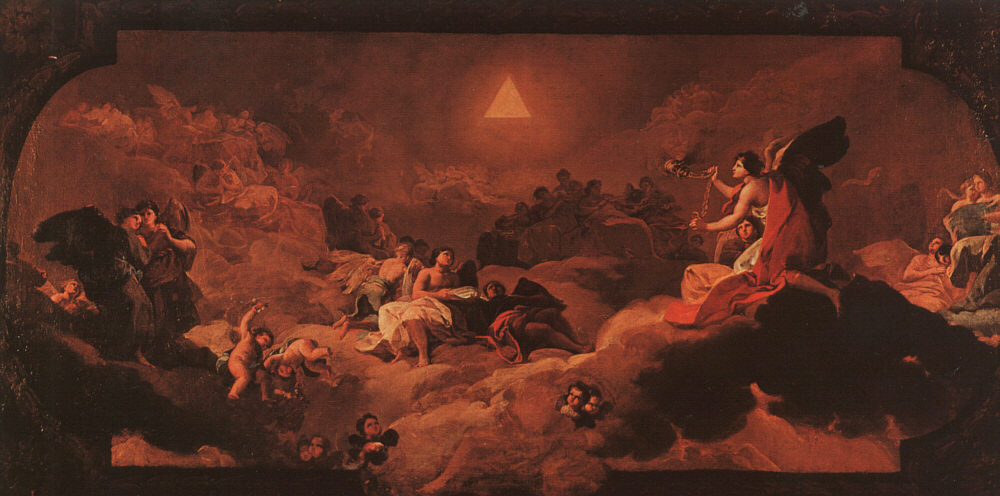
The Adoration of the Name of the Lord
Francisco Goya, 1772

Fideists like Ken Ham display, through their blockheaded refusal to countenance any possibility but one, not faith but the lack of it. The whole point of faith (as an act -- the content of faith is, of course, something else) is to hold fast to something, which isn't necessary if only that one thing even exists. To trust your spouse is one thing; to say that everybody is either lying, stupid, or crazy except your spouse, as a means of perpetuating your trust in your spouse, is ... well, something else.

And this, by the way, is why a Catholic need not and should not fear any of the traditional enemies and rivals of Christian faith. 'Christianity, if true, has nothing to fear from honest inquiry,' said Bishop Kallistos Ware. The advances of the sciences, claimants of supernatural or magical powers (whether false or true) from other religious traditions, corruption of every kind in the Church herself, the mere brute pain of life -- all these things are the perhaps which we, as Christians, ought to allow ourselves to be troubled by; they are the environment in which the word faith has meaning. And we can hardly invite those outside to a faith that we excuse ourselves from entering into, in its twilit glory.

Evil and suffering are here particularly relevant -- especially when they are, or are caused by, the sins of Christians. And Christians have sinned a great deal; we have scandalized the earth; the fact that we are, for some people, a hissing and a byword, cannot be put down merely to the hatred of darkness for light. Shutting one's eyes to evil and suffering, or giving non-answers like 'It's always darkest before dawn' (which didn't work out so neatly for, say, the victims of Auschwitz-Birkenau or the Japanese who survived Nagasaki only to die of radiation poisoning), is a false move -- and, when you come to think of it, an insulting one. For it implies that horrible things do not matter. The militant atheist who refuses to believe in a God who would allow such things to happen, and the hyper-Calvinist devil-worshipper who believes God would cause men to do these things and then damn them for it, both take such offenses more seriously than the cloying, Precious-Moments-y whitewasher who can say God never closes a door without opening my mouth from the comfort of an overstuffed armchair.


Look at these dipshits.

Anyway. The point is, when we speak of faith, we are, obviously, not speaking of reason; nor, as the Church has vehemently argued for centuries, of irrationality. (It has been drily pointed out before now that there is nothing specially rational about dismissing all forms of knowledge except reason, especially since reason does not clearly prompt us to do so.) Neither are we speaking of certainty, of 'blind faith' so-called, any more than we are speaking of a mere 'Well, maybe this whole Christianity thing is true' when we sing the Pange Lingua during the Maundy Thursday procession. What we are speaking of is a personal decision of trust; one that is, necessarily, prefaced by getting to know this Person well enough to decide whether we shall trust Him. And this getting-to-know will naturally take a multitude of forms -- that's to be expected when you are, according to the premise, getting to know the author and fountain of Being -- including reason.

My own reversion to belief was of exactly this kind. I had tensed myself up to maintain the blind fideism I absorbed as a child, afraid to be honest with myself, fearing the consequences of thinking things for no reason except that I thought they were true; and finally, my intellect caught up to me. I just couldn't sustain the covert dishonesty any more. Fideism snapped, and faith now had a chance. And, increasingly, since that time, I've been coming to understanding the tension in which faith exists -- a different kind of tension from the kind I had been using to try and sustain my fideism.

There is no way to prove this: nevertheless, my belief is that, if Christians are willing to experience in ourselves this sacred tension between uncertainty and conviction, our perhaps not can indeed communicate with the perhaps of the non-Christian. It may even be, within the natural exchange and substitution of the coinherence of mankind, the supernatural coinherence can be invoked, and God can make us who know faith to be faithlessness for the unfaithful, and thus communicate faith to those who could not or would not take it for themselves.


*Introduction to Christianity, pp. 46-47, 56-57.

Sunday, May 10, 2015

Novena for Peace

Tomorrow begin the Minor Rogation Days: three days (the Monday, Tuesday, and Wednesday between the Sixth Sunday in Easter and Ascension Thursday) of prayer and fasting for God's mercy and protection, in preparation for the feast of the Ascension of Christ. Then comes Ascension itself, forty days after Easter; the next nine days are spent prayerfully preparing for the feast of Pentecost, which is the origin of  the novena; then comes Pentecost, the birthday of the Church as we know it, ruled by the Holy Ghost in the Apostles.

This sequence has been somewhat disarranged by the more flexible calendar allowed by the Second Vatican Council. The Solemnity of the Ascension (which is a holy day of obligation) is frequently transferred to the following Sunday, so as not to inconvenience the faithful; in that case, while one can of course still pray a novena in preparation for Pentecost, its tie to the Virgin and the Apostles praying in the Cenacle, waiting for the Spirit, is weakened by the Ascension being observed a third of the way in, rather than setting the whole affair off.


"Of course we're not going to call it the 'Gather' book. What kind of lame title is that?"

However, I have the good fortune of being part of a parish that usually celebrates the Ascension on its Thursday date: the Ordinariate of the Chair of Peter, being grafted in from the Anglican Communion, preserves an older calendar -- one descending, not from Trent through Vatican II, but from the Mediaeval Sarum Use* through the Church of England. Our ritual, the fasting particularly, is still a lot more simplified and restrained than it would have been before the Roman-Anglican division; but it's perfectly possible to observe the minor rogations privately, and the pre-Pentecost novena -- which is what I chiefly want to talk about.

The disturbances in Baltimore a couple weeks ago have served to strengthen my pacifist convictions (which I had been questioning as I read the reports of increasingly horrific behavior on the part of ISIS). Every act of violence contains within itself the seed of an act of violence that will take retribution against it. Hatred breeds hatred, injustice breeds injustice, chaos breeds chaos. The quasi-military repression was a response to rioting; the rioting was a response to police brutality; police brutality was a response to crime; crime ... until eventually you reach Abel being killed by Cain, and realize that even they aren't the root of the problem.

But picking who's to blame, or who's at least more to blame, is a fruitless exercise. Not because everybody is equally guilty; that certainly isn't true. If we insist on finding a category of people to blame, rich white people is going to be it, for a multitude of reasons (the slave trade, colonialism, capitalism, Jersey Shore). And while the responses to American supremacy, both here and abroad, have been grossly unjust in many cases -- perhaps nowhere more so than in the evils perpetrated by the Islamic State -- I do think that they are, to an extent, a judgment on us for our sins: i.e., the consequences of our history in a world ruled by cause and effect. Treat people as property, as our ancestors did by the slave trade, and one day they will make havoc of your property; treat people as our rightful subjects, as our forefathers did by the practice of colonial subjugation and the hideous doctrine of Manifest Destiny, and one day they will apply that same heretical reasoning to you. Give, and it shall be given unto you; good measure, pressed down, and shaken together, and running over, shall men give into your bosom. For with the same measure that ye mete withal it shall be measured to you again.

No, the reason the blame game is fruitless is that, while a man can certainly try to prophesy to a valley of dry bones, you can only convert people. I mean, you cannot convert categories, because categories do not have minds or hearts to appeal to. You can't rebuke Whitey, however just it would be to do so; you can only rebuke whiteys, and that must, necessarily, be done by interacting with them as individuals -- individuals who are members of a category, certainly, but that doesn't override their individuality.


And really, would you ever want it to?

Worse, you cannot force any individual to change -- with one exception.

The one person you can work directly upon is yourself. This can only be done in divine grace; or rather, it can absolutely be done outside of grace, and it'll turn you into the sort of self-righteous twat that people wish was a mere stupid racist.

Though their systems differed in many important ways, Gandhi and Jesus have one striking attribute in common: everyone loves Gandhi, until the time comes to actually do anything he suggested. His famous dictum, We must be the change we wish to see in the world, is thrown around on t-shirts and pintergrams, or whatever it is the kids are into these days, and I am sometimes perversely cynical enough to think that people like throwing it around merely to make themselves sound deep, rather than out of a disinterested love of sound ethics. No matter. It's true, even if its truth has been made to wear one of those ridiculous awards-show dresses that porn stars have more self-respect and modesty than to don.

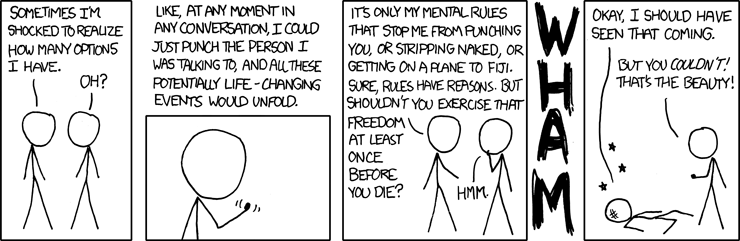
The point is, if we want a just society and a just world, we must begin not by nagging others to change -- although the time for that does come, now and again -- but by choosing to do justly, ourselves, as often as we find such a choice before us. If we want peace, we must practice peace; if we are seized by conscience and want to be forgiven for the sins we have committed, we must forgive. We must choose to end in ourselves the cycle of violence, because someone else might or might not end it, but we can do so right the hell now, and if we don't do it it may not ever be done. That's the freaky thing about free will -- there is no surely predicting it.


Now, what that looks like in practice, I have to admit, I don't really know. I know a few things, like giving money** and food and clothes and stuff to homeless people; but I have no grand schemes that will solve everything from world hunger to getting the kids to listen up when their dad talks to them, come on, we've been over this every day of the week since you were five. Suggestions are welcome; and that's one of the things prayer is for: to get wisdom, to know what to do when the time does come that we can do something. It is a form of watchfulness, and if we aren't trained to watch, we're less likely to notice things.

It's for that reason that I would invite my readership to join me in praying a novena for peace as we advance toward Pentecost this year. The prayers are taken from those said by St John Paul II during his 1982 trip to Great Britain, and Pope Francis' pilgrimage to the Holy Land last year, translated and adapted slightly. (For my Protestant readers, if you want to pray along but don't feel comfortable asking the Blessed Virgin Mary for her intercession, I doubt God will mind if you leave that bit out.)


St John Paul II visiting and forgiving Ali Acga, who tried to assassinate him, in prison.

Daily Prayers

Come, Holy Spirit, send to us from heaven a ray of your light. Reprove us of sin, and of righteousness, and of judgment. Guide us into all truth. Glorify Christ in us, receive of His, and shew it unto us. Bring all things to our remembrance, whatsoever He hath said unto us. Let not our hearts be troubled, neither let them be afraid.

May God convert the violent. May God convert those who have projects of war. May God convert those who manufacture and sell arms, and may He strengthen the hearts and minds of those who work for peace and reward them with every blessing.

Mary, Mother of Mercy and Queen of Peace, we entrust to you our prayers for peace: peace in our hearts, peace in our homes and families, peace in the world, especially in the Middle East. Hail Mary, &c.

Daily Intentions

May 15th: For pardon for all our own sins against justice and peace.
May 16th: For a firm commitment to peace in our daily lives.
May 17th: For the forgiveness and reconciliation of those we dislike.
May 18th: For peace, hope, and happiness for all who have suffered on our account.
May 19th: For an end to racism, and national repentance and harmony.
May 20th: For the repentance and conversion of ISIS and of all religious militants.
May 21st: For relief, strength, and joy for all who suffer religious persecution.
May 22nd: For love and graciousness toward all who treat us unfairly.
May 23rd: For reconciliation and unity among Christians.


*Sarum was the Latin name of the English city of Salisbury, where the Sarum Use developed and from which it spread. This variant of the Roman Rite was used in England by Catholics right through the sixteenth century, even after Queen Elizabeth I banned its use by law in an attempt to suppress Catholicism; thereafter, the underground Catholic Church gradually transitioned to the Tridentine rite, which was formally instituted when the hierarchy was restored. For more info, check this out.

**A lot of people object to the notion of giving money to homeless people. There is no space here for me to go into a full reply for why I am personally fine with it, but I would point out the following things:
- A poor person is a person who has not got much money. They aren't a specialized breed that, on getting fifty cents, immediately runs off to buy all of the crack that crack can crack because crack crack crack crack. Are some of them druggies? Sure. So are lots of well-off people, because there's fuck else to do in the suburbs. Give them money, and they may misuse it; but at least you can be sure you won't.
- If I give someone something, it's a gift. What business is it of mine what they do with it afterwards?
- I'd rather be duped than turn someone away who's legitimately in need. Does that mean you have to give to every person who asks you? Not necessarily, though it might not be a bad thing if you did, according to this neat Roman-era sage from the eastern Mediterranean basin. Regardless, if you give to someone and they didn't really need it, what does that prove? That your compassion glands work, and therefore you're somehow the loser in that transaction?

Thursday, April 30, 2015

The Baltimore Spring

A White Bourgeois Pacifist's Thoughts on the Baltimore Riots


Surely this man's opinion will be ... something.

The city hasn't changed as much as I expected it to under the curfew. It's quieter, although there do seem to be a few more sirens than usual in the small hours; then again, maybe it's just easier to pick them out over the lack of background noise. I feel like I've seen a lot more people on foot, too, though that probably has more to do with the improved weather. I went walking around myself on Wednesday morning, and the air smelled like tulips and honeysuckle.

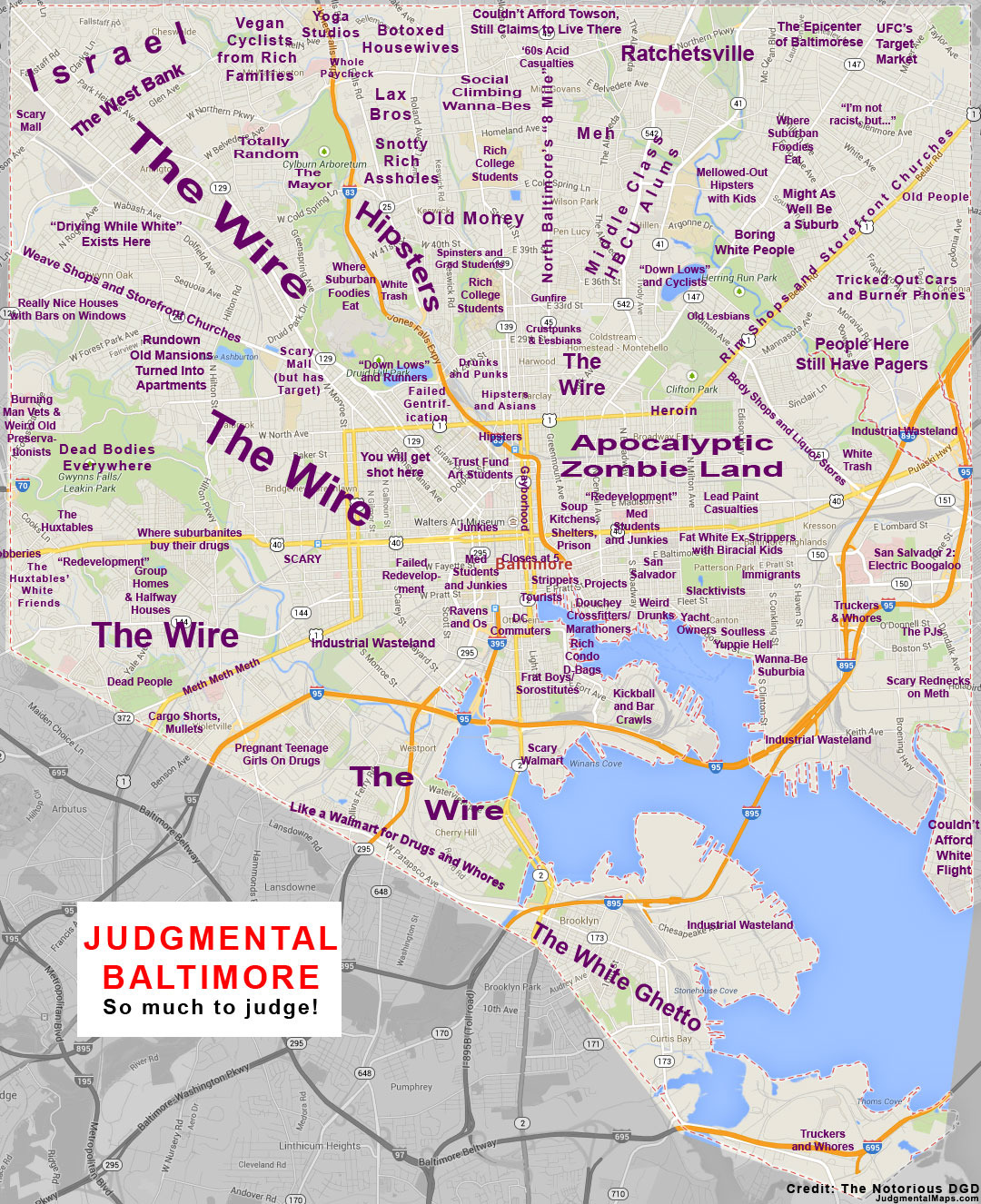
I didn't see that much damage from the riots. A few broken windows and boarded up storefronts, which aren't exactly uncommon in most of Baltimore. But of course, the neighborhood I live in wasn't in the thick of things -- it's in the center of the city, whereas most of the rioting and looting was in the west and southwest.


That's me, in between "Trust Fund Art Students," "Junkies," and "The Gayborhood."

The thing I've been most unsettled by has not been the riots. It's been the media reaction (both mass and social media). I try to maintain a healthy skepticism of my own insights on topics like this -- I'm white, I was raised in the middle class, I was out of the city on Monday night, and I've only lived in Baltimore for a bit less than two years, after all. But some of the responses to the events of the last few days seemed, to me, to be so off-base and bizarre that I felt a reply was worth making, for whatever my thoughts are worth.

First, it's important to note that, while the riots got a lot of attention, the vast majority of protesting in the wake of Freddie Gray's sad death has been peaceable. It started that way, and most of it stayed that way. I've seen it suggested that the looting and arson happened at the hands of crooks and delinquents who merely took advantage of the moment, rather than at the hands of any protesters at all; I'm not sanguine that that's completely true, but I'd be willing to bet that the overlap was a lot smaller than you'd think from watching the news. What's more, the cleanup seems to have gone swimmingly; I met a dude on Tuesday, the day after the worst of it, while looking to help with repair work and the like, and we couldn't find anything to do. (My suspicion is that what work was still left was in the areas where the roads were still shut down, which were too far out for either of us to walk, but still.) People have been coming out of the woodwork to put their city back together, and I gotta say, I'm kind of amazed. This place is more resilient than I gave it credit for.

And I believe it's that renewal that is going to triumph in Baltimore in the end, because that is the force of life, God's creation. And that creative energy isn't just a pleasanter thing than the anti-energies of destruction, oppression, and decay; it's a stronger thing. Rampage and violence cannot make, and they begin to collapse from within as soon as they come into being; they can only continue as long as the host in which they are burrowing parasites remains vital. Life, in God, is self-regenerating. That's why it's going to win.

Secondly, the riots may have been sparked by the Freddie Gray case, which is bad enough in itself -- a nearly-severed spine is no joke, especially after being stopped and searched for, um, running away from police (who weren't detaining him, or even talking to him), who took this as a reason to chase him. I feel like the Fourth Amendment got lost somewhere in here, since running away from police who happen to be around, as opposed to police who are actively detaining you, is not to my knowledge unlawful,* and seems to me more like plausible cause than probable cause, given the whole presumption of innocence thing and the "seriously, butt the hell out of private citizens' business" thing that the American law system is sort of based on ...


Hey, it's one of those fancy napkins people use for eating Irish babies.

Anyway, the riots may have been sparked by the Freddie Gray case. But they aren't, simply, about his death. Neither are they simply about the string of highly-publicized deaths of black persons at the hands of police over the last year, although I feel sure that's relevant. Nor can we simply say "Racism" and be done, though there is plenty of that to go around so no one has to feel left out.

The occasional remarks about "black protesters" and "black rioters" that I've seen on social media have kind of creeped me out, to say the least. It's not clear to me that looting the mall or setting fire to CVS would be somehow different if white people were doing it, or Latinos, or Asians. On the other hand, I've seen one or two people more or less excusing the violence as an expression of frustration on the part of the black populace, and even referring to it as some sort of just reprisal against the white, capitalist establishment.**

The problems with all this armchair activism are manifold. Does anyone seriously propose the belief that the only people who were out looting were all black? Or that, even if every single one of them was, their skin color was somehow gremlinizing their brains to make them do it? And conversely, if this was revenge against wealthy whitey, why is it that, of the damaged stores close to my neighborhood at least, all except one were owned, operated, and frequented by local African-American folks? Or, if we propose that the class element had more to do with it, why did they loot Mondawmin Mall (i.e., scary-yet-Target-having mall as above), as opposed to the banks or restaurants or businesses close to the Inner Harbor? It's questions like these that make me think that, though there was very possibly some overlap between protesters and purgers, the latter were for the most part taking advantage of the moment.

But besides that, this has prodded me to start trying to understand racism in America better. I think it's worth pointing out that it's this power to understand which is one of the great difficulties, but maybe not for the reasons that a lot of people think. Most conservatives seem to think that liberals just enjoy being moral indignant, while most liberals seem to think that conservatives are at least a little bit supremacist. I don't think either hypothesis is necessary -- or, insofar as we kind of need everybody working on this problem, productive.

A few years ago, I was having a conversation with a friend of mine, Nazim, a guy I knew from college, whose mother was white and whose father was Algerian; he looked pretty much Caucasian if he shaved, but when he grew his beard out he looked Arabic -- handsome dude. Now, I had always thought of racism as a belief, held consciously or (I could allow this) unconsciously, that one race was superior to others -- generally one's own.


With, uh, certain odd exceptions.

Nazim, however, talking about a class he'd had where they had been discussing the phenomenon of white privilege, and about his own experience of getting white privilege if he was clean-shaven, until people learned his name (after which he'd be treated as Arabic instead of white -- i.e., not necessarily worse, but perceptibly differently). As the conversation progressed, it came out that when Nazim's professor had spoken about racism, the point had not been about any beliefs at all, conscious or submerged, but about the systemic facts of who holds the power.

In other words, an imaginary city in which two-thirds of the people are black and also happen to be largely disadvantaged, while one-third of the people are white and also happen to be largely well-off, is still (by this definition) a racist city even if none of the white folks are intentionally being dicks about it. And honestly, while I think that a person's principles and intentions are even more important than what happens, what happens is still pretty damn important.

As far as white people intentionally being dicks goes, though, I think we have to allow that there's a great deal of that. I've kept fairly quiet on most of the recent, highly publicized cases in which a racist element has been proposed*** -- Trayvon Martin, Michael Brown, Eric Garner -- because I haven't known many of the facts, and I don't want to be a bandwagoneer, to say nothing of wishing to believe in the innocence of the cops in question until their guilt is proven (partly due to my aforesaid ignorance, and partly because these deaths were bad enough even if they were the result of horrible misunderstandings, let alone if they were callous murders). But. While I don't propose to decide on any of these things individually, the Ian Fleming rule of thumb remains: Once is happenstance, twice is coincidence, three times is enemy action. Further examination -- of facts, and of consciences -- is warranted.

And what then? I haven't got a fucking clue. I can try to do right by my neighbor in a given situation; how to help with systemic racism, even in my immediate neighborhood, I simply don't know. I will, therefore, conclude with the following excerpts from Mahatma Gandhi's Non-Violent Resistance, asking my readers -- if there are any who have committed violence, approved of violence, or excused violence as a black reaction to white oppression, and also all my other readers -- to consider them carefully.

Reader: Why should we not obtain our goal, which is good, by any means whatsoever, even by using violence? Shall I think of the means when I have to deal with a thief in the house? ... You seem to admit that we have received nothing, and that we shall receive nothing by petitioning. Why, then, may we not do so by using brute force? ...
Editor [Gandhi]: ... I have used similar arguments before now. But I think I know better now, and I shall endeavor to undeceive you. Let us first take the argument that we are justified in gaining our end by using brute force because the English gained theirs by using similar means. ... [B]y using similar means we can only get the same thing that they got. You will admit that we do not want that. Your belief that there is no connection between the means and the end is a great mistake. Through that mistake even men who have been considered religious have committed grievous crimes. ... [T]here is just the same inviolable connection between the means and the end as there is between the seed and the tree. I am not likely to obtain the result flowing from the worship of God by laying myself prostrate before Satan. If, therefore, anyone were to say: "I want to worship God; it does not matter that I do so by means of Satan," it would be set down as ignorant folly. We reap exactly as we sow. ... If I want to deprive you of your watch, I shall certainly have to fight for it; if I want to buy your watch, I shall have to pay for it; and if I want a gift, I shall have to plead for it; and, according to the means I employ, the watch is stolen property, my own property, or a donation. ... Will you still say that means do not matter? 
Passive resistance is a method of securing rights by personal suffering; it is the reverse of resistance by arms. When I refuse to do a thing that is repugnant to my conscience, I use soul-force.**** For instance, the Government of the day has passed a law ... I do not like it. If by using violence I force the Government to repeal the law, I am employing what may be termed body-force. If I do not obey the law and accept the penalty for its breach, I use soul-force. It involves sacrifice of self. Everybody admits that sacrifice of self is infinitely superior to sacrifice of others. Moreover, if this kind of force is used in a cause that is unjust, only the person using it suffers. He does not make others suffer for his mistakes. ... If man will only realize that it is unmanly to obey laws that are unjust, no man's tyranny will enslave him. 
Reader: I deduce that passive resistance is a splendid weapon of the weak, but that when they are strong they may take up arms.
Editor [Gandhi]: This is gross ignorance. Passive resistance, that is, soul-force, is matchless. ... What do you think? Wherein is courage required -- in blowing others to pieces from behind a cannon, or with a smiling face to approach a cannon and be blown to pieces? ... Believe me that a man devoid of courage and manhood can never be a passive resister. This, however, I will admit: that even a man weak in body is capable of offering this resistance. One man can offer it just as well as millions. Both men and women can indulge in it. ... Control over the mind is alone necessary, and when that is attained, man is free like the king of the forest and his very glance withers the enemy. Passive resistance is an all-sided sword, it can be used anyhow; it blesses him who uses it and him against whom it is used. ... It never rusts and cannot be stolen. ... It is strange indeed that you should consider such a weapon to be a weapon merely of the weak. 
-- Non-Violent Resistance (Satyagraha), pp. 9-11, 17-18, 51-52


*It's true that Freddie Gray was found to have a switchblade in his pocket, which Maryland law only permits to be carried openly. Then again, it was his spine that got almost severed, not the cops'. And, again, the only reason they found the switchblade (which he shouldn't have been carrying) was because they searched him, and they were searching him without probable cause -- on the grounds that he ran away when he saw them, which is not proof or even very sound evidence of anything.

**I've been especially puzzled by the vitriol I've seen directed at Mayor Rawlings-Blake. Being an anarchist, I have no special attachment to the Mayor, but the hate she's gotten for her handling of the situation baffles me, especially for her remark that the violent looters were "thugs" -- a statement that one person I know literally equated with calling them niggers. We did all notice at some point, I hope, that Stephanie Rawlings-Blake is black, and therefore likely wasn't making a euphemistic racial slur? And as for thuggery, if smashing windows, stealing stuff, and setting buildings on fire doesn't count, I'd be both interested and a little scared to learn what does.

***I don't for one moment believe that the recent spate of cases that the media have latched onto are the only ones; and in fact I have difficulty believing that this string of putatively racist cop cases is even a new phenomenon. My personal hunch is that, for whatever reason, it's become sexy to report on these things, and so they found a trend that already existed and started to make a media sensation out of it.

****This translates the Sanskrit term satyagraha, a difficult word to render in English -- truth force or insistence on truth would be alternates to the translation used by Gandhi here. It is arguably the key concept in all of his thought, and was a major influence on the anti-racist and civil rights activism of Nelson Mandela and Martin Luther King Jr. A more extensive treatment of it can be found here.

Saturday, April 25, 2015

Five Quick Takes

I.

I am sick as a dog right now; I've got one of those awful, blitzkrieg colds that abruptly sets up shop in your nasal passages and won't go away. My head feels like Keith Richards has been living in it: my throat is sore, my nose is running, my eyes are burning, and my sneezes have become that wretched hot-breath kind that build up beforehand and sort of linger afterward. On top of which, my roommate has already turned the heat off, but the cold snap Baltimore's gotten means my room feels like a broken fridge, so I'm slowly accumulating a sort of nest in my bed where the blanket is, with orange juice and bottled water beside me, as well as a rapidly increasing plateful of kleenex (stop judging me, I was having dinner and then when I finished the trash can was far away). I've also discovered that Safeway-brand generic Mucinex tastes like grape-flavored candy. Related: fuck you, twenty milliliters every four hours, I'm a grown-ass man, and I'm going to do what it takes to make this virus take a dirt nap.

I've also been marathoning Red vs Blue, which I never saw start to finish back in the Before time, and is now on Netflix. Watching Caboose and Donut and Grif kind of makes me feel smart, butch, and industrious.


"That guy Tex is really a robot ... and you're his boyfriend! So that makes you ... a gay robot."

Life is glorious.

Anyway, if you'd pray for me, I'd be grateful. Maybe give a shout out to St Blaise, if you're into that.

+     +     +

II.

You may already have seen in the news that a sizable earthquake struck Nepal near Kathmandu this morning. An avalanche also occurred, and the death toll currently stands at something like 1400 people, I understand. Prayers for them are earnestly solicited; UNICEF and Oxfam are already setting up relief efforts, as are Catholic Charities and a number of other humanitarian organizations.

+     +     +

III.

There have been some fairly good articles on the gay marriage controversy of late. Two that stand out, because of their fair-minded and courteous approach from one side to the other, are Frederica Mathewes-Green's post on why she hasn't been culture-warring against gay marriage (though she is an Orthodox Christian), and Damon Linker's piece at The Week in defense of Ryan T. Anderson and of respect for differing convictions generally (though he supports gay marriage). Reading thoughtful, even-handed essays like these makes me miss Andrew Sullivan being at The Dish again.

+     +     +

IV.


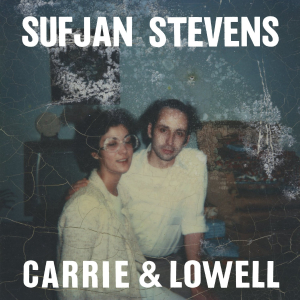
Sufjan Stevens and Florence + the Machine both have new albums out -- Carrie & Lowell and How Big, How Blue, How Beautiful, respectively -- and I've fallen in love with them both all over again.

Florence Welch's sound is as magnificent as it was on Lungs and Ceremonials, and has a new, rock-like energy infused into it, notably on "What Kind of Man," whose music video incorporates her characteristically enchanting religious imagery and gripping violence. She's one of the few artists I've ever heard do justice to the ferocity that erotic love can have; many are content to write and sing merely of the joys and sorrows it imparts, and God knows there are enough of those. But romance would, in the end, be insipid if there were no sense of danger in the beloved, and Florence + the Machine's music is full of danger, and of the quasi-mystical exaltation that is so often connected with both danger and romance (the music video for "No Light, No Light" is a splendid example of this).


Carrie & Lowell, meanwhile, features a return to the indie folk of Sufjan Stevens' work before the experimental electronica of The Age of Adz, sounding almost like a throwback to Seven Swans, but with a buoyancy of its own, faintly reminiscent of Illinoise. The sheer volume of music he has put out in so short a span of time -- his first studio album came out in 2000, and since then he has released six more, plus two Christmas albums, a multimedia album, and a B-side album -- would suffice another musician for an entire career, and his craftsmanship is incomparable. His complicatedly Christian themes (which always remind me a little of Flannery O'Connor for their combination of devout faith with honest, gritty grappling with the anguish and mysteries of living) persist here, particularly in "No Shade In the Shadow of the Cross," "Drawn to the Blood," and "John My Beloved." I'm swimming in it.


+     +     +

V.

... Bleh. I can't think of a fifth thing. I just thought of four things. Isn't there any end to the things? It's like -- ehrmagehrd, there is a "Donut: The Musical" video!


I said stop judging me!