Collect

Collect for the Fourth Sunday after Trinity

O God, the protector of all that trust in thee, without whom nothing is strong, nothing is holy: increase and multiply upon us thy mercy; that, thou being our ruler and guide, we may so pass through things temporal, that we finally lose not the things eternal; grant this, O heavenly Father, for the sake of Jesus Christ thy Son our Lord, who liveth and reigneth with thee, in the unity of the Holy Spirit, ever one God, world without end. Amen.
Showing posts with label Dorothy Day. Show all posts

Saturday, January 16, 2016

Catholic Anarchy, Part II: The Strength of Sin Is the Law

For Part I of this series, click here.


No man demands what he desires; each man demands what he fancies he can get. Soon people forget what the man really wanted first; and after a successful and vigorous political life, he forgets it himself. … One can only find the middle distance between two points if the two points will stand still. We may make an arrangement between two litigants who cannot both get what they want; but not if they will not even tell us what they want. … There is nothing that so much prevents a settlement as a tangle of small surrenders. We are bewildered on every side by politicians who are in favor of secular education, but think it hopeless to work for it; who desire total prohibition, but are certain they should not demand it; who regret compulsory education, but resignedly continue it; or who want peasant proprietorship and therefore vote for something else.
—G. K. Chesterton, What’s Wrong With the World, pp. 20-21


✠     ✠     ✠


So then, put simply, anarchism is the philosophy that the best way to organize society is for it to be genuinely self-governing, instead of being governed by a state whose authority is separated from and above that of the people as a whole. (Whether the state is instituted by elections, heredity, lottery, or any other means is not important for the anarchist: it is the state’s distinction from the citizenry as a whole, not its mode of coming into existence, that counts.)


But why think that? Most people haven’t, historically speaking—or, if they have, they’ve dismissed it as a pipe dream. And there’s a very practical case to be made for dismissing it as a pipe dream. However, I can’t help noticing in my studies of history that, in politics at least, practical people don’t seem to get what they want. Not reliably, anyway, and not for long.


Idealists, on the other hand, often make a remarkable impact: practical people have to take the unbending idealist into account, if only by shooting him. Stalin, speaking  to a French statesman who asked him about his influence with Russian Catholics, once said, ‘The Pope! How many divisions does he have?’ It’s witty enough in its own right; but it’s even funnier for other reasons, when you consider that the Soviet Union at that time was a thing of yesterday and vanished the day after tomorrow, while the Papacy is the oldest continuous institution on earth.* Idealism is much more practical than practicality—chiefly, I think, because it’s more human. Men are not bulletproof, but ideas and passions are; the pragmatist concerns himself only with men, but in so doing he leaves out the most important parts of man, his brain and his heart.
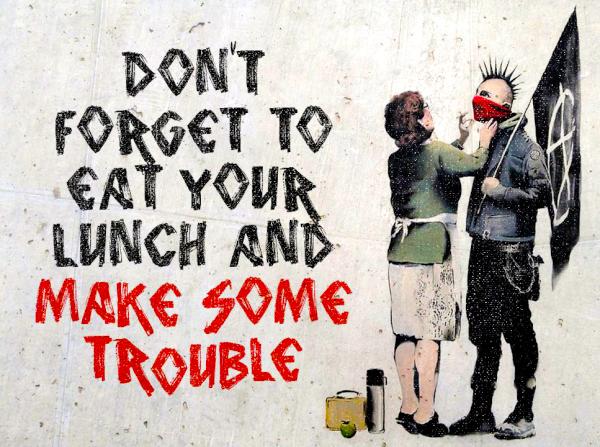


But back to anarchy. The idea is that men should be self-governing, and that, in a state, they just aren’t—even if it’s a professedly democratic state. The Man is still the Man even if you vote for him. And state governance, self governance, and chaos are the only options (until the Greys invade, but all the same we need something to do in the meantime).


This all, then, comes back to two simple questions: one, do men have the right to govern themselves? And two, is it best for them to exercise this right, or abdicate it in someone else’s favor?


Chesterton said (in a passage that I can’t find at the moment) said that there are two sorts of business in the world: the kind we wish a man to do for himself (or others) only if he does them well, like performing surgery or discovering the North Pole; and the kind we wish a man to do for himself even if he does them badly, like writing his own love letters or blowing his own nose. The classically democratic contention is that governing society is this second kind of thing; that we should wish the citizens of a society to run their society, even if they do so badly. Such is the dignity of the image of God and of its nose.


And the case for human self-government, from a Catholic perspective, is a pretty good one: if all men are rational, they are all qualified to contribute; if all men are sinful, they should all be caught. Aquinas, in discussing the nature of law in the Summa, says much the same thing:


A law, properly speaking, regards first and foremost the aim of the common good. Now, to direct anything to the common good belongs either to the whole people, or to someone who is the deputy of the whole people. And therefore the making of a law belongs either to the whole people or to a public personage who has the care of the whole people; for in all other fields, the direction of anything to its purpose concerns the one whom the purpose belongs to.**


St Thomas Aquinas: stirring up shit since 1243.


Bob Ludlow, one of the companions of Dorothy Day and an early contributor to the Catholic Worker, wrote, with reference to this passage and to anarchism in general:


The State is government by representation (when it is a democracy) but there is no reason why a Catholic must believe that people must be governed by representatives—the Catholic is free to believe one way or the other as is evident from St Thomas’ treatment of law … Anarchists believe that the whole people composing a community should take care of what governing is to be done rather than have a distant and centralized state do it. … Our Lord taught us to pray ‘Thy kingdom come on earth as it is in heaven’—in other words the nearer earthly government approximates what things are in heaven the more Christian it is. I do believe—whether it can be realized or not—that the anarchist society approaches nearer to this ideal than do other forms of government.***


That’s a quick-and-dirty summary of my own reasons for being an anarchist: I think it’s a nigh-inevitable logical consequence of taking the democratic theory of government seriously, and moreover that the democratic theory of government is a natural corollary to the Christian and Catholic theory of man. Most anarchists have rather different reasons for being anarchists—usually descending from the philosophy and politics born of the French Revolution, especially Marxism. But I have little to do with these; their criticisms of the middle and upper classes and of capitalist economics are often right, even biting, but I don’t find their proposed alternatives satisfying, practically or intellectually.


Now, in order for this to work, you’d need to get down to the levels where a society is small enough to actually run itself; say a small city, at the very largest. This of course would mean the destruction of nation-states as we know them,**** and in my opinion, that’d be a damn good start to any improvement of human life. The massive nation-state of the modern era, which is practically an invention of the eighteenth and nineteenth centuries, has seen greater luxuries of destruction and human horror than any other political form known to man, most often as a result of war and nationalism (or the two together, dancing the tango of suck).


An anarchist society couldn’t abolish war, but it would tend to put the lid on nationalism; and it would make the gigantic wars of the last three centuries harder to conduct, for two reasons. First, there’s the fact that no one society could draw upon the power required to wage such a war—whether we’re speaking of soldiers or money or technology.


And second, when waging a war is taken out of the hands of the state and put into the hands of the people who actually have to wage it, the people who bear the cost of the decision are the same ones making it; and that is an encouraging thought. Commander-in-Chief of the Armed Forces or no, you didn’t see George W. Bush disarming land mines at Fallujah, or Barack Obama hunched over a computer in Yemen orchestrating drone strikes, any more than you saw Truman flying over Nagasaki. They don’t have to see what they’re authorizing; only their tools and their victims pay that price. That is wrong.


Once again to be continued …


✠     ✠     ✠


*With the possible exception of the Emperors of Japan.
**Summa Theologica, Second Part, I.4.xc.3. I’ve tried to clean up the customary, but (for the lay reader) borderline impenetrable, Dominican translation by reference to the Latin; anybody who wants to check my work can look at the Latin and the Dominican fathers’ English side by side here.
***Day quotes this in her partial autobiography The Long Loneliness (pp. 268-269); it seems to be from a personal letter of Ludlow’s, or perhaps an article, but she doesn’t specify. Italics, or rather un-talics, are original.
****A nation-state, in the technical sense in which I’m using it, isn’t at all the same thing as a country. For example, France and Spain are countries, and the French and the Spanish are nations; the Basque people, who live on the western side of the Pyrenees between France and Spain, are also a nation but do not legally have a country. A nation is a group of people with a common cultural heritage, and usually a common ethnicity; many states, past and present, have been multinational—the USA and the Austro-Hungarian Empire are good examples. (The British Empire, since it was a colonial power, is a little different.)

Sunday, January 10, 2016

Catholic Anarchy, Part I: Um, Lolwut?

Around Christmas, when the reconnecting-with-friends-you-keep-forgetting-to-hang-out-with phase was in full swing, I found, a little weirdly, that anarchism came up several times. Maybe it’s because 2016 is an election year (and the two-and-a-half year run-up to elections have now become a remorseless aspect of our lives, as if media and politics weren’t independently intrusive and wretched enough), or maybe it was happenstance, but I thought I’d revisit the subject, which I haven’t written about substantively in a year and a half.

First, we have to be clear what we mean by anarchy. Normally the word is just used as a synonym for chaos, and most people assume that anarchists disdain or oppose order and law of every kind. There are anarchists who take that view, certainly. But they aren’t actually that representative of anarchists in general, any more than PETA are representative of vegetarians in general. The defining trait of anarchism is opposition to the state—whether on the grounds that it is unnecessary or that it is unjust. And the state is not simply synonymous with authority, nor even with law as such; otherwise, we could mean nothing by terms like ‘unjust war,’ ‘right to privacy,’ or ‘tyrant.’


Hey, how'd this get here?

What then do anarchists mean by the state? A gross oversimplification would be that the state is a governing body, enjoying legal authority over a society—the alternative being that society governing itself. An American would likely reply that our society does govern itself; to which an anarchist might say something like:

Oh really? You call the shots about tax rates, about military intervention in foreign countries, about anti-trust law, about speed limits, about the legality of using this or that substance? You know your representatives personally—at the local level, at the state level, at the national level? You know all the laws that apply to your life, and you know them because you made them, in conjunction with the other people they apply to—or at any rate, you all went through the preĆ«xisting laws and ratified them? When somebody says the government, your immediate thought is of the people it governs, because the two are synonymous? In what way, exactly, do you govern yourself, if none of the political details of your life are really in your control?

A statist (in the loose sense) might well reply that such a truly direct democracy would be impossible in a country on the American scale, which the anarchist might agree with; the statist and the anarchist would then proceed, most likely, to disagree about whether that’s a mark against anarchism, or a mark against America. However, the case for and against anarchy is one I’ll deal with later. For now, we are just exploring what anarchism basically is.

In brief, then, the state is a governing body distinct from the people it governs, who—irrespective of whether officers of the state assume their powers through elections, heredity, or any other means—may be called the subjects of the state.

And it must be pointed out that this state necessarily rests on the threat of violence in order to go on existing. This doesn’t mean that all states are cruel and capricious; some are fairly just, and, for all its incredible multitude of faults, the American state is one of the better ones available. (That isn’t saying a great deal in my opinion, but it’s still something to be grateful for.) But the state, unless it can infallibly persuade all of its subjects to do what it says—which, spoiler, it can’t—must rely on the ability to resort to force in order to go on existing. Otherwise, it will simply dissolve, as one citizen and another disagrees with one or another of its decisions and simply stops obeying it. More briefly, there’s no good in having laws if you cannot enforce them.

An anarchist will admit that there’s no good having laws if you cannot enforce them; you can then go in two directions with this. One is to denounce law as such. The other is to make consent the sole basis of law—not denying that there may be a profounder philosophical grounding for law, but in terms of what laws are civilly recognized. And if you’re going to have a society small enough to make consent the basis of its existence, you will, pretty much by default, have a society small enough to be authentically self-governing, without the supposed mediation of a state. Again, there are difficulties with this idea, and I will deal with them in a later post.

There are a few major streams in anarchist thought. A few examples (out of many):


· Social Anarchism, a family of schools which makes up the majority of anarchists past and present. Anarcho-Communism is one of the more prominent flavors; it arose in the ferment after the French Revolution, and was formulated in more detail by Peter Kropotkin (who refused a post in the infant Soviet regime, and whose funeral in 1921 was among the last expressions of popular opposition to the Bolsheviks). Social Anarchism in general favors direct democracy, public ownership of the means of production (e.g. natural resources, tools, and factories), and the abolition of private property—not to be confused with personal property.*


· Anarcho-Capitalism, which developed from certain forms of libertarianism. It advocates substituting all other institutions (including the justice system) with individual sovereignty and completely free markets. The Austrian School of economics is closely related, with such exponents as Ludwig von Mises and Murray Rothbard; minarchism, which advocates a state whose only functions are protecting individuals from certain forms of violence and fraud, is a related philosophy in the statist sphere.


· Anarcho-Syndicalism, which we’re all at least a little familiar with from that one scene in Monty Python and the Holy Grail. It is founded on principles such as class solidarity, direct action—i.e., pursuing a specifiable goal, viewing things like appointing mediators and advocates an unproductive distraction—and the abolition of the wage system (in favor of workers being self-managing). The Industrial Workers of the World, somewhat confusingly nicknamed the Wobblies, are an example,** with their famous slogan An injury to one is an injury to all.


· Anarcho-Pacifism, which frequently takes a religious tone (unlike much other anarchism). Pacifists who consider all use of force wrong will more or less inevitably become anarchists as well, since the state can only exist if it is backed up by force. Henry David Thoreau, Leo Tolstoy, Dorothy Day, Peter Maurin, and Mahatma Gandhi were all anarcho-pacifists (with varying levels of Christianity—Gandhi of course was a Hindu, but his political philosophy explicitly drew on the teaching of Jesus).

A lot of people have grilled me about how I can be an anarchist, of whatever flavor, when I’m also a practicing Catholic. It’s understandable, especially given that a lot of anarchists have been irreligious or anti-religious—like Emma Goldman, one of the most famous anarchists in history and a convinced atheist who viewed religion as an instrument, conscious or unconscious, of political oppression; or Louis Auguste Blanqui, who coined the slogan No gods, no masters, since a favorite among anarchists of nearly every stripe.

Nonetheless, I think it’s founded on a misunderstanding. A lot of people (Catholics not excepted) vaguely assume that supporting the Church involves a general support for authority of all kinds; as if belief in the Catholic faith came, not from examining it and finding it convincing, but from a general mood of liking things to be hierarchical. Now, I’m as susceptible as the next man to the Ʀsthetic appeal of hierarchy, but, if I do say so, I’m also canny enough to recognize the difference between finding something appealing and thinking that it’s true. And believing that the Catholic Church has authority in one realm doesn’t really involve you in the idea that this or that government has authority in some other realm—especially given that the Church quite specifically disclaims infallibility about anything that isn’t a matter of Christian teaching and practice. Besides this, the advancement of Dorothy Day’s cause for sainthood encourages me that anarchy and Catholicism are compatible.


And all that’s saying nothing of the Church’s long history as a firm, though by no means uncritical, sympathizer with radical politics. A long list of encyclicals, beginning with Rerum Novarum in 1891 and running throughout the twentieth and twenty-first centuries, down to Pope Benedict’s Spe Salvi and Pope Francis’ Laudato Si’, have called again and again for the humanization of politics and economics, in contrast not only to the destructive collectivism of dictatorships, but to the amoral capitalism of democracies.

Moreover, it’s arguable that the only lasting and functional anarchist society the world has yet seen was brought into being under the special patronage of the Catholic Church. The reducciónes of the Spanish Empire in South America, or at least those run by Jesuit missionaries, were frequently and for all intents and purposes a network of genuinely self-governing communities, which (a refreshing change in both colonialism and evangelism) did involve converting the indigenous peoples but did not involve Europeanizing them. Even Rousseau, no friend to Christianity, admired the reducciónes. Nor, when they were finally destroyed after a century and a half, did they collapse from internal conflicts—their demise was accomplished by the expulsion of the Jesuits from Portuguese and Spanish territories on political grounds, and active conquest on the part of the colonial powers (memorialized in the beautiful and tragic historical-fiction film, The Mission).

Don’t you hate it when they say To be continued, bitchiz …


*The distinction between private and personal property is one on which every form of socialism hangs, and is therefore, of course, more or less completely unknown to most capitalists. A quick-and-dirty summary of the distinction is: shit you can move is personal property; shit you can’t move is real property (as in the phrase real estate), and the way you think real property can or should be owned more or less shows what sort of economic theory you believe in. Communists and socialists believe that real property should always be public, while capitalists believe that it can be private (and thus almost equivalent to personal property, though not quite). Other systems, like distributism, take still other views.


**The IWW began in 1905, and its history since that time has been remarkable. Even just its founders were a fascinating bunch. They included: a Catholic priest, Fr Thomas Hagerty, sadly though understandably deprived of clerical faculties in 1902 due to his increasingly radical and dogmatic politics; Mary Harris ‘Mother’ Jones (for whom the magazine Mother Jones is named), who became an activist after she tragically lost her husband and four young children, and who memorably said of the Suffragette movement, ‘You don’t need the vote to raise hell!’, insisting that men deserved a wage that would allow their wives to care for the children and that the absence of mothers from the home was a major cause of juvenile delinquency; Lucy Parsons, the widow of Confederate veteran Albert Parsons, one of the Haymarket Martyrs—the pair had originally left Texas for Illinois due to intolerance of their interracial marriage; and Eugene V. Debs, one of the only prominent Socialist candidates for President (taking in nearly 6% of the vote in the 1912 election, and well over 3% in 1920 while he was in jail), who organized the historic Pullman Strike. Dorothy Day was also involved with the Wobblies, if informally, from about 1916 to 1926 or so.

Friday, July 4, 2014

Forgotten Keys of the Liberal Experiment

Well, first things first: happy Fourth of July, the day we declared our independence as a nation.


As commemorated in the documentary of the same name.

The recent SCOTUS declaration on the Hobby Lobby case, and its ensuing controversy, have strengthened my conviction that the American experiment has decisively failed.

Classical Liberalism, the philosophy that gave our nation birth, could be summed up without disastrous oversimplification as a belief in self-rule. This is more than just democracy as opposed to monarchy. Liberalism emerged out of the statist, absolutist governments that became popular during the Renaissance (themselves heirs of the gradual centralization of governments during the High and Late Middle Ages), which enjoined -- or, more precisely, took for granted -- a strictly hierarchical view of society and a supremacy of the state over its own laws that allowed it to meddle in nearly every aspect of life, just like it does today. The Enlightenment saw many political and economic philosophers reacting against what they declared to be tyranny, insisting by contrast on freedom of religion, freedom of speech and press, freedom of trade, and the equality of all men before the law.*

The turning of the tide against these ideals did not begin with the song SexyBack, though I dare say Mr. Timberlake did nothing to stem it. If you talk to a Leftist (or what most Americans think of as a Leftist), the Patriot Act may well be cited; if you talk to someone on the Right, the New Deal may be weighed and found wanting. I don't propose here to try and get to the bottom of that discussion. I would, however, point to a few essential elements of classical Liberalism that I think are simple statements of justice, whether Liberalism as a whole is right or not, and that I think our culture has lost touch with -- and must recover as central components of an American identity, if being an American is to be a noble thing.


1. The presumption of innocence. The crumbling of this belief at a popular level, within my own short lifetime, is a shock that I still haven't gotten over. It was, I feel, exemplified with a startling and unpleasant clarity in several recent instances, such as the Secretary of State's recent appallingly stupid remarks about Edward Snowden, or the employment of drone strikes against American citizens who, however criminal, were in that act deprived, by state fiat, of the right to trial by a jury of their peers. The trials of Casey Anthony and George Zimmerman displayed it, too: popular sentiment against the defendants was so high, people seemed somehow to forget that they were not being tried by the media -- or by a lynch mob -- and that the law which makes any reasonable doubt grounds for a verdict of Not Guilty is an integral, an indispensable, assumption of the American spirit. Whether they were in fact guilty is, in a sense, neither here nor there: what mattered was that there was not adequate evidence to prove their guilt beyond reasonable doubt, and therefore, the court was obligated to release them, and acted rightly in so doing.**

One would think (or hope) that a nation whose memory includes the disgraceful hysteria of the witchcraft trials of Salem, among the shabbiest collections of judicial mob-murders in history, would be a little more scrupulous about the presumption of innocence. Nor is the parallel of the witch-finder out of place; especially when we consider our country's disposition toward evils like pedophilia or terrorism, for, like the witch, the pedophile and the terrorist sleeper agent look like everybody else, allowing the most versatile phantasmagoria to project itself onto the screen of our half-conscious imagination. It may perhaps be said in defense of the witch-finder that, if we thought as he did that there were men and women vowing themselves to the Devil and using powers granted by him to wreck the economic infrastructure and kill those who displeased us, we'd probably behave no better than he.


The title page of Wonders of the Invisible World, a work on witchcraft and particularly on the Salem Witch Trials, by the execrable and impenitent Reverend Cotton Mather, who facilitated the ridiculous admission of spectral "evidence."

This belief, like most beliefs that are worth bothering with, cannot be derived from an examination of what is expedient; the presumption of innocence does not get results. It is a belief which elevates the protection of the innocent over the punishment of the guilty, and it therefore necessarily involves letting the likely, yet not manifestly, guilty person go free, not infrequently. A frightened or vindictive society will have no truck with that. But I do not care to live in a frightened or vindictive society. I assert that it is better to live and to die with a noble and a free soul, than to try to salvage one's bodily life for a while at the cost of such a soul. It is of course open to anybody to maintain that trying to salvage one's bodily life is worth sacrificing the bodily lives of others for, so long as they might possibly be guilty; but I for one am unwilling to countenance such a price.
It may be that, as imperial adviser, my friend Marsilius is better than I, but as inquisitor I am better. Even better than Bernard Gui, God forgive me. Because Bernard is interested, not in discovering the guilty, but in burning the accused. 
-- Umberto Eco, The Name of the Rose, p. 394
2. The equality of men. It may sound odd to describe this belief as having deteriorated, in an age when equality is a universal rallying cry, especially equality between the sexes and equality of marriage rights. Be all that as it may, I feel I sense this most of all with the wealthy and the politically powerful.

This will appear first of all to mean CEOs and Senators, and that isn't untrue. The fact that we not only tolerate but expect special treatment for such people (to say nothing of the bizarre cult of celebrities) is a far cry from the more fully democratic attitude of the First French Republic, in which, for all their other faults, statesmen like Robespierre (as Chesterton pointed out) were poor when they might easily have been rich. That was a bold statement of the real equality of rulers with ruled, and I don't know that it has been seen since.
A little while ago certain doctors and other persons permitted by modern law to dictate to their shabbier fellow-citizens, sent out an order that all little girls should have their hair cut short [to prevent lice]. I mean, of course, all little girls whose parents were poor. Many very unhealthy habits are common among rich little girls, but it will be long before any doctors interfere forcibly with them. ... As is common in most modern discussions the unmentionable thing is the pivot of the whole discussion. It is obvious to any Christian man (that is, to any man with a free soul) that any coercion applied to a cabman's daughter ought, if possible, to be applied to a Cabinet Minister's daughter. I will not ask why the doctors do not, as a matter of fact, apply their rule to a Cabinet Minister's daughter. I will not ask, because I know. They do not because they dare not. 
-- G. K. Chesterton, What's Wrong With the World, pp. 191-192
But the wealthy and politically powerful also means, more simply, America. That is, ourselves. We are not the only wealthy and politically powerful country in the world, obviously, but we're up there. And, while you could tell that we're rich and powerful from our immigration policies, you sure couldn't tell that we're a nation composed of more than ninety-nine percent immigrants from them. Or, if we were trying to discern the costs of war from (say) the media and popular objections to war, we could easily tell that war kills Americans, but I don't know whether it would be equally clear that war kills everybody else, too. Nor would it be clear whether we care about the latter, especially given our now persistent tradition, since the close of the Second World War and exemplified in both the Bush and Obama administrations, of not only excusing but defending war crimes.


Every act of war directed to the indiscriminate destruction of whole cities or vast areas with
their inhabitants is a crime against God and man, which merits firm and unequivocal condemnation.
-- Gaudium et Spes, The Pastoral Constitution on the Church in the Modern World, para. 80

3. The primacy of conscience. The poutrage over the Supreme Court's really extremely narrow ruling in the Hobby Lobby case -- I say narrow because it excused only a certain class of business owners from paying for contraceptive coverage, and excused them only over certain contraceptives -- has been very intelligently analyzed by Ross Douthat of The American Conservative.*** The thing that I find disappointing and alarming about it is the contempt of conscience it has manifested.

Advocates of the HHS mandate as originally drafted have proclaimed, loudly and quite correctly, that an employer's religious views have no place in an employee's bedroom. It has been drily pointed out that it seems a little unfair in that case to insist that an employer's wallet does have a place in an employee's bedroom; and, little love though I have for employers' wallets, I tend to agree. Insofar as, moral or immoral, boning is generally a freely chosen behavior, and it is for the sake of that freely chosen behavior that contraceptives are mostly used, insisting on contraception as not only a right but something that somebody else ought to be compelled by law to pay for seems to me to be rather tasteless (and not solely because I entertain no great hopes of the quality of state- or business-funded orgasms, based largely on my experience of other state- and business-funded services).


What leaves me baffled is the idea that the state not forcing people to act against their consciences is somehow tyrannical. I admit that my own views on the subject are, on our current spectrum, fairly extreme -- as that, for instance, I would strongly resist the idea of compelling a business owned by Jehovah's Witnesses to cover medical procedures that require blood transfusions, not because I think their beliefs at all reasonable, but because they do in fact hold those beliefs; and I don't think anyone should be compelled to violate their own conscience on someone else's behalf. But even if that view is refused as being too radical, contraception as such is not a vital good or service -- i.e., people do not need contraceptives for their physical well-being**** -- and it therefore still seems to me to be inappropriate to force an employer to pay for it.

Given that there is a state-funded option for health insurance, one might have supposed that, you know, having people sign up for that instead of employer-provided health insurance was a neat and obvious way of allowing for unusual convictions. But who wants that.

And the point is not simply about health insurance: it's about the conscience as set against the concerted mass of the state. Except for a rare few individuals, like Gandhi or Solzhenitsyn or Dorothy Day, the pressure even of an ostensibly liberal and enlightened state will be more terrible than the pangs of conscience. The First Amendment was not written simply to ensure that religious or political minorities did not wake up in prison while their houses of worship or printing presses were torched. It was written to assert that the conscience itself is the foundation of all law, and that it is the state which must kowtow to us, not the other way around. As Blessed Cardinal Newman said, conscience is the aboriginal Vicar of Christ; and every human person is a throne to that invisible apostle, which the state should not dare to desecrate. It may be answered, and truly, that some of these aboriginal Vicars bear upon their heads a blasphemous name, but by the same token, the angels themselves do not take it on themselves to rebuke one another.
And the servants of the master of the house came to him and said, "Master, did you not sow good seed in your field? How then does it have weeds?" He said to them, "An enemy has done this." So the servants said to him, "Then do you want us to go and gather them?" But he said, "No, lest in gathering the weeds you root up the wheat along with them." 
-- The Gospel according to Saint Matthew, 13.27-29
H. L. Mencken (a glib and quotable misanthrope of the last century) said that "We must respect the other fellow's opinion, but only in the sense and to the extent that we respect his theory that his wife is beautiful and his children smart." He meant it in its negative application, of course, but I feel that its positive application ought to be observed as well: we need not respect, in the sense of agreeing with, the other fellow's opinion; but we must absolutely respect his opinion in the sense of not forcing him to say or do things that involve him in the premise that his wife is ugly and his children stupid. Not even if they are.


Don't weed out the ugly and stupid yourself; let raptors do it.


*The pesky little problem of slavery did not at first deter them, given that they had conveniently defined humanity in such a way as to exclude the enslaved. Christianity is well-known to have cooperated in this bitter wrong -- although three significant facts tend to be left out of treatments of that problem today: first, that some communions, notably the Catholic Church, rather tolerated slavery as an evil that they could see no practical hope of eradicating and attempted to ameliorate, than enthusiastically supported it (though still falling short of the heroic Abolitionism of the Quakers); second, that while the pro-slavery movement did shamefully contain Christians as well as non-Christians, Abolitionism, so far as I understand, was an overwhelmingly Christian movement; and thirdly, that slavery does still exist today, and indeed exists in this country -- we just call it "illegal immigration," and not only underpay our slaves but occasionally kick them out of the country after they do the manual work that we are too busy or too lazy to do for ourselves.

**The presumption of innocence may be best, if indirectly, explained by the TVtropes page on Genre Savviness -- especially on the point that a genre savvy character is more likely than others to allow that things aren't always as they seem. I should think anybody who has lived through adolescence must know that things aren't always as they seem, even if things are as they seem with uncomfortable frequency.

***My anti-statist tendencies, to say nothing of my pacifism and my opposition to capitalism, prevent me from fitting in nicely with conservatives on the whole, but I've found TAC in general and Douthat in particular to be quite winsome. Of course, my anti-statist tendencies are equally out of place among liberals, as are my trenchantly pro-life views.

****I failed to be quite clear on this point in my last: I realize of course that some medicines that are in fact contraceptive have important health applications. Insofar as they are being used for those purposes, their contraceptive effects are (in my judgment) neither here nor there, and should indeed be covered by health plans, because if they're being used as medicine on the grounds that they, um, are medicine, then that's what a health plan is for. But this is not what anyone is even claiming the discussion of contraceptives is about. It is, explicitly, about contraceptive availability as a dimension of sexual liberation -- otherwise they wouldn't be bringing up the objection that their employer has no business in their bedroom (unless the boss is banging his secretary, I guess) in the first place.

Wednesday, October 2, 2013

Christianity and Anarchism, Part I: What Is Anarchy?

I'm pausing the Raw Tact series again in order to discuss what I mean in calling myself an anarchist. This seems specially appropriate in the wake of the government shutdown, but I've also been getting a lot of inquisitiveness on the subject of late, so I thought I'd try and satisfy the curiosity. Some people are puzzled that a Catholic should be an anarchist; the Catholic faith is, after all, the most hierarchical of all incarnations of Christianity -- surely it is a contradiction in terms to be a Catholic anarchist?

The definition of anarchism is one of the ticklish problems here, not least because there are so many varieties, some of which are mutually incompatible, while others often overlap. Anarchism is chiefly a leftist (or post-leftist*) system of thought, as with anarcho-communism or anarcho-syndicalism; but there are some descendants of the classical liberal and capitalist school of thought, while others eschew the whole business in favor of a totally primitive outlook.


Yeah, I'm this guy. I'm a little disappointed in me too.

The defining trait of anarchism would be rejection of the state. The socialistic anarchist who wishes to replace the state with self-governing, egalitarian economic communes, the anarcho-capitalist who wishes to replace the state and its operations entirely with private contracts, the anarcho-primitivist who wishes to replace the state with a return to prehistorical conditions of life -- all agree in considering the state an undesirable and unnecessary thing.

This doubtless sounds preposterous. And it must be admitted that many of the forefathers of anarchy were, to speak frankly, surprisingly bad reasoners. I've been reading some of the essays of Emma Goldman, one of the most important anarchist theorists of the early twentieth century, and was a little put out when, after page upon page of righteous railing against the injustice of the state and of the class system, she then spoke of the very concept of free will as a ridiculous idea. How anybody proposes to have human responsibility without free will, or any idea of justice apart from human responsibility, I don't claim to know. But I do not consider anarchism as such to be beholden to its prominent theorists (and I am confident that they would agree with me; they were as consistent as that in any case).

In her autobiographical book The Long Loneliness, Venerable Dorothy Day, herself a Catholic anarchist, quotes at length from Bob Ludlow, a fellow Catholic anarchist and a significant early contributor to the Catholic Worker, whose words are a more or less ideal expression of the views I've come to hold:

"Both among Catholics and anarchists ... a great deal of misunderstanding comes about by a confusion of the terms State, government and society. Father Luigi Sturzo's book Inner Laws of Society is the best Catholic treatment of the subject I have read. He brings out the point that the State is only one form of government. When you analyze what anarchists advocate (particularly the anarcho-syndicalists) it really boils down to the advocacy of decentralized self-governing bodies. It is a form of government.

"The confusion results because some anarchist writers use the term government as synonymous with the term State and make the categorical statement that they do not believe in government, meaning by that the State.

"The State is government by representation (when it is a democracy) but there is no reason why a Catholic must believe that people must be governed by representatives -- the Catholic is free to believe one way or the other as is evident from St. Thomas' treatment of law ... St. Thomas states: A law, properly speaking, regards first and foremost the order to the common good. Now to order anything to the common good belongs either to the whole people, or to someone who is the viceregent of the whole people. Hence the making of law belongs either to the whole people or a public personage who has care of the whole people ...

"Anarchists believe that the whole people composing a community should take care of what governing is to be done rather than have a distant and centralized State do it. You can see from the quotation from St. Thomas there is nothing heretical about such a belief. It certainly is possible for a Christian to be an anarchist. ...

"Our Lord taught us to pray 'Thy kingdom come on earth as it is in heaven' -- in other words the nearer earthly government approximates what things are in heaven the more Christian it is. I do believe -- whether it can be realized or not -- that the anarchist society approaches nearer to this ideal than do other forms of government. As the Christian lives in hope so may we set this as the idea, towards which we work even if it seems as impractical as Calvary." -- The Long Loneliness, pp. 268-269

Thursday, September 5, 2013

Pray and Fast for Syria

Pope Francis has proclaimed a voluntary fast this Saturday for peace in Syria. I plan to observe it, and I implore anyone who reads this to join the Holy Father in this. You don't have to be Catholic, or indeed a Christian, to do this; think of it as an act of solidarity with the suffering there, if you like.

Why fast, for Syria or anywhere? Here are four reasons:

1. Pope Francis asked us to. Not a binding reason, even for Catholics (since the fast is not an obligation but an invitation); but for those traditional Catholics who've been complaining that he isn't pontifical enough, and for those progressive Catholics who've complained that the Church doesn't show enough compassion for the suffering, here His Holiness is doing both. And even if you aren't a Catholic, he is an awfully nice man, so it's only polite to go along with it, don't you agree?

2. Fasting is a way of entering more profoundly into prayer. The Scriptures consistently associate prayer with fasting, and Our Lord presumes that His disciples will fast. Like kneeling or making the sign of the Cross, it is a sort of way of praying with the body as well as the soul; since we are souls and bodies at the same time, this is not only logical, but an enrichment of prayer. And we should be praying for Syria whether we elect to fast or not: the conflict is a ghastly one, and will likely be protracted even if the United States intervenes.

3. It is one way of showing solidarity with the suffering. It must be admitted that, since we are half a world away, this solidarity does not in and of itself help them. At least, not in any visible way; I don't profess to know what God does with the spiritual energy, if any, involved in fasting. But solidarity is good for us. It reminds us of what we too easily forget in our insanely easy lives, the real and bitter hardships that most people experience. That lesson in empathy can improve our character, and make better and more obviously efficacious acts possible to us. A simple fast may not sound like much, but after all, you have to start where you are -- and I'd lay fifties to any amount that a majority of Americans, perhaps even of American Christians, have never fasted.*

4. It is a symbol of nonviolence. Not that eating is a symbol of violence (unless you've watched Man vs. Food lately), but protests in the form of hunger strikes are a long-standing tradition of civil resistance, as exemplified in figures like Mahatma Gandhi, Cesar Chavez, and Venerable Dorothy Day. In contrast to strikes, or even sanctions, a fast is an act within oneself, and as such appeals to the opponent's conscience instead of his passions or appetites. Appeals to conscience are only too rare in our age, because, being accustomed to power, we subconsciously suppose that force will achieve peace; but the two are radically and intrinsically opposed. And as we suppose that no appeal save the appeal to force will succeed, we erode the power of the heart to respond to anything else. The determined refusal to appeal to anything except conscience, then, becomes a means of awakening and strengthening conscience; and if they harden their hearts, then we join with Jesus in weeping over a city that knew not the time of its visitation.


The normal rule for a Catholic fast (as observed in the Roman Rite, which encompasses most western Christians) is that one ordinary meal is allowed, as well as two snacks that are both less than half a full meal. That is the minimum; going further is of course permitted. It is traditional to abstain from meat on a fast day as well. Obviously the rule is defined relative to how much one normally eats, so there will be variation from person to person.

*Yes, counting Catholics. This is less because of the lax state of Catholic morals in this country, than just because Catholics are a (large) minority of Americans and a (larger) minority of American Christians.

Sunday, February 17, 2013

Mea Culpa

Listening to bizarre Christian folk-punk bands like mewithoutYou and the Psalters generally puts me in a brooding, elaborately conscientious mood, and this evening has proven no exception. (The Divine Liturgy of the Wretched Exiles is a fascinating album, by the way; I am seriously contemplating polluting myself with a MySpace account just so I can buy the rest of it.) In conjunction with the account of Christ's temptation in the desert, it has me thinking on the topic of spiritual evil.

Francis George, the Cardinal-Archbishop of Chicago, remarked a few years ago, "I expect to die in bed, my successor will die in prison and his successor will die a martyr in the public square. His successor will pick up the shards of a ruined society and slowly help rebuild civilization, as the Church has done so often in human history." It has widely (and, according to His Eminence, mistakenly) been interpreted as a reference to the HHS mandate, and specifically to its contraceptive provisions. Regardless of context, it is an eloquent overstatement (and was meant to be), and more or less went viral among Catholics, especially the fervent younger generation that, according to the media, has abandoned religion -- though, in my confessedly limited experience, it's becoming increasingly difficult to swing a cat without hitting half a dozen rosary-wielding, scapular-wearing, encyclical-quoting papists who have yet to clear their twenties.

And what does the Cardinal's mot have to do with spiritual evil? In itself, nothing. But there is something in the tone of the Young Papists that disquiets me when I hear them (okay, us) quote that -- a certain relish, bordering on enthusiasm. It would seem to be something distantly akin to the desire for martyrdom, something known to lunatics, saints, and lunatic saints. But the number of saints who have actively desired martyrdom doesn't seem terribly high, and many of those who did desire it were refused it: St. Francis is an outstanding example. St. Peter, on the other hand, though he accepted the cross, judged himself unworthy of it; and St. Thomas More, one of my favorite martyrs, did every morally licit thing in his power to avoid a death for which he had no desire at all. The tone of the Young Papists, on the other hand, has another element in it -- something that makes me think of this morning's gospel:

And the devil brought him to Jerusalem, and set him on a pinnacle of the temple, and said unto him, "If thou be the Son of God, cast thyself down from hence: for it is written, 'He shall give his angels charge over thee, to keep thee: and in their hands they shall bear thee up, lest at any time thou dash thy foot against a stone.'" And Jesus answering said unto him, "It is said, 'Thou shalt not tempt the Lord thy God.'" -- Luke 4.9-12

I don't mean that we Young Papists are Satan, although it may be worth bearing in mind that the first Vade Retro was addressed to the first Pope.* But the significance of this temptation is the same as the danger that can animate the desire for martyrdom, literal or figurative: the craving for a remarkable display of one's holiness -- for the good of others, of course; and as a proof that our faith is as strong as we claim. Tolkien hit the nail on the head when, explaining a theme that recurs through all of his works about Middle-Earth, he wrote to a friend, "[T]his frightful evil can and does arise from an apparently good root, the desire to benefit the world and others -- speedily and according to the benefactor's own plans".

I actually agree with the generally conservative sentiment that Christianity is on the defensive in this country, and that it will likely be so increasingly over the next few decades; though it must be said that that is an educated guess, not a prophecy, and God has a way of confounding the philosopher and the scribe. (It should be, but isn't, unnecessary to add that I still don't countenance the hysterical paranoia that, sometimes quite prosaically, attempts to equate our political-religious situation with the persecutions under the Nazis.) But that makes me more concerned about spiritual corruption rather than less. We are accustomed to thinking of the early Church as being incomparably pure and virtuous because of the persecutions, and I dare say they were rather more impressive than ourselves, spiritually speaking; but an attentive perusal of the New Testament and the primitive documents of the faith will reveal that they too had their share of half-hearted camp followers, superstitionists, freelance syncretists, jealous backbiters, self-anointed apostles, intransigent fanatics, and just plain fools. And persecution, while it can purify, can also destroy; I shall be bold to say that there have been many Christians, holy in their own way, who would not have had the nerve required if they had had to live, and perhaps die, under a persecuting state.

Moreover, if we do suppose that we are approaching an era of implicit -- or even explicit -- persecution, and relish the thought, whom exactly are we congratulating? God, who (perhaps) found our stubbornness in sin so incurable that He was forced to resort to a persecution to knock some sense into us? Ourselves, who, if we did not court persecution, cannot exactly claim credit for it; or if we did, have thus provoked a terrible sin in others?

And there is one of the questions that is rarely considered. When persecutions do come, we are specially warned in the Beatitudes to pray for those who persecute us. For, if we are unjustly persecuted, then those who persecute are sinning against us. (And if it isn't unjust, then persecution is perhaps not the word we are looking for: a man I knew remarked that Jesus said those who are persecuted for the sake of righteousness are blessed, but said nothing about people who are persecuted because they're jerks.) Dorothy Day, reflecting on the pacifist convictions and practice of the Catholic Worker Movement, addressed the question with stinging insight:

"On the other hand, to continue examining these subtleties: What about this business of letting the other fellow get away with things? Isn't there something awfully smug about such piety -- building up your own sanctimoniousness at the expense of the increased guilt of someone else? This turning the other cheek, this inviting someone else to be a potential thief or murderer, in order that we may grow in grace -- how obnoxious. In that case, I believe I'd rather be the striker than the meek one struck. No, somehow we must be saved together." -- Loaves and Fishes, p. 61

I can attest that there is definitely something smug about such piety. I was recently startled in a conversation with a few friends of mine by how self-righteous and disdainful I was being, merely on the grounds of the ideas that I held -- and I've barely done anything with those ideas except talk about them! Pride's roots go deep, deep down into the unlit and dripping places of the heart; it takes a hot and a persistent fire to scorch them out.

I don't think of this post as an accusation; certainly I haven't got anyone in particular in mind; or, to be more accurate, I am attempting to practice humility by remembering that the people I do have in mind do not necessarily suffer from the vice I'm talking about merely because I think they do, and/or dislike them. I prefer to think of this as a call to examination of conscience. Whether persecution is on the horizon, or beyond the horizon, or not, purity of heart is always worth having, and a pure heart is the fruit of (among other things) an examined life.

*The Vade Retro is a prayer against devils, beginning with the line "Get thee behind me, Satan" from Matt. 16.23.