Collect

Collect for the Fourth Sunday after Trinity

O God, the protector of all that trust in thee, without whom nothing is strong, nothing is holy: increase and multiply upon us thy mercy; that, thou being our ruler and guide, we may so pass through things temporal, that we finally lose not the things eternal; grant this, O heavenly Father, for the sake of Jesus Christ thy Son our Lord, who liveth and reigneth with thee, in the unity of the Holy Spirit, ever one God, world without end. Amen.
Showing posts with label St John of the Cross. Show all posts

Tuesday, July 16, 2019

Five Quick Takes

I’m having some difficulty with my next post on gender, partly because, as I cannot stress enough, I am not an expert. It’ll probably be another couple days. In the meantime I do recommend ContraPoints’ recent video Transtrenders, though, for people who’d like to hear about trans theory from an actual expert (however fervently she may claim not to care).
✠     ✠ ✠

Today is the memorial of Our Lady of Mount Carmel. I have always been fond of the Carmelite tradition: The Dark Night of the Soul by St John of the Cross (the poem, not the full mystical manual) was one of my first tastes of Catholic mysticism, and it carried me through some extremely black midnights of my own as a teenager grappling with sexuality and faith. I nearly took him as my patron saint, and one of the special pleasures of my parish is that our altar houses a relic of his. Given my voracious unchastity, I don’t really feel able to wear the Brown Scapular; but I still turn to St John of the Cross and St Teresa in prayer, and now and again I even get wild and read them.


✠     ✠ ✠

My friend Joey Prever is getting surgery soon for some back and foot issues. If you’d say a prayer for him, that’d be cool of you. Incidentally, he was recently interviewed by the Convertigo podcast, discussing his family’s faith journey and his own.
✠     ✠ ✠

I’ve been grappling with symptoms of depression again, so I finally got my Zoloft refill. I forgot how much it messes with sleep: it doesn’t so much keep you from sleeping as make you awake, which I expect can’t be great for you but doesn’t actually feel bad, and my depression manifests partly as insomnia anyway so it’s not like it’s interfering with sleep I’d otherwise be getting. A much bigger aspect of depression, though, is a lack of motivation; people tend to think of depression as being sad, when it’s much more a matter of being numb. That involves you in a kind of abstract sadness of course, but it’s a very different experience.
✠     ✠ ✠

I have heard, though I have not verified, that ICE (which, fuck ICE) has gone as far as setting up fake Grindr profiles to entrap illegal immigrants (which, actually don’t fuck ICE, it will end badly). So if you’re on Grindr—which I don’t recommend, but if you are—and you either are undocumented, or could be assumed to be undocumented by a racist ICE agent … uh, be extra careful, I guess? Deleting the app would be better. Do that.

Friday, August 19, 2016

Irresistible


Con su mano serena
En mi cuello hería,
Y todos mis sentidos suspendía.


With his gentle hand
He wounded my neck,
And all my senses were suspended.


—St John of the Cross, En Una Noche Oscura (The Dark Night of the Soul)


I met the Bride of Christ, the bruised beauty:
Her eye had a purple halo, and along her cheek
There ran a scarlet cord.
She sat on the end of my kitchen table, smoking a cigarette,
And explained that she’d run into the door.
I poured her a scotch
And another for myself, and we talked.


She told me about the years and months with him
When they were young, and they sailed the Mediterranean together,
And she spent her nights eating apples and figs;
She talked about their Christmases on ragged western islands,
And the elusive spring together on Kyushu.
She said his palms were rough and beautiful.
Her hands trembled as she spoke;
The painted nails were chipped, and underneath
There were grains of some dry substance, glittering.


I asked her about that time in autumn
When their neighbors called in a noise complaint,
Because the yelling and the noise of breaking glass were waking up the street,
And she wouldn’t talk to me for a week;
I asked her about the evening after that, when we drank too much coffee,
And she wore a turtleneck in the heat
With the pearl pendant he had given her.
She stubbed out her cigarette, studying the ashes,
And lit another one and changed the subject.
Our drinks fell and rose.


She would not say the specious litany—
‘He just gets a little angry sometimes’ or
‘It’s my fault; I should have had things ready.’
Instead, clear and cool: ‘He’s jealous.’
And, ‘It always hurts like the first time;
I love that.’


I looked down into my cup
And said something about taking her in, if she needed it.
Her smile frightened me, a mouthful of glass;
‘I get my own back.
I’ve dug my finger right through his wrist.’


I thought back to the first time I had met him:
Heat dropping from a dark sky,
A scarlet loveliness running along his throat,
His strangely tilted head, the smell of sweat, the motionless mouth,
His eyes, like hands that reach inside you,
Caressing you—such a tender touch,
But you can feel the force they’re capable of:
Like running a fingertip gently against a knife.
I understand her.
I am in love too.

Friday, March 20, 2015

A Mustard Seed

When I was five years old, my family went on a trip to Disneyland. I vaguely recall enjoying it, but five-year-olds are stupid so who knows whether it was any good.

One thing I did not enjoy, however, was the Pirates of the Carribean ride.* I took one look at the chaos and the shouting, and promptly screwed my eyes as tightly shut as they would go and hid my face in my hands. My mother kept telling me that it wasn't really scary and was just like Peter Pan, but I knew this was a devious ruse.

"You cheated!" "Pirate."

You sit on a throne of lies.

I wonder whether this is a good parallel to faith, especially to my extreme difficulty accepting the Church's teaching -- that is, according to my convictions, divine revelation -- about homosexuality. On the one hand, the similarities are fairly obvious: it was my mother's word, which I had no rational cause to doubt, against my kneejerk reaction and deliberately self-limited observation (I don't know that I've deliberately limited my observations about queer matters, but that isn't the chief point). On the other hand, the ride wasn't actually going to injure me in any way -- it might not even have scared me if I'd consented to open my eyes, but of course I have no way of knowing that -- whereas it is, in fact, terribly costly to lead a celibate life when you don't want to and aren't sure how; costly especially in loneliness, which is one of the hardest and most bitter crosses for a person to carry. Rewarding, perhaps, but that doesn't do away with the costliness. So maybe it's a good parallel and maybe it isn't.

I have been thinking more and more of late, though, that the opacity of the Church's teaching about homosexuality may be one of the conditions of faith for me. I don't get why God couldn't have, or at any rate didn't, design sex in such a way that that gay sex was as morally licit as straight sex; or, to put the same thing another way, why marriage is specifically for one man and one woman, as opposed to any two people irrespective of gender. I don't get that. I never have. But the Catholic Church, which I believe speaks with the authority of Christ, assures me that that is how invisible reality is shaped, so to speak, and so I'm presented with the choice of trusting the Catholic Church or withholding my trust from her.

And that's what faith is. St. Paul contrasts faith with sight, not because it's better not to see -- we look forward as Catholics to the Beatific Vision -- but because faith is precisely the decision to trust. It is an intellectual decision, but no less a decision for that; and that intellectual decision is the basis of love, because you cannot love what you refuse to know.

And honestly, with most of the Church's doctrine, I either see how it works clearly enough to be thoroughly satisfied of its truth, or at the least am content to shrug my shoulders and say, "Whatever, I believe you, Mama." This is one of the few, the very few, points where the faith is not merely opaque to me, but hard to believe, and even repellent. I think faith has to overcome that obstacle in us; save perhaps in a few happy souls whose growth into virtue is sufficiently natural and uninterrupted that the obstacle never arises. But such a dislike of divine things cannot simply be ignored, if it does arise.


Don't fight it, bro. Even God has a Mother.

For of course, as long as our -- my -- "faith" is merely assent to what seems either obvious or the most reasonable explanation of the obvious, it isn't faith, but rationality. Nobody is credited as having a strong faith in mathematics, or in mathematicians, because they firmly believe in the multiplication table. Faith comes in when it is a question of whom you trust, whom you choose to trust, and trust only becomes active and relevant when what's at stake is uncertain -- when trusting, or not trusting, has a concrete impact.

"If a man wishes to be sure of the road he travels on," said St. John of the Cross, "he must close his eyes and walk in the dark." And faith does become a kind of seeing, a way of knowing someone. When you trust somebody, you're finding out by experiment what kind of person they are. Now, that can be taken the wrong way: the experimental element here is not an experiment in the sense of a laboratory test in controlled conditions. Trust reposes its confidence in someone before they have unambiguously proven themselves worthy of it, though it may well start small and grow over time, in the style of the famous mustard seed. It's like the passage in The Silver Chair, maybe my favorite passage in the whole Chronicles of Narnia, where Jill meets Aslan for the first time:


   "Are you not thirsty?" said the Lion.
   "I'm dying of thirst," said Jill.
   "Then drink," said the Lion.
   "May I -- could I -- would you mind going away while I do?" said Jill.
   The Lion answered this only by a look and a very low growl. And as Jill gazed at its motionless bulk, she realized that she might as well have asked the whole mountain to move aside for her convenience.
   The delicious rippling noise of the stream was driving her nearly frantic.
   "Will you promise not to -- do anything to me, if I do come?" said Jill.
   "I make no promise," said the Lion.
   Jill was so thirsty now that, without noticing it, she had come a step nearer.
   "Do you eat girls?" she said.
   "I have swallowed up girls and boys, women and men, kings and emperors, cities and realms," said the Lion. It didn't say this as if it were boasting, nor as if it were sorry, nor as if it were angry. It just said it.
   "I daren't come and drink," said Jill.
   "Then you will die of thirst," said the Lion.
   "Oh dear!" said Jill, coming another step nearer. "I suppose I must go and look for another stream then."
   "There is no other stream," said the Lion.
   It never occurred to Jill to disbelieve the Lion -- no one who had seen his stern face could do that -- and her mind suddenly made itself up. It was the worst thing she ever had to do ...
Without faith, I think, we will be unable to see God as He wishes to be seen -- as we must see Him if seeing Him is to make us happy. Possibly for much the same reason that I couldn't enjoy the Pirates ride without trusting my mother, because my hands were over my eyes.** Of course, I'm not above making a virtue out of necessity, either: it's easier to commit yourself to walking in the dark if you haven't gotten where you're going before nightfall. I don't get it anyway, whether I bless God in faith or curse Him in stubbornness, so I might as well see if I can't do something useful with my not-getting-it.

Taken this way, I think that maybe when it comes to the Church's teaching about homosexuality, I can be okay with not knowing, not getting it. I guess the only thing to do is wait and see.


*For my younger readers, this was actually the ride that served as the basis of what is now bidding to be the most stupidly huge franchise since The Land Before Time, not a cheap attempt to capitalize on the films. (Cheap attempts to capitalize on the films are what the films are for.)

**The fact that I knew her to be perpetrating a malignant, manifestly ridiculous deception, as mothers who take their children to Disneyland are wont to do, is, for our purposes, neither here nor there.

Thursday, July 17, 2014

Five Quick Takes

I.

I've been gradually starting to deal with the sin of anger (and its countless manifestations -- impatience, outbursts, punitive withdrawal, hurtful sarcasm) over the last year or so. Hitherto, my anger had been so thoroughly repressed that it almost never manifested itself in any form at all, except for gigantic outbursts of frustrated wrath separated literally by years.


Like this, but without the advantage of the stylish indigo pants.

Anger is extremely scary for me. It's horrible to anticipate, horrible to feel, horrible to remember. I hate it because it almost always has the feeling, and very frequently the real-world result, of distorting my perspective, and if there's anything I value, it is fidelity to the truth -- which is inseparable from a fair-minded perspective. However, as the ancient saying goes, that which Christ does not assume, He cannot redeem; hiding things from Him, whether by also hiding them from ourselves or not, does not unite us to Him but rather creates distance. Not by conversion of the Godhead into flesh, but by the taking of the manhood into God: the maxim that governs the Incarnation of the Deity also, and for that reason, governs the deification of our humanity.

+     +     +

II.

I have, after some guilty months of neglect, picked up my copy of Melinda Selmys' Slave of Two Masters, a Catholic treatment of the God-and-Mammon problem. I can't believe I put it off. It brought out one element of economics that had completely escaped me before, which I'd therefore like to quote here:
Once Eve was cursed to have Adam "lord it over her," which aspects of the human endeavor did he choose for himself? It is usually assumed that Adam took the better portion and left the dregs to Eve ... 
But what is it that women produce? Men, arrogantly desiring to claim all of the credit for human achievement, have habitually missed the glaring and inescapable fact that women produce men. Society economics, science, culture, knowledge, politics, and production are all just things that serve human interests; only human persons are ends in themselves. ... 
This has dire consequences for a society in which not only men but also women have rejected women's work in favor of economic accomplishment. John Paul II, in Mulieris Dignitatem, suggests that the increased participation of women in social, economic, and cultural life could serve to positively transform those areas in the light of "women's genius." Yet this can be accomplished only if women's genius itself is preserved -- and that genius is intimately connected to motherhood. 
The economics of motherhood is governed by very different principles than the economics of the marketplace. In domestic life, the stronger do not triumph, or even seek to triumph, over the weak. ... John Paul II expressed a hope that it would be possible to reform economics so that it could be fueled by such an engine of love and affection, rather than being governed solely by self-interest. 
-- Slave of Two Masters, pp. 6-8

+     +     +

III.


Our Lady of Mount Carmel by Pietro Novelli. 1641. The saints depicted below, from left to right, are:

Yesterday was the Feast of Our Lady of Mount Carmel. As I believe I've said before, she and the Carmelite Order are and have been very important to me: the poetry of Saint John of the Cross was one of my first exposures to Catholicism, and Saint Teresa, judging from what I have read of her writings, must have been looking after me for some time. She drives me nuts, mostly by being right.

One oddly persistent trend that I've noticed about the Carmelites is their propensity to attract Jewish converts. Saint Teresa (foundress of the Discalced or reformed branch of the Order), Saint John of the Cross (who helped her found the Discalced), Saint John of Avila (her spiritual director), Saint Angelus of Jerusalem, Venerable Augustine Mary, and Saint Edith Stein, to name just six, were all Hebrew Catholics -- to employ a phrase coined by another Hebrew Catholic who was also a Carmelite, Elias Friedman.


I rather like this trend. I have a drop of Jewish blood myself, though it's well over a century old, and, coming through my father, doesn't count anyway -- but I have always had a sort of irrational fondness for the Jewish people, so that the discovery of a personal connection (however tenuous) was extremely pleasing, and it was a weird and happy coincidence that the Carmelites should seem to forge another link. Why Carmel should have such a draw, I'm not sure, though I have a hunch that it has something to do with the profound theology of suffering and darkness that is a mark of their spirituality. The Jews being no strangers to suffering, I could understand how it would be more naturally sympathetic than some other Catholic traditions. But that's definitely a guess.

+     +     +

IV.

Cole Webb Harter, author of the Andalusian Peafowl, an Eastern Catholic (I think he's Byzantine? I don't know my Eastern Churches that well) pop culture critic and thinker, recently did a piece on the Anarcho-Monarchist politics that he and Tolkien (and I) largely sympathize with, as exampled on My Little Pony: Friendship Is Magic.

Fluttershy is the best pegasus ever and I will not be gainsaid. No matter how

He has since gone on to a piece on the implicitly Distributist economic system that prevails in Equestria, something that tends to go hand-in-hand with Anarcho-Monarchism. I was planning to plug his post anyway -- Catholic Anarchist bronies, being few, ought to stick together -- and the delightful tour de force of his continued analysis of My Little Pony from these perspectives, at once whimsical and really fairly convincing, is a further reason to do so. The fact that Anarchy is grossly misunderstood by most Americans, and that Distributism has sadly made so little impact in this country (despite being the sole economic theory with a serious claim to be endorsed by the Church), is a third reason for me to say: tolle lege, tolle lege.

+     +     +

V.

If you all who are the praying sort would pray for my roommate, I'd be very grateful. He is in his sixties and is planning to go in for hip replacement surgery, which had to be postponed on account of a bout of laryngitis. The surgery hasn't yet been rescheduled, though he did receive Unction this past Sunday. I'll be away over the weekend, so if you would pray for his health and spirits, and for a safe, soon-effected surgery and a swift recovery, I'd be grateful.

Sunday, December 15, 2013

Mortar the Stones With Blood

We have already noted that this paradox appeared also in the treatment of the early Church. It was important while it was still insignificant, and certainly while it was still impotent. ... It was resented because, in its own still and almost secret way, it had declared war. It had risen out of the ground to wreck the heaven and earth of heathenism. It did not try to destroy all that creation of gold and marble; but it contemplated a world without it. It dared to look right through it as though the gold and marble had been glass. 
-- G. K. Chesterton, The Everlasting Man, Part II, Chapter 1: The God In the Cave

Here is the picture of Chesterton looking smart and fat and quotable that is required 
to appear on all Catholic blogs (and earns extra points on Protestant ones).

I haven't written much about my pacifist convictions, although I wrote a series on anarchism a few months ago. The controversy in the combox that extended through the last several Raw Tact posts, however (specifically Part X, Part XI, and the Appendix, as well as this interruptive but related post), has had my mind turning to the nature of reconciliation, and thus to pacifism -- for I believe that all reconciliation must, in the last resort, be pacifistic if it is to have real and lasting effects: those effects that take root in the heart, rather than in the smaller question of whether men are killing one another.

That is not irony or authorial cleverness, by the way. I really believe it. As a Catholic, I believe in the immortality of the soul; in Heaven; in Hell. That men kill one another is a horrible reality, and I long for it to cease, everywhere and forever. That men hate one another is far more hateful to me even than killing. After all, there are circumstances in which killing can be justifiable or at least excusable -- self-defense and innocent accident spring to mind. But God is love; God makes the sun shine upon the just and the unjust alike; when He was crucified, He not only cried out to the Father for the forgiveness of His tormentors -- something we have heard so often that, often, it fails to strike us -- but He was actively maintaining their life and well-being as they murdered Him. ("In Him all things hold together.")


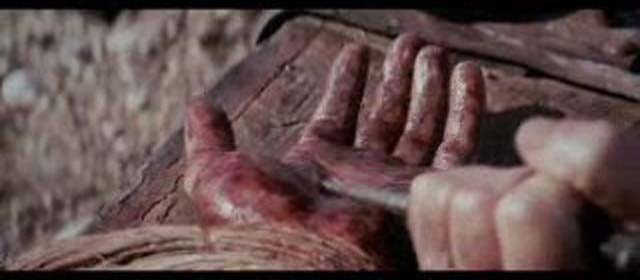
For all his flaws, Mel Gibson got something exactly right here, I'm told: the hand holding the nail is his.

The unearned, the utterly gratuitous character of all existence, is often lost on us. Jean-Paul Sartre experienced this when he perceived all things as de trop, superfluous, unnecessary. He was right, in a sense -- but without the conviction of the being and love of God, the experience was a negative, maddening one, which he himself described by the title of his book Nausea. The obverse side of this idea is what a Catholic means by grace. Not only salvation, but even existence, is a gift that we could never earn by any amount of goodness or anything else.
'I'm not asking for anybody's bleeding charity.'
'Then do. At once. Ask for the Bleeding Charity. Everything here is for the asking and nothing can be bought.'*
Or as Blessed Teresa of Calcutta put it in a little book of hers:
At a seminary in Bangalore, a nun once said to me, 'Mother Teresa, you are spoiling the poor people by giving them things free. They are losing their human dignity.' When everyone was quiet, I said calmly, 'No one spoils as much as God Himself. See the wonderful gifts He has given us freely. All of you here have no glasses, yet you can all see. If God were to take money for your sight, what would happen? ... What would happen if God were to say, "If you work for four hours, you will get sunshine for two hours"? How many of us would survive then?'**

Okay, she'd probably be fine.

The gratuity of the Divine gift of life is my chief reason for being a pacifist. Specious reasons and equally specious objections are frequently set forth by advocates and enemies of pacifism. It is perfectly possible to believe the Sermon on the Mount, and also believe in the justice of the cause of the First Crusade or the Battle of Lepanto; it is perfectly possible to believe in the justice of the First Crusade or Lepanto, and at the same time be a pacifist (at least in terms of personal vocation). But when I am confronted with the intolerable generosity of God in making me and sustaining me at every moment, I cannot bring myself to regard violence, even in self-defense or the defense of others, as anything but a distant second-best. To imitate His open-handed and open-hearted love, taking no vengeance, willing no ill, however deserved -- what can compare with that?***

It is often urged against pacifism that it is impractical. Now, I reject from the get-go that a Christian's chief concern ought to be with practicality. However, I also think that the practical effects of pacifism in history have been ignored. The independence of India was achieved through the wholly pacifist efforts of Gandhi and his followers, and the civil rights movement in this country was as successful as it was largely through the same influence. Not to turn this into a quotefest, but the following, from Gandhi's writings, seems to me to express the matter well:
Reader: I deduce that passive resistance is a splendid weapon of the weak, but that when they are strong they may take up arms. 
Editor: This is gross ignorance. Passive resistance, that is, soul-force [satyagraha in Sanskrit], is matchless. It is superior to the force of arms. ... Physical-force men are strangers to the courage that is requisite in a passive resister. Do you believe that a coward can ever disobey a law that he dislikes? Extremists are considered to be advocates of brute force. Why do they, then, talk about obeying laws? I do not blame them. They can say nothing else. When they succeed in driving out the English and they themselves become governors, they will want you and me to obey their laws. ... But a passive resister will say that he will not obey a law that is against his conscience, even though he may be blown to pieces at the mouth of a cannon. 
What do you think? Wherein is courage required -- in blowing others to pieces from behind a cannon, or with a smiling face to approach the cannon and be blown to pieces? Who is the true warrior -- he who keeps death always as a bosom-friend, or he who controls the death of others? Believe me that a man devoid of courage and manhood can never be a passive resister. 
This, however, I will admit: that even a man weak in body is capable of offering this resistance. One man can offer it just as well as millions. Both men and women can indulge in it. It does not require the training of an army; it needs no jiu-jitsu. Control over the mind is alone necessary, and when that is attained, a man is free like the king of the forest and his very glance withers the enemy. 
Passive resistance is an all-sided sword, it can be used anyhow; it blesses him who uses it and him against whom it is used. ... It never rusts and cannot be stolen. ... It is strange indeed that you should consider such a weapon to be merely of the weak.****
But it is not primarily the military or political implications of pacifism, potent though I believe -- or, more precisely, observe -- they are, that I'm interested in. Nor, though I also declare myself a pacifist in the class war and the culture war, am I focused predominantly upon those, either. I have in mind, above all else, a pacifist spirituality. I don't believe that the Lord Jesus had war chiefly in mind when He preached the Sermon on the Mount; indeed, there is no mention of the kinds of violence we are familiar with in war and tyranny at all: only the kind of day-to-day exasperations and frustrations that could be expected in a life among rowdy villagers. But there comes in the image of the gratuitous sunshine that falls with indifferent genersotiy upon evil and good alike; there, too, the blessing upon those who are persecuted, and the exhortation to rejoice and to bless when we suffer under it. That is the root of pacifism -- at least, of the kind of pacifism that I consider worthwhile. A rejection of violence merely as violence, and not as a kind of anti-sacrament that is the hatred it signifies, seems to me like a very arbitrary rule. Pacifism too must be sacramental. Pacifism, not animated by and acted to convey love -- well, if I give all I possess to the poor, and surrender my body to the flames ...

Only by choosing to end injustice in oneself -- to suffer its consequences and deliberately refuse to retaliate, with the soul as much as the body -- can the cycle of revenge be stopped. Every act of violence, of vengeance, of punishment, begins the cycle of violence afresh; and it will always be that way, until our attempts at justice are swept away in the terrible finality of the justice of God.


As illustrated here, possibly.

And this is how the Church first took root. Sanguis martyrum Ecclesiae semen, wrote Tertullian, "The blood of the martyrs is the seed of the Church." A martyr is one who chooses to love to the uttermost, a love so powerful that mortal life cannot contain its force. Nor has the reality or the spiritual power of martyrdom ceased in the intervening centuries. The power of the Church has always lain in her rejection of power, her refusal to be controlled by it; when she has embraced earthly attitudes towards power, she has experienced a corresponding decline, first in sanctity and then -- and then what else could possibly matter? Seek ye first the kingdom and all these things shall be added unto you; seek these things, and you shall lose them and the kingdom with it.

This is a great part of why I cannot bring myself to be alarmed, or even particularly interested, by the decline (such as it is) of Christianity as a cultural and political force in this country. This decline has bad effects, certainly, but it will not prevent God from reaching people however He pleases. It also has good effects, or at least it can; for instance, it could lead us to ask ourselves as believers why, exactly, the people have left their temples, and left their temples very largely not for another temple but for nothing at all, an act virtually without precedent in the religious history of mankind.


That time of year thou mayst in me behold
When yellow leaves, or none, or few, do hang
Upon those boughs which shake against the cold,
Bare ruin'd choirs where once the sweet birds sang.

If our sole response to such reflections is that this people who knoweth not the law are cursed, then I think we need to stop and seriously ask ourselves who the hell we think we are. Do we suppose that we are doing God some benefit by being the recipients of His astonishing generosity in the Scriptures and the sacraments? Do we think there isn't enough of His love to go around, and that if we share His compassion and patience with those outside there will be less left for ourselves? And even if, on some level, we do, are we to react like the resentful workers who expected more than the denarius they agreed to work for, or the elder brother who was angry with his father's joyful reception of the prodigal son?

The point is, the path to holiness suffers no obstruction from the Church losing status or prestige. Indeed, that kind of decline can make it easier rather than harder to grow in the love of God, by moderating the temptation to (to put it bluntly) avarice. And if we should come to the point that we are actively persecuted -- rejoice. For then, ours is the kingdom of heaven.

Christmas is a time when we are disposed to think about the warm, comforting side of Christianity; it is, also, a time when the kulturkampf gets more emphatic than usual. Annoy to the world, the Lord is come. But some of us were never told, and others of us forget, that there are as many martyrs celebrated in this season as in any other. Saint Lucy, martyred brutally under the Emperor Diocletian, was just this past Friday; Saint John of the Cross, commemorated yesterday, was not killed, but was imprisoned and savaged by the thoroughly Catholic society of sixteenth century Spain, and indeed by his own religious superiors; the day after Christmas is the day devoted to Saint Stephen, the first of the Christian martyrs. And on the twenty-ninth, though it is not a well-known memorial in this country, is the feast of Saint Thomas Becket, about whom T. S. Eliot wrote his remarkable play, Murder In the Cathedral. Becket too was murdered, at the altar no less, by a society that professed itself to be wholly Christian and Catholic. There is no enclave, no shelter that will shield us; but if in Jesus we mortar the stones of the Church with our blood, they will stand fast thereafter.
PRIESTS 
Bar the door. Bar the door.
The door is barred.
We are safe. We are safe.
They dare not break in.
They cannot break in. They have not the force.
We are safe. We are safe. 
THOMAS 
Unbar the doors! throw open the doors!
I will not have the house of prayer, the church of Christ,
The sanctuary, turned into a fortress.
The Church shall protect her own, in her own way, not
As oak and stone; stone and oak decay,
Give no stay, but the Church shall endure.
The church shall be open, even to our enemies. Open the door! 
PRIEST 
My Lord! these are not men, these come not as men come, but
Like maddened beasts. They come not like men, who
Respect the sanctuary, who kneel to the Body of Christ,
But like beasts. You would bar the door
Against the lion, the leopard, the wolf or the boar,
Why not more
Against beasts with the souls of damned men, against men
Who would damn themselves to beasts. My Lord! My Lord! 
THOMAS 
You think me reckless, desperate and mad.
You argue by results, as this world does
To settle if an act be good or bad.
You defer to the fact. For every life and every act
Consequence of good and evil can be shown.
And as in time results of many deeds are blended
So good and evil in the end become confounded.
It is not in time that my death shall be known;
It is out of time that my decision is taken
If you call that decision
To which my whole being gives entire consent.
I give my life
To the Law of God above the Law of Man.
Unbar the door! unbar the door!
We are not here to triumph by fighting, by stratagem, or by resistance,
Not to fight with beasts as men. We have fought the beast
And have conquered. We have only to conquer
Now, by suffering. This is the easier victory.
Now is the triumph of the Cross, now
Open the door! I command it. OPEN THE DOOR! 
-- T. S. Eliot, Murder In the Cathedral, Part II, pp. 73-74


*This is in C. S. Lewis' brilliant The Great Divorce, and takes place in what he calls the Valley of the Shadow of Life -- the first vale of Heaven seen by entering souls. I forget where it is exactly, and I haven't got a copy of the book with me, but, like so many passages, this one stunned me and has stuck in my memory.


**In the Heart of the World, pp. 57-58. Blessed Teresa is among my favorite figures in all Catholic history, for this and a host of other reasons.


***It may be said, and not without justice, that there will indeed be judgment at the end of time. That is of course quite true. But in my view, if God can wait that long to avenge Himself, I don't need to hurry things along. His justice will be more intelligent, more compassionate, and more just than mine, to put it mildly.


****Non-Violent Resistance (Satyagraha), M. K. Gandhi, pp. 51-52.
Saturday, November 2, 2013

Raw Tact, Part X: Agony, Ecstasy

I've been struggling a lot with depression over the past few weeks. What would have been my anniversary with my ex-boyfriend came up late last month; work has been running me into the ground; and I'm feeling like a real moral no-show -- alternating fits between unchastity and anger, with the occasional nervous breakdown for flavor.


Regrettably, adorable drunk lesbians formed no part of any of this angst.

2013 has been a rough year: a dear friend of our family died, my youngest nephew was born nearly two months premature, one of my sisters had to have her thyroid removed, my car (as of today) is in the shop for the third time in six months, Brett Ratner is still alive.* One of the things I've found disappointing and disconcerting is that, in all of this, my main focus has been on Me: My pain, My loneliness, My holiness, not only in contrast to all the suffering people all around me (that is, everybody), but even in contrast to my family and my friends. In one sense I take that to be a good thing -- I mean, that I'm increasingly aware of my selfishness. Saint John of the Cross says that one of the illuminations Divine grace gives us is an awareness of our imperfections, so that it seems at first as though we are losing ground, simply because we're seeing shortcomings that had escaped our notice before. "Dark with excessive bright Thy skirts appear," Milton says of God somewhere in Paradise Lost** -- the light is so brilliant that, until our eyes adjust, it causes blindness rather than sight. At least, I sure hope that's what's happening.

The question of why I would remain a Catholic through all of this, when I could greatly simplify things by, at the least, renouncing the Church's teaching on sexuality, has been posed to me more than once -- not only by others but by me. The simplest answer is that I'm persuaded that the Catholic faith is true, and with that comes the conviction that the Magisterium is reliable. Any dissent from the substance of her teaching on my part would be intellectually inconsistent, and, for someone built like I am, knowingly engaging in intellectual inconsistency would be the height of dishonor. I can be a whore, and that's one thing; but being a liar -- that would be a far deeper violation. It would remove the conditions by which I am able to sin and still repent, and I need those to function as a Christian. Even, perhaps, to function as a man.
"You think a wife might feel sensitive about her husband's honor -- even if it were sacrificed on her account?" said Miss Stevens. "Well -- I don't know." 
"I should think," said Miss Chilperic, stammering a little in her earnestness, "she would feel like a man who -- I mean, wouldn't it be like living on somebody's immoral earnings?" 
"There," said Peter, "if I may say so, I think you are exaggerating. The man who does that -- if he isn't too far gone to have any feelings at all -- is hit by other considerations, some of which have nothing whatever to do with ethics. But it is extremely interesting that you should make the comparison." He looked at Miss Chilperic so intently that she blushed. 
"Perhaps that was rather a stupid thing to say." 
"No. But if it ever occurs to people to value the honor of the mind equally with the honor of the body, we shall get a social revolution of a quite unparalleled sort -- and very different from the kind that is being made at the moment."***
But there's something else going on, too. Something I don't understand, except that I sense its presence, and it is not simply intellectual; it's deeper than that (by which I don't mean it is emotional -- as important as emotions are, they are not more core to a person than the mind, just different). I certainly haven't got the strength, and don't know whether I will receive the grace, to continue on the path of celibacy. But, deep within, something is happening -- God is doing something in the dark.

Man, this guy. He really knew what was up.

Why remain here in the dark -- without hope of marriage or children or earthly happiness or simple rest? So many answers pop up, even within the doctrinal framework I accept, that I just can't espouse: like You could still get married some day, or Everyone experiences loneliness, but it passes, or Celibacy is a beautiful gift from God -- you can do so many things as a celibate that married people can't, or You can adopt, you know, or ... the mind swims in a sea of meaningless encouragements. 

Meaningless, not because any of them aren't true in fact, but because none of them are what I want. When a man wants water, explaining to him that he can have as much steak as he likes is not likely to console his thirst. And what I want is a husband.


And that, on Catholic premises, I cannot have. Not even "am not allowed to." It just plain isn't possible.

I'm sure (on the basis of my theology) that there is some -- how can I put this -- some legitimate meaning in that desire, which I can have; but I don't really know what it is. I have for many years repudiated the ex-gay explanation that it is a confused mixture of the desires for a father, for male friends, and for a wife (because when you put all those roles in a blender, a husband comes out, obviously). Yet in this confusion and uncertainty, I can sense something happening, some activity of God's. I don't get it, and I don't sense it all the time -- in fact, more often than not, I'm simply unhappy. But when I do sense it, it is unmistakeable.

It would be very easy to interpret all this as comforting self-delusion, built to protect me from the vulnerability of a relationship or the risk of questioning my theology. Given that I'm a convert to Rome who passed through Calvinism, atheism, and witchcraft first, and that I've had gay relationships and gay sex, I do not find that way of reading the facts convincing; but you could read them that way if you insisted. What is at least equally interesting is that one can put the shoe on the other foot and read a lot of the LGBT movement as showing signs of an elaborate evasion of God**** -- not so much in its deviation from traditional morality or the explicit irreligion of some of its members, but rather, in its determined exaltation of romantic love as something almost like salvation. And that, I think, is something that a lot of us can sympathize with, gay or straight. Apart from Divine grace, it is called "idolatry," which is open to people of both sexes and all sexualities. With grace, such love can become something more like an icon of salvation, a means of approaching the Creator through the created -- as Dante did with Beatrice.

But I digress. (Maybe.) The point is, such suffering, and being in the dark about it, are not necessarily signs that God is absent, or uncaring, or trying to nudge me to go in a different direction. Christ Himself, in His agony in Gethsemane, shows us that. What God is doing, I don't know, and I don't know what comes next, nor how I will fall and fail. But my faith is in Him and not myself; if He knows, then the person who chiefly needs to know knows. Consoling? Occasionally. The point, whether consoling or not? Yes.

And when I do feel it, when I do receive consolations --


*Yes I'm still angry; the franchise started so well with X1 and X2, whatever their fridge-logic flaws. And then X3 was -- well, "Everyone says forgiveness is wonderful, until they have something to forgive," C. S. Lewis said.

**I don't know where, because the only place I recall reading this line is in Lewis' Preface to Paradise Lost -- oddly, though I have very little taste for Milton, I find Lewis so engaging as a literary critic that I read his commentary over and over again, at least once a year.

***Gaudy Night, pp. 376-377, by Dorothy Sayers, who was incomparably wonderful in all the ways. This is one of my favorite novels, of hers or anybody's, and gave me a clarity about the interplay of heart with intellect and about discernment that I have never gleaned from any deliberately spiritual manual.

****It should go without saying (but regrettably doesn't) that this would not apply to those Christians who, for theological reasons, take a different view of sexuality, like Justin Lee or Matthew Vines. That is also an important dimension of gay-Christian interaction; but it is a different one.

Monday, April 8, 2013

The Spear and the Distaff, Part Three: The Monstrous Regiment

The difference between the genders, and the mention in my previous post of feminism, make some discussion of the idea of hierarchy inevitable. To that subject I now turn. (I have by no means exhausted even my own amateur thoughts on the subject, but it was getting a bit wall-of-text-y, so I shall continue the subject in my next.)

Catholicism is linked in the minds of most people to the notion of hierarchy. This is one of the major objections people bring against traditional Christianity. That priests should have the power to perform the sacraments while laymen do not, that the Magisterium should have the power to define doctrine while the individual believer does not, that a husband should be the head of his wife, that only males should be eligible for the priesthood -- all of this hierarchy, to most modern secularists and many modern Christians, is intolerable. It's backward, it's chauvinistic, it's undemocratic.

I do not think hierarchy is chauvinistic, though many Christians have in fact been chauvinists, and culpably used the notion of hierarchy as their apron of fig leaves. I do not find the word backward useful: if it means that our ancestors believed it, well, yes, but that does not decide the question of its truth or falsity -- it must be examined on its intellectual merits; and if it means something else then I don't know what. Hierarchy is most certainly undemocratic: given that my own political sympathies lie chiefly with anarchy and monarchy,* that does not deeply trouble me, but let us divert ourselves to that subject for a moment.

There are three reasons for being a democrat (in the sense of believing in rule by the people). One is the optimistic reason, along the lines of Rousseau, that people are so good that if you give them all a say, things will turn out for the best. This, judging from my own observations and knowledge of history, is one of the most extraordinarily silly ideas in any field. Another is the pessimistic reason, that "power corrupts" and no one should be trusted with permanent or unrestricted power over others. There is a great deal in this view. But it does nothing to explain why many monarchies and empires have been, often for long periods of time, stable, happy, and well-governed, whereas democracies, as James Madison pointed out in the Federalist Papers, have on the whole "been as short in their lives as they have been violent in their deaths."

The third reason was put best by Chesterton. "The democratic contention is that government ... is not something analogous to playing the church organ, painting on vellum, discovering the North Pole ... and so on. For these things we do not wish a man to do at all unless he does them well. It is, on the contrary, a thing analogous to writing one's own love-letters or blowing one's own nose. These things we want a man to do for himself, even if he does them badly" (Orthodoxy, ch. IV). The idea here is that the goodness or badness of men is irrelevant: that our ideas must proceed from the nature of mankind and not from the character of its individual specimens. It is the idea that every rational creature has, as one of its intrinsic rights, a say in its society as a whole. Democratic rulership is, in this view, not a consequence of individual worth, but an office, held by every person.

Whether this is true about politics or not, the Catholic concept of hierarchy relies on this same distinction. For example, the sacrament of Holy Orders does not confer personal superiority upon the ordinand; it confers an office, a function, which he has neither the right nor the ability to assume for himself; and the power of this office comes through his actions, but it does not come from them.

Likewise, to the extent that there is any hierarchy between the sexes, I believe it can only be approached in this manner. Masculinity and femininity are offices; even if, in the specific context of marriage, the masculine spouse is given the job of headship, it does not follow that men are better than women, and no husband (or gender theorist) has any right to pretend such superiority. The First Blast of the Trumpet Against the Monstruous Regiment of Women was a piece of sexist nonsense and bad commentary,** and other works of the same cast are of the same value. Indeed, if we are going to talk about superiority as opposed to function, since functions are often given to notably unworthy persons, the greatest (simply) human being was and is the Mother of God, a function that by definition could be held only by a woman. If anybody objects to hierarchy because of fears that hierarchy means that men are better or more important than women, then their objection is entirely sound, and a defense of hierarchy consists in showing that it does not involve that misogynistic view -- and, further, of showing that the chauvinistic interpretation of hierarchy is untrue.

But if the distinction between masculine and feminine has to do with office, rather than person, why have it at all? Why not have complete egalitarianism, of function as well as of being, in which women can hold masculine roles and men can hold feminine roles? Well, for one thing, that seems to me rather to spoil the fun of having different things to begin with: everyone could be "It" in a game of tag, but it'd get boring fast. But it also seems to neglect the full import of the archetypes, and of the relational coinherence they possess. The masculine and the feminine are not simply about humanity, as was suggested in the first post of this series. C. S. Lewis addresses something of this in the last installment of the Cosmic Trilogy:

"[S]he had been conceiving this world as 'spiritual' in the negative sense -- as some neutral, or democratic, vacuum where differences disappeared, where sex and sense were not transcended but simply taken away. Now the suspicion dawned on her that there might be differences and contrasts all the way up, richer, sharper, even fiercer, at every rung of the ascent. How if this ... were not, as she had supposed, merely a relic of animal life or patriarchal barbarism, but rather the lowest, first, and easiest form of some shocking contact with reality which would have to be repeated -- but in even larger and more disturbing modes -- on the highest levels of all?
"'Yes,' said the Director. 'There is no escape. If it were a virginal rejection of the male, He would allow it. Such souls can bypass the male and go on to meet something far more masculine, higher up, to which they must make a yet deeper surrender. But your trouble has been what the old poets called Daungier. We call it Pride. You are offended by the masculine itself: the loud, irruptive, possessive thing -- the gold lion, the bearded bull ... The male you could have escaped, for it exists only on the biological level. But the masculine none of us can escape. What is above and beyond all things is so masculine that we are all feminine in relation to it.'" -- That Hideous Strength, ch. 14, part 5

In other words. Insofar as the masculine office represents that which initiates, that which comes in from an outside, and insofar as the feminine office represents that which receives, that which opens itself to that outside, they are icons of God and humanity, and more particularly of Christ and the Church (as St. Paul makes explicit). The distinction and even, in a specifically marital context, authority that Catholic doctrine recognizes with respect to gender, is preserving a symbolic or ritual lesson about the relationship between God and man: He initiates and we respond; He enters us and we receive Him; He is the Bridegroom, and we -- female and male, as St. John of the Cross understood very well -- are the Bride. This is one of the reasons I have tried to stress the relativity of gender, the fact that it exists in the context of relationship rather than as an abstract absolute. Gender is not a ranking system; it is a mystery play. Our genders, and the sexes that go with them, are the roles we have been cast in by the Director of the play. I suspect (suspect, not assert) that this is why, in the Church and in the family, authority is associated by Scripture and tradition with the masculine. (To avoid red herrings, I shall say here that I see no reason why the state -- which is properly governed by reason and lacks the added data of revelation -- should follow the same pattern; so that excluding women from equal participation in the political process, democratic or otherwise, is not a necessary corollary of this doctrine of hierarchy and is not something I desire.)

This is part of why there can be a simultaneous distinction between masculine and feminine roles, and yet equality between their worth. It should be noted, too, that though the authority of husbands and of priests is thus connected to masculinity as the icon of the divine, the feminine is, in a sense, the higher and more human of the two. The highest activity of mankind is to open itself to God -- to be the feminine to His masculine, speaking metaphorically. It is therefore no coincidence that, as was previously alluded to, the highest created being should be a Woman.

*It sort of makes sense, I swear.
**Though it must be admitted that the title, with its delicious and archaic polysyllables, is fairly entertaining, particularly the now quite obsolete spelling Monstruous.