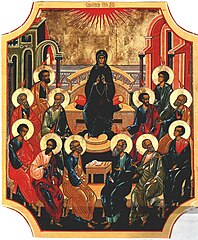
Collect

Collect for the Fourth Sunday after Trinity

O God, the protector of all that trust in thee, without whom nothing is strong, nothing is holy: increase and multiply upon us thy mercy; that, thou being our ruler and guide, we may so pass through things temporal, that we finally lose not the things eternal; grant this, O heavenly Father, for the sake of Jesus Christ thy Son our Lord, who liveth and reigneth with thee, in the unity of the Holy Spirit, ever one God, world without end. Amen.
Showing posts with label literature. Show all posts

Wednesday, July 10, 2019

Review: "Good Omens" (Miniseries)

So I watched the Amazon Good Omens miniseries, and I hated it so, so, so, so much. Hear me out.


A note before I begin. I don’t do ‘They changed it, so it sucks’ reviews of adaptations. Sometimes changes are very much for the better—the book version of Jumanji is eminently forgettable, while the movie (if a little dated) is great. Moreover, because film and page are different media, some changes are intrinsically necessary to suit the language of the new medium. But changes that take out good things that could have been included are defects, and changes that add bad or irrelevant things are defects. And changes aside, an adaptation should be able to stand on its own as a work of art. Make a movie with plot problems that are only resolved in the book you based the movie on, and what you’ve done is make a movie with plot problems. Having source material is no excuse for poor craftsmanship.


And to be clear and fair, two things I did not hate about the series were David Tennant and Michael Sheen as Crowley and Aziraphale. Their performances were exquisite, and almost carried the piece; in fact one of the things I hate about Amazon's Good Omens is that these two were squandered on such a dumpster fire of an adaptation. The chemistry between them is fantastic, and fits beautifully into the ‘Are they friends? Are they lovers? Are they enemies after all?’ ethos that the book conveys (the reason they’re not lovers being, in the book’s words, that ‘Angels are sexless unless they really want to make an effort’). Bravissimo to them both for outstanding performances.


Josie Lawrence's cameo as Agnes Nutter also deserves a better series than this, and I'm not 100% sure Miranda Richardson could do a bad job acting if she tried, so her Madame Tracy is very winsome indeed. But Tennant and Sheen between them couldn’t quite save it, and Lawrence and Richardson can’t either.


What I hated was, above all:
- the narration;
- nearly every other performance;
- many of the textual and character changes made from book to screen;
- the significant plot changes between the book and the script.


The second worst-handled aspect of the miniseries is the narration. Now, I don’t share the hostility of Cinema Sins et al. to narration as such, and I really like Frances McDormand. But her performance is, on this occasion, not good: it sounds like the voiceover for Blade Runner, uninvested in the story and irrelevant to it, and not at all like the narrator is having a good time. And that’s a tragic waste, because the one thing that narration, and nothing else, could have translated to the screen from the book is the merriment of its narrative voice. That merriment, the tell-tale quality of anything Pratchett touched, is almost entirely absent in the series, because so much of it comes from tone that McDormand didn’t capture and jokes that Gaiman didn’t include. And he came so close to so many, and it would have been so easy to put them in the voiceover! For instance, one of my favorite lines in the book is the isolated paragraph: ‘It has been said that the devil has all the best tunes. This is broadly true. But heaven has all the best choreographers.’ There were two scenes (one in heaven, one between Crowley and Aziraphale) where I felt sure we were going to hear that line in the narration … any minute now … nope.


And joyless cuts like this are legion: gone is most of the drunk conversation about how long eternity is, gone are the details of the Chattering Nuns of the Satanic Order of St Beryl, gone is the allusion to a wave of low-grade goodness emanating from the destruction of a telemarketers’ office, gone is all of Dog’s internal monologue, gone is the explanation for why there’s so much Queen playing.3 As a result the whole tone of the script is so much less funny and light than the novel, while at the same time not landing its punches nearly as well. But we’ll get to that.


The actress playing Anathema Device gives a lifeless performance, without any of the aura of wit and keen good sense that Anathema possesses in the book. She just sort of says lines while facing the relevant character. But this may be at least partly because she wasn’t given a real character to work with. There’s no sense that she’s straining to make sense of her ancestress’ prophecies because she has a sense of mission and purpose, and no hint that she’d rather not be psychic, as there is in the book. She’s completely flat. They ,try to give her a sense of arc by including Newton’s line near the end, ‘Do you want to be a professional descendant your whole life?’ But since being a professional descendant has had no negative consequences for her to date and she’s expressed no dissatisfaction with it, it doesn’t represent a resolution of anything she wants as a character, and the emotional payoff is accordingly zero.


Shadwell, being a character defined as much or more by description than by words, is pretty gutted on a screen. Michael McKeen ,is a good actor, but it’d take an Anthony Hopkins or a Cate Blanchett to make the depiction work. Brian Cox as Death was also specially disappointing. Of course, it’s hard to convey just how delightful Death as a character is when he’s in Terry Pratchett’s deft hands; but Brian Cox isn’t the man to do it, and it isn’t done. The other three horsemen, War, Famine, and Pollution, aren’t terrible, but their lines are (it was during Famine's first appearance on screen that I began to notice how uninteresting most of the dialogue was). Mostly they just say over and over that they’ve been waiting for the apocalypse for a long time, like a really long time, man, and they’re super into it. Let them tell you, they are super into the apocalypse, just stoked. I mean, they’ve been waiting for it for thousands of years, and now it’s here, and they are in. To. It. You don’t even know. They’re very big fans of the apocalypse, man.


As a sidebar, this is one of several examples of the incredibly bad pacing of the series. For a few episodes it’s fine; then, about halfway through, as the eleven-year-old Antichrist levitates into the air and begins scaring his three friends, the plot just sort of parks there for a nap. He promises them that his new friends are coming … and then adds that his new friends are going to come real soon … with the extra detail that it won’t be long before his new friends are here. An entire episode passes without anything, you know, happening (and there are only six episodes in the series). This would be bad enough for a peripheral subplot, but it lies soggily at the center of the action, both structural and temporal.


Returning to the acting, the child acting of the Them is bad. Really bad. This is common enough for child acting, although cinema like Signs,2 IT: Chapter One, and Stranger Things have proven that it is not actually a necessity; and when four of the ostensible principals of the story, including the Antichrist, are eleven-year-olds, it's pretty momentously important that they be talented actors. The Them’s performances are not only stilted and unconvincing, but boring; you can't engage with them as characters at all.


This is partly because of big problem number three, which is a big number two: with the exception of Crowley and Aziraphale themselves, the characters are mostly left out. This might be forgivable in a movie; in a miniseries, and one with the leaden-footed, repetitive plod of this one, it isn't. The Them’s funniest and most believable lines and scenes in the book (notably their Spanish Inquisition) are all whittled down almost past recognition, and often robbed of their significance when they do make it in. A perfect example is the description of the precocious Wensley: in the book it’s mentioned that his parents ‘called him Youngster, in the hope that he might take the hint.’ In the miniseries, it’s mentioned that his parents called him youngster, and that’s it. No payoff. Just a fact about Wensley’s life, with no relevance to literally anything. The children are not the only characters to be thus maimed, but, given that they are at the center of the convergence of the other disparate plot threads—the Horsemen, Anathema Device, Aziraphale and Crowley, and the representatives of Hell and Heaven that are trying to force the apocalypse—it shows worst in the Them.


Maybe some of these abbreviating changes were made in the name of giving Jon Hamm's Gabriel more screen time? Which would be a really odd choice, because Gabriel isn't even in the book and serves no narrative purpose in the adaptation that book-originals couldn't—for instance, the Metatron, whom he replaces in the crucial (anti-)climax for, to all appearances, no reason whatsoever. Or if they were dead-set on getting Hamm for star power, why not cast him as, I don't know, the Metatron? It’d be a wrench to give up Derek Jacobi’s appearance in anything, true, but the Metatron is an actual character who fits into the plot and themes of the book, in a way that Gabriel doesn’t. This is a pointless change that adds nothing. People who haven’t read the book don’t benefit by it, and assholes like me write two thousand word screeds denouncing it.


Speaking of the themes—I can hardly believe I’m saying this about a script written by one of the co-authors of the original novel, but it botches them badly. The theme is summarized pretty well in the moment at the book’s climax, when Aziraphale grabs Crowley by the wrist, staring at Adam Young with a light of joy in his eyes, and says that (despite everyone’s best efforts), ‘He isn’t good or evil. He’s just—human.’ This is transposed to Aziraphale and Crowley telling Adam this in a weird video game cut scene, an emotional punch that has no force behind it, because Adam has never raised the question of his own goodness or badness and knows nothing about the efforts of others to control him.


This meandering blandness washes into the showdown between Adam and Satan, another adaptation addition, where Adam rejects Satan because … Satan’s not his real dad, because he wasn’t there for him as a kid? Yeah, that’s the reason. Huh. Okay. This big-lipped alligator of a clichéd let-me-explain-this-with-my-words motive has no setup, no relevance to anything that happens, and no character payoff since Adam had already made his pivotal decision, but there it is. Humans aren’t fundamentally good or evil! but if Satan had been emotionally available to Adam Young then maybe the world would have ended on schedule. Plot!


And then we’re still not done for some reason because Aziraphale and Crowley have to be punished by their respective sides, because it’s not yet sufficiently clear that heaven and hell are actually both full of jerks, I guess. This isn’t terrible, and honestly almost any pretext to get Sheen and Tennant on screen as these characters is worth the contrivance, but—particularly though not only because of the twist it’s resolved in—it adds nothing and goes nowhere, since both the information and the character development it ostensibly represents are things we already had from the first five and a half episodes.


So, yeah. Thing Bad, or at best Thing C+ (I’d have said D- but Tennant and Sheen really are that phenomenal). I’m almost pissed I signed up for Amazon Prime to watch it.


1Not to be confused with Michael Sheen.
2Yes, I will fight you: the child acting in Signs is excellent. I admit I did start hating M. Night Shyamalan pretty late; I even enjoyed Lady In the Water, though I did and do acknowledge that it has some major problems and, ahem, dubious casting decisions. This doesn’t change the fact that Abigail Breslin and Rory Caulkin gave remarkably good performances in Signs.
3To be clear, the use of Queen does not require explanation in any context whatever; but when an explanation is (1) offered, (2) funny, and (3) one of the running jokes of the whole book, mayhap it belongs in the narration.
Also yes, I realized while copying this into blog post form that I'd moved a paragraph without correcting the footnote numbers. Sorry.

Tuesday, May 28, 2019

Review: "Jennifer the Damned"

When my mother sat me down at the kitchen table one night, about a month before my 
class was scheduled to receive Holy Communion, I had no idea she was about to tear my world apart. My mind could not conceive of anything worse than that she was going to have to work a double shift again.
‘Jennifer, you won’t be receiving Communion with the rest of your class.’
Tiny shards of pink crystal hope exploded inside my heart, lacerating my dreams. ‘Why?’
‘Communion is not meant for us.’
‘Sister Joan says it’s meant for everyone, to save our souls from the devil.’
My mother smiled her crooked, perverse smile. ‘Jennifer, you and I … we don’t have souls.’

—Karen Ullo, Jennifer the Damned

✠     ✠ ✠

So not only is Catholic vampire fiction its whole own subgenre, we have a Facebook page now! We are: Karen Ullo (Jennifer the Damned), Eleanor Bourg Nicholson (A Bloody Habit), J. B. Toner (Whisper Music), and myself (Death’s Dream Kingdom). I’ll be reviewing my three compatriots’ novels, beginning here with Mrs Ullo’s book, which I got last week and whose nigh-400-pages I devoured in just a few days. (All four novels, I believe, can be purchased on Amazon; I have included direct-from-publisher links for each, both because the books are sometimes cheaper that way and because screw Amazon.)

Jennifer the Damned is set in contemporary Louisiana and California. The titular Jennifer was stolen from her birth mother by the lovely, heartless, and masterful Helen Carshaw, a vampire centuries old, who chose Jennifer as her protégé. She raises Jennifer as her own daughter—feeding her only the raw or rare meat that she can digest—and places her in Catholic school, in order to nurture her in both knowledge of God’s love for humanity and hatred that that love is withheld from the likes of them.

As the novel opens, Helen has disappeared, and Jennifer Carshaw has been in the care of a small convent of teaching nuns for a few years. She has been receiving a robustly Catholic education, and even a fairly normal high-school-misfit social experience—save that she alone is excluded from the sacraments, and especially from the Communion, that she so badly yearns for and envies her classmates for being able to access.

But Jennifer is experiencing her transfiguration into a full-fledged vampire, and the insatiable bloodlust that goes with it. The very smell of the Precious Blood at Mass drives her close to blind frenzy. Left to navigate undeath on her own, Jennifer decides to attempt a balance between her secret life as a vampire and the life she wants as a human being.

Here Be Spoilers
(Jump to Next Section to Skip Them)

The attempt, though valiant, fails. Jennifer learns a degree of self-control and develops the cunning to dispose of her kills without leaving any incriminating evidence behind, but she cannot truly balance the demands of the human life she has led till now with the new urges of the vampire: after a handful of anonymous disappearances, she loses control and kills the boy she has been dating. Around the same time, Helen’s bizarre plans, which involved turning a classmate of Jennifer’s named Jeremy into a vampire as her ‘brother,’ gradually become clearer: Jennifer despairs of ever managing a semblance of human life at home, and, as the FBI zero in on her, finding more and more evidence of her murders, she deserts the nuns and her school, adopting a false identity and telling Jeremy how to reach her later.

A few years later, while she is living in Los Angeles and working as a makeup artist, she meets someone new, a young actor named Conner who takes a shine to her. She begins toying once again with the idea of leading a human life, at least part of the time. But Jeremy, who is now experiencing his own growth into full vampire-hood, comes to find her: abandoned by their pseudo-mother, they have only each other to rely on as fellow undead. Nevertheless Jennifer opens herself up, little by little, to Conner’s increasing affection and seriousness about their relationship. Against all her prior experience, Jennifer even begins to see signs of mortality returning to her body—until her false identity is exposed and, like a pantomime demon out of a trap-door, Helen emerges. Helen informs them that she, Jennifer, has become the most pathetic of creatures, a mortal vampire, and demands that her two pseudo-children kill Conner and come with her; driven by rebellion and revenge for the humanity she took from them, they instead destroy her.

Jennifer leaves Conner, hospitalized after their confrontation with Helen, with a note expressing her regret and her love for him, and returns to Louisiana and the nuns. She confesses what she has been and done, including all her murders, and agrees to face justice, asking only to receive the Eucharist first, now that she at long last is sure she has a soul. The priest consents, she drinks the Precious Blood, and there the novel ends.

(Spoilers End)
Here Be Lit-Crit

Jennifer the Damned is comparable to Twilight in premise, yet with the superior craftsmanship of Anne Rice. It takes the psychological and spiritual gravity of being a vampire seriously, in a way that many of its rivals fail to do, even Dracula, whose vampires are indeed evil but merely evil, without the depth of a human sinner or even of a fallen angel like the possessed Weston of Perelandra. Feeling cut off from humanity not merely in a social way, but in an urgently sacramental sense, is something I’ve rarely come across outside of Rice’s work. I wonder whether the choice of Louisiana, such an important location in Interview With the Vampire, may itself be a tribute to Rice. (Louisiana has become virtually the Transylvania of Southern Gothic, also popping up in Vampire: The Requiem and the stories of Jacques St Germain).

Structurally, the novel works well enough; stylistically, though it has a few sags into cliché, it’s generally very good—better than Dracula. But where Jennifer the Damned really shines is its pacing. This is itself a cliché, I know, but I couldn’t put it down! I always needed to know what was going to happen next: I cared what happened to Jennifer and the people around her.

If the novel has weaknesses, they are two: audience grasp of the mechanics of vampirism, and the ending. Now, it is appropriate that we don’t fully understand how being a vampire works at the beginning, partly because we the readers are learning with Jennifer as the story progresses. However, a major mechanical shift away from what we had been led to think, one that’s highly plot-relevant, takes place fairly close to the end without really being foreshadowed. This leaves us feeling more like the mechanics have been fiddled with to convenience the plot, than that we are continuing to learn with Jennifer and that if we’d been a little cannier with the facts we had we might have seen this twist coming. It’s not a fatal flaw but it’s the worse of the two, in my opinion.

The other flaw is that the closing feels kind of rushed. Jennifer’s love interest in the last third of the book falls for her so quickly that I was inclined to put it down to vampire charm, but then that explanation seemed to be repudiated, which resulted in the romance coming across as over-idealized—though, to be fair, not cloying or problematic like Stephenie Meyer’s; the characters’ behavior and dialogue stays convincing. The one truly important death of the book happens with little fanfare, which was a real disappointment. And while I can’t quite bring myself to call this a problem—because if I’m truthful, it’s kind of the point of the book—I am furious over the openness of the very end! I want there to be sequels so I can find out, even indirectly, what happened.

Should You Read It?

If you are a fan of vampire literature or coming-of-age stories, definitely! All in all I give Jennifer the Damned a B+, with the note that it could’ve gotten an A- if Ullo had stuck the landing just a little better (and if there are sequels I am optimistic that she will). Go forth and buy.

✠     ✠ ✠

Wednesday, June 6, 2018

La Estrella del Mar, or, Mother of Exiles

Trucks rumble—the hustle and the hum
Of gears gas engine exhaust choke POTHOLE and there’s a cut on the forehead,
Red over the white frightened eyes in the dark.
She bends down over POTHOLE her baby
And she knows what’s coming next but it hasn’t happened yet,
So she cradles and coos and tries not to think
About the kennel they’ll put her son in
With the chainlink door and the concrete floor and the ugly foil blanket made for an alien.
And the dry road south is all sand sand sand POTHOLE sand,
Back down to Sinaloa, the land of the rattlesnake,
Sand in the hair the mouth the eyes, like an itching thirsting disease.


Turn your bodies against the drums, boys:
It’s the I.C.E., it’s the Committee of Public Saftey,
It’s Herod and he means it this time.


The trucks aren’t full of people.
They’re full of MS13 monsters like her,
They’re full of sluts who wouldn’t get an abortion like her,
They’re full of cost-benefit ratios like her,
They’re full of huddled masses like her,
They’re full of not our problems like her.
But her eyes are two thousand years old
And the message of the angel still shines out of them
The mystery the plea the glory the warning
That this is an ikon of the all-consuming Fire.
What will you do when that Fire falls on you?


Turn your bodies against the drums, boys:
It’s the I.C.E., it’s the Committee of Public Safety,
It’s Herod and he means it this time.


So pick up your ploughshares and your pruning hooks,
This is no time for passivity, it’s time for pacifisticuffs:
If what you want is peace then go be peace’s power,
Lift up your voice, your open hands toward that White Tower
And cover it with brown sand.
Hate burns white-hot—don’t be fooled by its easy appeal:
Love is brown like earth and wood and dried blood and Jewish skin
And the eyes of the baby that immigrant woman is holding for the last time.
Call on the mountains to fall on us, the hills to hide us,
For their earth is full of love
And perhaps thus we shall learn to love our brother.


Turn your bodies against the drums, boys:
It’s the I.C.E., it’s the Committee of Public Safety,
It’s Herod and he too will die.

✠     ✠ ✠

EDIT: Notes on the Text
Title. La Estrella del Mar. This is the Spanish form of the Latin title Stella Maris, 'Star of the Sea.' This title (derived from a fanciful etymology of the name Miriam or Mary) has been used for the Blessed Virgin Mary since at least the early Middle Ages, and has particular reference to the guiding stars used by sailors.
Mother of Exiles. This is an alternate name for the Statue of Liberty, believed to have been coined by Emma Lazarus in her famous sonnet, The New Colossus.
l.10. Sinaloa. The state of Sinaloa lies on the Pacific coast of Mexico, and is the principal center of the infamous Sinaloa Cartel, considered the single most powerful drug trafficking organization in the world by US intelligence. Cocaine, heroin, and methamphetamines are among their chief wares.
land of the rattlesnake. The Mexican flag and seal feature a rattlesnake being throttled by an eagle, in reference to an ancient Aztec legend. Though its bite is seldom fatal if treated promptly, the rattlesnake is the leading cause of snakebite injuries in the US, and ranges throughout the Americas.
l. 13. the Committee of Public Safety. This Orwellian title belonged to one of the institutions of the French Revolution, and oversaw the Reign of Terror in 1793-94.
l. 14. Herod. Cf. Matthew 2.1-18.
l. 16. MS13. Also known as Mara Salvatrucha, this extensive gang operates mostly in North and Central America, partly under the auspices of the Sinaloa Cartel. It is known for a multitude of crimes, including murder, human trafficking, and child prostitution. Most MS13 members are Salvadoran; the gang was originally founded to protect emigrants from El Salvador who had come to the US after the Central American civil wars of the 1980s.
l. 19. huddled masses. Cf. The New Colossus ll. 10ff.
ll. 21-22. But her eyes ... out of them. Cf. Luke 1.26-35.
l. 24. all-consuming Fire. Cf. Hebrews 12.28-29.
l. 25. What will you ... falls on you? Cf. Matthew 21.42-44; Acts 2.1-4, 15-21, 38.
l. 29. your ploughshares and your pruning hooks. Cf. Isaiah 2.1-5.
l. 32. White Tower. A mashing together of White House and Trump Tower.
l. 35. wood and dried blood and Jewish skin. In reference to the Crucifixion.
l. 37. Call on the ... to hide us. Cf. Revelation 6.12-17.
l. 42. he too will die. Cf. Matthew 2.19-20.

Saturday, March 24, 2018

Meditations for Holy Week 2018

✠ ✠ ✠


Palm Sunday
(Matthew 21.1-11, Mark 11.1-11, Luke 19.28-44, John 12.12-18)

Here is no continuing city, here is no abiding stay.
Ill the wind, ill the time, uncertain the profit, certain the danger.
O late late late, late is the time, late too late, and rotten the year;
Evil the wind, and bitter the sea, and grey the sky, grey grey grey.
O Thomas, return, Archbishop; return, return to France.
Return. Quickly. Quietly. Leave us to perish in quiet.
You come with applause, you come with rejoicing, but you come bringing death into Canterbury:
A doom on the house, a doom on yourself, a doom on the world.

We do not wish anything to happen.
Seven years we have lived quietly,
Succeeded in avoiding notice,
Living and partly living.
There have been oppression and luxury,
There have been poverty and license,
There has been minor injustice.
Yet we have gone on living,
Living and partly living.

—T. S. Eliot, Murder In the Cathedral

Fig Monday
(Matthew 21.12-22, Mark 11.12-26, Luke 19.45-48)

A shadow passed over Saruman’s face; then it went deathly white. Before he could conceal it, they saw through the mask the anguish of a mind in doubt, loathing to stay and dreading to leave its refuge. For a second he hesitated, and no one breathed. Then he spoke, and his voice was shrill and cold. Pride and hate were conquering him.

—J. R. R. Tolkien, The Two Towers

Temple Tuesday
(Matthew 21.23-26.2, Mark 11.27-13.37, Luke 20.1-21.38, John 12.19-50)

Professing only a moral union, they fled
from the new-spread bounty; they found a quarrel with the Empire
and the sustenance of Empire, with the ground of faith and earth,
the golden and rose-creamed flesh of the grand Ambiguity. [1]

Fast as they, the orthodox imagination
seized on the Roman polity; there, for a day,
beyond history, holding history at bay,
it established through the themes [2] of the Empire the condition of Christendom
and saw everywhere the manumission of grace into glory.
Beyond the line of ancient imperial shapes
it saw the Throne of primal order, the zone
of visionary powers, and almost (in a cloud) the face
of the only sublime Emperor; as John once
in Patmos, so then all the Empire in Byzantium:
the Acts of the Throne were borne by the speeding logothetes, [3]
and the earth flourished, hazel, corn, and vine. [4]

—Charles Williams, The Region of the Summer Stars, ‘Prelude’

Spy Wednesday
(Matthew 26.3-16, Mark 14.1-11, Luke 22.1-6)

If suddenly he should change his mind,
Tell the dark boy with copper hair
To go, to go,
And he went, lamenting, granting
His mercy from eyes like ruined planets—
Would the end of the world find him friendless?
Before God Glorified, he thought,
I shall stand,
And my knees knock from not kneeling.

Only his mother, he supposed, and one or two
With whom he had never been possessed,
Might say something to extenuate,
Might ask forgiveness for a fool’s despair.
But then, suddenly, he laughed,
Saying
The bars are all open in hell.

—Dunstan Thompson, Lament for the Sleepwalker, ‘Merciful God This is a Strange Reckoning’


Maundy Thursday
(Matthew 26.17-46, Mark 14.12-42, Luke 22.7-46, John 13.1-17.26)

And a woman spoke, saying, Tell us of pain.
And he said:
Your pain is the breaking of the shell that encloses your understanding.
Even as the stone of the fruit must break, that its heart may stand in the sun, so must you know pain.
And could you keep your heart in wonder at the daily miracles of your life, your pain would not seem less wondrous than your joy;
And you would accept the seasons of your heart, even as you have always accepted the seasons that pass over your fields.
And you would watch with serenity through the winters of your grief.

Much of your pain is self-chosen.
It is the bitter potion by which the physician within you heals your sick self.
Therefore trust the physician, and drink his remedy in silence and tranquility:
For his hand, though heavy and hard, is guided by the tender hand of the Unseen,
And the cup he brings, though it burn your lips, has been fashioned of the clay which the Potter has moistened with His own sacred tears.

—Kahlil Gibran, The Prophet

Good Friday
(Matthew 26.47-27.61, Mark 14.43-15.47, Luke 22.47-23.53, John 18.1-19.42)

Father was eighty years old now, and promptly at 8.45 each evening—an hour sooner than formerly—he would open the Bible, the signal for prayers, read one chapter, ask God’s blessing on us through the night, and by 9.15 be climbing the stairs to his bedroom. Tonight, however, the Prime Minister was to address the nation at 9.30. One question ached through all of Holland like a long-held breath: would there be war?

… Then the Prime Minister’s voice was speaking to us, sonorous and soothing. There would be no war. He had had assurances from high sources on both sides. Holland’s neutrality would be respected. It would be the Great War all over again. There was nothing to fear. Dutchmen were urged to remain calm and to—

The voice stopped. Betsie and I looked up, astonished. Father had snapped off the set and in his blue eyes was a fire we had never seen before.

‘It is wrong to give people hope when there is no hope,’ he said. ‘It is wrong to base faith upon wishes. There will be war. The Germans will attack and we will fall.’

He stamped on his cigar stub in the ashtray beside the radio and with it, it seemed, the anger too, for his voice grew gentle again. ‘Oh my dears, I am sorry for all Dutchmen now who do not know the power of God. For we will be beaten. But He will not.’

—Corrie ten Boom, The Hiding Place

Holy Saturday
(Matthew 27.62-66, Luke 23.54-56)

A voice came from beyond the river: ‘Do not do it.’

Instantly—I had been freezing cold till now—a wave of fire passed over me, even down to my numb feet. It was the voice of a god. Who should know better than I? A god’s voice had once shattered my whole life. They are not to be mistaken. It may well be that by trickery of priests men have sometimes taken a mortal’s voice for a god’s. But it will not work the other way. No one who hears a god’s voice takes it for a mortal’s.

‘Lord, who are you?’ said I.

‘Do not do it,’ said the god. ‘You cannot escape Ungit [5] by going to the deadlands, for she is there also. Die before you die. There is no chance after.’

‘Lord, I am Ungit.’

But there was no answer. And that is another thing about the voices of the gods; when once they have ceased, though it is only a heart-beat ago and the bright hard syllables, the heavy bars or mighty obelisks of sound, are still master in your ears, it is as if they had ceased a thousand years before, and to expect further utterance is like asking for an apple from a tree that fruited the day the world was made.

—C. S. Lewis, Till We Have Faces


Easter Sunday
(Matthew 28.1-8, Mark 16.1-20 [6], Luke 24.1-49, John 20.1-23)

A red-gold glow burst suddenly across the enchanted sky above them as an edge of dazzling sun appeared over the sill of the nearest window. The light hit both of their faces at the same time, so that Voldemort’s was suddenly a flaming blur. Harry heard the high voice shriek as he too yelled his best hope to the heavens, pointing Draco’s wand:

Avada Kedavra!

Expelliarmus!

The bang was like a cannon blast, and the golden flames that erupted between them, at the dead center of the circle they had been treading, marked the point where the spells collided. Harry saw Voldemort’s green jet meet his own spell, saw the Elder Wand fly high, dark against the sunrise, spinning across the enchanted ceiling … toward the master it would not kill, who had come to take full possession of it at last. …

One shivering second of silence, the shock of the moment suspended: and then the tumult broke around Harry as the screams and the cheers and the roars of the watchers rent the air. The fierce new sun dazzled the windows as they thundered toward him, and the first to reach him were Ron and Hermione, and it was their arms that were wrapped around him, their incomprehensible shouts that deafened him. Then Ginny, Neville, and Luna were there, and then all the Weasleys and Hagrid, and Kingsley and McGonagall and Flitwick and Sprout, and Harry could not hear a word that anyone was shouting, nor tell whose hands were seizing him, pulling him, trying to hug some part of him, hundreds of them pressing in, all of them determined to touch the Boy Who Lived, the reason it was over at last …

—J. K. Rowling, Harry Potter and the Deathly Hallows

✠ ✠ ✠

[1] They here refers to the heretics of the first several centuries and particularly to the Gnostic and Nestorian heretics, whose beliefs refused either the fact or the fullness of the Incarnation (the grand Ambiguity of the two Natures, human and divine).
[2] In Byzantine terminology, a theme was roughly equivalent to a province.
[3] The office of logothete was an administrative role, originally applying to financial affairs and eventually extended to the civil service generally.
[4] The hazel in Williams’ poetry is typically cited because of its pedigree as a tool in magic (wands being by preference made of hazel), and thus by extension as a sign for transcendent and supernatural things generally; corn in contemporary British English could be used to signify grain in general, as opposed to maize in particular. Thus, hazel, corn, and vine could be understood as the spiritual, civil, and cultural aspects of the Empire, or as a trinal symbol of the Eucharist itself (spiritual power in combination with the grain and wine derived from corn and vine), or most probably both.
[5] In Till We Have Faces, Ungit is a pagan goddess of fertility, vaguely equivalent to Aphrodite, but more Sumerian in character, with a devouring aspect as well.
[6] Mark 16.1-9 are original to the Gospel. Mark 16.11-20 are more dubious, and seem to represent a redactor’s effort to harmonize the ending of Mark with the ending of Luke.

Sunday, December 31, 2017

2017: A Year in Revue

✠     ✠     ✠

2017, the year of Are You Kidding Me With This Shit, has drawn to its close; some of my family have chosen theme words for 2018 (I guess it’s a custom like a New Year’s resolution?). I have selected the word blood-feud.

I generally do an arts review for the past year on New Year’s Eve, and this year is no exception. First up, much to my own surprise, is Kesha. She started making music when I was in college (in fact, we both went to the University of Maryland, though we never met), and I had always assumed she was just a forgettable, fun, kind of trashy singer who would have a few years of popularity and then fade. However, this year—after a lengthy legal battle with her ex-producer—she released a new album, and when I heard the single Praying, I was floored. Not only is it head and shoulders above her earlier work, it’s a good song in its own right: in particular, it showcases her remarkable vocal range, which I’d never guessed at before. The music video is compelling, too, featuring a lush mixture of Christian and Hindu religious symbolism, from Salvation Mountain, a dramatic example of American Christian folk art, to Holi, the Indian ‘festival of colors,’ which celebrates renewal, forgiveness, and the triumph of goodness over evil.

Though decidedly late to the party, I also have to give props to The Young Professionals, an Israeli pop-electro fusion band that I discovered thanks to a friend. Their music is fun and catchy, as pop should be, with a delicious Middle Eastern edge that sets it apart. Their music videos are deeply baffling; they’ve been compared to a high-end Milanese fashion show, and they’re certainly as bizarre as anything I’ve ever seen on a catwalk. But despite this, they are well-suited to the music, and their imagery is striking rather than repellent in its weirdness.

Another instance of me being late to the party would be that, thanks to Film Theory, I’ve just discovered Gravity Falls. I haven’t finished Season One yet, but I’m already a solid fan: it’s almost as good as Rick and Morty. In fact, there are some pretty persuasive fan theories that the two shows are secretly connected—theories bolstered by the fact that Alex Hirsch, the creator of Gravity Falls, is friends with Justin Roiland, one of the two minds behind Rick and Morty. (Falls has the added bonus of being something you could watch even if the kids are still up.) I’m not familiar with Hirsch’s other work, but I’ll keep my eyes peeled for his name in future.

In writing, I am super excited that the lovely and talented Eve Tushnet has another novel in the works, which she kindly asked me to beta-read. It’s about 250 pages and I got through it in three or four days; usually when I’m reading or watching something, even something I like, I’ll take frequent breaks, because I have the attention span of a coked-up squirrel. Not this. Every page of her writing makes me want to read the next one. If you’d like to get a taste of her fiction RFN (and you do), I strongly recommend her novel Amends, in which a group of alcoholics are put into a rehab reality show. It’s one of the cleverest, funniest, most empathetic, and shrewdest books I’ve ever read: her characters are so well-crafted that I feel like I’d recognize them if we met in real life.

Lastly, but not leastly, I recently found out about Drew Magary, author of several iterations of The Hater’s Guide to the Williams-Sonoma Catalogue. Apparently he’s been at it since 2012, and a friend of mine recommended it to me. Reminiscent of Mallory Ortberg or P. J. O’Rourke, Magary roasts the Williams-Sonoma Christmas offerings (SEE WHAT I DID THERE?) not only with gusto, but with profound, nay, philosophical insight into the raving stupidity that would make any single product advertised seem worth the price.

Finally, as the custom is, I’d like to wish my ten biggest readerships, or at any rate my best guess at them, a happy 2018. This year it’s English, Russian, French, Ukrainian, German, Polish, Irish Gaelic, Portuguese, Hindi, and Indonesian.

Happy New Year
С Новым Годом
Bonne Année
Щасдивого Нового Року
Frohes Neues Jahr
Szczęśliwego Nowego Roku
Bhliain Nua Sásta
Feliz Ano Novo
नया साल मुबारक हो
Selamat Tahun Baru

Catch you all on the flip side!

PS: I have been having some seriously strange formatting problems, hence the absence of pictures and mixture of fonts; advice is welcome.

✠     ✠     ✠