Collect

Collect for the Fourth Sunday after Trinity

O God, the protector of all that trust in thee, without whom nothing is strong, nothing is holy: increase and multiply upon us thy mercy; that, thou being our ruler and guide, we may so pass through things temporal, that we finally lose not the things eternal; grant this, O heavenly Father, for the sake of Jesus Christ thy Son our Lord, who liveth and reigneth with thee, in the unity of the Holy Spirit, ever one God, world without end. Amen.
Showing posts with label power. Show all posts

Wednesday, January 16, 2019

An Image of the City, Part V: Introduction to Power

Servant of God has greater chance of sin
And sorrow, than the man who serves a king.
For those who serve the greater cause may make the cause serve them,
Still doing right: and striving with political men
May make that cause political, not by what they do
But by what they are.

—T. S. Eliot, Murder In the Cathedral

✠     ✠ ✠

Every man and woman has rights as an individual, yet every man and woman comes into existence through other individuals (their parents, grandparents, and so on), and is born into a society, that is, a web of preëxisting relationships. We are creatures with a context, a context that we cannot choose and can only partly influence; and, so much of that context being other people, it includes a substantial number of duties and obligations that, whether we like it or not, we were born into, as the child of a monarch is born into royalty.


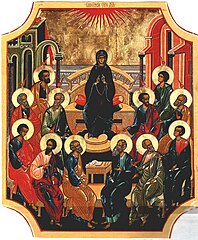
Ikon of the Trinity, made at Clear Creek Abbey, OK

This is what we call society. But that word has to be fleshed out, because it has many different aspects: the family is a society, religions are societies, political parties, schools, ethnic groups, artistic movements, trades, municipalities are societies. Society is a vast web of intertwined worlds, and everybody belongs to many of them at once. A number of forces govern every society, and the one I want to examine—one that forms a major element in all Leftist political theory—is the structures of power.

I suspect that this, more than any other thing, certainly more than any ostensible Issue in politics, underlies the difference between the Right and Center on the one hand, and the Left on the other, in this country. The Right and the Center (which latter embraces much of the Democratic Party and most if not all relatively liberal Republicans) move very easily in the framework of rights, which considers every person as an individual; and there is a great deal to be said for that. Each one, the prophet Ezekiel said, shall die for his own sins. But what they tend to, and in some ways have to, leave out, is the context of the individual: the why behind the what of their needs, goals, and actions. And if the doctrine of the Trinity, which states that relationship is part of the essential fabric of existence, means anything, it means that context cannot be ignored. Context is, in fact, part of the text. Style is not overlaid upon substance, style is a part of substance. And it is the Left, not the Right or the Center, that grapples with this the most readily.

This is not to say that the Left is generally correct about … well, anything, technically (though I do in fact agree with the American Left about a good deal). It is only to say that they are addressing a question that most political discourse in this country has, whether ignorantly or cynically, mostly ignored since 1783.

This question of power structures is the motor behind a lot of contemporary progressivist movements and causes: Black Lives Matter, fourth-wave feminism, most queer rights groups, First Nations [1] advocacy, and so on. Now, I don’t claim to understand power structures very well—most of what I’ve learned about power has had less intersectionality and more safe words—but what I do grasp can be summed up thus:


UNICORN GUY IS ALWAYS PERTINENT

1. Social power tends to be wielded by groups who share some kind of common social identity: wealth, ethnicity, religion, sex, and language are all popular social identity definers (e.g. the property requirements of the Roman Senate or the use of French by the English nobility in the Mediæval period).
2. Social power consists in the ability of a group to secure its interests and privileges. Most if not all groups tend to try to increase their privileges.
3. Although egalitarian power structures are possible, in which partnership is valued over dominance, both human selfishness and concerns about scarcity (real or imagined) tend to promote dominance hierarchies, in which power is distributed unequally among social groups.
4. Dominant social groups tend to appeal to theoretical justifications of their disproportionate share of power; these justifications frequently involve maligning other social groups in some way, making it their own fault (intrinsically or historically) that they are excluded from power.


Also known as the 'Should've Thought of That Before You Became Poor' Rule.

A few important addenda are worth noting: for instance, that social power is not intrinsically bad. Being able to secure your interests is a good thing; that’s why people want it. But of course we know very well from both history and daily life that people trying to get things they want don’t necessarily behave very well. It’s that tendency, not the fact of power, that’s bad.

Additionally, with regard to the fourth point about theoretical pretexts for inequalities of power, certain facts must be kept very firmly in mind. Firstly, the abstract truth of the pretext has little or nothing to do with its use by the powerful: typically they are not much interested in abstract truth (only scholars, artists, and sometimes judges normally have a taste for that), but are quite interested in effective tools for maintaining their social power. A justification might be entirely false, entirely unprovable, mixed and mangled, or even completely true: the socially powerful are still going to treat it as a tool, with all of the consequences that generally produces. These justifications are puppet monarchs, installed by foreign interests: the actual strength of the puppet’s claim to the throne is irrelevant; it could be a perfectly good claim, but the foreign interests will conduct themselves much the same way anyhow. I expect that any theoretical justification for inequality will tend to do more and more damage in the self-interested hands of the powerful, as the admixture of truth in the justification goes up. But any of them can do such a lot of damage anyway that this may not matter even if I’m right.

Another facet of the problem is that the origin of these justifications can be deceitfully centered on the disadvantaged. The totalitarian government of Stalin was rooted in Marxism, which was specifically formulated to liberate the oppressed. Christianity, which was a faith of slaves and women in the early centuries of the Roman Empire, became first the backbone of that civilization, and then its weapon and the weapon of its European descendants. The white identity politics of our own day revolve largely around the idea that whites are in some way endangered—culturally, economically, or racially. We might have expected that these puppet claims would always be crafted by the socially powerful post facto, as justifications for a state of affairs that was crowbarred in by explicit force; but, although that certainly happens, it is not nearly so universal as we might have assumed. The powerful and privileged will take any theory that comes to hand, even one snatched from a beggar.

✠     ✠ ✠

[1]First Nations is (I understand) the generally preferred term for what used to be called Native Americans. In European colonial history, native has often been a derogatory word; and of course American Indian was always nonsense ethnologically speaking, based on a mistake Columbus clung to throughout his life despite evidence to the contrary.

Tuesday, January 23, 2018

Christendom and Christianity, Part III

Joints cramped: a double entity
spewed and struggled, good against good;
they saw the mind of the Emperor as they could,
his imagination of the wars of identity.
He walked slowly through his habitation
in the night of himself without him; Byzantium slept …

Phosphorescent on the stagnant level
a headless figure walks in a crimson cope,
volcanic dust blown under the moon.
A brainless form, as of the Emperor,
walks, indecent hands hidden under the cope,
dishallowing in that crimson the flush on the mounds of Caucasia.

—Charles Williams, Taliessin Through Logres, ‘The Vision of the Empire’ 

It may be that, as imperial adviser, my friend Marsilius is better than I, but as inquisitor I am better. Even better than Bernard Gui, God forgive me. Because Bernard is interested, not in discovering the guilty, but in burning the accused. And I, on the contrary, find the most joyful delight in unravelling a nice, complicated knot.
—Umberto Eco, The Name of the Rose
✠      ✠      ✠

The reason that I loathe and distrust any prospect of a confusion, or even too close an alliance, between the Church and the state is stated in an ancient maxim: corruptio optimi pessima, or roughly, ‘The better something is, the worse its corruption will be.’ That a blending of Church and state is, intrinsically, a corruption of the Church, even if her members are well-behaved, is intuitive to me and therefore difficult to explain and defend; but I’ll take a stab at it.

The principal thrust of my last post was that the economy of justice (on which civil society by its nature operates) and the economy of grace (on which the Church by her nature operates) are fundamentally different: yes, you have to understand justice before you can recognize grace, but that is because you can only appreciate a gift when you can distinguish it from a payment. Hence, I consider the project of Christendom to be a category error. That makes it sound both abstract and innocent; and innocent it may very well be, but category errors, when we try to force them from abstraction into reality, beget monstrosities.

The two historical grounds on which the Church is most criticized today are perhaps religious wars, especially the Crusades, and state persecutions, especially the Inquisition. I am a little ambivalent about the motives that lay behind the wars; a case could be made that the purposes of the Reconquista or the Jacobite Wars or even the First Crusade were just. And while the persecutors and inquisitors and witch-finders were diabolically wrong, even the devil often deals in half-truths, and the persecutors had a point. That was why they were successfully deceived.
There is a thought that stops thought. That is the only thought that ought to be stopped. That is the ultimate evil against which all religious authority was aimed. … Mr H. G. Wells has raised its ruinous banner; he has written a delicate piece of skepticism titled Doubts of the Instrument. In this he questions the brain itself … The creeds and the crusades, the hierarchies and the horrible persecutions were not organized, as is ignorantly said, for the suppression of reason. They were organized for the difficult defense of reason. Man, by a blind instinct, knew that if once things were wildly questioned, reason could be questioned first. … With a long and sustained tug we have attempted to pull the miter off pontifical man; and his head has come off with it. [1]
But of course the key and tragic word in this passage is the word blind. Man’s blind instinct was correct enough, but without clarity of vision it became, in practice, an impulse to burn and strangle. Chesterton himself knew this well; as he points out in his biography of St Francis, it is only by understanding the rush and romance that originally attended such causes that we can understand how they ever came to seduce people into evil—and only thus can we arm ourselves against making the same mistake.

And as traditional as I am, especially in religious matters, I think the contemporary secular world is in fact right about the religious wars and the persecutions being wrong and evil. The secular opponents of Christianity often propose rather silly or historically illiterate reasons for condemning religious wars and persecutions, but this doesn’t make their condemnation wrong; and there is some excuse for the violence, but not much. And what excuse there is, set beside the sick things done in the name of serving Christ through violence, is of no consequence.

I won’t multiply examples, but I will provide a few, for the benefit of those who wish to defend or at least ameliorate the project of Christendom.

In the early thirteenth century, Pope Innocent III declared a crusade against the Albigenses, a group of heretics in southern France, after his legate in the region was murdered. In the first year of the crusade, the city of Béziers was besieged and promptly breached. The abbot who was commanding the forces was approached and asked what the soldiers should do about distinguishing Catholics from Albigenses, since of course anybody could escape simply by pretending to be a Catholic. He is reported to have said, ‘Cædite eos. Novit enim Dominus qui sunt ejus’: which means, ‘Kill them. For the Lord knows which ones are his.’ According to the abbot himself in a letter to the Pope, the entire population of the city was slaughtered—men, women, children, the clergy (at the cathedral altar no less)—amounting to nearly twenty thousand dead. He expressed no remorse, sorrow, or condolence. And after all, why should he? The Crusades were performed as acts of worship, and worship always involves a sacrifice. What priest would think to apologize for offering such a voluminous sacrifice to his god?

Turning to persecutions, we may consider the fifteenth century’s infamous Malleus Maleficarum, or Hammer of Witches, which was popular among witch-finders despite its unpopularity with the Vatican and many bishops. Charles Williams describes the methods used to extract confessions from witches, and why they were extracted:
The accused is in prison; she is manifestly guilty. But ‘common justice demands that a witch should not be condemned to death unless she is convicted by her own confession.’ ‘Common justice’ therefore demands that she shall be tortured to compel her to confess so that she can be put to death. There can be but few sentences in all the strange and horrible past of man so difficult for us to understand—really understand. But here it is at the very root of torture. Judge and assistants were working for common justice. … No-one could be put to death for witchcraft by the evidence of others. Was the idea less than noble? this was the result. In 1676 a certain learned lawyer of Innsbruck added, as it were, a finishing touch: ‘The torture chamber should be constantly sprinkled with holy water and a smoke made with blessed herbs.’
… She may even be promised mercy: ‘let the judge promise that he will be merciful—with the mental reservation that he means he will be merciful to himself or the State; for whatever is done for the safety of the State is merciful.’ Or if she has been promised her life, there are three ways round the promise: (i) it may be kept on the condition that she helps convict other witches, and providing that she is imprisoned for life …; (ii) she may be kept imprisoned for a while and then burnt; (iii) the judge who promises her life may resign the office of passing sentence and leave her condemnation to another judge. [2]
Time and stomach would fail me to give any more detailed account of the hideous torments and treacheries performed in the ostensible service of Christ by professedly Christian societies and individuals: of the siege of Jerusalem in the First Crusade, where, when the city was breached, so many Muslims were killed that the Crusaders’ accounts describe wading through blood up to their ankles, and the Jews who lived there were burned in their synagogue; of the sacking of Byzantium in the Fourth Crusade, in which Catholics killed Orthodox and Pope Innocent III himself condemned the act in horror; of the Saint Bartholomew’s Day Massacre in the sixteenth-century, in which French Protestants were murdered by the thousands, and Pope Gregory XIII ordered hymns of celebration and commemorative medals with the legend Ugonottorum Strages MDLXXII, ‘The Slaughter of the Huguenots 1572’; of the dozens of Catholic martyrs in England, Wales, and Scotland, and the ridiculous and blasphemous battle-cry of the Scottish Covenanters: Jesus and no quarter; of the tortures employed by the Inquisition in the Netherlands, from which there was no appeal, whose agents hung heretics upside down by their genitalia, burned men to death, and buried women alive; of the insane witchcraft panics in Trier, in Würzburg, in Salem. Knowingly or not, these things were done in the service of He Who Walks Behind the Pews, whom the poets also call Tash, Moloch, Wyrm, and Nyarlathotep. [3]

Societies that regarded themselves as Christian did other and much better things, too. I'm glad of those things. But the aim of civil society is justice, and its means are expediency; whereas the aim of the Church is holiness, and her means are supernatural. Earthly means cannot effect celestial ends, not because they aren't worthy, but because they have no capacity to do so. And when the attempt is made, either the Church is gutted to serve the state, or she is made monstrous by handling the state's sword.

I sincerely believe that the reason these horrible evils have sprung up in the soil of Christianity is that Christianity is true, and that therefore the power it wields over men’s hearts, when they are misled by the attempt to erect the kingdom of God as a kingdom of this world, is lethally poisoned. If Christ had accepted the kingdoms of the world, and the glory of them, it would have been by worshipping Satan and so becoming Antichrist.

And I believe it is precisely the prospect of restoring Christendom that remains a temptation to many Catholics today, not in spite of but because of their orthodoxy, virtue, and devotion. Satan likes to play on our strengths even more than he likes to play on our weaknesses; it’s ‘better’ style.


✠      ✠      ✠


[1] G. K. Chesterton, Orthodoxy.
[2] From Williams’ history Witchcraft.
[3] Not that Lovecraft himself would have conceived of Nyarlathotep or any of his creations in these terms. But the fact that he disbelieved in the figure he painted does not make the portrait any less accurate.

Wednesday, January 17, 2018

Christendom and Christianity, Part II

There is certainly a sense in which execution might be done [1]; we might turn vengeance into sacrifice. It is dangerous, but it could be done. … We should say, in effect: ‘We have no right to punish you for what you have done in the past. But we are determined that we shall make it dangerous for men to do as you have done; we shall make it a matter of death. We shall sacrifice you to that new thing …’ The shedding of that blood would be a pronunciation of sentence against us and our children if we denied or disobeyed the law we had newly made. ‘It is good,’ said Caiaphas, and spoke a truth all civil governments have been compelled to maintain—and ecclesiastical also; why else were heretics condemned?—‘that one man should die for the people.’ … Whether it is conceded outside the Church is another matter. But she herself must not tamper with it. Those who sincerely reject the Single Sacrifice may perhaps be driven back on the many types of it, even if—no, because the centrality of all the types is unacknowledged. But belief in the Single must refuse the multiplicity.


—Charles Williams, The Forgiveness of Sins

✠ ✠ ✠

It may sound oxymoronic to assert that Christian principles are necessarily in tension with any society built upon Christian principles. But then, the very word oxymoron literally means ‘a sharp foolishness’—as in something that seems stupid at first glance but is actually quite practical or profound. For instance: tungsten has one of the highest melting points of any element, and due to this very little is known about liquid tungsten, for the terribly silly-sounding reason that nobody’s figured out how to make a container to hold it in.

Building a society on Christian principles is, I expect, possible, as it’s probably possible in principle to make a container that will hold liquid tungsten. [2] But history and theory alike suggest that both operations are insanely difficult, and apt to result in a lot of people getting burnt.

I do want to do full justice to Christendom. Our forefathers from Constantine to Chesterton were trying to build, maintain, and defend something that they were deeply convinced was good and right; and not a few among them were saints and heroes, some displaying the kind of grace that puts modern liberals like myself to shame. If they failed—or even if they succeeded and yet it would have been better otherwise—it was not for want of sincere goodwill. I make no secret of the fact that I, personally, think that the attempt to construct Christendom was a fatal mistake; but it was a very natural, plausible, persuasive mistake to make, and it did good as well as harm.

This paradox of Christendom-against-Christianity springs from what society, as such, consists in. Civil society is built on the persons, families, conventions, laws, and governments of the commonwealth in question. Its ‘economy’ is primarily the economy of justice: obligations are distinguished from liberties by enforcement—e.g., paying one’s taxes is an obligation, whereas making charitable donations (even those that may be relevant to taxes) is not. And where obligations end, the state’s power of enforcement ends. Cultural expectations, personal convictions, or individual relationships, may introduce other kinds of pressure, but law and the enforcement of law are ultimately synonymous. [3]

This is quite pointedly not the economy of the Church operates on. She accepts its existence, obviously, as she continues to accept the existence of gravity when celebrating the Ascension; indeed, the economy she does operate on is comprehensible only when the economy of justice has first been grasped, as the Ascension can only be recognized as something remarkable once we’ve noticed gravity. But the essential character of the Church is the economy of grace; of gift; of that which transcends, eludes, and defies obligation. Grace—that is, being filled with the life of God—is not only far past the just deserts of such selfish and flawed beings as ourselves, it’s past what any creature, however, good, could deserve from its creator. We could no more merit grace than a perfect sculpture could merit a sincere proposal of marriage from the sculpture; but our God has proposed to be not only Pygmalion, but Aphrodite to our Galatea.

This is part of which the relationship between St John the Baptist and Christ was, and remains, so important. Among them that are born of women there hath not risen a greater than John the Baptist: notwithstanding he that is least in the kingdom of heaven is greater than he. All the virtues of the ancient world were becoming parodies of themselves, from the stubborn piety of the Jews to the vigilant equity of the Romans. The reëstablishment of the visible ideal of justice was necessary, if the grace that transcends justice was to be seen for what it was by anybody. But when once that ideal of justice had been re-manifested, it was promptly transcended by the gospel. Where the Baptist commanded tax farmers not to defraud anyone, Christ told his listeners to chase after those who had requisitioned their property in order to give the thieves more; where the Baptist forbade soldiers to bully and harass the populace, Christ told those who were humiliatingly struck to peaceably invite a fresh blow. Free, wild, irresponsible self-gift, not to fellow Christians but to fellow men as such, friend or foe or stranger, is the ethic of the gospel.

And it is probably pretty obvious why you cannot build a civil society on that sort of principle. Generosity and forgiveness and pacifism and mercy—in a word, grace—can be lived out within a society built on justice. But you cannot build an economy of justice out of the elements of grace. The attempt to do so corrupts both: either justice will be treated as a gift, as though we did not owe it to our fellow man to respect his humanity by not murdering him or robbing him or lying to him; or grace will be treated as an obligation, not only in supernatural but in civil terms, and things that ought to be accepted as gifts will be demanded as payment.


I think, however, that the difference here is that all exclusion from the economy of grace is self-exclusion. Refusal to forgive is not punished by refusal of forgiveness, in the sense that refusal to pay a debt is punished by imprisonment. [4] Rather, refusal to forgive inevitably entails a rejection of the economy of grace, in the sense that refusal to eat and drink inevitably entails death. The refusal of grace places us squarely back in the economy of justice—where everything must be earned if we are to obtain it. And, considering that we depend on God to sustain every aspect of our existence, dealing with him in the economy of justice is a Sisyphean prospect.

Hence, no matter how good the intentions of those who wish to build Christendom, and even no matter how good their results, I think the project of building it is flawed as a matter of first premises. I don’t believe there can be any kingdom of heaven except the kingdom of heaven; I don’t believe that we can erect any Christian society except that which is in fact ruled by Christ. And that will come—but when it does, it’s the end of the world. Nonetheless there are other problems I have with Christendom, which I propose to go into in my next.

✠ ✠ ✠

[1] Williams wrote this during the Second World War, and was addressing what was to be done with, or to, or about Germany by the Allies.

[2] I mean, one that will hold it and not immediately melt and/or catch fire.
[3] This is, in my opinion, substantially the same as what Dante wrote in On Monarchy, that non enim jus extenditur ultra posse (‘law does not extend beyond power,’ i.e. you can only really have laws as far as you can enforce them).
[4] At least, I think this analogy is misleading, in our specific cultural context; but I could be wrong even about that, and whether I am or not, it is an analogy that our Lord did not hesitate to use in his cultural context.

Monday, January 8, 2018

Christendom and Christianity, Part I

The last temptation is the greatest treason:
To do the right deed for the wrong reason.
… Ambition comes behind and unobservable.
Sin grows with doing good. When I imposed the King’s law
In England, and waged war with him against Toulouse,
I beat the barons at their own game. I
Could then despise the men that thought me most contemptible,
The raw nobility, whose manners matched their fingernails.
While I ate out of the King’s dish
To become servant of God was never my wish.
Servant of God has greater chance of sin
And sorrow, than the man who serves a king.
For those who serve the greater cause may make the cause serve them,
Still doing right: and striving with political men
May make that cause political, not by what they do
But by what they are.

—T. S. Eliot, Murder In the Cathedral

✠ ✠ ✠

I grew up in a deeply conservative, pro-life, evangelical household whose breadwinner was a US Naval intelligence officer. Democrats, we were not. Yet the idea of electing a man like Donald Trump as a Republican was not only revolting but baffling to all of us: a man with absolutely no experience, a record on pro-life issues that could be kindly described as spotty [1], a serial adulterer and sexual aggressor, a man with more lawsuits to his name than cells in his body, and one whose fantasticated ego can brook neither limit nor dissent—none of this has anything to do with the GOP my parents signed up for. The adult campaigns run by Kasich, McCain, or Romney (whatever their flaws) make me almost homesick now.

The question has been posed many times about how he could possibly have been elected. It’s been given several intelligent answers, and I think many have an element of truth; but what baffles me is that so many Christians should have supported, and should continue to support, such a grossly unworthy and incompetent figure not only as the President, but as their hero. The tendentious, hysterical, self-appointedly more-Catholic-than-the-Pope rag Lifesite News have declared him their pro-life person of the year for 2017. [2] What the hell happened?

I believe the key lies in the divergence between two superficially similar, historically entangled, yet essentially contrasting and usually inimical ideas. The one is Christendom; the other is Christianity.

By Christianity, I mean the religion taught by Jesus and handed down through his Apostles and the successors they appointed. More specifically, I mean Catholicism, which may be defined by being in full communion with the Bishops of Rome. But the tension between Christianity and Christendom shows up readily in other traditions, too; and there’s a sense in which American history revolves around that tension, and does so more thanks to its Protestant heritage than its Catholic minority.

By Christendom, I mean the attempt to organize civil society on Christian principles, with the express aim of defending Christian truth and promoting Christian faith among the populace. The only objection to doing this is that it cannot be done.

I believe that the Christian imagination has given this truth a magnificent, perhaps unconscious, poetic expression in the famous legend of the Holy Graal. Only a handful of knights—Arthur himself never among them—are said to have attained the relic; and in Malory’s Le Morte D’Arthur, the late but ‘canonical’ version of the story, the guardian of the Graal warns Lancelot that the quest will lead to the ruin of Arthur and his realm. C. S. Lewis, commenting on Charles Williams’ Arthurian poems, says the following:

The saints, beginning with Christ Himself, not by failure but by their very sanctity, inevitably cause immense suffering. Christians naturally think more often of what the world has inflicted on the saints; but the saints also inflict much on the world. Mixed with the cry of martyrs, the cry of nature wounded by Grace also ascends—and presumably to heaven. That cry has indeed been legitimized for all believers by the words of the Virgin Mother herself—‘Son, why hast thou thus dealt with us? Behold, thy father and I have sought thee sorrowing.’ To be silent on this point was impossible for Williams. … He felt that the final reconciliation, far from excluding, pre-supposed a full recognition of all that had been valid in the protests. It was, after all, the protesting Job who had been accepted of God, not his plausible comforters. His irony, his skepticism, his pessimism must all be allowed their say. He was sure they were not merely wrong. At the very least, he felt, Grace owes courtesy to the Nature it must so often reject. …

Galahad has caused Lancelot immense sorrow simply by being born. [3] He has caused Lancelot (and the Round Table in general) further sorrow by beginning ‘the adventures of the Sangreal,’ for ‘when this rich thing goeth about the Round Table shall be destroyed.’ His example has led many of them to undertake the quest of the Grail, and for them the quest has ended in humiliation and failure. This is ‘the double misery’ of Logres—to see their lower good destroyed by the higher and then to lose the higher also. … Logres is becoming Britain. The bright cloud which had almost descended to earth is being drawn back into the Land of the Trinity whence it came: the hard, worldly, unambiguous landscape emerges. There is no irony in Mordred, only commonplace cynicism. [4]

My imaginary, literary idea of why relics like the Graal, and the Holy Lance in the story of the Dolorous Blow, cause such destruction despite being explicitly good objects, is that they represent complete fusions of the material with the spiritual, as is proper to sacraments. [5] Hence anything a person does with them is ‘magical,’ in the sense of being not only the act they perform, but also the spiritual thing such an act symbolizes: wound a man with the Holy Lance, and you have not only symbolically but literally used a spiritual thing to injure a fellow man. It is a kind of witchcraft. For hands and hearts unready to handle these things, being given access to them is no kindness: they can use them only for their own ends (however virtuous), and the power they unleash will inevitably be ruinous.

This, then, is the poetic meaning, the meaning at which the story of the Graal was originally written (or so I conjecture—direct analysis of the images of Mediæval art, while great fun, is not my field of expertise). But allegorically, and whether the poets who composed the legends thought so or not, the meaning indicated is that Christendom is at best ill at ease with Christianity, and at worst actively hostile to it. Mordred, the bastard son of Arthur, was a wicked man, but we are not informed that he was an unorthodox one. Camelot is apt to maintain a double poise / of Catholic morals and another kind of catholic mockery. / It is laidly alike to be a wittol and a whore, / and wittoldom and whoredom are alike good cause for war. [6] Using supernatural things for natural ends is always a kind of witchcraft; and using Christian morals and Christian theology to construct a just society, while it is not necessarily using the specifically supernatural for the merely natural, always carries that temptation in itself.

For of course the thing about politics is that it is a game of power, of pragmatism, and of sides. And the thing about political sides is that what they’re after is the civil, financial, or military force to effect their plans; and those kinds of power have no tendency to encourage the love and holiness that our Master’s teaching exclusively consists in. Love and force are opposites.

I want to explore this further over my next few posts; for now, I leave my readers with another quotation from T. S. Eliot’s version of St Thomas Becket, killed in the midst of a Christian nation and a Catholic cathedral:

Peace! be quiet! remember where you are, and what is happening;
No life here is sought for but mine,
And I am not in danger: only near to death.
… The Church shall protect her own, in her own way, not
As oak and stone; stone and oak decay,
Give no stay, but the Church shall endure.
The church shall be open, even to our enemies. Open the door!

✠ ✠ ✠

[1] In 1999, Trump described himself as loathing abortion but considering the right to choose paramount, up to and including partial-birth abortion. Now, to do him justice, he seems to have moved away from that viewpoint long before his 2016 campaign. His apparently cavalier attitude toward the lives of the poor and sick, his hostility to refugees (even those that have lived in this country for years or decades, let alone those fleeing the horrors of groups like ISIS), and his alarming readiness to engage in braggadocio with unbalanced communities like North Korea, continue to leave me dissatisfied with any claim that he is pro-life.
[2] That awful sound you’re hearing is me, retching.
[3] Galahad was Lancelot’s illegitimate son, begotten on the Lady Elaine, daughter of the keeper of the Graal and a consecrated virgin; due to an enchantment Lancelot had supposed himself to be sleeping with Queen Guinevere, and when the enchantment faded, he was so horrified at his faithlessness to the Queen, and she in turn was so angry with him, that he went mad for months. The ironies at play in Galahad, the High Prince destined to achieve the Graal, being begotten through such a web of immoralities, is a literary accomplishment of the first order, and a kind of mythologized picture of the ironies at play in the redemption being accomplished through the corruption and weakness of the Apostles, the Jewish priesthood, and the Roman state.
[4] Arthurian Torso pp. 175-177.
[5] Relics are, of course, not sacraments per se, and do not have the intrinsic effects the sacraments do. This is one of several reasons this explanation is imaginative and artistic, rather than philosophical.
[6] From Williams’ poem The Meditation of Mordred, ll. 17-20. Laidly is an Anglo-Scottish dialectal word meaning ‘ugly,’ while wittol is an obsolete synonym for ‘cuckold,’ especially one who knowingly tolerates his wife’s adultery.

Thursday, November 10, 2016

Aftermathematics

The Lord, even the most mighty God, hath spoken: and called the world, from the rising up of the sun unto the going down thereof.
Out of Sion hath God appeared: in perfect beauty.
Our God shall come, and shall not keep silence: there shall go before him a consuming fire, and a mighty tempest shall be stirred up round about him.
He shall call the heaven from above: and the earth, that he may judge his people.
… But to the ungodly said God: Why dost thou preach my laws, and takest my covenant in thy mouth;
Whereas thou hatest to be reformed: and hast cast my words behind thee?
When thou sawest a thief, thou consentedst unto him: and hast been partaker with the adulterers.
Thou hast let thy mouth speak wickedness: and with thy tongue thou hast set forth deceit.
Thou satest, and spakest against thy brother: yea, and hast slandered thine own mother’s son.
These things hast thou done, and I held my tongue, and thou thoughtest wickedly, that I am even such a one as thyself: but I will reprove thee, and set before thee the things that thou hast done.
O consider this, ye that forget God: lest I pluck you away, and there be none to deliver you.

—Psalm 50.1-4, 16-22 (said as part of Mattins on the tenth of a month in the Book of Common prayer)

✠     ✠     ✠

Well, I wasn’t expecting that.


Anyway. I’d like to say a few words to my left-wing friends and readers, and a few to my right-wing friends and readers.

First, to those of you on the left, especially Christians. Like you probably are, I’m horrified at the idea of four years, or four days, under Trump’s presidency. Like you probably are, I’m floored that he won at all. But I think that we should take this breathing space, between now and 20th January, to take a good, hard look in the mirror; because personally, I think we on the left had a hand in Trump’s ascendancy.

How can I say such a thing? Mostly because of the contemptuous, caustic, belligerent hatred I’ve been seeing on my Facebook feed over the last year. I don’t know that I’m guiltless of it. Now, if all of that had been directed at Trump and not at his supporters, it’d be a little, a very little, different—but what I’m talking about is the venom and the scorn directed at his supporters, accusing them of everything from allying themselves with the Ku Klux Klan to garden-variety stupidity. Yet this is only a specifically political expression of a cultural dynamic that’s been going on for decades: that of the progressive, enlightened, cosmopolitan elite looking down their noses at the conservative hicks clutching their guns and flags and Bibles, and lecturing them about their backwardness and bigotry. Express that kind of arrogance for any group of people long enough, and they’ll become exactly what you say, if only because they know it’ll annoy you: and you’ve made yourself insufferable. Hell, we’ve seen Portlandia (and if you haven’t, please, enrich yourself).

Note, this is a divide between city and countryside; not between white and black, or any other minority. Racism plays a real and ugly role in American politics, certainly, but it isn’t the only factor, as the smotheringly self-righteous urban white liberal and the Dixie-flag-toting rural black conservative could tell you. At least, the rural black conservative could, since he is probably less ruled by fashion.


Does this make liberals' view of the Dixie flag wrong? Not necessarily.
Does it make the question more complicated than liberals like to admit? Kinda, yeah.

I’m not saying leftist values1 are wrong—there are some I disagree with, sure, but that isn’t the point. The point is, how you say things is almost important as what you say; and, for a group of people whose core values ostensibly include respect for those who are different from yourself, I think the left has made a pretty poor showing in both style and substance for some time now. David Wong (of John Dies at the End fame), who grew up in the countryside and has since become a citified priss like the rest of us, puts it pretty well in this column:

Hey, remember when Hurricane Katrina hit New Orleans? Kind of weird that a big hurricane hundreds of miles across managed to snipe one specific city and avoid everything else. To watch the news … you’d barely hear about how the storm utterly steamrolled rural Mississippi, killing 238 people and doing an astounding $125 billion in damage. But who cares about those people, right? What’s newsworthy about a bunch of toothless hillbillies crying over a flattened trailer? … To those ignored, suffering people, Donald Trump is a brick chucked through the window of the elites. ‘Are you assholes listening now?’

‘But isn’t this really about race? Aren’t Trump supporters just a bunch of racists? Don’t they hate cities because that’s where the brown people live?’ … I never saw a family member, friend, or classmate be mean to the actual black people we had in town. We worked with them, played video games with them, waved to them when they passed. What I did hear was several million comments about how if you ever ventured into the city, winding up in the ‘wrong neighborhood’ meant you’d get dragged from your car, raped, and burned alive. … If you’d asked me at the time, I’d have said the fear and hatred wasn’t of people with brown skin, but of that specific tribe they have in Chicago … It was all part of the bizarro nature of cities, as perceived from afar—a combination of hyper-aggressive savages and frivolous white elites. Their ways are strange. And it wasn’t like pop culture was trying to talk me out of it …

[Rural populations] are getting the shit kicked out of them. I know, I was there. Step outside of the city, and the suicide rate among young people fucking doubles. The recession pounded rural communities, but all the recovery went to the cities. … The vast majority of possible careers involve moving to the city, and around every city is now a hundred-foot wall called ‘Cost of Living.’ … And if you dare complain, some liberal elite will pull out their iPad and type up a rant about your racist white privilege. Already, someone has responded to this with a comment saying, ‘You should try living in a ghetto as a minority!’ Exactly. To them, it seems like the plight of poor minorities is only used as a club to bat away white cries for help.

Personally, I believe this is because the left has lost touch with its roots: namely, the desire to be a voice for the dispossessed and the disenfranchised. The modern left, its genesis lying in the French Revolution and the various kinds of socialism that were born in the nineteenth century, was originally a workers’ rights movement more than anything; it later became a movement against oppression and destitution in general. Does that mean addressing the racism, sexism, &c., that have been and continue to be forces in American society? Absolutely! But it means caring for all the dispossessed and disenfranchised, and that will always include the poor—even the rural, white, conservative, uneducated poor. And to be blunt, for the last fifty years, the American left has been so caught up in (real) ideological forms of oppression that it’s forgotten the cold, simple, silent oppression of the dollar—which has no loyalties and is no respecter of persons.


The Haymarket Martyrs' Monument in Forest Park, Illinois.

Nor, to stay blunt, is the left in this country above using the power of the state to force things on the populace against their will. The contraceptive mandate of the HHS in the wake of the Affordable Care Act is an excellent example: not only because it totally disregarded and scorned the conservative conscience as nothing more than sexism (because, if someone doesn’t want to pay for someone else’s contraceptives, it can only be because they’re anti-woman—there couldn’t be anything more to understand from the likes of them, right?), but because it invoked governmental authority as a compulsive and even a morally superior force against that conscience. Is it so shocking if the right wing does the same? You invoked force in the name of righteousness; you have it.

If we, the left, want to appeal to the minds and hearts of the American people, we have some self-examining and some repenting to do. We have to look hard at our snobbery, our dogmatism, and our sense of entitlement, and disentangle those things from the authentic values of equality and compassion for the disadvantaged that we profess to hold dear. And we have to be prepared to listen to, and believe, rural conservatives.

To my friends and readers on the right, I must confess, I have little to say; not out of hostility, but because I can’t think of much. I hope you’ll be as willing to defy the status quo under Trump as you were under Obama, if it becomes necessary, and I hope you’ll accept that my fears for myself and my family (my brother-in-law is an immigrant from Ecuador; my nephew has Down Syndrome; I’m gay and an anarchist) are sincere, and respect those fears rather than belittling them. And if—God forbid—those fears should turn out to be justified, I hope you’ll have my back.


✠     ✠     ✠

1A hopelessly generic phrase, especially since the American left is atypical of leftist movements. But the details need not detain us.

Wednesday, September 7, 2016

The Other Slavery

Toward the close of the nineteenth century, the new kind of economic life that had arisen and the new developments of industry had gone to the point … that human society was clearly becoming divided more and more into two classes. One class, very small in number, was enjoying almost all the advantages which modern inventions so abundantly provided; the other, embracing the huge multitude of working people, oppressed by wretched poverty, was vainly seeking escape from the straits wherein it stood. Quite agreeable, of course, was this state of things to those who thought it in their abundant riches the result of inevitable economic laws and accordingly, as if it were for charity to veil the violation of justice which lawmakers not only tolerated but at times sanctioned, wanted the whole care of supporting the poor committed to charity alone. The workers, on the other hand, crushed by their hard lot, were barely enduring it … and some of them, carried away by the heat of evil counsel, were seeking the overturn of everything …

—Pope Pius XI, Quadragesimo Anno §§3-4

✠     ✠     ✠


I’ve been thinking about slavery lately. Maybe it’s because of the Black Lives Matter movement and the racial questions that have been flying around; maybe it’s because a lot of arguments for the progressivist view of homosexuality use slavery as an example of a moral stand the Church took a very long time to formulate. Regardless, I’ve been thinking about it.

We all accept that slavery is both wrong and a thing of the past. In America, anyway; I mean, we had a war about it and everything. I doubt we really examine those ideas, though—and not only because slavery is not just a thing of the past, even in this country. Sex slavery is probably the most horrible example; but I dare say there are much less dramatic, salacious instances of human trafficking going on more or less under our noses, too. But, though we’ve been taught from childhood (quite rightly) that slavery is wrong, I don’t know how well we understand that belief.

To begin with, what do we mean by the term slavery? Owning another human being, of course; but what do we mean even by that definition? After all, part of the idea that slavery is wrong is, usually, that you can’t actually own another person, because people aren’t things. Yet we still mean something by the word, if only legally, and it’s worth figuring out what. When we say that one person is, or was, a master and this other person their slave—what are we in fact saying?

Let’s start with a textbook sort of definition: slavery is a state where one person (the slave) is considered by law to be the property of another (the master), and to owe the master his work with or without wages, and without the possibility of leaving this state by choice.


A portrait of the Spanish slave ship La Amistad, where a slave revolt in 1839 culminated in 
an internationally acclaimed US court case that judged the enslaved Africans to be rightly free.

So what is it we find awful about that? The possibility of mistreatment from the master? But slavery would hardly be okay if we just instituted laws regulating how slaves can be treated; it wouldn’t even be okay if all masters treated all their slaves kindly. So is it the idea that person can be property? Well, yes, but we have to unpack what we mean by that. What we’re talking about is not just a legal title, but one person controlling another, in a way the latter has no say in and can’t escape from.1 I think we see intuitively that that, even when it’s occasionally necessary (as with those too debilitated by illness to make their own informed decisions), can never justly be more than a temporary ‘patch’ on a bad situation, and for someone who is capable of governing their own affairs, it’s horrific arrogance and injustice. And that is something we definitely have not eliminated from modern, cosmopolitan America.

What I’m talking about is wage slavery. Once upon a time, opposition to wage slavery was one of the rallying causes of the Left; but with the red scare of the ‘50s and the cultural revolution of the ‘60s, class conflict was largely swept out of the arenas of public discussion, and such a Left as we still have (within the American mainstream) does little more than push for socialized healthcare and unemployment benefits—programs which, however worthy in themselves, address only symptoms of social inequality and do nothing to relieve the causes.

The idea of wage slavery is actually an ancient one: sages as far back as Aristotle and Cicero considered working for a wage, even as a legally free person, to be closely akin to slavery, and the comparison has been discussed often since then, both before the post-Revolutionary Left was formed and since its inception.2 Frederick Douglass, who knew something about being a slave, remarked that ‘experience demonstrates that there may be a slavery of wages only a little less galling and crushing in its effects than chattel slavery, and that this slavery of wages must go down with the other.’ And while the condition of the wage worker, at any rate in our own time and place, is a reasonably comfortable one, not to be compared with the historical slave or the Third World sweatshop laborer, and while that does matter, two facts still hold: first, the outstanding conditions we enjoy (I don’t know how securely) were won for us primarily by the Old Left3; and second, if slavery is objectionable in itself and not because of its attendant conditions, then wage slavery is still wrong no matter how comfortable we are as wage slaves.


There is no more glaring example of the analogy between chattel and wage slavery than that of illegal immigrants (particularly but not only from Latin America) in the contemporary US, especially those who take work harvesting crops. They come here because they have nothing in their own countries—because it was taken from them, by the tax collector or the cartel or whatever you please; I mean, people don’t make the difficult, dangerous, exhausting, and illegal journey up here for fun. They often take agricultural work, not because they’re unfit for anything else, but because the masters of the fields will let just about anybody do it, it doesn’t matter if they haven’t mastered English, and it does technically pay. The masters, for their part, know very well that they can pay these men, women, and children less than minimum wage with no benefits and work them an illegal number of hours; because, since their presence is technically unlawful, everything is happening under the table, and if the workers complain—fine, report them to INS and get a new batch of wets. It’s not like there won’t be more.

But none of this is slavery because … we don’t call it that. I mean, they could stay in their own countries (and rot). Or they could get another under-the-table job (that will not be substantively different in any way). Or they could become citizens (which generally takes a bare minimum of a year in paperwork and several thousand dollars they don’t have in processing fees).


It’s a small thing (given that the Church’s clergy have done things that in my view are far worse than permitting her children to own slaves), but I suspect that one reason the Church did take such a long time to say, in so many words, that slavery is wrong4 is that she expected it to be impossible to eliminate. I mean, can you imagine a world without wage slavery—that is, a world where everyone works coöperatively and shares what they have, without needing wages (or even perhaps money) to keep things equitable? A world where things like applying for a job or getting fired or getting a performance review just … didn’t exist?

The alternative to chattel slavery is universal freedom; the alternative to wage slavery is universal autarky,5 i.e., individual ownership of the means of one’s livelihood. The smallest of small businesses are modern examples of this kind of autarky, as are most freelancers in whatever field, from journalism to landscaping. The corporate masters who set and pay the wages are cut out, and the people who actually do the work make an agreement with the people who actually need the work done. It’s quite deliciously simple; and if it seems pie-in-the-sky, well, so did Abolitionism.

So, what now? Take up the banner against wage slavery? Absolutely, yes. But also, before doing that, take a few moments to reflect. The existence of wage slavery is more than just another example of society needing reform. I think it’s a symptom of the fact that, whatever we do, ye have the poor always with you, and—this part of the verse generally gets forgotten—whensoever ye will ye may do them good. The opportunity to do good is open to the individual, and it’s continuous; waiting for an institution to do it is a waste of time; there is no program, no theory, and no age that will bring about utopia on earth. The only power that can do that is God’s; which also means that any sincerely pursued utopia will become a god to its pursuer. That is why attempts to summon utopia are generally founded on infallible dogma—and human sacrifice.


Hieronymus Bosch, The Last Judgment triptych, 1505.

✠     ✠     ✠

1I.e., legally and/or socially can’t escape from. Runaway slaves have doubtless existed as long as slavery has, or as near as makes no difference.
2Though American politics has had its own enclave within Western politics more generally, nearly all modern political ideas and trends can be regarded as descending from the Enlightenment as it expressed itself in the French Revolution. Both those who supported it (in their varying ways) and those who opposed it (also in varying ways) were all but defined by it: Edmund Burke, Karl Marx, Pope Leo XIII, Emma Goldman, Mary Harris Jones, Charles Maurras, Ludwig von Mises, George Bernard Shaw, G. K. Chesterton, Vladimir Lenin, Benito Mussolini, and Dorothy Day all swim in its current, in whatever direction. American uniqueness has lain largely in how narrow our own range of normal political parties is. European political parties, by contrast, are far more numerous and differ more meaningfully.
3The Old Left, primarily a workers’ movement, roughly equates with the socialist and anarchist strains of thought; taking a further step from the classically Liberal tradition of thinkers like Locke, sought to effect—rather than merely make room for—liberty and equality among men, in the political and economic spheres. This is in contrast to the New Left, which tends to be more of a students’ movement, whose emphasis in liberty and equality tends to be on cultural matters (e.g. racism, sexism, homophobia). The two strands of thought are not mutually exclusive, though historically, each group has often ignored or sneered at the other.
4I say the Catholic Church took a long time over this, and she did. But it’s worth noting that some of her prominent members said so far earlier on. St Patrick practically abolished the slave trade in Ireland in the fifth century, and St Gregory of Nyssa in the fourth was openly opposed to any form of slavery, right in the heart of the Byzantine Empire.
5From the Greek αὐτάρκεια, meaning self-sufficiency, self-rule. The term is used in a few different senses, and my use isn’t philosophically rigorous.