Collect

Collect for the Fourth Sunday after Trinity

O God, the protector of all that trust in thee, without whom nothing is strong, nothing is holy: increase and multiply upon us thy mercy; that, thou being our ruler and guide, we may so pass through things temporal, that we finally lose not the things eternal; grant this, O heavenly Father, for the sake of Jesus Christ thy Son our Lord, who liveth and reigneth with thee, in the unity of the Holy Spirit, ever one God, world without end. Amen.
Showing posts with label atheist. Show all posts

Tuesday, May 17, 2016

Gay and Catholic, Part VII: Defiance

If I judge that a thing is true, I must preserve it. If I attempt to solve a problem, at least I must not by that very solution conjure away one of the terms of the problem. … There exists an obvious fact that seems utterly moral: namely, that a man is always a prey to his truths. Once he has admitted them, he cannot free himself from them. One has to pay something.
—Albert Camus, The Myth of Sisyphus


✠     ✠     ✠


This piece deals with a different aspect of the theology of sexuality than the rest of this series. In the preceding posts, I’ve been dealing with the doctrinal basis for, and details of, my Side B principles (along with a little background to the discussion in general). But this piece is picking up where my last left off, which was with the question: given the apparently pointless suffering that being Side B can involve, how can God—who is supposed to be love—require it of us? How can we believe in a God who would do this to us?


I consider this a specified form of the problem of pain in general. After all, it’s loneliness and the fear of loneliness that make Side B objectionable, together with the apparent meaninglessness of that loneliness (since God could presumably have either made homosexuality innocent or spared us from enduring it). And loneliness and meaninglessness are, perhaps, two of the greatest sources of pain in all human life. So that I think we may reasonably rephrase How could God do this to us? as, How could God, who is supposed to be perfectly good, make a world full of suffering?


And it isn’t a specially gay problem, obviously. Even forgetting the rest of history, the great-grandchildren of the women and men who saw—or forged—the camps at Dachau and Treblinka and Buchenwald, the thermonuclear bombs dropped on Hiroshima and Nagasaki, the prisons of Lubyanka and the Gulag, the carpet-bombing of Dresden, and the Rape of Nanjing, should know something about the terrible gravity of the problem of suffering.


When I set up the extermination building at Auschwitz, I used Zyklon B, which was a crystallized prussic acid which we dropped into the death chamber from a small opening. It took from three to fifteen minutes to kill the people in the death chamber, depending upon climatic conditions. We knew when the people were dead because their screaming stopped. … We had two S.S. doctors on duty at Auschwitz to examine the incoming transports of prisoners. These would be marched by one of the doctors, who would make spot decisions as they walked by. Those who were fit to work were sent into the camp. Others were sent immediately to the extermination plants. Children of tender years were invariably exterminated since by reason of their youth they were unable to work. … Very frequently women would hide their children under the clothes but of course when we found them we would send the children in to be exterminated.1


Knowing that that happened, and that what Christians mean by God could have stopped it and didn’t, can you believe that He exists? There must be a hundred religions in the world, but the reality of suffering justifies a hundred atheisms. The man who can't see that has a cold black pit where his heart was supposed to go.


Atheism and mysticism are the only two really satisfying answers.2 I’ll explain what I mean by mysticism here a little more in a moment, but I want to emphasize this point: there can be no mere waiving of the problem. We Christians do that too often and too easily—in this country, at least, where (for all our caterwauling) we are so comfortable, both in our persons and in our religion.


Whether the horrible reality of suffering is a fatal flaw in Christianity as such, or a mystery that the human mind is simply too limited to plumb, it is not an arithmetical puzzle with an easy, uncomplicated answer. Pretending so—being a Job’s comforter, explaining to the sufferer that it is secretly his own fault; or a pedantic busybody who just recites doctrine and refuses to acknowledge, still less to care for, the needs and aches of the heart, refusing to practice compassion in any sense of the word; or a religious blatherskite3 spewing pious idiocies about everything happening for a reason and opening doors and all that obnoxious crap—is an outrage and a scandal, and deserves to have its face spat in.4 It is noteworthy that Jesus never, even once, does any of these things. Or, if we insist on taking His remark that This sickness is not unto death, but for the glory of God in the manner of the third jerk, we may at least observe that He promptly backed that up by raising someone from the dead.


Guercino, The Raising of Lazarus, 1619


When I describe mysticism as one of the two possible responses to the problem of pain, then, I am not for one second proposing to whitewash the world, à la Chesterton’s optimist. The kind of mysticism I mean is the kind which says that God is so powerful that He can take evil—real, hideous evil—and use it to make a lovelier, richer good: a good that, with our inevitably limited perspective, we cannot see from here and now; a good that makes it worth our while to have endured injustice and pain, without pretending that injustice and pain are not important or not real. I mean, there’d be no question of redeeming them if they weren’t ugly.


For the alternatives would seem to be that suffering is too trivial to be worth correcting, a profound insult to all who suffer; or, that evil is finally victorious. Suffering is an unavoidable and indisputable fact. The Christian doctrines of redemption and judgment, the doctrine that what Hoess did can be made an instrument of good, is saying that evil never gets the final word, that it will be truly and really defeated on its home turf, that it has no right to be here and will one day be expelled.


As far as I can tell, the facts are consistent with both the atheist interpretation and the mystical. As I’ve written about a little bit before, I have other grounds for finding the mystical interpretation more satisfying.


Francisco de Zurbaran, Saint John of the Cross, 1655


Yet honestly, even if it came down to which view I prefer, I’d refuse to give evil the satisfaction of triumphing in my head. (I could never decide my views based on what I like better; but I do, in fact, like this one better, and we are talking about the response of the heart here.) The same revolt against suffering that makes me sympathize with many kinds of atheism makes another part of me unwilling to be an atheist, because that would mean letting suffering win. Fuck that. Loneliness and meaninglessness and mass murder and all the rest of it are evil, they’re ugly, they’re horrible, and they are going to lose. I consider that a damn fine world to live in.


This is exactly why Jesus chose to die. I mean, also a whole bunch of other reasons, but this one too. In choosing to be crucified, He was taking on the whole depth of human suffering, drinking the cup to the last drop, because He knew—no, as a man, He believed that His Father was greater than all of that, and could transfigure it all into glory, could see to it that the corrupt reverends, the oppressive officials, and even His own dear and cowardly friends would not have the last word.


Let us run with patience the race that is set before us, looking unto Jesus the author and finisher of our faith; who for the joy that was set before him endured the cross, despising the shame, and is set down at the right hand of the throne of God. … Ye are come unto Mount Sion, and unto the city of the living God, the heavenly Jerusalem, and to an innumerable company of angels, to the general assembly and church of the firstborn, which are written in heaven, and to God the Judge of all, and to the spirits of just men made perfect, and to Jesus the mediator of the new covenant, and to the blood of sprinkling, that speaketh better things than the blood of Abel. … Now he hath promised, saying, Yet once more I shake not the earth only, but also heaven. And this word, Yet once more, signifieth the removing of those things that are shaken, as of things that are made, that those things which cannot be shaken may remain.5


So the agonies that being Side B can provoke are something that I’ll neither deny nor surrender to. To pretend it doesn’t hurt would be a lie. To let the hurting change what I believe would be a defeat that I can’t countenance. I’m sure other people operate differently; that doesn’t bother me. Every person has his or her own battle to fight. But this one is mine, and this is how I fucking fight.


From Margaret Hodges' version of Saint George and the Dragon, illustrated by Trina Schart Hyman.

✠     ✠     ✠


1From the deposition of Rudolf Hoess at the Nuremberg Trials, quoted by William Shirer in The Rise and Fall of the Third Reich, pp. 968-969.
2Unless of course one finds the case for Side A intellectually satisfying. This would not be waiving the problem, but discovering that the problem had been only a sort of optical illusion. I don’t find Side A finally convincing, which is why the problem arises; but, on the one hand, if I did, the problem wouldn’t arise over this, while on the other, it would arise over some other example of human suffering.
3From Old Norse blaðra ‘to speak inarticulately, talk nonsense’ and Anglo-Saxon scite ‘dung’ (whence ‘shit’). Thanks, Wiktionary!
4They don’t let you do that, it turns out.
5Hebrews 12.1c-2, 22-24, 26b-27, in the King James because it sounds way more badass.


Saturday, August 8, 2015

Five Quick Takes

I.


In Camille Paglia's interview late last month at Salon.com, she displayed a great deal of what makes her one of my favorite people in the world. Her incisive intellect, boldness, detachment, and honesty should be hallmarks of everyone who wants to be a thinking person. I've rarely found it anywhere else, except from Andrew Sullivan when he wrote for The Dish. Some samples of her brilliance, e.g. on religion:
I'm speaking here as an atheist. I don't believe there is a God, but I respect every religion deeply. All the great world religions contain a complex system of beliefs regarding the nature of the universe and human life that is far more profound than anything that liberalism has produced. We have a whole generation of young people who are clinging to politics and to politicized visions of sexuality for their belief system. They see nothing but politics, but politics is tiny. There is a huge metaphysical realm out there that involves eternal principles of life and death. ... The real problem is a lack of knowledge of religion as well as a lack of respect for religion. I find it completely hypocritical for people in academe or the media to demand understanding of Muslim beliefs and yet be so derisive and dismissive of the devout Christian beliefs of Southern conservatives. ... Exactly what are these people offering in place of religion? In my system, I offer art -- and the whole history of spiritual commentary on the universe. ... [M]y generation in college during the 1960s was suffused with Buddhism, which came from the 1950s beatniks. Hinduism was in the air from every direction ... So I really thought we were entering this great period of religious syncretism, where the religions of the world were going to merge. But all of a sudden, it disappeared! ... Young people have nothing to enlighten them, which is why they're clinging so much to politicized concepts, which give them a sense of meaning and direction.
And on politics and the media:
Liberalism has sadly become a knee-jerk ideology ... They think that their views are the only rational ones, and everyone else is not only evil but financed by the Koch brothers. It's so simplistic! ... When the first secret Planned Parenthood video was released in mid-July, anyone who looks only at liberal media was kept completely in the dark about it, even after the second video was released. But the videos were being run nonstop all over conservative talk shows ... It was a huge and disturbing story, but there was total silence in the liberal media. That kind of censorship was shockingly unprofessional. [They] were trying to bury the story by ignoring it. Now I am a former member of Planned Parenthood and a strong supporter of unconstrained reproductive rights. But I was horrified and disgusted by those videos and immediately felt there were serious breaches of ethics in the conduct of Planned Parenthood officials. But here's my point: it is everyone's obligation, whatever your political views, to look at both liberal and conservative news sources every single day. You need a full range of viewpoints to understand what is going on in the world.
+     +     +

II.

I've been fumbling my way toward some outline of economics for ... well, about fifteen years now, I guess. It's hard work -- I have no head for it -- but, in the hundred years and some stretching from Rerum Novarum in 1891 to Laudato Si' this year, the Church has been grappling with the human consequences of the industrial and technological revolutions of the last three centuries.

The main thing that I feel both the capitalist and the socialist trends have lost touch with is that economics, in addition to being a science (sort of), is also a humanity: its subject matter is precisely human choice and well-being, and to isolate it from our nature and our needs -- making it all a matter of mathematics, of outlay versus intake and tax versus public spending -- is to subjugate mankind to his own machines. That is the real robot uprising (get out of here, Terminator) of which novels and movies are a pale, unconscious, yet terrifyingly true reflection; and it will probably not be able to actually destroy mankind, but it has certainly crushed the spirits of many men by robbing them of worthwhile work.


No, no one asked for you, Elysium. You sucked, and are irrelevant.

For man needs work. Work, not wages used to be a slogan of the Left, and it fits right into the creation pattern: man was made to till the garden and keep it, and to be deprived of the meaningful, creative work that that phrase symbolizes is to be condemned to perpetual boredom. Work became frustrated in its effects by the Fall, but it did not essentially change its nature, just as man became corrupted by sin but did not cease to be man. To say that man needs worthwhile work is saying that man needs purpose, and economics, isolated from the idea of purpose as it is from human nature -- relying almost entirely on his resources and his wants for its material -- is just the OS for the Matrix.

+     +     +

III.

Anna Magdalena of The Catholic Transgender has posted a link to this excellent article on Public Discourse (the online journal of the Witherspoon Institute, which was heavily, and it seems justly, criticized for its publication of the Regnerus study on same-sex parenting), dealing with trans issues from a scientific angle, and coming out with an uncharacteristically generous stance for a conservative body to publish. Jennifer Gruenke, the author, writes:
... [W]e know that there are multiple pathways of sexual development and that they are not all regulated together. One pathway is the development of the gonads into either ovaries or testes; another is the development of external genitalia, and another is the development of the brain to be predisposed toward one gender. We know that the gonads and external genitals can differ from each other, and that both can differ from chromosomal sex. So we ought to expect to find people whose brain pathway differs from the other pathways. ... And I would predict that people with such a mutation would look just like cases of transgendered people. ... [C]hromosomal reductionism is an unacceptable account of sex.
This is only one step forward; where it leaves trans and intersex people theologically, I don't know (though Melinda Selmys, some time ago, posted a thought-provoking piece on the subject). I'm hopeful that the Church's grasp of this subject (and my own!) will continue to develop.

+     +     +

IV.


Counterclockwise from bottom left: the dormition, assumption, and coronation of the Mother of God.
Illumination from the Ramsey Psalter, an English psalter of the late tenth century.

I always get excited as Assumption draws close (reminder to my papist readers: it isn't a holy day of obligation this year because it falls on a Saturday, but it's a good idea to go to Mass on the 15th anyway). It's long been one of my favorite feasts in the Church's year; I'm not sure why, except that it's just so cool. The idea of a person being taken into heaven bodily, like Enoch and Elijah (and just maybe St John), has always exercised an immense fascination for me. Traditional tales like the cave of the Seven Sleepers, though bearing all the hallmarks of fiction, are addressed to the same interest in a purely literary way.

The importance of the feast is not simply about the Blessed Virgin Mary, still less about assumption as either a literary or a historical phenomenon. Mary is an exemplar of the whole Church, both the Daughter of Zion and the Jerusalem above, which is the mother of us all. What has been given first and most vividly to her is, in the end, the reward of every Christian; that is, of everyone who consents to be reconciled to God. Indeed, to a Catholic, she is a prototype of humanity: where Christ is both Man to God and God to Man, Mary is more particularly Man to Christ, the Eve to His Adam and the Queen to His King -- for these are the gifts that God has always had to give to mankind. We are archetypally involved in the Assumption.

+     +     +

V.

Lately, I've been thinking regularly of (and giggling at) the wonderful line that C. S. Lewis gave to Trumpkin the Dwarf in Prince Caspian: "I haven't much use for lions that are Talking Lions and don't talk, and friendly lions though they don't do us any good, and whopping big lions though nobody can see them."


I hope that God isn't offended by my giggles. Given that He is a whopping big lion, I'm sure He can handle Himself (though of course the thing to be worried about is that He can also handle me). Faith is hard; making the best of doubt seems, sometimes, to be the only thing to do. And who knows -- one day, perhaps I'll be able to laugh at the fact that, once upon a time, I needed to bother to laugh at doubt.

Thursday, April 16, 2015

Lost In the Comsos, Part II: The Matter of the Ultimate Turtle

In order for any treatment of Catholic belief to make sense, we must begin with its most fundamental elements. The existence of the world as we know it, the thing that batters us about through our five-windowed senses, does not as a rule require a great deal of argument, unless one is talking to a sophomore philosophy major, and so I shall leave that aside. However, the existence of God -- i.e., of a Supreme Being, both self-existent and in some fashion the cause of all other existence, and in most religions believed to be in some sense a personal being -- does call for demonstration of some type, since most people don't find the existence of God to be self-evident.*

Bertrand Russell, contemporary of C. S. Lewis and author of the famous essay Why I Am Not a Christian, selected the classical cosmological argument or argument from causality for special censure. His rebuttal, I gather, has been taken up since by the New Atheists (Richard Dawkins, Sam Harris, etc.; but not all contemporary atheists fall into this group, such as Camille Paglia.)
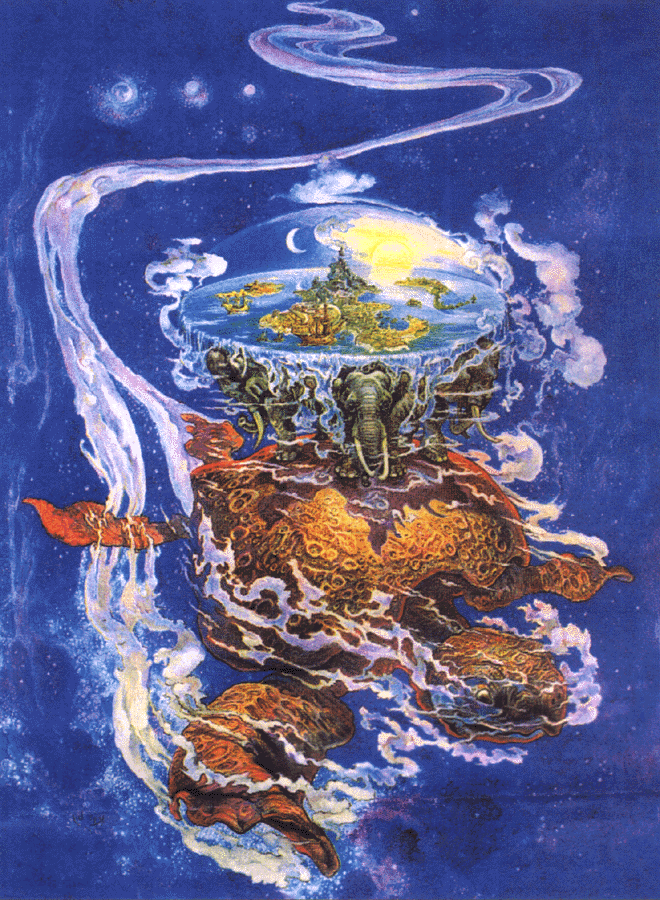
Perhaps the simplest and easiest to understand is the argument of the First Cause. (It is maintained that everything we see in this world has a cause, and as you go back in the chain of causes further and further you must come to a First Cause, and to that First Cause you give the name of God.) That argument, I suppose, does not carry much weight nowadays, because, in the first place, cause is not quite what it used to be. The philosophers and the men of science have got going on cause, and it has not anything like the vitality it used to have; but apart from that, you can see that the argument that there must be a First Cause is not one that can have any validity. ... If everything must have a cause, then God must have a cause. If there can be anything without a cause, it may just as well be the world as God, so that there cannot be any validity in that argument. It is exactly of the same nature as the Hindu's view, that the world rested upon an elephant and the elephant upon a tortoise; and when they said "How about the tortoise?" the Indian said, "Suppose we change the subject."
Now, in deference to Mr Russell, I must admit that I'm not altogether clear what "the philosophers and the men of science" were doing about causality at that time, though I venture to suggest that whatever it was, it didn't succeed in eliminating the nature or fact of causes.


But the meat of the argument, of course, lies elsewhere. And it's quite true that, if everything requires a cause, the idea of a First Cause is -- well, in direct contradiction to the claim that everything requires a cause, QED. And not a few would-be apologists, when confronted with this terribly obvious fact, have indeed tried merely to change the subject, often by resorting to fideism. I make no secret of the fact that I have very little respect for this kind of philosophical legerdemain, and feel that it borders on dishonesty and intellectual cowardice even at its best.

However, it must be noted that Mr Russell apparently didn't grasp the real nature of the cosmological argument. As stated by St Thomas Aquinas, and maintained by his disciples (among others), the argument is most definitely not that everything has to have a cause; and that is not the form that Russell at first gives the syllogism, even in his own essay. What the argument states is that "everything we see in this world has a cause"; a crucial distinction. The idea is that there are two possible kinds of things: those whose existence is contigent, i.e. calls for some sort of explanation about its origin, and those whose existence is necessary, i.e. a self-existent being or class of beings. The Catholic contention is that the existence of contigent things -- "everything we see in this world" -- requires some necessary being to explain its existence, not that all things must have a cause, which would be a hopelessly self-defeating argument for the reality of God.

In brief, Catholics, and most monotheists, assert that if reality as we know it is to make any sense, there must be a minimum of one necessary being in order to cause contingent things to be.

Now, it's quite true that an Uncaused Cause, while consistent with the Abrahamic notion of the God, is a great deal less specific than the Mosaic thundercloud upon Sinai, the Crucified and Resurrected Logos, or the Exalted One who assumed Muhammad from al-Aqsa in Jerusalem. However, at the moment, we are dealing only with what the cosmological argument professes to demonstrate: not what it makes no claims of demonstrating, or how much more we were expecting it to demonstrate.

The difficulty about the alternatives proposed by Russell is threefold. To begin with, if we admit that a First Cause is necessary but posit that it is the world as a whole, rather than an independent being who made the world,** what we have actually arrived at is a form of pantheism, rather than atheism proper. This form of pantheism need not be of the specifically Hindu or Daoist type that peoples the universe with a plethora of particular deities, but, if "the whole show" is to be considered a self-existent entity, then it is, to that degree, a god, if an impersonal one. (The catch there is how an impersonal god could bring personal consciousnesses -- that is, ourselves -- into existence, since nothing comes from nothing, and correspondingly no agent can bestow what it does not possess; and if we allow the universe to have purposiveness or mind, then we have arrived again at a personal God, if a pantheistic one.)


A wild PANTHEIST DEITY has appeared!
[FIGHT]   [RUN]   [CAPTURE]

Another flaw in the argument is precisely in the contingency of the universe and the things in it. The first premise laid down by St Thomas and co. is that all the things we experience in this world are contingent, i.e. that any of them might not have existed and might cease to exist; and if everything is contingent, then nothing would exist, because, given enough time, everything would eventually "go out" -- and then there would be nothing to bring anything back.

Russell's reply was that he saw no reason why there should not be an infinite succession of contingent things, each caused by a predecessor -- things caused by other things, forever. The difficulty with this, I think, is the "turtles all the way down" problem:
After a lecture on cosmology and the structure of the solar system, William James was accosted by a little old lady. "Your theory that the sun is the center of the solar system, and that the earth is a ball which rotates around it, has a very convincing ring to it, Mr James, but it's wrong. I've got a better theory," said the little old lady. 
"And what is that, madam?" inquired James politely. 
"That we live on a crust of earth which is on the back of a giant turtle." 
... James decided to gently dissuade his opponent by making her see some of the inadequacies of her position. "If your theory is correct, madam," he asked, "what does this turtle stand on?" 
"You're a very clever man, Mr James, and that's a very good question," replied the little old lady, "but I have an answer to it. And it is this: the first turtle stands on the back of a second, far larger, turtle, who stands directly under him." 
"But what does this second turtle stand on?" persisted James patiently. 
To this the little old lady crowed triumphantly, "It's no use, Mr James -- it's turtles all the way down."
I suppose we can only hope that Mack doesn't belch.


Elephants and turtles both seem pretty strong. I don't see what all the fuss is about.

This, of course, is not disproof. The fact that the human mind (or most human minds) will not accept a "turtles all the way down" explanation of existence, since it does not really explain anything, does not in itself show that this un-splanation is untrue. That said, I don't think I'd want to go up as a surety for it, even if I believed it. The thesis that there is something which necessarily exists, on the other hand, has the merit of being obviously rational (whether false or true), even if we don't see why a necessary being should exist; though, when you come to think of it, asking why a necessary being exists is probably a nonsense question.

Finally, there is the pesky little problem of getting something out of nothing. If the only things that exist are contingent, that is, caused (and thus unnecessary), how can "the whole show" be a necessary or uncaused thing?

I've let myself stray a bit into arguing, rather than merely stating Catholic belief, here. It's hard not to; analyzing things is terribly fun. But I hope this has, at least, clarified the difference between the idea of a First Cause and the idea (or failure of idea) that Russell rightly derided.


*Many people claim to find God's existence self-evident, including some saintly individuals; Bl. John Henry Newman, I believe, said so. I can certainly allow that some people have a natural, mystical gift, by which the reality of God is experienced as an immediate fact, rather than arrived at through reasoning or instruction or both; nonetheless, I do suspect that, when most people say that they consider God's existence self-evident, what they tend actually (if unconsciously) to mean is that they do not wish to argue about it.

**There are a few possible meanings for making the world here; the "emanations" of Neo-Platonism and Gnosticism, though wholly distinct from the Judaeo-Christian concept of creation ex nihilo, are still a consistent interpretation of the cosmological argument's implications.

Wednesday, September 24, 2014

Why I Am a Catholic, Part IV: The Real Rhino

I wrote, in my first post, that I think the atheism that refuses to believe in a God who could tolerate the evils and sufferings we do see in the world, is less like a snarky member of Anonymous, and more like the hero of James and the Giant Peach,* defying the monstrous Rhino that killed his parents and is coming after his friends. If you can't play the video or don't feel like clicking the link, the salient material is that the Rhino is coming at them, in a vulnerable position -- I mean, they live in a giant peach, which isn't exactly the Fort Knox of the vegetable kingdom -- surrounded with thunderclouds. James makes his friends climb up into the silk rigging that they've been using to fly the peach,** so he can provoke the Rhino to attack him on the peach and disconnect the silk and seagulls, flying his friends to safety. As planned, the Rhino charges at him, as he shouts, "Come out and show your face, you stupid beast! You're not even a real Rhino! You're just a lot of smoke and noise! I'm not afraid of you! I'm not afraid of you!"


Feeling that way about God seems to be to be linked in with the idea that God is directly responsible for suffering -- that He has specifically chosen the anguish of His creatures over some viable alternative. Or, to be blunter, that He does not merely permit death, but kills; does not merely allow pain, but inflicts it; does not merely suffer heartbreak to exist, but breaks hearts.

It'd be easy to say that none of these things is, in theological language, positively willed by God. When I was growing up, as a Calvinist, this explanation was so common as to be a stock answer, and I've found it to be pretty common among Catholics, too; for the philosophical problem of a good God who does evil things would seem to be insoluble and self-defeating. Holy Scripture, however, has no such scruples: I am the LORD, and there is none else. I form the light, and create darkness: I make peace, and create evil: I the LORD do all these things.***

It is probably worth saying that, from a strictly literary perspective, the right approach to this verse (and some others like it) is to take the word evil in the broadest sense, signifying almost anything we would not want or like. However, since the import of the text is still one of the universal dominion of God, that doesn't help much. And neither, when you come to think of it, does the conciliating distinction between what God specifically wills and what He simply permits. A God who positively willed the gas chambers at Auschwitz, for instance, would be abominably evil; a God who merely allowed the gas chambers at Auschwitz may not be that, but it's still difficult to believe that He is both all-powerful and also the source and definition of all goodness, and even if He is, He's baffling. The faith that attempts to solve this conundrum in such a way that the difficulty no longer exists, in my opinion, has fundamentally failed to grasp the scope of the problem -- and, in trying to turn it into an intellectual exercise with an "answer," has fundamentally failed too to understand the real function of faith.

So where can faith go from here? I tend to think it can't go anywhere from here; it has reached a dead-end, and must turn around and retrace its steps. That is at any rate what I had to do, though I lingered in the cul-de-sac for a while, trying to convince myself that I was supposed to be there. (I'm speaking of the time I spent as a determinist, which I've written of in a little more detail in this post, for which I'd like to make a trigger warning.)

We return to the problem of pain in the world. And let's just start there. We don't start with an intuitive awareness of God; we're taught that He exists or persuaded that He exists. But we do start with the capacity to perceive that we live in a world full of suffering and evils.


For instance, the Deep Ones.

And when we take that as our starting point, the problem of suffering is not eliminated, but its relationship to the being and goodness of God is turned upside down. It becomes, not a question of starting with the goodness of God and trying to believe that all the awful things in the world are really expertly disguised blessings -- but of seeing those awful things, and asking whether it is still possible that the Being that is behind reality (the Uncaused Cause, the Absolute Mind, whatever you want to call it for now) is somehow on our side despite all of that.

It isn't a profession that we know why this or that evil has been allowed; still less is it a pretense (and this is one of the reasons that I cannot abide those belief systems that deny the existence of evil) that horrible things have the same right to exist as lovely things. It is asking the question of whether the real Rhino, supposing that there is a real Rhino, is benevolent and compassionate. Like Albert Camus' picture of the Absurdist man, acknowledging what at any rate appears to be a meaningless and lonely universe, faith in God is precisely the choice to believe that there is more to reality than meets the eye, and that that more is absolutely good -- is, in fact, a Person who loves us. As I have said there is a romantic defiance in the best atheism, so there is a romantic defiance in theism, one that we mostly forgot during the high noon of Christendom and the evening of polite deism: the defiant belief that even under the ragged wreck of our loves and hopes, the deepest reality justifies those loves and those hopes, and has, finally, the power to make them triumph; and this deepest reality we call God.


Martyrdom of Saint Sebastian, Giovanni Bassi, 1525

Why a God who loves us would suffer the world as we know it to exist is a separate question, and one that I rather suspect hasn't got an answer we can grasp. It may be that finite minds like ours couldn't ever grasp it in any meaningful way, though I'm inclined to doubt that; it is almost certainly true that, if we could grasp why God would allow evil and pain, we haven't got all of the facts we need. Either way, theodicy remains, in my view, repellent; and I don't think the Scriptures or most of the great saints, though they have "asserted eternal providence," have ever attempted "to justify the ways of God to men."

I do not so much admit as insist that this is not an "answer." I earnestly want an answer, and this isn't one; although taking this perspective may put us in a position where real faith is possible, the most this does is raise what I take to be the right questions.
It is a solemn and uplifting sight [in Job] to see those eternal fools, the optimist and the pessimist, destroyed in the dawn of time. And the philosophy really perfects the pagan tragic irony, precisely because it is more monotheistic and therefore more mystical. Indeed the Book of Job avowedly only answers mystery with mystery. Job is comforted with riddles; but he is comforted. Herein indeed is a type, in the sense of a prophecy, of things speaking with authority. For when he who doubts can only say 'I do not understand,' it is true that he who knows can only reply or repeat 'You do not understand.' And under that rebuke there is always a sudden hope in the heart; and the sense of something that would be worth understanding.****
But if, in going from the fact of anguish to faith in God, we are professedly only passing from mystery to mystery, why make the transition at all? Isn't faith, in that case, just wishful thinking? -- the insufferable, the saccharine choir of Look at the big picture and Everything happens for a reason and God never closes a door without opening my mouth, and all the rest of the sentimental bullshit told by people who don't get it to people who can't hear it?

This, I believe, is where we do turn precisely to reasoning our way through evidence. But it remains personal rather than abstract, because the evidence I propose to examine is that evidence which we call the Gospels, written by people about a Person who professed to be -- at the very lowest -- the perfect and utterly authoritative expression of that Absolute Mind which we have already spoken of. Its relevance to the distinction between faith and wishful thinking can be summed up in Its perfect and authoritative and, on a Catholic showing, divine cry, Why hast Thou forsaken Me?

But we'll get to that in the next post.


This series has been kind of heavy, so here's a puppy eating a cupcake by way of compensation.


*The disloyal, yet still very largely enjoyable cinematic adaptation. A number of features, such as this very episode of the Rhino, were added to the contents of the book. I object to that sort of thing, but the addition is a good piece all the same. And they certainly gave a satisfying portrait of Aunt Sponge and Aunt Spiker.

**Come on. If you didn't balk at a kid being friends with a gigantic grasshopper with an aristocratic English accent and a monocle, you've got no right to talk balk over a peach being suspended from spider-silk rigging and flown by seagulls.

***Isaiah 45.6-7. One could observe that it is immediately after this verse about God creating evil that the verse from which the blog Rorate Caeli takes its title is found, if one were inclined towards that kind of cutting, smart-aleck humor.

****G. K. Chesterton, The Everlasting Man, p. 98.

Tuesday, September 16, 2014

Why I Am a Catholic, Part III: Apostate

In my last, I described my sojourn into apostasy. I had been intending to pass on from that and revisit it a few times later, but I feel it'd be better to camp there for a little while instead. (I've also changed the name of this series, accenting the personal angle that I feel must be taken with this -- accenting it for myself as much as anybody else, since I'm bad at that, but I digress.)

The apostate is something very different from the atheist who is sincerely convinced of atheism. I don't mean the person who has committed some concrete act of apostasy -- the burner of incense to the genius of the Roman Emperor, the signer of the Act of Supremacy, the one who treads upon the fumie. The one who does these things need not be surrendering to anything but the frailty of human nature, under torture or the threat of torture. Or conversely, they may do such things as these, or nothing at all, out of a sincere (if, in the Catholic view, mistaken) belief that God does not exist; or that the Absolute is so different from the Christian God that, for all intents and purposes, He does not exist.


Fumie (literally "things to step on") were used in the persecution of the Church in Japan: they depicted
Christ or the Virgin, and people were required to step on them. Those who objected were exposed as Catholics.

But this is not the kind of apostasy that I am writing of here. The apostate in this sense is one who has been abandoned by God, or has felt compelled to abandon Him, and may or may not be an atheist in the rational sense at all. It's expressed, I think, in the song "Dear God" by XTC:
But all the people that you made in your image
See them starving on their feet
'Cause they don't get enough to eat from God
I can't believe in you
Dear God, sorry to disturb you but
I feel that I should be heard loud and clear
We all need a big reduction in amount of tears
And all the people that you made in your image
See them fighting in the street
'Cause they can't make opinions meet about God
...
I won't believe in heaven or hell
No sinners, no saints, no devil as well
No pearly gates, no thorny crown
You're always letting us humans down
The wars you bring, the babes you drown
That is not the voice of a philosopher, delivering his opinion that there does not happen to be a Supreme Being; neither is it the voice of a teenager who's trying to make his parents mad. That is the anguished voice of one betrayed.

St. Paul's mystery of iniquity is the perennial complaint of the apostate. If I may trust my own weird experience, it isn't simply a matter of having an extremely puzzling riddle to crack. That doesn't help, but it also isn't what's at stake -- God knows there is no shortage of nuts-hard-to-crack in the universe (indeed, as Lady Julian and science conspire to tell us, all that is made is a nut). What's at stake is how the nightmare anguish that exists in the world, in our own lives, can possibly be compatible with the reality of a God who is both good enough to object to it and powerful enough to stop it, and of whom it can't plausibly be maintained that it's none of His business. Why did I have to lose this man over a stupid mistake? How could You let this innocent little girl be tormented? Why did you let these people be gunned down at random by a maniac?

The fact that apostates often wrestle with the problem of evil, in public and in private (frequently in their work if they are artists of any kind), for many years after some decisive renunciation of faith, may be an ironic testimony to the doctrine that Baptism imparts an indelible mark upon the soul. Some of my favorite authors are those, like Flannery O'Connor and Shusaku Endo, whose work depicts, not a knock-down argument for regarding the difficulty as having a complete and satisfactory answer, but the difficulty itself as material for faith: as a part of the human experience that must be treated as legitimate and somehow brought to God, if coming to God is going to have any meaning. Not by conversion of the Godhead into flesh, but by the taking of the Manhood into God. And after all, we start with our own experience in a way that we definitely don't start with divine revelation; howbeit that was not first which is spiritual, but the natural, and afterward that which is spiritual.

Translated into more poetic language, the apostate's case might perhaps go something like this:
This is one thing, therefore I said it, He destroyeth the perfect and the wicked.
If the scourge slay suddenly, he will laugh at the trial of the innocent.
The earth is given into the hand of the wicked: he covereth the faces of the judges thereof; if not, where, and who is he?
... Let him take his rod away from me, and let not his fear terrify me:
Then would I speak, and not fear him; but it is not so with me.
My soul is weary of my life; I will leave my complaint upon myself; I will speak in the bitterness of my soul.
I will say unto God, Do not condemn me; shew me wherefore thou contendest with me.
Is it good unto thee that thou shouldst oppress, that thou shouldst despise the work of thine hands, and shine upon the counsel of the wicked?
... Thou knowest that I am not wicked; and there is none that can deliver out of thine hand.
Thine hands have made me and fashioned me together round about; yet thou dost destroy me. 
-- Job 9.22-24, 9.34-10.3, 10.7-8
Job is one of the most neglected books in Scripture -- the majority of allusions to it that I've seen have consisted in the single phrase I know that my Redeemer liveth, ripped from its original context and content, and slapped as a piece of sentimental uplift onto car bumpers and the dust-jackets of inspirational something or other. I can't think of anything more insulting. The fumie at least had actual icons on them. It'd be like taking a picture from Dachau that happened to have a smile in it, and using it to advertise sugarless gum.


But does your soul feel clean?
*ting*

For it is the whole point of the book of Job that God, when He confronts both Job and Job's comforters, offers no answer, no explanation. He gives no account of Himself. As Charles Williams points out in He Came Down From Heaven, God's reply mostly only plagiarizes things Job has already said in his storm of accusation directed upwards. There is no theodicy offered there.

Or rather, there is; it is that offered by Job's friends: Job is suffering because he has, in some manner, sinned, and must repent. Reading Job's outrage, and his abuse of his friends as well as his God, those of us who were raised in the Christian faith might be inclined to agree with them, having been brought up to believe that there are certain things one simply doesn't say to, or about, God. The Almighty's own response to Job's friends is as follows:
And it was so, that after the LORD had spoken these words unto Job, the LORD said to Eliphaz the Temanite, My wrath is kindled against thee, and against thy two friends: for ye have not spoken of me the thing that is right, as my servant Job hath. Therefore take unto you now seven bullocks and seven rams, and go to my servant Job, and offer up for yourselves a burnt offering; and my servant Job shall pray for you: for him I will accept: lest I deal with you after your folly, in that ye have not spoken of me the thing which is right, like my servant Job. 
-- Job 42.7-8

Job, Leon Bonnat, 1880

This is why I cannot and will not despise the apostate, the anti-theist. Those who do despise them have no business with apologetics. I think that no one, however virtuous, can truly grapple with the problem of evil and not understand apostasy. Christ Himself, mounted upon the cross, his face lifted up into heaven, demanded of that heaven, Why hast Thou forsaken Me?

God's effective silence to Job was matched by His absolute silence to His Son. That silence echoes down the corridors of history; it resounds like music in the human heart; deep calleth to deep in the roar of thy cataracts, all thy waves and billows are gone over me; hearts and sufferings coinhere, and at the heart of them all lies the Sacred Heart, still pierced, still bleeding, still burning. The silence was followed by the Resurrection? -- yes, but that was in the macrocosm. We, in the microcosm that we (idly enough) call "real life," cannot see that.

Which means that that referral to the macrocosm, to the Resurrection, cannot really be used as an answer. That reality left its evidences upon history; and I do think that Pascal was right, when he said that there is enough light for those who wish to see as there is enough darkness for those who don't. But to place one's faith in the Resurrection and in the universe that it signifies is precisely an act of faith -- it is not simply the obvious and reasonable thing to do, ever.

That, I think, was my mistake. Not only as a child, but for years afterward, and even in my conversions from atheism to Christianity and from Christianity in general to Catholicism in particular. I never fully grappled with the fact that the act of faith was an act of faith -- that is, trusting a Person, not simply accepting an idea -- not of following a chain of reasoning to its logical end. Following that chain did put me in a position to make an act of faith. I don't regret that. And, while it's impossible to know whether I would have made the same decision if I had grappled with that question during my conversions, I think I might have done. But it has left me to grapple with that same problem now.


Jacob Wrestling with the Angel, Gustave Dore, 1855

I don't believe there is any irreverence in such a struggle; My servant Job hath spoken of Me the thing that is right. Returning to Charles Williams:
No pot -- so far -- has asked questions of the potter in a voice the potter can understand; when it does, it will be time enough to compare pots to men. The criticism is not aimed at Saint Paul, who dropped the phrase in the midst of a great spiritual wrestle, not as a moral instruction. But it has been used to often by the pious to encourage them to say, in love or laziness, 'Our little minds were never meant ...' Fortunately there is the book of Job to make it clear that our little minds were meant. A great curiosity ought to exist concerning divine things. Man was intended to argue with God.*
And how is any of this an answer to apostasy or an argument against atheism? It isn't; that's very largely the point. I believe Christians must accept and respect the fact that, for some people, the problem of evil is an insurmountable objection to God's existence -- the problem of evil as experienced in their own lives. And not accepted and respected as some sort of condescending indulgence of the weakness of others, either. The brute fact is, unless our own heart's been broken the same way theirs has, we don't know what we're talking about.

While, if our own hearts have been broken, we should know better than anybody that faith is a mystery. I don't honestly know why I'm not an atheistic apostate. The brain-breaking problem of how God could allow the suffering that exists in the world, I can't answer; the pain I've suffered, the pain I've caused, in my own twenty-seven years, I don't know what to do with that. Sometimes I understand why I believe, but those times, I couldn't express it in words: I could point at Him, but nothing else, not really. I could pile up arguments this high, putting someone in a position where Catholicism is intellectually possible and even plausible; and without the gift of faith, given mystically, it's not going to matter.

None of which is a reason to waive the rational element in the discussion. It's just a reason to put it in its place.
O LORD, thou hast deceived me, and I was deceived: thou art stronger than I, and hast prevailed: I am in derision daily, every one mocketh me.
For since I spake, I cried out, I cried violence and spoil; because the word of the LORD was made a reproach unto me, and a derision, daily.
Then I said, I will not make mention of him, nor speak any more in his name. But his word was in mine heart as a burning fire shut up in my bones, and I was weary with forbearing, and I could not stay. 
-- Jeremiah 20.7-9

*He Came Down From Heaven, p. 30.

Tuesday, September 9, 2014

A Case for the Catholic Faith, Part II: Enigma of the Absolute

A title I chose not least because it's the name of a kickin' song by the sadly neglected band Dead Can Dance. But I digress, and I haven't even started yet.

I wrote a first draft of this post -- running through a very few of the standard arguments in favor of the existence of, if not the Christian God in particular, at any rate a God or Supreme Being or Absolute -- and showed it to some friends, because I had a vague yet nagging feeling that something was the matter with it. The upshot of that was, I'd gone through my chosen arguments well enough, but it didn't matter, because I wasn't risking anything in what I'd written. I wonder whether that isn't why apologetics, intellectual or otherwise, are so often ineffective: people can usually tell, sooner or later, when you're not really opening up, and people hate things that are fake -- hence, for example, the popularity of zombies: something that looks human but isn't, and whose danger justifies taking out our hatred of fake things upon it. If I'm going to write about faith, let's go for a living faith instead of an undead faith.


So, I want to try for a more personal approach. A big part of my own experience of faith has certainly been its intellectual element, both in converting and in continuing to believe; but that itself takes place in a broader, human context. So, instead of laying out arguments that I think are convincing, I'm going to talk about arguments that convinced me, and why, and how.*

It's pretty easy to sum these arguments up briefly, as a rule -- syllogisms are like that far oftener than you'd think -- and that's true even in the life contexts that they came in for me. So I've mostly only expressed them here as they occurred to me, rather than including the counterarguments, variations, and so on. Anyone who wants to raise them is welcomed and encouraged to do so in the comments.

I've spoken before, briefly, about respect for atheism. This is partly because I think serious thought deserves respect, and that assuming someone has not thought seriously simply because they disagree with you is asinine. It's also because I used to be an atheist for a very short while, and not only was it (in the long run) a major advance for my faith, I also couldn't help but notice that it wasn't Christian sneers that brought me back any more than it was mere juvenile flippancy that wrecked my faith in the first place.


I still don't know quite how it happened, actually. I was maybe eighteen or nineteen. It was during a retreat in Ocean City with Campus Crusade, which might have been embarrassing if I'd still been able to feel anything. I was sitting in the conference room we had in the hotel -- I guess there were maybe a couple hundred students there, more or less, but I'm bad with guesstimations -- during one of the worship sessions. I used to feel weird in those pretty frequently; sometimes I could get into them, but more and more I felt out of place, and looking around at everyone who was into it just made things worse, like I didn't belong. (Also, sometimes the songs were shitty, but that was a separate problem.) But I was trying to pray, and looking around, and trying to pray some more. I felt tensed up, like I was trying to hold something together in my hands. In one strange moment, I realized that what I was trying to hold together was my belief in all of this; and then I suddenly felt tired, and just let go. And my faith was gone.

I got up, almost physically numbed. I had been a Christian -- a goody-two-shoes choir-boy -- for as long as I could remember: baptized at six months old, raised on the Bible and The Chronicles of Narnia and The Hiding Place, trying to evangelize my friends as an eight-year-old, listening to "Adventures in Odyssey" before bed. And now none of that was anything at all. I trudged back up to the hotel room and sat down on one of the beds, staring. I felt nothing. I thought nothing.

A couple of my friends came up later. I didn't like to tell them because I knew they'd be upset, but I didn't know what else to do. I can't remember what I said exactly; I just remember them sitting there with me, praying, crying. It was all meaningless to me. Literally everything was. I was half-expecting, when I went to sleep, not to wake up -- that I, or all of existence, would just sort of dissolve, and then there would be nothing and no me to notice the nothing. I was a little freaked out by that, but only a little.


The next day was Sunday, and we started on our way home. I still didn't feel much. I was wondering, vaguely, what my life was going to be like now. I had been intending to go into ministry of some kind, as a pastor or a writer or something. Well, I could still write; I couldn't really think of much that I still wanted to write about, but I could easily be an editor, maybe a critic. And there was nothing stopping me now from getting a boyfriend, or even from sleeping around with any guy who took my fancy and was willing to be taken by it, as it were, so that at least simplified things.

We started the drive home through the Delmarva Peninsula, surrounded by farm fields -- tobacco, I think. My friends stopped at a church on the way. Partly out of habit, and partly to keep them company, I went in. I don't remember the service much: it was unremarkable, the standard pop Protestant affair. It felt odd not to join the prayers or the singing. I thought some more about what I might do with my life.

But then came time for Communion. And I wanted to take Communion. It may have been the first actual desire I'd felt since the previous night. I tried at first to brush it off: it's habit, it doesn't mean anything, atheists don't do that. But the desire didn't go away. So I started to think.

There was a miraculous clarity in that moment. I had never thought the matter through because I wanted the answer before then; only in order to show how to get to the answer that I already had. And my emotions were still so dead that they seemed to have no power to distort my judgment. It struck me, too, how quickly I was able to go from one step to the next -- I didn't feel weighed down or confused by feelings or desires, I just wanted the answer. The real one.

Okay. Was there any reason to believe in a God, of some kind, just to start with? Well, here I was thinking; I was a mind. That didn't seem like something I could seriously dispute; I was a Classics major, not a Philosophy major.


And mind, consciousness, doesn't come from nothing, because nothing comes from nothing. Nor does it come from matter, because matter is unconscious -- that'd be the same as coming from nothing. My existence as a mind seemed to call for some sort of explanation. So there had to be a conscious mind that brought mine into being.** And of that prior mind, either it had to be self-existent itself, or it had to depend on a source for its own origin; and so on.

The idea of an infinite regress of caused minds was something I instinctively found ridiculous. And it seemed also to violate Ockham's Razor, the rule of thinking that the simplest explanation should be preferred to all others (or, as my father rephrased it, "Don't make shit up"). One had always struck me as being a simpler concept than infinity, so the idea of one absolute Mind won out over the idea of an infinite regress of minds twice over.


I always assumed that an Absolute Mind would have a monocle.

The service was continuing around me. Okay, so there was presumably some sort of God, whether it was the Christian God or not. And it was, following the argument, the self-existent source of minds -- of all minds, I assumed, though I suppose there's no particular reason there couldn't be multiple self-existent minds. But so far, I knew of one.

How about reasons for supposing that this Mind was, specifically, God as Christians understand the word?


*People who, like me, are deeply boring, may recognize the argument I went over with myself that day as being basically a form of the (somewhat oddly named) cosmological argument, one of the five classical arguments for God's existence formulated by St Thomas Aquinas -- though in his work, he meant them more as explanations of what is meant by the term God without referring to special revelation. It has some relationship to the argument from consciousness (used by C. S. Lewis in Miracles), the teleological argument (which has been given a degraded for by Creationist popularizers), and the kalam argument (which originated with Spanish Moslem scholars and made its way into Christian thought through Aquinas' friend St Bonaventure). The influence upon me of Lewis' own, generally very reliable, popularizations of the major philosophical definitions, explanations, and arguments in the apologetic sphere is probably quite transparent to anyone who has any acquaintance with his work, so I haven't bothered to notate it.

**I don't recall whether I considered, at the time, the possibility that I was a self-existent mind. Not perhaps the, but a god, as it were. I wouldn't have found it credible then, and I don't find it credible now, for a number of reasons, of which two spring to mind: first, I sleep -- there are literally interruptions in my consciousness on a regular basis, which suggests that I am not a self-existent or absolute consciousness; and second, I'd think that if I were a self-existent mind, I'd know it.