Collect

Collect for the Fourth Sunday after Trinity

O God, the protector of all that trust in thee, without whom nothing is strong, nothing is holy: increase and multiply upon us thy mercy; that, thou being our ruler and guide, we may so pass through things temporal, that we finally lose not the things eternal; grant this, O heavenly Father, for the sake of Jesus Christ thy Son our Lord, who liveth and reigneth with thee, in the unity of the Holy Spirit, ever one God, world without end. Amen.
Showing posts with label art. Show all posts

Tuesday, June 25, 2019

Review: "I'm Gay" by Eugene Lee Yang

Every single courageous act of coming out chips away at the curse of homophobia. Most importantly it’s destroyed within yourself, and that act creates the potential for its destruction where it exists in friends, family, and society.

—Anthony Venn-Brown, A Life of Unlearning
✠     ✠ ✠


Photo by Noam Galai

Eugene Lee Yang of the Try Guys (a foursome who try weird new experiences on YouTube) recently released a coming out video, simply titled I’m Gay. It tells his story wordlessly, through dancing and music, and while ‘interpretive dance’ sounds … well, put bluntly, pretty fucking stupid to anybody who grew up in my generation, this video floored me. I first saw it on Saturday and I’ve already watched it six or seven times, as well as his making-of video. It’s stunning. And I am not the first to observe that, of the possible ways, an intricately designed, visually spectacular internet video of interpretive dance is arguably the gayest way to tell people that you’re gay.

The story is arranged in six scenes, corresponding to the six colors of a typical Pride flag: red, orange, yellow, green, blue, and purple. Yang tells his archetypal yet fairly complex story with incredible economy—only a single scene (the red) lasts longer than one minute, and every movement is choreographed to communicate its meaning vividly. The best way I can review it is just to describe it, pointing out a few of the symbols that stood out to me. I’ll take the scenes one by one, adding the keywords from the making-of video.

The Red Scene: Nature

This presents Yang in a family setting. A coffee table surrounded by a couch and two chairs sits in front of a red wall, with father, mother standing behind, brother and sister on the couch on either side of Yang; he is dressed in an androgynous red costume representing his different-ness, while his family are in grey, suggesting that they have not yet taken a side, perhaps not recognized a conflict. Childhood, playfulness, and innocence are the salient characteristics of most of the children’s movements. At first their playfulness is not gendered, their mother’s beauty and their father’s rigidity are equal ingredients in all three; but their play soon begins to be an imitation of the same-sex parent—except Yang, who begins imitating his mother more than his father. The camera pulls out more and more, away from the wall, showing that its confines are artificial and belie the real shape and size of the room and that there are large windows letting in bright light further off. When Yang is about to use his mother’s lipstick, his father slaps it out of his hand and hits him; then the family marches offscreen into the next scene.

The Orange Scene: Nurture

A large crowd of people dressed mostly in grey, American clothing (save for Yang, who is in orange-colored clothes that seem to be some variety of hanbok, traditional Korean garb) are marching into a room full of benches. This is stated in the commentary to represent school and work as well, but the primary imagery chosen is that of a church, with a cross-bearing pulpit and two candelabra full of bright orange candles. The main mass of people march in an ordered pattern, sometimes covering their eyes or grabbing their heads as if in pain or anger. Yang’s dancing and leaping become wilder and more joyful as he goes, until one of the grey-clad people stops him, moving his body into a rigid, pious posture like the others, then forcing him to bow and dismissing him. Yang takes a seat in a pew with a toothy smile, and the grey clothes of the others shift to white and black: sides are being taken, opposition expressed. The man behind the pulpit is in white, as are the people on the far side of the aisle from Yang, whose side is in black; the pastor figure begins making violent gestures like a fundamentalist preacher, and the camera zooms in on Yang’s face as he looks away.

The Yellow Scene: Love


This scene is particularly complex in its action. The music shifts suddenly to a lighter passage, building gradually through the scene. Sitting on a bench in front of a stand of trees and sunflowers and golden streetlamps, dressed in a vest and yellow trousers, Yang sees a girl in black dancing. The floor is covered in yellow leaves, as if signifying the organic change that is about to take place. He gets up to dance with her, and they leap and swirl for a while, until he sees another figure, a male, also dressed in yellow trousers. He moves into a pas de deux with him, with acrobatic, extraordinarily graceful movements. At first the two men move away from the girl and she moves more slowly after them. Then the men briefly move back: Yang reconnects with her, and she gives a kindly gesture connecting the two men again. (Yang describes her as representing the genuine ally, helping him discover and accept himself.) The other man lays himself on the ground, catching Yang in a suspended hold and slowly lowering him onto his body. They are about to kiss as the scene changes.

The Green Scene: Community

Here Yang appears in an elegant, sequined, deep green drag costume with a large pompadour wig, going down a set of stairs, greeting and embracing other drag queens and women as they head down to a dance floor. Their costumes are in an assortment of rainbow colors, but green predominates, at once dark and lush. The music has become energetic again, and characters dance for a few moments—then a figure in white, shown only from behind, approaches them, his fingers in the shape of a gun: likely a tribute to the mass shooting at Pulse three years ago. The dancers pause; then the outer ring ducks out of sight, then the rest, leaving only Yang visible, his face fearful as he raises his hands as if to stop the shooter, but then arms reach up from below and pull him out of the frame.

The Blue Scene: Hate

This is maybe the toughest part of the video to watch. We see Yang from above, in a crowd of anonymous white-clad people, bloodied and being kicked from every side. He is dressed only in a pair of jeans that are much longer than his legs; he cannot walk, cannot escape. The brutalizers disperse suddenly, and the camera moves down, showing him pulling himself along the ground, a blue dumpster and garbage bags behind him. Suddenly his family reappears: his mother and brother are now in black instead of grey, and his father and sister are now in white. His mother and brother move to help him up, but his father and sister begin fighting them, and before long his family are all fighting each other and slide out of the shot; Yang is pushed onto the ground again as they leave, and lies there, convulsing, trying to get up. Darkly echoing the first scene with the red lipstick, Yang touches the red blood on his mouth as he finally manages to sit up, then stand.

The Purple Scene: Pride

Yang is again in an arresting drag outfit, indigo shading into violet. He rises from the ground, at first with his back to the camera, but he quickly turns, anxious in his beauty. Crowds of people, some in white, some in black, surround him; some of those dressed in black reach out as if to caress or encourage, some of those in white shove or paw him, but most are busy yelling at each other as he slowly walks forward, finally reaching a point beyond the crowd; as he does, the shot switches to a distant and unfocused one that slowly pulls back in to his face. The music climaxes and stops, and we hear the angry arguments behind, but the shot lingers on Yang’s face: uncomfortable, anxious, defiant, the lips moving slightly, the eyes going back and forth uncertainly and then—just a couple of seconds before the scene ends, it all smooths out. Yang’s mouth is set, his eyes steady, his brows un-knotted. A peaceful, self-assured dignity closes the scene.


Credits

The credits play over a final, narrative-less scene. Yang is dressed in a luxuriant robe, apparently an open-breasted version of the shenyi (a traditional Chinese robe for men), silver and turquoise in color with what looks like a tea-green obi (a Japanese garment that’s a little reminiscent of a corset), seated alone in the room from the red scene, now with the encroaching wall removed. He rises, gesturing with the magnificent trailing sleeves that had at first appeared to be a gown; as if in response, six figures from the green scene—one in each color: red, purple, blue, orange, yellow, and green—file in. When they have all taken their positions, mirroring the arrangement of the family from the beginning, Yang sits down again in the center, and the legend For the LGBTQIA+ Community appears on the screen.

This is one of the most powerful and visually captivating short videos I’ve ever seen. I rank it with the music videos for Hunger or Spectrum by Florence + the Machine. I recommend it to anyone with a taste for dance or design, or anyone who cares about LGBT issues. Or really, anybody who’s open to watching it. Hats off to Eugene Lee Yang for a beautiful piece of art.

✠     ✠ ✠

Tuesday, May 28, 2019

Review: "Jennifer the Damned"

When my mother sat me down at the kitchen table one night, about a month before my 
class was scheduled to receive Holy Communion, I had no idea she was about to tear my world apart. My mind could not conceive of anything worse than that she was going to have to work a double shift again.
‘Jennifer, you won’t be receiving Communion with the rest of your class.’
Tiny shards of pink crystal hope exploded inside my heart, lacerating my dreams. ‘Why?’
‘Communion is not meant for us.’
‘Sister Joan says it’s meant for everyone, to save our souls from the devil.’
My mother smiled her crooked, perverse smile. ‘Jennifer, you and I … we don’t have souls.’

—Karen Ullo, Jennifer the Damned

✠     ✠ ✠

So not only is Catholic vampire fiction its whole own subgenre, we have a Facebook page now! We are: Karen Ullo (Jennifer the Damned), Eleanor Bourg Nicholson (A Bloody Habit), J. B. Toner (Whisper Music), and myself (Death’s Dream Kingdom). I’ll be reviewing my three compatriots’ novels, beginning here with Mrs Ullo’s book, which I got last week and whose nigh-400-pages I devoured in just a few days. (All four novels, I believe, can be purchased on Amazon; I have included direct-from-publisher links for each, both because the books are sometimes cheaper that way and because screw Amazon.)

Jennifer the Damned is set in contemporary Louisiana and California. The titular Jennifer was stolen from her birth mother by the lovely, heartless, and masterful Helen Carshaw, a vampire centuries old, who chose Jennifer as her protégé. She raises Jennifer as her own daughter—feeding her only the raw or rare meat that she can digest—and places her in Catholic school, in order to nurture her in both knowledge of God’s love for humanity and hatred that that love is withheld from the likes of them.

As the novel opens, Helen has disappeared, and Jennifer Carshaw has been in the care of a small convent of teaching nuns for a few years. She has been receiving a robustly Catholic education, and even a fairly normal high-school-misfit social experience—save that she alone is excluded from the sacraments, and especially from the Communion, that she so badly yearns for and envies her classmates for being able to access.

But Jennifer is experiencing her transfiguration into a full-fledged vampire, and the insatiable bloodlust that goes with it. The very smell of the Precious Blood at Mass drives her close to blind frenzy. Left to navigate undeath on her own, Jennifer decides to attempt a balance between her secret life as a vampire and the life she wants as a human being.

Here Be Spoilers
(Jump to Next Section to Skip Them)

The attempt, though valiant, fails. Jennifer learns a degree of self-control and develops the cunning to dispose of her kills without leaving any incriminating evidence behind, but she cannot truly balance the demands of the human life she has led till now with the new urges of the vampire: after a handful of anonymous disappearances, she loses control and kills the boy she has been dating. Around the same time, Helen’s bizarre plans, which involved turning a classmate of Jennifer’s named Jeremy into a vampire as her ‘brother,’ gradually become clearer: Jennifer despairs of ever managing a semblance of human life at home, and, as the FBI zero in on her, finding more and more evidence of her murders, she deserts the nuns and her school, adopting a false identity and telling Jeremy how to reach her later.

A few years later, while she is living in Los Angeles and working as a makeup artist, she meets someone new, a young actor named Conner who takes a shine to her. She begins toying once again with the idea of leading a human life, at least part of the time. But Jeremy, who is now experiencing his own growth into full vampire-hood, comes to find her: abandoned by their pseudo-mother, they have only each other to rely on as fellow undead. Nevertheless Jennifer opens herself up, little by little, to Conner’s increasing affection and seriousness about their relationship. Against all her prior experience, Jennifer even begins to see signs of mortality returning to her body—until her false identity is exposed and, like a pantomime demon out of a trap-door, Helen emerges. Helen informs them that she, Jennifer, has become the most pathetic of creatures, a mortal vampire, and demands that her two pseudo-children kill Conner and come with her; driven by rebellion and revenge for the humanity she took from them, they instead destroy her.

Jennifer leaves Conner, hospitalized after their confrontation with Helen, with a note expressing her regret and her love for him, and returns to Louisiana and the nuns. She confesses what she has been and done, including all her murders, and agrees to face justice, asking only to receive the Eucharist first, now that she at long last is sure she has a soul. The priest consents, she drinks the Precious Blood, and there the novel ends.

(Spoilers End)
Here Be Lit-Crit

Jennifer the Damned is comparable to Twilight in premise, yet with the superior craftsmanship of Anne Rice. It takes the psychological and spiritual gravity of being a vampire seriously, in a way that many of its rivals fail to do, even Dracula, whose vampires are indeed evil but merely evil, without the depth of a human sinner or even of a fallen angel like the possessed Weston of Perelandra. Feeling cut off from humanity not merely in a social way, but in an urgently sacramental sense, is something I’ve rarely come across outside of Rice’s work. I wonder whether the choice of Louisiana, such an important location in Interview With the Vampire, may itself be a tribute to Rice. (Louisiana has become virtually the Transylvania of Southern Gothic, also popping up in Vampire: The Requiem and the stories of Jacques St Germain).

Structurally, the novel works well enough; stylistically, though it has a few sags into cliché, it’s generally very good—better than Dracula. But where Jennifer the Damned really shines is its pacing. This is itself a cliché, I know, but I couldn’t put it down! I always needed to know what was going to happen next: I cared what happened to Jennifer and the people around her.

If the novel has weaknesses, they are two: audience grasp of the mechanics of vampirism, and the ending. Now, it is appropriate that we don’t fully understand how being a vampire works at the beginning, partly because we the readers are learning with Jennifer as the story progresses. However, a major mechanical shift away from what we had been led to think, one that’s highly plot-relevant, takes place fairly close to the end without really being foreshadowed. This leaves us feeling more like the mechanics have been fiddled with to convenience the plot, than that we are continuing to learn with Jennifer and that if we’d been a little cannier with the facts we had we might have seen this twist coming. It’s not a fatal flaw but it’s the worse of the two, in my opinion.

The other flaw is that the closing feels kind of rushed. Jennifer’s love interest in the last third of the book falls for her so quickly that I was inclined to put it down to vampire charm, but then that explanation seemed to be repudiated, which resulted in the romance coming across as over-idealized—though, to be fair, not cloying or problematic like Stephenie Meyer’s; the characters’ behavior and dialogue stays convincing. The one truly important death of the book happens with little fanfare, which was a real disappointment. And while I can’t quite bring myself to call this a problem—because if I’m truthful, it’s kind of the point of the book—I am furious over the openness of the very end! I want there to be sequels so I can find out, even indirectly, what happened.

Should You Read It?

If you are a fan of vampire literature or coming-of-age stories, definitely! All in all I give Jennifer the Damned a B+, with the note that it could’ve gotten an A- if Ullo had stuck the landing just a little better (and if there are sequels I am optimistic that she will). Go forth and buy.

✠     ✠ ✠

Thursday, May 23, 2019

Beauty and the Horde of Ruiners

Does Belle have Stockholm Syndrome?

No.

Thank you for watching. Like, share, and subscribe to my channel. Thank you of course to all my lovely patrons, I couldn’t do this without y- … oh. You want me to actually, like, talk about the thing.

—Lindsay Ellis,
Is ‘Beauty and the Beast’ About Stockholm Syndrome?


✠     ✠ ✠

So listen. I am here for weird, creepy readings of films. The Brazil reading of Sleeping Beauty, for example: it makes more sense to think that after Prince Philip’s capture by Maleficent, the rest of the film is an illusion crafted by her to keep him quiescent. After all, she knew about Flora, Fauna, and Merriweather (fairies so incompetent they can’t bake a single cake in secret), and Maleficent is the mistress of all evil—how plausible is it that she would leave the one person with the ability to break her revenge spell, unguarded no less [1], in a dungeon that her principal rivals can enter and leave at will? It makes much more sense to suppose that the vision of Aurora in the castle is only the beginning, and that the rest, fairies, dragon, and triumph, is still part of the vision. Prince Philip never gets out.


Or, this woman lost. Which is plausible. Sure. Sarcastic? Why would you ever think I'm being sarcastic?

Or the interpretation of 101 Dalmatians that it’s secretly a coded anti-nuclear satire, in which the dogs are the ordinary people who will be both metaphorically and literally skinned by the H-bombs crafted by the wealthy and insane elite, and—wait, this was the actual premise of a bizarre sequel to the novel? Really? Huh.

Or the incredibly uncomfortable reading of I, Robot, which, well, was just not a very good movie in the first place; but it becomes rather nauseatingly lucid if you read it as a race allegory, with the humans as white people and the robots as their black slaves. Detective Spooner is an abolitionist, not although but because he’s a racist: basically he doesn’t trust the robots to be slaves, which is an unkind but not wholly false interpretation of the original Republican Party (look up how Oregon handled the slavery controversy); meanwhile Sonny, the good robot, is a race traitor, raised to the level of human free will by a kindly, white-man’s-burden-minded scientist. Through the race lens it is a super fucked up movie, though to be fair I doubt this was intentional on the part of the filmmakers.

But there is a steaming cold take that I am not here for: partly because it ruins the single best Disney film ever made, yes I will fight you, but chiefly because it isn’t actually justified by the story. And that is the obnoxious ‘Beauty and the Beast is about Stockholm Syndrome and/or falls into the toxic I-can-fix-him trope’ take. [2] These takes typically rely on the fact that the Beast is savage at first, but later Belle falls in love with him. Which, yes, that’s the plot of the movie. What it isn’t is an adequate analysis of Stockholm Syndrome or the I-can-fix-him trope.

Now, there is dispute in the psychiatric and law enforcement professions about whether Stockholm Syndrome is even real; it has not been thoroughly researched and does not appear in the DSM-V. So rather than beg that question, and since the trope of abuse victim who is loyal to their abuser due to affection-based denial does have a basis in reality, independently of the events the putative disorder is named for, I’m going to refer to this trope as Frollery. Frollery, thus defined, would include all varieties of loving and trusting an abuser or believing that one can ‘fix’ an abusive partner with enough longsuffering sweetness and obedience. The question, thus re-termed, is this: is Belle a victim of Frollery?


The answer is still no: Belle maintains her freedom, her own judgment, and (most importantly) complete clarity of mind throughout.

Let’s start with Belle’s captivity in the Beast’s castle. She agrees to this under some duress—well, she suggests it under duress; the Beast either isn’t mean enough (not likely, he’s still in jerk mode at this point of the story) or isn’t cunning enough (more plausible) to suggest this; but it is still under duress, insofar as it’s to save her father from imprisonment and possible death. [3] So I’m prepared to agree that she’s being held against her will. Captivity, check.

… Except that it’s quickly made clear that she has no intention of respecting the promise she made if the Beast gets intolerable, as he does over the enchanted rose. He acts violently, maybe not toward her per se but in a way that could certainly have injured her; she leaves immediately, and to all appearances for good. Whatever implicit threat there may have been in living with the Beast, there is evidently no threat involved in leaving the Beast, implicit or explicit.

And even after he saves her from wolves, there is a clear moment of hesitation in Belle’s face over whether to take him back to the castle and patch him up, or to just leave. She chooses to take him back out of compassion—which is demonstrated even further by her repeated, point-blank refusal to accept his blame-shifting or excuses in the scene where she tends his wounds. She gives absolutely no weight to anything he says, and isn’t even intimidated by his roars of anger, insisting that no, both this situation and this narrative are going to go down her way. This is not only uncharacteristic, it’s the exact opposite of how a victim of Frollery behaves. Placating and agreeing with an abuser are the traits of Frollery, not telling him in no uncertain terms that this mess is entirely his fault.


Moreover (though this is a less important note), it’s worth pointing out—as Lindsay Ellis does in the excellent video that I’m more or less ripping off—that the animation of the Beast and the backing score after his rose-rage episode, showing a sudden devastating realization that he’s made a horrible mistake, reveals a genuine example of something that abusers like to pretend to have: genuine regret. An abuser exhibits their regret to the victim as a manipulation tactic. The Beast, though he has this beat of regret, never brings it up to Belle at all; it is shown exclusively to the audience: the Beast, in a moment where he can gain nothing by it, experiencing and exhibiting remorse. Taken together with his trying to save face with Belle in the wound-tending scene, as opposed to trying to manipulate her by saying how sorry he was that she drove him to his bad behavior, that is one of several reasons we have to credit his change of character as the film proceeds.

And speaking of that change of character, while it’s occasioned by Belle, she doesn’t prompt it. That is, she doesn’t take it upon herself to be his therapist, or threaten to leave again if the Beast doesn’t clean up his act. He feels for her, wants to be better because of her, and she responds to him actually doing that. At no point does she set out to fix him. He fixes himself. The literary parallel is Darcy's change of character in Pride and Prejudice after being called out by Elizabeth, not the dubious penitence of Christian Grey.


Grey is a Gaston type when you think about it; he only gets away with it because 
Jamie Dornan's smouldering gaze and sharp jawline and perfectly sculptured torso, 
which is set off so perfectly by the lines of suit, and, uhh, what was I talking about?

The famous library scene has been criticized on the grounds that the Beast was really just informing Belle of an additional room in the house that she hadn’t known about, which is stupid on two different levels. To begin with, him giving her the library as a gift is not just telling her about a room. It’s a transfer of ownership (i.e., what a gift is, guys). That library is now hers. She could ban the Beast from it, like he banned her from the West Wing, if the mood struck her. She could demand to take the books with her if she ever decides to leave again.

Which leads us to the second point. Belle, as she has demonstrated, is prepared to leave; she’s staying because she made an agreement, but she doesn’t think that agreement outweighs her safety. There’s no indication that the Beast could leave even if he wanted to, but even supposing he could, where is he going to go? He’s not only a monster, he’s one who has a curse to break that’s intimately connected with his castle. Other than (i) the castle itself or (ii) some of its contents (like, say, a library), what the hell was the Beast supposed to give Belle? And the choice to give her a library, i.e. something that’s transportable at least in principle, suggests that this is not an attempt to bribe her to stay. He’s doing this because he likes her and wants to do something for her that she will enjoy. Remember your fairy-tale rules: something other than genuine love wouldn’t have broken the curse.

And speaking of the agreement and of fairy-tale rules, here, as so often, the fairy-tale tellers show a very sound instinct for orthodoxy and even for canon law. Westley in The Princess Bride is a similar exemplar, quite correctly pointing out that Buttercup’s putative marriage to Humperdinck was invalidated by both defect of form and lack of consent on her part. Belle being held in the Beast’s castle is cited by some critics of the story as a diriment impediment to their possible marriage, a diriment impediment being one that voids a marriage (as distinct from a prohibitory impediment, which simply makes it an act of disobedience to the Church but still a valid marriage).

But what the crucial Canon 1089 of the Code actually states is this: No marriage can exist between a man and a woman who has been abducted or at least detained with a view of contracting marriage with her unless the woman chooses marriage of her own accord after she has been separated from the captor and established in a safe and free place. Well, the captivity itself was suggested by Belle in the first place and had nothing to do with marriage, even on the Beast’s end (since it is mutual true love that he needs, not marriage); but even if we fudged those facts, Belle was separated from the Beast and established in a safe and free place when she went to rescue her father from dying of exposure. True, her village rapidly became unsafe for her—thanks to Gaston, who had been stalking her and ignoring her No for months at least, and who is the only character in the film who does imprison her against her will, in the cellar, while he leads the townsfolk off to murder the Beast. And speaking of Gaston, his increasing violence throughout the film and especially his threat to commit Maurice does arguably bar him from ever validly marrying Belle: Canon 1103 says, A marriage is invalid if entered into because of force or grave fear from without, even if unintentionally inflicted (an ameliorating clause, but Gaston clearly can’t plead even that), so that a person is compelled to choose marriage in order to be free from it.


A last-ditch effort I’ve seen to make Beauty and the Beast problematic is the argument that Belle is self-isolating, even that she has Schizoid Personality Disorder—which is characterized by a lack of interest in relationships, detachment, apathy, and emotional coldness—on the grounds that she has no real friends in the village. This, it is argued, is why she doesn’t respond to Gaston’s advances either, and it also explains why she is more at home with a castle full of animated objects than she is in the town.

But here again, the actual facts of the film refuse to fit that narrative. For one thing, Belle does have relationships she cherishes, not only with her father Maurice but with the bookseller; she’s even shown trying to be friendly with the baker, telling him about the book she’s reading, but he shuts her down with a dismissive ‘That’s nice’ and immediate pivot to his business concerns. And the notion that Belle is emotionally self-isolating and cold is ludicrous. She’s introverted, certainly, and it doesn’t help that the villagers harp ceaselessly on her oddness, that being the only thing other than her beauty they’ve bothered to notice—of course it’s going to be hard to make friends in that environment. But she’s capable of everything from casual kindness to animals and strangers (as shown in “Bonjour!”) to finding compassion for a hideous monster. Cold, she ain’t.


So yeah. If you want a bona fide example of Frollery romanticized and justified, try the Fifty Shades of Grey franchise, or Overboard (which is a fun romp and was also Problematic Romance: The Movie before E. L. James ever set pen to royalty check). Or hell, look to something like Interview With the Vampire for a toxic romance acknowledged and deconstructed within the narrative itself. But get your grubby illiterate paws off Beauty and the Beast’s innocence, ruiners.

✠     ✠ ✠


[1] And don’t give me any ‘But there’d be no point in guarding him because her minions are incompetent’ stuff. She’s well aware of that after their failure with Aurora, and if Maleficent can transmogrify herself into a dragon, I decline to believe that she can’t magick up a simple home security system with fairy-oriented facial recognition software.
[2] Note that I am not saying the film couldn’t be used as a manipulative pretext by an abuser; it absolutely could. But I don’t consider ‘An abuser could lie about it’ to be a particularly damning critique of anything.
[3] Not that the Beast was planning to kill Maurice or anything. But it was a freezing, drafty cell, and Maurice was an old man.

Tuesday, November 21, 2017

Five Quick Takes

✠     ✠     ✠

I.

The assault of Christmas has begun, complete with terrible music. I don’t hate Christmas music per se, but I find that the selection played in public is mostly of that segment I do hate. Generally I prefer religious to secular Christmas songs, not on principle, but simply because there are lots of religious songs in the genre that I like and few secular ones. (That, and some of the secular ones, like Baby It’s Cold Outside, are frankly creepy.) I strongly prefer something that has a mysterious, almost a haunting, note to it, something Mediæval; I’ve always found that note to evoke certain qualities of Christmas—the sense of nestling together with cold outside and warmth within, the traditional magical associations, and the grand mystery of God entering his own creation secretly in the dead of night—which the sugary, sentimental music about presents and Santa and family just fall so far short of.

The movie The Santa Clause, of all things, actually presented a surprisingly complex and winsome picture of the mythos that incorporated a sense of ancientry, that taste of spice and well as sugar, that even a secular Christmas needs in order to keep from being merely just another toothaches-and-hangovers festival. Loreena McKennitt’s enchanting album To Drive the Cold Winter Away does the same; my family opens presents to it every year.

II.


And Thanksgiving also exists. I did a Thanksgayving celebration last year, with a small group of friends who lived away from their families. (My family usually observes the holiday on the following Saturday, since both my sisters are married and have large families-in-law, so the scheduling is a headache otherwise.) I’m not sure what I’ll do this year; possibly, bask in my lack of obligations.

III.

I saw IT: Chapter One with a friend in Pittsburgh, near Halloween. I haven’t read the book, so I don’t know exactly how faithful it was to the source material, but it was a pretty good film; I give it a B+.

It got me thinking about horror as a genre. What is it we go to horror looking for? I mean, to be scared, obviously, but why and how? I mean, you can read or watch true crime stuff, which is often pretty frightening yet clearly touches a different nerve; even when the antagonist of a horror movie is a ‘mundane’ threat like a serial killer, there’s always something else, some element of being beyond our normal frame of reference, that makes it more than just a story about a crime. Whether it’s a fantastic element like a ghost or a witch or a vampire, a sci-fi element like an alien or an AI, or merely a realistic yet unknown element like a cult or a lunatic, horror seems to appeal to our sense of being unprotected from an Other.

This, to me, makes it a perfect vehicle for exploring religion. Not only in the sense that sincerely religious characters make excellent horror villains (and excellent heroes, too, like Vanessa Ives and Ethan Chandler in Penny Dreadful), but in the sense that horror, I suspect by its nature, involves itself with some kind of intrusion into the known world by an unknown, which is very largely what religion deals in as well: certainly Semitic religion, such as Judaism and Christianity, and several varieties of neo-paganism as well. It’s said that the most frightening thing to the mind is the unknown, and there’s nothing more incomprehensible or uncontrollable than Deity.

IV.

I could do with prayer, Mudbloods. I’m not in great shape, spiritually speaking. I have no one to thank but myself, and in fact God’s arranged things so that I don’t have to deal with a tithe of the consequences of my actions; but I do need to work on my problems all the same, and one of those problems is not praying well, or much. So, I could use your help.

V.


If my check on Friday is as good as I think it’s going to be, I’ll be able to afford not only Christmas presents, but my next tattoo. I want to get an IHC monogram (a representation of the name of Jesus as written in Greek letters), over my left pec. I have two already: on my left shoulder, the cross and M from the back of the miraculous medal, and on my right, my two favorite lines from Dante’s Purgatorio.1 The monogram would be my third, and I want the sign for Virgo as my fourth, maybe on one of my calves. I’d like to get a few more after that; we’ll see.

✠     ✠     ✠

1The lines in question are:
‘Sovegna vos a temps de ma dolor,’
Poi s’ascose nel foco che gl’affina.
These roughly translate to: ‘“Think ye betimes of how I suffer here,” / Then plunged him in the fire which refines them’ (Purg. XXVI.147-148); the words are spoken by a soul in Purgatory, coming to the edge of the purifying fires that sanctify the Lustful to beg Dante for his prayers, and then casting himself back into the penance that strengthens his love for God. I had the first line done in black and the second in red, in imitation of the instructions in a missal or sacramentary (text printed in black is what to say, and text in red is what to do). This doubles as an allusion to T. S. Eliot, another favorite author of mine, who quoted these lines in several of his poems.

Sunday, October 29, 2017

Thirteen Terrors

By necessity practical and by philosophy stern, these folks were not beautiful in their sins. Erring as all mortals must, they were forced by their rigid code to seek concealment above all else; so that they came to use less and less taste in what they concealed. Only the silent, sleepy, staring houses in the back-woods can tell all that has lain hidden since the early days, and they are not communicative, being loath to shake off the drowsiness which helps them forget. Sometimes one feels that it would be merciful to tear down these houses, for they must often dream.

—H. P. Lovecraft, The Picture in the House

✠     ✠     ✠

I am a fan as well as an author of horror, and I’m correspondingly picky about what things give me that delicious, skin-crawling sensation that we seek from horror. Jump scares, carnivorous aliens, and common murderers don’t do much for me: anybody can write that. What I for one want out of a horror movie is a sense that the range of possible experience has been enlarged; it isn’t mere nervous shock, but imaginative enrichment in the realm of the terrible, that makes really good horror. For those who share that taste, I offer thirteen suggestions for an eerie Halloween this year.


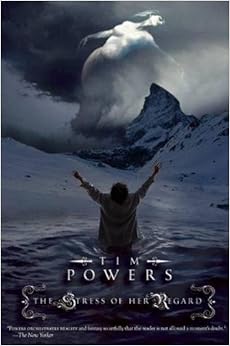
13. The Stress of Her Regard, written by Tim Powers. This brilliant reinvention of the vampire novel which blends its traditional undead antagonists with the Gorgons and the Muses, is a wonderfully persuasive piece of writing. I prefer the romantic yet depraved monsters of Anne Rice (or even Bram Stoker) to the recent flush of merely sentimental vampires that people like Stephenie Meyer have given us, but I prefer Powers’ bizarre, inhuman creations to either. The novel drags in places, but it’s a lavishly constructed world and the characters are beautifully painted.

12. Pan’s Labyrinth, directed by Guillermo del Toro. With this film and the book beneath, I was half-tempted not to count them, since they’re more dark fantasy than horror proper. Then I decided that was stupid because nobody cares, and besides, I recommend them both. Pan’s Labyrinth is a wonderful modern fairy-tale, and, like many good fairy-tales, also contains one of the most terrifying monsters I’ve ever seen, the Pale Man. With del Toro’s trademark effects and perfect sensibility for Faërie, this is not a film to miss if you have the slightest taste for fantasy, foreign film, movies with ambiguous endings, or just great storytelling.

11. Octavia, written by Melinda Selmys. Her short-story collection Against Nature is horror in a stricter sense (and contains some truly chilling stories, particularly ‘Catastrophic Beauty,’ ‘Rite of Atonement,’ and ‘Mother R’lyeh’), whereas Octavia is more along the lines of ‘hard fantasy,’ i.e. that kind of fantasy that is imagined as consistently as good sci-fi, of which Tolkien is the most famous example. The exploration of time, memory, secrecy, and causation in Octavia, and the dark mirror that it gives of the sacrament of Confession was creepy and fascinating to me. There were parts of it I found confusing, but the world and the people that Selmys imagines are captivating.

10. IT: Chapter One, directed by Andy Muschietti. Now, fair dues, I haven’t read the book and I only just saw the film this weekend, but I watched with a critical eye. I give the film a B+, maybe an A-: there were moments that were just a little too stereotyped to be convincing, including a few plot puzzles, although do look at this episode of Film Theory on that subject. But overall it was fantastic—the acting was superb (even though nearly all the principal characters were children), the effects were excellent without descending into mere showing off even once (such a common vice!), and the picture that it gave of the culture of childhood was remarkably good. So many books and movies try to depict children and betray only that the writers haven’t got the faintest recollection of what it was like to be a child, but IT beautifully captured the mixture of innocence, boldness, fear, sin, and that curiously rigid social code that characterize school age.


9. V/H/S, produced by Brad Miska. V/H/S is really a collection of stories within a frame, à la Boccaccio or Chaucer, rather than a single narrative; and not all of those stories are quite as good as the best of them (which, to my mind, are the first sub-frame story, ‘Amateur Night,’ and the fourth, ‘The Sick Thing That Happened to Emily When She Was Younger’). The short films are by no means cohesive, so if you don’t like anthologies then this movie is not for you; however, each of the short films is in my opinion creepy as hell in its own right, and if what you’re after is that peculiar shudder, I recommend it.

8. All Hallows’ Eve, written by Charles Williams. A unique book, penned by a devout Christian who knew a great deal more about the theory of ceremonial magic than most people do, All Hallows’ Eve depicts spiritual corruption through sorcery in a way I’ve never seen done elsewhere—plenty of people can write a morally evil character, but a character who is genuinely spiritually evil is beyond the ken of most. Williams is also rare in his power to make the reader feel that they’re dealing with unexplained but powerful realities, as opposed to the much commoner effect of making the reader feel they’re dealing with a villain whose powers the author hasn’t adequately thought out. War in Heaven, Descent Into Hell, and Many Dimensions have similar qualities, but Hallows is, narrowly, my favorite.


7. Nosferatu, directed by F. W. Murnau. This was the first vampire film, and one of the earliest surviving films, a silent movie released in 1922. Rather loosely based on Stoker’s Dracula, it retains the capacity to frighten even a modern viewer, not least because of Max Schreck’s ghastly appearance and manner as the titular vampire: no Lestat or Claudia or Armand, Nosferatu’s Count von Orlok is as visibly animal as he is practically cunning, and the blending of that human, cruel intelligence with the powers of the undead in this movie rivals anything that its modern successors have to offer.

6. Todd and the Book of Pure Evil, created by Charles Picco, Craig David Wallace, and Anthony Leo. Based on a short film of the same name, Todd is a horror-comedy set in a high school, sort of like if Buffy the Vampire Slayer were much more laden with sex jokes, poop jokes, loving tributes to death metal, and were Canadian. I tried Todd and the Book of Pure Evil more or less at random as a Netflix suggestion, and in so doing discovered one of my all-time favorite TV shows. It’s a typical monster-of-the-week format, but with writing so delightful and characters so convincing—even, a mythology so solid, for all its flippancy on the surface—that it blows most of its ostensible parallels out of the water. Not unlike Rick and Morty, one of my favorite things about it is its willingness and power to combine profoundly emotional moments and profoundly stupid (but funny!) jokes in a single episode or even a single scene.


5. The VVitch, directed by Robert Eggers. I must admit, I thought the music for The VVitch was stereotypical and overdone. On the other hand, I thought every other thing about it was just about perfect, so I’m prepared to overlook the music. The acting, the script, the periodicity, the pacing, everything was spot-on; and, most importantly, the titular witch was treated seriously: not as a pretext to critique Christianity (an intrinsically valid but all too often artistically boring pursuit) or to assert some kind of feminine spirituality, nor as a mere delusion—unless the majority of the film’s events were delusions, which is a possible and fittingly terrifying interpretation, though I don’t accept it myself—but as a real and active malice, operative both through temptation to luxury and indulgence and through temptation to paranoia and hatred, just as real evil spirits operate. (See also Eve Tushnet's review of the film in The American Conservative.)

4. Stranger Things, created by Matt and Russ Duffer. Once again this isn’t strictly horror; it’s mixed with period piece (though, the period being the eighties, the periodicity isn’t overstated, which if anything makes it better) and adventure in a rather Spielbergian vein. I’ve only just started season two, but I can definitely testify that season one, while packed with homages to older films and shows, plays with its sources and the tropes they use in a magnificently independent way. The Duffer brothers give their name the lie: practically every detail of Stranger Things is a delight of smart filmmaking.

3. The Invitation, directed by Karyn Kusama. I must also credit Phil Hay and Matt Manfredi, the writers of this film, for its brilliance. I grew up in the world of the Waco siege, the Heaven’s Gate suicides, and the scandals of the Church of Scientology, and even (or especially) as a religious person I’m sensitive to the dangers that lurk in the religious and philosophical impulses of man. The Invitation exemplifies those dangers with a realism I’ve never seen anywhere else; it freaked me out about as much as any other movie I have ever watched, with the possible exception of The Blair Witch Project—though since I do not believe in the Blair Witch but do believe in cults, I have to give this movie precedence in terms of pants-staining excellence.

2. This Book Is Full of Spiders, written by David Wong. This novel, the second in the Undisclosed trilogy, surpassed its outstanding predecessor by leaps and bounds. The peculiar brilliance of this novel is the skill Wong displays in juxtaposing the danger of the actual monsters with the danger of fear and hysteria, without minimizing either one. Many authors are all too apt to reduce or eliminate one of these dangers in the name of accenting the other; Wong, properly confident in the world he’s built and his own power as an author, follows each to its logical end in the framework of the universe he’s built, and thus he earns every victory and every horror his book contains. (Note that Spiders is better, but not at all incomprehensible, if you’ve already read the first book in the trilogy, John Dies at the End.)


1. The Babadook, directed by Jennifer Kent. In my experience, this is quite simply the best horror film that has yet been made. The script, directing, and cinematography are superb; the special effects are spot-on; the story has a wonderful balance of the primal fears of childhood and the psycho-social fears of adulthood; and the acting is, in every case, quite simply perfect. I cannot recommend this movie highly enough, and I look forward to literally anything else Kent does.

I’d also like to give an honorable, if fundamentally different, mention to my friend Eve Tushnet’s talk at the recent Doxacon gathering on The Humiliation of Authority in Horror Films, which is illuminating and engaging; I can also recommend Leah Libresco’s Wizardry and the Wounds of the World.

✠     ✠     ✠