Collect

Collect for the Fourth Sunday after Trinity

O God, the protector of all that trust in thee, without whom nothing is strong, nothing is holy: increase and multiply upon us thy mercy; that, thou being our ruler and guide, we may so pass through things temporal, that we finally lose not the things eternal; grant this, O heavenly Father, for the sake of Jesus Christ thy Son our Lord, who liveth and reigneth with thee, in the unity of the Holy Spirit, ever one God, world without end. Amen.
Showing posts with label Just War Theory. Show all posts

Thursday, June 18, 2015

A Pacifist Manifesto


I've written before, especially in the wake of the report to Congress on the outcome of state-sanctioned torture under Bush and Obama, of my pacifist convictions. I've wanted for some time to outline them more clearly; they express and govern, not simply an attitude to war, but an attitude to all interpersonal interactions, that I believe is badly needed in this country. St John Paul II's words about a culture of death hovering over the world apply just as much to the money-worshippers, war criminals, abortion advocates, and racist bigots of America and western Europe as they do to the fanatical religious terrorists, child-conscripting warlords, police state oppressors, and drug-trafficking butcher mafiosi of the rest of the world.

Violence is an abhorrent thing. This is the principle from which all pacifist conviction proceeds; and it is a principle that, though simple and obvious enough, is worth stating, because an awful lot of the time, debates over things like Just War Theory or gun control start at the wrong end -- with practicalities. I have nothing against being practical, but starting with the practical is the wrong way to do it, because in order for something to be practical, we need first to know what it is we are practicing and why. The inherent flaw of all mere pragmatism is its breezy uselessness; action, especially revolution, comes only from idealists.

Violence is abhorrent because life is precious. Life; that is, the lives of all human persons. (Though a legitimate and interesting inquiry, I won't be touching on animal rights here.) Any ethic that does not accept the sanctity of human life cannot be pacifistic, which is one of the reasons that the American Left has not succeeded in being consistently anti-war for a long time. It has opposed the Right, certainly; but mere opposition to the Right is of no importance in itself. But the support the Left gives to abortion*, assisted suicide, and euthanasia makes it impossible for it to be really pacifistic, because the essential quality that makes violence wrong has already been dispensed with. It is of course equally impossible for the Right to be pacifistic (not that it would be), because, for all its co-option of the pro-life cause, its typical endorsement of the death penalty, its military hawkishness, its hostility to immigration and public health services, and its acceptance of torture all defile any claim to regard life as sacred.


Both parties being wrong? Whodathunkit?

Now, one of the corollaries of the sanctity of life is the duty and right to preserve one's own life. The Church teaches, and I accept, that this makes violent acts to defend oneself or someone else against a violent aggressor morally legitimate. This is the root of the concepts of self-defense, protection of others (especially but not only one's family), law enforcement, and Just War Theory -- all of which I accept in principle. It's impossible to deny that every one of these ideas, as practiced by humans, is subject to human imperfection, and increasingly so the more humans are involved. Nevertheless, the maxim stands that Abuse does not abolish use; and one could hardly demand that, say, a man stand aside and let a home invader rape his wife, on the grounds that US conduct in Vietnam was reprehensible.

So, I acknowledge self-defensive violence -- let us say, chivalry -- to be intrinsically allowable. But I renounce it. Renunciation is a mirror image of denunciation: where denunciation condemns a thing in itself as bad, renunciation (what the doctors and mystics have called the Way of Negation, or apophatic theology) seeks God by forsaking a recognized good. Pacifism, set beside chivalry, is thus like celibacy set beside marriage, fasting set beside feasting, or vowed obedience set beside personal liberty.

But non-violence in itself is not very significant, for the same reason that not having sex isn't very significant unless you use it to refocus your attention and energies toward God. That reverence for life and for one's fellow-man has to be more than merely negating the impulse to injure him for liking Nickelback; more, even, than choosing, difficult and worthwhile though it is, to forsake one's right to defend oneself, out of respect for the image of God even in an aggressor. I identify the following principles as a fully pacifist ethos, the body of non-violence animated by the soul of charity.


1. Magnanimity. It's difficult to get this idea into a single word; magnanimity in the Aristotelian sense, which my Thomist readers may think of, is a somewhat different thing: generally it means being above revengefulness, or more generally, the opposite of being petty. That is included here. But more than that, the idea I'm going for as an outworking of pacifism is the deliberate choice to think as well of other people as the evidence allows you to. In other words, taking their words and actions in the kindest, most generous sense you know how; considering whether they may not be right, not least because it's hard to be unbiased towards oneself; remembering that even if what they say or do is truly unfair, or worse, they may have all sorts of extenuating circumstances of which we can have no knowledge, and extending them the benefit of the doubt, because for all we know they are doing as rightly as they know how -- and perhaps a lot better than we would in their shoes.

This is a hard virtue to master, because of course it's (usually) easy to think well of people who are nice to you, so that magnanimity is mostly called for when dealing with jerks. This, too, is why I speak of a deliberate choice, and not a sunny disposition. Having a sunny disposition is a capital thing, but it's also easily dispelled in most people, and when things get rough, a pleasant temper is no substitute for a will firm in the habit of love.


2. Restraint. This virtue could be flippantly summed up as "the opposite of comboxes." It's funny and sad that patience, which is theoretically so easy to practice at a keyboard (if only for the mechanical reason that it takes longer to type something than it does to say it), should be so nearly absent from the internet. Of course, it isn't only on the internet that we need patience; it's easy to see the chinks in a Christian's practice of moderation and long-suffering at Starbucks or in traffic.

It's more than just patience, though; restraint involves recognizing the limits of what we can and can't know. We can guess that, say, the defendant in such-and-such a case is guilty/a racist/likes Nickelback, but we can't know it. And we shouldn't pretend that we do. We can suspect that so-and-so who wrote that nasty article about us is a closeted and self-hating homophobe, or anti-Catholic, or a crypto-Marxist, but we can't know it. And we shouldn't claim to. It isn't merely that such behavior is rude and unloving, though it certainly is. It's that this lack of reverence for the image of God in one's brother, this refusal to extend the grace and charity and generosity that are the stuff of life (for all life is lived as a gift from others), is precisely the root of violence. Restraining your violent hands is mere repression if you don't do so by opening your heart to love and compassion, begging the grace to do so.


Matthias Gruenewald, The Small Crucifixion, 1510

3. Forgiveness. It's startling to me, and tragic, to see how little this virtue is practiced among Christians in this country. There's no shortage of bitterness, wrath, and rage-porn (thanks, HuffPost!), especially when it comes to horrible things like child abuse in the Church. There is also a great deal of the opposite problem of invalid indulgence: i.e., waving things away, pretending that they don't matter. This is lousy ethics, because it's lousy theology. An indulgence (roughly, letting someone off from a punishment) can only be granted to someone who has been forgiven already, and forgiving a sin requires confession and contrition -- i.e., acknowledging sin for what it is, and being sorry and saying so -- to come first. (The sickening behavior of Archbishop Nienstedt and the officials of the Archdiocese of Minneapolis-St Paul is an example of utter failure to confess or to be contrite, and of attempting to acquire indulgences and apply them to others to ameliorate the penalties of unabsolved sins.)

And mark this: of its very nature, forgiveness is a gift; and gifts cannot be demanded. It's excluded by the nature of what a gift is -- something unearned, an act of generosity on the part of the giver. No justice can bind any person to forgive. Of course, if we refuse to forgive, then we will not be forgiven, but that seems to have more to do with the cosmic laws of spiritual causality than with a rule imposed arbitrarily from without.

Nor, however fashionable it may be to point out the psychological and even physiological benefits of forgiveness, is it really possible to forgive in order to benefit oneself by forgiving. That, too, is contrary to the nature of forgiveness. It turns the gift into a kind of purchase, making the words of absolution a price for one's own peace of mind. No. Forgiveness is about the other person, not ourselves. Joss Whedon, though an atheist, knows far better: "To forgive is an act of compassion, Buffy. It isn't given because it's deserved, it's given because it's needed." Or, in Pauline language, While we were yet sinners, Christ died for the ungodly.

You can't, of course, compel repentance in another soul. If you could, we'd be living in a world of robots; the fact that the robots were made of flesh and bone would make no difference to that. But you can be ready to extend forgiveness at any moment, hoping for it, praying for it, opening one's heart to it. And that means ...


4. Bearing the Cost. This is not different in substance from forgiveness; in Hannah Hurnard's beautiful allegory Hind's Feet on High Places, the central character encounters a little speaking flower which says to her, "My name is 'Bearing-the-Cost,' but some call me 'Forgiveness.'" But the two do differ in expression. Forgiveness, insofar as it involves repentance and reconciliation, is the perfection of bearing the cost; bearing the cost is the decision to open oneself to forgiveness. And this decision is, metaphysically, the embrace of martyrdom.

Make no mistake: it is far easier (for most of us) to face forgiving someone than to face death, especially death by torture, as so many martyrs did. And forgiveness can be approached, though not completed, with pretty mixed motives.** But there is a continuum between the two decisions. Both involve the deliberate choice to open oneself to injury, to accept the anguish of being victimized by another person's sin, rather than retaliating. The Crucifixion is the model of this decision: Jesus did not run away; He did not resist; He didn't even ask them to stop torturing Him. He received the sins of Gentile and Jew, state and church, crowd and elite, stranger and friend, into Himself, and returned only love.

Very few of us will be called to that kind of self-sacrifice in the body. Most if not all of us, I suspect, will get the chance to make that kind of self-sacrifice of the soul; will suffer some injury or injustice so far from any justification as to leave open to us the possibility of a vicarious offering of ourselves to God for the sake of the offenders, praying with our Master, Father, forgive them, for they know not what they do.


*I'd add that contraception, in my opinion, fails to fully acknowledge the sanctity of life. However, this, though important, is a related issue rather than a directly relevant one, and -- with certain exceptions -- contraceptives are generally concerned to prevent conception, rather than to procure the death of an embryonic human being, so that referring to contraceptives as a form of violence is at best misleading. Hence, I won't go further into the matter than to acknowledge here that it is a related and important topic of its own.

**Not that mixed here should be taken to mean false or thoroughly self-centered. Self-interest and even fear can prompt us to try to forgive; but the divine spark of love, however small, must be invested into the action if it is to be forgiveness. Thankfully, God distributes these sparks pretty freely.

Friday, December 19, 2014

His Blood Be Upon Us

Like my last post, this one deals with torture. Don't read it while you're eating or if you don't like things that are hellish in their ghastliness. Otherwise, uh, soak it up, I guess.


O for a voice like thunder, and a tongue
To drown the throat of war! When the senses
Are shaken and the soul is driven to madness,
Who can stand? When the souls of the oppressed
Fight in the troubled air that rages, who can stand?
When the whirlwind of fury comes from the
Throne of God, when the frowns of His countenance
Drive the nations together, who can stand?
When Sin claps his broad wings over the battle
And sails rejoicing in a flood of death;
When souls are torn to everlasting fire
And fiends of hell rejoice upon the slain,
O who can stand? O who hath caused this?
O who can answer at the throne of God?
The Kings and Nobles of the land have done it!
Hear it not, Heaven, thy ministers have done it!

-- Poetical Sketches, "Prologue Intended for a Dramatic Piece of King Edward the Fourth," William Blake


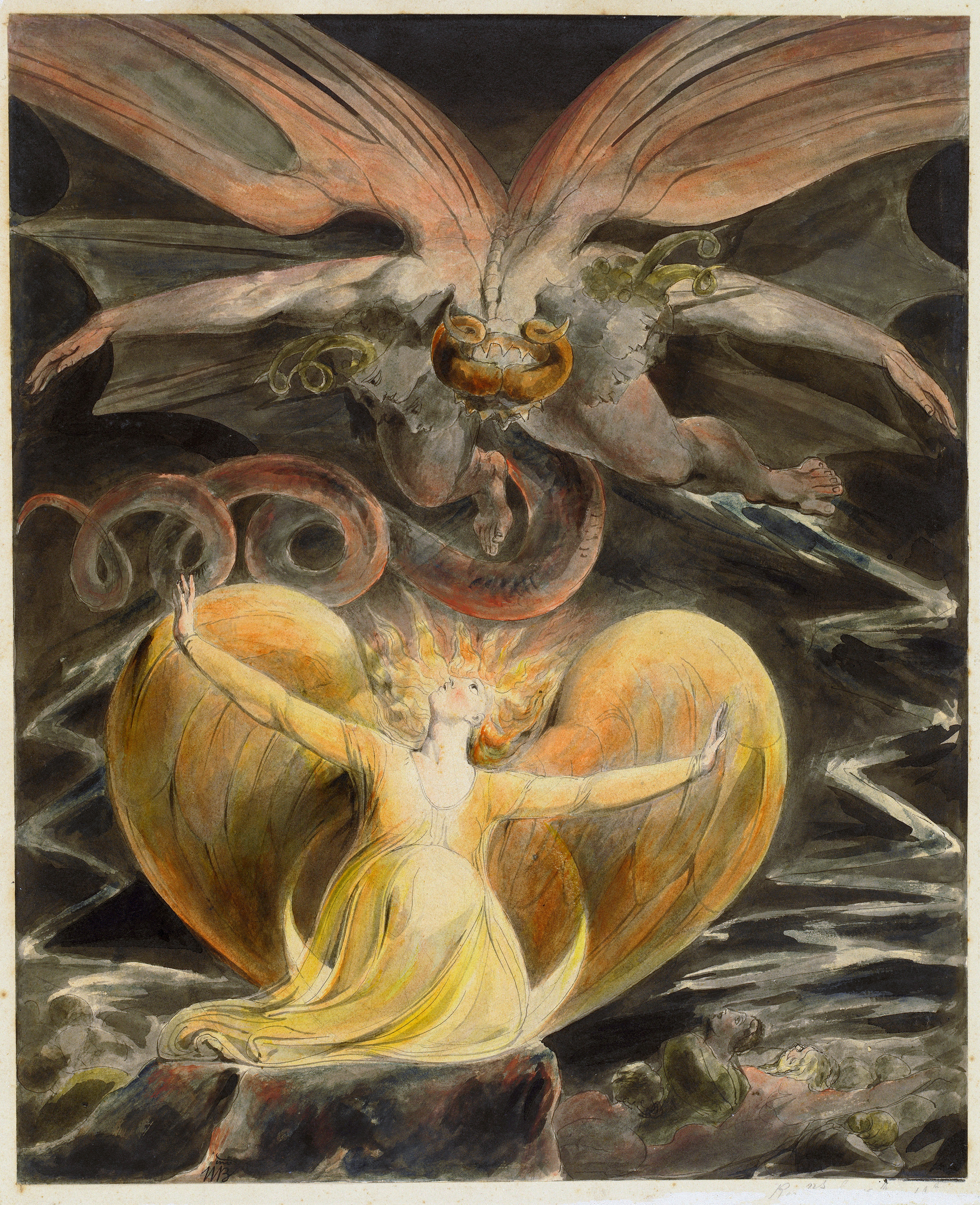
The Great Red Dragon and the Woman Clothed with the Sun, William Blake, 1805

+     +     +

I've written a little on the subject of torture recently, in the wake of the report made by the SSCI. My previous post was more concerned to explain my own pacifism; my blood then curdled to see people -- nearly all of them professing and practicing Christians -- positively coming out of the woodwork to defend the use of torture, as a drastic necessity or even as a work of positive justice.

For the purposes of this post, I'll ignore the more obvious blasphemies of creatures like Sarah Palin. D. C. McAllister at The Federalist is one author who has come forward in defense of torture.* She writes:
... 79 percent of evangelicals in America and 78 percent of Catholics (along with 68 percent of all Americans, according to a recent poll) ... say torture can be justified. ... Torture in some forms and in some circumstances -- conducted by the police and military officials -- can be morally justified because (1) torture is not necessarily morally worse than killing (i.e., the death penalty); (2) the terrorist has forfeited his right to life and his dignity by his own evil actions; and (3) the innocent lives that can be saved are of higher value than any moral claims by the terrorist who has committed atrocities.
Now, in strict fairness, I must say that I was predisposed to disagree with (and indeed be pretty horrified by) McAllister's essay; having read it, as objectively as I can, I do find it objectively horrifying. I also think that its argument is rationally sloppy. However, since it seems to be fairly representative of Christian defenders of torture, and also better written than many -- for instance, she has the great good sense to define her terms -- I've chosen it as my point of departure.

McAllister defines torture as "the infliction of severe pain on a defenseless person for the purpose of breaking his or her will," which seems as good a definition as any.** This, from the start, places torture decidedly outside the traditionally Christian view of violence.


Have a kitten. You're, uh, going to need it.

The abhorrence of Jesus for violence hardly needs to be explained; though He seems to have been angry, or at least exasperated, often enough, we have only two instances on record of His being by any description violent, neither one against human beings. And when things came to the point, He made quite explicit His refusal to employ any kind of force, and indeed, openly begged His Father to forgive His crucifiers. Yet all that being said -- and even apart from the subsequent history of Christendom, with its wars and rumors of wars -- it is difficult, even so, to take the view that, say, the mother who knocks a man on the head with a lamp to keep him from raping her daughter has really sinned by doing so. To argue, as some pacifists do, that even defending the life of a defenseless innocent is wrong, is far too demanding a doctrine for most people to even consider.

The Catholic (and mainstream Christian) solution to this paradox has been that violence in defense of one's own life or the life of another is morally permissible -- and may even, when it comes to those who depend on us, be a duty -- but that this is qualified in three important ways. First, it's precisely defending the innocent that is allowed here, not a general license to harm or cause pain to an attacker. Second, coming from this first concern about motive, the defensive means must go only as far as it takes to effectively restrain an attacker from hurting someone, no further. And third, at any rate in the case of self-defense, it is also permitted to forsake this right, rather in the way that forsaking the right of marriage in favor of celibacy is not required of Christians yet is still a good work. These notions about violence -- which, I think, first began to be formulated by St Augustine, after Constantine's quasi-conversion had improved and complicated the relationship between the Church and the Empire -- finds expression both in the idea of self-defense, and in the tradition of Just War Theory.

In any case, one of the essential threads in the tapestry is that only an aggressor may be responded to through violent means; another is that only those means which effectively prevent an aggressor from causing harm, and no more, may be used. St Thomas, whom McAllister refers to a number of times in her essay, is quoted in the Catechism on this point.
Human life is sacred because from its beginning it involves the creative action of God and it remains for ever in a special relationship with its Creator ... God alone is the Lord of life ... The legitimate defense of persons and societies is not an exception to the prohibition against the murder of the innocent ... "If a man in self-defense uses more than necessary violence, it will be unlawful: whereas if he repels force with moderation, his defense will be lawful ..." Torture which uses physical or moral violence to extract confessions, punish the guilty, frighten opponents, or satisfy hatred is contrary to respect for the person and to human dignity.***
How does all this this exclude torture? Well, look back at the definition: torture is the infliction of severe pain on a defenseless person. Defenseless people are in no position to be aggressors; they have already been restrained. The moment an aggressor's power to harm is neutralized, according to the Christian tradition, our right to use violence disappears -- because it ceases thereby to be self-defensive violence. And this holds in the formulation of Just War Theory, whose exponents have long maintained that not only civilians but even prisoners of war have a right to humane treatment, precisely because they no longer qualify as aggressors.

But what about terrorism? Terrorists are already breaking all the rules of justly conducted warfare -- they deserve to have those rules broken right back on them!
Deserves it! I daresay he does. Many live that deserve death. And some die that deserve life. Can you give it to them? Then do not be too eager to deal out death in judgment. For even the very wise cannot see all ends.****

Gandalf the Grey, wearing what may be the finest "bitchplease" face in pretend-history.

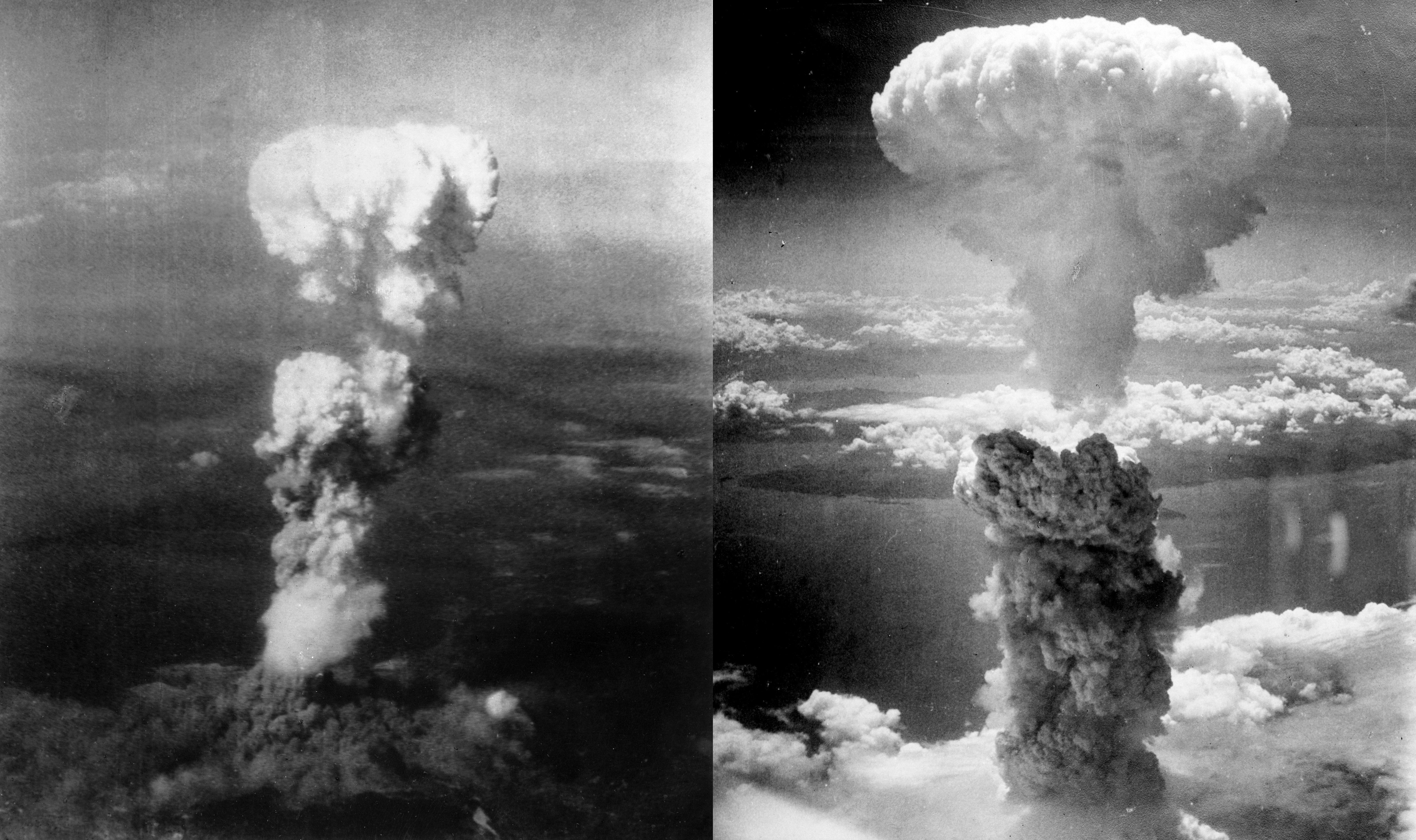
And if we speak of just deserts, I think we must be prepared to meet the ghosts of the Cherokee, the Chickasaw and the Choctaw, the Muscogee and the Seminole, the Sioux and the Dakota, the dead of Tippecanoe and Wounded Knee; the ghosts of African and Caribbean slaves, the "strange fruit" that hung from Southern trees, the victims of depraved Tuskegee; the ghosts of Dresden, Hiroshima, and Nagasaki; the palatably-termed "collateral damage" of Afghanistan and Iraq.

McAllister's argument is (in my judgment) founded on deeply un-Christian premises. She asserts that it's worse to kill someone than to torture them, because "When someone is dead, they have no autonomy, no hope of life, and no dignity. They're dead." This line of thinking is materialistic: it makes life the highest good, and declares that those who lack life lack humanity. But some of the most basic Christian doctrines are the immortality of the soul and the resurrection of the body. If the soul continues to exist, then they do still have autonomy and dignity; and if we will be raised again to life at the Last Day, then hope of life is a given as well. No thoroughly Christian defense can be made for the claims McAllister here makes as part of the basis of her argument.

She goes on to point out that death by torture (namely stoning) was the standard form of capital punishment prescribed in the Torah; she also states that
If killing were not morally justifiable on the basis of human dignity, God would be a monster. But he isn't. Why? Because of human guilt. Even though the Bible says "Thou Shalt Not Kill," God orders Joshua to "go in and clean house, and don't leave anything breathing! Don't leave a donkey, child, woman, old man or old woman breathing. Wipe out Jericho!" He can order this because these people had violated God's law and in so doing had forfeited their rights and lost all sense of dignity.
I decline to speculate -- still less (for once), to pontificate -- on why God did this or that in the Old Testament. Most of that part of the Bible is very mysterious to me; though I will point out that, in Job, God sternly rebukes those who deduce from human suffering that the person who suffers deserves to do so.

That question aside, I don't think that appeals to the Old Testament work for us, for two reasons. First, the Torah and the rest of the Old Testament record God dealing directly with a nation with whom He had made a covenant. He has made no such covenant with America. It isn't to be expected that a one-for-one correlation between the Torah and political justice as such should exist.

And second, to be blunt, I'm deeply disturbed by a lot of things in the Old Testament. Slavery, racism, and infanticide all make more or less regular appearances, and they aren't always being practiced by Gentiles, nor even by apostate Jews. I don't know what the explanation for that is; I am quite certain that if someone deduces from their presence in Scripture that these things are morally acceptable, that person creeps me the fuck out, and frankly I don't want them anywhere near me or my nephews. If the story of the averted sacrifice of Isaac would have made just as much sense to you if Abraham had murdered his son and God had accepted it as worship, like Moloch, your theology is Satanic.


"Tash! Tash! The great god Tash! Inexorable Tash!" (There was no nonsense about "Tashlan" now.)
-- C. S. Lewis, The Last Battle, Cap. XII: Through the Stable Door

But, one might point out, Isaac was innocent, and McAllister's argument was that these people forfeited their human dignity by violating God's law. What, the babies? The farm animals? They got what was coming to them?

Besides, how do we measure this? -- how bad does a person have to be before they forfeit their rights as a human being, made in the image and likeness of God? Do they have to be a war criminal like Adolf Eichmann or Osama bin Laden or Saddam Hussein? What if they're only a war criminal like Harry Truman or George W. Bush or Barack Obama? Or is it perhaps a question of whether they fly the Stars and Stripes over their killings?

She asserts, too, that the use of the death penalty in the Bible plainly shows that human dignity is mutable, and that the doctrine of hell shows this even more so. I don't think either of those things follows. Of the first, the Catholic Church (and most Christian thought on this subject with her) admits that defending yourself against unjust aggression entitles you to use such force as will restrain the attacker -- even lethal force. But that is justified only if lethal force is the only kind that will suffice, and is permitted not because the criminal deserves it, but because you aren't obligated to surrender your own life. To use more force than is strictly necessary, or to desire a criminal's death for its own sake, rather than (in the logical sense) accidentally, is wrong.

As for hell, the Catholic tradition -- while not excluding the language that God sends people to hell -- has laid more emphasis on the fact that the damned choose hell. "Without that self-choice there could be no hell," as C. S. Lewis states in The Great Divorce. If God respects that choice, it is because of human dignity and autonomy, not in spite of them: He will force everlasting bliss upon none who refuse it.


William Blake, The Lovers Whirlwind, Francesca da Rimini and Paolo Malatesta, 1827

McAllister treats it as a truism throughout that it is worse to kill than to torture, and that therefore, if war can be accepted, so can torture. I dispute this also. Everyone is eventually going to die, so that killing is morally important for slightly different reasons than our usual modern, scientistic, materialist habits of thought would imply: important because God, not man, is the Lord and giver of life, and because man is made in the image of God. Conversely, not everyone will be subjected to torture; it is an avoidable evil, unlike death, which can at best be postponed.

I do maintain that it is worse to torture a man than to kill him. For -- going back to that important definition -- a victim of torture is defenseless (whatever his past conduct), and the only kind of killing I admit to be just is the killing of an aggressor, and even then I admit the justice of killing only when nothing else will suffice.

Conversely, torturing a man is specifically designed -- as McAllister says -- to break his will. That is, to reduce him from the status of a rational soul to that of a shambling mess, by terrifying him and treating him like filth. Her assertion that "Interrogative torture is not prolonged, maximal, pleasurable, vengeful, or punitive, and it does not have long-term debilitating consequences that completely disrupt a person's ability to function normally" reads like a tasteless joke. Yeah, I'm sure the prisoners who had pureed food rammed into their rectums will just get over it; that the ones who were waterboarded literally hundreds of times weren't traumatized at all; that the torturers who had admitted to prior anger management issues and freaking sexual assault didn't experience any sensations of pleasure, vengeance, or punishment while they were subjecting the victims to mock burials or threatening to rape their mothers; that the victims who were wrongly imprisoned in the first place (which lasted for months after the CIA had determined there was no reason to keep them there), and the one who died because of the way he was treated --

Did you miss that part before, Ms. McAllister? When you were talking about innocent lives being worth more than the lives of terrorists (for each one of whom Christ died), did you miss the fact that innocent people were detained and tormented along with the guilty? When you were saying that it's worse to kill someone than to torture him, did you miss that we did exactly that, and in the most degrading and hideous way possible?


I haven't even brought up the question of the horrific effects of torture upon the perpetrator -- since, in order to torture someone, you have to make yourself (however temporarily) the sort of person who will torture someone. Some CIA operatives felt the same way, objecting to what their employers nonetheless ordered them to do; some of them were disturbed to the point of weeping. But I can barely stand to write any more about this. 

Still, it may be worth noting, for anyone who can still stand to read about it, that torture has also been conclusively shown to not work. At all. Even those who gave information under torture often gave false or misleading information -- because why the fuck wouldn't they? -- and literally all of the useful information we obtained was gotten without torture. I am not kidding or exaggerating, and I'm not pulling it out of my ass, either; it was one of the things the SSCI found in their investigation.

I take that back; it did work for one purpose. It made the psychologists who developed the torture techniques the CIA used over $81 million. But I'm sure that's a coincidence, and not one of the most despicable examples of war profiteering in Western history.

Ms. McAllister, if you should happen to read this, I implore you to look squarely at what you have been defending and acknowledge that it is evil, and to repent.

To anyone reading this: I have been fasting and praying today for the healing of victims of torture, and I solicit your help in doing so, as I solicited the same thing for torturers this past Wednesday. Tomorrow, I plan to do the same thing, on behalf of those who did or do advise or approve of torture. The torturer, the tortured, and the one who counsels torture are all my brethren -- I will dissociate myself from none of them, but confess and practice the coinherence, reciting with the great John Donne:
The Church is Catholike, universall, so are all her Actions; All that she does, belongs to all. ... And when she buries a Man, that action concernes me: All mankinde is of one Author, and is one volume ... The Bell doth toll for him that thinkes it doth; and though it intermit againe, yet from that minute that that occasion wrought upon him, hee is united to God. ... [A]ny mans death diminishes me, because I am involved in Mankinde ... The Bell rings out, and tells me in him, that I am dead. 
-- Devotions Upon Emergent Occasions, Meditation XVII

Pilate took water, and washed his hands before the multitude, saying, I am innocent of the blood of this just person;
see ye to it. Then answered all the people, and said, His blood be on us, and on our children. -- Matthew 27.24-25

+     +     +


Torture victim at Abu Ghraib, four of whom have since been sued by a US defense contractor.

God of our fathers, known of old,
Lord of our far-flung battle line,
Beneath whose awful Hand we hold
Dominion over palm and pine --
Lord God of hosts, be with us yet,
Lest we forget -- lest we forget!

The tumult and the shouting dies;

The Captains and the Kings depart:
Still stands Thine ancient sacrifice,
An humble and a contrite heart.
Lord God of hosts, be with us yet,
Lest we forget -- lest we forget!

Far-called, our navies melt away;

On dune and headland sinks the fire:
Lo, all our pomp of yesterday
Is one with Nineveh and Tyre!
Judge of the Nations, spare us yet,
Lest we forget -- lest we forget!

If drunk, with sight of power, we loose

Wild tongues that have not Thee in awe,
Such boastings as the Gentiles use,
Or lesser breeds without the Law --
Lord God of hosts, be with us yet,
Lest we forget -- lest we forget!

For heathen heart that puts her trust

In reeking tube and iron shard,
All valiant dust that builds on dust,
And guarding calls not Thee to guard,
For frantic boast and foolish word --
Thy mercy on Thy people, Lord!

-- Recessional, Rudyard Kipling (composed for Queen Victoria's Diamond Jubilee) 


*I have assumed (based on her argument and background) that McAllister is a professing Christian. If I'm mistaken about this, and she is simply conducting a hypothetical argument on Christian premises, then I apologize, as in that case much of my own argument is merely irrelevant to her. (I have done my best in the course of my argument to avoid assuming that she is a Protestant or a Catholic, since she has attended and written for Protestant institutions but also very largely cites Catholic sources in her essay.)


**We need not be detained by the philosophically important, but only orthogonal, possibility of torture whose primary purpose is not to break the victim, but to satisfy some appetite of the torturer, such as lust for revenge or perverted sexual appetite (which latter, as in BDSM, need not be a violation of the victim's will at all).

***Catechism of the Catholic Church, paras. 2258, 2263-2264, 2297; italics are original. The section in quotation marks is taken from Aquinas' Summa Theologica, Part II, Second Part, Question 64, Article 7.

****The Lord of the Rings: The Fellowship of the Ring, p. 69. This may be the more significant in that neither Tolkien personally nor the character of Gandalf can be regarded as pacifists, nor cowards, nor intellectual slouches.

Friday, December 12, 2014

Peace Which Passeth Understanding

Warning: this post deals frankly with torture, which is some fucked-up shit; it is not recommended for people who are easily disturbed by things that are completely horrible.

I was more than a little irked when I was sent a link to the article "Our Partial Pacifism" on First Things, which lays the blame for our government's acceptance of torture, partly at least, at the feet of pacifists. Author Matthew Schmitz says the following:
Traditionally, Christians have argued that there is something called "just war." Leaders and their nations are bound to prosecute war justly without resorting to immoral tactics. Some things are in bounds, some out. 
In reply, pacifism insists that all war is evil -- that it is hell, so we must stay the hell out of it. This position is much derided, but more for the conclusions it reaches than the argument it makes. Many people believe along with the pacifists that war does indeed necessarily involve evil actions and so any attempt to impose a moral standard on our conduct is doomed from the start. 
Elizabeth Anscombe noted this in reviewing the justifications offered for the use of the atom bomb. Those who argued for it did not argue that it was in fact justified, they argued that war always and everywhere demanded the unjustifiable ...

Efficiency! Also genocide!

There are of course pacifists who believe that it is always wrong to use any form of violence, even in defense of the lives of innocents; not I. I accept self-defensive violence and indeed Just War Theory. Mind you, that still leaves approximately all wars open to criticism, since most are fought for unjust reasons, by unjust means, or both; but if the question is whether it is in principle morally acceptable to defend one's country by violence, then my answer is yes.

The reason I still describe myself as a pacifist is that I personally reject violence, because I feel called to do so. I think that the renunciation of the right of self-defense is not strictly necessary, yet a good thing, as renouncing the right to marry in favor of celibacy or the right to property in favor of poverty are good things. I think that pursuing one's ends through consistently non-violent means is a more excellent way, and that not making use of one's rights in order to imitate Christ, who emptied Himself of His rights as the Deity, more closely, is one legitimate path to holiness, and one for which we have a great deal of Scriptural, historical, and saintly precedent. Saint Joan herself, it may be noted, urged her opponents to withdraw rather than be killed, and carried no weapon but only a banner.

I hasten to add that my conviction of a pacifist vocation has been little tested. I don't know what I would do in the heat of anger or, still more, fear. I've participated in one anarchist anti-Nazi protest that included (but was not stopped by) a few protesters being arrested, and at the time I felt no impulse even to run, let alone to fight; that is as close as I have come. So I don't propose to make myself a poster-boy in all this.


Reminder: I'm this guy.

Turning to the question of torture, I don't know that I accept the charge that pacifism -- whether of the vocational sort that I espouse, or of the absolutist sort that would condemn a man for defending the lives of his children (such as seems to be implied by Shane Claiborne and others) -- has contributed to our acceptance of torture. It's true, certainly, that the same oversimplifications about justice and violence are present in both systems; but I don't see, based on my knowledge of the history of philosophy, that absolutist pacifism has had anything like enough range or influence to indirectly cause a corruption of Just War Theory into the pragmatic, patriotic theology that justifies torture, whether espoused with the honesty and reluctance of a Charles Krauthammer or the twisted, diseased sacrilege of a Sarah Palin. Torture has been a recurring problem, practical and philosophical, throughout Western history, and nearly all our institutions both political and ecclesiastical are stained with it; I do not think it is pacifism that has made it appealing as a solution to the minds of a frightened and unreflective generation.

I was heartbroken, and horrified, when, as a high schooler listening to discussions at my school over the then-current interrogations and invasions connected with the pursuit of al Qaeda and the Taliban, I realized that some of my Christian brethren were seriously proposing that torture could be countenanced. Mark Shea's ire is, in my opinion, completely justified. Torture is a hideous and fundamental assault upon the dignity of man as the image of God; no Christian may ever approve of its use, and the fact that Christians have done so in the past and do so in the present is one of the blackest marks on our history.

So what am I saying? That the lives of terrorists are more valuable than the lives of infants? Well, do let's keep in mind that there is no exchange center where you can trade one life for another, or weigh them in scales. Let's remember, too, that every human being -- including, as Scripture so often reminds us, our enemies -- is precisely a human being, an icon of the uncreated God; not a cost-benefit ratio. Or, to be more exact, there is an exchange center, and it looks like this:


Neither the U.S. government nor any other has access to that medium of exchange; nor is such a way of trading lives how the coinherence functions, whatever necromancers say.

But after all, torture works, right? It gets intel we wouldn't get otherwise, doesn't it? Well, no, there's actually no reason to think that at all. People regularly hold out under torture, or give false or misleading information -- whether out of cunning or to make the pain stop. Why wouldn't they? Besides which, whether it works is really beside the point. If something is always wrong, it's still wrong if it works. And torture is always wrong. It degrades not only the victim but the torturer; in order to ram food into a man's rectum or threaten to slit his mother's throat as a means of forcing him to talk, you have to become the sort of person who is willing to do that ramming and that threatening, and that kind of person is horrible.

It is peculiarly tragic, and stupid, that pro-life Catholics should apparently be disproportionately likely to advocate such measures. We, of all people, ought to know better. Not only because of the clear voice of the Church on such matters; not only because the dignity of all human life is, literally, the point of being pro-life; but because we have a special reason to recollect that everyone does eventually face the Four Last Things: death -- judgment -- heaven -- hell. What will you gain by saving your own skin, or someone else's, at the expense of your soul's corruption? It is, all but literally, making a deal with the devil: obtaining an expanse of earthly life, at the cost of damnation.


Inasmuch as ye have done it unto the least of these, My brethren, ye have done it unto Me.

Not that that penalty cannot be avoided, if you do approve of torture or have done so in the past, or have even participated in it. But the sole way out is repentance.

And all this is part of why I have, to the best of my ability and with little confidence in myself, renounced even just violence. It may be a hard path, one with its own spiritual perils, and one not strictly necessary nor suitable for every person; but it has the advantage of being a simple one. I believe that accepting violence even when it is just to do so carries with it the dangerous tug toward accepting violence when it is not just to do so, and I do not propose to open myself to that risk.

Moreover, such a vocation is eschatological. As celibacy prefigures the kingdom in which they neither marry nor are given in marriage, but are like the angels of heaven, as poverty prefigures the kingdom in which they kept all things in common and none of them called anything his own, so pacifism prefigures the kingdom in which there will be no more pain, and God will wipe away every tear from their eyes. And it has this eschatological or prophetic character because it imitates our Lord, who, as He said, could at the moment of His arrest have called upon twelve legions of angels to halt the injustice, sparing the Apostles their lapses into cowardice and apostasy and perhaps converting both the Sanhedrin and the soldiers; but He would not force them. He represented in His person a new way of being, a peace which passeth understanding, and to Greeks foolishness. His victory was the victory of love, which is more powerful than power. He received into Himself the totality of human hatred and violence, together with the uttermost consequences, and showed Himself the conqueror.


The third week in Advent is an Ember week, one of the four traditional weeks in which Wednesday, Friday, and Saturday are observed as days to fast (wholly or partially) and to abstain from meat. This year, that means the 17th, 19th, and 20th of December. I encourage you, readers, to join me in observing this fast, not only in preparation for Christmas, but in penitence and humble supplication to God for forgiveness and healing in this country.

Saturday, August 9, 2014

Why I Am a Pacifist

Reflect now, how Our Lord Himself spoke of Peace. He said to His disciples, 'My peace I leave with you, my peace I give unto you.' Did He mean peace as we think of it: the kingdom of England at peace with its neighbors, the barons at peace with the King, the householder counting over his peaceful gains, the swept hearth, his best wine for a friend at the table, his wife singing to the children? Those men His disciples knew no such things: they went forth to journey afar, to suffer by land and sea, to know torture, imprisonment, disappointment, to suffer death by martyrdom. What then did He mean? If you ask that, remember then that He said also, 'Not as the world gives, give I unto you.'

-- T. S. Eliot, Murder In the Cathedral, Interlude

+     +     +


This past Wednesday was the Feast of the Transfiguration; next Friday marks the Assumption of Mary.* I had never paid much attention to the confluence of these two great feasts of the Church before this year -- I had always noticed it, but not known what, if anything, to make of it. Indeed, it seemed to me a little inconvenient for our Eastern brethren (Orthodox and Catholic alike), because they observe a two-week fast leading up to the Assumption, but there is the Transfiguration, one of the greatest feasts of the year, interrupting it, which I kind of thought would break the mood.**

However, as I was looking up a novena to pray to help prepare for the Assumption, which has long been one of my very favorite feasts, I came upon this one, which links the Assumption firmly to the power of God over life and to His own Resurrection. That, of course, is very natural; but what I had not known about until hunting for an icon to go with this poem that I wrote, is the association, going back to the primitive Fathers of the Church, between the Transfiguration and the Resurrection. They taught that the splendor revealed to SS. Peter, James, and John there was a foretaste of the resurrected, glorified body. To set it in apposition to the Assumption -- a foretaste of the Resurrection, in a sort of diptych with an echo of Christ's Resurrection and an anticipation of the final resurrection of all the dead -- is therefore a very striking feature of the Church's calendar.


The Assumption of the Virgin by Nicholas Markell

It is striking, too, that this sequence should come in conjunction with a slough of martyr's days. Notably, there are the memorials of St. Lawrence, arguably the patron of sassy comebacks, who famously told his executioners while he was being roasted alive, "Have a bite, it's done"; St. Maximilian Kolbe, a Polish Franciscan who was a missionary to Japan and a profound Marian mystic, who offered his own life in exchange for a prisoner in a concentration camp; and, today, St. Teresa Benedicta of the Cross, also known as Edith Stein, a German Jewess who after years as an atheist converted to Catholicism. She spent years teaching and writing philosophy, until in 1933 she was forced out of that profession by the newly instituted anti-Semitic laws; the next year, she became a Carmelite nun. She and her sister Rosa, also a convert, were eventually murdered by the Nazis at Auschwitz.

Today is also remarkable as the anniversary of the bombing of Nagasaki. Hiroshima was bombed on the feast of the Transfiguration -- unnatural light against supernatural light, as it were -- and Nagasaki, three years to the day after holy Teresa Benedicta offered up her life. The second atomic bomb hit the ground only a third of a mile from Urakami Cathedral, the city itself having been a major center of the Catholic faith in Japan for three centuries.

I find myself coming back and back to these events in grief. I have never believed that these bombings were right. One of the most basic rules of just warfare is that noncombatants are not to be touched, and one of the express purposes of both bombings was to cow the Japanese into surrender by targeting the civilian population. The Catechism states in no uncertain terms that
The Church and human reason both assert the permanent validity of the moral law during armed conflict. The mere fact that war has regrettably broken out does not mean that everything becomes licit between the warring parties. Non-combatants, wounded soldiers, and prisoners must be respected and treated humanely. Actions deliberately contrary to the law of nations and to its universal principles are crimes, as are the orders that command such actions. ... Every act of war directed to the indiscriminate destruction of whole cities or vast areas with their inhabitants is a crime against God and man, which merits firm and unequivocal condemnation. -- Paras. 2312-2314
The inability or refusal of even many Catholics in this country to call this particular spade a spade, or more precisely a bloody shovel, is a burning sorrow to me. I have heard the arguments a thousand times over: it saved American lives by shortening the war, it saved Japanese lives by shortening the war, the Japanese were guilty of horrific war crimes themselves, pamphlets were dropped on Hiroshima warning people to get out, and on and on. I have no sympathy with such arguments. A crime is a crime, regardless of what it was done to obtain. Killing defenseless people is murder, war or no war. And call it karma if you want, but I think that corrupt actions have a tendency to work backward and poison even the good intentions of the people who do them -- or approve of them after the fact.

And as for the notion of saving lives, well, two things. First, why don't we pretend we can go back in time. We'll go to Nagasaki, and we'll sit down with the little girl whose skin was melted and mutilated by atomic radiation, whose father had already been killed in action and who watched her mother burned alive by the bombing, and we'll explain to her that it was to save Japanese lives that we did that.


"Am I my brother's keeper?"

Secondly, no, it didn't save lives. Because everybody dies eventually anyway. That isn't just a clever turn of phrase about just and unjust methods of warfare, that is the brutal facts of life and how it always ends. God Himself ended His life in death; and that death was followed by resurrection, but death came first. You cannot save a man's life; you can only grant him a reprieve.

And that leads me into one of my chief reasons for being a pacifist. Objecting to war because it causes men to die is, to my mind, a bad reason: you might as well object to sex because it brings men into existence, only to die seventy years later (if they're lucky). True, war brings about many tragic deaths that would otherwise be avoidable, but so does hiking. And for that matter, some defenders of Just War Theory -- my masters C. S. Lewis and G. K. Chesterton among them -- have rightly pointed out that men are quite as likely as not to be adequately prepared for death in a trench or a tank, since the issue is forced upon them. Nothing like imminent death to set your mind on the Four Last Things.

I don't object to war because it makes men corpses. I object to war because it makes men killers.

+     +     +

PRIESTS [severally]
My Lord, you must not stop here. To the minster.
To the cloister. No time to waste. They are coming back, armed. To the altar, to the altar.

THOMAS
All my life they have been coming, these feet. All my life
I have waited. Death will come only when I am worthy,
And if I am worthy, there is no danger.
I have therefore only to make perfect my will.

PRIESTS
My Lord, they are coming. They will break through presently.
You will be killed. Come to the altar.
Make haste, my Lord. Don't stop here talking. It is not right.
What shall become of us, my Lord, if you are killed; what shall become of us?

THOMAS
Peace! be quiet! remember where you are, and what is happening;
No life here is sought for but mine,
And I am not in danger: only near to death.

-- T. S. Eliot, Murder In the Cathedral, Part II

+     +     +

Children, women, and men lose their lives every day. War does not alter the death rate in the slightest: it has been holding steady at 100% for as long as records have been kept on the subject (Enoch and Elijah notwithstanding), and very possibly longer. But war, like murder, involves people in the deliberate snuffing out of human life. Man is the image of God: to take another man's life is to violate that image, to deface the living icon of God. It is impossible to do such a thing without risking corruption of the soul. To do so deliberately and consciously, without just cause and just means, is, apart from repentance, damnation.

The sanctity of human life is a truth with which we have long lost touch; we live in a remarkably cynical age. I'm talking about everything from abortion to war to the death penalty. And, behind these, the despair of eternal values that animates both the realpolitik that effects many of the wars we are and have been entangled in, and the utopian idealism (notably to be found in many forms of socialism) that claims to confront such wars. The despair of the former is no doubt obvious enough; the despair of the latter is subtler, but no less present, for when (as always happens in a broken world) the utopian finds his hopes disappointed -- when he discovers, as Solzhenitsyn said, that the line dividing good from evil runs not between classes or parties but down the middle of every human heart -- he has nothing to fall back on. When neither circumcision is anything, nor uncircumcision, he has no faith in a new creature to sustain him.

It is faith in a new creature, the deliberate decision to know all men in Christ, that moves me to be a pacifist. For the love of Christ constraineth us, because we thus judge, that if one died for all, then all were dead: and that he died for all, that they which live should not henceforth live unto themselves, but unto him which died for them, and rose again. Wherefore henceforth know we no man after the flesh: yea, though we have known Christ after the flesh, yet now henceforth know we him no more (II Cor. 5.14-16).


I don't mean that I think violence is always wrong, for everybody, regardless of circumstance. I believe that I am personally called to pacifism, and would urge others to adopt it, but I condemn no one on grounds of not being a pacifist.

A number of contemporary Christian pacifists, such as Shane Claiborne, have taken the view that Jesus' own teaching and that of the primitive Church was pacifistic, not simply in the sense of renouncing violence -- that is, choosing to forsake something that can sometimes be licit in itself, as a celibate acknowledges the good of marriage, but forsakes it for a different path -- but in the sense of denouncing violence, that is, maintaining that it is always and in every situation wrong. I sympathize with, but cannot adopt, such a position.*** If a man kills another man solely in direct defense of his own life, I can't really bring myself to say that he is spiritually condemned unless he repents of that self-defense. Or that the man who uses violence to prevent his wife or his child from being harmed is reprehensible for doing so. He is doing something that risks his own spiritual well-being, for unnatural actions, even those that incur no guilt, always wound the soul and pose a temptation to it to distort its own moral compass thereafter; and every act of violence, however thoroughly justified (to the extent that they ever can be), provokes a thirst for revenge in the person against whom it is committed and in those who care about them -- so that violence is, almost inevitably, self-perpetuating.

But, provided that his purpose is to defend himself or someone else, and that he is not seeking the other's death for its own sake, I don't believe he has sinned. Indeed, based on the example of St. Joan among others, I would go so far as to say that participating in a truly self-defensive war is, in itself, permissible; though God knows there are precious few of those.

Violence can sometimes be permissible. But I don't think it is ever required, and I think furthermore that it is always better to lay down one's own life rather than taking somebody else's. Shew I unto you a more excellent way: so to reverence the image of God in one's fellow man, that the ugly outlines of one's fellow man cannot overshadow it or blot it out, not even if it should hold a spear or a thorny crown.

I think that pacifism, like celibacy or poverty, is a sign of renouncing something that is sometimes licit -- in this case, self-defense by force -- for the sake of the kingdom of heaven. It is, if you will, an eschatological or prophetic act, displaying hope and faith in the world to come, where violence, injustice, and suffering will have no place: electing as our Master did to suffer these things rather than to inflict them upon others, so as to end in oneself the cycle of revenge that naturally springs from every act of violence. Nonviolence anticipates the new creation: which, as I opened with, is precisely the mystery that was expressed in the Transfiguration of the Lord, and again in the Assumption of the Mother of God. That living self-sacrifice that triumphed over death, that virgin maternity -- these things are the opposite of violence, and signify the victory of peace.


+     +     +

You think me reckless, desperate and mad.
You argue by results, as this world does,
To settle if an act be good or bad.
You defer to the fact. For every life and every act
Consequence of good and evil can be shown.
And as in time results of many deeds are blended
So good and evil in the end become confounded.
It is not in time that my death shall be known;
It is out of time that my decision is taken
If you call that decision
To which my whole being gives entire consent.
...
Now to Almighty God, to the Blessed Mary ever Virgin, to the blessed John the Baptist, the holy apostles Peter and Paul, to the blessed martyr Denys, and to all the Saints, I commend my cause and that of the Church.

-- T. S. Eliot, Murder In the Cathedral, Part II


*For those readers not already familiar, Catholic and Orthodox Christians believe that the Blessed Virgin Mary was assumed bodily into heaven at the close of her life, in a similar way to the assumption of Elijah the Prophet. Opinion is divided in the West about whether she died first, with most theologians believing that she did; in the East, I gather, there is a complete consensus that she died, and in fact the feast is known as the Dormition ("falling asleep") of the Mother of God, rather than as her Assumption.

**These two feasts actually illustrate some of the interesting contrasts between Western and Eastern spirituality (Western and Eastern, not Catholic and Orthodox, because there are a Western-rite Orthodox and Eastern-rite Catholics: the divergence of spiritualities is really much more geographical than ecclesiastical). I am not as thoroughly acquainted with the East as I would like to be; but I understand from what I have read that the Transfiguration there equates in devotional importance with the Passion in the West, and that, where a Western saint might be associated with the Stigmata, an Eastern saint would be linked with the light of the Transfiguration.
     The contrast of accent, between Dormition and Assumption, I can't account for with my present knowledge -- though I suppose it's just possible that it is comparable to the fact that Westerners tend to speak about the Blessed Virgin Mary where Easterners tend to speak about the Mother of God: the same person, of course, but I suppose the one accents her unlikeness to most other believers where the other accents her likeness. I mean, not many people are (or wish to be) virgins through their whole lives, but parenthood is very common; and correspondingly, only a tiny fraction of the human race have ever been assumed into heaven, with or without death, but as for dying, like Aslan said, "Most people have, you know. Even I have." But of course all of this is pure speculation.

***The view that I take is the same as that set forth in the Catechism of the Catholic Church. Some scholars and activists assert that the ancient Church was definitely pacifist. It is in my opinion indisputable that the Church forbade her members to join the military, and that those who converted who were soldiers already were urgently exhorted to find work that did not involve them in killing people. However, this does not necessarily equate to the strictest pacifistic position that killing is always wrong for any reason at all, and it does not even necessarily involve us in the belief that Just War Theory is false, because the Roman Empire -- like most governments -- could not be relied upon to send her troops only into just wars. This means that, even if Just War Theory is (as the Catholic Church teaches) essentially correct, it would still impinge upon soldiers not to participate in unjust wars, which a great many Roman wars were. As for joining the military, it involved swearing oaths to the genius of the Emperor, which was precisely the symbolic act of idolatry that many of the martyrs were killed for in the first place: one could hardly expect the Church to approve of people entering the army by such a means even if she were not pacifistic.
     The Sermon on the Mount is often cited in support of the most rigorously pacifist viewpoint (whether of theology, or of the history of theology): the argument being that Jesus taught us never to retaliate. I am not so sure of this, not because I believe that Jesus did teach us to retaliate -- He certainly didn't -- but because the kind of things the Sermon on the Mount deals with don't appear to me to be coming up in a context of war, or even of injurious violence. The conjunction of being slapped on the right cheek, having your pants sued off you, and being forced to carry a soldier's bags for a while, all suggest that what Christ was speaking of here was the desire to retaliate born of humiliation -- a subtler and a broader thing than the more specific manifestation that violent revenge takes.

Wednesday, May 28, 2014

For Kerry Is an Honorable Man

Remember this guy?


He played Captain America in The Avengers, I think?

Well, our beloved Secretary of State, John Kerry, has apparently decided that the reason he hasn't returned to the United States from Russia, after leaking volumes of information about seriously unconstitutional and frankly horrifying breaches of the right to privacy on the part of the U. S. government, is not that he doesn't want to be tried for treason and executed, or perhaps not even tried. No, the reason is that he's a wuss, it seems. If it were so, it were a grievous fault, and grievously hath Snowden answered it.

I speak not to disprove what Kerry spoke (beginning near the 3 minute mark); he says, among other things, that "He should man up and come back to the United States. If he has a complaint about what's the matter with American surveillance, come back here and stand in our system of justice and make his case."

I'd say he's made his case already, and pretty damn effectively. As for the criticism that he is holed up in Russia -- which, quite true, is an authoritarian country -- I venture to suggest that revoking Snowden's passport was not Snowden's idea, and he claims himself that Russia was not where he had intended to stay. Considering that it is precisely the U. S. state that not only revoked his passport but chose when to do so, I don't think it stretches credulity to suppose that the moment for doing so may have been chosen in order to discredit him.

As for standing in our system of justice, well, let's reflect on that for a moment. Do you remember these three guys? They all have two things in common.


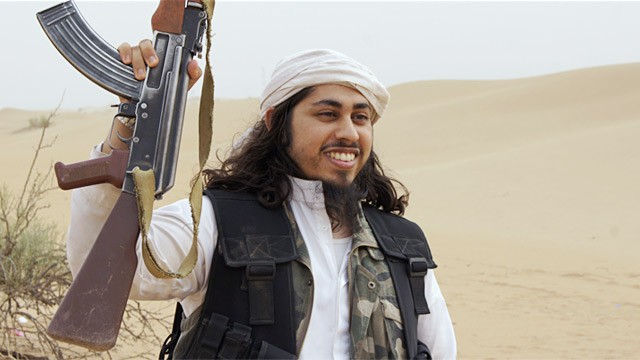
Anwar al-Awlaki


Samir Khan


Abdulrahman al-Awlaki

Anwar al-Awlaki and Samir Khan were al-Qaeda agents: the former was one of its most prominent members, particularly after the death of Osama bin Laden, while the latter edited an Islamic militant journal in which al-Awlaki had a hand. Both were killed in a drone strike.

If the third, Abdulrahman al-Awlaki, looks kind of out of place with the other two, don't worry, there's a perfectly satisfying explanation. He was the son of Anwar al-Awlaki. He was also killed in a drone strike, at the age of sixteen, two weeks after his father. His crime? Being in the wrong place at the wrong time. The government avers that his death was unintentional, collateral damage from the targeting of Ibrahim al-Banna, a suspected (though, it seems, so far unconfirmed) member of al-Qaeda, who, for those of you keeping score at home, was not killed in the drone strike that took young Abdulrahman's life.

They were all killed in drone strikes; that's one thing. The other thing they have in common is that they were all American citizens, killed outside of combat and without due process. There is a word for this kind of killing, and that word is "murder."

All American citizens are entitled by law, if accused of any crime, whether the attached penalty is death or not, to a trial by a jury of their peers. That, Mister President and Mister Secretary of State, is what "due process" fucking means. President Obama chose to ignore this, and, with no precedent whatever (not that precedent would make such an act not a war crime), authorized the targeted murder of two Americans; and in fact accomplished the murder of a third as well, who was wholly innocent, recently orphaned of his father by his country, and barely old enough to drive.


With liberty and justice for all. (Some restrictions may apply. May be unavailable in certain areas.)

Given the precedent of detaining and even murdering citizens without trial that has now been established by this administration, I find it difficult to criticize Snowden for being reluctant to return home, even assuming that Kerry is being quite truthful when he states that he would be permitted to come back in spite of his revoked passport. I haven't a great deal of liking for Kerry, but I would have thought -- or at least hoped -- that someone with his history of anti-war work and his criticisms of government policy in Vietnam would have been, if not less stupid, at least less willing to embarrass himself with such a hypocritical rebuke.

And the defense is what? That these men, living and dead, endangered American lives? Their lives sure were. Also, point of interest: everybody dies. You don't, in any final sense, save American lives by killing American terrorists or anybody else -- you just put it off till a later date. And that does matter. But in view of the fact that everybody dies, whatever else we believe comes after that, we have more reason, not less, to care about justice simply for its own sake: because if death (as I do not believe) is followed by mere nothingness, it can scarcely be held to matter when exactly you hit that point; and if (as I do believe) death is followed by judgment, then you are suddenly going to find yourself caring a very great deal about whether the things you did in life were right or wrong.

Well, turning to ethical grounds, is the defense maybe that they were war criminals? Very probably the elder al-Awlaki and Khan were; though not, perhaps, with the certainty with which we can observe that the members of this administration are war criminals. The right to trial by jury is not asterisked, any more than the right to privacy. The whole point of our justice system is that if you have an accusation against someone, you try them, presuming that they are innocent, and then you either damn well prove they aren't or else you let them go.


(Or if that's taking too long we'll just murder your ass.)

Of course, those three dead men have reached the end of their stories, whatever that end may be. I fear and hope for their souls, and don't claim to know anything at all about their eternal fates. And Snowden is about as stuck as stuck gets: he might be able to come back if there were an amnesty, which doesn't seem likely in the paranoid political climate we enjoy, and if he has to stay in Russia, I fear for him there. Maybe the saddest part of all this, though, to my mind, is the squalid corrosion of the American public's attitude to the state: we saw a sixteen-year-old boy (to say nothing of the others) killed, we watched it reported on national and international news, and we shrugged our collective shoulders and said, "Collateral damage. What can you do." Anyway, that was like five news cycles ago; no one can be expected to remember. So let it be with drone strikes.

Pray for our nation, readers, I urge you. Pray for a revival of conscience, in the leadership, yes, but above all among the people -- which inevitably means, in each individual heart, beginning with one's own. Pray for Edward Snowden, in whatever net of circumstance he may, perhaps, be trapped. And pray for the souls of three dead men: two whose crimes, it may well be, rebounded upon their own heads; and one whose innocence was no protection against the realpolitik of his own people.