Collect

Collect for the Fourth Sunday after Trinity

O God, the protector of all that trust in thee, without whom nothing is strong, nothing is holy: increase and multiply upon us thy mercy; that, thou being our ruler and guide, we may so pass through things temporal, that we finally lose not the things eternal; grant this, O heavenly Father, for the sake of Jesus Christ thy Son our Lord, who liveth and reigneth with thee, in the unity of the Holy Spirit, ever one God, world without end. Amen.
Showing posts with label Gandhi. Show all posts

Friday, January 29, 2016

Catholic Anarchy, Part III: Sedition

In this same time … our good Lord shewed a ghostlie sight of his homelie loving: I saw that he is to us all thing that is good and comfortable to our help. … And in this he shewed a litle thing, the quantitie of a hasel-nutt, lying in the palme of my hand, as me seemed; and it was as round as a ball. I looked theron with the eie of my understanding, and thought, ‘What may this be?’ and it was answered generallie thus: ‘It is all that is made.’ I marvelled how it might last: for me thought it might sodenlie have fallen to naught for litleness. And I was answered in my understanding, ‘It lasteth, and ever shall: for God loveth it. And so hath all thing being by the love of God.’
—Lady Julian of Norwich, Revelations of Divine Love, ch. 5

✠     ✠     ✠

How, then, is a state to be overthrown? There are two ways of doing so, direct action and indirect action; indirect action (in an ostensibly democratic culture such as ours) tries to elect people who will work to dismantle the structures of power, while direct action simply tries to get on with the dismantling and never mind electing anybody. Of these, only direct action is likely to be any good, because not one man in a thousand is going to dismantle the system that put him in power; he is far likelier to work, as far as in him lies, to render that system hostile to his rivals for power.1


Direct action can again be divided into two kinds: the coercive and the persuasive. Coercive direct action includes all techniques that rest on either violence or the threat of violence, from armed revolt to sabotaging property to holding Cold Stone Creamery executives at gunpoint with demands for socialized ice cream distribution. By contrast, persuasive direct action encompasses the range of tactics that appeal to the opponent’s conscience and intellect, from pamphleteering to strikes to non-coöperation with the law.

As a professed pacifist, I naturally look to persuasive rather than coercive action. But, given that I view my pacifism as a matter of personal calling, not universal obligation, the question remains of whether I prefer persuasion as a matter of liking, or think that it’s simply better strategy than coercion; and I think the latter.

The chief argument in favor of coercive direct action is that it accomplishes radical change in a short period, which persuasion can’t, because some people just won’t be persuaded. The trouble about this argument is that it’s wrong from start to finish.

First of all, let’s talk about radical change. It shouldn’t be confused with merely drastic change. The word radical comes from the Latin radix,2 which means ‘root’; it is change at a root level, a change of heart, that is at stake here. And coercive means can’t effect that. Thinking it could was the error of the Middle Ages at their worst, attempting by force of arms to protect and expand the dominion of the Prince of Peace. Trying to force profound change on a population breeds only hypocrisy; it’s a law of human nature. Radical change has to come from within, and be permitted to flower through patient tending—pulling a plant will not make it grow taller, and the harder you pull, the likelier you are to tear it up.

Persuasion is not the best way of effecting a change of heart: it’s the only way. For many people it may not do its work alone: it may require experiment or experience for them to change their minds. And, yes, there will always be people who can’t be reached. ‘That we should wish to cast [Sauron] down and have no one in his place is not a thought that occurs to his mind.’3 That’s life, and there’s no getting round it.

But the fact is, coercive direct action does accomplish something. It can right certain material injustices, even if it can’t effect radical change as such. Surely that’s better than nothing?


Maybe. Maybe not. It depends on what the coercion brings with it. But we can say this about all coercion, before we know anything else about it: it is, whether implicitly or practically, violent. And if violence is the problem, adding in more violence is doomed to failure. Not all anarchists are pacifists, either personally or philosophically, but the state’s power to compel is something we all object to, and compelling them to cut it out is pure hypocrisy.

The only way it could be justified is to classify the agents of the state as the enemy, an other, not a human neighbor. Both Christianity and democracy forbid such a thing. And anyway, if the problem with the state is the separateness of the state and the people, siding with the people just makes it worse. It doesn’t solve anything. Dehumanizing one’s opponents is always wrong; which is why I describe myself, in the words of Dorothy Day, as a pacifist in the class war.

So what does persuasive direct action actually consist in? It has three primary forms: advocacy; striking; and civil disobedience. Advocacy includes every kind of argument for anarchy, spoken and written, from pamphlets to full-length books. It also encompasses techniques chiefly meant to draw public attention to the cause of anarchism, like protests or artistic displays. The aim here is persuasion in its purest form: gaining a hearing from people, explaining what we mean by anarchy, and trying to convince them to adopt it.

Striking is normally a refusal of work in some way or other.4 A walkout at a company (especially in fields of work with ‘hard’ products, like farming or construction, as opposed to ‘soft’ products like entertainment or research) is the commonest form, and its aim is to bring about negotiation, or to bolster the cause of the strikers in an ongoing dispute; the same is true of rent strikes, culture strikes, and student strikes. I know only little about this, as I’ve never been in a position to participate in one (partly because I’ve been fairly well treated by my employers to date). Abstaining from voting can be considered a form of striking as well; though, given there's no quorum for electing public officials—i.e., no matter how low voter turnout is, the person who gets the most votes out of that turnout will win the election—it’s largely symbolic, and blends a little into the third category.

Lastly, there is civil disobedience: this is peaceful but direct defiance of the law. This may be a symbolic action, like Gandhi’s Salt March, or it may be simply a result of conscience clashing with legislation. There are times when anybody should do this, anarchist or not, as when the resistance movements in Europe in the 1940s concealed Jews. That isn’t so much anarchism as basic human decency. When it comes to specifically anarchist civil disobedience, though, the technique has a more determinate character. Civil disobedience doesn’t require attention-grabbing defiance of every individual law; after all, many laws do codify right behavior no matter who did the codifying, and many more are just less trouble (and no affront to your dignity as a person) to obey than to make a fuss over.

But some laws aren’t like that. Some laws are simply wrong, and should not be obeyed, or should even be specifically disobeyed: for example, not only should you not turn Jews over to the Nazis (not obeying), you should help them get away, however much you can (disobeying). Rosa Parks’ famous refusal to coöperate with the segregationism of the Montgomery bus system, though not a defiance of a law exactly, is of a kind with civil disobedience. A more exact and contemporary example would be Edward Snowden’s disclosure of surveillance information; that the spying was going on in the first place was wrong, and it was also wrong that it was being kept secret; his publication was, therefore, an act of conscience, a symbolic protest, and a kind of advocacy all in one.
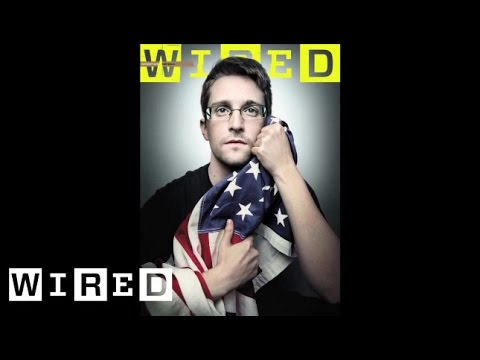

Okay, the pic may be a little melodramatic, but the article's good and hefty.

Other laws, while they may not be violations of justice per se, may still be unwarranted, offensive intrusions into the general human right of liberty. Quiet refusal to fall in line with laws that have no right to be instituted are not usually effective as protests, but, from an anarchist point of view, they’re perfectly legitimate choices ethically (for example, in places where selling alcohol is banned on Sundays, an anarchist would see nothing immoral about selling and buying it anyway).

But what does any of this matter? There are never many Parkses, Snowdens, or Gandhis in any generation. What effect can something as small as one person have on an entire political system? What can one woman or man do?

First, break the spell of size. The state may be huge, but it is made of human beings; there’s nothing else in it. If there are many of them, there are many of everybody else, too. And second, it is our submission to coercion that gives it its power. Sedition doesn’t have to mean conspiracy and rebellion, when it is conducted not against the powerful but against their power; sedition can be as simple and clear as the word No. Realize for a moment that every state would crumble to dust in a day if everyone in its simultaneously refused to coöperate with its directives. Only one thing is needed to bring down principalities and powers: namely, the will to do it. From the moment we choose it, we have liberty. All the rest is the flower; the will is the seed.


How can this sort of sedition have victory? That’s what persuasive direct action is for: annoying your friends into agreeing with you. Because with every person you convince, the number of free people expands. Maybe, one day, the state will crumble; in the meantime, anarchy has already begun.

✠     ✠     ✠

1There have been exceptions: Cincinnatus, the first dictator of republican Rome, was famous for being a dictator that actually followed Roman law and retired when the emergency was over; similarly, King Juan Carlos of Spain, who quietly blended in with the totalitarian regime of Francisco Franco, emerged after the tyrant’s death as a democratic reformer, transforming his own office into a constitutional monarchy. But these men are precisely exceptional. Rulers like Julius Cæsar, William of Orange, Napoleon Bonaparte, Vladimir Lenin, and Augusto Pinochet are the rule. Being trapped in the spider’s web of power politics is a far commoner fate even among would-be reformers, men being what we are.
2From which we also get the word radish, which is why radishes have long been a symbol of political unrest [citation needed].
3Said by Gandalf in The Lord of the Rings: The Two Towers, Book III.
4Hunger strikes are the only exception to this that I’m aware of, but, like the other forms of strike, they are often used as a negotiating tactic, or sometimes for publicity.

Thursday, April 30, 2015

The Baltimore Spring

A White Bourgeois Pacifist's Thoughts on the Baltimore Riots


Surely this man's opinion will be ... something.

The city hasn't changed as much as I expected it to under the curfew. It's quieter, although there do seem to be a few more sirens than usual in the small hours; then again, maybe it's just easier to pick them out over the lack of background noise. I feel like I've seen a lot more people on foot, too, though that probably has more to do with the improved weather. I went walking around myself on Wednesday morning, and the air smelled like tulips and honeysuckle.

I didn't see that much damage from the riots. A few broken windows and boarded up storefronts, which aren't exactly uncommon in most of Baltimore. But of course, the neighborhood I live in wasn't in the thick of things -- it's in the center of the city, whereas most of the rioting and looting was in the west and southwest.


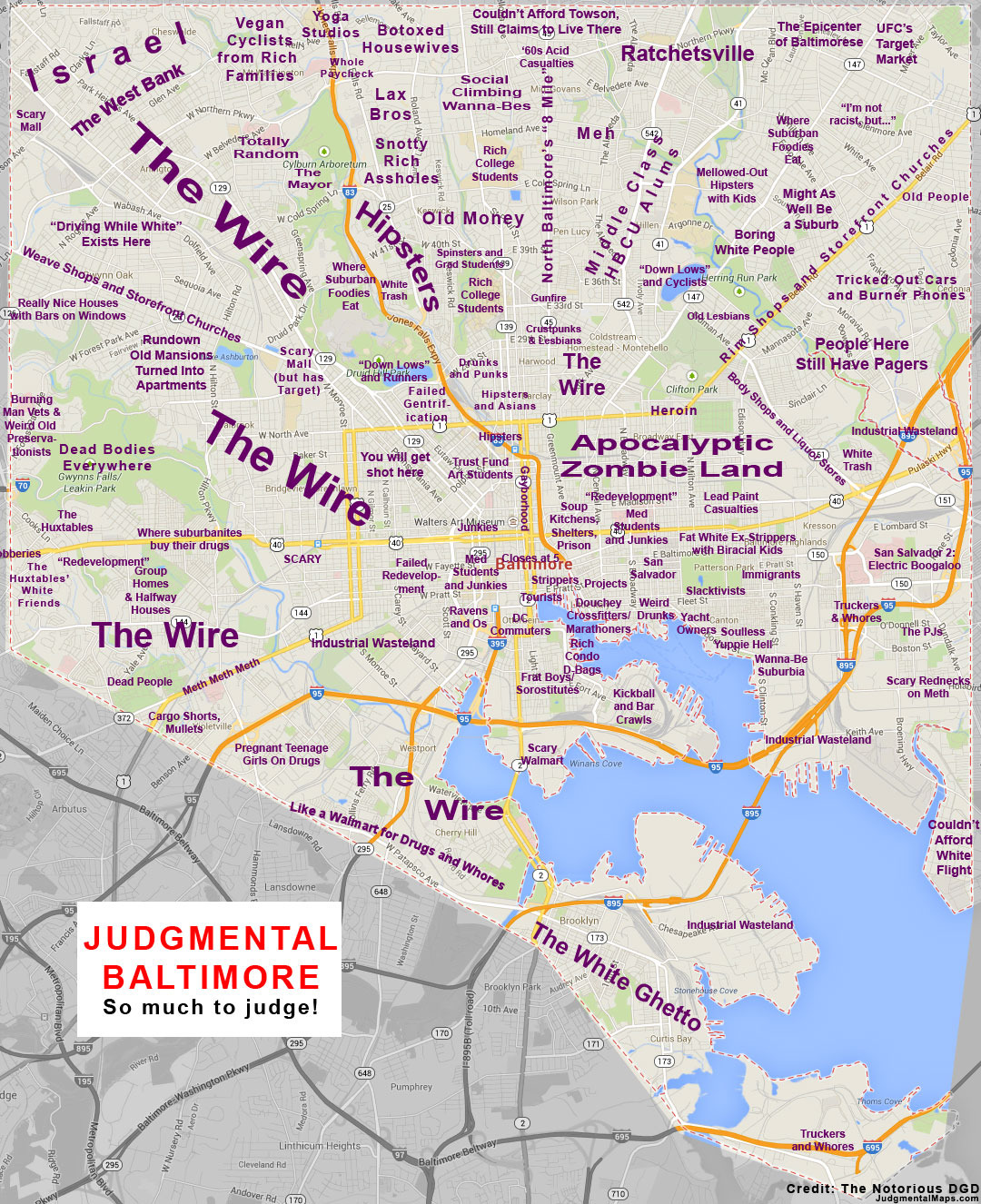
That's me, in between "Trust Fund Art Students," "Junkies," and "The Gayborhood."

The thing I've been most unsettled by has not been the riots. It's been the media reaction (both mass and social media). I try to maintain a healthy skepticism of my own insights on topics like this -- I'm white, I was raised in the middle class, I was out of the city on Monday night, and I've only lived in Baltimore for a bit less than two years, after all. But some of the responses to the events of the last few days seemed, to me, to be so off-base and bizarre that I felt a reply was worth making, for whatever my thoughts are worth.

First, it's important to note that, while the riots got a lot of attention, the vast majority of protesting in the wake of Freddie Gray's sad death has been peaceable. It started that way, and most of it stayed that way. I've seen it suggested that the looting and arson happened at the hands of crooks and delinquents who merely took advantage of the moment, rather than at the hands of any protesters at all; I'm not sanguine that that's completely true, but I'd be willing to bet that the overlap was a lot smaller than you'd think from watching the news. What's more, the cleanup seems to have gone swimmingly; I met a dude on Tuesday, the day after the worst of it, while looking to help with repair work and the like, and we couldn't find anything to do. (My suspicion is that what work was still left was in the areas where the roads were still shut down, which were too far out for either of us to walk, but still.) People have been coming out of the woodwork to put their city back together, and I gotta say, I'm kind of amazed. This place is more resilient than I gave it credit for.

And I believe it's that renewal that is going to triumph in Baltimore in the end, because that is the force of life, God's creation. And that creative energy isn't just a pleasanter thing than the anti-energies of destruction, oppression, and decay; it's a stronger thing. Rampage and violence cannot make, and they begin to collapse from within as soon as they come into being; they can only continue as long as the host in which they are burrowing parasites remains vital. Life, in God, is self-regenerating. That's why it's going to win.

Secondly, the riots may have been sparked by the Freddie Gray case, which is bad enough in itself -- a nearly-severed spine is no joke, especially after being stopped and searched for, um, running away from police (who weren't detaining him, or even talking to him), who took this as a reason to chase him. I feel like the Fourth Amendment got lost somewhere in here, since running away from police who happen to be around, as opposed to police who are actively detaining you, is not to my knowledge unlawful,* and seems to me more like plausible cause than probable cause, given the whole presumption of innocence thing and the "seriously, butt the hell out of private citizens' business" thing that the American law system is sort of based on ...


Hey, it's one of those fancy napkins people use for eating Irish babies.

Anyway, the riots may have been sparked by the Freddie Gray case. But they aren't, simply, about his death. Neither are they simply about the string of highly-publicized deaths of black persons at the hands of police over the last year, although I feel sure that's relevant. Nor can we simply say "Racism" and be done, though there is plenty of that to go around so no one has to feel left out.

The occasional remarks about "black protesters" and "black rioters" that I've seen on social media have kind of creeped me out, to say the least. It's not clear to me that looting the mall or setting fire to CVS would be somehow different if white people were doing it, or Latinos, or Asians. On the other hand, I've seen one or two people more or less excusing the violence as an expression of frustration on the part of the black populace, and even referring to it as some sort of just reprisal against the white, capitalist establishment.**

The problems with all this armchair activism are manifold. Does anyone seriously propose the belief that the only people who were out looting were all black? Or that, even if every single one of them was, their skin color was somehow gremlinizing their brains to make them do it? And conversely, if this was revenge against wealthy whitey, why is it that, of the damaged stores close to my neighborhood at least, all except one were owned, operated, and frequented by local African-American folks? Or, if we propose that the class element had more to do with it, why did they loot Mondawmin Mall (i.e., scary-yet-Target-having mall as above), as opposed to the banks or restaurants or businesses close to the Inner Harbor? It's questions like these that make me think that, though there was very possibly some overlap between protesters and purgers, the latter were for the most part taking advantage of the moment.

But besides that, this has prodded me to start trying to understand racism in America better. I think it's worth pointing out that it's this power to understand which is one of the great difficulties, but maybe not for the reasons that a lot of people think. Most conservatives seem to think that liberals just enjoy being moral indignant, while most liberals seem to think that conservatives are at least a little bit supremacist. I don't think either hypothesis is necessary -- or, insofar as we kind of need everybody working on this problem, productive.

A few years ago, I was having a conversation with a friend of mine, Nazim, a guy I knew from college, whose mother was white and whose father was Algerian; he looked pretty much Caucasian if he shaved, but when he grew his beard out he looked Arabic -- handsome dude. Now, I had always thought of racism as a belief, held consciously or (I could allow this) unconsciously, that one race was superior to others -- generally one's own.


With, uh, certain odd exceptions.

Nazim, however, talking about a class he'd had where they had been discussing the phenomenon of white privilege, and about his own experience of getting white privilege if he was clean-shaven, until people learned his name (after which he'd be treated as Arabic instead of white -- i.e., not necessarily worse, but perceptibly differently). As the conversation progressed, it came out that when Nazim's professor had spoken about racism, the point had not been about any beliefs at all, conscious or submerged, but about the systemic facts of who holds the power.

In other words, an imaginary city in which two-thirds of the people are black and also happen to be largely disadvantaged, while one-third of the people are white and also happen to be largely well-off, is still (by this definition) a racist city even if none of the white folks are intentionally being dicks about it. And honestly, while I think that a person's principles and intentions are even more important than what happens, what happens is still pretty damn important.

As far as white people intentionally being dicks goes, though, I think we have to allow that there's a great deal of that. I've kept fairly quiet on most of the recent, highly publicized cases in which a racist element has been proposed*** -- Trayvon Martin, Michael Brown, Eric Garner -- because I haven't known many of the facts, and I don't want to be a bandwagoneer, to say nothing of wishing to believe in the innocence of the cops in question until their guilt is proven (partly due to my aforesaid ignorance, and partly because these deaths were bad enough even if they were the result of horrible misunderstandings, let alone if they were callous murders). But. While I don't propose to decide on any of these things individually, the Ian Fleming rule of thumb remains: Once is happenstance, twice is coincidence, three times is enemy action. Further examination -- of facts, and of consciences -- is warranted.

And what then? I haven't got a fucking clue. I can try to do right by my neighbor in a given situation; how to help with systemic racism, even in my immediate neighborhood, I simply don't know. I will, therefore, conclude with the following excerpts from Mahatma Gandhi's Non-Violent Resistance, asking my readers -- if there are any who have committed violence, approved of violence, or excused violence as a black reaction to white oppression, and also all my other readers -- to consider them carefully.

Reader: Why should we not obtain our goal, which is good, by any means whatsoever, even by using violence? Shall I think of the means when I have to deal with a thief in the house? ... You seem to admit that we have received nothing, and that we shall receive nothing by petitioning. Why, then, may we not do so by using brute force? ...
Editor [Gandhi]: ... I have used similar arguments before now. But I think I know better now, and I shall endeavor to undeceive you. Let us first take the argument that we are justified in gaining our end by using brute force because the English gained theirs by using similar means. ... [B]y using similar means we can only get the same thing that they got. You will admit that we do not want that. Your belief that there is no connection between the means and the end is a great mistake. Through that mistake even men who have been considered religious have committed grievous crimes. ... [T]here is just the same inviolable connection between the means and the end as there is between the seed and the tree. I am not likely to obtain the result flowing from the worship of God by laying myself prostrate before Satan. If, therefore, anyone were to say: "I want to worship God; it does not matter that I do so by means of Satan," it would be set down as ignorant folly. We reap exactly as we sow. ... If I want to deprive you of your watch, I shall certainly have to fight for it; if I want to buy your watch, I shall have to pay for it; and if I want a gift, I shall have to plead for it; and, according to the means I employ, the watch is stolen property, my own property, or a donation. ... Will you still say that means do not matter? 
Passive resistance is a method of securing rights by personal suffering; it is the reverse of resistance by arms. When I refuse to do a thing that is repugnant to my conscience, I use soul-force.**** For instance, the Government of the day has passed a law ... I do not like it. If by using violence I force the Government to repeal the law, I am employing what may be termed body-force. If I do not obey the law and accept the penalty for its breach, I use soul-force. It involves sacrifice of self. Everybody admits that sacrifice of self is infinitely superior to sacrifice of others. Moreover, if this kind of force is used in a cause that is unjust, only the person using it suffers. He does not make others suffer for his mistakes. ... If man will only realize that it is unmanly to obey laws that are unjust, no man's tyranny will enslave him. 
Reader: I deduce that passive resistance is a splendid weapon of the weak, but that when they are strong they may take up arms.
Editor [Gandhi]: This is gross ignorance. Passive resistance, that is, soul-force, is matchless. ... What do you think? Wherein is courage required -- in blowing others to pieces from behind a cannon, or with a smiling face to approach a cannon and be blown to pieces? ... Believe me that a man devoid of courage and manhood can never be a passive resister. This, however, I will admit: that even a man weak in body is capable of offering this resistance. One man can offer it just as well as millions. Both men and women can indulge in it. ... Control over the mind is alone necessary, and when that is attained, man is free like the king of the forest and his very glance withers the enemy. Passive resistance is an all-sided sword, it can be used anyhow; it blesses him who uses it and him against whom it is used. ... It never rusts and cannot be stolen. ... It is strange indeed that you should consider such a weapon to be a weapon merely of the weak. 
-- Non-Violent Resistance (Satyagraha), pp. 9-11, 17-18, 51-52


*It's true that Freddie Gray was found to have a switchblade in his pocket, which Maryland law only permits to be carried openly. Then again, it was his spine that got almost severed, not the cops'. And, again, the only reason they found the switchblade (which he shouldn't have been carrying) was because they searched him, and they were searching him without probable cause -- on the grounds that he ran away when he saw them, which is not proof or even very sound evidence of anything.

**I've been especially puzzled by the vitriol I've seen directed at Mayor Rawlings-Blake. Being an anarchist, I have no special attachment to the Mayor, but the hate she's gotten for her handling of the situation baffles me, especially for her remark that the violent looters were "thugs" -- a statement that one person I know literally equated with calling them niggers. We did all notice at some point, I hope, that Stephanie Rawlings-Blake is black, and therefore likely wasn't making a euphemistic racial slur? And as for thuggery, if smashing windows, stealing stuff, and setting buildings on fire doesn't count, I'd be both interested and a little scared to learn what does.

***I don't for one moment believe that the recent spate of cases that the media have latched onto are the only ones; and in fact I have difficulty believing that this string of putatively racist cop cases is even a new phenomenon. My personal hunch is that, for whatever reason, it's become sexy to report on these things, and so they found a trend that already existed and started to make a media sensation out of it.

****This translates the Sanskrit term satyagraha, a difficult word to render in English -- truth force or insistence on truth would be alternates to the translation used by Gandhi here. It is arguably the key concept in all of his thought, and was a major influence on the anti-racist and civil rights activism of Nelson Mandela and Martin Luther King Jr. A more extensive treatment of it can be found here.

Sunday, December 15, 2013

Mortar the Stones With Blood

We have already noted that this paradox appeared also in the treatment of the early Church. It was important while it was still insignificant, and certainly while it was still impotent. ... It was resented because, in its own still and almost secret way, it had declared war. It had risen out of the ground to wreck the heaven and earth of heathenism. It did not try to destroy all that creation of gold and marble; but it contemplated a world without it. It dared to look right through it as though the gold and marble had been glass. 
-- G. K. Chesterton, The Everlasting Man, Part II, Chapter 1: The God In the Cave

Here is the picture of Chesterton looking smart and fat and quotable that is required 
to appear on all Catholic blogs (and earns extra points on Protestant ones).

I haven't written much about my pacifist convictions, although I wrote a series on anarchism a few months ago. The controversy in the combox that extended through the last several Raw Tact posts, however (specifically Part X, Part XI, and the Appendix, as well as this interruptive but related post), has had my mind turning to the nature of reconciliation, and thus to pacifism -- for I believe that all reconciliation must, in the last resort, be pacifistic if it is to have real and lasting effects: those effects that take root in the heart, rather than in the smaller question of whether men are killing one another.

That is not irony or authorial cleverness, by the way. I really believe it. As a Catholic, I believe in the immortality of the soul; in Heaven; in Hell. That men kill one another is a horrible reality, and I long for it to cease, everywhere and forever. That men hate one another is far more hateful to me even than killing. After all, there are circumstances in which killing can be justifiable or at least excusable -- self-defense and innocent accident spring to mind. But God is love; God makes the sun shine upon the just and the unjust alike; when He was crucified, He not only cried out to the Father for the forgiveness of His tormentors -- something we have heard so often that, often, it fails to strike us -- but He was actively maintaining their life and well-being as they murdered Him. ("In Him all things hold together.")


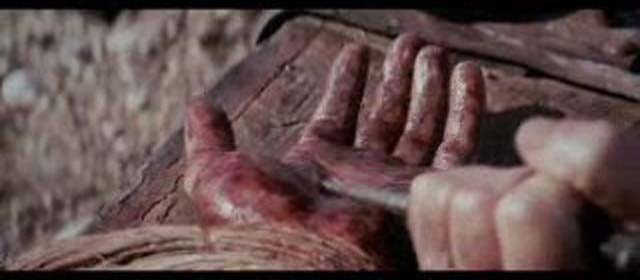
For all his flaws, Mel Gibson got something exactly right here, I'm told: the hand holding the nail is his.

The unearned, the utterly gratuitous character of all existence, is often lost on us. Jean-Paul Sartre experienced this when he perceived all things as de trop, superfluous, unnecessary. He was right, in a sense -- but without the conviction of the being and love of God, the experience was a negative, maddening one, which he himself described by the title of his book Nausea. The obverse side of this idea is what a Catholic means by grace. Not only salvation, but even existence, is a gift that we could never earn by any amount of goodness or anything else.
'I'm not asking for anybody's bleeding charity.'
'Then do. At once. Ask for the Bleeding Charity. Everything here is for the asking and nothing can be bought.'*
Or as Blessed Teresa of Calcutta put it in a little book of hers:
At a seminary in Bangalore, a nun once said to me, 'Mother Teresa, you are spoiling the poor people by giving them things free. They are losing their human dignity.' When everyone was quiet, I said calmly, 'No one spoils as much as God Himself. See the wonderful gifts He has given us freely. All of you here have no glasses, yet you can all see. If God were to take money for your sight, what would happen? ... What would happen if God were to say, "If you work for four hours, you will get sunshine for two hours"? How many of us would survive then?'**

Okay, she'd probably be fine.

The gratuity of the Divine gift of life is my chief reason for being a pacifist. Specious reasons and equally specious objections are frequently set forth by advocates and enemies of pacifism. It is perfectly possible to believe the Sermon on the Mount, and also believe in the justice of the cause of the First Crusade or the Battle of Lepanto; it is perfectly possible to believe in the justice of the First Crusade or Lepanto, and at the same time be a pacifist (at least in terms of personal vocation). But when I am confronted with the intolerable generosity of God in making me and sustaining me at every moment, I cannot bring myself to regard violence, even in self-defense or the defense of others, as anything but a distant second-best. To imitate His open-handed and open-hearted love, taking no vengeance, willing no ill, however deserved -- what can compare with that?***

It is often urged against pacifism that it is impractical. Now, I reject from the get-go that a Christian's chief concern ought to be with practicality. However, I also think that the practical effects of pacifism in history have been ignored. The independence of India was achieved through the wholly pacifist efforts of Gandhi and his followers, and the civil rights movement in this country was as successful as it was largely through the same influence. Not to turn this into a quotefest, but the following, from Gandhi's writings, seems to me to express the matter well:
Reader: I deduce that passive resistance is a splendid weapon of the weak, but that when they are strong they may take up arms. 
Editor: This is gross ignorance. Passive resistance, that is, soul-force [satyagraha in Sanskrit], is matchless. It is superior to the force of arms. ... Physical-force men are strangers to the courage that is requisite in a passive resister. Do you believe that a coward can ever disobey a law that he dislikes? Extremists are considered to be advocates of brute force. Why do they, then, talk about obeying laws? I do not blame them. They can say nothing else. When they succeed in driving out the English and they themselves become governors, they will want you and me to obey their laws. ... But a passive resister will say that he will not obey a law that is against his conscience, even though he may be blown to pieces at the mouth of a cannon. 
What do you think? Wherein is courage required -- in blowing others to pieces from behind a cannon, or with a smiling face to approach the cannon and be blown to pieces? Who is the true warrior -- he who keeps death always as a bosom-friend, or he who controls the death of others? Believe me that a man devoid of courage and manhood can never be a passive resister. 
This, however, I will admit: that even a man weak in body is capable of offering this resistance. One man can offer it just as well as millions. Both men and women can indulge in it. It does not require the training of an army; it needs no jiu-jitsu. Control over the mind is alone necessary, and when that is attained, a man is free like the king of the forest and his very glance withers the enemy. 
Passive resistance is an all-sided sword, it can be used anyhow; it blesses him who uses it and him against whom it is used. ... It never rusts and cannot be stolen. ... It is strange indeed that you should consider such a weapon to be merely of the weak.****
But it is not primarily the military or political implications of pacifism, potent though I believe -- or, more precisely, observe -- they are, that I'm interested in. Nor, though I also declare myself a pacifist in the class war and the culture war, am I focused predominantly upon those, either. I have in mind, above all else, a pacifist spirituality. I don't believe that the Lord Jesus had war chiefly in mind when He preached the Sermon on the Mount; indeed, there is no mention of the kinds of violence we are familiar with in war and tyranny at all: only the kind of day-to-day exasperations and frustrations that could be expected in a life among rowdy villagers. But there comes in the image of the gratuitous sunshine that falls with indifferent genersotiy upon evil and good alike; there, too, the blessing upon those who are persecuted, and the exhortation to rejoice and to bless when we suffer under it. That is the root of pacifism -- at least, of the kind of pacifism that I consider worthwhile. A rejection of violence merely as violence, and not as a kind of anti-sacrament that is the hatred it signifies, seems to me like a very arbitrary rule. Pacifism too must be sacramental. Pacifism, not animated by and acted to convey love -- well, if I give all I possess to the poor, and surrender my body to the flames ...

Only by choosing to end injustice in oneself -- to suffer its consequences and deliberately refuse to retaliate, with the soul as much as the body -- can the cycle of revenge be stopped. Every act of violence, of vengeance, of punishment, begins the cycle of violence afresh; and it will always be that way, until our attempts at justice are swept away in the terrible finality of the justice of God.


As illustrated here, possibly.

And this is how the Church first took root. Sanguis martyrum Ecclesiae semen, wrote Tertullian, "The blood of the martyrs is the seed of the Church." A martyr is one who chooses to love to the uttermost, a love so powerful that mortal life cannot contain its force. Nor has the reality or the spiritual power of martyrdom ceased in the intervening centuries. The power of the Church has always lain in her rejection of power, her refusal to be controlled by it; when she has embraced earthly attitudes towards power, she has experienced a corresponding decline, first in sanctity and then -- and then what else could possibly matter? Seek ye first the kingdom and all these things shall be added unto you; seek these things, and you shall lose them and the kingdom with it.

This is a great part of why I cannot bring myself to be alarmed, or even particularly interested, by the decline (such as it is) of Christianity as a cultural and political force in this country. This decline has bad effects, certainly, but it will not prevent God from reaching people however He pleases. It also has good effects, or at least it can; for instance, it could lead us to ask ourselves as believers why, exactly, the people have left their temples, and left their temples very largely not for another temple but for nothing at all, an act virtually without precedent in the religious history of mankind.


That time of year thou mayst in me behold
When yellow leaves, or none, or few, do hang
Upon those boughs which shake against the cold,
Bare ruin'd choirs where once the sweet birds sang.

If our sole response to such reflections is that this people who knoweth not the law are cursed, then I think we need to stop and seriously ask ourselves who the hell we think we are. Do we suppose that we are doing God some benefit by being the recipients of His astonishing generosity in the Scriptures and the sacraments? Do we think there isn't enough of His love to go around, and that if we share His compassion and patience with those outside there will be less left for ourselves? And even if, on some level, we do, are we to react like the resentful workers who expected more than the denarius they agreed to work for, or the elder brother who was angry with his father's joyful reception of the prodigal son?

The point is, the path to holiness suffers no obstruction from the Church losing status or prestige. Indeed, that kind of decline can make it easier rather than harder to grow in the love of God, by moderating the temptation to (to put it bluntly) avarice. And if we should come to the point that we are actively persecuted -- rejoice. For then, ours is the kingdom of heaven.

Christmas is a time when we are disposed to think about the warm, comforting side of Christianity; it is, also, a time when the kulturkampf gets more emphatic than usual. Annoy to the world, the Lord is come. But some of us were never told, and others of us forget, that there are as many martyrs celebrated in this season as in any other. Saint Lucy, martyred brutally under the Emperor Diocletian, was just this past Friday; Saint John of the Cross, commemorated yesterday, was not killed, but was imprisoned and savaged by the thoroughly Catholic society of sixteenth century Spain, and indeed by his own religious superiors; the day after Christmas is the day devoted to Saint Stephen, the first of the Christian martyrs. And on the twenty-ninth, though it is not a well-known memorial in this country, is the feast of Saint Thomas Becket, about whom T. S. Eliot wrote his remarkable play, Murder In the Cathedral. Becket too was murdered, at the altar no less, by a society that professed itself to be wholly Christian and Catholic. There is no enclave, no shelter that will shield us; but if in Jesus we mortar the stones of the Church with our blood, they will stand fast thereafter.
PRIESTS 
Bar the door. Bar the door.
The door is barred.
We are safe. We are safe.
They dare not break in.
They cannot break in. They have not the force.
We are safe. We are safe. 
THOMAS 
Unbar the doors! throw open the doors!
I will not have the house of prayer, the church of Christ,
The sanctuary, turned into a fortress.
The Church shall protect her own, in her own way, not
As oak and stone; stone and oak decay,
Give no stay, but the Church shall endure.
The church shall be open, even to our enemies. Open the door! 
PRIEST 
My Lord! these are not men, these come not as men come, but
Like maddened beasts. They come not like men, who
Respect the sanctuary, who kneel to the Body of Christ,
But like beasts. You would bar the door
Against the lion, the leopard, the wolf or the boar,
Why not more
Against beasts with the souls of damned men, against men
Who would damn themselves to beasts. My Lord! My Lord! 
THOMAS 
You think me reckless, desperate and mad.
You argue by results, as this world does
To settle if an act be good or bad.
You defer to the fact. For every life and every act
Consequence of good and evil can be shown.
And as in time results of many deeds are blended
So good and evil in the end become confounded.
It is not in time that my death shall be known;
It is out of time that my decision is taken
If you call that decision
To which my whole being gives entire consent.
I give my life
To the Law of God above the Law of Man.
Unbar the door! unbar the door!
We are not here to triumph by fighting, by stratagem, or by resistance,
Not to fight with beasts as men. We have fought the beast
And have conquered. We have only to conquer
Now, by suffering. This is the easier victory.
Now is the triumph of the Cross, now
Open the door! I command it. OPEN THE DOOR! 
-- T. S. Eliot, Murder In the Cathedral, Part II, pp. 73-74


*This is in C. S. Lewis' brilliant The Great Divorce, and takes place in what he calls the Valley of the Shadow of Life -- the first vale of Heaven seen by entering souls. I forget where it is exactly, and I haven't got a copy of the book with me, but, like so many passages, this one stunned me and has stuck in my memory.


**In the Heart of the World, pp. 57-58. Blessed Teresa is among my favorite figures in all Catholic history, for this and a host of other reasons.


***It may be said, and not without justice, that there will indeed be judgment at the end of time. That is of course quite true. But in my view, if God can wait that long to avenge Himself, I don't need to hurry things along. His justice will be more intelligent, more compassionate, and more just than mine, to put it mildly.


****Non-Violent Resistance (Satyagraha), M. K. Gandhi, pp. 51-52.

Monday, October 14, 2013

Christianity and Anarchism, Part III: The Collapse of the American Experiment

I'm advancing a rather more controversial theory in this piece than usual, so I'd like, correspondingly, to take more trouble to emphasize that I do so as an amateur. I learn rather slowly, but I am open to learning, and I ask readers and commenters to have both facts in mind.

Now then, on to offending people.


That oughta do it.

The Pledge of Allegiance, the Constitution, and the high school civics class that none of us paid attention to, set forth for our belief that our country is a democratic republic. Our essential concept of governance is self-governance; our mode of governance, rather than direct democracy, is through elected representatives. We thus combine liberty with order and individuality with stability. This was really the whole point of the Founding Fathers' endeavor in declaring us an independent nation: to create, for perhaps the first time in history, a country that really ruled itself.

It was a noble experiment. I posit that that experiment has ended, and that it has ended in failure.

It would be easy, if time consuming, to run through the petty, face-saving dishonesty of literally everything that every politician and press agent says; it would be even easier to merely list the number of unelected and unwanted governmental agencies, even without going into the ways they meddle incessantly with our daily lives and, for some people, make them effectively unlivable; easiest of all, maybe, to point out the current hypocrisy and destructive self-regard of both the White House and Congress* in refusing to arrive at any type of compromise, while collecting the paychecks they have very effectively blocked others from receiving, because they are too stubborn to concede anything at all, even provisionally and for the sake of the American people -- especially those who depend upon the government for their livelihoods and even their health. But I don't really have the expertise to treat that in detail; and besides, it is the special vice of the state to make corruption and incompetence dull as well as destructive. At least other kinds of evil make a bit of a bang with it.

The point doesn't lie in any one instance of corruption or stupidity, though. It doesn't even lie in the trend. Many anarchists espouse anarchism because of the actual corruption of governments, without stopping to consider that states are made of people, and behave that way -- a stateless society would not solve the problem of the human heart.

No: the problem lies in what we consider the state to be. It's a problem of Us versus Them. Them should be Us, but they're not. Take it from an extremely, a seemingly inordinately personal perspective for a moment. Do you actually know the President? How about your Senators? Your Representatives? The members who represent you in your state's own government? Local government? Do you even know their names?**

Self-government means self-government. When it starts meaning something else, when it starts meaning "This person I don't know can have free rein to handle my affairs," self-government has ceased to exist. This has not only happened in America, it has happened so totally as to be, in all likelihood, irrevocable. When once it has become not only acceptable, but natural and even expected, that a minority of voters shall actually vote, and that an even smaller proportion shall dictate the outcome of an election (regardless of office), self-government is dead. The mass of people have handed over their crowns, to be watched by the public guardsmen while they slumber. (Who put them to sleep is a different question, which need not for the moment detain us.)

The experiment of classical Liberalism has failed; we do not govern ourselves any more than our seventeenth-century ancestors did. One difference is that our ancestors knew quite clearly that they didn't govern themselves, and could tell you who did govern them; another is that their governors, amid all their own corruption and incompetence, at least had style.


A statist and a womanizer, but damn the man had class.

There are, at this juncture, two directions we can go in. 

One, which is the direction I think Liberalism logically leads into, is the Anarchist approach properly so-called. Unlike the other schools of thought (such as Communism) that formed largely in response to the French Revolution and its consequents, Anarchy puts no more trust in a supposedly revolutionary state than in its monarchic or republican*** predecessor. Well, let us suppose that, whether by violence or through a massive withdrawal of obedience on the part of the people -- non-violent civil resistance, which Gandhi practiced to such great effect in India -- the state has ceased to exist. What then replaces it? Strictly speaking, nothing. Actual communities -- not arbitrarily created districts, but organic communities -- govern themselves, according to their own needs and choices.


Okay, maybe "needs" was a strong word.

The difficulties with such a scheme are many, and I intend to deal with them at greater length in my next. The only difficulty I will cite here is that nobody will do this. Everybody will say, "Oh, wouldn't that be nice," and then dismiss it as completely impracticable. To that particular critique, Emma Goldman made a very intelligent reply:

"What, then are the objections? First, Anarchism is impractical, though a beautiful ideal. ... A practical scheme, says Oscar Wilde, is either one already in existence, or a scheme that could be carried out under the existing conditions; but it is exactly the existing conditions that one objects to, and any scheme that could accept these conditions is wrong and foolish. The true criterion of the practical, therefore, is not whether the latter can keep intact the wrong or foolish; rather it is whether the scheme has vitality enough to leave the stagnant waters of the old, and build, as well as sustain, new life." -- Anarchism: What It Really Stands For, p. 49

That is not in itself an argument for Anarchy, as opposed to either Despotism or (ostensible) Democracy. But it is, in my opinion, a proper framing of what the argument is about.

The alternative to Anarchy, in the aftermath of the American experiment, is Monarchy. And that is what we will almost certainly adopt. Over and over again, and without necessarily losing their enthusiasm for individual liberty as a way of life, human societies return to one form or another of Monarchy. (Most likely, as post-Republican Rome did in the years leading into the Empire, we shall do so with a full facade of continuing institutions whose real powers and purposes change completely -- as, some would argue, all the major branches of our government already have done.)

Dozens of reasons could be cited for this perennial monarchic tendency: revisiting Oscar Wilde, who said that the trouble with Socialism was that it left you with no free evenings, the same comment could be made about all forms of self-government, whether direct or indirect. Monarchy allows ordinary people to get on with their ordinary lives, rather than bothering about the fiddly needs of the commonwealth -- and that is a good thing as well as a bad thing. Monarchy, as I have touched on, characteristically displays patronage of the arts and sciences, and is in general a more beautiful and romantic thing than unmodified republican government, allowing loyalty and courtesy to flourish in a way democracies rarely manage. Monarchy, contrary to popular American belief, does not actually display itself to be reliably worse than any other form of government. Indeed, G. K. Chesterton pointed out in What's Wrong With the World that Monarchism is very democratic in sentiment, at least where it has not been infected with the notion of Divine Right: Democracy is the notion that every man can rule, he says, while Monarchy is the notion that any man can rule.

But even from a strictly revolutionary -- nay, from an entirely Anarchist -- point of view, the Monarchist state has one decided advantage over the state run by an elected committee. A committee is harder to catch than a king.

*I decline categorically to play the blame game as to the Democratic Party and the GOP. I consider both bodies equally reprehensible in this matter; and in any case, my approach to them is to wish a pox on both their houses.

**To those of you who have your hands up, put them down. First of all, you are filthy liars, and second, local government is marginally less important to daily life than the return policy at the supermarket.

***Republican, not in the sense of resembling the GOP in some way, but in the sense of operating on principles of representation, election, and official power, in contrast to the principles of suzerainty, inheritance, and personal power that may be loosely said to characterize monarchies and aristocracies.