Collect

Collect for the Fourth Sunday after Trinity

O God, the protector of all that trust in thee, without whom nothing is strong, nothing is holy: increase and multiply upon us thy mercy; that, thou being our ruler and guide, we may so pass through things temporal, that we finally lose not the things eternal; grant this, O heavenly Father, for the sake of Jesus Christ thy Son our Lord, who liveth and reigneth with thee, in the unity of the Holy Spirit, ever one God, world without end. Amen.
Showing posts with label beauty. Show all posts

Monday, April 29, 2019

Five Quick Takes

✠     ✠ ✠

I have an announcement: Mudblood Catholic is moving! I was recently picked up by a blogging platform, and I’ll be relocating accordingly. I’m not sure yet of the exact date, but I believe it should be some time next month. I’ll keep you informed about the details!

✠     ✠ ✠

Speaking of movement, I’ve been drifting away from anarchism lately. Less for practical reasons—I always knew anarchism was impractical (even if it isn’t nearly as impractical as people suppose)—than because it’s hard to maintain simultaneously that men should govern themselves, and also that the state, i.e. the structure which most men at most times and in most places have recognized as a legitimate governing power, is intrinsically illegitimate. How can their political choices be genuine, with the sole exception of that one? The system may be salvageable: I don’t rule out a possible return to my anarchist convictions. But even in anarchism, I accepted that there would have to be some sort of compromise with the state, since it clearly isn’t going anywhere right this second.

So yeah, after my first time voting for a President eleven years ago, I’m probably gonna vote for the second time in 2020. Feels a little odd.

✠     ✠ ✠

I’ve been feeling the bite of singleness a lot more in 2019 than in previous years. Singleness, not loneliness; I’ve often felt that, and if anything it’s troubled me somewhat less this year than before. But that’s only one of the trials of being single. The workload of just being alive is hard to handle by yourself. A couple, or a commune, can divide among themselves the responsibilities of earning a living, cleaning, cooking, budgeting, making social arrangements, and the like. When you’re single, either you do those things for yourself or they do not get done.

This is one of the principal things that many straight Christians who take a traditional view of sexual ethics forget, or neglect. I rather suspect it’s also one of the things that tends to move many Christians to progressivist views on sexuality; a subconscious conviction that God wouldn’t impose a burden like that on people (and indeed, it is not he but our society’s determination to identify intimacy with sexuality that imposed this burden).

I am open to dating: I don’t consider a relationship as such in the least contrary to my beliefs, because finding an intimate relationship through dating doesn’t have to be sexual (though I certainly make no claim to be a good boy whether dating or not). But, I’m not dating anyone now. And I’m a little stumped; as so often.

✠     ✠ ✠

My antifa posts are really taking the energy out of me, so don’t expect them to get any more regular. There’s only so much white supremacism I can stand to wade through in a given month.

✠     ✠ ✠

I’ve been reflecting a little of late on social media. It’s commonly accepted that it’s an echo chamber, that it gives anger and hatred a place to flourish, that it aids the spread of misinformation, that people are crueller online than they’d ever be in real life, and so forth. All of that’s true, and I don’t know that I have a good solution to any of it.

All the same, and while I do have to be thoughtful and restrain my desire to reply a lot of the time, when I think about Facebook or Twitter, I have to say: they’re delightful! Not 100% of the time, but by and large. I know so many sweet, smart, funny, caring, devout people that I’d never have heard of except thanks to Twitter. The number of brilliant jokes and adorable animals in my Facebook feed far outweighs the impact of most of the online nastiness I come across, and it’s nearly all stuff I’d never have come across except thanks to social media. We spend a lot of time lamenting the divisiveness and ragesturbation of American media, and well we should; but one of the ways we can counteract that darkness is by seeing the good that’s there and enjoying it.

And if that makes me basic, consider: perhaps basic will save the world. It’d fit right in with meek and poor in spirit.

✠     ✠ ✠

Sunday, September 10, 2017

The Courtesy of Deep Heaven, Part I

‘This is the courtesy of Deep Heaven: that when you mean well, He always takes you to have meant better than you knew. It will not be enough for always. He is very jealous. But for tonight, it is enough.’
…
Before the other angels a man might sink; before this he might die, but if he lived at all he would laugh. If you had caught one breath of the air that came from him, you would have felt yourself taller than before. Kingship and power and festal pomp and courtesy shot from him as sparks fly from an anvil. The ringing of bells, the blowing of trumpets, the spreading out of banners are means used on Earth to make a faint symbol of this quality. It was like a long sunlit wave, creamy-crested and arched with emerald, that comes on nine feet tall, with roaring and with terror and unquenchable laughter.


—C. S. Lewis, That Hideous Strength


✠     ✠     ✠


If there is anything that American culture has been tragically cut off from, I think, it is courtesy. I don’t mean merely politeness; that can be found here and there even in this country—every age and nation has a mixture of civilized people and barbarians: typically the barbarians are more common, and the civilized people more wicked.


But I digress. When I speak of courtesy, I mean the exterior behavior and interior attitude proper to a royal court, the court of a king who is justly loved and admired by his subjects. And, to one another, the mutual respect and generosity of nobles who really do think highly of one another. If God is the king of creation and we are his adoptive children, even his physical relatives through the Incarnation, then we are ‘princes and princesses of the blood,’ and should think of each other as such.


I have a hunch that this is one of the gifts of the Anglican patrimony, something that the English spiritual tradition is specially good at. Each tradition has its own character: the Roman Rite and Church,1 I think, have a particular talent for simplicity, clarity, and law—which animates all the weaknesses and strengths of specifically Roman Catholicism. The straight answers to simple questions, the sparing beauty of a well-celebrated Roman Rite liturgy, the complexities of the moral life mediated through defined principles, are all expressions of the Roman spirit of obedience to the law.


The English tradition, by contrast, in both its Catholic and Anglican expressions, has been more marked by ornament and subtlety—the bold colors of the Mediterranean acquired a twilit quality in the insular north. In Mediæval England, there were a variety of liturgical forms that displayed sometimes dramatic elaborations of the simple Roman Rite: the Sarum Use,2 which was one of the main bases of Cranmer’s Book of Common Prayer, opened with a procession in which all the altars in the church were censed, concluding with a series of prayers at the rood screen in front of the sanctuary.3 Likewise, when we look at English history, on spiritual matters, there is a persistently sounded note of courtesy; Hugh of Lincoln, Lady Julian, Thomas More, Katharine of Aragon, Edmund Campion, Chesterton, Charles Williams: all have this royal graciousness, a beauty so different from the stark and militant glory of Spanish saints like John of the Cross or Ignatius de Loyola, the æthereal quality of German mystics like Tauler, or the rationalistic clarity of French Catholicism exemplified in Aquinas, Pascal, or Garrigou-Lagrange.4 The humor and tact and generosity of these English saints have a family resemblance to them that I find striking.


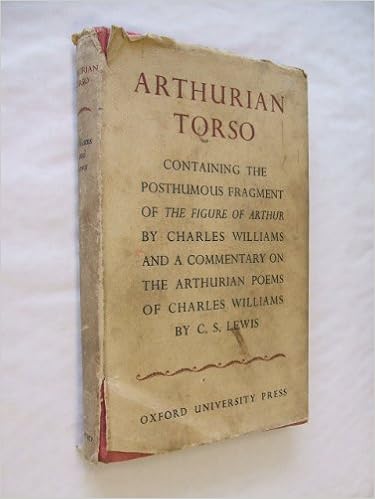
There are a few dimensions to this charism of courtesy that I’d like to analyze—the grammar of spiritual courtesy, if you will. These are not simply beliefs, though they involve beliefs. They are habits and attitudes, implied by and implying a whole outlook on earthly things as seen in the light of heaven. The central reality which these dimensions reveal is expressed by C. S. Lewis in part of his commentary on Charles Williams’ Arthuriana.


For the purposes of the poem it is feigned that Arthurian Britain was a province of the Byzantine empire. The whole conception of Arthur’s kingdom and the offered grace of the Grail are attributed to the Emperor. From this point of view the Emperor symbolizes God. But we must see with our imaginations why God should be so envisaged.


The image of the Empire is the final form of something that had always haunted Williams and which he often referred to simply as ‘the City.’ The word is significant. Williams was a Londoner of the Londoners. On many of us the prevailing impression made by the London streets is one of chaos; but Williams, looking on the same spectacle, saw chiefly an image—an imperfect, pathetic, heroic, and majestic image—of Order. … Such is Byzantium—Order, envisaged not as restraint nor even as a convenience but as a beauty and a splendor.


Yet order, in the sense of discipline and civility, is not the whole of what Williams sees in Byzantium: if it were, the Roman empire might have been as apt an image as the Byzantine. He chooses the Byzantine because we think of it as something more rigid, more stylized, more scrupulously hierarchical, more stiffly patterned than the Roman. Its organization suggest something geometrical; and that was what Williams desired. His great saying ‘Hell is inaccurate’ implies his outlook on heaven. He was deeply aware of Divine Order as something of a flawless and mathematical precision imposing itself on the formless flux of natural moods and passions, imposing itself in the shape of virtue, courtesy, intelligence, ritual. Sin could be defined as ‘the preference of an immediately satisfying experience to the believed pattern of the universe; one may even say to the pattern of the glory.’ … His ideal poetry is that which can ‘grow mature with pure fact.’5


It is ‘the City’ that I want to define in this series, as best I’m able. Or rather, that one of its numberless neighborhoods which is the heavenly archetype of England. Its borders seem to me to lie along certain qualities, which I shall call:


1. Precision. By this I mean an exact, disinterested attention to facts, without reference to what use we want or fear they’ll be put to.
2. Magnanimity. By this I mean thinking as well of others as we can, allowing that they may be worse than that but hoping sincerely that they’re not.
3. Irony. By this I mean being able to acknowledge the evil and the ridiculous, without letting them spoil the proper pleasures of the pure and the noble.
4. Hierarchy. By this I mean being able to accept one’s own role and those of others without resentment, embarrassment, tyranny, or slavishness.
5. Republic. By this I mean a genuine belief in the equal dignity of all men, acknowledging their hierarchical callings as roles to play.
6. Largesse. By this I mean a cheerful readiness both to give to and accept from others, rooted in hierarchy and republic alike—such that a peasant and a king could exchange Christmas gifts and each be genuinely delighted and grateful.
7. Decorum. By this I mean a particular kind of consideration for others’ feelings, that seeks not only not to injure them, but to avoid any ‘taking advantage of’ one’s position or powers.


The rest of this series will be spent fleshing out these definitions.


Lancelot came to the Canon; my household stood
around me, bearers of banners, bounteous in blood;
each at the earthen footpace ordained to be blessed and to bless,
each than I and than all lordlier and less.


The Table ascended; each in turn lordliest and least—
slave and squire, woman and wizard, poet and priest;
interchanged adoration, interdispersed prayer,
the ruddy pillar of the Infant was the passage of the porphyry stair.6


✠     ✠     ✠


1For those not familiar, a Rite of the Catholic Church is a coherent tradition of liturgy, language, and devotion. A style with a history behind it, if you will. The word Church can mean a few things in technical language: in this context, it means a self-governing Christian body with valid sacraments; I have in mind specifically those Churches that are in full communion with the Pope. This is why Roman Catholic Church, as applied to the whole Catholic communion, is kind of a misnomer. The Roman Catholic Church, strictly, is the Church of the Roman Rite (and a handful of other Rites), whose institutional head is the successor of Peter. There are others, such as the Coptic, Syro-Malabar, Byzantine Greek, Chaldæan, and Maronite Catholic Churches who are in full doctrinal agreement with and spiritual submission to the Roman Pontiff, but who are institutionally autonomous (governed by their own Patriarchs), and whose traditions are generally non-Latinate and non-Western.
2Sarum is the Latin name for the city of Salisbury in the south of England; originally, this liturgy was simply the diocesan liturgy of Salisbury, established in the eleventh century. It became common throughout England, Wales, and parts of Ireland and Scotland, until its official suppression under Queen Elizabeth I in favor of the Protestant Prayer-Book, and its less official extinction as the underground Catholics shifted to the Tridentine liturgy. The ritual of the Sarum Use, as least as interpreted by the Oxford Movement, was largely revived in the Anglo-Catholic wing of the Anglican Communion. Other English and Welsh uses included those of Bangor, York, Durham, Hereford, and Lincoln.
3In Catholic churches, the term sanctuary refers not to the building as a whole but to the area around the altar, where the Blessed Sacrament is confected and reserved (the part of the church with pews in it is the nave). A rood screen was a partition, usually of wood, that separated the sanctuary from the nave, surmounted by a crucifix flanked by figures of the Mother of God and St John; the rood screen was pierced by windows or latticework, often to the point of being more window than wall. (It is in this way quite different from the ikonostasis of the East, which normally obstructs the congregants’ view of the sanctuary and is meant to do so; the rood screen is designed to be a conceptual, more than a perceptual, partition.)
4The canny reader will have noticed that a number of these names were of alien nationality to the culture they’re identified with here: Austin of Canterbury was a Roman monk, Katharine of Aragon was Spanish, Loyola was a Basque, Aquinas came from Italy. I use them as examples of what I take to be the spirit of the pertinent culture, and of course culture is not the same thing as ethnicity or citizenship.
5Arthurian Torso: Williams and the Arthuriad, pp. 104-107. I can hardly recommend this book highly enough, and it is, of course, out of print.
6Stanzas 7 and 12 of Charles Williams’ poem Taliessin at Lancelot’s Mass. The porphyry stair is a reference to the chambers of the Emperor in Byzantium.

Tuesday, April 4, 2017

Natural Lawyer Jokes, Part II

The lover sees the Lady as the Adam1 saw all things before they foolishly chose to experience good as evil … The phenomenal Beatrice—Beatrice as she is in this fallen world—has for an instant been identical with the real Beatrice—Beatrice as she (and all things) will be seen to be, and always to have been, when we reach the throne-room … Romantic Love is neither necessarily joined to bodily fruition nor necessarily abstracted from it: the way to which the glory invites us may run through marriage or it may not. Unless it were possible—and heavenly—to be enamoured of the glory without desiring the woman, how should we ever grow mature for the life of heaven where that glory in its fullest meridian blaze will clothe every woman and every man, every beast, blade of grass, rock? (‘In the third heaven the stones of the waste glimmer like summer stars.’)

—C. S. Lewis, Arthurian Torso pp. 116-118


✠     ✠     ✠

Continuing in my analysis of Dr Feser’s paper, I have again come across a total, categorical disagreement. Let’s start with his allusion to The Four Loves:

C. S. Lewis usefully distinguishes Eros from Venus. Venus is sexual desire, which can be (even if it shouldn’t be) felt for and satisfied by any number of people. Eros is the longing associated with being in love with someone, and no one other than that one person can satisfy it. Obviously Venus can and very often does exist without Eros. Eros typically includes Venus, but it not only focuses Venus specifically on the object of romantic longing, but carries that longing to the point where Venus itself, along with everything else, might be sacrificed for the sake of the beloved if necessary. … As Lewis wisely notes, it is an error to think that Venus without Eros is per se morally suspect. … Eros is too unstable and outside our control to think it essential to the moral use of Venus. Sometimes mere affection (which, like Venus itself, can be felt for any number of people) has to suffice to civilize Venus.2

So far, so good, and a sound reminder to our culture, which is (I think) more Eros-crazed than sex-crazed, and that irrespective of Christian belief. As Lewis points out through the mouth of his devil Screwtape, the fact that we think marrying for the sake of preserving chastity and raising a family is low, as compared to marrying for love, is a symptom of how far from the idea of marriage as a sacrament we’ve really come.

But then Feser takes a turn in his argument in which I absolutely cannot accompany him.

Like Venus, Eros is natural to us. It functions to channel the potentially unruly Venus in the monogamous and constructive direction that the stability of the family requires. Of course, a respect for the moral law, fear of opprobrium, and and sensitivity to the feelings of a spouse can do this too, but unlike Eros the motivations they provide can all conflict with the agent’s own inclinations, and are thus less efficacious. … Venus and Eros, then, considered in terms of their natural function, might be best thought of not as distinct faculties, but as opposite ends of a continuum. Venus tells us that we are incomplete, moving us toward that procreative action whose natural end … requires the stability of marital union for its success. Eros focuses that desire onto a single person with whom such a union can be made and for whom the Erotic lover happily forsakes all others and is even willing to sacrifice his own happiness. Eros is the perfection of Venus; mere Venus is a deficient form of Eros. … ‘Consummate love’ … combines all three of the basic kinds of love—commitment, the intimacy of friendship, and the passion that begins with mere infatuation but develops into something more stable. It is difficult to achieve, but is commonly regarded as definitive of the best marriages.3


The Birth of Venus, Sandro Botticelli, 1486

A credible theory; but, as a student of history, a poet, and a lover,4 I firmly assert that it’s all wrong. To begin with, Eros does have a tendency—probably even a predominant tendency—to fix the lover’s desire upon a single beloved. But this tendency does little else to govern Venus, and as a rule Eros (in its ‘chemically’ pure state, without the governance of a well-formed conscience) has no interest in any moral law whatever. Among the passions, none (except maybe religious passion!) shows a stronger tendency to resemble the Unfettered archetype. So to describe its natural direction as ‘constructive’ is, in my opinion, special pleading.

Then there’s the observation that principle, shame, and decency can all serve the same purpose Dr Feser assigns to Eros, but that they may conflict with the person’s inclinations. What, and Eros can’t? My life is the very story of Eros conflicting with others of my own inclinations. And I am sure I’m not the first edition of that story. It isn’t clear to me that Eros even tends to streamline one’s motives, let alone that it was designed to do so.

Thirdly—and this is a lesser point, but it’s important, given the claims made by Neo-Scholasticism for what shows something to be natural—it must be pointed out, as a matter of historical record, that romantic love was not regarded as a dignified or spiritual phenomenon until the twelfth century, at least in Christendom and its Euro-Levantine predecessors5—except, in Greece and later in Rome, for homosexual Eros. To revere romantic love, that fanatical, self-abasing, inconstant, reckless, and involuntary phenomenon, was as ridiculous to our Christian ancestors of the early Middle Ages as it was to their pagan ancestors of the classical era. Nor, until the eighteenth and nineteenth centuries, was the romantic tradition linked to marriage even by Romantics; for the Troubadours who originated the tradition of courtly love, adultery was of its essence.6 The idea that Eros is shown by actual human habits to be naturally directed toward marriage is an artifact of a long and localized cultural development—or, more bluntly, pure moonshine.


In other words, the original rock stars were groupies for their fans.

As I’ve written about several times before, both in contemplating homoeroticism and in commenting on poetry, I think the basic function of Eros is something quite different, which C. S. Lewis, Dorothy Sayers, and above all Charles Williams wrote about.7 Returning to The Four Loves, it’s easy to forget the initial threefold division that he sets up, which cuts across the four: namely, the loves of need, gift, and appreciation.

Need-love cries to God from our poverty; Gift-love longs to serve, or even to suffer for, God; Appreciative love says: ‘We give thanks to thee for thy great glory.’ Need-love says of a woman, ‘I cannot live without her’; Gift-love longs to give her happiness, comfort, protection—if possible, wealth; Appreciative love gazes and holds its breath and is silent, rejoices that such a wonder should exist even if not for him, will not be wholly dejected by losing her, would rather have it so than never to have seen her at all.8

This appreciative love, Eros-as-awe if you will, is not primarily directed toward union with the beloved. It is not a way of possessing, nor even of giving, but of seeing; it is contemplative, where need-love is (usually) penitent and gift-love is active. All three have their place. But contemplative Eros will not be directed to an end other than contemplation. Lord, dost thou not care that my sister hath left me to serve alone? bid her therefore that she help me; and he would not.

Of all the loves [Dante] had known … [his love for Beatrice] is the one which, with will and judgment assenting, he declares to be a revelation of divine truth. It is not the febrile anguish of the death-Eros, in which possession forever mocks desire; nor yet the simple and affectionate exchange which does not look beyond possession. … It is a love whose joy—and therefore its fulfillment—consists in the worshipful contemplation of that which stands over and above the worshipper. True to its origins in courtly love, it finds its entire happiness in being allowed to do homage to an acknowledged superior.9


I don’t deny that Eros-as-need and Eros-as-gift exist, and of them, Dr Feser’s evaluation might possibly be accurate. But those experiences are so irrelevant—I almost said, so alien—to Eros-as-awe, they’re nearly as different from it as they are from the other loves. I’m tempted to say, oxymoronically, that need-Eros and gift-Eros aren’t even Eros.

I won’t quite go that far in fact. When defied, language has a way of avenging itself. And I’ve studied enough Greek mythology to be wary of invoking the wrath of any of the gods, let alone such potent deities as Eros and Apollo. But I will say that Eros is an essentially different thing from conjugal love, and that it’s not psychologically or morally necessary to have both for the same person, nor both at the same time—nor, indeed, to have either one at all. I think conjugal love is more a matter of storgê (governed by the virtue of justice) than of Eros necessarily.2 I therefore disagree entirely with Dr Feser’s assertion that ‘it is hard to see how marriage and family as institutions could survive unless Erotic and consummate love were generally honored … and approximated at least to some significant extent in most marriages.’ Marriage and family existed for a minimum of centuries in Euro-Levantine culture before marital Eros was honored by anybody.

But all this is actually quite consistent with a Thomistic metaphysic—consistent, if not perhaps very characteristic of its proponents. Then again, we had to wait seven hundred years between Dante and Charles Williams: philosopher-kings are plentiful and may be bought in bunches at any bookstore, but the philosopher-poet, the visionary of ‘the feeling intellect,’ the scholar of Romantic Theology, these are rare men.

This should conclude the erotic digression; my analysis of Dr Feser’s work will continue in a subsequent post.

✠     ✠     ✠

1Charles Williams (and Lewis in discussing Williams’ work) often refers to unfallen man, of both sexes, collectively as ‘the Adam.’ Since the Hebrew ’adham does simply mean ‘human,’ generically, there is a linguistic case to be made for this. Williams himself may have derived the habit from his all-important doctrine of the Coïnherence of humanity (what could inadequately be summarized as the mutual inter-animation of mankind), or from his magical training as an adept of the SRIA.
2Neo-Scholastic Essays, pp. 392-393; the famous ‘four loves’ written of by Lewis, derived from the various Greek words translated ‘love,’ are storgê, philia, erôs, and agapê, which roughly equate to familial affection, friendship, sexual love, and unconditional love.
3Ibid., pp. 393-394.
4Or at any rate, as one who has been a lover.
5I am ignorant of the romantic traditions of Indic, Oriental, Polynesian, Amerindian, and African cultures, indeed I don’t even know if there were any. I mean, I expect there were, since all men have roughly similar impulses regardless of what they do with them. But what I’m writing here, I only know to be true of the web of cultures spanning the Morocco-Iceland-Russia-Arabia region.
6I’m oversimplifying here, but not for the reason you’d probably think. Courtly love was expected to be directed to a Lady whom you weren’t married to, and who was almost certainly married to somebody else: you, the lover, were a poet, and your beloved was a noblewoman you desired to glorify. (The element of social superiority was key in the development of courtly love; fossilized aspects of it survive even now, as when a man kneels to propose.) There were two ‘schools’ of courtly love: one considered the apex of courtly love to be enjoying one’s Lady sexually; the other considered sex to be kind of beside the point (whether opposing it on moral grounds, or just artistically indifferent), because it viewed love’s true consummation as the adoration of the Lady’s person. The former school gave us poetry like The Romaunt of the Rose; the latter, poetry like The Divine Comedy.
7All three of them, Williams especially, would shake their heads and sigh if I neglected to mention here that Dante and Wordsworth were their great ancestors in this tradition of romantic theology. Milton, Donne, Blake, and just possibly Austen may belong on the list as well.
8P. 17.
9Dorothy Sayers, Introduction to the ‘Purgatorio,’ p. 43.

Tuesday, January 10, 2017

The Poems of Charles Williams, Part Three: The Beatrician Vision

The Beatrician experience may be defined as the recovery (in respect to one human being) of that vision of reality which would have been common to all men in respect to all things if Man had never fallen. The lover sees the Lady as the Adam saw all things before they foolishly chose to experience good as evil … The great danger is lest he should mistake the vision which is really a starting point for a goal; lest he should mistake the vision of Paradise for arrival there. He must follow this road till it leads him to the Byzantine precision. … The Beatrician experience does not usually last … The glory is temporary; in that sense Beatrice nearly always dies. But a transitory vision is not necessarily a vision of the transitory. … The phenomenal Beatrice—Beatrice as she is in this fallen world—has for an instant been identical with the real Beatrice—Beatrice as she (and all things) will be seen to be, and always to have been, when we reach the throne-room at Byzantium. The precise moment at which the phenomenal Beatrice loses her identity with the real one is a repetition of the Fall …

—C. S. Lewis, Arthurian Torso, “Williams and the Arthuriad,” pp. 116-117


✠     ✠     ✠

I’ve written a little already about Williams’ Arthurian cycle, contained in the two volumes Taliessin Through Logres and The Region of the Summer Stars. I’d like to continue my analysis, turning now to his doctrine of romantic love as expressed there.

Doctrine is not too strong a word. Williams was a thoroughgoing Neoplatonist, and considered every earthly good a ‘preparatory form’ of the universal Good, i.e. God. The two ways of communion with God—renouncing earthly goods, like the hermit, or embracing them, like the husband—must both acknowledge their reality and objective good-ness. The hermit may renounce them in his preference for the final reality, but he must not condemn or despise them; the husband may embrace them in legitimate delight, but must not content himself with them as though they could finally deserve his whole worship or satisfaction. And, as many works have been written on ascetic theology, so Williams wrote on romantic theology: the way of the affirmation of images, as asceticism is the way of the renunciation of images.

The Romantic Way experiences its object in a certain mode. This can be a person (like Beatrice for Dante, or in a quite different way, Frodo Baggins for Samwise Gamgee), or a thing (like nature of Wordsworth, a favorite reference point of Williams); its key quality is that all goodness is understood through it and in relation to it. It is a kind of temporary theophany.


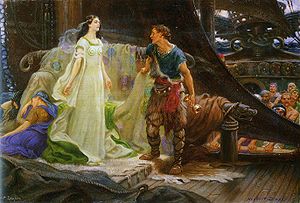
Tristan and Isolde [or Iseult], Herbert Draper, 1900

Williams describes Sir Palomides, a Saracen knight who joined the Round Table, meeting Queen Iseult of Cornwall between her husband, King Mark, and her lover, Sir Tristram, and falling in love himself:

I saw the hand of the queen Iseult;
down her arm a ruddy bolt
fired the tinder of my brain
to measure the shape of man again;
I heard the king say: ‘Little we know
of verses here; let the stranger show
a trick of the Persian music-craft.’
Iseult smiled and Tristram laughed.
Her arm exposed on the board, between
Mark and Tristram sat the queen,
but neither Mark nor Tristram sought
the passion of substantial thought,
neither Mark nor Tristram heard
the accent of the antique word.
… Blessed (I sang) the Cornish queen;
for till to-day no eyes have seen
how curves of golden life define
the straightness of a perfect line,
till the queen’s blessed arm became
a rigid bar of golden flame
where well might Archimedes prove
the doctrine of Euclidean love,
and draw his demonstrations right
against the unmathematic night …1

In Iseult’s body, Palomides sees the logic of the universe. Her arm exhibits the Logos to him, the Word of the Father, and to that extent he is momentarily converted: God-made-flesh is a beheld and believed reality.

But neither vision nor belief lasts. The former passes, and the latter is forsaken with it. We experience the fall, the loss of the glory, with a renewal of terror:

In the summer house of the Cornish king
suddenly I ceased to sing.
Down the arm of the queen Iseult
quivered and darkened an angry bolt;
and, as it passed, away and through
and above her hand the sign withdrew.
Fiery, small, and far aloof,
a tangled star in the cedar roof,
it hung; division stretched between
the queen’s identity and the queen.


It’s too familiar. How many couples have we known who’ve broken up, even by the violent, organic schism of divorce, because one or the other is no longer in love? How many times have we ourselves met someone who used to be enchanting, and found them suddenly vacant of that radiance? The contrast is a shock, sometimes to the point of being actively disgusting.2 And Palomides, lacking either habitual grace or the theology of romantic love to guide him through the occlusion of the glory, pursues what little he still perceives:

Relation vanished, though beauty stayed;
too long my dangerous eyes delayed
at the shape on the board, but the voice was mute;
the queen’s arm lay there destitute,
empty of glory …
Cœlius Vibenna over the dead
cast the foul Chthonian spells,
on ghost and bone and what lingers else;
… the Pope in white, like the ghost of man,
stood in the porch of Lateran;
and aloof in the roof, beyond the feast,
I heard the squeak of the questing beast,
where it scratched itself in the blank between
the queen’s substance and the queen.3

None of the knights of the Round Table have been able to capture the Questing Beast. Palomides, who being still unbaptized is not yet eligible for the Table, decides to do so—he becomes obsessed with it.

I determined, after I saw Iseult’s arm,
to be someone, to trap the questing beast
that slid into Logres out of Broceliande
through the blank between the queen’s meaning and the queen.

Having that honour I would consent to be christened,
I would come then to the Table on my own terms …
But things went wrong; Tristram knocked me sprawling
under the tender smile of Iseult; my manhood,
chivalry, and scimitar-play learned from the Prophet,
could not gain me the accurate flash of her eyes.

Once I overthrew Lancelot by cheating at a tourney,
whence, enraged, fleeing, I was taken by pirates;
Lancelot freed me—he rode on to Carbonek;
did I smile when I heard that he my saviour was mad?

For bees buzzed down Iseult’s arm in my brain;
black gnats, whirring mosquitoes …
and I thought if I caught the beast they would cease certainly.
… There would be nothing but to admire the man
who had done what neither Tristram nor Lancelot did.4

Smarting under the loss of Iseult before he has even gained her, and unable to conceive the Dantean road of love as intellectual adoration without carnal consummation, Palomides has attempted the egoïst’s compensation of proving his worth before conceding that worth to others; and, though baptism is oriented to God, in Christendom it is inevitably a concession to one’s fellow Christians as well.

So the Questing Beast is met in the blank between / the queen’s substance and the queen—i.e., in the moment when the meaning of the beloved and her person are perceived as horribly separate—because it is a symbol of ‘the conversion of the Godhead into flesh,’ the theory of the Incarnation which the Athanasian Creed specifically disclaims. It is an attempt to reclaim the Beatrician vision by force: an attempt to make love operate entirely in terms of appetite.


He tries to defeat Tristram and so win Iseult’s love, but is beaten himself; he tries to triumph over Sir Lancelot, the finest of Arthur’s knights, so salvaging his ego, yet he can do so only by cheating, and is then rescued by him—the secret and the public humiliations coïnhere. Neither erotic consummation nor knightly glory is available to him any more. And in pursuing the Questing Beast at all, Palomides rejected the possibility of erotic love as a way of the soul: renouncing carnal enjoyment of the beloved, but remembering the vision of her identity and simply rejoicing in that beauty, maintaining faith in the queen’s substance even when it is obscured by the queen.

This may sound like a fantasy, but minds like Charles Williams, C. S. Lewis, and Dorothy Sayers all accepted it. The idea that sex is, for a lover, kind of beside the point (however licit and fun it might be) goes right back to the troubadours. They didn’t all agree, but there were those among them for whom the simple contemplation of glory in the beloved was the essential end of courtly love, and everything else was icing. A culture like ours, in which egalitarianism and sexual satisfaction are the basic standards of happiness, is almost unable to believe that somebody could feel that way.5 But the poets and their commentators tell us that it was a real phenomenon—the Divine Comedy is about that very thing—and facts don’t have to be likely or even comprehensible.

✠     ✠     ✠

1The Coming of Palomides ll. 35-48, 55-64.
2The disgust may be reasonable: romantic love is no respecter of persons, and can be felt for someone who is, in their phenomenal identity (i.e. the person we meet), ghastly. The next poem in Taliessin, ‘Lamorack and the Queen Morgause of Orkney,’ deals with just such a love—even in the throes of his devotion, Sir Lamorak doesn’t consider Morgause beautiful or good, but he is overpowered by the experience of her nonetheless. But this disgust may also be a mundane result of suddenly seeing the flaws we had formerly missed or deliberately ignored in the excitement of eros; or, it may be an expression of the horror of suddenly lacking the vision of glory that had inhered in the beloved, perhaps mere moments ago.
3The Coming of Palomides ll. 65-69, 76-78, 81-86. Cœlius Vibenna was an Etruscan noble and a friend of Romulus; the Etruscans were notorious sorcerers, and introduced divination by entrails to Rome. Chthonian is a reference to Vibenna’s magic (from the Greek χθών chthōn, ‘deep earth, under-soil’)—gods such as Hades, Persephone, Hecate, and the Furies were chthonic.
The Questing Beast, also called the Blatant Beast or Beast Glatisant in some Arthurian sources, is an interesting, difficult symbol. It is usually depicted similarly to the ancient Egyptian serpopard. The names blatant and glatisant come from archaic words meaning ‘yelping’ or ‘barking’ (glapissant in Old French, while blatant is related to the word bleat). I think the interpretation I’ve provided here is accurate, but I’m sure others are possible.
4Palomides Before his Christening ll. 9-14, 17-26, 28, 31-32.
5‘How are these gulfs between the ages to be dealt with by the student of poetry? A method often recommended may be called the method of The Unchanging Human Heart. … Just as, if we stripped the armor off of a mediæval knight or the lace off of a Caroline courtier, we should find beneath them an anatomy identical to our own, so, it is held, if we strip off from Virgil his Roman imperialism, from Sidney his code of honor, from Lucretius his Epicurean philosophy, and from all who have it their religion, we shall find the Unchanging Human Heart, and on this we are to concentrate. … But how if these [“lowest common multiples”] are not really the most important elements in the actual balance of the poem we are reading? Our whole study of the poem will then become a battle between us and the author in which we are trying to twist his work into a shape he never gave it …
‘Fortunately there is a better way. Instead of stripping the knight of his armor you can try to put his armor on yourself; instead of seeing how the courtier would look without his lace, you can try to see how you would feel with his lace; that is, with his honor, his wit, his royalism, and his gallantries out of the Grand Cyrus. I had much rather know what I should feel like if I adopted the beliefs of Lucretius than how Lucretius would have felt if he had never entertained them. … To enjoy our full humanity we ought, so far as is possible, to contain within us potentially at all times, and on occasion to actualize, all the modes of feeling and thinking through which man has passed. … For the truth is that when you have stripped off what the human heart actually was in this or that culture, you are left with a miserable abstraction totally unlike the life really lived by any human being.’ From C. S. Lewis’ Preface to ‘Paradise Lost,’ pp. 62-64.