Collect

Collect for the Fourth Sunday after Trinity

O God, the protector of all that trust in thee, without whom nothing is strong, nothing is holy: increase and multiply upon us thy mercy; that, thou being our ruler and guide, we may so pass through things temporal, that we finally lose not the things eternal; grant this, O heavenly Father, for the sake of Jesus Christ thy Son our Lord, who liveth and reigneth with thee, in the unity of the Holy Spirit, ever one God, world without end. Amen.
Showing posts with label queer theory. Show all posts

Sunday, June 16, 2019

Are "Celibate Gays" Really Gay?

Dryden also ‘meant’ by wit the essential gift of the poet. He defined this gift as … ‘propriety of thoughts and words.’ … This definition would commit us to the consequence, ‘Euclid was the greatest wit that ever set pen to paper.’ It may also be asserted almost safely that no human being, when using the word wit to talk with and not talking about the word wit, has ever meant by it anything of the sort. Nor does Dryden himself anywhere make the slightest use of this definition …

We might tax our brains for a long time to explain how a man of Dryden’s stature could have said anything so false to all actual usage, so useless, and so unsupported, if we did not realize its tactical function. He is thinking neither about what the word actually meant nor about what it could, in the interests of clarity and precision and general utility, be made to mean. It is a valuable vogue-word. Therefore a strong point in the critical battle. He wants to deny the enemy the use of it.

—C. S. Lewis, Studies In Words
✠     ✠ ✠


Yes.

Freelance journalist Brandon Ambrosino tweeted up a storm about ex-gay organizations a day or two ago, and concluded with a shot at self-identified celibate gays, stating in no uncertain terms that anyone who abstains from gay sex due to traditionalist moral or religious beliefs doesn't even qualify as gay. As he put it, ‘Gayness is more than gay sex, but it can’t be less’ (I think I recall that correctly). I'm not at all sure why he came after me and my friends [1]. Perhaps he had us on the brain because Revoice just took place, I don't know. Regardless, he did it—and seemed more than a little thin-skinned about it: anyone who wishes can go to his Twitter feed and look it up, but I can’t, because he blocked me and several other people who, in his words, came for him and got bitchy.


Anyway. I actually don't want to just rag on Mr Ambrosino for a whole post: partly because I have no intention of obeying a guy who’s not my dom, partly because I've liked a lot of other things he's written, but chiefly because I do think I understand where he’s coming from. Ex-gay organizations have taken to rebranding and moving the goal-posts a hell of a lot in the last fifteen years or so, as it became irrevocably clear that orientation change does not work, but many of them remained unwilling to really face up to the facts. Some ex-gay people have even appropriated the Side B label, notwithstanding the fact that Side B’s salient characteristics are rejecting SOCE and embracing LGBTQ identity and culture. [2]

Further still, some people’s experience of Side B has been toxic for a variety of reasons. A lot of my own attempts at chastity as a Side B person were shot through with problems that could easily have wrecked my mind, if I hadn’t had the help of guides much wiser than myself. Defensiveness and suspicion toward celibate gay identity are perfectly understandable in these circumstances.

But that doesn’t make this gatekeeping definition of gayness a sound one. I believe it’s not only a poor use of language, but actually damaging to the community it’s ostensibly meant to serve, for a great many reasons. I will list just seven.

1. It’s not how anybody actually uses the word. Okay, ‘anybody’ is an overstatement. There is an ideologically driven minority among gay people who do insist that the word be used to indicate beliefs as well as orientation; and thirty or forty years ago, that meaning was much commoner currency. Nonetheless, it isn’t how the majority of people use the word now. It normally indicates orientation, experience, and self-identity, none of which depend on having sex to exist. That is how we know we’re gay before trying gay sex, after all.

There is one other group, however, who habitually use this definition. This leads me into a second and bigger issue …

2. It endorses a definition of gayness originally designed by homphobes to justify and maintain homophobic practices. Now, the origin of a term or definition is not the only thing that determines its value, but it is one of them. And, well, in this case, it's a doozy.

I mentioned ex-gay practices above, which I endured personally. The definition expressed by Ambrosino is the exact same one drafted and used by ex-gay organizations like the Restored Hope Network to this day, because it’s one of the things that helps them move the goalposts. You’re ‘not gay anymore’ because you stop having gay sex, which they can then sell with all the appeal of orientation change—a bait-and-switch change of identity. It downright encourages ambiguous, deceitful language and thought patterns, both with oneself and others. It’s arguably the most basic tool in the ex-gay box. Insisting on gay sex as a qualifier for gay identity gives ex-gay groups more room to maneuver and ammunition to do it with, not less.

3. It erases ace and demi identities. Asexual, aromantic, demisexual, and demiromantic identities all have queer expressions (indeed, insofar as they depart from the het norm, they’re queer by definition). An asexual but homoromantic woman is every bit as entitled to call herself a lesbian as a sexually active polyamorous lesbian is. [3] Under a you-must-be-open-to-gay-sex definition, grey identities are implicitly excluded.


4. It forces people who are still navigating their own feelings into a false dichotomy. This is especially true of teens, I think, who have the most navigating to do and the most at stake in doing it; but it’d certainly apply to, e.g., the heterosexually married Christian man in his thirties who’s finally facing up to the fact that his feelings about his best guy friend are erotic, not just affectionate. A person who’s told that they have to have gay sex (or at least be open to it) in order to ‘really’ be gay is being given an ultimatum about their feelings and identity, and maybe being asked to choose between deeply held religious convictions and powerful instinctive and emotional desires—being asked to call one of those things false and insignificant, when they aren’t ready to do that. What good does that do to anyone? Why is a choice like that necessary? They should not be compelled by others to choose what part of themselves to lie about.

This is normally what Side B is saying to fellow traditional Christians. In this case, we find ourselves saying it to fellow LGBTQ people. The dichotomy is artificial either way.

5. It erases Side B Christians who support gay civil rights, including those of us who’ve been traumatized by SOCE. Okay. In the name of not pulling a bait-and-switch myself, I’ll say frankly here that there are Side B people who don’t support complete political equality between, e.g., gay and straight marriages. [4] But a lot of us do support full political equality, and have paid for that belief among our families, friends, and churches. Furthermore, a lot of us are ex-ex-gays, survivors of conversion therapy. We rejected that stuff because it’s unnecessary, wrongheaded, and toxic. We learned that the hard way—which, if I may be a bit tart, is more than can be said of Mr Ambrosino. We paid for our identities. Having those identities invalidated again, by members of the very community we’ve been vilified for asserting, is a blow upon a bruise.

6. It adds an ideological modifier onto an identity more defined by experience than by behavior. Don’t misunderstand me; I’m not saying that every LGBTQ person’s experience is the same. But the shared thread among them is the experience of being othered, excluded, demeaned, treated as less than, on the basis of our attractions or gender expression. We all experience that, in our fears while we're closeted and in our lives when we leave it. That unites lesbians, gay men, bisexuals, trans people, and everyone else in the community, not sexual activity.


Really it couldn’t be sex that united the gay community, not just because (for a variety of reasons) some of us never have any, but because our sexual acts and experiences are so radically different. An act of gay sex usually contains none of the same ingredients as an act of lesbian sex; in that way, each resembles heterosexual sex more than the other. This is, of course, a ridiculous line of reasoning, but that’s kinda why I don’t take this view.

7. It drives an unnecessary wedge between LGBTQ people during a time when anti-gay sentiment appears to be rising rather than falling. Infighting is dull and wasteful at the best of times. When you have a homophobic administration elected by a right-wing portion of the populace, it’s dangerous. And sure, the media distorts things and my own consumption of media is kinda random; but I’ve been seeing a lot more stories about homophobic violence lately, including a couple of nasty scares even at Pride events. This is not a smart time to be fractious.

When Side B people speak up for ourselves and the LGBTQ community as a whole, that is precisely what we’re doing: speaking up for ourselves, and for the LGBTQ community as a whole. If you think we don't get targeted for harassment and hatred because our families or our churches know we're 'the good gays,' you're wrong. We are endangered when the gay community is endangered, and vice versa. Homophobes don’t generally care that (most) Side B people are attempting celibate lives; they care that we’re gay. That’s the thing they hate. That is why, for example, an institution like the Catholic Church can be at one and the same time welcoming on paper, full of homosexually active clergy, and riddled with homophobia in its attitudes, rhetoric, and policies. They’re targeting the identity, the rallying point for the community: often as not, they’re prepared to ignore the sex.

Want to deprive your enemies of a word? Fine. But know who they really are first. You might learn something.

✠     ✠ ✠

[1] At any rate, many of my friends can truthfully claim celibacy. I admire celibacy, and I consider celibacy and monogamous heterosexual marriage the only two intrinsically licit sexual states; but, phrased gently, it would be generous at the expense of accuracy to describe me as chaste, and I'm certainly not going to marry a woman. [5]
[2] With qualifications? Sure. But then again, St Augustine embraced Neo-Platonism with qualifications, St Thomas Aquinas embraced Aristotle with qualifications, St Edith Stein embraced Phenomenology with qualifications. That doesn’t make any of them not part of those traditions: it just means they’re a different part of the tradition.
[3] Yes, she might well add the qualifier ace lesbian at her discretion. But that’s exactly what it is: a qualifier, added at her discretion, not a contradiction.
[4] I’m not crazy about this fact. But I don’t want to be accused of pinkwashing a movement that is pretty diverse in certain ways, including some ways that a lot gay people would find objectionable. All the same, I don’t consider it a very damning criticism of the Side B community, since there are outliers in the gay community, like Milo Yiannopoulos or Jack Donovan, that most LGBTQ people find objectionable, too.
[5] Phrased less gently, I’m kind of a whorebag.

Wednesday, December 26, 2018

What Is Side B Anyway?

And the Church must be forever building, and always decaying, and always being restored.
For every ill deed in the past we suffer the consequence:
For sloth, for avarice, gluttony, neglect of the word of GOD,
For pride, for lechery, treachery, for every act of sin.
And of all that was done that was good, you have the inheritance.
For good and ill deeds belong to a man alone, when he stands alone on the other side of death,
But here upon earth you have the reward of the the good and ill that was done by those who have gone before you.
And all that is ill you may repair if you walk together in humble repentance, expiating the sins of your fathers;
And all that was good you must fight to keep with hearts as devoted as those of your fathers who fought to gain it.
The Church must be forever building, for it is forever decaying within and attacked from without;
For this is the law of life ... 
—T. S. Eliot, Choruses from 'The Rock'
✠     ✠ ✠


Given the response a number of people have had to the Q Christian Fellowship’s announcement about representatives of Side B at their upcoming conference, I thought it might be as well to outline what, exactly, Side B is and what its implications are (with a hat tip to the Liturgical Queer, who inspired me). I haven’t done this before, for the rather silly but simple reason that it never occurred to me. This is partly because I’d thought it was clearer than, apparently, it is.

For one thing, a lot of people think that Side B is just ex-gay thought, but without its guarantees of successful orientation change. This isn’t the case at all. Side B was formed as a response to, and a rejection of, ex-gay thought, just like Side A was. It’s true that Side B takes a traditional ethical viewpoint, in contrast to Side A; but in general the origin, culture, and identity of Side B bear more resemblance to Side A than they do to anything out of Exodus or NARTH.

For another, a lot of people think that Side B Christians want to convert everyone to Side B beliefs. I’ll concede that we are very eager to convert our own churches to Side B beliefs: which largely means, getting them to treat us with the love, respect, and solidarity they profess (to a great extent falsely) to have for us. But, while I’m certain there are individuals who consider it their mission to convert Side A people to a Side B viewpoint, I can’t actually think of any. Most of us are—or more accurately, would be, considering the suspicion of our heterosexual brethren—perfectly willing to live and let live, not because the truth doesn’t matter (it does) but because it is neither our business nor particularly effective to go around browbeating people with your beliefs. Within a given church, since it’s a community defined by belief, it may make sense to have such discussions, but that’s quite different.

Now, I don’t want to paint Side B with too broad a brush; there’s a diversity of views, to be sure. The essential parameters are these:
- a traditional sexual ethic (i.e., sex belongs in a one-man, one-woman marriage)
- rejection of ex-gay practices and narratives
That’s it.


This obviously leaves a lot of space for what a given Side B person might think. Like I said, there are different versions of Side B, just as there are different versions of being gay in general. A Side A transman might believe firmly in monogamy, where a secular lesbian might think there’s nothing wrong with sleeping with a different person every night. Are they both right? No. Are they both queer? Yes. Likewise here: I think what I’ve laid out is typical of Side B, but there are many skeins in the rich tapestry of the community.

Some representative areas where Side B and Side A can work together include:

1. Refugee and asylum sponsorship, advocacy, and work. There are still a lot of places in the world, especially in Africa and Asia, where is it dangerous to be LGBT. I’m talking about everything from socially approved harassment to execution by stoning. The worst places include: Chechnya, part of the Russian Federation, in which men reputed to be gay are currently being shut in concentration camps; Iran, which executes adult men for homosexual behavior, but only requires 74 lashes for underage males; Nigeria, in which, if you get caught, you’d better hope it’s in the south and you merely have to languish in prison for a decade or so, because in the north they just kill you; Tanzania, which recently embarked on a large-scale anti-gay witch hunt; Saudi Arabia, which allows anything from an arbitrarily long imprisonment to flogging to castration to execution, and accents that last one for repeat offenders; Somalia, which allows the death penalty, but is at least chaotic enough that you can hope they forget to bother; and Uganda, which narrowly avoided instituting the death penalty in 2013 and settled for life imprisonment. Keep in mind, these are just some of the places in the world where your life and liberty could be endangered if you come out, or get outed by someone else, because everyone including the government will come after you. We know only too well that even ostensibly gay-friendly places like, say, Orlando can suddenly become scenes of horror and tragedy.

Getting LGBT people out of these countries and into safer parts of the world should be a no-brainer to everybody. It’s certainly a no-brainer to Side B. Rainbow Railroad is one organization I know of that does this. This of course goes hand in hand with our next point.

2. Supporting national and international legal reforms. This includes advocating legally classifying anti-gay crimes as hate crimes, for example, or supporting efforts to make gender identity and sexual orientation protected categories with respect to things like housing, employment, and access to public goods and facilities. Sodomy laws were of course struck down in the US as of Lawrence vs Texas, but they still stand in other places, and extending aid to those who are working to repeal them in other countries definitely qualifies.

I’d add supporting LGBT civil unions on an international basis, too. Some Side B folks do support civil gay marriage, since they consider their beliefs about marriage strictly religious. Some others, myself included, can’t unhesitatingly endorse gay marriage per se, but I think I’m right in guessing that an overwhelming majority of us are in favor of civil unions at the least. ‘Found family’ is one of the things that’s always laid at the heart of the gay movement, especially due to the fraught relationships so many of us have with our biological families; civil unions are a legal way of recognizing that. Adoption is in a distinct but analogous position here, and a Side B person can definitely support gay adoption (I certainly do).


3. Combating false and demeaning stereotypes about LGBT people, especially those that prevail among Christians. An example would be some of the more prejudiced reactions to the recent resurgence of scandal in the Catholic Church: calls for total bans on same-sex attracted men being admitted to seminaries were widespread, and remain a cause célèbre among many conservative or traditionalist Catholics. One individual, a rare instance of an uncloseted man with SSA (his preferred term), wrote an article published in First Things titled ‘Why Men Like Me Should Not Be Priests,’ asserting that chastity is disproportionately hard for homosexual men as such, and that we are accordingly unsuitable for such a demanding vocation. He adduced his own experiences struggling with chastity, and slipping into hookup culture at times, in support of his argument. The problem with these claims is not just that they’re detrimental to gay people (though they certainly are), but that they’re a bad reading of the evidence.

Traditional Christian culture, Catholic and evangelical alike, punishes not only homosexual acts, but homoerotic feelings, and deviations from quite rigid gender norms—a friend of mine, for example, was told that in order to be confirmed at his Anglican parish, he had to not only cut off all contact with his LGBT friends, but dress and speak differently (and this man was married to a woman). Moreover, while hookups can be treated as discrete, individual sins that can be repented and forgiven, anything that would humanize gay sex, like placing it in the context of a loving relationship, is typically treated as a more serious violation of chastity because it’s ‘living in sin’ instead of merely sinning. Without, quite, saying that the distinction has no value, I will point out that in this case, it makes hookups more appealing, not less: they satisfying both the craving of sexual lust for physical release, but also the intense psychological need that homosexual release should be a sordid and animalistic thing, without sincere affection or loyalty. A chastely celibate partnership between two uncloseted gay men is more of a threat to that identity than any number of anonymous blowjobs in a back room.


This is only one example of damaging preconceptions about LGBT people, and of how the shame and repression they inculcate can easily turn what was a calumny into a self-fulfilling prophecy. On wholly Side B premises with a thoroughgoing commitment to the most rigorous interpretations of Catholic sexual ethics, there is no reason to presuppose that a gay person is any less fit than a straight one to serve as a Catholic institution’s teacher, organist, secretary, youth minister, therapist, nurse, or priest. Each one of us must be examined not on our orientation, but on our merits—which is exactly what these positions call for anyway. Besides, given the incessant lectures we receive about how we shouldn’t reduce ourselves to our sexuality (from confessors and pastors, fellow parishioners, and total strangers in Christian media), it’d be nice if other people would stop doing it to us.

4. Demanding clarity from churches about how LGBT Christians can and can’t serve in them, along with the relevant circumstances and the justification. This alone is going to turn up a lot of homophobic subsoil. Vague assurances of ‘welcome’ are no match for a lived experience of exclusion, heteronormativity, and gaslighting. Churchclarity.org, which I discovered through Twitter, is a great example of an effort to get churches to move from generalized affirmations of love to a concrete explanation of what their love is going to look like—which empowers LGBT believers of all sorts of convictions to make an informed choice about going to this or that church.

What Churchclarity is doing, however, is (and professes to be) just one part of this. If, for example, a given church won’t hire LGBT employees or won’t ordain LGBT Christians because they believe they’re more prone to sexual misconduct, that’s a deeply problematic justification for a stance that is admittedly clear. My own Catholic tradition is particularly frustrating on this point: her teaching that homosexual persons, like all persons, are to be treated with ‘respect, compassion, and sensitivity’ is in theory straightforward; but then she goes and ruins it with a bunch of well-actually-ing about what does and doesn’t count as prejudice and unjust treatment. As a Side B person, I strongly advocate for reform in the Catholic Church’s attitudes and policies, and especially for an examination of the extent to which her pastoral habits have been formed by discredited psychological theories of homosexuality. (The ex-gay claims and personal licentiousness of Msgr. Anatrella, recently disgraced along similar lines to ex-Cardinal McCarrick, spring to mind, given his former influence with the Vatican.)

Calling every congregation, parish, diocese, synod, presbytery, and communion to implement policies that actually promote the dignity and well-being they claim to desire for LGBT believers is what’s at stake here. A church that wants to call itself Side B in its doctrine needs to put its money where its mouth is and prove that it doesn’t discriminate against homosexually attracted believers simply because of their attractions—by doing things like employing and ordaining qualified gay Christians, and treating our gifts as being just as valuable as those of straight brothers and sisters by allowing us to exercise them for the good of the body. If your policies demand that LGBT believers, even the ones who are in complete theological agreement with you and live out the chastity they confess, must assume the roles of dependent recipients of your gifts and never more, then whatever your stated beliefs, your behavior is homophobic. And it’s wrong.


5. Attending to medical and social issues that confront LGBT people. People think of HIV here, which isn’t totally false (especially when you had a creep like Martin Shkreli on the loose), though it is recycling a trope that wasn’t entirely true even in the 1980s. But of course, even with Truvada and other godsend medical advances, HIV is still an issue in the gay community. Similar half-truths abound with respect to suicide and substance abuse.

A more pertinent example would be homelessness among LGBT young people: studies over the last twenty years suggest that anywhere from 11 to 40% of homeless youth are LGBT (as opposed to around 3% of the general populace), and that domestic abuse or family expulsion are leading factors here. It is sad and infuriating to think that a minister should need to tell the parents among his flock not to savage, molest, or evict their children for their sexuality or gender identity; sadder and more infuriating that many do not. Drawing attention to this societal travesty, and urging believers of whatever convictions to open their homes and hearts to young people who need to get off the street, are fundamental responsibilities of Christian compassion.

6. Defending the legitimacy of LGBT terminology and identities for Christians. It still leaves me baffled that so many Christians have a problem with words like ‘gay’ and ‘lesbian,’ especially since so few of them have a problem with the word ‘straight’ (or ‘bisexual,’ for some reason). Saying I’m gay is not a theological, political, philosophical, or moral statement. It is not an assertion about my sexual activity or lack thereof. It is not an assertion that this is the most important part of who I am, any more than any other I’m statement is such an assertion (I’m an American, I’m a teacher, I’m a nerd …). It’s just using the normal adjective that most speakers of English use to denote a guy who likes guys the way most guys like women.


That said, I personally am prepared to take it a step further and say that queer identities are not incompatible with even a robustly Side B Catholicism. Because what is identity? A lot of things. There are ontological identities like ‘rational agent,’ but when most people talk about their identity I’m prepared to bet they don’t have ontology in mind. Sense of self would be a closer synonym: a narrative of experiences, principles, relationships, ideas, and so forth that we find deeply important. Given that our sexual orientation has a profound impact on our experiences, emotions, and relationships, I see no reason to exclude it from identity in this sense.

And even beyond this, when we look at how groups of people work, we find that group identities are forged by shared experience and especially shared suffering. The early Christians, who were frequently persecuted in fact and could be persecuted at any moment in theory, are an example: the letter to the Hebrews and the Apocalypse are eminent examples of a kind of resistance literature, books that reminded the addresses of who they were, of the solidarity of the Church, of their purpose and their hope—in a word, of their identity. In a very different way, blackness in the US can be regarded as a social identity, forged primarily through suffering and chronic social injustice: ‘black’ isn’t an ethnic group the way Swedish or Korean are ethnic groups, but the shared historical experience of black people in the United States, regardless of their diverse ancestry, created a common identity that reflects a common history.

In the same way, LGBT people in general know what it’s like to grow up different, confused, maybe scared, often mocked or excluded, because of our attractions. We know what it is to realize that what we’re feeling for other boys is what they’re feeling for girls—the chasm that opens up in an instant between us and them, between us and the future we were raised to anticipate. We know collectively what it is like to live and move in a world that was designed by, and caters to, people whose relationships are to a large extent radically different from ours, even when we share their convictions.


These six points are general, exemplary categories, not an exhaustive list or some sort of authoritative confession. But I hope they help clarify for our more hostile or skittish Side A sisters and brothers why we are, precisely, sisters and brothers, both as Christians and as queer family; and that they rouse and spur our heterosexual fellow believers to treat us better.

✠     ✠ ✠

Tuesday, June 9, 2015

An Apologia for the Romantic Way

Tell me not (Sweet) I am unkinde
That from the Nunnerie
Of thy chaste breast and quiet minde
To Warre and Armes I flie. 
True; a new Mistresse now I chase,
The first Foe in the Field;
And with a stronger Faith imbrace
A Sword, a Horse, a Shield. 
Yet this inconstancy is such
As you too shall adore;
I could not love thee (Dear) so much
Lov'd I not Honor more. 
-- Richard Lovelace, To Lucasta, Going to the Warres, 1649

+     +     +


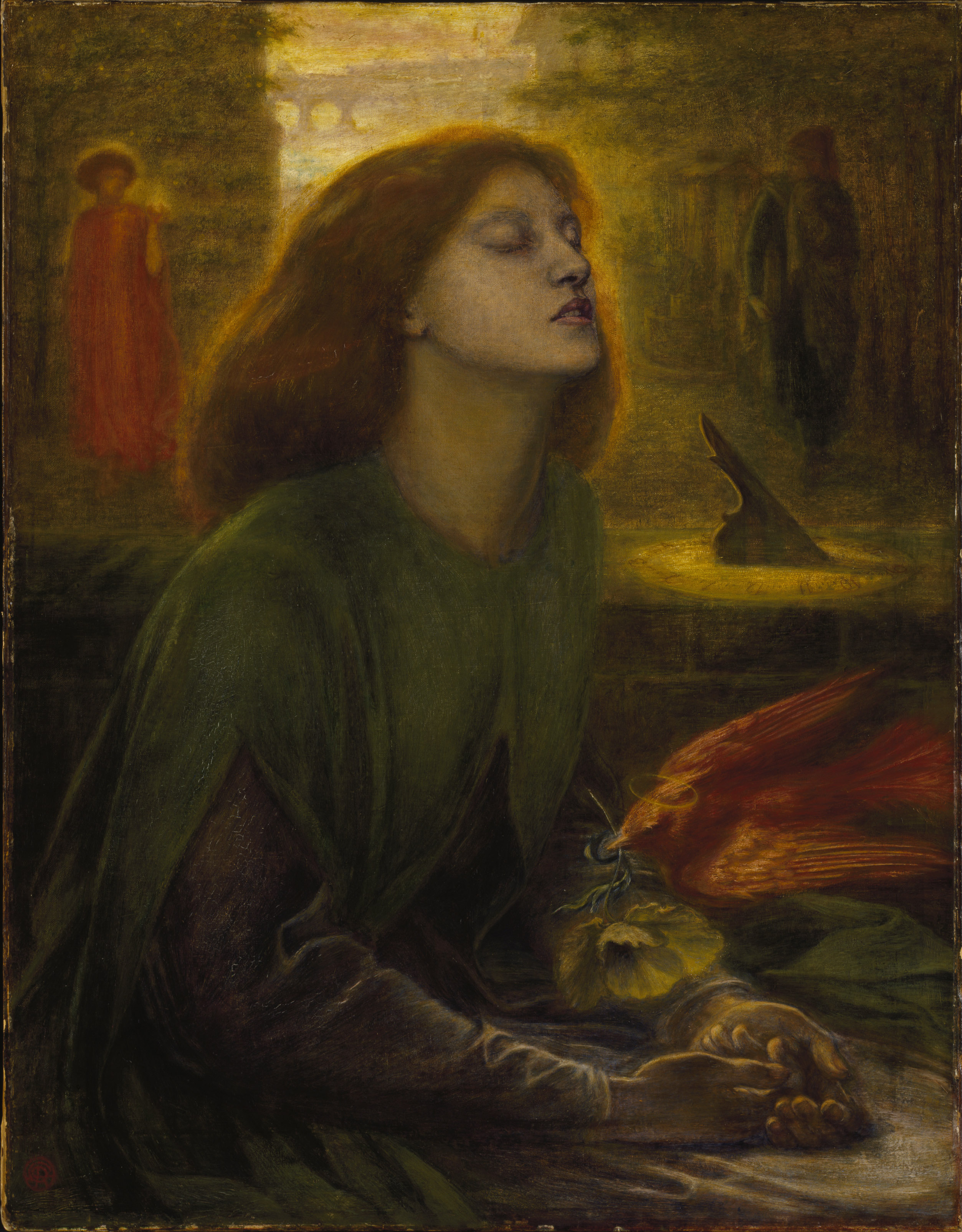
Dante Gabriel Rossetti, Beata Beatrix, 1870

Before I differ from Tyler Blanski's article The Protohomosexual of a few weeks ago, I'd like to note an important agreement between us. He writes movingly in his final subsection ("We Are Oriented") of the intrinsic human impulse toward sexuality-as-procreation. There are other reasons that we are interested in sex, obviously, and other ways in which we display the urge to create; about the only thing we are told in Genesis about God, before being told that we are made in His image, is that He is a maker, and our creative drive is in a sense our most thoroughly human attribute. We share freedom and intellect with the angels, and we share body and social instinct with animals; but creativity appears to be a distinctly human phenomenon, and in sexual reproduction, every level of our being -- spiritual and animal -- is involved at once. No wonder it's so pleasurable, and so complicated.

So, as a philosopher* and as a Catholic, there is important overlap between Blanski's views and mine. And, in the last resort, I hold that that overlap is weightier than our divergence, not only because we are both Catholics (and therefore agree about things beside which even sexuality is almost trivial), but because our views of this topic are, I think, more similar to one another than either is to contemporary secular orthodoxy.

That said, there is a difference, and it is important.

Blanski, in seeking to answer the question of why so many straight people are pro-gay, turns to the Western romantic tradition, and particularly to the revolutionary shift that took place in the movement of Courtly Love. Of course, classical antiquity and the early Mediaevals knew perfectly well that people sometimes fall in love, but it hadn't been customary to admire them for it -- largely because no one can help observing that people make some absolutely terrible decisions under the influence of erotic love. The twelfth-century poets of Courtly Love practically invented a new way of looking at eros, of which the Arthurian tradition (especially the story of Guinevere and Lancelot) is probably the best-known modern survival among English speakers. It became a sort of erotic cult: the devotee considered himself the slave of his lady, and his love for her mixed the romantic with the worshipful. The Church was scandalized more than once by the tradition of Courtly Love; and, for their part, the troubadours were divided among themselves: some counted themselves dutiful sons of the Church, while others preferred to flaunt their dedication to their ladies as against the faith.


Edmund Blair Leighton, The Accolade, 1901

That lovers are inclined to rebel against any limits on their devotion is, of course, human nature, and did not begin with Courtly Love. What those poets did introduce was a quasi-religious attitude in which the service of the beloved became a kind of separate moral dispensation, one that could override other ethical principles. And it is this characteristic of Courtly Love which Blanski fixes his argument upon, citing its tendency toward narcissism, its removal of eros from the realities of daily life, its readiness to deceive and to betray, its dismissal of children from lovers' concerns, its general lawlessness. All of this forms it (Blanski argues) into a proto-homosexual disposition; i.e., it turns sexual love into an end in itself, instead of a means to the creation of the family, and therefore containing in itself the seeds to the modern LGBT rights movement.

Now, these were real traits of Courtly Love, both in its poetic theory and its lived practice. Nor -- though it has decayed considerably over the last century, largely due to the influence of Marxism (which decries the lover's service to his lady) and many forms of feminism (whose criticisms are more diverse) -- have we seen the end of the erotic tradition the troubadours gave birth to. But Courtly Love was not as simple as Blanski implies, nor can it be dismissed as summarily as he seems to want to do. The vigorously Catholic rebuttal to this element of his argument can be summed up in a single word: Beatrice.


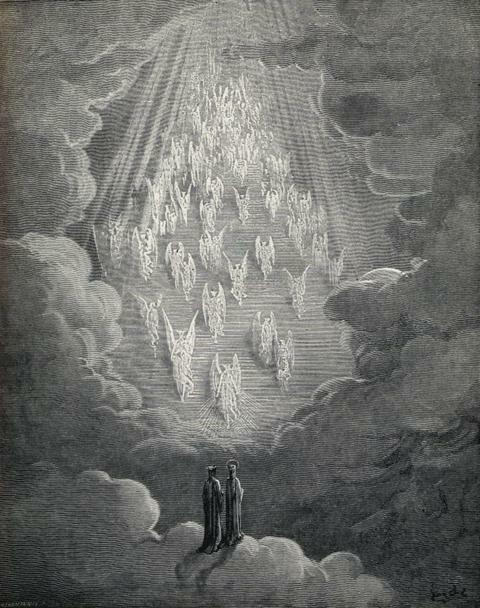
Gustave Dore, Paradiso: Canto I, 1868

Dante, perhaps the greatest poet of Western history, didn't just write the Inferno. It was preceded by La Vita Nuova, which chronicled his earlier acquaintance with and love for Beatrice, and followed by Purgatorio and Paradiso, in which she comes to him after her death and rescues him by grace and illumination. And the common thread that runs through all of them is precisely: Courtly Love, employed by a wholly orthodox Catholic, as a way of the soul to God. Beatrice is Dante's beloved, and she functions to him, from the first moment of their meeting, as an image of Christ. In her, Dante beheld the glory of the Creator; her mere presence is enough to fill him with humility, joy, and love, and he responds neither with rejection nor with idolatry, but with veneration -- that kind of mingled delight and awe that we pay to the angels and the saints. Many lovers have felt it, and it can be used as a way of seeing God; like anything can.

Using erotic love as a way of the soul has its dangers: covert narcissism, overt idolatry, foolishness, lust, impatience. They must be acknowledged, and the professed romantic must be as cognizant of these dangers, as firm in his purpose, and as faithful to the doctrines and the sacraments, as the professed religious brother or sister has to be. But none of this renders it unusable as a way of the soul, nor, I believe, should erotic love be dismissed or hedged off as something that only great souls may attempt. Greatness and sanctity come from devoting oneself to the Way,** not as pre-existing superiorities that justify the use of the Way.

Incidentally, Dante's love for Beatrice illustrates the antidote to what I believe Blanski's error to be. Both Dante and Beatrice were married to other people, yet there is no hint that Dante regarded this as at all relevant. This is not because they were adulterous and simply didn't care: there's no evidence that they had anything but the most casual contact -- he himself reports going into raptures when, after nine years of acquaintance, Beatrice condescended to say hello to him in the street one day. Dorothy Sayers, in her introduction to her translation of the Purgatorio, that this love
is not the febrile anguish of the death-Eros, in which possession forever mocks desire; nor yet the simple and affectionate exchange which does not look beyond possession. It is in fact not concerned with possession one way or the other, though it may survive loss. It is a love whose joy -- and therefore whose fulfillment -- consists in the worshipful contemplation of that which stands over and above the worshipper. True to its origins in courtly love, it finds its entire happiness in being allowed to do homage to its acknowledged superior. ... If earthly love, as such, is but a type and an overflowing of our innate (though it may be unrecognized) desire for God, then it is inevitable that there should always be something in its nature which transcends and eludes possession.***
The troubadours might have said the same; C. S. Lewis notes in The Allegory of Love that there was debate among them as to whether sexual intimacy with one's lady was the pinnacle of eros, or something beside the point. Dante took the latter view.


As ... seen here? Possibly?

The point is, eros, though it's become linked in our minds with marriage, is really an independent phenomenon. It is not incompatible with marriage; but there is nothing in Scripture, and little in history, to make either one the necessary companion or guardian of the other. The idea that eros necessarily leads to marriage or forms a good foundation for it is, in fact, about as young as words like homosexual and heterosexual. Eros is a tradition that may be entered by any loving soul who will, regardless of the object of love -- conditioned, as Dante's love was, by the same orthodox structure of ethics and economy of sacraments that governs all of Christendom. More briefly, the Romantic Way rightly considered is part of the Way as a whole, and operates on the same principles and within the same limits.

These conditions are not foreign to the tradition of erotic love. Nor is Dante a lonely example; the Cavalier and Metaphysical poets of seventeenth century England were exponents of the same in their own milieu of royalism and romanticism. Poets like John Donne and Richard Lovelace knew well how to combine eroticism with religious devotion, and the divided tongues of fire that we call Baroque art exhibit this synthesis magnificently.

Does this open to door to the possibility of a homoerotic devotion? I believe it does, in principle, though -- since marriage exists in its own right, independently of eros, just as eros exists independently of marriage -- marriage is still defined in its own terms, which, as a Catholic, I admit and even insist are oriented toward the family. Homoeroticism of this kind, used as a way of the soul, would be obliged to renounce sexual intimacy with the beloved. But this is no new idea. Its earliest expression in the West may be Plato's depiction of Socrates' erotic mysticism in the Symposium, and, in one form or another, it has continued, all the way down to (admittedly, sadly obscure) examples like Dunstan Thompson and Philip Trower. The notion that a love which cannot lead to marriage is intrinsically perverse, in my opinion, smacks of a baptized Freudianism that I have no truck with.

What of the Catechism's phrase that same-sex sexual desire is "intrinsically disordered," i.e. a misdirected impulse (like all sexual desire that is in itself unable to issue in life)? Well, that's true. But eros can't be reduced to the desire for sex, and, though it seems it generally does, it doesn't always produce the desire for sexual union with the beloved. I've been in love once or twice without any conscious desire to sleep with the person in question. It wasn't any less or otherwise romantic love on that account.

For eros is not primarily a way of craving, but a way of seeing; and the seen beloved is being seen in her or his archetypal goodness through the lens of erotic love. The beloved may not live up to her or his archetype of possible goodness, and the lover may in one way or another be disobedient to the heavenly vision. But the heavenly vision remains, and the heavenly vision isn't really about sex, even when it's connected to sexual desire. It is, on its minor scale, an intimation of the Beatific Vision, in which seeing is receiving and receiving is loving: None is afore, or after other; none is greater, or less than another; but the whole three Persons are coeternal together, and coequal. And the Romantic Way is defined by a maxim from the same creed: One, not by conversion of the Godhead into flesh, but by taking of that manhood into God; one altogether, not by confusion of substance, but by unity of Person. That is, the Way has not been changed in its own nature, so that the beloved is made an idol, but the Way assumes the lowers Ways into Itself, redirecting their natural courses toward a supernatural end -- so that, if we open ourselves by grace to the possibility, all roads lead to that Rome where Christ Himself is Roman.****


From Saint George and the Dragon as told by Margaret Hodges, illustrated by Trina Schart Hyman.


*I don't mean philosopher here in any technical, still less exalted, sense. I just mean a person who likes to think about how reality works and how we ought to live in it, and really that's a much commoner pastime than we sometimes realize; almost everybody does it, at least a little bit.

**I.e., to any of the specific forms of the Way into God which is God, namely Christ. The way of monastic devotion is one of these ways, and one of the most obvious due to the renunciations it involves. But the other ways, those that accent affirming the image of God in His creation (rather than accenting the distinction of substance between God and His creation), are nonetheless the Way.

***Introduction to Sayers' translation of the Purgatorio, p. 43.

****Dante's Purgatorio XXXII.102.

Saturday, January 31, 2015

Kintsukuroi, Part III: Guydentity Crisis

Over the past decade, I've heard the word identity about enough times that at this point, every time I hear it, I feel like renouncing pacifism and beating the speaker to death with a shovel.* Unfortunately they don't let you do that, I've found.

One of the reasons the word causes such difficulties is that it means different things to different people, and even, at times, different things to the same person. Substituting a phrase like "This is who I am" reveals something of the problem: who I am in what sense? Ontologically? Emotionally? By conviction? By upbringing?

Catholic sources (with the exception of heretical ones like Dignity) have for the most part avoided and discouraged any use of LGBT language. A lot of people ascribe this to groundless homophobia, but I don't. The stated concern in the relevant documents published by the Church is of people reducing themselves to their homosexuality by identifying as gay; and, while I don't believe that that problem is nearly as prevalent as many of the Catholic authors and priests I've interacted with have supposed, it bears saying that the problem would be worthy of their attitude if it were. And after all, some of us do reduce ourselves to our sexuality, and it isn't a pretty or dignified sight. Seeing a grown man flirting like a high school sophomore, because he's stuck in the mindset that his worth depends on the rapidly decreasing number of fucks he can score, is deeply pathetic.


Desperation doesn't look good on anybody.

But this isn't a peculiarly a problem of the LGBT community. It's a general problem of American society -- in my experience, even when I was a gay activist, it was no more prevalent among us than among anybody else -- and narrowing our attention to queer-identifying people is in my opinion extremely unhelpful. In addition to creating a double standard between homosexual and heterosexual people (which, to do them justice, some Catholic authors have begun to pay attention to), it feeds into an unfair and frankly very damaging stereotype of gay people: namely, that gay sexuality is solely about having sex, that any notion of gay identity is constructed entirely around sex, and that any and all people who identify as gay (or whatever) are, in a more or less clinical degree, obsessed with sex.

I don't think that any of this is true, and I think that a gay identity, properly understood, is as capable of "baptism" as any other element of a culture. Now, it's that properly understood that is the linchpin of all this, so I'm going to take a moment and explain it.

One strategy taken by much of the LGBT community in the fight for gay rights has been to insist on homosexuality as immutable and inborn. The equivalence often drawn between sexual orientation and race or ethnicity is the result: if gay people are members of a natural minority, the reasoning goes, then they are entitled to the same legal protections that are rightly given to other minorities. In some circles the argument is carried further, asserting a metaphysical or transcendental difference between gay people and straight people -- Matthew Vines, for instance, in his viral video on the subject, states that while for most men an help meet for him is a woman, for a gay man a suitable companion can be found only in another gay man, which at least suggests that the difference between gay and straight is a difference of being rather than of quality.


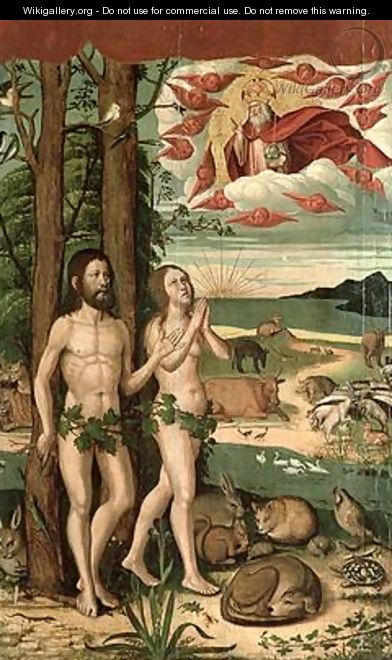
Adam and Eve, Jan Mabuse, ca. 1510
Nice 'fro, Father Adam.

I don't take this view -- partly because the only difference of being among humans that the Church recognizes (to my knowledge) is that between women and men; partly because the highly variegated history of homoeroticism, and the existence of sexual fluidity in some people, suggest otherwise; partly because gay essentialism looks to me like a bald assertion, and certainly an indemonstrable one. It isn't the universal orthodoxy within the LGBT community that people outside that community often suppose, either, but that need not detain us.

However, I do take the view that another definition of the word identity can be meaningfully, and usefully, applied to LGBT experience. It is the definition we use when we say things like "I am a Catholic," "I am an American," "I am a barista," and so forth. It is the sense of self, the collection of experiences, feelings, and ideas that make us who we are in a psychological rather than an ontological way. Identity, in this sense, is a statement of what is most deeply important to us, that through which we relate to others and to ourselves and to God. It isn't necessarily inborn or immutable, but it can't just be changed at will, either; nor should it.

The Catechism has the following to say about sexuality:
"When God created man, he made him the in the likeness of God. Male and female he created them, and he blessed them and named them Man when they were created." Sexuality affects all aspects of the human person in the unity of his body and soul. It especially concerns affectivity, the capacity to love and to procreate, and in a more general way the aptitude for forming bonds of communion with others. ... Chastity means the successful integration of sexuality ... and thus the inner unity of man in his bodily and spiritual being. Sexuality, in which man's belonging to the bodily and biological world is expressed, becomes personal and truly human when it is integrated into the relationship of one person to another, in the complete and lifelong mutual gift of a man and a woman.**
On the face of it, this would appear to exclude any fully Christian expression of sexuality other than marriage, which the Church obviously doesn't maintain. Sexual integration is as necessary for a celibate life as any other, if not more so. But what are its implications for homosexuality?

To start with, sexuality here is more than just the desire for sex and reproduction -- that desire doesn't exist in isolation, and it doesn't seem relevant to our general tendency to form relationships with people, either. Sexuality includes the desire for sex, but (as far as my understanding goes) it encompasses the whole embodied-ness of human love in its various forms, some of which involve having sex and some of which don't. That this is called sexuality is, I think, due to the fact that being a man or a woman is one of the chief defining features of our embodied-ness.***


And where does being gay lie in all this? Well, I think one of the key points is that being a gay man (for example) can't be reduced to wanting to boink other dudes, for the same reason that being a straight man can't be reduced to wanting to sleep with women. There's a whole world of feelings and experiences that goes with it -- a world that differs from man to man, as much as one man does from another, but in any case a real one that should be respected. The experience of embodied-ness and relationship for a gay man need not be all that different from the experienced embodied-ness and relationships of a heterosexual, though it appears to me that they generally are; the point is that these things make a profound contribution to our sense of self, and, in that specific sense, to our identity.

But doesn't this construct an identity -- in however limited a sense -- around sin? Let's parse that a little.


To begin with, a sin is always a choice; sexual orientation is a disposition, i.e., part of the raw material out of which we make choices. Even when our dispositions are bad or undesirable, they aren't sins per se.

Second, unless you displace everything else in order to make more room for your sexual orientation (which strikes me as a pointless, weird thing to do), just to acknowledge that you happen to be gay doesn't mean you're building your whole sense of self around it. People sometimes do, of course; but I think the only response to that is to encourage prudence and balance, not to do away with the idea of sexual orientation as such. Sexual orientation is admittedly a construct, but it sums up what is, for a lot of us, a vast area of shared experience in terms of relationship, self-image, and so forth, that isn't easy to state concisely any other way. And because the stuff it's tied into is so deeply important to the human person -- as the text from the Catechism suggests, with its references to affectivity and to the general capacity for forming relationships -- I think we need a way of talking about it.

Lastly, I rather think that the advice "Don't identify with your sin," in this and many other contexts, is not altogether satisfactory in the first place. It is quite true that this can impose false mental limits and inhibit growth. But then, so can an insistence on a theology of victory that makes inadequate room for human frailty, and for being honest about that frailty. St Paul was not confined by his past as a religious terrorist, but he positively went out of his way to bring it up, to embarrass himself with his weaknesses and flaws; or rather, to boast of them.
There was given to me a thorn in the flesh, the messenger of Satan to buffet me, lest I should be exalted above measure. For this thing I besought the Lord thrice, that it might depart from me. And he said unto me, "My grace is sufficient for thee: for my strength is made perfect in weakness." Most gladly therefore will I rather glory in my infirmities, that the power of Christ may rest upon me.
Japanese pottery has a technique called kintsugi or kintsukuroi, for which I've named this series. If a ceramic vessel, like a tea bowl, is broken, rather than throwing it out or repairing it invisibly, the cracks are mended in a way that draws attention to and beautifies the damage -- for instance, with gold or silver seams.


This is part of a larger Japanese aesthetic philosophy called wabi-sabi, in which the history and imperfections of an object are embraced as part of it. This may sound very strange to Western, classically-formed ears; but I believe that it is, fundamentally, hardly different from the triumphant lines of the Exsultet: O truly necessary sin of Adam, destroyed completely by the Death of Christ! O happy fault that earned for us so great, so glorious a Redeemer!

This is a hard saying, and not many can accept it. In this, and indeed in most things, it's far easier to join with those who would reject imperfection -- whether by trying to do away with it or by pretending that it doesn't matter. The mental and spiritual balance required to achieve kintsukuroi of the soul is a delicate thing, and I for one am no master at it; but I believe that this, rather than either getting a new bowl or saying that a broken bowl isn't broken, is the task at hand.


**Catechism of the Catholic Church, paras. 2331-2332, 2337, italics original.

***In saying this, I don't mean to ignore the difficult and subtle questions that attend intersex people or trans issues. I take the integral significance of sex to the person to be a starting point, from which we may seek to address these matters, not a pretext to pretend that they are unreal or unimportant. However, it's both off-topic and quite beyond my competence to do so here.

Monday, June 2, 2014

A Question I Have No Good Answer To

Why is it wrong?

Since childhood, with only a relatively short period of wavering in my late teens and early twenties, I have taken the Bible's word for it -- and, since 2008, the Catholic Church's word for it -- that gay sex is wrong. I've never truly understood why; I don't have the revulsion from it that a lot of straight people do (though certainly a lot of straight people don't have that response either, my favorite reaction probably being that of C. S. Lewis, who for his part described homosexuality merely as "opaque to the imagination").


This is what I think of when I think of things being "opaque to the imagination."

I don't mean by this that I don't follow the syllogism of natural law generally used to defend the Church's position from a strictly philosophical, as opposed to a religious, standpoint. The argument of natural law is widely misunderstood, so I'll take a brief detour to explain it.

The argument from natural law isn't an argument that homosexuality doesn't occur in nature, which would be utterly ridiculous. I dare say some Christians have attempted to make that assertion (and there are probably a great many more who didn't mean that exactly, but who spoke with sufficient carelessness or stubbornness as to leave the impression that they did*), but this, even if it were true, wouldn't have anything to do with the natural law argument.

Rather, the idea of natural law to which Catholics appeal here is that of the law of human nature -- and by that meaning, not whatever human beings happen to be like, but that to which human beings are called by our specific character as rational animals. Our animality, obviously, includes plenty of things we share with the animal kingdom as a whole; what is under discussion here is that which is specifically human, specifically rational -- that which can fall under the categories of morality.

To take an extreme example, in this sense of natural law, it is unnatural for one man to kill another. This statement doesn't mean that men don't in fact kill one another on occasion; it means that it goes against that nature which is specifically human to do so. For one animal to kill another wouldn't necessarily be unnatural, because animals don't have rational souls and therefore don't have a moral compass or responsibility, so they wouldn't be contradicting their own natures to do so.


Admit it, you were waiting for him to up and kill some folk the whole series.

Now, the contention of natural law theorists** about homosexuality is not that it is arbitrarily wrong for us, though innocent among animals. It is that the reproductive system is, well, a system designed with the purpose of reproduction***, and that the proper activity of rational beings like ourselves is to use things in accordance with their purpose -- or, at the very least, not use them in a way that contradicts their purpose. Insofar as homosexual sex, by definition, can't lead to reproduction, it is therefore defined as wrong by the nature of the act.

If you're like me, you have one or both of two reactions to that line of argument:

1. That makes total sense.

2. But fuck that noise.

It's always been vaguely surprising to me that I can be both in full agreement with, and at the same time bitterly scornful of, the same argument. I've been grateful to have something more than "Because God says so" as a reason for having to regard being gay as a cross, instead of just a thing, with no moral implications. And when I look at this argument with detachment, trying to imagine as far as possible how I'd feel if I were evaluating it objectively and as someone who wasn't affected by its truth or falsehood, I have to assent that it's perfectly sound. Yet, as I've discussed with a few of my fellow queer believers, the consequences of living in accord with that belief -- the loneliness, the confusions and misunderstandings, and, yes, the blue balls -- seem grossly out of proportion to the gravity of violating it. I mean, seriously? It's so wrong to use something out of accord with its intended purpose that it's literally better for a gay guy or a lesbian to live alone for seventy years? It's like saying that it's better to have your hand chopped off than to use a wrench to pound a nail in!


Q: How many lesbians does it take to change a light bulb?
A: One, I assume. That's kind of a weird question; what brought that up?

Convincing though I find the natural law argument in principle, I personally would not be able to maintain my belief in it -- or at any rate, I wouldn't be able to care -- if the authority of the Church didn't back up the conclusion as the bearer of revelation. It so happens that the Church does, and I can. Nevertheless, at a heart level, I'm not satisfied, and for that reason (among others) I cannot bring myself to look sternly upon those who can't accept the Church's teaching on this subject.

I look forward with some small hope to the day when I'll understand, but for now, I have to acknowledge that I don't feel I have a good answer to this. Do I trust the Church? Of course. But having food that keeps you alive is not the same as having food that makes you feel full, or even being healthy.

I do, however, have an incomplete hunch. I've long suspected that the biological and reproductive angle was the wrong tack to take. The body, after all, is matter; and matter isn't bad, indeed, it's good, but matter doesn't get its significance from itself -- it gets it from the spiritual realm. God is spirit and God created matter, so this is true automatically, and it is specially true of what we might call spiritualized matter, i.e. the body and the seven sacraments.

Now, God, according to Catholic theology, is Trinity, and this means among other things that relationship is at the heart of all existence. This is part of what is meant by the famous phrase "God is love." The simultaneous unity and differentiation of the Divine Persons makes all of their relationships asymmetrical: God the Father begets God the Son and God the Spirit proceeds from both. No two relationships within the Trinity are exactly alike. Proper modes of relating are therefore not only important, they are of the essence of reality.


Depicted: blueprints for existence. Handle with care.

What has this got to do with sex? Well, one of the things that Christians in general and Catholics in particular believe about sex is that it isn't just a pleasure, but a peculiar way of relating to a person, incommensurate with any other way of relating. Scripture represents it as one of the primary analogies for the way Christ relates to the Church, and refers to it in both the Old Testament and the New as effecting a kind of union between the parties, referred to as a one-flesh union -- what we might today refer to as being welded into a single organism.

And if it is the spirit that gives the body its significance, then I think we get a conclusion that may seem surprising, but, to me anyway, makes a lot more sense than supposing that using our sex organs the wrong way, just as such, is the fundamental problem. Namely, we get the conclusion that the underlying problem with homosexuality lies in the mode of relationship between two men or two women, and that it is the spiritual problem in this mode of relating that makes these relationships infertile, rather than the inevitable infertility which renders such relationships wrong. If I may put it this way, two masculine souls don't fit together the right way for sex to unite them (and the same for two feminine souls), and that is what the essential problem is: the fact that two guys can't conceive a child is a sign of the problem, not the problem itself.

I said earlier that I had only an incomplete answer, and indeed that is all I have. I don't know what it is about masculine, or feminine, souls that would mean they don't fit together the right way for gay sex to ever be right; I take it that the metaphorical shape of our souls is in some way symbolized by the literal shape of our bodies, but beyond that plausible assumption -- I consider it no more than that -- I haven't a clue.


Hell if I know what's going on here.

I've heard a few explanations -- many of them extremely confident assertions of rigidly defined gender roles. I'll concede that stereotypes don't arise for no reason at all, and that they always have a basis in authentic archetypes; but I have to say that most of the explorations of gender (psychological or spiritual) that I've seen from Christian sources justify, or at best are very little better than, the skeptical and deconstructionist approaches often taken by those outside the faith in academia. Moreover, they fail even to do justice to Christian history. How would St. Francis, a grown man who refused sexual love and financial and military ambition, and who asked the Holy Roman Emperor to direct his subjects to feed the little birds, fare among the proponents of self-styled "muscular Christianity"? Or how would our contemporary worshipers of the virginal daughter becoming the obedient wife respond to St. Joan of Arc, dressing herself in men's clothing with her hair cut short and rallying men to battle? To say nothing of still stranger figures and phenomena, like St. Marina the Monk or the erotic mysticism of St. John of the Cross.**** Asserting the spiritual reality of gender, and recognizing certain of its consequences in theology and in life, should not lead us to assume that we know everything there is to know -- a hubristic and shallow approach to any question. As is the assumption that, because someone (perhaps ourselves) doesn't know something, therefore nobody knows anything.

That's as much as I've got right now. I still don't get why it's wrong -- not at a heart level -- but I have enough that I think I can accept working by faith and not by sight: again, right now. Tomorrow will doubtless have its own trouble, which will suffice it.


*The late Fr. John Harvey, on whom be peace, the founder of the Courage apostolate, is the example that springs to mind. He wrote -- and the phrase has been picked up by Dr. Joseph Nicolosi, the head of NARTH -- that "There are no homosexuals, only heterosexuals with a homosexual problem." What he meant (I think) was that the desires and dispositions of a person are not determinant of their nature; or, to put it another way, all men are fundamentally men rather than fundamentally gay or fundamentally straight; or, to put it still another way, gay men aren't a different kind of thing from straight men. Though I certainly agree that human dignity is the same for everyone and that desires don't determine what we are, I think that putting it this way is really stupid. It defies what the majority of people in fact mean by words like "homosexual" or "gay," thus putting what I consider an unnecessarily dogmatic view of terminology ahead of the basic purpose of language, communication.

**Yes, most natural law theorists -- so far as I'm aware, anyway -- are Catholics. But it's perfectly possible to be a non-Catholic natural law theorist, and vice versa: I'm given to understand that Eastern Catholicism in particular has little to no tradition of conceiving of human nature and morality in these terms. Additionally, I don't know of anyone who's made a case for a natural law theory that approves of human homosexuality as a positive good; but it's possible that someone has, or has made the attempt.

***This doesn't involve us in the belief that the reproductive system was designed with no other purpose than reproduction. That is part of why the Catholic Church concedes that natural family planning is morally licit, though of course it can be used to excess or with wrong motives: one need not be actively trying to have a baby every time, provided one is not only pursuing the other purposes of sex but also refraining from actively obstructing the reproductive purpose. But all of this is too complex to do justice to in a footnote.

****Because someone will ask, I'm not claiming (and don't think) that any of these figures were themselves gay, although depending on one's definition we could view St. Joan and St. Marina as genderqueer (with the proviso that the gender here referred to is the social aspect of gender, rather than implying that gender in its spiritual dimension was, in them, distorted in some way). I'll allow that any of them might have been gay, though I know of no evidence for it and find the question a bit of a bore -- especially in the case of St. John of the Cross, whose bridal imagery is in my opinion far more striking if he was in fact strictly heterosexual. But all of this is, at most, tangential.

Friday, March 28, 2014

Review: "God and the Gay Christian" by Matthew Vines

I realize that it is not customary to begin a review with an explanation of why you perhaps shouldn't be writing it. Nevertheless, the point of a review is to evaluate a book for potential readers, and doing so honestly is obligatory. I wouldn't feel I had fulfilled that obligation unless I stated frankly from the outset that I may not be able to evaluate this book objectively.

In one sense, nobody can do that -- everybody has a position on these topics these days -- but the pertinent reason is that I'm in this book. Matthew Vines refers to Stephen Long's blog, Sacred Tension (a fairly well-known blog in the gay Christian mesocosm*), and specifically to the post Falling In Love. It so happens that I am "Andrew."** I hasten to add that Stephen's portrait of our relationship is true (though I think it rather more generous and gentle towards me than I deserve), and also that I don't think that Mr. Vines has misrepresented it, though it feels odd to read about it "out of context," as it were -- but that's inevitable.

I don't believe that this has adversely affected my ability to judge the book; if I did, I'd probably have sent the advance copy back with an apology. But I would feel less than fully honest if I withheld this information from my own readers, so that they can come to their own conclusions about whether I've judged Mr. Vines' work fairly, and why or why not.

This review will of necessity be woefully incomplete. I hadn't read more than halfway through God and the Gay Christian before I became convinced that the only really adequate review of its contents would be a book in itself. I haven't written that book, and have cut out a lot of things I would have liked to put into this review for the sake of brevity; but the brute fact is that the questions Vines raises here are vital ones, not only for life as a homosexually attracted believer, but for a Christian perspective on sexuality in general. That is a sizable topic even in its own right, and when we consider its implications for the Church's ability to evangelize the world, it becomes colossal.

The book is coming out on May 6 of this year, via Convergent Books, and will (I gather) be available both in bookstores and online.

UPDATE: The book has actually been available since April 22nd. Derp.

The Strong Points

I haven't watched the hour-long video that Matthew Vines released a couple of years ago on this same subject, but it went viral, and I think I can see why. His writing is highly accessible, and he makes his points with concision. He writes confidently, but without rancor -- a welcome change of tone in this debate, in which both sides are very much to blame for the mutual bitterness and resent that frequently animates gay-Christian dialogue -- and his power to do that is fairly remarkable, considering the difficulties that every gay believer tends to find himself in, both interior and exterior.

More than that, Vines' devotion, and particularly his passion for evangelism, shines through in this book. He strives to be faithful to the Scriptures, when it would have been far easier to simply dismiss them as incorrect or irrelevant, on this topic at the least (nor would he have been unable to find churches that would support him). I think his refusal to discard the Bible in that way laudable. And he pinpoints one of the basic problems with the approach to this topic that conservative Christians all too characteristically take, in the opening paragraph of chapter seven:
I am far from the only gay Christian who has heard the claim that gay people will not inherit the kingdom of God. That message is plastered on protest signs at gay-pride parades. It is shouted by roaming street preachers at busy intersections and on college campuses. The result is that, for many lesbian, gay, bisexual, and transgender people, all they have heard about the kingdom of God is that they won't be in it.***
I admit I fundamentally disagree with his solution, so to speak, but his statement of the problem is exact -- and, to a well-formed Christian conscience, should be shaming.

His analysis of the story of Sodom, one of the most famous of the "clobber passages," is also more or less sound; and the distinction he draws between lustful indulgence and authentic relationships between people of the same sex, while I don't think it goes as far as he thinks it does, is nevertheless an important one.

He also raises an extremely important point in chapter 9 in his discussion of the image of God: that gay sexuality can't be reduced to the desire for gay sex, and that to do so is destructive. I've read a lot of traditionally-minded Christians either claiming, or seeming to claim, that a homosexual person's sexuality as a whole is misdirected, not just the specific desire for sexual union with another man or another woman. But sexuality is more than simply sexual desire; Vines rightly says that it involves our capacity for relationship in general (consciously or unconsciously echoing the Catechism in paragraphs 2331 and 2332), and the Church does not and should not condemn a person's entire sexuality in that way. And that realization has to be part of a life-giving, Christian view of sexuality, whether it approves of gay sex or not.

The Weak Points

Nevertheless, Vines' argument in general is seriously unsound, in three basic ways: incomplete information, unsubstantiated assumptions, and invalid reasoning.

I do not suggest that this is an effect of deliberate distortion or deceit on his part. That would be an exceedingly serious charge to level at anybody, let alone a fellow Christian, and one whose experience I can sympathize with a great deal: I'm a gay believer too, after all, and I was raised in the Reformed tradition from which he hails. I am here dealing strictly in the things he says. I propose to take him at his word when he asserts that he says them because he thinks they are true -- and I have deep respect for that.

Still, the argument is gravely faulty. To begin with, almost his entire argument is characterized by two serious fallacies: first, that modern understandings (notably of sexual orientation and gender relations) are correct simply because they are modern -- the mistake of "chronological snobbery"; and second, that the doctrine of gender complementarity means nothing more than anatomical compatibility.

Taking his treatment of gender as our example, the only attempt Vines makes to demonstrate that an ancient approach to it is wrong is to appeal to the fact that most Christians today (that is, most American Christians) don't believe it. It's quite true that the language of Scripture was affected by the culture it was written in -- but then, so are our own ideas about gender. He gives no reason to trust the ideas about gender that are popular in our day rather than the ones that were popular back then. And the same lack of a critical approach to our own era's thinking comes up again and again. In principle, a case could surely be made for the characteristic contemporary view. But Vines doesn't in fact make a case for it; it operates simply as a consistent assumption. (The closest he comes is in an extremely disputable exegesis of Galatians 3.28, where he takes the statement that "in Christ there is neither male nor female" to be a criticism of patriarchy as such -- but he does not provide anything like adequate evidence to back this up.)

Similarly, a great deal of his interpretation of both Leviticus and the New Testament relies on the notion that the perceived feminization of men who were the passive partners in anal intercourse was considered disgraceful, and those who inflicted it were disgraced for doing so -- which is quite true, but which he explains solely in terms of the rampant misogyny of the time, without considering the possibility that, for the authors of Scripture at least, sexual complementarity might have played a role as well. The idea that, misogyny aside, there might nevertheless be some kind of disgrace in treating a man like a woman or vice versa is never even raised, let alone refuted. He rightly distinguishes between a belief in complementarity and a misogynistic outlook, but fails to consider whether there is anything more to complementarity than human anatomy -- whether gender is also a spiritual fact, and not exclusively a physical and psychological fact -- which might have a profound effect upon our view of gender relations: which, in the traditional view and especially in the Catholic view (as articulated in Theology of the Body), does have precisely a determinant role in sexual ethics.

Vines' data on the stability of sexual orientation is incomplete and poorly interpreted. He takes the collapse of the ex-gay movement, in addition to the testimony of the APA et al. that reorientation therapies don't work, as more or less conclusive proof that sexual orientation is fixed, a premise on which a great deal of his argument is constructed. But this does not follow; sexual fluidity is equally well known to the APA, and the fact that something cannot be changed by trying to make it change, doesn't mean that it is immutable -- for the same reason that pulling on the top of a sapling won't make it grow faster, yet that does not prove that saplings don't grow.

One of the largest and most basic problems, though, can be stated in relation to the following passage:
Mandatory celibacy for gay Christians differs from any other kind of Christian self-denial, including voluntary celibacy for some straight Christians. ... For straight Christians, abstinence outside marriage affirms the goodness both of marriage and of sex within marriage. But for gay Christians, mandatory celibacy affirms something different: the sinfulness of every possible expression of their sexuality. ... Functionally, it is castration. Such an absolute rejection of one's sexuality might make sense if one's sexual desires were oriented exclusively toward abusive or lustful practices. It makes considerably less sense when at least some of one's desires are oriented toward a covenantal relationship of mutual love ...****
I won't listen to those who claim that all homosexual practice is degraded, an assertion that is demonstrably false -- one has only to look at loving gay couples to know that. But when once we admit that, yes, some people may be called through no choice of their own, yet by the nature of their sexual desires, to abstain totally from those desires, then we must logically admit that the doctrine that homosexual sex is intrinsically wrong still makes sense even in the context of a modern approach to sexual orientation.

The traditional doctrine might, of course, be false, even if it does make sense. But that must be proven or disproven on other grounds; the grounds of the suffering it causes are defined to be irrelevant to its truth or falsity by the nature of the argument. For someone whose desires are oriented toward something that Christians en masse agree is wrong for one reason or another -- say, polygamy, or pedophilia, or objectum sexuality***** -- is apt to experience the same trials of frustration, loneliness, and misunderstanding that afflict a queer experience. If we can dismiss the traditional doctrine of homosexuality as unwholesome on the grounds of these sufferings, then they are equally valid reasons to dismiss them for other cases; but if suffering is not an adequate reason by itself to dismantle those doctrines, then it isn't relevant to this discussion either.

I don't say this out of any insensitivity to what I'm proposing. I am all too keenly aware of the cost of this particular discipleship. It's true that going without sex, in itself, is not the agony or even the inconvenience that many people suppose, and it's also true that some people don't find celibacy much of a cross to bear. But some of us do, and it is those who find it a torment (whether from within or from without) who are, as it were, at stake here. The scorched earth style of what some churches are pleased to call their fellowship, and the "put up and shut up" attitude evinced by many Christians, are grossly inappropriate, and deserve frank and unequivocal condemnation as being utterly unchristlike whenever they manifest themselves; and I myself have endured the way of this cross, and fallen not only on my knees but on my face under its weight; even now I am daily crucified upon the absence of the man that I love.

But I love the truth too. I often stray, but altering the path I'm walking on is another matter, and I can't do that over thorns and stones, however savage. The presence of such things is not a sign that this is not what God has for us: the Cross and the lives of the saints teach us that. They were stoned; they were sawn asunder, were tempted, were slain with the sword: they wandered about in sheepskins and goatskins; being destitute, afflicted, tormented (of whom the world was not worthy).

I don't for one moment suppose that Vines himself would do anything else, if he were once convinced that this were God's will. He is in fact convinced that God's will is something else, and no one should presume to cast doubt on his motives when the only thing he's done is disagree with a particular traditional doctrine. But the plain fact is, when rigorously analyzed, his case just isn't adequate: it is riddled with faulty reasoning, unquestioned assumptions, and incomplete data, and these things are of the very stuff of his necessary premises and most important steps of argument.

Is It Worth Reading?

It depends on why you're reading it. If you are looking for a sound historical, linguistic, logical, and Biblical study, I would have to say no. His training isn't sufficient in these areas (though I'd be quite pleased to see what he did with it if it were -- what, perhaps, he will do with it some day in the future when it is?), and the sources he relies upon appear in many cases to be either incomplete or tendentious.

However, if what you're looking for is a readable work that does express many of the exemplary contemporary arguments for a gay-affirming interpretation of Scripture, I think this is a very important book indeed, and one that will probably have a widespread and lasting influence. I am of the opinion that Vines has given gravely wrong answers to the questions that he has raised, but he has raised exactly the right questions: addressing matters that are both important in themselves and very much on the minds and hearts of the rising generation, gay and straight, and even Christian and non-Christian. Any coherent, thorough articulation of traditional Christian beliefs about homosexuality is going to have to go a lot further than "God made Adam and Eve, not Adam and Steve" -- further even than, "Look, read this Christopher West book" -- and it's going to have to do so in a way that addresses the same issues that God and the Gay Christian addresses, and with just as much clarity and appeal.


**Naturally I obtained his permission before revealing what he chose to keep private when he wrote the relevant post. We agreed that, insofar as it is our story, we may both tell it.


***Chapter 7, "Will Gay People Inherit the Kingdom of God?", p. 119. Page numbers in the published edition may not correspond exactly.


****Chapter 1, "A Tree And Its Fruit", pp. 18-19, emphasis mine.


*****I have deliberately chosen examples that are, in my judgment, dissimilar from both homosexuality and one another for this line of argument. This is partly because I think a diverse set of examples strengthens the argument. 

     It is also partly in the forlorn hope of quelling the firestorm that will probably arise from having brought up pedophilia: pro-gay people furiously denouncing me for implying that they are the same, and and anti-gay people just as furiously agreeing with me that they are the same; when in fact I do not think that they are the same at all and, having been the victim of someone else's pedophilia on the one hand, and being gay myself on the other hand, am outraged at the conflation of the two.
     If you're unfamiliar with objectum sexuality and, reasonably enough, scared to google it, you can read a rational treatment of the subject here, and an inappropriate and hilarious treatment here.