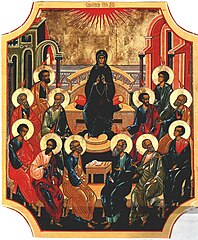
Collect

Collect for the Fourth Sunday after Trinity

O God, the protector of all that trust in thee, without whom nothing is strong, nothing is holy: increase and multiply upon us thy mercy; that, thou being our ruler and guide, we may so pass through things temporal, that we finally lose not the things eternal; grant this, O heavenly Father, for the sake of Jesus Christ thy Son our Lord, who liveth and reigneth with thee, in the unity of the Holy Spirit, ever one God, world without end. Amen.
Showing posts with label holiness. Show all posts

Wednesday, February 20, 2019

Judgment (A Poem)

Judgment

When the Son of Man shall come in glory, and all his angels with him,
Then shall he sit upon the throne of his glory:
And before him shall be gathered all nations:
And he shall separate them one from another, as a shepherd divideth his sheep from the goats.
And he shall set the sheep on his right hand,
But the goats on the left, because of the smell.

Then shall the King say unto them on his right hand,
‘Come, ye blessed of my Father, inherit the kingdom prepared for you
From the foundation of the world:
For I was an hungred, and ye spake to me of fasting:
I was thirsty, and ye gave me ascetical lectures:
I was a stranger, and ye told me how to get home:
Naked, and ye reminded me of the sanctity of property:
I was sick, and ye forbad me to be a tedium to my neighbor:
I was in prison, and ye were just judges and noble juries.’
Then the righteous shall answer him, saying,
‘Yea, Lord, all this and more we know,
For verily, inasmuch as we have done unto the least of these thy brethren,
We have stored up our love only for thee.’

Then shall he say also unto them on the left hand,
‘Depart from me, into the Consuming Fire prepared for you:
For I was an hungred, and ye spoiled me:
I was thirsty, and ye plied me with wine:
I was a stranger, and ye took no heed to your state in life:
Naked, and ye coddled me:
Sick, and in prison, and ye rewarded my errors.’
Then shall they also answer him, saying,
‘I knew thee, that thou art a hard man.’

And these shall go away into the Consuming Fire:
But the righteous into all the kingdoms of the world, and the glory of them.

Tuesday, July 10, 2018

Five Quick Takes

✠ ✠ ✠

I got back from a five-day visit to the Adirondacks this past weekend. It was gorgeous, it always is, but I cannot say I’m sorry to be back in the land of air conditioning and cell phone reception. The insects were especially bad this year: I brought a canister of Off and so did several other people, and I’m still covered in bites from deerflies and mosquitoes.

✠ ✠ ✠

The McCarrick scandal, especially when set beside the corruption and incompetence of the Archdiocese of Baltimore—the squalid matter of The Keepers, though hopefully the worst of it, is yet only a part of it—it’s all stuff I am unfilially glad I’ve escaped by being incardinated into the Ordinariate back in 2013. But all the same, I am perfectly sure that the reason the Ordinariate has not been rocked by any scandals of that magnitude is that we’ve only existed for six years. We are as full of people as any other diocese, and we will necessarily bring all the same human problems with us into the one, holy, Catholic, and apostolic Church.

The first evangelist was a prostitute1; the first Pope was an apostate; the mind behind most of the New Testament was a judicial murderer. I worry about anyone whose faith is at all grounded in the misguided belief that Catholics are generally better than other people. They’ll have to face a harsh morning, and so much the harsher if they hit the snooze button.


This is not to deny the magnificent witness of the saints. Our Lord the Spirit has made quite ordinary human beings into miracles of wisdom, joy, self-mastery, courage, and compassion, and several of them (Joan of Arc, Thomas More, John of the Cross, Mother Teresa) were instrumental in my own conversion, as ruthlessly intellectual as I told myself it was. But there is a very great difference between observing, in an individual life, the diagrammatized exposition of the Glory, and attributing the Glory to the diagram. You might just as well suppose that a good novel must necessarily have been written on a nice computer.

1I am aware that there is debate over whether St Mary Magdalene was the same person as the (euphemistically so called) ‘sinful woman’ of Luke 7. I personally think that they were the same person, for a few reasons; but whether I’m correct or not, the popular accusation that this was a smear campaign against the Magdalene is patently ridiculous from a Christian perspective. There is no past that could constitute a smear campaign. Even if there were, all of the Apostles would still have to be ranked lower than she on the social hierarchy.

✠ ✠ ✠

I am nearly always reading something by Charles Williams, and last week, one of the few books I brought with me into the mountains was a single-volume copy of Taliessin Through Logres and The Region of the Summer Stars, his two enchanting books of Arthurian poetry. In both, Williams writes on multiple allegorical levels—the first author, perhaps, to successfully bend Dante’s bow in six hundred years. Thus the Byzantine Empire (more exactly, the Roman Empire as seated at Byzantium; Williams’ picture is deliberately anachronistic in several respects) is itself at one level of interpretation; but at another level it is the human body, and at another it is all human society, and at another still it is the kingdom of heaven.

What I find so fascinating about this is, it’s such a tightly constructed allegory that it’s almost self-exploiting. There were many more poems that Williams intended to write, before his untimely death in 1945, and between the poems as written, his uncompleted work The Figure of Arthur, and C. S. Lewis’ commentary on both, it’s possible to plausibly reconstruct substantial areas of the mythos that Williams never had an opportunity to touch on. As I’ve often wanted to write an adaptation of the Matter of Britain, this is really exciting for me.

✠ ✠ ✠

If I weren’t so tired of hearing it, it’d crack me up that so many Christians are so firmly convinced LGBT people are locked inside identity-label-cages. Talk to us! We’re not! Or just watch this adorable vlogger on the subject.

✠ ✠ ✠


I’m trying to get back into the habit of saying a daily rosary, and I did hit on a great trick: I can’t go on Facebook until I’ve said my rosary. I’ve been applying that rule for two or three weeks, and so far I’ve only forgotten once!

What’s harder is being present in the prayers. Not, I don’t think, because they’re formulas: I do as poorly if not worse when I try to pray spontaneously. But attending mentally to a person who is not present to my senses, even artificially as an e-mail or a social media post or something, is difficult. Everything reminds me of something, which means there’s a lot of noise in my brain. Probably I should learn some concentration techniques, or mind-clearing techniques or whatever. And, obviously, pray about it.

✠ ✠ ✠

Monday, June 25, 2018

The Fall of Uncle Ted

ITHAMORE. Look, look, master; here come two religious caterpillars.
BARABAS. I smelt ‘em ere they came.
ITHAMORE. God-a-mercy, nose! Come, let’s begone. …
FRIAR BARNARDINE. Thou hast committed—
BARABAS. Fornication: but that was in another country; and besides, the wench is dead.

—Christopher Marlowe, The Jew of Malta

✠ ✠ ✠

I just heard the news that Cardinal Theodore McCarrick has been removed from public ministry on the instructions of the Holy See. Two allegations of abuse of a minor, and three allegations of sexual misconduct with adults, have been advanced.

The original child abuse scandal that the Boston Globe broke turns sixteen this year. The Catholic Church seems to have learnt something, though perhaps not much, in that time. Cardinal DiNardo, the current president of the USCCB, stated that ‘As clergy in God’s Church, we have made a solemn promise to protect children and young people from all harm. This sacred charge applies to all who minister in the Church, no matter the person’s high standing or long service. This morning was a painful reminder of how only through continued vigilance can we keep that promise.’ Too little, too late? Possibly. The issue of the canonical trial of Cardinal McCarrick remains to be seen, as does any reformatory work—including, among other things, whatever reparations to victims are possible—that the Catholic Church in this country undertakes.


But why, why, why the lies and evasion and backroom squalor, the hypocritical concealment of hypocritical perversion? Rod Dreher (about whom I have mixed feelings [1]) expresses it very well at The American Conservative:
McCarrick was a major bone in my throat. Take a look at this story from the Boston Globe: 
‘Prominent church opinion-makers, including two cardinals, have suggested that the clergy sexual abuse crisis is a relatively minor phenomenon that is being turned into a major scandal by the media and others with an ax to grind. Cardinal Theodore E. McCarrick of Washington, for example, told The Washington Post this week that some newspapers are having a “heyday” with the issue. “Elements in our society who are very opposed to the Church’s stand on life, the Church’s stand on family, the Church’s stand on education … see in this an opportunity to destroy the credibility of the Church.’” 
Imagine seeing and hearing things like that from the likes of McCarrick, knowing that he was a serial abuser of priests and seminarians—and knowing, obviously, that he knows it. He was playing a role. The stories about Uncle Ted were rampant on the East Coast, among priests. I know this because they told me. These weren’t just rumors … 
Some bishops were part of a gay cabal who looked out for each other, and made sure their secrets stayed safe. Many other bishops were neither gay nor sexually active, but had a strong sense that the Church’s image must be protected at all costs. This is how a dysfunctional family works. Nobody notice that Uncle Ted has his hands down Cousin Bobby’s pants. If we don’t talk about it, maybe it’s not happening … 
Which brings us to the laity. [A] reader wrote, with admirable self-recognition, that ‘we’d fooled ourselves into thinking’ that the crisis was over. This is why actual sex abuse victims remained silent about their abuse: because they knew that people wouldn’t believe them, because they didn’t want to believe them. … When I blew the whistle on a priest in my own parish in 2005, a friend of mine who was on the parish council reproached me bitterly. Of course we all knew what Father had been accused of, and that he wasn’t supposed to be in ministry, he said. But we kept it from the parishioners for their own good.
‘We kept it from them for their own good’: the plausible, Satanic mantra of the gaslighting abuser. Is the Catholic Church as obsessed with image as Hollywood and the White House? I wouldn’t have thought so, but maybe I was naïve; not that I ever thought the Church was perfect—my acquaintance with Christian history and my Calvinist upbringing prevented me from falling for that idea—but I had supposed that she was better than this.

This is what happens when the ikon is allowed to calcify into the idol. In ordinary language, an ikon [2] is a depiction of God, Christ, or a saint, and ritual veneration of the ikon is an act of reverence to the person it depicts, rather like kissing a loved one’s photo while separated from them. More broadly, the function of an ikon is to establish contact between ourselves and the persons, mysteries, and archetypes of the heavenly realms, and in this way practically every thing is an ikon: each woman and man is an ikon of God, Christ is the ikon of the Father, every word is an ikon of an idea, every love-affair is the veneration of an ikon. That which transcends the senses must nevertheless be presented to us in terms of the senses, because that’s how human beings learn. I think it is in this light that we must understand the profession of the Second Council of Nicæa, that reverence for ikons is not only licit but necessary in Christian worship; even if we were to ban wood and paint, sculpture and tapestry, from the liturgy (which is a good deal more austere than the instructions for the Tabernacle), it would still be true that the incomprehensible God can only be approached through images—poetic if not pictorial, and perhaps no less crude for being conceptual.

But there are two skewed ways of looking at ikons, and Iconoclasm is only one of them. The other error is the mental blending of the type with its archetype, the confusion of the ikon with the thing it communicates. This is when the ikon becomes the idol, usurping the reverence and loyalty due only to God, and issuing inevitably in monstrosity and corruption, and often in bloodshed. The lover who pretends that all his beloved’s real flaws are mere harmless quirks is an idolator; so, too, are the official who conceal the sexual predation of athletes to protect the college’s reputation, and the statesman who forces other peoples to bear the cost of the prosperity of his own nation.

Returning to Dreher:
I’m traveling right now in the Azores. One of my party is a faithful Southern Baptist layman. His confession is going through its own scandals right now. He and I were talking about Uncle Ted last night. He’s not gloating at all. Nobody should gloat. …  
Despite all that, I must tell you: this Uncle Ted story is all very good news. I mean that sincerely. Everything that was hidden, and foul, and corrupt, and that thrived in the darkness, is being exposed. My Catholic faith was not strong enough to withstand knowing that Uncle Ted, and those like him, were getting away with this injustice. I was a prideful, triumphalistic Catholic, and that set me up for a big fall. A Russian told me when I was coming into the Orthodox faith that there are so many scandals in the Orthodox Church that no Orthodox has the right to look down on Rome. If I had been the same kind of Orthodox Christian, my Orthodoxy would have been at risk. 

If you are committed to remaining a Catholic, I strongly urge you to remind yourself that God allows chastisement to fall upon his people for the sake of their repentance. Maybe you’ve fallen so in love with the institution that you’ve forgotten the One who is supposed to be at its center. That happened to me once. 
This is an opportunity to repent. This is what judgment means. This is what purification is. That same light will shine into the dark corners of your soul and mine, if we let it. 
… As a Catholic, I always imagined that one day I might have to suffer for the Church. I never imagined that I would have to suffer from the Church. Losing my Catholic faith was the most painful thing that ever happened to me, but honestly, I thank God for it. It broke me, and I needed breaking. I was ideological, I was triumphalist, I was sentimental—and I was much weaker in my faith than I realized. … 
This e-mail just came in. This is a perfect example of the role the laity has played in perpetuating the scandal: I simply don’t understand your eagerness with this prosecution of McCarrick. I support the legal ramifications, but not your public dancing on his grave. You have to understand the intense hatred the media have for Catholicism. We MUST protect our brand, our shield, our faith! I fully support Pope Francis and his softened tone, and even swipes at capitalism because the media love him. And image is everything. … In short, we must handle these issues swiftly, legally, but privately! As a successful advertising executive in NYC I am looked up like an alien because I am a weekly Mass attender … Image is everything, and when it comes to the One True Church we MUST protect her!
The Sleep of Reason Produces Monsters, Francisco de Goya, 1799

Dreher’s correspondent happens to be a layman, but the attitude this person evinces is plentiful among clergy too. And in mere justice, we must concede to Caiaphas that it is expedient that one man should die for the people. Although even Caiaphas did not sink to the grotesque slogan ‘We must protect our brand.’

No matter what degree it occurs in—pope, cardinal, bishop, priest, deacon, religious, or pew-warmer—the worship of the Church is one of the wickedest and most disastrous forms of idolatry possible. The better and more plausible the idol (which is almost the same as saying: the nobler and more important the ikon that has been turned into an idol), the more loathsome and horrifying its corruption, for much the same reason that a character with lousy powers makes an unsatisfying supervillain, but a good supervillain is of the same stuff as a good superhero. The Church is a beautiful and sacred ikon; she is accordingly an ugly and powerful idol, as capable of devouring children as Ashtoreth or Tlaloc or Kālī. [3] And insofar as she is an idol the Church deserves to be smashed. Such smashing will not hurt the Church-as-ikon, the Body of Christ; for that identity is of heaven, where neither moth nor rust doth corrupt, and where thieves do not break through nor steal. Nor is it any kindness to the Church (or to one’s neighbor) to let her be an idol to others; there is no virtue in protecting the Church’s ‘brand’; the Church’s one job is to be an ikon, and those who try to keep the popular image of Catholicism squeaky clean, by any means other than trying to keep actual Catholicism squeaky clean, are as guilty of corrupting and breaking the Church as those who blatantly attack her.

If not guiltier. For the Iconoclast may be a heretic but at least he is not a hypocrite; and our Lord was far gentler with the Samaritans than he was with the Pharisees.

✠ ✠ ✠

[1] On the one hand, I was and remain extremely unimpressed with his attitude toward poverty, his willingness to tolerate or even defend the President’s ugly utterances, his paranoid view of Pope Francis, and a soupçon of apparent homophobia exhibited in this very article. On the other, this article displays some of his best qualities, too: honesty about the flaws of churches, frank refusal to take pleasure in scandal, and willingness to confess his own faults (this last being a quality that many people whom I agree with far more fail to display).
[2] I use this spelling to differentiate the religious object from other uses of the word icon. The theology and spirituality of ikons is much more characteristic of the East, but it is also part of the proper heritage of the West. The peculiar heresy of Iconoclasm that shaped the East in the eighth and ninth centuries had little influence in the West, until the Protestant Reformation; and even then, the Anglican and Lutheran traditions were mostly tolerant of ikons—both retained the use of crucifixes, for instance.
[3] Many people are familiar with Ashtoreth (or more properly Ashtart) as an ancient Canaanite goddess, to whom babies were sometimes offered. Tlaloc was an Aztec deity who also received child sacrifices (many Aztec gods received human sacrifice in one form or another); apparently, because Tlaloc was a deity of fertility and rain, the children were injured before being actually killed, in order to make them cry, their tears being considered a form of sympathetic magic that would prompt Tlaloc to send rain. Kālī is a severe and terrifying Hindu goddess, normally considered a destroyer of evil and a protectress, who has often been associated with human sacrifice.

Saturday, March 10, 2018

Compassion-Coäggression

Telling a Suffolk College employee No today when she asked if she could pray for me felt freeing. Now, I spend most of my day talking privately in my head to God, so it’s not like I’m anti-Christian or anti-prayer. But so many times in my life prayer has been used as spiritual manipulation. It’s one element among many that makes communal faith difficult to navigate. I refuse to give up my power to straight Christians. I refuse to be someone who needs condescension from caring Christians to belong.


—Abel Potter [1]

✠ ✠ ✠

Compassion is power. That, I think, is why it is so frequently resented.

Both evil and good qualities can hamstring Christian witness and kindness. Evil—in the forms of rudeness, judgmentalism, scandalous behavior, and whatever else—does so in a fairly straightforward way. But even good qualities can inhibit evangelism, more subtly; and Christians are not always to blame for this, but at any rate we can’t do anything (except pray) for the flaws of others, and flaws of our own we can and should work on.

The assertion that good behavior can be bad evangelism may seem paradoxical: yet paradox or not, it is as old as Christianity. Christ commanded his disciples quite definitely to do whatever the Pharisees said, on the ground that they sat in Moses’ seat. Charles Williams offers a key to the mystery:
The hypothesis was that there was operative within the Church the sacred and eternal reconciliation of all things, which the Church did not and could not deserve. The Church (it was early decided) was not an organization of sinless men but of sinful, not a union of adepts but of less than neophytes, not of illuminati but of those that sat in darkness. Nevertheless, it carried within it an energy not its own, and it knew what it believed about that energy. …

But this was not sufficient; there had to be a new self to go on the new way. … There are always three degrees of consciousness, all infinitely divisible: (i) the old self on the old way; (ii) the old self on the new way; (iii) the new self on the new way. The second group is the largest, at all times and in all places. It is the frequent result of romantic love. It forms, at any one moment, the greatest part of the visibility of the Church, and, at most moments, practically all of oneself that one can know, for the new self does not know itself. … [The old self on the new way] transfers its activities from itself as a center to its belief as a center. It uses its angers on behalf of its religion or its morals, and its greed, and its fear, and its pride. It operates on behalf of its notion of God as it originally operated on behalf of itself. [2]
The problem with the old self on the new way being that the gospel is not about improved behavior, but about a fundamental change in one’s being. Or, to use the word preferred by the Gospels, a change in life. And no amount of good behavior adds up to a fundamental change in being; that is why salvation is by grace, by the gratuitous infusion of the life of the Trinity, whose operations are invisible and do not come by obedience to the law, however good the law remains.

The phrase passive-aggressive is familiar enough, signifying a resentment and resistance that refuses to express itself in a direct, honest mode. The particular vice—or, more clearly, the particular damaging virtue—that I wish to address is what I dub compassion-coäggression. I believe it’s one of the chief temptations of compassion, precisely because compassion is power.

Compassion, i.e. love directed specifically toward those who are enduring some evil, is a very good thing. Where it gets ticklish is in the diversity of evils that people endure. Compassion for pain and suffering is fairly straightforward, and aims to alleviate it, by removing the source of the pain or at least accompanying the sufferer. Compassion for intellectual and moral evils, however, requires a degree of mutual coöperation in its activity, that the simpler forms of compassion need not involve; it is more susceptible to the various lusts for superiority. Even without (immediately) ceasing to be sincerely loving, compassion easily embraces an admixture of self-righteousness, preachiness, condescension—in a word, the desire to control—that is incompatible with love in the end. And control means enjoying something as an extension of oneself.

Christians have shown this ambivalent love for others throughout history; the story of European colonists evangelizing the Americas and Africa, for instance, reads like a nightmare. But Christian-LGBT relations are the example I know best, and a very pertinent one in contemporary culture, so I will use it as a basis for analyzing compassion-coäggression, and leave to you, gentle reader, to apply the pattern to others areas.

The rise of the gay rights movement, lying in the expansion of liberal, revolutionary, and utilitarian ideas of how society and the state should work, has naturally met with a cold reception among most Catholics. Here in North America, and in some other parts of the world, things are less frosty; but a glance at the Church’s support [3] for severely homophobic policies in parts of Africa shows how cruel Catholic responses to LGBT people can be. Yet there in the Catechism, plain as day, is the exhortation to treat LGBTs with respect, compassion, and sensitivity, and to avoid every sign of unjust discrimination. Are this commands simply being ignored?

Yes; and no. Yes, in the sense that anything worth calling respect, compassion, sensitivity, or avoiding discrimination seems markedly absent from the words of men like Bishop Fabian Bruskewitz, who referred to homosexuality as ‘a perversion that is repulsive to normal human beings.’ Or Cardinal John Onaiyekan, who applauded a Nigerian bill placing further restrictions on LGBT freedoms, when same-sex intimacy was already illegal throughout the country and punishable by death in some parts of it. Or the illustrious Cardinal Robert Sarah, who compared ‘Western homosexuality’ to Nazism in its hostility to the Church. Or Archbishop Lewis Zeigler, who suggested that the outbreak of Ebola in his country might in part be divine punishment for homosexual behavior.

But no, in the sense that any amount of spiritual love can be practiced toward somebody who’s in the wrong, that doesn’t involve protecting them from any kind of harm. It would, of course, be outrageous and ridiculous to claim that any punishment is suitable for any offense; but without a definitive teaching from the Church on what respect, compassion, sensitivity, and unjust discrimination mean, there are several worlds of room in which to argue that there’s nothing respectful or compassionate about letting people sin, or that sensitivity can’t restrain us from speaking the truth, or that the prohibition on unjust discrimination doesn’t address the question of whether there’s such a thing as just discrimination.

And the problem with this kind of hypocrisy is, to the mind that is formed by it, it is completely plausible. Hypocrites are frequently not conscious frauds. The lie runs far deeper.
Jesus entered again into the synagogue; and there was a man there which had a withered hand. And they watched him, whether he would heal him on the sabbath day; that they might accuse him. And he saith unto the man, that had the withered hand, Stand forth. And he saith unto them, Is it lawful to do good on the sabbath days, or to do evil? to save life, or to kill? But they held their peace. And when he had looked round about on them with anger, being grieved for the hardness of their hearts, he saith unto the man, Stretch forth thine hand. And he stretched it out: and his hand was restored as whole as the other. And the Pharisees went forth, and straightway took counsel with the Herodians against him, how they might destroy him. [4]
If the Catholic doctrine of chastity is to have the slightest credibility with those outside the Church—still more importantly, if Catholics have the slightest desire to love queer people not with words or tongue, but with deeds and in truth—then the rights and dignity of LGBT people must, must, be pushed to the forefront: both in the hearts of those who state that doctrine, and in what they say in stating it. Otherwise, all such statements do is provide a veneer of compassion that conceals and rationalizes brutality.

The silent complicity of many Catholics in homophobic discrimination and even violence, whether here or abroad, is partly due to ignorance. How many people follow which bishops have made what statements on which legal proposals in sub-Saharan Africa? And of course, if you aren’t queer yourself or don’t travel in substantially queer circles, it’s easy to miss a lot of things that we take for granted. Even supposing that you live a life of unimpeachable chastity (you do, don’t you? the Catholic requirements are the same for everybody, it isn’t like it’s unfair), if you are a heterosexual and mostly know others who profess heterosexuality, you don’t need to decide whether to come out. You don’t get lectured about identifying with Christ if you say I’m straight. You don’t risk getting kicked out of the house by your parents and forbidden to be along with your siblings, as happened to a schoolmate of mine last month. You don’t have to deal with Catholic clerics and administrators saying they love straight people with one breath, and explaining that that’s consistent with firing them in the next. Which, in all seriousness, good for you. Because this stuff sucks.

But the silent complicity needs to end, through greater light and greater love. Ignorance is (or can be) an innocent thing, but it’s not a good thing; it is, among other dangerous possibilities, a favorite tool of the tyrant. [5] And not all of this complicity is innocent, nor is it all silent. Complacency, bigotry, fear, and malice form part of it too. Fessing up to that complicity is needed from Catholics, and apologies, too. Better information about LGBT people is needed, information gleaned from sources other than NARTH pamphlets and decades-expired studies. A clearer grasp of Catholic teaching is needed, one that classifies sins according to their real gravity and accents what Scripture and the Catechism actually accent. And above all, what is needed is a deeper love of our neighbor. We’re here, we’re queer: look at us, talk to us, show with your actions that you care about us.

At the evening of life, said St John of the Cross, we will be judged on our love. We’re here. Love.

✠ ✠ ✠

[1] His name and the name of the academic institution in question have been altered.
[2] He Came Down From Heaven, pp. 118-119.
[3] When I speak here of the Church’s support, I am speaking of the endorsement of local Catholics and their hierarchs. The Vatican itself very rarely comments on the laws of particular countries.
[4] Mark 3.1-6.
[5] I’m not calling the Catholic Church a tyrant here. I am much more afraid of the state, that being the body which imposes civil and criminal laws—like sodomy laws, for example.

Sunday, May 7, 2017

Whiskey Priest

There was already a deep black wordless conviction in him that the way to avoid Jesus was to avoid sin.

—Flannery O’Connor, Wise Blood

✠     ✠     ✠

I’m rereading The Power and the Glory, one of my favorites. Graham Greene’s characters have the spiritual subtlety of real life, something that many good authors don’t achieve. (Michael O’Brien comes close in Father Elijah, but even there the good and bad characters are, just a little, too simple: they come across as photorealistic portraits more than fully enfleshed people.)

Thinking of Mexican anticlerical laws is always strange to me—you grow up with this cartoonish picture of everything south of the Rio Grande as mass of Guadalupe statuettes and gory, sentimental paintings of the Savior … In 1926, the Cristeros rebelled in reaction to an abrupt, severe anticlerical shift in the administration; at that time there were about forty-five hundred priests in Mexico. Eight years later, a little more than three hundred were left, to serve a nation of fifteen million. Not all the priests were killed—some were merely chased out of the country or forced to marry. Of the thirty-one Mexican states, seventeen had no clergy at all.


Members of a Cristero regiment with their banner, a modified form of the Mexican flag, with 
an image of the Virgin and the legend Long live Christ the King and Our Lady of Guadalupe.

The central character of The Power and the Glory (nameless, referred to only as the priest) is the last active priest in his state,1 operating in secret and always on the move. But he is a ‘whiskey priest,’ one whose moral flaws are aggressively clear to anyone who meets him,2 despite the higher standard he preaches: he is a raging alcoholic, or as raging as he can be under the circumstances, and has an illegitimate daughter. His holiness is totally invisible to him, or at any rate he can always explain it away. Partly because he is, truly, sinful.

He fell uneasily asleep, and the old man crouched on the floor, fanning the fire with his breath. Somebody tapped on the door and the priest jerked upright. ‘It is all right,’ the old man said. ‘Just your coffee, father.’ He brought it to him—grey maize coffee smoking in a tin mug, but the priest was too tired to drink. He lay on his side perfectly still: a rat watched him from the maize.
‘The soldiers were here yesterday,’ the old man said. He blew on the fire. The smoke poured up and filled the hut. The priest began to cough, and the rat moved quickly like the shadow of a hand into the stack.
‘The boy, father, has not been baptized. The last priest who was here wanted two pesos. I had only one peso. Now I have only fifty centavos.’
‘Tomorrow,’ the priest said wearily.
‘Will you say Mass, father, in the morning?’
‘Yes, yes.’
‘And confession, father, will you hear our confessions?’
‘Yes, but let me sleep first.’ He turned on his back and closed his eyes to keep out the smoke.
‘We have no money, father, to give you. The other priest, Padre José …’
‘Give me some clothes instead,’ he said impatiently.
‘But we have only what we wear.’
‘Take mine in exchange.’
The old man hummed dubiously to himself, glancing sideways at what the fire showed of the black torn cloth. ‘If I must, father,’ he said. He blew quietly at the fire for a few minutes. The priest’s eyes closed again.
‘After five years there is so much to confess.’
The priest sat up quickly. ‘What was that?’ he said.
‘You were dreaming, father. The boy will warn us if the soldiers come. I was only saying—’
‘Can’t you let me sleep for five minutes?’ He lay down again. Somewhere, in one of the women’s huts, someone was singing—‘I went down to my field and there I found a rose.’
The old man said softly, ‘It would be a pity if the soldiers came before we had time … such a burden on poor souls, father …’ The priest shouldered himself upright against the wall and said furiously, ‘Very well. Begin. I will hear your confession.’ The rats scuffled in the maize. ‘Go on then,’ he said. ‘Don’t waste time. Hurry. When did you last … ?’ The old man knelt beside the fire, and across the clearing the woman sang: ‘I went down to my field and the rose was withered.’
‘Five years ago.’ He paused and blew at the fire. ‘It’s hard to remember, father.’
‘Have you sinned against purity?’
The priest leaned against the wall with his legs drawn up beneath him, and the rats accustomed to the voices moved again in the maize. The old man picked out his sins with difficulty, blowing at the fire. ‘Make a good act of contrition,’ the priest said, ‘and say—say—have you a rosary?—then say the Joyful Mysteries.’ His eyes closed, his lips and tongue stumbled over the absolution, failed to finish … he sprang awake again.
‘Can I bring the women?’ the old man was saying. ‘It is five years …’
‘Oh, let them come. Let them all come,’ the priest cried angrily. ‘I am your servant.’ He put his hand over his eyes and began to weep. The old man opened the door: it was not completely dark outside under the enormous arc of starry ill-lit sky. He went across to the women’s huts and knocked. ‘Come,’ he said. ‘You must say your confessions. It is only polite to the father.’ They wailed at him that they were tired … the morning would do. ‘Would you insult him?’ he said. ‘What do you think he has come here for? He is a very holy father. There he is in my hut now weeping for our sins.’ he hustled them out; one by one they picked their way across the clearing towards the hut, and the old man set off down the path towards the river to take the place of the boy who watched the ford for soldiers.


I love this passage. The irony is bitter and beautiful at the same time. The bitterness comes, not only in the priest’s exhaustion, which you can almost feel in the flat aching squalor of the descriptions, but in the totally unwitting double meaning of that remark, There he is in my hut now weeping for our sins. Weeping, because of the stupidity of the peasant who couldn’t or wouldn’t understand the priest’s desperate need to sleep, and because of the sins that, by the villagers’ politeness, will keep him awake for hours more. The monotony of some pains is as bad as the pain itself, and it seeps out of the pages here.

But there’s beauty in it too, and not just the beauty that comes from seeing something painful and familiar depicted well. Is the priest weeping for himself?—certainly; and yet—he could have escaped, he could have abandoned these villagers with whom he can barely spend a single night, a single Mass; nobody could blame a man for running from ceaseless misery sure to end in death, when the alternative is to endure it for the sake of doing what seems to be almost no good. But he can’t do that. He can’t let himself; he tries, several times throughout the book, and cannot. In an unconscious way, deeper even than his selfishness,3 the priest is weeping for their sins.


I love the paradox of holiness the priest represents. It’s so common for us Catholics to think of holiness in sugary, pastel-colored images—the child at her First Communion in a miniature wedding gown, explaining the mysteries of virtue to astonished parents—or in terms of miracles or the stark heroism of martyrdom—the nun levitating in an ecstasy, the singing saint on the pyre. And that hateful phrase, ‘The point of life is to be a saint,’ with the unspoken understanding that the point of life is to make it into My First Book of Saints. Eliot knew better: The last temptation is the greatest treason: / To do the right deed for the wrong reason. ‘Be a saint’ is a bad circumlocution for ‘Be in love with God,’ because ‘Be a saint’ is, grammatically if not deliberately, about oneself, and the mind pulls very easily in the selfward direction. Greene’s shabby, drunken, giggling priest is a wonderful antidote to that poison: he has no virtues but love. Look to God, look to God, forget sanctity, its only purpose is to draw you to Him, so look to God.

Yet scares me a little, too. Because of course it’s an appealing idea, being holy and yet having all the self-indulgence I want. That’s the danger. Christianity can be almost as dangerous to Christians as it can to devils. Not least when the Christians can come up with profound, cleverly phrase, self-effacing epigrams. There’s no way out of the danger, I think; it must simply be endured. Or perhaps it’s the perfection of love that neutralizes the danger.

✠     ✠     ✠

1The novel is set in the state of Tabasco, on the southern coast of the Gulf. The persecution there was at its absolute worst.
2Not a hypocrite, that’s different. A hypocrite doesn’t believe in what he preaches, or else doesn’t admit that he falls short of it; the whiskey priest has a clear knowledge of his sinfulness, but, through the interior pressure of belief or the exterior pressure of having a job to do, still has to preach the virtue he doesn’t possess. A priest who’s an alcoholic is the archetypal version of the trope, hence the name. The guilty doubts harbored by Reverend Mightly Oats in Carpe Jugulum are a psychological example; Bethany, the semi-lapsed Catholic heroine of Dogma, might count as well.
3Such as it is: this passage shows his flaws at their most excusable. He has markedly lower points in the book, usually involving brandy.

Saturday, December 3, 2016

The Terrible Speed of Mercy

Anyone who begins with ‘hard cases make bad law’ needs to end with the corollary that therefore law alone cannot answer hard cases.

—Melinda Selmys


He threw himself to the ground and with his face against the dirt of the grave, he heard the command. GO WARN THE CHILDREN OF GOD OF THE TERRIBLE SPEED OF MERCY.

—Flannery O’Connor, The Violent Bear It Away


✠     ✠     ✠

The latest sky to fall on us here in Rome has been the publication, and lack of reply to, the dubia sent to Pope Francis by four Cardinals (Brandmüller, Burke, Caffarra, and Meisner). These dubia, ‘doubts’ in Latin, are questions about the recent exhortation Amoris Lætitia, which discussed, among other things, relaxing the discipline of refusing Communion to those who have divorced and been remarried.1 Chapter VIII of the exhortation, ‘Accompanying, Discerning, and Integrating Weakness,’ is the chapter to which the Cardinals’ concerns are addressed.

I must admit I never finished reading Amoris Lætitia when it originally came out: Pope Benedict’s intense, contemplative style captivated me, but Francis’ casualness doesn’t suit my palate very well. However, I made a point of reading chapter VIII before writing this, and my immediate reaction was that it was not only right, but so unremarkable against the backdrop of Catholic and Scriptural tradition that I can hardly understand where the difficulties are coming from.

A great example of what I mean can be found in II Kings 5,2 in the story of Naaman the leper being healed by Elisha.

Then went he down, and dipped himself seven times in Jordan, according to the saying of the man of God: and his flesh came again like unto the flesh of a little child, and he was clean. And he returned to the man of God, he and all his company, and came, and stood before him: and said, ‘Behold, now I know that there is no God in all the earth, but in Israel … Thy servant will henceforth offer neither burnt offering nor sacrifice unto other gods, but unto the LORD. In this thing the LORD pardon thy servant, that when my master goeth into the house of Rimmon to worship there, and he leaneth on my hand, and I bow myself in the house of Rimmon: when I bow down myself in the house of Rimmon, the LORD pardon thy servant in this thing.’ And [Elisha] said unto him, ‘Go in peace.’3

Now, monotheism is kinda the lesson of the Tanakh. I am the LORD thy God, which have brought thee out of the land of Egypt; thou shalt have no other gods before me. It was, moreover, the lesson that Elisha’s master and predecessor, Elijah, had been most concerned to urge on King Ahab and his subjects, culminating in the massive showdown on Mount Carmel that concluded with the slaughter of four hundred and fifty prophets of Baal. And Naaman comes, receives a miracle, and says in so many words that there is no god but God.

And then he confidently requests forgiveness for a sin he hasn’t even committed yet, and that sin is pretending to worship another deity, a nice mixture of idolatry and dishonesty. And Elisha dismisses him with a blessing.4


There is absolutely no question that idolatry is wrong; and yet here, God makes a concession. The same thing happens with astonishing frequency to the (topically relevant) marriage bond in the Old Testament: not only did Jacob, the progenitor of the nation, have two wives, but he and his grandfather both fathered children on concubines (Bilhah and Zilpah in Jacob’s case, Hagar in Abraham’s), who weren’t even wives per se; David, the man after God’s own heart, had eight wives and an undisclosed number of concubines. But from the beginning it was not so; yet here we are, drawing water from the well in Sychar—and challenging this strange newcomer, who seems to think he’s even greater than our father Jacob who gave us this well, to produce his credentials.

The dubia themselves, with my translations into the vernacular, are as follows:

1. … [Has it] become possible to grant absolution in the sacrament of penance and thus to admit to holy Communion a person who, while bound by a valid marital bond, lives together with a different person more uxurio5 without fulfilling the conditions provided for by Familiaris Consortio … [?] Can the expression ‘in certain cases’ found in Note 351 (305) … be applied to divorced persons who are in a new union and who continue to live more uxurio?

Vernacular: Are you saying that people who divorce and remarry can be absolved and receive the Eucharist, even if they continue sleeping with their new ‘spouse’ and don’t even try to live otherwise?

2. … Does one still need to regard as valid the teaching of St John Paul II’s encyclical Veritatis Splendor, 79 … on the existence of absolute moral norms that prohibit intrinsically evil acts and are binding without exceptions?

Vernacular: Are you saying morality is relative?

3. After Amoris Lætitia (301) is it still possible to affirm that a person who habitually lives in contradiction to a commandment of God’s law … finds him or herself in an objective situation of grave habitual sin … ?

Vernacular: Are you saying that sin isn’t even still a thing?

4. After the affirmations of Amoris Lætitia (302) on ‘circumstances which mitigate moral responsibility,’ does one still need to regard as valid the teaching … [that] ‘circumstances or intentions can never transform an act intrinsically evil by virtue of its object into an act “subjectively” good or defensible as a choice’?

Vernacular: Are you saying that whether something is evil can depend on the circumstances?

5. … Does one still need to regard as valid the teaching … based on sacred Scripture and the Tradition of the Church … that conscience can never be authorized to legitimate exceptions to absolute moral norms … ?

Vernacular: Are you saying that, if you’re sincerely convinced that something that’s evil is okay this time, it really is?


My ‘translations’ are obviously ham-fisted, but, I hope, correct on the whole. From my reading of chapter VIII, the answers are ‘Yes’ to dubium 1 and ‘Of course not’ to dubia 2-5, largely because I don’t see what in Amoris Lætitia even prompts dubia 2-5. His Holiness stresses, repeatedly, that any relaxation of current disciplinary norms cannot be treated as a new norm, that it is not to be applied lightly nor without careful discernment and a deep devotion to the Church and her doctrine, and that the divine ideal remains exactly what it always was. The difference lies precisely in the pastoral application of the norm, not the nature of what is and isn’t norm-al. Given the precedents set by Scripture, and by the actual practice of Christendom,6 that all sounds extremely normal to me.

As to granting absolution and holy Communion to those who are, in the old-fashioned phrase, living in sin—well, for one thing, that’s already done all the time for people who are living in the sins of gossip, conceit, pettiness, uncharity, or self-righteousness. Those sins aren’t testable in quite the same way as adultery or fornication, but they are far more perilous to the soul. To insist on keeping a discipline with respect to ‘quantifiable’ sins, while ignoring sins that are just as public and just as scandalous but harder to ‘specify,’ I think we’re following a deeply misguided approach to Christian holiness.

After all, it isn’t as though our Lord’s approach to morality was free of scandal. He regularly ignored the detailed regulations that the Pharisees had laid down around the Sabbath, even while saying that the Pharisees ‘sit in Moses’ seat’ and ought to be obeyed; he advised us to make friends for ourselves by unrighteous mammon and compared God to an unjust judge, a thief, and a usurious tyrant; he told religious scholars and respectable pastors that the local hookers would get to heaven before they did. Flannery O’Connor’s Francis Tarwater, who puts so much energy into denying and desecrating his vocation as a prophet (and, even once he accepts it, is a heretical and schismatic prophet), is more like the Gospels than many even of the saints.


For another thing, it must be kept firmly in mind that when partaking of the Eucharist is discussed, we’re talking about discipline, not doctrine. The Christian East, both Orthodox and Catholic, has never had the rule that one must go to Confession after a mortal sin before receiving the Blessed Sacrament; indeed (if I’m rightly informed), they don’t even use the distinction the West makes between mortal and venial sins. Does that mean the discipline of the West has no value and should be changed? Not necessarily. But it does help to put it in its proper place: discipline, unlike doctrine, is indeed a relative thing, because discipline and all pastoral practice is the process of relating eternal truth to temporal, contingent situations. That’s always going to be messy. And while changes should never be made lightly or to suit our personal convenience, they can be legitimately made. The Sabbath was made for man, not man for the Sabbath. And the application of the law has to be done with sensitivity to both the spirit of the law (for the letter killeth, but the spirit bringeth life) and the needs and capacities of the person in question, neither denying the possibility of graces nor presuming upon them. Only then can the law actually help people—and apart from that, well, the strength of sin is the law.

And does all this mean that right and wrong are relative, or subjective, or conditional, or something? No. It means that people aren’t machines where you can type in moral data and expect a correct response to come out. For I delight in the law of God according to the inward man: but I see another law at work in my members. If you find that difficult to accept, just think of that one sin—you know the one—that you have to confess over and over and over and over. Where would you be, if God had withheld his grace from you until you defeated that?


And you needn’t worry: the people who really aren’t interested in God will be damned. You don’t have to be afraid that anything other than total, unconditional love will be found in the kingdom of heaven.

✠     ✠     ✠

1There are certain exceptions. To begin with, Catholics don’t simply believe that you shouldn’t get a divorce; they believe that, for a valid and sacramental marriage, divorce quite literally isn’t a real thing. That spiritual bond remains in place until one of the spouses dies, even if they get legally divorced (as a man who’s been enslaved has a moral right to autonomy even if he is legally considered property). Because of this, in certain desperate circumstances, like getting children away from an abusive parent, civil divorce can be tolerated by the Church; it just doesn’t end the marriage, sacramentally—neither party is free to remarry, and if they do, they’re committing adultery. Sometimes exceptions are also made if an invalidly married couple want to return to the Church, and are willing to attempt to live as brother and sister rather than as spouses, but cannot completely separate for some serious reason (such as having children to raise). Additionally, a marriage may be found to have been invalid in the first place (e.g. they discovered that they were too closely related to contract a marriage in the Church’s law), in which case it doesn’t bind the parties. A civil divorce will probably be needed for practical purpose, but what’s needed from the Church is an annulment, which certifies that this truly was an invalid marriage, and not just a royal pain in the ass that they don’t want to put up with anymore.
2Aww yeah, bringing out the Old Testament, gonna go evangelical all up in this bitch.
3II Kings 5.17-19. Rimmon was one of the baals, the various local gods of the Levant (El and Molech were others); this particular baal was an Assyrian deity, Ramanu, ‘the Thunderer.’
4Elisha, too, was a sinner, and could have blessed wrongly. But the Old Testament is keen on object lessons, the books of Kings particularly so, and we can reasonably suppose that God could have made his displeasure known if Elisha had given Naaman a bad blessing—we see that displeasure fall on the prophet’s servant Gehazi for his lying just a few verses later. I think the plain sense of the text is that Elisha blessed and God ratified.
5More uxurio: literally, ‘in the wifely style,’ i.e. boning.
6Louis XIV of France is a good example. His Most Christian Majesty kept a large number of mistresses, who were not only not married to him but generally married to some other noble to satisfy social expectations, thus making them even less appropriate objects of his … attention than concubines. And yet he was a famously pious monarch, never (to my knowledge) publicly reproached by the clergy for his continual and well-known unfaithfulness to his wife. Either this is some of the rankest hypocrisy ever practiced by French clerics, or they were exercising a certain disciplinary latitude. Or both.