Collect

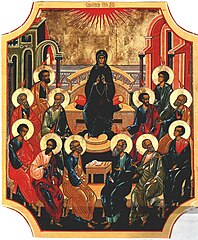
Collect for the Fourth Sunday after Trinity

O God, the protector of all that trust in thee, without whom nothing is strong, nothing is holy: increase and multiply upon us thy mercy; that, thou being our ruler and guide, we may so pass through things temporal, that we finally lose not the things eternal; grant this, O heavenly Father, for the sake of Jesus Christ thy Son our Lord, who liveth and reigneth with thee, in the unity of the Holy Spirit, ever one God, world without end. Amen.
Showing posts with label transgender. Show all posts

Tuesday, July 16, 2019

Five Quick Takes

I’m having some difficulty with my next post on gender, partly because, as I cannot stress enough, I am not an expert. It’ll probably be another couple days. In the meantime I do recommend ContraPoints’ recent video Transtrenders, though, for people who’d like to hear about trans theory from an actual expert (however fervently she may claim not to care).
✠     ✠ ✠

Today is the memorial of Our Lady of Mount Carmel. I have always been fond of the Carmelite tradition: The Dark Night of the Soul by St John of the Cross (the poem, not the full mystical manual) was one of my first tastes of Catholic mysticism, and it carried me through some extremely black midnights of my own as a teenager grappling with sexuality and faith. I nearly took him as my patron saint, and one of the special pleasures of my parish is that our altar houses a relic of his. Given my voracious unchastity, I don’t really feel able to wear the Brown Scapular; but I still turn to St John of the Cross and St Teresa in prayer, and now and again I even get wild and read them.


✠     ✠ ✠

My friend Joey Prever is getting surgery soon for some back and foot issues. If you’d say a prayer for him, that’d be cool of you. Incidentally, he was recently interviewed by the Convertigo podcast, discussing his family’s faith journey and his own.
✠     ✠ ✠

I’ve been grappling with symptoms of depression again, so I finally got my Zoloft refill. I forgot how much it messes with sleep: it doesn’t so much keep you from sleeping as make you awake, which I expect can’t be great for you but doesn’t actually feel bad, and my depression manifests partly as insomnia anyway so it’s not like it’s interfering with sleep I’d otherwise be getting. A much bigger aspect of depression, though, is a lack of motivation; people tend to think of depression as being sad, when it’s much more a matter of being numb. That involves you in a kind of abstract sadness of course, but it’s a very different experience.
✠     ✠ ✠

I have heard, though I have not verified, that ICE (which, fuck ICE) has gone as far as setting up fake Grindr profiles to entrap illegal immigrants (which, actually don’t fuck ICE, it will end badly). So if you’re on Grindr—which I don’t recommend, but if you are—and you either are undocumented, or could be assumed to be undocumented by a racist ICE agent … uh, be extra careful, I guess? Deleting the app would be better. Do that.

Thursday, July 11, 2019

Gender Jamboree, Part Two

I heard the squeak of the questing beast,
where it scratched itself in the blank between
the queen’s substance and the queen.


—Charles Williams, ‘The Coming of Palomides’


✠     ✠ ✠


CW: genital injury, suicide


The Rebuke of Adam and Eve, Domenico Zampieri, 1646 (source).
Gotta love Adam's 'What?' shrug.

So! God made mankind in his image, male and female, and that’s normally pretty straightforward, but in a small minority of cases we find male and female characteristics mixed; we call this physiology intersex. Accurate estimates of how many people are intersex are difficult to find, as the subject isn’t well-studied, but an estimate of about 1% seems to be a safe generalization from studies that have been done to date, making it only a little less common than red hair.1


Ironically, this knowledge was actually a little more common until a hundred or so years ago. The twentieth century saw an extensive use of surgery on intersex newborns, modifying or eliminating their unusual characteristics; when these surgeries had yet to be developed, and most babies were delivered at home and by midwives, it was familiar enough to them to deliver the occasional intersex baby. Legal cases right down to the eighteenth century make occasional mention of intersex people.


Nor has intersexuality been wholly unknown to the Church. Although there are few references to the phenomenon in Catholic history, they are mentioned in passing (under the title androgynes) by St Augustine, and Gratian, the foremost canon lawyer of the Middle Ages, discusses them briefly. Those canonists who addressed the subject stated that if one sex could be determined to be predominant in an intersex person, that person should be treated as being of that sex (up to and including that a principally male intersex person could be validly ordained2), while allowing that there might be cases in which it was impossible to judge for certain which sex predominated in a person’s body. At least one cleric at that time gave the opinion that, in cases where someone’s physiology was evenly mixed, they were to be given the choice, under irrevocable oath (no pressure), of which was their sex.


However, to the best of my knowledge, only canon law has directly addressed intersexuality to date, and it’s done so rarely. Theological reflection on what defines male and female is not the same thing, though the two are related. St John Paul II’s extensive meditation on male and female in Theology of the Body may, after adequate unpacking, speak to the question; but even understanding, let alone unpacking, that tome is going to be the work of generations. And in the meantime, the sciences do have something more to say, which theology needs to operate upon. (Like any science, theology operates upon facts: the differentia of theology is that some, though not all, of those facts are provided by God’s revelation. The rest are derived from observation and inference, the same place we get most facts.)


The surgical correction of intersexuality has come under fire. Initially developed in the 1950s, it was thought at the time that it would be easier for the child to develop as whichever gender they were raised, and that a confused identity would be avoided if the confusing body were adjusted. Nor was the practice even limited to intersex children. Anatomically typical male children who exhibited a micropenis,3 or whose genitals were irreparably damaged in infancy, in some cases received vaginoplasty and were raised as girls.


One notorious and particularly tragic case was that of David Reimer, born in 1965. His penis was destroyed in a botched circumcision4 a little before the age of two. His parents took the advice of Dr John Money (I swear I did not make his name up), a pioneer and advocate of performing sex reassignment in infancy, on the grounds that infants healed much more easily and completely and that surgeries of this kind would be less traumatic if they could not be remembered. Their son was surgically reconstructed as a girl, and raised in a thoroughly female environment. The much-crowed-over success of the procedure, accompanied by some very weird follow-up creepiness from Dr Money, lasted until he was 13. Reimer had never felt like a girl, he had become suicidally depressed, and he told his parents he would kill himself if forced to see Money again. The next year his parents told him the truth about his history, on the advice of his psychiatrist. Reimer then shed his feminine identity and began living as a boy again, seeking multiple medical interventions to restore his physical masculinity, including hormone treatment, a double mastectomy, and phalloplasty. He went public with his story late in 1997.


That story came to an end just over six years later. His relationship with his parents, naturally enough, remained difficult, and he struggled with unemployment; his twin brother died of an overdose in 2002; and in 2004, his wife of over thirteen years asked for a separation. Two days later Reimer shot himself in the head.


A superficially similar, if somewhat happier, case is that of Christiane Völling, born in 1959, who in 2011 became the first intersex person to win a suit for damages over non-consensual sex reassignment surgery. Born with XX chromosomes, her phenotype was unclear at birth: she had ambiguous genitals but was assigned and raised male (an unusual decision at the time, since, to use a very crude phrase, it was considered ‘easier to dig a hole than build a pole’), and experienced a relatively early, vigorous, masculine puberty. Völling was found to have an undeveloped but complete set of female reproductive organs during an appendectomy at age 14; she was told only that she was ‘60% female,’ which caused her severe psychological distress. Her female reproductive organs were removed four years later, despite the fact that the full details of her diagnosis had been withheld from her in the name of protecting her mental health. She continued for some time after that to live as a man, but eventually transitioned into life as a woman. She was awarded €100,000, nearly forty years later, for receiving an unnecessary surgery without being able to give informed consent.


So cases like these are clear-cut evidence of original biology over imposed sociology, right? Proof that no matter what you do to a person’s body through surgery, you can’t make a man into a woman or vice versa, and that trying to only makes them miserable. Right? Well … hang on. Before we can address that, we need to talk about gender dysphoria.5


Gender dysphoria is the distress a person feels due to their physical sex characteristics not matching their inner sense of gender identity. Most people who identify as transgender experience gender dysphoria, and vice versa, but the two aren’t the same thing. Reimer and Völling exemplify both the experience itself, and the therapeutic and medical steps generally taken to address it; the difference is that they were identifying with sexual characteristics that had been excised from them, whereas gender dysphoria is generally used to talk about people whose bodies have developed normally but whose identity or sense of self is in conflict with their bodies. And the thing is, both transgender identity and the dysphoria that typically accompanies it appear to be just as persistent—just as deeply rooted and intractable to all psychotherapy and socialization—as the gender identities that Reimer and Völling display.


This doesn’t mean that trans identities are therefore automatically valid and unquestionable, no. What it does mean is that our analysis isn’t finished yet. I'll discuss dysphoria and identity further in my next.


✠     ✠ ✠


1That the intersex minority is a small one is not, philosophically speaking, significant. What makes intersex bodies important to the discussion is that they exist at all, not how common they are.
2The canonists did say that intersex men could not be licitly ordained, due to canonical requirements forbidding the ordination of men with physical deformities. However, requirements of this kind could in principle be changed (as, e.g., the Church can and occasionally does relax the Roman ban on ordaining married men).
3A micropenis is a penis that is at least 2.5 standard deviations smaller than the mean. It is not a health risk, although it can be caused by growth hormone deficiency, androgen insensitivity, and certain other conditions, as well as by intersexuality.
4The late circumcision was an attempt to treat phimosis, a condition in which the foreskin is too constricting and impedes penile function. Treating phimosis is not generally considered necessary until after the age of three.
5Though it appears in current DSM manuals, this term is controversial in some circles, as some people consider it pathologizing and stigmatory. I can’t really get into that discussion right now; the thing that the term ‘gender dysphoria’ is talking about does exist, and the term is already in use, so, with apologies to any readers who are bothered by it, it’s the term I’ll use for the present.

Friday, July 5, 2019

Gender Jamboree, Part One

Now I know your heart, I know your mind
You don’t even know you’re being unkind
So much for all your highbrow Marxist ways
Just use me up and then you walk away
Boy you can’t play me that way

Well I guess what you say is true
I could never be the right kind of girl for you
I could never be your woman

—White Town, Your Woman (lyrics by Jyoti Prakash Mishra)

✠     ✠ ✠

Edit: Now that Mudblood Catholic is up and running on Patheos, I've re-written this post. You can find the new version here.

Due to Reasons™, the new hot-button issue of the kulturkampf seems to have moved to trans issues rather than gay issues. Due to most Catholics understanding trans issues even more poorly than they understand gay issues—an unenviable accomplishment—I feel it’s worthwhile to do some mansplaining here at Mudblood Catholic. However, before I begin, I wish to make two disclaimers. One, which technically is a disclaimer appended to this entire blog (see the ‘About the Mudblood’ box at the bottom of the page), is that I submit everything I say to the final judgment of the Catholic Church. I contend pretty strongly that the Church has not in fact defined her final judgment in these matters, but if and when she does so, by ecumenical council or pontifical definition, I will accept that.

The other is that I write this primarily because I know a lot of Catholics will listen to a cis1 person more willingly than they’ll listen to a trans person. I am not writing this because I’m any kind of expert on trans issues. I’m very much an amateur, and I urge anyone who’s willing to do so to go to trans sources rather than me. Natalie Wynn of the Contrapoints channel on YouTube, though she wouldn’t suit everyone’s taste stylistically, is an intelligent and engaging exponent of trans theory whom I recommend; Daniel Ortberg, a columnist for Slate, is another prominent source on trans issues2; and though I haven’t read their work, I understand that Thomas Page McBee, Imogen Binnie, Raquel Willis, and Akwaeke Emezi are generally well-regarded by the trans community.


Right, now that those are out of the way, what’s up with this left-wing genderist stuff anyway?

A review complete revision of high school biology is in order to start with.3 The format we were taught was that, at conception, XX chromosomes make a girl and XY chromosomes make a boy. This is roughly true, but it is an oversimplification because it was high school biology. Without touching the other aspects of gender (social, psychological, and spiritual), we may consider at least three on a strictly biological basis: chromosomes, gonads, and phenotype. This is going to get kind of technical, so bear with me.

There are two basic sex chromosomes in Homo sapiens, codified as X and Y. Most humans have two sex chromosomes in their cells, of which one is always X: thus, a vast majority of people have either XX chromosomes or XY chromosomes. XX people are female, XY people are male. Clear, but not quite accurate to all human biology.


The other two biological components of sex are gonads, or reproductive organs (either ovaries or testes), and phenotype, or the shape and appearance of the body (including the external genitals, the breasts, and secondary sex characteristics such as body hair and voice). Most of the time, these three things develop straightforwardly and together, but occasionally they do not.

There are several ways and reasons that chromosomes, gonads, and phenotype can diverge from each other. Sometimes the divergence comes in the reproductive cells themselves. For instance, there are a tiny number of XX males: the sex-determining SRY protein, which is normally attached to the Y chromosome, in rare instances gets exchanged to an X chromosome during the production of sperm, thus producing persons who are genetically female (XX chromosomes) but who frequently appear entirely male (male phenotype) and have testes rather than ovaries (male gonads). This is one of many intersex conditions,4 biological states in which male and female characteristics are mixed. Sometimes intersex conditions produce visible ambiguities, sometimes not.

Another example of intersex biology is CAIS, complete androgen insensitivity syndrome. People who have CAIS have XY chromosomes and testes, but their cells do not respond to androgens at all (androgens are the hormones responsible for masculine sexual development and characteristics; testosterone is the best-known androgen). Hence, their phenotype is wholly female: the testes don’t descend, but remain where the ovaries would be in the abdomen; a vagina rather than a penis forms—often the passage is shallower than in cissex1 women, but it’s there; the breasts develop in feminine form; body hair and voice are typically female. CAIS typically isn’t discovered until puberty, at which point the absence of menstruation generally prompts a visit to the doctor.5

There are other intersex or otherwise unusual biologies in human beings, and I won’t linger over them, interesting though the subject is. The point I’m making here is not that gender is a social construct because biology is a confusing science—we’ll get to that discussion—but simply to point out that, even though it covers a majority of people, the black-and-white idea that male and female are totally obvious in every case just isn’t true. That doesn’t mean that male and female don’t exist, any more than the phenomena of dawn and dusk mean that day and night don’t exist. But it is a very good reason to be patient and cautious and ready to learn, before we make snap judgments about other people. It certainly calls for theological examination and reflection, as distinct from simply quoting Genesis 2 and calling trans people Satan.

As a matter of fact, Genesis 2, and the rare passing reflections on it made by St Paul, seem to hint at the coïnherence as well as the distinction of the sexes. Adam is caused by God essentially to give birth to Eve6; he is male, and yet he is maternal, as is artistically proper to a person formed out of the earth (which is always Mother Earth in myth). And the Apostle says frankly, in the very act of confirming the distinction between women and men in the symbolism of liturgical dress, that nevertheless woman and man depend upon each other and each comes from the other, and both from God—harking back, maybe, to his earlier7 letter to the churches in Galatia, in which he said rapturously that there is no male or female in Christ. Indeed, the Virgin Birth itself, re-rooting the human race and the Second Adam in a sinless woman, reverses the pattern of the creation narrative: again birth takes place by the direct intervention of God, but this time it is a woman who is given the role then appointed for the male, and the flesh of her flesh, whom she also names, is the male—the same Man who, once again in sleep, gives birth from his side to the Church.


Again, none of this is to say that sex or gender don’t really exist. It is to say that we may not always understand them perfectly, and that God is apparently prepared to do surprising things with them sometimes. There’s a great deal more to be said—we haven’t even gotten to trans identities as such yet. But I think this forms a good period for the moment.

Go here for Part Two.

✠     ✠     ✠

1For those not familiar, the prefix cis- is simply the opposite of the prefix trans-; both are derived from Latin: the former means approximately ‘on this side of,’ while the latter means ‘on the far side of, beyond.’ (For example, when a part of the Gaulish people settled in northern Italy, the Romans referred to that region as Cisalpine Gaul, i.e. ‘Gaul on this side of the Alps,’ and to the area of modern France as Transalpine Gaul.) Cisgender, or cis for short, is thus simply the contrary of transgender.
2Because qualifiers are necessary for friggin everything: I’m not saying I agree with everything these people have written (e.g., both are firmly pro-choice, and Wynn at least is an atheist). But it’s always better to learn about a human experience from the horse’s mouth.
3In starting here I am not saying that biology is the only thing to consider, nor the most important thing. But I do think biology is moderately accessible to people of all political and religious views, and it is something that (to be blunt) some churchmen do not seem adequately acquainted with, so it seems like a decent starting point.
4Intersex people used to be called hermaphrodites; the word comes from a myth about Hermes and Aphrodite having a child together, who had male genitalia, feminine breasts, and long hair, whom they uncreatively named Hermaphroditus. However, the word never really signified all intersex conditions in the first place, and is found insulting by some intersex people.
5There’s an incredibly problematic House episode about CAIS, if incredibly problematic House episodes are your thing.
6Perhaps we see here the faintest of hints from the Holy Ghost of our own future scientific discoveries, a sort of Easter egg. Adam has XY chromosomes, and Eve is made from Adam but is not simply a copy of Adam; she is made from his X side alone, which is then doubled, forming a person who is reflective and yet different. Thus man, in meeting his fellow, meets himself and becomes fully human by relationship. (Whether and to what extent Genesis 2 represents historical as well as mythical realities is for our purposes immaterial.)

Thursday, August 31, 2017

An Analysis of the Nashville Statement

A Truth thats told with bad intent
Beats all the Lies you can invent
It is right it should be so
Man was made for Joy & Woe
And when this we rightly know
Thro the world we safely go
Joy & Woe are woven fine
A Clothing for the soul divine
Under every grief & pine
Runs a joy with silken twine


—William Blake, Auguries of Innocence


✠     ✠     ✠


The Nashville Statement on a Christian view of sexuality has provoked a lot of reaction, not only from those who think we should revise that view, but among traditionalists themselves. I don’t consider myself beholden to it—the assertions of a group of men who don’t even claim the authority that I believe the Catholic Church really possesses will, inevitably, be of only so much value to me. But it’s caused enough of a ruckus among my friends and allies that I want to go through it.


I agree with a good deal of it, and for this reason I won’t spend much time on my agreements, since it’d unreasonably inflate this post. My difficulties with it, while fewer, are serious, and they begin in the preamble, with this passage:


Many deny that God created human beings for his glory, and that his good purposes for us include our personal and physical design as male and female. It is common to think that human identity as male and female is not part of God’s beautiful plan, but is, rather, an expression of an individual’s autonomous preferences.


No Christian, I think, need cavil at the assertion that mankind generally and man and woman in particular are icons of God’s glory. However—this is where the connotations get ticklish—it doesn’t follow from this either that there are no grey areas between male and female, or that any felt uncertainty or ambiguity in one’s own gender identity is an attempt to substitute our preferences for God’s plan. A vocation to celibacy is not an assertion of personal autonomy against God’s design for sex; being nearsighted is not an assertion of personal autonomy against God’s design for eyes. The Nashville Statement appears to be saying that any experience of gender dysphoria is either willful rebellion, or a disposition to it—and I don’t believe that that’s borne out by Scripture or the tradition of Christendom.


The vexed term identity comes up here too, which is no surprise. Generally, when I hear LGBT people use it, it’s a shorthand for something like ‘part of my story as a person’; whereas when I hear Christians use it, it’s a shorthand for ‘intrinsic, ontological attribute.’ Either usage could be defended, but it’s worth noting that, to the extent that either group insists on reading its own habitual meaning into the texts of the other group, there’s going to be a lot of misunderstanding, hurt, and anger. (For what it’s worth, I prefer using identity in the ‘story’ sense, partly because it seems to be more common.)


Some of the same implicit problems emerge a little further on in the preamble:


Our true identity, as male and female persons, is given by God. It is not only foolish, but hopeless, to try to make ourselves what God did not create us to be.


I don’t know about hopeless; God didn’t create us to be sinners, but we’ve managed that with remarkable efficiency. And speaking of which—on what grounds do we know that sin, which (as I’m certain the framers of the Nashville Statement would agree) affects us so deeply, can’t introduce a real discord into the relations between body, brain, and soul? There’s some evidence that trans experience is correlated to differences in the brain structure of the trans person, which may suggest that assertions that their body doesn’t match their identity reflect the reality of gender vis-à-vis the brain. And whether it’s a result of the Fall or not, we do know that there are various degrees and kinds of what are called intersex conditions: there are people who exhibit secondary and even primary characteristics of both sexes, or who have the phenotype1 of one sex with the DNA and sex organs of the other.2 We need not pretend that hard cases do away with the existence of the basic pattern; but we cannot and must not pretend either that the hard cases do not matter or do not exist. It goes far beyond Scripture to do so, and it’s a gross disservice to those who do find themselves, through no choice of their own, in between the normal categories.


Moving on to the content, I more or less agree with Article I, though its omission of divorce from the denial is a little sketchy. Of course, the evangelical world is very much divided about what constitutes proper grounds for divorce—though, if as the Statement says, the marriage covenant represents Christ and the Church, then Charles Williams’ dictum springs to mind: Adultery is bad morals, but divorce is bad metaphysics. I would also point out the incredible deadness of conscience about divorce in Protestant circles (I’d say evangelical, but that would seem to unfairly exculpate mainline Protestants, who are if anything still more cavalier about the austere view of divorce presented in the Gospels); in the context of a prophetic rebuke to the surrounding culture, forwardness about one’s own sins—especially when they are so topical—is badly needed, both for the world and for the church.


With Article II, I have one important difference. The affirmation states that God requires ‘chastity outside of marriage and fidelity within marriage.’ This, while true, is again misleading: God requires chastity of spouses toward one another as well, because chastity isn’t synonymous with abstinence from sex. It’s perfectly possible to be unchaste with one’s spouse, by engaging in sex that’s abusive, or objectifying, or closed to life, or merely excessive.3


Articles III and IV seem basically fine, but Article V gets difficult again. The text:


We affirm that the differences between male and female reproductive structures are integral to God’s design for self-conception as male or female.
We deny that physical anomalies or psychological conditions nullify the God-appointed link between biological sex and self-conception as male or female.


The problem being, Why?


I don’t think it’s reading things into the document to say that this affirmation and denial are ‘aimed at’ transgender folks. And I dare say most transgender Christians would agree—if they wouldn’t, I’m sure I’ll be corrected—that our bodies, in both genes and phenotype, are integral to God’s design, and that male and female sex are holy and precious images of the Lord. But if, as mentioned above in discussing the preamble, we know that genetics and phenotype can be out of alignment or ambiguous, then what can the denial here mean? and what place can intersex people occupy in churches that, apparently, deny their existence?4 Scripture says that God made man male and female, and (though Scripture does not say this in so many words) it’s reasonable to read it as seeing the two sexes as peculiar images of God’s character, which is why their differences are metaphysically real and spiritually valuable, rather than only socially constructed or irrelevant to an advanced age. But as St Paul says that neither is the man without the woman, neither the woman without the man, for as the woman is of the man, even so is the man also by the woman, but all things of God—is it really so inconceivable that certain people, not merely in their tastes but in the very structure of their bodies, are icons of the unity and interdependence of the sexes, rather than of their distinction and simplicity?


Article VI, which states that those born with a physical disorder of sex development are created in the image of God and have dignity and worth equal to all other image-bearers, is very right and proper in this context. I’m not sure that it’s adequately supported by or consistent with the other contents of the Nashville Statement; but, credit where credit is due. I certainly had an unusual upbringing, in (I’ve since come to suspect) an enclave of good sense and compassion within the evangelical world; but at any rate in my own experience, I’ve found the actual behavior of evangelicals to be worthy of better beliefs than they often hold.5


With Article VII I start having more explicit problems. The text:


We affirm that self-conception as male or female should be defined by God’s holy purposes in creation and redemption as revealed in Scripture.
We deny that adopting a homosexual or transgender self-conception is consistent with God’s holy purposes in creation and redemption.


(Just like it says in the Bible: And Moses said unto the people, Also, ye shall not identify as homosexual or transgender, certes: Deuteronomy 22.31.) Now, I’m not certain what the framers of the Nashville Statement mean by self-conception. Like identity, it’s a word that could mean a bunch of different things. If all the framers meant is that sexuality and gender identity aren’t the sole or central aspects of who an LGBT person ontologically is, I could agree; but if, as I suspect, they’re saying that LGBT people shouldn’t consider their sexuality or their perceived6 gender a part of who they are in any sense, then I reject this entirely. I see no reason, Biblical or otherwise, to exclude our sexuality from our sense of who we are: it’s part of our story, and while we aren’t controlled by our stories, they are, well, the story of us. Insisting that being LGBT must be relegated to a footnote is (to me) neither intuitively obvious, nor justified by the pages of Scripture or the tradition of the Church. But even if we took an exclusively negative view of everything other than cisgender heterosexuality: Most gladly therefore will I glory in my infirmities, that the power of Christ may rest upon me. Therefore I take pleasure in infirmities for Christ’s sake: for when I am weak, then I am strong.


Articles VIII and IX seem again to be fine to me. Article X comes across as dangerously ambiguous, however.


We affirm that it is sinful to approve of homosexual immorality or transgenderism and that such approval constitutes an essential departure from Christian faithfulness and witness.
We deny that the approval of homosexual immorality or transgenderism is a matter of moral indifference about which otherwise faithful Christians should agree to disagree.


There are several ways this could be read, but I’m not much satisfied by any of the ones I’ve come up with. Does the phrase essential departure from Christian faithfulness and witness mean those who disagree with the Nashville Statement aren’t even Christians? If so, I again totally reject this assertion. I am a Catholic, and my body of doctrine is considerably more demanding than the framers of this document would assent to; not only about sex, but about the Church, sacraments, and authority. Nevertheless I insist that they are Christians, my brethren through baptism. This isn’t because I consider the Real Presence in the Eucharist or the infallibility of the Holy See matters of indifference, but because I don’t consider Christian and wrong incompatible categories.7 But the beliefs about church authority held by the framers and signatories of the Statement, I gather, are mostly of a sola Scriptura nature—to use the convenient summary from the Thirty-Nine Articles of the Church of England: Holy Scripture containenth all things necessary to salvation: so that whatsoever is not read therein, nor may be proved thereby, is not to be required of any man, or be thought requisite to salvation.8 The point here being, the Bible has very little to say about homosexuality (five verses)9 or transgenderism (zero verses), so where do you get off making this an indispensable condition of Christianity?


Articles XI, XII, and XIV, again, look fine on the surface of them. Article XIII gives me pause:


We affirm that the grace of God in Christ enables sinners to forsake transgender self-conceptions and by divine forbearance to accept the God-ordained link between one’s biological sex and one’s self-conception as male or female.
We deny that the grace of God in Christ sanctions self-conceptions that are at odds with God’s revealed will.


In itself, the denial is not so much a specific doctrinal stance, as a description of what the words God’s revealed will mean. But the affirmation is more problematic. Though I’ve left Calvinism far behind, one of Calvin’s sayings springs to my mind: Where God hath shut his holy mouth, we would be wise to close ours. And—I’m sorry—where has God said that gay or trans identities aren’t a thing? III Corinthians 8.5? IV Concordance 1.16?


I’m concerned about this partly for doctrinal reasons (it may be silly, but even as an ex-Protestant I want and expect more vigorously Scriptural confession from my former compatriots), and partly for personal ones. I’m not trans myself, though I experienced some gender dysphoria as a child; it went away, as dysphoria sometimes does; but for some people, it doesn’t go away, and Article XIII here is dangerously ambiguous about this. It could easily be read in the cruellest sense, that those who continue experiencing gender dysphoria are secretly resisting God’s grace—something I believe we have no right to say. Nor, given the total absence of trans issues from Scripture, is this directly justified by the Bible, and someone who seriously believes that only the Bible is infallible should limit and qualify their beliefs accordingly.


So all in all, I don’t find the Nashville Statement satisfying. And I find it especially lacking in its dealing with trans issues: I feel that it jumps to conclusions that aren’t justified by Scripture, and are inconsistent with what we know of trans identities through biology. One or two of my trans friends have pointed out that, coming so soon after Trump’s order banning trans individuals from the military, it’s also pretty tactlessly timed; and while that doesn’t affect its truth or falsity, it does matter, courtesy being the social form taken by charity. The fact that certain figures like Matt Walsh appear poised to encourage all the same mistakes about trans people that we are barely getting past with gay people is also discouraging.


To any LGBT people, especially trans or genderqueer people, who are reading this: I love you; more importantly, God loves you; and if shit goes pear-shaped for you in this country, I will do what I can to defend and help you. My house is a safe place for you.


To any signatories or sympathizers who are reading this, I hope you’ll reconsider, on Biblical grounds. I don’t think that the word of God really supports the cultural lines that are drawn in this statement, and I think it rushes to judgment on matters that the conscience of Christendom has not yet pronounced on—which, to me as a Catholic, is an important omission. And regardless, I hope and pray that you will take great care to live up to Article VI. I don’t know how much you know about trans people and their lives, but it’s Article VI, rather than any other point, that most people (Christian or not) like to ignore in the way they treat trans people.


✠     ✠     ✠


1Phenotype means the visible characteristics of something: e.g., identical twins have identical phenotypes, while fraternal twins will have some differences. Male and female phenotypes would include the literal shape of the genitals as well as of the breasts, the amount and location of body hair, tendencies toward musculature, and so forth.
2One of the better known examples of this is Complete Androgen Insensitivity Syndrome or CAIS. Some people experience some degree of insensitivity to androgens, i.e. hormones like testosterone, which (among other things) prompt the development of male characteristics, like phenotype and brain structure, in fetuses with XY chromosomes. An XY fetus with CAIS will be genetically male and develop testes, but the male phenotype won’t develop, leading to an entirely female appearance; for many people with CAIS, the only symptom of abnormality is the absence of menstruation during or after puberty.
3Not that I think there’s some absolute amount of sex that is too much. But it would be perfectly possible for a married couple to have sex that in itself is mutually honoring and self-giving, but to be so preoccupied with it that it distracts them from other legitimate needs and duties.
4I give full weight to apparently here. Both from reading others’ work and from having my own read, I know that it’s very easy for a reader unfamiliar with the author’s mind to take something totally different and entirely unexpected from their words. But until and unless clarification is forthcoming, I take the Nashville Statement to mean what I’m addressing here.
5We were the sort of evangelicals who distinguishes ourselves with vigor, not to say contempt, from fundamentalists, if that gives you the idea.
6Provisionally ignoring whether this perception is ontologically right or not.
7Of course, I have a kind of advantage over the Nashville Statement authors, in that I have no problem believing that those who are objectively outside the pale of orthodoxy will go to heaven; Christ is the only Savior, but not everybody knows what’s happening when he saves them, as I would put it, and the advantage the Church visible has is one of knowing what’s going on. Hence I can comfortably place the pale of orthodoxy wherever Rome sees fit to put it, without needing to believe that the opponents I thus gain are necessarily hell-bound.
8I don’t believe this. But anybody who does had better make damn sure they don’t start requiring things that aren’t in Scripture from the faithful.
9The five verses in question (Leviticus 18.22 and 20.13, Romans 1.26-27, I Corinthians 6.9, I Timothy 1.10) address homosexual immorality—but of course it must be pointed out that Side A believers would argue that homosexual immorality is as wrong as heterosexual morality, but that marital relations between gay men or lesbian women aren’t immoral, and that these verses are accordingly irrelevant.