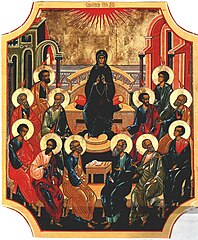
Collect

Collect for the Fourth Sunday after Trinity

O God, the protector of all that trust in thee, without whom nothing is strong, nothing is holy: increase and multiply upon us thy mercy; that, thou being our ruler and guide, we may so pass through things temporal, that we finally lose not the things eternal; grant this, O heavenly Father, for the sake of Jesus Christ thy Son our Lord, who liveth and reigneth with thee, in the unity of the Holy Spirit, ever one God, world without end. Amen.
Showing posts with label prayer. Show all posts

Tuesday, September 25, 2018

The Next Catholic Reform, Part I

‘We agree about a lot of things,’ the priest said, idly dealing out his cards. ‘We have facts, too, we don’t try to alter—that the world’s unhappy whether you are rich or poor—unless you are a saint, and there aren’t many of those. It’s not worth bothering too much about a little pain here. There’s one belief we both of us have—that we’ll all be dead in a hundred years.’ He fumbled, trying to shuffle, and bent the cards: his hands were not steady.
‘All the same, you’re worried now about a little pain,’ the lieutenant said maliciously, watching his fingers.
‘But I’m not a saint,’ the priest said. ‘I’m not even a brave man.’ He looked up apprehensively: light was coming back: the candle was no longer necessary. It would soon be clear enough to start the long journey back. He felt a desire to go on talking, to delay even by a few minutes the decision to start. He said, ‘That’s another difference between us. It’s no good your working for your end unless you’re a good man yourself. And there won’t always be good men in your party. Then you’ll have all the old starvation, beating, get-rich-anyhow. But it doesn’t matter so much my being a coward—and all the rest. I can put God into a man’s mouth just the same—and I can give him God’s pardon. It wouldn’t make any difference to that if every priest in the Church was like me.’ 
—Graham Greene, The Power and the Glory

✠ ✠ ✠

The ecclesiastical scandal of sexual abuse and official concealment have been on the minds, lips, and hearts of every practicing Catholic (and many others) for almost two months. Wrath, despair, gossip, and scapegoating pervade op-eds and Facebook statuses and homilies.

I’ve not said much so far; not as much as I’d have expected me to, anyway. I wanted to process a little, and I’m glad that I did, since some of the things I was originally intending to write, I would’ve had to retract or modify beyond recognition. But I’d like to put forward my—necessarily tentative—analysis of how we got here as a Church, and how we can get out.


Lesson number one is that we can’t get out. There is no policy, no safeguard, no system, and no group that can be trusted absolutely, because the world is fallen. Our collective forgetfulness of that fact as it applies to the clergy is a part of the reason the scandal developed as it did. We can place our trust in the God who redeems evil; we cannot trust any human being, ourselves included, never to do evil.

It may be said that that is not much of a lesson, since we knew it already. Apparently knowing something is not much good if we do not act on it: Show me your faith without works, and I shall show you my faith by my works

Secondly, there have been lots of explanations of how the scandal is the fault of laxity and heresy, or gay men in the priesthood, or clericalism, or the discipline of celibacy, or the Sexual Revolution, or Catholic teaching on sexuality and marriage, or lizard people from outer space (I may have dreamed this). Any, all, or none of these deeper-cause-oriented explanations may have some merit, and I’ll be going into my own moderately educated guesses on the subject later. But we must remember the straightforward fact that the persons responsible are, first of all, the abusers themselves and the people who covered for them; and that the primary victims are the victims of sexual abuse, not innocent clergy or the Church’s credibility or anything like that. This scandal, like all scandals, is first of all about people.

This highlights another facet of the problem, which thankfully I have seen a good number of commentators cottoning to: this is a problem for you and me. It can’t be adequately dealt with by episcopal chanceries, religious institutes, or bishops’ conferences. If the light which is in thee is darkness, how great is that darkness! Obviously the coöperation of the clergy will be required—a dismaying thought—and obviously we will continue to depend upon our bishops and priests, however corrupt or incompetent, for the sacraments, without which the Church can hardly subsist. This reform is going to require not only boldness, but delicacy, humility, patience, and clear-headedness. It’s going to take a long time, of which some will be discouraging and a great deal will be dull, and some people are going to give up on it.

But. I’d point to two precedents, one from the Mediæval Papacy and one from the Catholic missions in East Asia, that I think provide us with models of what our Lord the Spirit may do to effect this reform.

The late ninth to early eleventh centuries were an ugly age for the Holy See. A string of corrupt, arrogant, violent Popes reigned: for instance, Sergius III, who was credibly (though not certainly) reputed to have had two rivals to the papal throne murdered, and to have fathered the future Pope John XI on his mistress; Stephen VI, who had the corpse of one of his predecessors exhumed and ‘tried’ for ecclesiastical misconduct, a notorious farce known as the Cadaver Synod, after which the body of the deceased Pope was mutilated and thrown into the Tiber; or Benedict IX, who was twice expelled from Rome by popular revulsion at his depraved, unpriestly conduct, and eventually consented to abdicate on the condition that he be reïmbursed for the bribes by which he had originally been elected. We might well have expected that the Catholic Church would collapse under the weight of its own scandals and stains, or at least that the Papacy would.

But, from the early tenth century, a new development—favored at times even by the immoral and self-aggrandizing pontiffs—had been taking place in the Church, too. In the year 910, William the Pious, Duke of Aquitaine, had donated a portion of his land to a group of monks who wanted to live according to a more rigorous interpretation of the Rule of St Benedict than was normal at the time. These monks founded Cluny Abbey, and the Cluniac branch of the Benedictine family of monastics soon became well-known for its purity of conduct and the vigor of its spiritual life. In Pope St Leo IX, the Cluniac Order found a more permanent ally, and a run of several reform-minded pontiffs followed, until the two movements were united in the famous St Gregory VII. From his reign forward, the Papacy and the Church experienced a revitalization that led to the founding of the Franciscan, Dominican, and Carmelite Orders, full reunion with the Maronite Church of Lebanon, a decisive end to secular interference in papal elections, and, indirectly, the career of St Thomas Aquinas and the composition of his Summa Theologiæ.


Hundreds of years later, during the Catholic and Protestant Reformations, the Jesuit order was founded, and St Francis Xavier carried the gospel from Europe through the Near East to India, China, and even Japan. He had the greatest hope for Catholic Christianity in Japan, and his missionary successors (principally Portuguese Jesuits) maintained the community there for decades, centered in Nagasaki. It made a lasting impact on Japanese culture; for instance, tempura is descended from the tradition of four times dedicated to fasting from meat, during which Catholics would fry seafood and vegetables in batter to make them more satisfying cuisine, which was the first exposure of the Japanese to frying—and because these four fasting periods were called in Latin the quatuor tempora, the Japanese referred to the foods that signified them as tempura. Anyway, the Christian community in Japan enjoyed peace and even a certain caché through the sixteenth century.

But in the seventeenth (for reasons we needn’t go into), the state’s outlook on Catholicism soured. The Kirishitan, as Christians were known, came to be regarded as agents of Portuguese and Spanish colonists, and Christianity was finally outlawed. The decision was accompanied, at first, by such persecutions as the Church was familiar with from history. But the Japanese daimyō were smarter than the Roman emperors, and as soon as they saw that mere martyrdom was more apt to encourage the Kirishitan than to break them, they began aiming not to kill, but to compel apostasy through torture—especially, whenever it could be obtained, the apostasy of priests. The Japanese persecutors must be given credit; they took seriously the Christian idea that sin is worse than death, and accordingly sought to procure sin rather than death, in order to suppress Christianity.

By the middle of the seventeenth century, the Church in Japan had no visible presence; anyone suspected of Christianity might be ordered to renounce it, particularly by trampling on a fumie, a depiction of Christ or the Virgin designed for the desecrating act of being stepped on.

But the Kakure Kirishitan, the ‘hidden Christians,’ continued. Their outward apostasy, painful though it surely was, did not extinguish the light in their hearts. Without clergy, without Scriptures, without sacraments save baptism alone, these communities in southern Japan maintained their existence for two hundred desolate years. We know this because, when Japan was reöpened under the Meiji Emperor in the nineteenth century and foreign religions were again declared legal, some of the Kakure Kirishitan met with Catholic priests, to profess their interest in seeing a Mass celebrated. It eventually came out that, not only did the Kakure Kirishitan still exist after two centuries of isolation, not only had they clung to their few precious relics—pieces of rosaries and cassocks, memories of the celibate priests—but even their rudimentary calendar commemorating Christmas and Good Friday was still correct.

The Church persists, because God never ceases to dwell among us. The creation saw him not only ordering the world by his Word, but brooding over it by his Spirit, a presence consummated in his personal appearance in the first-century puppet kingdom of Judæa: a peasant from a shabby village in the most backwards part of the Mediterranean. That is where God chose to live, in poverty and disgrace and, at length, a rushed and cruel execution.


This is the world he recklessly adores. Whatever else happens to, in, because of, the holy Catholic Church and her ministers, he will not abandon us.

But that same holy Catholic Church is, mystically, his Body: i.e., the organism by which he is normally pleased to effect his will on earth. Which means that you and I are his chosen instruments. And if we are to reform and reïnvigorate that Body, we must call for certain specific qualities in the reform.

1. Prayerful. Any change we call for from the hierarchy must be rooted in God and oriented to him. Without this, nothing else we do will matter.
2. Non-partisan. Any reform must be genuine reform, not the mere triumph of one sect or style of Catholicism over its rivals. Abuse and concealment do not map to the leanings of bishops, priests, or diocesan cultures, and strict traditionalists are no less guilty than pastoral progressives. (Heresy, to be sure, must be dealt with—but that would be true regardless of any link it had to the scandals.)
3. Concrete. Any reform must be both achievable (for instance, “Get rid of sin” would not be a practical goal as applied to the Church’s structure) and specifiable: e.g., meeting or exceeding legal standards for reporting is not concrete, but notifying the local DA of all accusations deemed credible is; disciplinary measures are not concrete, but deprived of faculties to hear confessions is.
4. Public. Whatever reforms are advocated, they must be a matter of public record and accountability. The culture of deceit that has befouled the Church is not going to go away spontaneously, and those clergy that are hiding their own wrongdoing, of whatever kind, are counting on this to just blow over. That must not happen. Rather, for every change the laity call for, there must be an accompanying means of our independently investigating whether and how it is really being implemented, and whether and how it’s working.
5. Sustainable. Every reform we demand must include a plan for maintaining its work. This may or may not mean a way of perpetuating specific policies or institutions: the key thing here is preserving a purified culture among the clergy, and every reform is a means to that end; and few means are so perfect that they will never admit of change. In any case, we need such reforms as will outlast popular attention to the scandal and the current generation of the clergy.

✠ ✠ ✠

Tuesday, August 21, 2018

What Can We Do About Abuse?

His Reverence is tired from preaching
To the halt, and the lame, and the blind.
Their spiritual needs are unsubtle,
Their notions of God unrefined.

The Lord washed the feet of his servants.
‘The first shall be last,’ he advised.
The Archbishop’s edition of Matthew
Has that troublesome passage revised.

In the crypt of the limestone cathderal
A friar recopies St. Mark,
A nun serves stew to a novice,
A choirboy sobs in the dark.

—Dana Gioia, The Archbishop

✠     ✠ ✠

The devastating contents of the Pennsylvania grand jury report on Catholic sexual abuse concealment have elicited a collective roar of wrath from the laity. The response from high-ranking bishops like Wuerl, Lori, and DiNardo has been tepid, and most of the reactions that I’ve seen have been angry and contemptuous of them. Cardinal Wuerl in particular, a former Bishop of Pittsburgh, was named in the report more than two hundred times. Calls for his resignation, or failing that his degradation, have been pouring out from every source.

What is less forthcoming, though by no means entirely absent, is active compassion for the victims. There are a few possible reasons for this. One quite cynical reason could be that it’s more fun to be angry and demand that somebody else be punished—‘It is always agreeable to hold someone responsible,’ as Charles Williams pointed out in his history of witchcraft—than it is to do the work of intelligent, active compassion toward those who are suffering the aftermath of abuse. But even those whose intentions are of the best don’t necessarily know how to support victims. I’m a survivor of molestation myself (though not at the hands of a priest or minister), and, aside from a listening ear, I wasn’t sure what else to offer fellow victims—particularly those whose experiences had been more traumatic than mine. Based on a conversation with a friend who was abused by a clergyman, I put forward the following.

1. Listen to those who report abuse.

One of the biggest barriers to dealing with abuse well is that victims are so frequently dismissed and disbelieved. This trend is improving, but it’s still uphill work. The cowardly motive (namely, that white people tend to believe there is literally nothing worse than Making A Scene) and the self-interested motive (usually phrased as ‘the desire not to give scandal’ in polite Catholic circles) are factors in this. So too is the fact that, yes, sometimes children make things up to get attention; but this is a reason to investigate, not to ignore. Better to exonerate an innocent man the hard way than to condemn a child to continued predation.

Listening can be extraordinarily hard. What you have to listen to may be terribly ugly; it may make you feel sick, enraged, helpless. And certainly, most cases of abuse call for the services of a qualified psychotherapist at the very least. But this doesn’t eliminate the need for the victim to be able to talk about it with family and friends: the abused person needs to know by experience that their loved ones cherish them-as-abuse-victim, because that’s part of their story now.

We may also be inclined to dismiss a story because it doesn’t fit the abuse narratives we are accustomed to (dear God, what an awful sentence). For example, a lot of Catholics have been calling for the expulsion of all gay or same-sex attracted men from the priesthood, and a rigorous application of Pope Benedict XVI’s canon that established ‘deep seated homosexual tendencies’ as an impediment to ordination. A number of female abuse victims have, rightly, complained that this shutters their experiences, which if anything can be even more horrific, like that of the girl who was not only raped and impregnated by a priest, but forced to get an abortion. Similarly, we are in the habit of thinking of abuse and pædophilia as nearly synonymous; but ephebophilia (attraction to adolescents) and sexual harassment of adults by adults (such as McCarrick’s ‘career’ seems principally to have consisted in) are major factors here too. Hearing what is there, as distinct from what we expect, can require deliberate and sustained attention.

Note: listen to, not talk to. We often want to find the perfect words that will make this better. There aren’t any. What we generally fall into instead are clichés, which are either pathetic or monstrous in this context. And we rarely want to admit ignorance, because it feels like defeat, for them and for us. But one thing that survivors frequently need the most is somebody who will tell the truth. Abuse almost invariably depends on manipulation, gaslighting, and lies; a person who will say ‘I don’t know’ just because it’s true can be incredibly healing.

2. Realize that abuse can affect your loved ones.

I’m not recommending paranoia here. But there are parents who won’t or can’t believe that their child could ever be targeted, whether because of the normal human irrationality that thinks of that as something that only happens to other people, or due to a clericalist attitude toward their own priests. Anxiety, that is, worrying over things simply because they could happen, isn’t helpful or productive; attentiveness to things that do happen is. (I’ll talk about spotting abuse a little later on.)

3. Pray for all victims.

There are far more victims than any one person could hope to meet, let alone minister to, even if they were all still alive. Given the time scale involved, some have passed away; others, sadly, have committed suicide. And then there are the legions who even now do not feel able to come forward. Speaking up about abuse can be horribly painful and frightening.

What we can do is pray for the living and the dead. It is difficult for most of us to feel like we’re doing anything important by praying: it’s so easy (even though somehow we rarely get around to it). And of course, the trite, lazy I’ll pray for you that means I want to escape this discussion but look more spiritual than you while doing so is justly pilloried, but it’s easy to slide into the opposite error of scorning prayer altogether.

Prayer is very subtle; it is also very simple. Its simplicity is that, as his children and heirs, we ask God to do something and (provided it isn’t bad for us or wouldn’t spoil something else he has for us) he does it. Its subtlety is that we don’t know the mind of God, nor can we plumb the total operations of cause and effect—even the physical world that the sciences study largely eludes our comprehension, and examining the spiritual is a more delicate work still. But one of the things that sincere prayer does is prepare us to act and to be still. We are all responsible for one another; all of us are limited, both by our finitude and by preëxisting obligations; thus, knowing how to act, and when, and for whom, can be challenging. Prayer illuminates us because in it we turn ourselves deliberately to the God who is light and who exists in trinitarian relationship, and so we receive the light of relationship to guide us. The problem with I’ll pray for you as described above, is that there is no authentic opening of the self: the point of that phrase is to close oneself to others.

4. Hold the perpetrators, and those who enable them, responsible.

I’ve seen a good deal of scapegoating over the last week or so. The scandal is the fault of clerical celibacy, or homosexuals, or the male-only priesthood, or American cultural license, or Satan. Any or all of those explanations may have some weight, but all of them (with the probable exception of the last) are in my view negligible. Whatever else is true, and whatever the cultural context in which the offenses took place, this is true: the deacons, priests, and bishops who abused either adults or children are responsible for their behavior, and the clerics who concealed it are responsible for both that behavior and its concealment. While exceptions could conceivably be made (though I certainly can’t think of any that should be), these individuals should be degraded or laicized, handed over to civil authorities for legal penalties, and—if they will not confess, repent, and do penance—excommunicated.

Holding the perpetrators responsible is not a substitute for confronting the cultural and systemic problems in the Catholic Church that made these decades of open-secret abuse possible. The abuse certainly did not happen in a vacuum: the last several years have been an avalanche of disclosures about sexual abuse in the entertainment industry, in politics, in college and professional athletics, everywhere. But every system is composed of individual people, and holding them responsible for their actions is accordingly the starting point for systemic reform.

It may be a difficult task for lay Catholics to hold our clerics responsible. Demonstrations on the sidewalks of cathedrals, while possibly a good thing, are only a token. A radical restructuring of ecclesiastical governance may be needed. A lot of long-term measures, like imposing poverty on bishops (to help curb the image-consciousness that fosters silence), or having diocesan priests formed in monastic institutions (which statistically have a much lower rate of abuse than diocesans do, according to the John Jay Report),* may be prudent or even necessary. But the place to start—though not to remain—is in confronting the specific people responsible for the specific offenses under consideration. Go general too quickly, and the trees will be lost in the forest.

*EDIT: I'm given to understand that, due partly to the practice of taking a new name when entering a religious institute, abuse by religious priests may go even more seriously underreported than abuse by diocesan priests. To the extent that that's the case, obviously there would be no benefit to training diocesan clergy in religious houses.

5. Educate yourself on the nature, effects, and symptoms of abuse.

This is not a comprehensive list of those things by any means, but I want to hit on some important aspects of the problem.

Since most people, thank God, don’t experience sexual abuse, most people don’t necessarily understand it very well. The archetype most of us have from the Very Special Episode—in which a stranger with sunglasses and a greased smile appears from nowhere, holding something forbidden in arms posed like a mantis and addressing Our Hero as ‘Hey kid! Wanna see something cool?’—has approximately no relation to reality. Most victims are abused by someone they know, not infrequently by a relative or a friend of the family. And abusers themselves show a variety of psychological profiles. Some act out as a response to stress combined with personality problems or affective immaturity, and tend to resort to whomever is available; others are premeditating predators who are specifically fixated on a particular type of victim, and for whom the power dynamic or sadism is a key aspect.

A common thread in the experience of nearly all victims is secrecy. The number of the abused who report the abuse within a year of its occurring (or beginning) is relatively small; it’s quite common for victims to wait years, even decades, before disclosing their experiences, and for them to deny the truth if asked directly. This is true for a number of reasons. Many victims, and especially children, are dismissed by the people they confide in as making things up, even reprimanded or punished. Many children, who are often cannier than we give them credit for, can anticipate that they won’t be believed if they do speak up. Many abusers groom and manipulate their victims emotionally in a variety of ways: forming a rewarding attachment to the abuser, persuading the victim that they wanted or even initiated the abuse, and threatening the victim or the victim’s loved ones are all standard tactics. This is why, although we certainly should enact the best policies we can in safeguarding children and teens and in dealing with sexual misconduct among adults, it’s hard to tell whether current policies are working. The fact that a lot of current accusations pertain to offenses from decades ago has no relevance; we probably aren’t going to have useful data on whether, e.g., the Dallas Charter is doing its job for another twenty years—one of the many reasons why it is indecent to rehearse how well the Church is supposedly doing now, or that the bulk of the accusations are old.

Because of this long-term secrecy, detecting abuse can be difficult. It’s typical for abused children and adults to exhibit symptoms of PTSD, such as feelings of worthlessness, nightmares, depression, disturbed sleeping patterns, aversion to church, poor body image, self-harm, self-isolation, and anxiety. Though I don’t want to encourage armchair psychiatry in the least, the appearance of symptoms like this—the more so the more there are, and especially if they emerge suddenly or in uncharacteristic ways—justifies gently approaching someone and asking them if something has happened or if they need help.

The first thing a survivor of abuse needs is to both be safe, and feel safe. If these conditions aren’t both meet, it is exceedingly unlikely that they will ever process or recover from their experience. Accordingly, the first necessity for each of us in supporting victims is patient receptivity. Patient, because you cannot extract the truth without committing another boundary violation against the victim, one less heinous but possibly worse in its effects, since it’s apt to make the victim less willing and less able to trust those who would help him or her to recover; receptivity, because so many victims, especially children, are disbelieved and dismissed. No claim of having been abused should be discounted without looking into it.

Encouraging and validating survivors is vital as well: their sense of self-worth has been damaged by someone else, and, while there are probably people who can restore that sense of self-worth without much direct help from others, they are vanishingly rare. We were made to understand both others and ourselves in terms of relationships.

Lastly, a word on sex education. Explaining to young children that their bodies are their own, that certain parts of their bodies are special and private, and that not everything authority figures like priests, teachers, or babysitters say has to be obeyed, is a crucial task; so too is both telling them they can speak up and be believed if something should happen, and following through on that promise. I don’t envy the parents who have to figure out how to explain these things to a child without coming to pieces. But sex education of this kind cannot be shirked. Many parents worry that the more they explain to their child, the more curious the child will be about such matters, and thus the more prone to sin. That concern has some weight, but not much: it’s a little like thinking that it is kinder not to evangelize, because people who are less informed about God will be judged more gently. Curiosity and sinfulness are going to emerge anyway, and children are not known for their discretion in sharing information with each other. Better to be sure they get healthy, age-appropriate information from you than to leave them to their own guesses and schoolyard gossip.

✠     ✠ ✠

Tuesday, July 10, 2018

Five Quick Takes

✠ ✠ ✠

I got back from a five-day visit to the Adirondacks this past weekend. It was gorgeous, it always is, but I cannot say I’m sorry to be back in the land of air conditioning and cell phone reception. The insects were especially bad this year: I brought a canister of Off and so did several other people, and I’m still covered in bites from deerflies and mosquitoes.

✠ ✠ ✠

The McCarrick scandal, especially when set beside the corruption and incompetence of the Archdiocese of Baltimore—the squalid matter of The Keepers, though hopefully the worst of it, is yet only a part of it—it’s all stuff I am unfilially glad I’ve escaped by being incardinated into the Ordinariate back in 2013. But all the same, I am perfectly sure that the reason the Ordinariate has not been rocked by any scandals of that magnitude is that we’ve only existed for six years. We are as full of people as any other diocese, and we will necessarily bring all the same human problems with us into the one, holy, Catholic, and apostolic Church.

The first evangelist was a prostitute1; the first Pope was an apostate; the mind behind most of the New Testament was a judicial murderer. I worry about anyone whose faith is at all grounded in the misguided belief that Catholics are generally better than other people. They’ll have to face a harsh morning, and so much the harsher if they hit the snooze button.


This is not to deny the magnificent witness of the saints. Our Lord the Spirit has made quite ordinary human beings into miracles of wisdom, joy, self-mastery, courage, and compassion, and several of them (Joan of Arc, Thomas More, John of the Cross, Mother Teresa) were instrumental in my own conversion, as ruthlessly intellectual as I told myself it was. But there is a very great difference between observing, in an individual life, the diagrammatized exposition of the Glory, and attributing the Glory to the diagram. You might just as well suppose that a good novel must necessarily have been written on a nice computer.

1I am aware that there is debate over whether St Mary Magdalene was the same person as the (euphemistically so called) ‘sinful woman’ of Luke 7. I personally think that they were the same person, for a few reasons; but whether I’m correct or not, the popular accusation that this was a smear campaign against the Magdalene is patently ridiculous from a Christian perspective. There is no past that could constitute a smear campaign. Even if there were, all of the Apostles would still have to be ranked lower than she on the social hierarchy.

✠ ✠ ✠

I am nearly always reading something by Charles Williams, and last week, one of the few books I brought with me into the mountains was a single-volume copy of Taliessin Through Logres and The Region of the Summer Stars, his two enchanting books of Arthurian poetry. In both, Williams writes on multiple allegorical levels—the first author, perhaps, to successfully bend Dante’s bow in six hundred years. Thus the Byzantine Empire (more exactly, the Roman Empire as seated at Byzantium; Williams’ picture is deliberately anachronistic in several respects) is itself at one level of interpretation; but at another level it is the human body, and at another it is all human society, and at another still it is the kingdom of heaven.

What I find so fascinating about this is, it’s such a tightly constructed allegory that it’s almost self-exploiting. There were many more poems that Williams intended to write, before his untimely death in 1945, and between the poems as written, his uncompleted work The Figure of Arthur, and C. S. Lewis’ commentary on both, it’s possible to plausibly reconstruct substantial areas of the mythos that Williams never had an opportunity to touch on. As I’ve often wanted to write an adaptation of the Matter of Britain, this is really exciting for me.

✠ ✠ ✠

If I weren’t so tired of hearing it, it’d crack me up that so many Christians are so firmly convinced LGBT people are locked inside identity-label-cages. Talk to us! We’re not! Or just watch this adorable vlogger on the subject.

✠ ✠ ✠


I’m trying to get back into the habit of saying a daily rosary, and I did hit on a great trick: I can’t go on Facebook until I’ve said my rosary. I’ve been applying that rule for two or three weeks, and so far I’ve only forgotten once!

What’s harder is being present in the prayers. Not, I don’t think, because they’re formulas: I do as poorly if not worse when I try to pray spontaneously. But attending mentally to a person who is not present to my senses, even artificially as an e-mail or a social media post or something, is difficult. Everything reminds me of something, which means there’s a lot of noise in my brain. Probably I should learn some concentration techniques, or mind-clearing techniques or whatever. And, obviously, pray about it.

✠ ✠ ✠

Thursday, March 15, 2018

Rosary Meditations

‘Now is the judgment of this world: now shall the prince of this world be cast out. And I, if I be lifted up from the earth, will draw all men unto me.’ This he said, signifying what death he should die. 
—The Gospel According to Saint John, 12.xxxi-xxxiii
✠ ✠ ✠

The Crucifixion has been one of the principal focuses of Christian piety since the first century, and naturally so. St Paul’s mystical assertion of the Coïnherence set the tone, and the King James translation (to my mind) still captures it more vividly in English than any other I know: I am crucified with Christ: nevertheless I live; yet not I, but Christ liveth in me: and the life which I now live in the flesh I live by faith in the Son of God, who loved me and gave himself for me. The interanimation of our being with his, expressed in rare and exceptional cases by the Stigmata, is the principle of all Christian life.

The West has tended to accent identification with the suffering of the Cross. Various devotions to the Passion—the Stations of the Cross, meditations on the sorrows of the Virgin, the very use of the crucifix—are salient features of Latin Catholic piety. The East, by contrast, has tended to emphasize a different image: Christus Victor or ‘Christ the Conqueror,’ drawing on phrases of St Paul and especially of St John, the latter of whom in his Gospel depicts the Crucifixion, Resurrection, and Ascension as a single act of divine glory, which might rather be called the Exaltation. Neither image need (or, indeed, can) exclude the other; but different rites have different spiritual styles, and while this is a very good thing, it can lead to neglect of one image or the other.

The Anglican Use, though obviously about as Western as rites come in geographical terms, may bear some relation to the ancient rites of the East. [1] And there does seem to be a persistent tendency, if not to turn, yet at least to glance eastward, among Catholics of the English tradition; perhaps St Theodore of Canterbury [2] bequeathed it to us. In the spirit of the glance eastward, I’d like to suggest some Scriptural meditations for the mysteries of the Rosary, connecting them with the Exaltation seen as a single action.


The Joyful Mysteries

I. The Annunciation to the Blessed Virgin Mary by Gabriel
- In the holy tabernacle I served before him; and so was I established in Zion: and I took root in an honorable people, even in the portion of the Lord’s inheritance.
- I shall put enmity between thee and the woman, and between thy seed and her seed; he shall bruise thy head, and thou shalt bruise his heel.
II. The Visitation of the Blessed Virgin Mary to Elizabeth
- The temple of God was opened in heaven, and there was seen in his temple the ark of his covenant.
- By the hands of the apostles were many signs and wonders wrought among the people: insomuch that they brought the sick into the streets, that at least the shadow of Peter passing by might overshadow some of them.
III. The Nativity of the Lord Jesus Christ at Bethlehem
- The Word was made flesh, and dwelt among us: and we beheld his glory.
- Behold, the Lord rideth upon a swift cloud, and shall come into Egypt: and the idols of Egypt shall be shaken at his presence.
IV. The Presentation of the Lord Jesus Christ in the Temple
- Take thine only son, Isaac, whom thou lovest, and offer him for a burnt offering on one of the mountains which I will tell thee of.
- There shall be a root of Jesse, which shall stand as an ensign of the people; to it shall the Gentiles seek: and his rest shall be glorious.
V. The Discovery of the Lord Jesus Christ in Jerusalem
- Mary kept all these things and pondered them in her heart.
- As for that place wherein the ark is laid, it shall be unknown until the time that God gather his people again together, and receive them unto mercy.


The Luminous Mysteries

VI. The Baptism of the Lord Jesus Christ in the Jordan
- Behold the lamb of God, that taketh away the sin of the world.
- As in Adam all die, even so in Christ shall all be made alive.
VII. The Miracle of the Lord Jesus Christ at Cana
- Jesus said unto her, ‘Woman, what have I to do with thee? mine hour is not yet come.’
- When the king saw Esther the queen standing in the court, she obtained favor in his sight: and the king held out to Esther the golden scepter that was in his hand.
VIII. The Proclamation by the Lord Jesus Christ of the Kingdom
- This day this scripture is fulfilled in your hearing.
- The night is far spent; the day is at hand. And the God of peace shall bruise Satan under your feet shortly.
IX. The Transfiguration of the Lord Jesus Christ upon the Mountain
- Behold, there talked with him two men, which were Moses and Elijah: who appeared in glory, and spake of his decease which he should accomplish in Jerusalem.
- I have resolved to know nothing but Jesus Christ and him crucified.
X. The Institution by the Lord Jesus Christ of the Eucharist
- Father, the hour is come; glorify thy Son, that thy Son may also glorify thee: as thou hast given him power over all flesh.
- If then ye have been raised with Christ, set your minds on things above, where Christ is seated at the right hand of God.


The Sorrowful Mysteries

XI. The Agony of the Lord Jesus Christ in Gethsemane
- By night I sought him whom my soul loveth: I sought him, but I found him not.
- Whom have I in heaven but thee? And there is none on earth I desire but thee.
XII. The Scourging of the Lord Jesus Christ at the Pillar
- My beloved is radiant and red, the chiefest among ten thousand.
- Lo, in the midst of the throne and of the four living creatures, and in the midst of the elders, stood a Lamb as it had been slain, having seven horns and seven eyes, which are the seven spirits of God sent forth into all the earth.
XIII. The Crowning of the Lord Jesus Christ with Thorns
- Behold the king with the crown wherewith his mother crowned him on the day of his espousals, and on the day of the gladness of his heart.
- His eyes were as a flame of fire, and on his head were many crowns; and he had a name written, that no man knew, but he himself; and he was clothed with a vesture dipped in blood.
XIV. The Bearing by the Lord Jesus Christ of the Cross
- Who is this that cometh up out of the wilderness like pillars of smoke, perfumed with myrrh and frankincense?
- Having despoiled principalities and powers, he made a spectacle of them openly, triumphing over them in his cross.
XV. The Crucifixion of the Lord Jesus Christ and his Death
- I sleep, but my heart is awake.
- As Moses lifted up the serpent in the wilderness, even so must the Son of Man be lifted up, that whosoever believeth in him should not perish, but have eternal life.


The Glorious Mysteries

XVI. The Resurrection of the Lord Jesus Christ from the Dead
- He that believeth on me, the works that I do shall he do also; and greater works than these shall he do; because I go unto the Father.
- That which was from the beginning, which we have heard, which we have seen with our eyes, which we have looked upon, and our hands have handled, declare we unto you, that ye also may have fellowship with us.
XVII. The Ascension of the Lord Jesus Christ into Heaven
- Now have come the salvation and the power and the kingdom of our God, and the authority of his Christ.
- Ye shall see heaven open, and the angels of God ascending and descending upon the Son of Man.
XVIII. The Descent of the Holy Paraclete Spirit upon the Cenacle
- He that believeth on me, as the scripture hath said, rivers of living water shall flow from him.
- I will not leave you as orphans; I will come to you. At that day ye shall know that I am in the Father, and ye in me, and I in you.
XIX. The Assumption of the Blessed Virgin Mary into Heaven
- The Jerusalem above is free, which is the mother of us all.
- The whole creation groaneth and travaileth in pain together, waiting for the adoption, the redemption of our body.
XX. The Crowning of the Blessed Virgin Mary the Theotokos
- I saw a woman clothed with the sun, with the moon under her feet, and a crown of twelve stars upon her head.
- Christ is all and is in all.

✠ ✠ ✠

[1] Specifically: the Anglican Use (or Divine Worship as it is now officially called) derives from the Book of Common Prayer, the basis of all liturgies of the Church of England. The Book of Common Prayer was itself derived from the Sarum Use, the most illustrious of the several local forms of the Mass in Mediæval England (and which even influenced rites outside the Isles, as far off as Norway and Portugal). The Sarum Use is descended from the Gallican Rite, which is widely conjectured to be of ultimately Eastern antecedents: either directly, according to the once-popular Ephesine theory that it was brought to Lyons by St Irenæus from Ephesus, or indirectly, through the heterogeneous ancestry of the Ambrosian Rite used in Milan. This may sound far-fetched to a modern reader, but Eastern influence on the whole of the Church was far greater in the first few centuries; monasticism was the child of Egypt, yet rapidly spread as far afield as Ireland, and as late as the eighth century there was a long string of Greek and Syriac Popes.
[2] St Theodore was originally from Tarsus in Asia Minor, and served as the Archbishop of Canterbury from 668 to 690.

Tuesday, November 21, 2017

Five Quick Takes

✠     ✠     ✠

I.

The assault of Christmas has begun, complete with terrible music. I don’t hate Christmas music per se, but I find that the selection played in public is mostly of that segment I do hate. Generally I prefer religious to secular Christmas songs, not on principle, but simply because there are lots of religious songs in the genre that I like and few secular ones. (That, and some of the secular ones, like Baby It’s Cold Outside, are frankly creepy.) I strongly prefer something that has a mysterious, almost a haunting, note to it, something Mediæval; I’ve always found that note to evoke certain qualities of Christmas—the sense of nestling together with cold outside and warmth within, the traditional magical associations, and the grand mystery of God entering his own creation secretly in the dead of night—which the sugary, sentimental music about presents and Santa and family just fall so far short of.

The movie The Santa Clause, of all things, actually presented a surprisingly complex and winsome picture of the mythos that incorporated a sense of ancientry, that taste of spice and well as sugar, that even a secular Christmas needs in order to keep from being merely just another toothaches-and-hangovers festival. Loreena McKennitt’s enchanting album To Drive the Cold Winter Away does the same; my family opens presents to it every year.

II.


And Thanksgiving also exists. I did a Thanksgayving celebration last year, with a small group of friends who lived away from their families. (My family usually observes the holiday on the following Saturday, since both my sisters are married and have large families-in-law, so the scheduling is a headache otherwise.) I’m not sure what I’ll do this year; possibly, bask in my lack of obligations.

III.

I saw IT: Chapter One with a friend in Pittsburgh, near Halloween. I haven’t read the book, so I don’t know exactly how faithful it was to the source material, but it was a pretty good film; I give it a B+.

It got me thinking about horror as a genre. What is it we go to horror looking for? I mean, to be scared, obviously, but why and how? I mean, you can read or watch true crime stuff, which is often pretty frightening yet clearly touches a different nerve; even when the antagonist of a horror movie is a ‘mundane’ threat like a serial killer, there’s always something else, some element of being beyond our normal frame of reference, that makes it more than just a story about a crime. Whether it’s a fantastic element like a ghost or a witch or a vampire, a sci-fi element like an alien or an AI, or merely a realistic yet unknown element like a cult or a lunatic, horror seems to appeal to our sense of being unprotected from an Other.

This, to me, makes it a perfect vehicle for exploring religion. Not only in the sense that sincerely religious characters make excellent horror villains (and excellent heroes, too, like Vanessa Ives and Ethan Chandler in Penny Dreadful), but in the sense that horror, I suspect by its nature, involves itself with some kind of intrusion into the known world by an unknown, which is very largely what religion deals in as well: certainly Semitic religion, such as Judaism and Christianity, and several varieties of neo-paganism as well. It’s said that the most frightening thing to the mind is the unknown, and there’s nothing more incomprehensible or uncontrollable than Deity.

IV.

I could do with prayer, Mudbloods. I’m not in great shape, spiritually speaking. I have no one to thank but myself, and in fact God’s arranged things so that I don’t have to deal with a tithe of the consequences of my actions; but I do need to work on my problems all the same, and one of those problems is not praying well, or much. So, I could use your help.

V.


If my check on Friday is as good as I think it’s going to be, I’ll be able to afford not only Christmas presents, but my next tattoo. I want to get an IHC monogram (a representation of the name of Jesus as written in Greek letters), over my left pec. I have two already: on my left shoulder, the cross and M from the back of the miraculous medal, and on my right, my two favorite lines from Dante’s Purgatorio.1 The monogram would be my third, and I want the sign for Virgo as my fourth, maybe on one of my calves. I’d like to get a few more after that; we’ll see.

✠     ✠     ✠

1The lines in question are:
‘Sovegna vos a temps de ma dolor,’
Poi s’ascose nel foco che gl’affina.
These roughly translate to: ‘“Think ye betimes of how I suffer here,” / Then plunged him in the fire which refines them’ (Purg. XXVI.147-148); the words are spoken by a soul in Purgatory, coming to the edge of the purifying fires that sanctify the Lustful to beg Dante for his prayers, and then casting himself back into the penance that strengthens his love for God. I had the first line done in black and the second in red, in imitation of the instructions in a missal or sacramentary (text printed in black is what to say, and text in red is what to do). This doubles as an allusion to T. S. Eliot, another favorite author of mine, who quoted these lines in several of his poems.

Sunday, June 11, 2017

Dona Eis Requiem, Part II

Help him as far as possible, not by tears, but by prayers and supplications and alms and offerings. For not unmeaningly have these things been devised, nor do we in vain make mention of the departed in the course of the divine mysteries, and approach God in their behalf, beseeching the Lamb who is before us, who taketh away the sin of the world; not in vain, but that some refreshment may thereby ensue to them. … Therefore with boldness do we then intreat for the whole world, and name their names with those of martyrs, of confessors, of priests. For in truth one body are we all, though some members are more glorious than others; and it is possible from every source to gather pardon for them, from our prayers, from our gifts in their behalf, from those whose names are named with theirs. Why therefore dost thou grieve? Why mourn, when it is in thy power to gather so much pardon for the departed?

—St John Chrysostom, Homily XLI on I Corinthians

The Church is Catholike, universall, so are all her Actions; All that she does, belongs to all. … All mankinde is of one Author, and is one volume; when one Man dies, one Chapter is not torne out of the booke, but translated into a better language; and every Chapter must be so translated … but Gods hand is in every translation; and his hand shall binde up all our scattered leaves againe, for that Librarie where every booke shall lie open one to another … Any mans death diminishes me, because I am involved in Mankinde; And therefore never send to know for whom the bell tolls; It tolls for thee.

—John Donne, Devotions upon Emergent Occasions XVII

✠     ✠     ✠

I said I’d make some suggestions about what Catholics can do to reach out to the LGBT community, in commemoration of Orlando, and I will start with the most and least practical thing, which is to pray for the dead. Most practical, because you can do it without even getting up, and for the dead themselves it is the only thing you can do; also, because I have a hunch that you won’t in fact do anything else for them, or for us the living LGBT community, if you don’t start here. Least practical, because you have responsibilities to the living that are not discharged by praying for somebody else. But these prayers are the subject of this post.

A brief reminder, which should be unnecessary: we do not know the eternal fate of any departed soul except those whom the Church has declared to be saints. We know1 that those who have been canonized are in heaven with God. No other soul’s destination has been revealed to us; for all we know, hell could be entirely empty of human souls (and it may be noteworthy that in the terrifying parable of the sheep and the goats, hell is described by Jesus as a place that was never designed for humanity at all). No one, for a Catholic, can be adjudged beyond the hope of final reconciliation and entry into the glory of God.2


A Divine Mercy Chaplet or a Rosary would be peculiarly suitable, fifty beads for fifty dead. If you are a priest, I appeal to you to make the dead of the Pulse shooting one of the intentions of your next Mass.

These are the names of the victims:3

Stanley Almodovar III, age 23
Amanda Alvear, 25
Oscar Aracena-Montero, 26
Rodolfo Ayala-Ayala, 33
Alejandro Barrios Martinez, 21
Martin Benitez Torres, 33
Antonio Davon Brown, 30
Darryl Roman Burt II, 29
Jonathan Camuy Vega, 24
Angel Candelario-Padro, 28
Simón Adrian Carrillo Fernández, 31
Juan Chavez Martinez, 25
Luis Daniel Conde, 39
Cory James Connell, 21
Tevin Eugene Crosby, 25
Franky Jimmy Dejesus Velázquez, 50
Deonka Deirdre Drayton, 32
Mercedez Marisol Flores, 26
Peter Ommy Gonzalez Cruz, 22
Juan Ramon Guerrero, 22
Paul Terrell Henry, 41
Frank Hernandez, 27
Miguel Angel Honorato, 30
Javier Jorge Reyes, 40
Jason Benjamin Josaphat, 19
Eddie Jamoldroy Justice, 30
Anthony Luis Laureano Disla, 25
Brenda Marquez McCool, 49
Jean Mendez Perez, 35
Kimberly Jean Morris, 37
Akyra Monet Murray, 18
Jean Carlos Nieves Rodriguez, 27
Luis Omar Ocasio Capo, 20
Geraldo Ortiz Jimenez, 25
Eric Ivan Ortiz-Rivera, 36
Joel Rayon Paniagua, 32
Enrique Rios Jr., 25
Juan Pablo Rivera Velázquez, 37
Yilmary Rodríguez Solivan, 24
Christopher Joseph Sanfeliz, 24
Xavier Emmanuel Serrano-Rosado, 35
Gilberto Silva Menendez, 25
Edward Sotomayor Jr., 34
Shane Evan Tomlinson, 33
Leroy Valentin Fernandez, 25
Luis Sergio Vielma, 22
Luis Daniel Wilson-Leon, 37
Jerald Arthur Wright, 31

As well as the perpetrator and final casualty:

Omar Mateen, 29

Do not omit to pray for him, Christian. Our faith moves us to forgive—or at least begin to forgive—or, failing that to, to beg the grace to begin; or, it is worthless. Prayer, for others or oneself, is an act of compassion: it isn’t given because it’s deserved, it’s given because it’s needed.


✠     ✠     ✠

1Or more exactly, if we accept the Catholic religion we believe this to be the case.
2Not until the Last Judgment, anyway; but that can take care of itself.
3The names are listed alphabetically by surname. Given the extremely high proportion of Latino victims, some of the names may not appear where an English speaker would expect, as Spanish surnames are taken from both the father and the mother, with the mother’s second but the father’s treated as primary: e.g., someone named Juan Martinez Reyes would be listed under M, not R.