Collect

Collect for the Fourth Sunday after Trinity

O God, the protector of all that trust in thee, without whom nothing is strong, nothing is holy: increase and multiply upon us thy mercy; that, thou being our ruler and guide, we may so pass through things temporal, that we finally lose not the things eternal; grant this, O heavenly Father, for the sake of Jesus Christ thy Son our Lord, who liveth and reigneth with thee, in the unity of the Holy Spirit, ever one God, world without end. Amen.
Showing posts with label Dorothy Sayers. Show all posts

Monday, May 30, 2016

Five Quick Takes

I.


Last week was a tiring one. Trinity and Corpus Christi are celebrated with great pomp at my parish (go ahead, act surprised), and I had cupcakes to bake and long shifts at work and helping a friend move and a new story I’m working on and insomnia—that last will hopefully be lessened, now that I have an AC unit in my window.


For months now I haven’t been keeping up with my prayers, except the Rosary, nor with reading Scripture, and my spiritual reading has been occasional and erratic. But I have today off, and I felt a sort of tug to open up my BCP and pray Mattins.1 It was surprisingly refreshing: still familiar, a comforting aspect in itself, but it just felt so good to be actually talking to Him, and using the words of Scripture to do it. You don’t always get consolations from prayer, of course—that’s not what it’s for. But sometimes you do, and it was nice to get one this morning. Thank You.


1The BCP is the Book of Common Prayer of the Church of England. I use the 1662 verson, with a few modifications (e.g., praying for the President instead of the Queen in the antiphons, and for the Pope instead of the Queen in the litany). Mattins, or Morning Prayer (also spelled Matins; I prefer the two Ts to distinguish it from the Roman hour of that name), is a descendant of the Catholic offices of Matins and Lauds together, as prayed in MediƦval England before the Henrician schism.


✠     ✠     ✠


II.


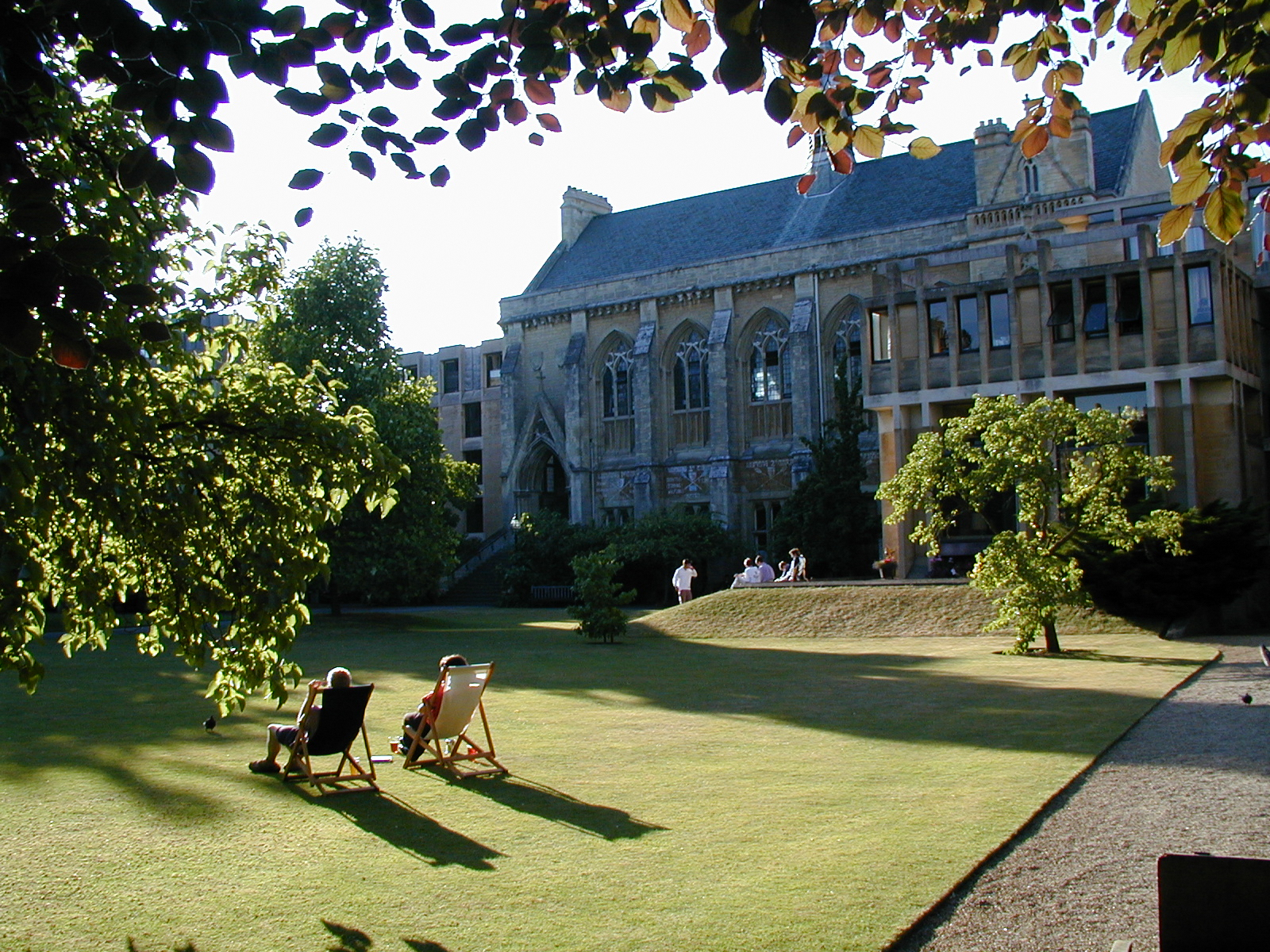
I’ve just begun rereading Dorothy Sayers’ inimitable novel Gaudy Night. Her mastery of literature and language astonishes me. Gaudy Night is specially brilliant, and the theme that unites its two plots—one a detective mystery, the other a complicated romance, both intertwined in an Oxford women’s college—is that of the challenge of balancing the passions of the mind with the passions of the heart. In a way, it’s a novel about discernment.


‘But suppose one doesn’t quite know which one wants to put first. Suppose,’ said Harriet, falling back on words which were not her own, ‘suppose one is cursed with both a heart and a brain?’
‘You can usually tell,’ said Miss de Vine, ‘by seeing what kind of mistakes you make. I’m quite sure that one never makes fundamental mistakes about the thing one really wants to do. Fundamental mistakes arise out of lack of genuine interest. In my opinion, that is.’
‘I made a very big mistake once,’ said Harriet, ‘as I expect you know. I don’t think that arose out of lack of interest. It seemed at the time the most important thing in the world.’
‘And yet you made the mistake. Were you really giving all your mind to it, do you think? Your mind? Were you really being as cautious and exacting about it as you would be about writing a passage of fine prose?’
‘That’s rather a difficult sort of comparison. One can’t, surely, deal with emotional excitements in that detached spirit.’
‘Isn’t the writing of good prose an emotional excitement?’
‘Yes, of course it is. At least, when you get the thing dead right and know it’s dead right, there’s no excitement like it. It’s marvellous. It makes you feel like God on the Seventh Day—for a bit, anyhow.’
‘Well, that’s what I mean. You expend the trouble and you don’t make any mistakes—and then you experience the ecstasy. But if there’s any subject in which you’re content with the second-rate, then it isn’t really your subject.’
[…] ‘Did you discover that by making a fundamental mistake?’ asked Harriet, a little nervously.
‘Yes,’ said Miss de Vine. ‘I once got engaged to somebody. But I found I was always blundering—hurting his feelings, doing stupid things, making quite elementary mistakes about him. In the end I realized that I simply wasn’t taking as much trouble with him as I should have done over a disputed reading. So I decided he wasn’t my job.’ She smiled. ‘For all that, I was fonder of him than he was of me. He married an excellent woman who is devoted to him and does make him her job. I should think he was a full-time job. He is a painter and usually on the verge of bankruptcy; but he paints very well.’2


Like I said, the book’s fantastic. Go forth and read.

2Gaudy Night, pp. 199-201.


✠     ✠     ✠


III.


I’ve now hit four Amazon reviews for my own novel, Death’s Dream Kingdom, and gotten some questions about the sequel. Sales are slow, of course—I hate having to promote my work, it feels like I must sound arrogant—but, for a quasi-self-published piece, it’s really not doing badly.


If you want to know what you’re getting into, I suggest reading some of the following entries on TVtropes:


✠     ✠     ✠


IV.


Our sacristan passed away late last year, and his house, which is attached to the parish, is slowly being emptied, cleaned, and re-painted. (I also inherited a neat leather jack from him, and a nice red silk tie.) In August, four other members of the parish and I will be moving into it as a little community: we all need a place to live, the church needs some revenue, and the house would just stand there empty otherwise. It was the church’s rectory for many years, and then it served as a convent for some teaching nuns—Mount Calvary always was a thoroughly Anglo-Catholic parish, even before it converted! Anyway, your prayers for the incipient community are welcome.


✠     ✠     ✠


V.


Pandora attempts to close the box. Based on a painting by F. S. Church, 19th century.


Since I found myself more deeply accepting celibacy—that acceptance is certainly still a work in progress, but I think I’ve been dragged past a corner—I’ve been noticing a couple of interesting changes, one of which is that I seem to be taking slightly better care of myself. I’m not sure all the reasons I’ve done that so poorly for so long; part of it was the depression, certainly, but I think I also always vaguely expected to be able to pass the buck to a partner one day: he’d nag me to take care of myself and I’d do it, and vice versa. It’s funny, because there are some forms of housework I actually like doing, like sweeping, but when it comes to cleaning and organizing my own room, or working out, or anything like that, it seems to require an inordinate amount of effort. But, that’s a little less true now. I feel that that’s a good sign.


In the myth of Pandora and her box of evils, Hesiod (the poet who relates the tale) says that though all the other contents of the box, like pain, anger, drudgery, and gossip escaped, one thing was trapped inside when Pandora hastily shut the lid: hope. To this day, there’s debate over exactly what he meant by that. Was he saying that hope was trapped in the box, and so we mortals have no hope? Or that hope would be another evil, and at least we were spared that? Or did the box close on hope to preserve it from the attacks of the evils, which would have destroyed it?3 I can’t say why exactly, but I feel as if I understand this myth better than I used to. As if there’s something about celibacy that’s intimately connected to a clear understanding of hope. I’m not sure what that would be, but (ugh, no pun intended) I hope I find out.

3From what I know of Hesiod, my money’s on one of the more pessimistic readings, but I have no proof. A rather ingenious interpretation I heard of in college, and one fully in accord with ancient Greek misogyny, is that Pandora’s box represents the vagina, and hope is the evil that keeps men going back there. An even more ingenious reversal would be to connect that meaning of the myth to the maternity of the Blessed Virgin Mary, who did bring forth hope into the world.

Monday, April 13, 2015

Lost In the Cosmos, Part I: A Map of a Mountain

One of the hardest things in discussing Catholicism with most people, I find, is that they don't usually quite grasp the nature of Catholic belief. I don't mean that they do not know what Catholic doctrine is; that is also true, but is a separate and much simpler problem; I mean that the kind of belief Catholics espouse is unfamiliar to them -- whether in the sense of not having experienced it themselves, or of not expecting it of an institutional Church.


Honestly, by now, everybody expects you, guys.

Dorothy Sayers, who wrote a good deal (if half-incidentally) about Christian belief, ran into the same difficulty, and composed a short catechism indicating much of the problem. Take the following selections, for instance:
Q.: What is the doctrine of the Trinity?
A.: "The Father incomprehensible, the Son incomprehensible, and the whole thing incomprehensible." It's something put in by theologians to make it more difficult -- nothing to do with daily life or ethics.
Q.: What is meant by the Atonement?
A.: God wanted to damn everybody, but His vindictive sadism was sated by the crucifixion of His own Son, who was quite innocent, and, therefore, a particularly attractive victim. He now only damns people who don't follow Christ or who never heard of Him.
Q.: What does the Church think of sex?
A.: God made it necessary to the machinery of the world, and tolerates it, provided the parties (a) are married, and (b) get no pleasure out of it.
Q.: What does the Church call sin?
A.: Sex (otherwise than as excepted above); getting drunk; saying "damn"; murder, and cruelty to dumb animals; not going to church; most kinds of amusement. "Original sin" means that anything we enjoy doing is wrong.
Q.: What is faith?
A.: Resolutely shutting your eyes to scientific fact.
I cannot help feeling that, as a statement of Christian orthodoxy, these replies are inadequate, if not misleading.*
I feel rather as Miss Sayers did, and, while the particularly American difficulties in the early twenty-first aren't exactly the same as those of Great Britain in the middle of the twentieth, they are closely related in both fact and genesis. It is a tragic irony that those nations which were thought to be, and in some ways were, beacons of Christian belief a hundred years ago, should have retained only the most degraded and nonsensical rags of what they once knew -- a more difficult prospect for evangelism than the merely unreached (which is why the dicastery for the New Evangelization was set up).

The difficulty is, people tend to think of Catholic theology, and Christian theology more generally, as a list of things one has to accept to be "part of the club." This misconception isn't helped at all by the massive number of Christians, Catholic and Protestant alike, who also believe it. Indeed, the contemporary debate between evangelical and mainline Protestants, and between traditionalist and progressive Catholics, takes place wholly within this sphere. Evangelicals and traditionalists, legitimately concerned with the meaning and identity of the "club," wish all of the regulations to remain entirely the same; while mainliners and progressives, legitimately concerned with the openness and catholicity of the "club," want the rules relaxed or even dispensed with to expedite the functionality, inclusivity, and retention rate of the club. Both are right in their way, and both are mistaken.**

The rightness of each lies in what it is trying to defend. Conservatives, so-called, are perfectly right to treasure the theology, ethics, and ritual that the Church has maintained for so long. Meanwhile liberals, so-called, are perfectly right to be concerned about the tendency of Christians to be mere sticks-in-the-mud over trivialities or licit cultural differences, and to scandalize those outside by prioritizing rightness over love. (There are other theological debates that cut across and inflame the divide, of course, but these need not detain us.)

Where both sides, and many outside the faith, go wrong is precisely in thinking of the Church as something like a club, and of Christian doctrine as the terms of membership. That isn't it at all. What the Church professes to have is not a list of rubber-stamped ideas, like a political platform or a manifesto; what the Church professes to have is revelation -- that is, personal contact with the Maker of the cosmos, and His own instructions on what reality is and what's to be done about it.


In other words, as a Catholic, I value the Church because she tells me facts I couldn't have found out for myself, and gives me tools for dealing with those facts; I'm not simply accepting anonymous verbal formulas, and insisting that human happiness consists in repeating those formulas after saying "I believe that". For example, part of the reason that I ultimately converted had to do with the Catholic spirituality of the Blessed Virgin Mary. I found, in my own heart, and throughout religious history, a need for a "Great Mother," a spiritually maternal power; this need was, naturally enough, filled in most pagan societies by the worship of goddesses like Isis, Cybele, Hera, or Shakti. But if man is in the image of God, I reasoned, then the basic needs and impulses of the human heart -- however contaminated by sin -- are essentially in accord with reality; they reflect something of reality, even if they do so imperfectly. Evil and the devil cannot create, they can only distort, so that this longing for a "Great Mother" was precisely a reflection of something real and good. Returning my gaze to Christian history, it was precisely the Catholic and Orthodox traditions that did justice to this need, and did so with the only plausible candidate, the Mother of God. I accepted this as a mystery because I had already accepted it as a fact, and I accepted it as a fact because I had discovered it as a fact.

A few writers -- Dorothy Sayers, Ronald Knox, Walker Percy, Flannery O'Connor, Charles Williams -- have succeeded in conveying this corrected approach to Christian belief. The Catholic Church teaches, not "Say such-and-such and you will be saved from hell, because for some reason God is a real stickler about saying such-and-such" but, "Reality is this kind of thing" -- and the necessary way of dealing reality is, therefore, built into its nature, not into any arbitrary divine fiat.***

This, incidentally, is one of the reasons that Catholicism can combine its adamant belief that it possesses the fullness of divine truth, with the thesis that those who are not professing Catholics can nevertheless be received into eternal fellowship with God. It isn't at all a matter of indifference to the truth. It's more like being able to climb a mountain without a map: it isn't a good idea exactly, and you'd do well to get a map and heed it, and if you deliberately go against a map you've got then you're going to hurt yourself; but it is, nonetheless, possible to reach the top without one. The Church's concern with truth -- from the great essential mysteries, like the Trinity and the Atonement, to the minutiae of imperfect contrition and the wording of the liturgy -- is wholly practical.


Now, the importance of any of this to a given person hinges on whether that person does, in fact, trust the Catholic Church. Plenty of people very naturally don't, for a multitude of reasons. However, I don't intend to argue the Church's trustworthiness in this series, not because the subject isn't important, but because I happen to be writing about something else at the moment. What I want to lay out is what the Church does, in point of fact, teach and believe. Her grounds for doing so I propose to leave aside, simply because doing both at once is probably beyond my powers, and has a tendency to muddy explanations. I may pick that thread up again later; we'll see. For the present, I want only to state what Catholic doctrine actually is, not in academic terms, but in terms of the reality that those academic terms were chosen to describe.


*Taken from Creed or Chaos?, "The Dogma Is the Drama," pp. 33-34. It is an outstanding collection of essays, and I warmly recommend it to everyone, particularly to inquirers into Christian beliefs, and to catechists and teachers of religion.

**Fortunately, I see round everyone and never make mistakes of any kind whatever.

***Especially since all the available evidence suggests that God drives a Toyota.
I'm not sorry.

Monday, March 30, 2015

Holy Week 2015

What follows are some suggested meditations for Holy Week, taken from a number of English authors (two Catholics and five Anglicans), as well as some selections from the Litany and the Collects of the 1662 Book of Common Prayer. I'll be trying to reduce my time online this week, and am planning to be entirely off for the Triduum (Maundy Thursday, Good Friday, and Holy Saturday), so this will be my last update until after Easter; for the same reason, I won't be approving comments for a little while, though of course readers are still free to leave them if they don't mind waiting to see them published.

Fig Monday (March 30th)


Named for the famous incident in which Jesus blasted the fig tree -- His sole miracle of destruction -- this is also the date (ritually, at least; the precise chronology of Holy Week in history is notoriously difficult to work out from the Gospels) of the cleansing of the Temple.
At the back of the Christian moral code we find a number of pronouncements about the moral law, which are not regulations at all, but which purport to be statements of fact about man and the universe, and upon which the whole moral code depends for its authority and its validity in practice. These statements do not rest on human consent; they are either true or false. If they are true, man runs counter to them at his own peril. He may, of course, defy them, as he may defy the law of gravitation by jumping off the Eiffel Tower, but he cannot abolish them by edict. Nor yet can God abolish them, except by breaking up the structure of the universe, so that in this sense they are not arbitrary laws. ... There is a difference between saying: "If you hold your finger in the fire you will get burned" and saying, "If you whistle at your work I shall beat you, because the noise gets on my nerves." The God of the Christians is too often looked upon as an old gentleman of irritable nerves who beats people for whistling. This is the result of a confusion between arbitrary "law" and the "laws" which are statements of fact. ... Scattered about the New Testament are other statements concerning the moral law, many of which bear a similar air of being arbitrary, harsh, or paradoxical: "Whosoever will save his life shall lose it"; "to him that hath shall be given, but from him that hath not shall be taken away even that which he hath"; "it must needs be that offenses come, but woe unto that man by whom the offense cometh" ... We may hear a saying such as these a thousand times, and find in it nothing but mystification and unreason; the thousand and first time, it falls into our recollection pat upon some vital experience, and we suddenly know it to be a statement of inexorable fact. ... The cursing of the barren fig-tree looks like an outburst of irrational bad temper, "for it was not yet the time of figs"; till some desperate crisis confronts us with the challenge of that acted parable and we know that we must perform impossibilities or perish. 
-- Dorothy Sayers, The Mind of the Maker pp. 8-10
From all evil and mischief; from sin, from the crafts and assaults of the devil; from thy wrath, and from everlasting damnation,
Good Lord, deliver us.
From all blindness of heart; from pride, vain-glory, and hypocrisy; from envy, hatred, and malice, and all uncharitableness,
Good Lord, deliver us.
From fornication, and all other deadly sin; and from all the deceits of the world, the flesh, and the devil,
Good Lord, deliver us.
From lightning and tempest; from plague, pestilence, and famine; from battle and murder, and from sudden death,
Good Lord, deliver us.
From all sedition, privy conspiracy, and rebellion; from all false doctrine, heresy, and schism; from hardness of heart, and contempt of thy Word and Commandment,
Good Lord, deliver us.
By the mystery of thy holy Incarnation; by thy holy Nativity and Circumcision; by thy Baptism, Fasting, and Temptation,
Good Lord, deliver us.
By thine Agony and bloody Sweat; by thy Cross and Passion; by thy precious Death and Burial; by thy glorious Resurrection and Ascension; and by the coming of the Holy Ghost,
Good Lord, deliver us.
In all time of our tribulation; in all time of our wealth; in the hour of death, and in the day of judgment,
Good Lord, deliver us.

-- From the Litany

Temple Tuesday (March 31st)


Named for the time before Passover that Jesus spent in the Temple court teaching. The many parables of Holy Week, the challenges from and to the Pharisees and Sadducees, and the Seven Woes are associated with this day.
Of all that was done in the past, you eat the fruit, either rotten or ripe.
And the Church must be forever building, and always decaying, and always being restored.
For every ill deed in the past we suffer the consequence:
For sloth, for avarice, gluttony, neglect of the Word of GOD,
For pride, for lechery, treachery, for every act of sin.
And of all that was done that was good, you have the inheritance.
For good and ill deeds belong to a man alone when he stands alone on the other side of death,
But here upon earth you have the reward of the good and ill that was done by those who have gone before you.
And all that is ill you may repair if you walk together in humble repentance, expiating the sins of your fathers;
And all that was good you must fight to keep with hearts as devoted as those of your fathers who fought to gain it.
The Church must be forever building, for it is forever decaying within and attacked from without;
For this is the law of life; and you must remember that while there is time of prosperity
The people will neglect the Temple, and in time of adversity they will decry it. 
-- T. S. Eliot, Choruses from 'The Rock' II.25-37
That it may please thee to succor, help, and comfort all that are in danger, necessity, and tribulation,
We beseech thee to hear us, good Lord.
That it may please thee to preserve all that travel by land or water, all women laboring of child, all sick persons, and young children; and to show thy pity upon all prisoners and captives,
We beseech thee to hear us, good Lord.
That it may please thee to defend, and provide for, the fatherless children, and widows, and all that are desolate and oppressed,
We beseech thee to hear us, good Lord.
That it may please thee to have mercy upon all men,
We beseech thee to hear us, good Lord.
That it may please thee to forgive our enemies, persecutors, and slanderers, and to turn their hearts,
We beseech thee to hear us, good Lord.
That it may please thee to give and preserve to our use the kindly fruits of the earth, so as in due time we may enjoy them,
We beseech thee to hear us, good Lord.
That it may please thee to give us true repentance; to forgive us all our sins, negligences, and ignorances; and to endue us with the grace of thy Holy Spirit, to amend our lives according to thy holy Word,
We beseech thee to hear us, good Lord.

-- From the Litany

Spy Wednesday (April 1st)


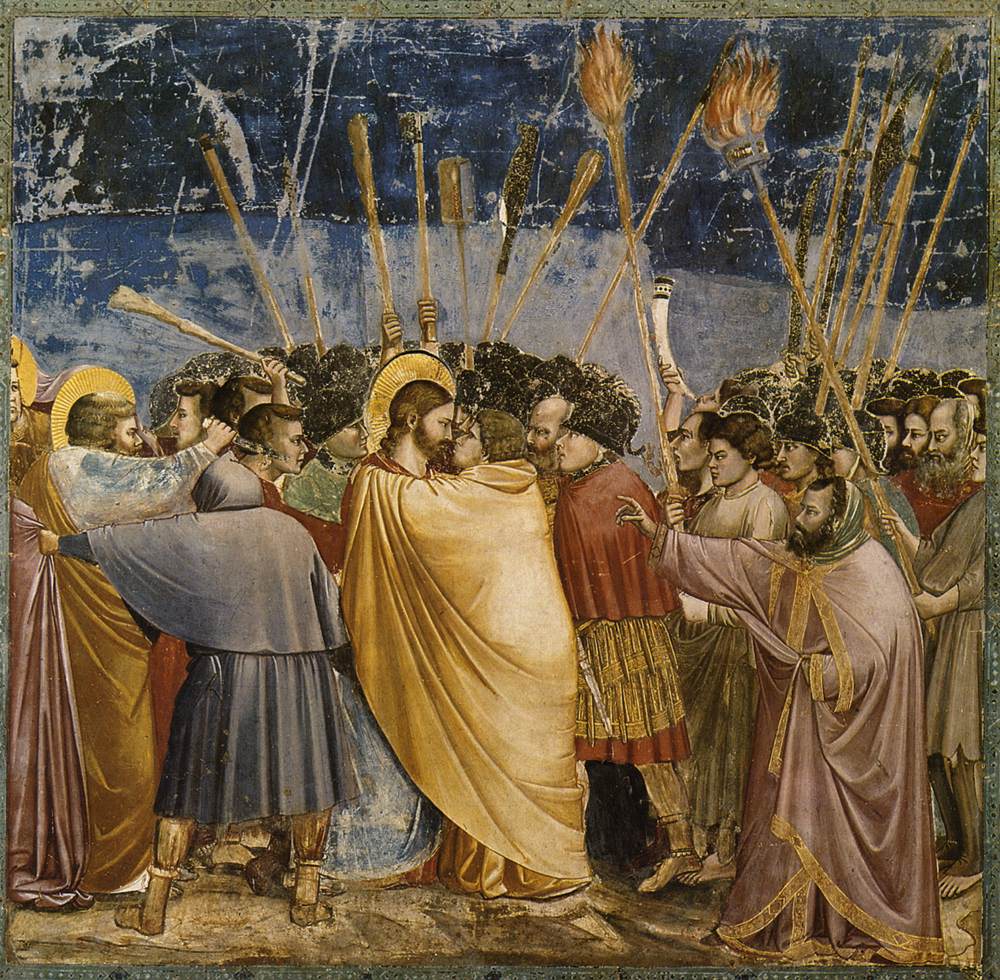
Giotto, The Arrest of Jesus and Kiss of Judas, 1306

This day is named for Judas Iscariot. When exactly he conferred with the Sanhedrin and agreed to betray Jesus to them is not known; Matthew and John seem to imply that the anointing of Christ at Bethany, which seems to have happened before the triumphal entry, spurred his decision.
But presently [Eve] remembers that the fruit may, after all, be deadly. She decides that if she is to die, Adam must die with her; it is intolerable that he should be happy, and (who knows?) with another woman when she is gone. I am not sure that critics always notice the precise sin which Eve is now committing, yet there is no mystery about it. Its name in English is Murder. ... If the precise movement of Eve's mind at this point is not always noticed, that is because Milton's truth to nature is here almost too great, and the reader is involved in the same illusion as Eve herself. ... Thus, and not otherwise, does the mind turn to embrace evil. No man, perhaps, ever at first described to himself the act he was about to do as Murder, or Adultery, or Fraud, or Treachery, or Perversion; and when he hears it so described by other men he is (in a way) sincerely shocked and surprised. Those others 'don't understand.' ... If you or I, reader, ever commit a great crime, be sure we shall feel very much more like Eve than like Iago. 
-- C. S. Lewis, A Preface to 'Paradise Lost', pp. 125-126
Almighty God, we beseech thee graciously to behold this thy family, for which our Lord Jesus Christ was contented to be betrayed, and given up into the hands of wicked men, and to suffer death upon the cross, who now liveth and reigneth with thee and the Holy Ghost, ever one God, world without end. Amen.

-- First Collect for Good Friday

Maundy Thursday (April 2nd)


The name maundy is an English slurring of the Latin mandatum, which means 'command,' and appears in the Vulgate phrase Mandatum novum do vobis, or, in English, 'A new command I give unto you'. The original consecration of the Eucharist, and the subsequent delineation of the New Covenant, took place on this night; it is now the first night of the Triduum, the apex of the liturgical year -- a solemn celebration that takes place over three days, commemorating the institution of the Mass and the priesthood, the Crucifixion, and the Resurrection.
He determined to be incarnate by being born; that is, he determined to have a mother. His mother was to have companions of her own kind; and the mother and her companions were to exist in an order of their own degree, in time and place, in a world. They were to be related to him and to each other by a state of joyous knowledge; they were to derive from him and from each other; and he was to deign to derive his flesh from them. ... But what did happen? The web depended on its exchanged derivation, which itself sprang from the fact not only that all derived from him but that he had ordained that he, in his flesh, would derive from all. The two derivations were, in him, a single act ... Somewhere, somehow, the web loosed itself from its center -- also by its free choice. ... Sin had come into the great co-inherent web of humanity; say rather that all the web burst into sin, and broke or was antagonized within itself; knot against knot, and each filament everywhere countercharged within itself. It broke? alas, no; it could not break unless its maker consented that it should and he would not consent; his good will towards it ... was too great. He loved it; he had loved it in the making and he loved it made ... No; she had turned from him; she had attempted to deracinate her life; but he was still her root, and she should still have at her disposal all that he had given her; she should still have life. Intolerable charity! 
-- Charles Williams, The Forgiveness of Sins, pp. 120-122, 128
Almighty and everlasting God, by whose Spirit the whole body of the Church is governed and sanctified: Receive our supplications and prayers, which we offer before thee for all estates of men in thy holy Church, that every member of the same, in his vocation and ministry, may truly and godly serve thee; through our Lord and Savior Jesus Christ. Amen.

-- Second Collect for Good Friday

Good Friday (April 3rd)


Matthias Grunewald, The Crucifixion, ca. 1501

Words fail me. Chesterton can take over.
In this story of Good Friday it is the best things in the world that are at their worst. ... It was, for instance, the priests of a true monotheism and the soldiers of an international civilization. Rome, the legend, founded upon fallen Troy and triumphant over fallen Carthage, had stood for a heroism which was the nearest that any pagan ever came to chivalry. ... But in the lightning flash of this incident, we see great Rome, the imperial republic, going downward under her Lucretian doom. ... Rome was almost another name for responsibility. Yet [Pilate] stands forever as a sort of rocking statue of the irresponsible. ... There too were the priests of that pure and original truth that was behind all the mythologies ... It was the most important truth in the world; and even that could not save the world. ... The Jewish priests had guarded it jealously in the good and the bad sense. ... They were proud that they alone could look upon the blinding sun of a single deity; and they did not know that they had themselves gone blind. ... And as it was with these powers that were good, or at least had once been good, so it was with the element which was perhaps the best, or which Christ himself seems certainly to have felt as the best. The poor to whom he preached the good news, the common people who heard him gladly ... there was present in this ancient population an evil more peculiar to the ancient world. ... It was the soul of the hive; a heathen thing. The cry of this spirit also was heard in that hour, 'It is well that one man die for the people' ... that the one universal human spirit might suffer a universal condemnation; that there might be one deep, unanimous chorus of approval and harmony when Man was rejected of men. There were solitudes beyond where none shall follow. ... Nor is it easy for any words less stark and single-minded than those of the naked narrative even to hint at the horror of exaltation that lifted itself above the hill. ... [A] cry was driven out of that darkness in words dreadfully distinct and dreadfully unintelligible ... and for one annihilating instant an abyss that is not for our thoughts had opened even in the unity of the absolute; and God had been forsaken of God. 
-- The Everlasting Man, pp. 210-212
O merciful God, who hast made all men, and hatest nothing that thou hast made, nor wouldest the death of a sinner, but rather that he should be converted and live: Have mercy upon all Jews, Turks, Infidels, and Heretics, and take from them all ignorance, hardness of heart, and contempt of thy word; and so fetch them home, blessed Lord, to thy flock, that they may be saved among the remnant of the true Israelites, and be made one fold under one shepherd, Jesus Christ our Lord, who liveth and reigneth with thee and the Holy Spirit, one God, world without end. Amen.

-- Third Collect for Good Friday

Holy Saturday (April 4th)


The only thing we are specifically told happened the day after the Passion is that the surviving disciples and the Holy Family rested on the Sabbath as the Torah required. However, it's also hinted that the Lord did something in the realms of the dead at this time, which the Mediaeval Church developed in speculation and art into the awesomely-named tradition of the Harrowing of Hell. No liturgy celebrates this, however; the only liturgy this day is the Easter Vigil, the glorious climax of the Triduum and the very beginning of the Easter season. (This is the time when adult converts, having been catechized over the preceding months, are normally baptized as Catholics.)
For if all the pains contained in hell, on earth, and in purgatory -- including death and all -- were set before us, we ought rather to choose all that pain than sin itself ... And I was shown no harder hell than sin, for of its very nature, the soul knows no other hell but sin. Yet fixing our intent in love and meekness we are made all fair and clean by the working of mercy and grace. For as mighty and as wise as God is to save us, so is he most willing; it is Christ himself who is the ground of all Christian law, and he taught us to do good as against evil. In this we see that he himself is that love, for he does to us as he bids us do to others ... Inasmuch as his love is never broken toward us when we sin, so does he will that it is never broken within ourselves or toward our fellow Christians; rather we should hate the sin itself but endlessly love every soul as God loves it. 
-- Lady Julian of Norwich, The Revelation of Divine Love, Thirteenth Showing
Grant, O Lord, that as we are baptized into the death of thy blessed Son our Savior Jesus Christ, so by continually mortifying our corrupt affections we may be buried with him; and that, through the grave, and gate of death, we may pass to our joyful resurrection; for his merits, who died, and was buried, and rose again for us, thy Son Jesus Christ our Lord. Amen.

-- Collect for Easter Eve

Easter Sunday (April 5th)


Caravaggio, The Incredulity of Saint Thomas, 1602

The Resurrection, I presume, calls for little explanation. Or more accurately, little that I'm equipped to give. I'll only note that the first eight days of Easter, from this day through the following Sunday, are treated by the liturgy as one: eternity invading time, heaven breaking into the terrestrial plane, in the act of the Resurrection. This is why the number eight -- one step outside the seven-day week that forms the standard measurement of time on earth -- is often a symbol in Christianity of eternity.
Here saies S. Augustine, when the soule considers the things of this world ... She rests upon such things as she is not sure are true, but such as she sees, are ordinarily received and accepted for truth: so that the end of her knowledge is not Truth, but opinion ... But saies he, when she proceeds in this life to search into heavenly things ... The beames of that light are too strong for her, and they sink her, and cast her downe ... and so she returns to her owne darknesse, because she is most familiar, and best acquainted with it; Non electione, not because she loves ignorance, but because she is weary of the trouble of seeking out the truth, and so swallowes even any Religion to escape the paine of debating, and disputing ... But then in her Resurrection, her measure is enlarged, and filled at once; There she reads without spelling, and knowes without thinking, and concludes without arguing ... What a death is this life! what a resurrection is this death! For though this world be a sea, yet (which is most strange) our Harbour is larger than the sea; Heaven infinitely larger than this world. For, though that be not true, which Origen is said to say, That at last all shall be saved, nor that evident, which Cyril of Alexandria saies, That without doubt the number of them that are saved, is far greater than of them that perish, yet surely the number of them, with whom we shall have communion in Heaven, is greater than ever lived at once upon the face of the earth ... In Heaven we shall have Communion of Joy and Glory with all, alwaies; Ubi non intrat inimicus, nec amicus exit, Where never any man shall come in that loves us not, nor go from us that does. 
-- John Donne, Evening Sermon at St. Paul's on Easter Day, March 28, 1624
Almighty God, who through thine only-begotten Son Jesus Christ hast overcome death, and opened unto us the gate of everlasting life: We humbly beseech thee, that as by thy special grace preventing us thou dost put into our minds good desires, so by thy continual help we may bring the same to good effect; through Jesus Christ our Lord, who liveth and reigneth with thee and the Holy Ghost, ever one God, world without end. Amen.

-- Collect for Easter Day
Tuesday, November 11, 2014

Why I Am a Catholic, Part VI: The Witness of Wickedness

The beginning of Christendom is, strictly, at a point out of time. A metaphysical trigonometry finds it among the spiritual Secrets, at the meeting of two heavenward lines, one drawn from Bethany along the Ascent of Messias, the other from Jerusalem against the Descent of the Paraclete. That measurement, the measurement of eternity in operation, of the bright cloud and the rushing wind, is, in effect, theology.


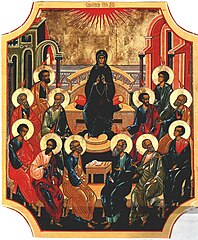
The history of Christendom is the history of an operation. It is an operation of the Holy Ghost towards Christ, under the conditions of our humanity; and it was our humanity which gave the signal, as it were, for that operation. The visible beginning of the Church is at Pentecost, but that is only a result of its actual beginning -- and ending -- in heaven.


-- Charles Williams, The Descent of the Dove, p. 1


It's all quite straightforward.

+     +     +

I'm sometimes asked why, as a gay man, I would join the Catholic Church, which is regarded -- not altogether groundlessly -- as so notoriously homophobic. More often, I've come across more general (and, in my opinion, better supported) objections to Catholicism on the basis of her history. When we consider how late the Church banned slavery, how long she accepted (in practice if not in theory) the use of torture, the variegated corruption of her prelates in much of the Middle Ages and the Renaissance -- it's easy to see how the idea that the Catholic Church is the ark of salvation and the infallible teacher of mankind is, well, a hard one to swallow.

I can say that, from the beginning, the general character of the Church never once formed a motive for my conversion. The character of individual saints did; the heroism, the unswerving devotion to principle, the mystical wisdom, and the incredible compassion of saints like Thomas More, Joan of Arc, John of the Cross, Dante, Mother Teresa, Thomas a Kempis, and Francis of Assisi made a deep impression upon me. Nor did it escape me that, even in those Protestant figures whose examples and writings I found the most profit from, like C. S. Lewis, Hannah Hurnard, and Dorothy Sayers, those elements were often at the very least wholly compatible with Catholicism -- if not far more characteristic and consistent of Catholic than of Protestant theologies.

But I also knew enough about the history of the Catholic Church to know that her children, and sometimes her shepherds, had connived in some of the greatest evils of western history. Perhaps it displays to what extent I am a child of my age, but I have always regarded the Crusade, the witch-hunt, and above all the Inquisition with the utmost loathing; and have known since childhood that all were dripping with holy water and wafted the scent of incense, though where they obtained their consecrations and their glowing coals is a little harder to know.


And it isn't right to simply dismiss that as a result of churchmen being sinners like the rest of us, nor pin it solely on people who were living inconsistently with Catholic principles. Doubtless these people were living inconsistently with Catholic principles, but that is not the point. Nor, to be blunt, is the fact of that inconsistency at all obvious to anyone who is not well-versed in both theology and history, and to be well-versed in either one is the study of decades: if the Church is infallible, and her pastors admit or even actively counsel certain things, surely those things are Catholicism?* And if those certain things are evil ... The mystery of iniquity in the Church is a great stumbling block to many who might otherwise consider her claims, and I believe that that mystery must, in justice, be recognized and mourned by Catholics. I think that repentance -- that is, apologizing to the victims of Catholics' sins, asking for forgiveness, and making what reparation we can through prayer and good works -- is the appropriate response to much of Catholic history (something of which St John Paul II set us a great example**), and an admirable expression of the coinherence of believers in the Church. We rejoice with those who rejoice, we mourn with those who mourn; and if necessary, we mourn for those who will not mourn and rejoice for those who cannot rejoice, sharing in one another's sins and merits together, as one body.

But why accept her claims in the first place?

For me, that's a difficult question to answer, not because I have so little reason to do so that I can't express it without sounding lame, but because I feel I have so much reason to do so that I can never decide where to start. So here are a few lines of thought that moved me personally to accept that the Catholic Church is what she says she is, as I accepted that Jesus is what He said He is.

One tack, commonly used by apologists, is a sort of historical-philosophical one. Beginning with the Gospels, not as inspired documents but as simple records left by people who at any rate claimed to be there, we may arrive at the conclusion that, guided by the Holy Ghost or not, they are reliable in essentials. This would then establish some basic facts about the Person and work of "Jesus who is called Christ". Among these would be the fact that He established a Church, commissioning Apostles (from the Greek for emissary or ambassador, i.e., personal representatives) to propagate and govern it. He never wrote a word, and never ordered them to, that we know of -- and you may be sure the infant Church would have preserved that like the Shroud of Turin; the only thing we know from the original sources is that He passed His own authority on to the men He appointed: He that heareth you heareth me; and he that despiseth you despiseth me; and he that despiseth me despiseth him that sent me. And at the head of these men, He set the shuffling, impetuous, snobbish, and apostate saint: and told him that he was His own personal steward, the man on whom He would build the whole Church, holding the same authority to bind and loose as Heaven itself.


Now, in making Peter His steward (the language of Matthew 16 directly echoes the language of Isaiah 22.15-25, where God appoints a new steward on behalf of the house of David over the kingdom of Judah), Christ was not in my opinion saying that Peter, personally, was the rock of the Church. The character of St Peter, dearly as I love him, would make that too much of a howler. It seems reasonably clear to me, based on the Scriptural allusion made and the specifications of powers (some of which were applied to the Apostles more generally later on), that what He was doing was instituting an office which would serve as that basis: a function, admittedly to be filled by a man, as the Presidency of the U.S. is filled by a man, but not a personal virtue or inherent power any more than the Presidency. In other words, the function of the Rock is to be an ongoing part of the Church -- perhaps explaining why St Paul calls the Church the pillar and ground of the truth -- prevailing against the gates of Hell and binding and loosing in earth and Heaven being perpetual powers of the Body of Christ, expressed in this office because that is what Christ designated it to do.

And, conveniently, it isn't even a matter of sorting out the claims of various successors to the Apostles: not even such great prelates as the Patriarchs of Constantinople or the Archbishops of Canterbury have professed to be the Rock on which all the Church is built; nor have even the Bishops of Jerusalem or Antioch, places where St Peter was also a bishop for a time, have set forth rival claims. The only continuing office that has claimed or does claim to be one and the same with the stewards -- or, to use the Latin title, the vicars -- of Christ, is the Bishopric of Rome. One may accept or reject the claim, especially on the grounds of the immorality of many of St Peter's successors; personally I find it oddly appropriate that so many of them should be shufflers, impetuous, snobs, and apostates.

And if it is precisely the discharge of the office, not the character of the man, that receives the graces promised by Jesus, then we may -- in my opinion, should -- expect everything not covered by those graces to go wrong, even with the Popes, sooner or later. Following Peter's career, I'd say that most of them went wrong sooner, and generally later as well. I think, too, that that applies to the Church as a whole. Romano Guardini, a theologian of the last century who influenced many important figures in the Church (such as Pope Benedict XVI and Pope Francis), once said, "The Church is the Cross upon which Christ is crucified; and who can separate Christ from His Cross?" I think that is exactly the right way of looking at it. I might say, as a sort of supplement, that, in the Church, everything that can go wrong, will go wrong, but that there is a scarlet cord of truth that will not break, and from that scarlet cord the whole house hangs as the city crashes down around it.

And that is why I am not greatly perturbed by the real wickedness of the Church. Not because it has been misprised and exaggerated (though that's also true much of the time); not because the glories of her many saints cancel out the black marks of Raymond of Toulouse, Bernard Gui, or Torquemada. But because, trusting Jesus to be who He said He was, I trust Him to do what He said He would do: to be with you alway, even unto the end of the world.


It's all quite straightforward.

A healthy awareness of my own sinfulness doesn't hurt, either. Dorothy Sayers, with her usual biting clarity, points out in her essay The Triumph of Easter:
"Why doesn't God smite this dictator dead?" is a question a little remote from us. Why, madam, did He not strike you dumb and imbecile before you uttered that baseless and unkind slander the day before yesterday? Or me, before I behaved with such cruel lack of consideration to that well-meaning friend? And why, sir, did He not cause your hand to rot off at the wrist before you signed your name to that dirty little bit of financial trickery? You did not quite mean that? But why not? Your misdeeds and mine are nonetheless repellent because our opportunities for doing damage are less spectacular than those of some other people.***
It isn't, and isn't meant to be, a complete answer to the problem of evil. But I think it puts the problem into, shall we say, a more practical perspective.

A painter of the Umbrian school
Designed upon a gesso ground
The nimbus of the Baptized God.
The wilderness is cracked and browned

But through the water pale and thin
Still shine the unoffending feet
And there above the painter set
The Father and the Paraclete.

-- T. S. Eliot, Mr. Eliot's Sunday Morning Service, ll. 9-16


+     +     +

According to their own evidence, the manifestation came. At a particular moment, and by no means secretly, the heavenly Secrets opened upon them, and there was communicated to that group of Jews, in a rush of wind and a dazzle of tongued flames, the secret of the Paraclete in the Church. Our Lord Messias had vanished in his flesh; our Lord the Spirit expressed himself towards the flesh and spirit of the disciples. The Church, itself one of the Secrets, began to be.

-- The Descent of the Dove, p. 3


*The reason that Catholic theology does not teach this is rather technical, but worth noting, in a woefully abbreviated form. The doctrine of the infallibility of the Church means that, when the Church invokes her full authority to preach and teach her message, the Holy Ghost protects her from any admixture of falsehood. This is true in the strictest sense of the words; note the corollaries. Those things which aren't her message -- such as nearly all scientific, most historical, and many philosophical questions -- are questions on which she has no supernatural insight; if her clergy do say anything about them, it can only be the fruit of expertise (or the lack of it), not of inspiration. And even those things which are her message, the doctrine and moral code of Christianity, are not necessarily wholly protected from error if she does not invoke her full authority, which in fact she rarely does, either in the person of the Pope or by means of an ecumenical Council. And finally, the Church is not prevented from pursuing wrong policies as ways of trying to implement the truth. Having the truth will get you somewhere, but it does not produce perfection by itself: faith, wisdom, patience, and love must greatly leaven mere correctness, or it is apt to do a great deal more harm than good.

**Having been the victim of abuse myself (though not at the hands of a priest), I am not insensitive to the criticisms of St John Paul's pontificate on this score. It was, in my opinion, a great and serious flaw. But I do not believe that any great man is free of flaws; and I think that his personal expressions of grief and apology for the many sins of the Church throughout history should not be accounted any less sincere, or any less worthy of imitation, on the grounds that His Holiness was not perfect either.

***From the collection Creed or Chaos?, p. 19. The essay goes on to grapple with the problem of evil in much greater detail from a Christian viewpoint, in the context of the Crucifixion and Resurrection.

Thursday, October 2, 2014

Review: "The Accidental Marriage" by Roger Thomas

Roger Thomas' debut novel, The Accidental Marriage, is the story of Scott and Megan, a gay man and a lesbian living in San Francisco, who conceive a child together and find themselves on a path to a very different friendship than they hitherto had. Megan is pressured into conceiving by her wife, Diane, and Scott, being a friend, offers to donate sperm so the child can be conceived by artificial insemination; when this fails to work, the two conceive the child naturally. Diane finds out, and their relationship comes to pieces, so Scott takes Megan in and the two decide to marry so that Megan can be covered by Scott's insurance. The friendship slowly begins to assume the feeling of a home, even as Scott starts to find himself being edged out of his job --

And I have an anti-spoiler policy, so I won't say any more about it than that.

The Accidental Marriage is being published by Ignatius Press, and will be available as of October 7th.

The Strong Points

Some of the dream sequences in the novel, particularly the opening one, are well-written; Thomas manages to capture the atmosphere and logic of dreams, and to use some foreshadowing, convincingly. There are also a few rather charming exchanges, such as this one (from page 86), a little while after the two lead characters have set up housekeeping together:
     "Sounds good," Megan said with a smile, then put down the paper and looked soberly at Scott. "With respect to cleaning, I'm happy to continue what I've been doing, but I have one condition."
     "What's that?" Scott asked.
     "Aim better."
The Weak Points

I am genuinely sorry to say that this was among the worst books I've ever read. It is fatally flawed at every level of its construction.

To begin with, the novel is about a gay man and a lesbian. Yet there is literally nothing about the characters that makes them persuasive as gay people. We are told, several times, that they're gay; that's as gay as it gets. I don't mean that gay men and lesbians need to be caricatures, but there is no hint, at any point, of any real emotional or even merely sexual interest in men on Scott's part, nor in women on Megan's. The closest we come is, in the last quarter of the novel, an awkwardly composed flirtation that cannot quite bring itself to use the term "gaydar"; and even this scene has no real erotic sensibility. The pairings the book starts out with -- Diane and Megan on one side, Scott and Greg on the other -- barely make it into the book at all, except as hooks upon which to hang extremely demeaning ideas about gay relationships (Diane is domineering and abusive, of course, and Greg cheats on Scott and comes home drunk and high when he comes home at all, of course); but presumably these people and the relationships they formed with the central characters were important to  them at some point. Why don't we see any of that? Without it, neither the characters nor the situation they're in can be accepted by the reader; unless the reader is willing to suspend any and all disbelief on the strength of "They're gay."

Regrettably, this really seems to be the author's view. A number of comments throughout the novel (such as the speech of the lesbian character about how she had been saved from a life of literal sex slavery, for no stated reason other than "because lesbians") suggest a total ignorance of gay culture, accompanied by buying into grossly offensive and dehumanizing stereotypes. The most bizarre manifestation of this to my mind is that, except I think for our heroine and the quickly-discarded boyfriend of our hero, every homosexual character in the novel is presented at least once as being hostile to and contemptuous of procreation and of babies. Even if someone has no queer friends, I'd have thought that the fight for adoption rights and the actual phenomenon of gay adoptions, whatever one's moral view of the matter, would have been adequate evidence that this was not a typical feature of LGBT-identifying people. But this is only one instance of an astonishing unrealism that honestly leaves me wondering whether Roger Thomas has ever gotten to know even one gay person in real life.

Now, gay culture is not something anybody is required to approve of, whether as a whole or in any specific aspect. And for that matter, it's perfectly permissible to write about something with the aim of revealing its badness. But if you're writing a realistic novel about gay characters -- and one set in modern San Francisco, no less -- being conversant with gay culture is not an optional extra. It is the chosen matter of the work, and the author who refuses to acquaint himself with it is not being decently modest or subverting tropes, but revealing his own bad craftsmanship and failure to do the work of writing.*

Even tired queer stereotypes would make more persuasive characters than Scott and Megan do; the US version of Queer As Folk, which played the gay tropes for all they were worth (at least in the male characters), managed to get rounded and convincing characters out of it. The Accidental Marriage reads as though the author isn't even aware of the basic stereotypes of mincing fashionista males and tough, tomboyish females, and the sad result is to come out with characters that lamely fulfill vague, generic masculine and feminine cliches: the man lives in a mess and is only concerned about his career, while his female friend is able to turn the mess into a clean, flower-decorated apartment and cook him real meals instead of the fast food he has hitherto been relying on (the portrait of Megan seems to contain a really distasteful helping of sexism -- she is depicted as helpless and confused nearly every time she isn't cooking, cleaning, or taking care of the baby) ...

If a descent into cheap gay stereotypes was what the author wished chiefly to avoid, he had a magnificent chance to play with, complicate, and subvert those stereotypes, since they will inevitably be in the reader's mind anyway, and in so doing to make really three-dimensional characters. But he dodged or missed the issue and its concomitant opportunity, and the lack of living energy in the central characters and most of the supporting cast is the cost.

And that brings up a still more fundamental problem with the characters. They not only aren't convincing as a gay man and a lesbian; they aren't convincing as people. They have no distinctive style of speech -- almost any line in the book could be transferred to any other character, and the reader would have no sense of wrongness. They have no interests; for instance, we are told (again told, not shown) a few times that Scott loves his car, but there is no actual activity related to it to suggest this. Even what brought the two of them together as friends is never adequately explained: the backstory of their friendship is a slightly more elaborated version of "They met one time," and there's nothing that the friendship is about, nothing the characters have in common in either interests or circumstances, until the baby is conceived.

There are other problems, largely thematic, that I find frankly disturbing. Though the novel never uses the word "ex-gay" or its variants, it reads like a manifesto. The question of the genesis of homosexuality is not directly discussed, but both Scott and Megan share their life stories, and, what do you know: he was shy, his father abandoned the family, his mother smothered him, another boy suggested he might be gay and then he experimented with it; she never knew her father, she was chronically afraid of men her whole life because of the way they treated her mother. No acknowledgment of the problems of post-SOCE marriages, which are going to plague the titular marriage whether they identify with the ex-gay movement philosophically or not, is made at any point. The plot itself feels only partly as though it arises out of the characters, and more as if the author, confident (and perhaps laudably so) in the truth of Catholic moral teaching, has contrived a story that exhibits that truth, and suppressed any element of either character or plot that would interfere with that story's smooth development.

Perhaps worst are the a handful of discreet sex scenes between Scott and Megan. None contains the smallest suggestion that the characters feel anything but what a heterosexual couple would feel, either bodily or psychologically; the last of them (though I am quite confident that this thought never entered the author's mind) has an extremely weird feel to it, so much so that my initial reaction to reading it was to find it -- well, to be honest, it made me think of rape. The fact that "corrective rape" has been a conventional "cure" for homosexuality, and continues to be in certain parts of the world, contributes to the nauseating tinge of the passage -- all the more tragic in that, from its placing and content, it is clearly meant to be (no pun intended) a moving and emotion-laden climax to the novel.

The underlying problem, I suspect, is that the author wished to write an edifying novel. But a novelist must begin by wishing to write a good novel. If he does not do that, it will not be edifying either; indeed, it will constitute an embarrassment to its own aims. Shoddy craftsmanship is the almost inevitable consequence of such writing; it is to literature what Docetism is to the Incarnation: insincere and, therefore, artistically false and irrecoverable. Any edification that a novelist achieves will be brought forth by the general cast of his mind, not by dominating the story and its characters, as it were, by force. Dorothy Sayers, herself a devout Christian and an author with a firm grasp upon the theological nature of the creative process, explains this essential flaw, so common in idealistic authors of fiction:
A writer cannot create a character or express a thought which is not in his own mind. (It will be remembered that we are dealing with an ideal writer; it is always possible for a man to put on paper sentiments and characteristics that are not sincere expressions of himself but merely derivative. Even then, though the manufactured stereotype betrays itself by its falsity, it remains a true expression of an intrinsic spiritual falsity within the writer.)  ... For if a character becomes merely a mouthpiece of the author, he ceases to be a character, and is no longer a living creation. Still more, if all the characters speak with their author's voice, the whole work loses its reality, and with it, its power. ... Incidentally, this is the weakness of most "edifying" or "propaganda" literature. The Energy is active only in one part of the whole, and in consequence the wholeness is destroyed and the Power diminished. You cannot, in fact give God His due without giving the devil his due also.**
There is, sadly, a great deal more to be said about the book's problems; but this has already become unmanageably long, so I will conclude my critical portion here.

Is It Worth Reading?

If you are gay, I beg you not to read this. I would be personally embarrassed as a Catholic for your impression of us to be affected by this.

If you are a Christian who doesn't know any gay people very well, I again advise against reading this book. It has no real knowledge of LGBT people or culture to offer you. As an alternative, if you want to get to know some queer-identifying people, I suggest watching a movie by a gay filmmaker, reading a book by a transgender author, looking at paintings by a lesbian artist, or even, if all else fails, talking to us.

It's a cruel thing to say, but the only thing I could honestly recommend this book for is how not to think or talk about gay people. Its good intentions are plain enough; but they are not enough -- they do not make a good novel. And it is by its own goodness as a piece of art, not by its capacity to be used as a proof-text volume for Catholic moral teaching, that a novel must be judged. If Jesus made tables as a carpenter, we may be sure that He made them with great holiness; but we may be equally sure that He was, for that very reason, chiefly concerned to make a good table. Piety is not a substitute for craftsmanship, and to exchange the two corrupts them both.


*In saying that this grossly homophobic lens seems to be Thomas' perspective, I don't wish to take away his character. There are such things as failures of communication, and I'd be very sorry to believe that he espouses half the opinions that an unfriendly reading of his novel would suggest. What I am saying is that, taken as any ordinary reader that is not personally acquainted with him is likely to take it, it comes across as being shockingly bigoted. I would far rather attribute this to ignorance than malice, and see no special reason to suppose the latter.

**The Mind of the Maker, pp. 39-41. Sayers uses a trinity of terms, Idea, Energy, and Power, in specialized senses in this book: the Idea is the fundamental concept of the artistic work (of whatever kind); the Energy is the creative activity -- meaning not only the act of putting words onto paper, but the craftsmanship and the decisions that take place under the condition of revealing the Idea; and the Power is the interaction of the book with its audience: first with the original author, and then with everyone who reads it. The three are directly analogous to the Divine Persons of Father, Son, and Holy Ghost, and the correspondence between the activity of artistic creation and the original Creation by the Holy Trinity, in both architect and the things made, is the chief theme of The Mind of the Maker. I would strongly recommend this book to anyone who wishes to study either the creative process or the Trinity.