Collect

Collect for the Fourth Sunday after Trinity

O God, the protector of all that trust in thee, without whom nothing is strong, nothing is holy: increase and multiply upon us thy mercy; that, thou being our ruler and guide, we may so pass through things temporal, that we finally lose not the things eternal; grant this, O heavenly Father, for the sake of Jesus Christ thy Son our Lord, who liveth and reigneth with thee, in the unity of the Holy Spirit, ever one God, world without end. Amen.
Showing posts with label Pope John Paul II. Show all posts

Sunday, August 14, 2016

The Index of Creation

The Beatrician experience1 may be defined as the recovery (in respect to one human being) of that vision of reality which would have been common to all men in respect to all things if Man had never fallen. The lover sees the Lady as the Adam saw all things before they foolishly chose to experience good as evil, to ‘gaze upon the acts in contention.’ Williams believes that this experience is what it professes to be. The ‘light’ in which the beloved appears to be clothed is true light; the intense significance which she appears to have is not an illusion … The great danger is lest he should mistake the vision which is really a starting point for a goal; lest he should mistake the vision of Paradise for the arrival there. … The immediate glory will dazzle him ‘unless he has a mind to examine the pattern of the glory’ …


—C. S. Lewis, Arthurian Torso: Williams and the Arthuriad2


✠     ✠     ✠


I’ve written before about the late Pope’s Theology of the Body, and my attempts to ‘digest’ it on my slow and uphill road toward chastity. I’ve recently hit upon a possible alternative, however, one that seems to be much more accessible to somebody with my temper and imagination, and I’d like to explore it.


Theology of the Body looks at our bodies from the perspective of creation, drawing together the Roman scholastic tradition, German idealist philosophy, and the wisdom tradition of the Scriptures themselves and the methods of the Church Fathers. I love it, but I’m not completely satisfied with it and don’t feel totally at home in it—not because I’m gay (though I would have liked to see St John Paul addressing homosexuality directly in TOB), but because of … call it the work’s atmosphere. It’s a mountainous sort of book: huge, cold, airy, with a dappled mixture of clarity and clouds. It’s beautiful, but, for me at least, it isn’t home.



But I think I may have found this other way of approach to the mystery of the body. Not one that’s more doctrinally correct, any more than the Roman or Byzantine or Antiochene liturgies could be ranked by correctness, but one that my mind and heart can grasp more firmly: an approach that illuminates the mystery, answers the questions and intuitions that I have about the body, and hints at solutions to difficulties that TOB rarely if ever addresses. This way of approach can be gleaned from Charles Williams’ work on poetry, particularly on Dante, the Arthurian cycle, and the Romantics.


The difference between St John Paul II’s tome and Williams’ thought could be expressed by saying that, where the pastor considered the body primarily in terms of a created thing with a proper pattern and function, the poet considered the body primarily in terms of a medium of revelation.3 (Each view is capable of including the other; the distinction is one of accent, not of content.) He states his fundamental attitude in the essay The Index of the Body, where, quoting Wordsworth’s lines the human form To me became an index of delight, Of grace and honor, power and worthiness, he reflects on them as follows:


The word index is the beginning. The question proposed is whether we shall take that word seriously as a statement of the relation of the human form to ‘grace and honor, power and worthiness.’ … An index is a list of various subjects, with reference to those places where, in the text of the volume, they are treated at greater length. But, at least, the words naming the subjects are the same; and a really good index will give some idea of the particular kind of treatment offered on the separate pages. Some such idea, Wordsworth’s lines suggest, the body and even the members of the body may give … The Sacred Body [of Christ] is the plan upon which physical human creation was built, for it is the center of physical human creation. The great dreams of the human form as including the whole universe are in this less than the truth. As His, so ours; the body, in this sense of an index, is also a pattern. We carry about with us an operative synthesis of the Virtues … ‘Grace was in all her steps, heaven in her eye; / In every gesture dignity and love’ is much more a definite statement of fact than we had supposed; footsteps are astonishing movements of grace.4


After reading or quoting Williams, I generally feel that nothing I can say could exalt the hearer’s thoughts more than what’s just been said: yet, our beloved brother Charles also according to the wisdom given unto him hath written, in which are some things hard to be understood. I haven’t finished searching out the great wealth of meaning that he conveys, but what I do understand so far is, roughly, as follows.


First, in contradistinction to the great saint’s return to the chronological beginning to understand the body, Williams looks to Jesus as the point of origin for the body. He followed the tradition of Bl Duns Scotus, asserting that God would still have become man if we had never fallen; from the beginning, independently of our sinfulness, He meant to become a man, to be born of a Mother, and that that Mother should herself have ancestors and companions. So the body of Jesus, though not the physical progenitor of the human race, is the center of the human race—our final cause, as the body of Adam was our efficient cause.


Second, it explains something of why we find physical beauty (especially erotic beauty) so powerful, and have so hard a time practicing chastity. For anyone who’s attempted chastity for any appreciable length of time knows that it isn’t just a matter of controlling your libido—it includes that, but there’s a sense of enchantment about sex that is something more and other than satisfying a biological impulse. A man who is enamored of a woman or man will probably want to sleep with the object of their desire at some point (though at times, more mysteriously, erotic love produces the impulse to perpetual continence), but the first impulse is something much more like adoration. The impulse to possess the beloved, though it often follows, is at the very beginning felt to be far less important than the impulse to revere the beloved.


This suggests that the magic of erotic love (however transitory) is not illusion, but a kind of transfiguration: a vision of what the actual person was meant to be, in their unfallen or archetypal identity. In the world as we know it, there will always be the risk of confusing the archetype with its earthly ectype, pretending that the beloved has no flaws or that the beloved’s flaws are virtues; or, alternately, being disobedient to the heavenly vision and sinking into a contented vulgarity.5 But all of these things are human imperfections; the vision is, in fact, a vision of a fact. And man was made for truth, and the senses are one of our means of receiving it, however surprising that may be to the adept who was expecting one of Yoda’s dismissive lectures about ‘crude matter.’ That the truth should reach us through our eyes, our hands, our tongues, our chests, our legs, is not really any stranger than that the truth should reach us in the first place.


Third, this also seems to me to reposition our understanding of chastity. The teleological perspective taken by St John Paul II in particular, and Roman Catholics in general, makes sense to me, but I’ve always found it vaguely unsatisfying.6 To adapt Chesterton, I always felt that it explained something, but in a way that made the explanation seem far less important than the fact; and thus unworthy of the fact. The perspective taken by Williams—call it the esoteric view7—hints at significances and mysteries inhering in the body which would transfigure chastity, from the vegetarian-sounding fulfillment of the good of a rational and embodied creature, to the virile, pregnant, magical idea of a ritual invocation of spiritual energies through the visible body that is charged with them.


I don’t fully understand this third part. But it makes me a lot more optimistic that there is something worth understanding here, and that feels a lot better than the law-centered concept of chastity I’ve always had up to now. Most aspects of chastity have always seemed very arbitrary to me (of course, since God made the body, He kind of has a right to be arbitrary if He likes, but it’s easy to resent and hard to accept, and also doesn’t really sound like Him). Williams’ esoteric conception of the body seems like the sort of thing that would be worth slowly penetrating, until the fullness was found.


Of course, there’s much more to this way of looking at the body. It isn’t just that this explains chastity, or sexuality in general for that matter. That the human form should be an index of delight, Of grace and honor, power and worthiness implies (and Williams certainly thought) that the body indexes creation as a whole, not just its fecundity or its orderliness; the doctrine that man is made in the image of God, if it means anything at all for the body, implies the same. But this is what I have understood up to now. I hope I will have more to say about this as time goes on!
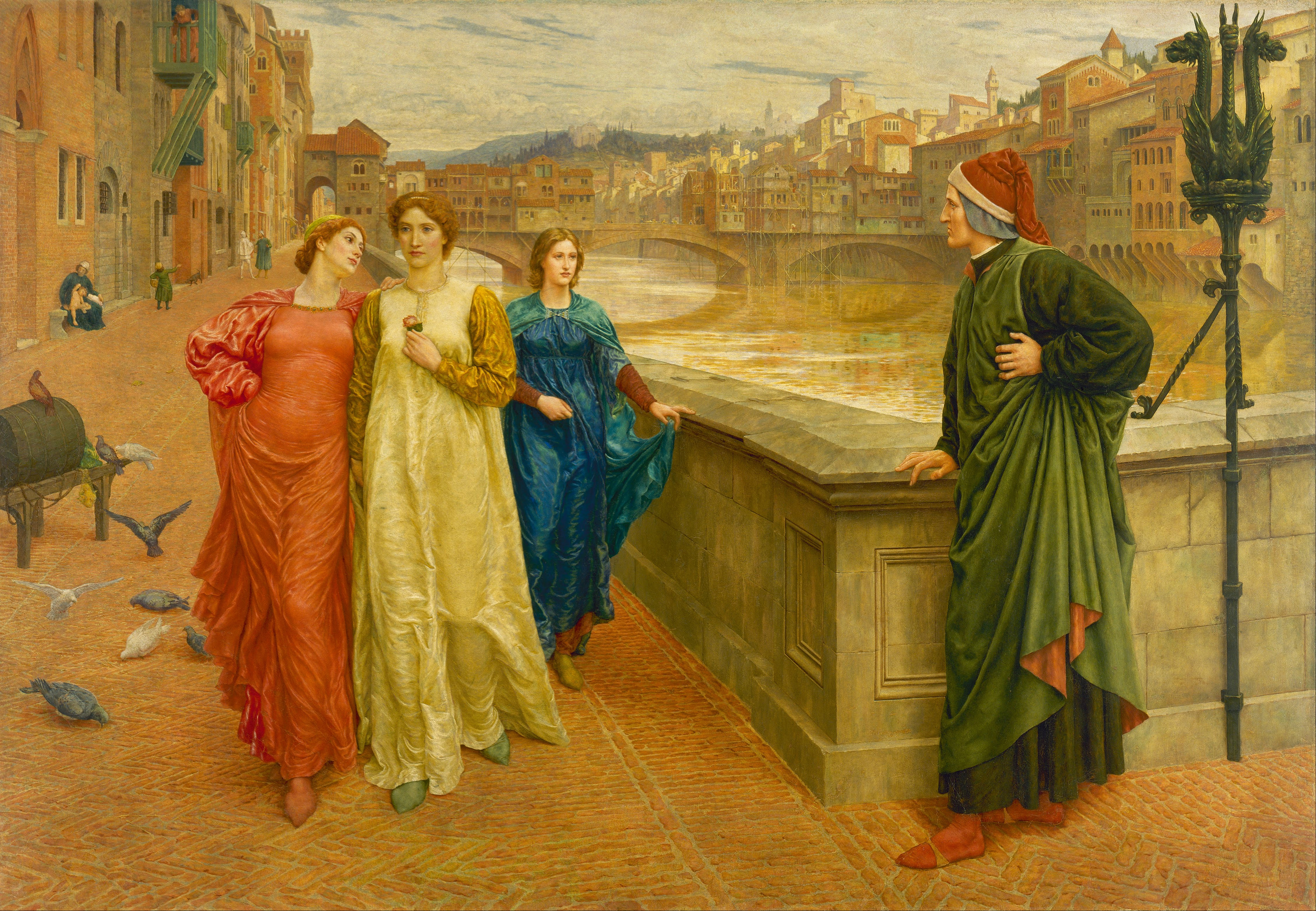


Henry Holiday, Dante and Beatrice, 1883


✠     ✠     ✠


1I.e., the kind of experience of love that Dante had when he met Beatrice. Not all loves have this quality, though many do, with or without an erotic element.
2I just got a copy of this during my trip to Portland, and I am still over the moon about it. Arthurian Torso is tough to find—Lewis’ career as a professor of literature is largely and unjustly forgotten today, and Williams is tragically obscure. Unfortunately it’s a frustrating book to cite as well, because the two halves of it (an incomplete work of Williams’ which was meant to be published as The Figure of Arthur, parallel to his earlier work The Figure of Beatrice, but which he was prevented from finishing by an abrupt death; and Lewis’ own commentary on both this work and Williams’ volumes of Arthurian poetry) are by different authors, but the book is not really a collaboration.
3Another way of putting it would be that St John Paul II tended to the Aristotelian where Williams tended to the Platonic. The Pope considered the body’s nature in itself, so to speak, where Williams treated it (and everything else) first and foremost as an icon of the divine glory, a means to adoration. This brings out the contrast in their approaches very clearly, since treating the body as a means is almost exactly how St John Paul defined lust, though obviously he was not thinking in terms of adoration; while conversely, for Williams, the body was a means first of all because everything is a means, everything refers to God, and only exists by so referring.
4The Image of the City, pp. 81, 86. This collection is a posthumous anthology of Williams’ essays (mostly published in periodicals) on literary and theological subjects.
5I don’t mean by this that the vision in which Williams thought romantic love consisted is the only way of rising above vulgarity. The human soul can be exalted by virtually any good, if it follows that good diligently and disinterestedly. But, if a person has this kind of vision—whether they fall in love with a person or are enchanted by a piece of art or anything else—and then decides, for whatever reason, to cynically dismiss what it had to tell them (‘I was young then,’ ‘puppy love,’ ‘it was a phase’: the maxims of the lie are many), they will at least be merely vulgar toward the object of the vision. A great many marriages, whether they conclude in divorce or not, show this unhappy progression.
6The word unsatisfying means no more than itself. I accept the Church’s teaching on homosexuality, contraception, monogamy, etc.; when I say I find the explanation unsatisfying, it means I am left hungry for more explanation.
7The word esoteric is not a quite happy one, first and foremost because it is horribly vague. It is also a very artificial category: there is a shared atmosphere among many of the things labelled today as esoterica (the Rosicrucian tradition, Kabbalah, certain forms of neopaganism, astrology), but for the most part these things were simply part of the common heritage of wisdom in the West until after the Protestant Reformation. Unfortunately I haven’t been able to come up with an alternative to esoteric that isn’t even more unsatisfying.

Thursday, June 18, 2015

A Pacifist Manifesto


I've written before, especially in the wake of the report to Congress on the outcome of state-sanctioned torture under Bush and Obama, of my pacifist convictions. I've wanted for some time to outline them more clearly; they express and govern, not simply an attitude to war, but an attitude to all interpersonal interactions, that I believe is badly needed in this country. St John Paul II's words about a culture of death hovering over the world apply just as much to the money-worshippers, war criminals, abortion advocates, and racist bigots of America and western Europe as they do to the fanatical religious terrorists, child-conscripting warlords, police state oppressors, and drug-trafficking butcher mafiosi of the rest of the world.

Violence is an abhorrent thing. This is the principle from which all pacifist conviction proceeds; and it is a principle that, though simple and obvious enough, is worth stating, because an awful lot of the time, debates over things like Just War Theory or gun control start at the wrong end -- with practicalities. I have nothing against being practical, but starting with the practical is the wrong way to do it, because in order for something to be practical, we need first to know what it is we are practicing and why. The inherent flaw of all mere pragmatism is its breezy uselessness; action, especially revolution, comes only from idealists.

Violence is abhorrent because life is precious. Life; that is, the lives of all human persons. (Though a legitimate and interesting inquiry, I won't be touching on animal rights here.) Any ethic that does not accept the sanctity of human life cannot be pacifistic, which is one of the reasons that the American Left has not succeeded in being consistently anti-war for a long time. It has opposed the Right, certainly; but mere opposition to the Right is of no importance in itself. But the support the Left gives to abortion*, assisted suicide, and euthanasia makes it impossible for it to be really pacifistic, because the essential quality that makes violence wrong has already been dispensed with. It is of course equally impossible for the Right to be pacifistic (not that it would be), because, for all its co-option of the pro-life cause, its typical endorsement of the death penalty, its military hawkishness, its hostility to immigration and public health services, and its acceptance of torture all defile any claim to regard life as sacred.


Both parties being wrong? Whodathunkit?

Now, one of the corollaries of the sanctity of life is the duty and right to preserve one's own life. The Church teaches, and I accept, that this makes violent acts to defend oneself or someone else against a violent aggressor morally legitimate. This is the root of the concepts of self-defense, protection of others (especially but not only one's family), law enforcement, and Just War Theory -- all of which I accept in principle. It's impossible to deny that every one of these ideas, as practiced by humans, is subject to human imperfection, and increasingly so the more humans are involved. Nevertheless, the maxim stands that Abuse does not abolish use; and one could hardly demand that, say, a man stand aside and let a home invader rape his wife, on the grounds that US conduct in Vietnam was reprehensible.

So, I acknowledge self-defensive violence -- let us say, chivalry -- to be intrinsically allowable. But I renounce it. Renunciation is a mirror image of denunciation: where denunciation condemns a thing in itself as bad, renunciation (what the doctors and mystics have called the Way of Negation, or apophatic theology) seeks God by forsaking a recognized good. Pacifism, set beside chivalry, is thus like celibacy set beside marriage, fasting set beside feasting, or vowed obedience set beside personal liberty.

But non-violence in itself is not very significant, for the same reason that not having sex isn't very significant unless you use it to refocus your attention and energies toward God. That reverence for life and for one's fellow-man has to be more than merely negating the impulse to injure him for liking Nickelback; more, even, than choosing, difficult and worthwhile though it is, to forsake one's right to defend oneself, out of respect for the image of God even in an aggressor. I identify the following principles as a fully pacifist ethos, the body of non-violence animated by the soul of charity.


1. Magnanimity. It's difficult to get this idea into a single word; magnanimity in the Aristotelian sense, which my Thomist readers may think of, is a somewhat different thing: generally it means being above revengefulness, or more generally, the opposite of being petty. That is included here. But more than that, the idea I'm going for as an outworking of pacifism is the deliberate choice to think as well of other people as the evidence allows you to. In other words, taking their words and actions in the kindest, most generous sense you know how; considering whether they may not be right, not least because it's hard to be unbiased towards oneself; remembering that even if what they say or do is truly unfair, or worse, they may have all sorts of extenuating circumstances of which we can have no knowledge, and extending them the benefit of the doubt, because for all we know they are doing as rightly as they know how -- and perhaps a lot better than we would in their shoes.

This is a hard virtue to master, because of course it's (usually) easy to think well of people who are nice to you, so that magnanimity is mostly called for when dealing with jerks. This, too, is why I speak of a deliberate choice, and not a sunny disposition. Having a sunny disposition is a capital thing, but it's also easily dispelled in most people, and when things get rough, a pleasant temper is no substitute for a will firm in the habit of love.


2. Restraint. This virtue could be flippantly summed up as "the opposite of comboxes." It's funny and sad that patience, which is theoretically so easy to practice at a keyboard (if only for the mechanical reason that it takes longer to type something than it does to say it), should be so nearly absent from the internet. Of course, it isn't only on the internet that we need patience; it's easy to see the chinks in a Christian's practice of moderation and long-suffering at Starbucks or in traffic.

It's more than just patience, though; restraint involves recognizing the limits of what we can and can't know. We can guess that, say, the defendant in such-and-such a case is guilty/a racist/likes Nickelback, but we can't know it. And we shouldn't pretend that we do. We can suspect that so-and-so who wrote that nasty article about us is a closeted and self-hating homophobe, or anti-Catholic, or a crypto-Marxist, but we can't know it. And we shouldn't claim to. It isn't merely that such behavior is rude and unloving, though it certainly is. It's that this lack of reverence for the image of God in one's brother, this refusal to extend the grace and charity and generosity that are the stuff of life (for all life is lived as a gift from others), is precisely the root of violence. Restraining your violent hands is mere repression if you don't do so by opening your heart to love and compassion, begging the grace to do so.


Matthias Gruenewald, The Small Crucifixion, 1510

3. Forgiveness. It's startling to me, and tragic, to see how little this virtue is practiced among Christians in this country. There's no shortage of bitterness, wrath, and rage-porn (thanks, HuffPost!), especially when it comes to horrible things like child abuse in the Church. There is also a great deal of the opposite problem of invalid indulgence: i.e., waving things away, pretending that they don't matter. This is lousy ethics, because it's lousy theology. An indulgence (roughly, letting someone off from a punishment) can only be granted to someone who has been forgiven already, and forgiving a sin requires confession and contrition -- i.e., acknowledging sin for what it is, and being sorry and saying so -- to come first. (The sickening behavior of Archbishop Nienstedt and the officials of the Archdiocese of Minneapolis-St Paul is an example of utter failure to confess or to be contrite, and of attempting to acquire indulgences and apply them to others to ameliorate the penalties of unabsolved sins.)

And mark this: of its very nature, forgiveness is a gift; and gifts cannot be demanded. It's excluded by the nature of what a gift is -- something unearned, an act of generosity on the part of the giver. No justice can bind any person to forgive. Of course, if we refuse to forgive, then we will not be forgiven, but that seems to have more to do with the cosmic laws of spiritual causality than with a rule imposed arbitrarily from without.

Nor, however fashionable it may be to point out the psychological and even physiological benefits of forgiveness, is it really possible to forgive in order to benefit oneself by forgiving. That, too, is contrary to the nature of forgiveness. It turns the gift into a kind of purchase, making the words of absolution a price for one's own peace of mind. No. Forgiveness is about the other person, not ourselves. Joss Whedon, though an atheist, knows far better: "To forgive is an act of compassion, Buffy. It isn't given because it's deserved, it's given because it's needed." Or, in Pauline language, While we were yet sinners, Christ died for the ungodly.

You can't, of course, compel repentance in another soul. If you could, we'd be living in a world of robots; the fact that the robots were made of flesh and bone would make no difference to that. But you can be ready to extend forgiveness at any moment, hoping for it, praying for it, opening one's heart to it. And that means ...


4. Bearing the Cost. This is not different in substance from forgiveness; in Hannah Hurnard's beautiful allegory Hind's Feet on High Places, the central character encounters a little speaking flower which says to her, "My name is 'Bearing-the-Cost,' but some call me 'Forgiveness.'" But the two do differ in expression. Forgiveness, insofar as it involves repentance and reconciliation, is the perfection of bearing the cost; bearing the cost is the decision to open oneself to forgiveness. And this decision is, metaphysically, the embrace of martyrdom.

Make no mistake: it is far easier (for most of us) to face forgiving someone than to face death, especially death by torture, as so many martyrs did. And forgiveness can be approached, though not completed, with pretty mixed motives.** But there is a continuum between the two decisions. Both involve the deliberate choice to open oneself to injury, to accept the anguish of being victimized by another person's sin, rather than retaliating. The Crucifixion is the model of this decision: Jesus did not run away; He did not resist; He didn't even ask them to stop torturing Him. He received the sins of Gentile and Jew, state and church, crowd and elite, stranger and friend, into Himself, and returned only love.

Very few of us will be called to that kind of self-sacrifice in the body. Most if not all of us, I suspect, will get the chance to make that kind of self-sacrifice of the soul; will suffer some injury or injustice so far from any justification as to leave open to us the possibility of a vicarious offering of ourselves to God for the sake of the offenders, praying with our Master, Father, forgive them, for they know not what they do.


*I'd add that contraception, in my opinion, fails to fully acknowledge the sanctity of life. However, this, though important, is a related issue rather than a directly relevant one, and -- with certain exceptions -- contraceptives are generally concerned to prevent conception, rather than to procure the death of an embryonic human being, so that referring to contraceptives as a form of violence is at best misleading. Hence, I won't go further into the matter than to acknowledge here that it is a related and important topic of its own.

**Not that mixed here should be taken to mean false or thoroughly self-centered. Self-interest and even fear can prompt us to try to forgive; but the divine spark of love, however small, must be invested into the action if it is to be forgiveness. Thankfully, God distributes these sparks pretty freely.

Sunday, May 10, 2015

Novena for Peace

Tomorrow begin the Minor Rogation Days: three days (the Monday, Tuesday, and Wednesday between the Sixth Sunday in Easter and Ascension Thursday) of prayer and fasting for God's mercy and protection, in preparation for the feast of the Ascension of Christ. Then comes Ascension itself, forty days after Easter; the next nine days are spent prayerfully preparing for the feast of Pentecost, which is the origin of  the novena; then comes Pentecost, the birthday of the Church as we know it, ruled by the Holy Ghost in the Apostles.

This sequence has been somewhat disarranged by the more flexible calendar allowed by the Second Vatican Council. The Solemnity of the Ascension (which is a holy day of obligation) is frequently transferred to the following Sunday, so as not to inconvenience the faithful; in that case, while one can of course still pray a novena in preparation for Pentecost, its tie to the Virgin and the Apostles praying in the Cenacle, waiting for the Spirit, is weakened by the Ascension being observed a third of the way in, rather than setting the whole affair off.


"Of course we're not going to call it the 'Gather' book. What kind of lame title is that?"

However, I have the good fortune of being part of a parish that usually celebrates the Ascension on its Thursday date: the Ordinariate of the Chair of Peter, being grafted in from the Anglican Communion, preserves an older calendar -- one descending, not from Trent through Vatican II, but from the Mediaeval Sarum Use* through the Church of England. Our ritual, the fasting particularly, is still a lot more simplified and restrained than it would have been before the Roman-Anglican division; but it's perfectly possible to observe the minor rogations privately, and the pre-Pentecost novena -- which is what I chiefly want to talk about.

The disturbances in Baltimore a couple weeks ago have served to strengthen my pacifist convictions (which I had been questioning as I read the reports of increasingly horrific behavior on the part of ISIS). Every act of violence contains within itself the seed of an act of violence that will take retribution against it. Hatred breeds hatred, injustice breeds injustice, chaos breeds chaos. The quasi-military repression was a response to rioting; the rioting was a response to police brutality; police brutality was a response to crime; crime ... until eventually you reach Abel being killed by Cain, and realize that even they aren't the root of the problem.

But picking who's to blame, or who's at least more to blame, is a fruitless exercise. Not because everybody is equally guilty; that certainly isn't true. If we insist on finding a category of people to blame, rich white people is going to be it, for a multitude of reasons (the slave trade, colonialism, capitalism, Jersey Shore). And while the responses to American supremacy, both here and abroad, have been grossly unjust in many cases -- perhaps nowhere more so than in the evils perpetrated by the Islamic State -- I do think that they are, to an extent, a judgment on us for our sins: i.e., the consequences of our history in a world ruled by cause and effect. Treat people as property, as our ancestors did by the slave trade, and one day they will make havoc of your property; treat people as our rightful subjects, as our forefathers did by the practice of colonial subjugation and the hideous doctrine of Manifest Destiny, and one day they will apply that same heretical reasoning to you. Give, and it shall be given unto you; good measure, pressed down, and shaken together, and running over, shall men give into your bosom. For with the same measure that ye mete withal it shall be measured to you again.

No, the reason the blame game is fruitless is that, while a man can certainly try to prophesy to a valley of dry bones, you can only convert people. I mean, you cannot convert categories, because categories do not have minds or hearts to appeal to. You can't rebuke Whitey, however just it would be to do so; you can only rebuke whiteys, and that must, necessarily, be done by interacting with them as individuals -- individuals who are members of a category, certainly, but that doesn't override their individuality.


And really, would you ever want it to?

Worse, you cannot force any individual to change -- with one exception.

The one person you can work directly upon is yourself. This can only be done in divine grace; or rather, it can absolutely be done outside of grace, and it'll turn you into the sort of self-righteous twat that people wish was a mere stupid racist.

Though their systems differed in many important ways, Gandhi and Jesus have one striking attribute in common: everyone loves Gandhi, until the time comes to actually do anything he suggested. His famous dictum, We must be the change we wish to see in the world, is thrown around on t-shirts and pintergrams, or whatever it is the kids are into these days, and I am sometimes perversely cynical enough to think that people like throwing it around merely to make themselves sound deep, rather than out of a disinterested love of sound ethics. No matter. It's true, even if its truth has been made to wear one of those ridiculous awards-show dresses that porn stars have more self-respect and modesty than to don.

The point is, if we want a just society and a just world, we must begin not by nagging others to change -- although the time for that does come, now and again -- but by choosing to do justly, ourselves, as often as we find such a choice before us. If we want peace, we must practice peace; if we are seized by conscience and want to be forgiven for the sins we have committed, we must forgive. We must choose to end in ourselves the cycle of violence, because someone else might or might not end it, but we can do so right the hell now, and if we don't do it it may not ever be done. That's the freaky thing about free will -- there is no surely predicting it.


Now, what that looks like in practice, I have to admit, I don't really know. I know a few things, like giving money** and food and clothes and stuff to homeless people; but I have no grand schemes that will solve everything from world hunger to getting the kids to listen up when their dad talks to them, come on, we've been over this every day of the week since you were five. Suggestions are welcome; and that's one of the things prayer is for: to get wisdom, to know what to do when the time does come that we can do something. It is a form of watchfulness, and if we aren't trained to watch, we're less likely to notice things.

It's for that reason that I would invite my readership to join me in praying a novena for peace as we advance toward Pentecost this year. The prayers are taken from those said by St John Paul II during his 1982 trip to Great Britain, and Pope Francis' pilgrimage to the Holy Land last year, translated and adapted slightly. (For my Protestant readers, if you want to pray along but don't feel comfortable asking the Blessed Virgin Mary for her intercession, I doubt God will mind if you leave that bit out.)


St John Paul II visiting and forgiving Ali Acga, who tried to assassinate him, in prison.

Daily Prayers

Come, Holy Spirit, send to us from heaven a ray of your light. Reprove us of sin, and of righteousness, and of judgment. Guide us into all truth. Glorify Christ in us, receive of His, and shew it unto us. Bring all things to our remembrance, whatsoever He hath said unto us. Let not our hearts be troubled, neither let them be afraid.

May God convert the violent. May God convert those who have projects of war. May God convert those who manufacture and sell arms, and may He strengthen the hearts and minds of those who work for peace and reward them with every blessing.

Mary, Mother of Mercy and Queen of Peace, we entrust to you our prayers for peace: peace in our hearts, peace in our homes and families, peace in the world, especially in the Middle East. Hail Mary, &c.

Daily Intentions

May 15th: For pardon for all our own sins against justice and peace.
May 16th: For a firm commitment to peace in our daily lives.
May 17th: For the forgiveness and reconciliation of those we dislike.
May 18th: For peace, hope, and happiness for all who have suffered on our account.
May 19th: For an end to racism, and national repentance and harmony.
May 20th: For the repentance and conversion of ISIS and of all religious militants.
May 21st: For relief, strength, and joy for all who suffer religious persecution.
May 22nd: For love and graciousness toward all who treat us unfairly.
May 23rd: For reconciliation and unity among Christians.


*Sarum was the Latin name of the English city of Salisbury, where the Sarum Use developed and from which it spread. This variant of the Roman Rite was used in England by Catholics right through the sixteenth century, even after Queen Elizabeth I banned its use by law in an attempt to suppress Catholicism; thereafter, the underground Catholic Church gradually transitioned to the Tridentine rite, which was formally instituted when the hierarchy was restored. For more info, check this out.

**A lot of people object to the notion of giving money to homeless people. There is no space here for me to go into a full reply for why I am personally fine with it, but I would point out the following things:
- A poor person is a person who has not got much money. They aren't a specialized breed that, on getting fifty cents, immediately runs off to buy all of the crack that crack can crack because crack crack crack crack. Are some of them druggies? Sure. So are lots of well-off people, because there's fuck else to do in the suburbs. Give them money, and they may misuse it; but at least you can be sure you won't.
- If I give someone something, it's a gift. What business is it of mine what they do with it afterwards?
- I'd rather be duped than turn someone away who's legitimately in need. Does that mean you have to give to every person who asks you? Not necessarily, though it might not be a bad thing if you did, according to this neat Roman-era sage from the eastern Mediterranean basin. Regardless, if you give to someone and they didn't really need it, what does that prove? That your compassion glands work, and therefore you're somehow the loser in that transaction?

Monday, February 16, 2015

Five Quick Takes

I.

Lent starts the day after tomorrow, and I'm still not sure what I'm going to do. I am stocking myself up with delicious food against the fast on Wednesday -- and I took the precaution of taking that day off work, because for whatever reason I get frightfully short-tempered when I fast -- but I haven't picked a discipline to adopt, or even a book to go through. (Last year I read Theology of the Body, which I recommend; you can get through it over one Lent if you read three or four sections a day, which is a tall order when what you're reading is St John Paul II, but doable.)


Though we made little use of it at my parish this year, our calendar does retain the pre-Lenten season as an option, in which the vestments are switched from green to purple (commemorating the purple robe of the Passion) and the Alleluia is removed from the liturgy, but the Gloria is retained until Lent proper. I like the way each season of the liturgical year interlocks with the next in the Anglican Use and Tridentine calendars. The conclusion of the Epiphany season in Candlemas, February 2nd, the celebration of Christ being presented in the Temple, is emblematic of this: it is a joyful feast, and part of the Christmas cycle, but in its memory of the prophecy of Simeon, it also looks forward to Jesus' Crucifixion and the anguish of the Mother of God. The movement of the Christian year -- from our Lord's descent into time in Advent and Christmas, His earthly life from then through Holy Week to the Ascension, and then returning into eternity with His humanity in Pentecost and Trinity -- is a beautiful thing, and I'm glad to have found a tradition that observes it in its richness.

+     +     +

II.

Snow is falling outside at the moment. (I specify because, in the ancient house I live in, snow falling inside is not altogether out of the question.) Baltimore is, I'll be frank, a ratty, run-down city; I've said before that it grows on you, like a fungus. But almost anywhere is beautiful when it's covered with snow, and not only because the grime is hidden. There's some magic quality that snow has -- one that grown-ups, sadly, tend to lose touch with in grumbling about the traffic and the shoveling. I feel as though, if it felt the way it looks, it would be warm instead of cold. The silence it lays over things is like an enchantment. And the way fresh-fallen snow glitters always gets me, like something out of a fairy tale. I'll take even nasty traffic for this.


+     +     +

III.

I've been thinking about ISIS lately. I feel weirdly dumb, having a sense like I ought to do something about it, and having no idea what I possibly could do. Pray, certainly; it's amazing how easy it is to dismiss that -- both in theory ("Yeah, sure, I'll pray, but I want to do something too," as if prayer, entered into in faith, isn't doing something) and in practice ("Sure, I'll pray for you," and then you never do). It's easy to feel powerless, with or without prayer, when contemplating the brain-numbing savagery of these men. And it's easy to feel oneself torn between the desire to protect the defenseless, the desire to adhere to nonviolent love even to the point of martyrdom, and mere naked fear at the thought of actually going to Syria or Iraq and doing either one there.

Easy, too, to go for the blame game: "Sure, Islam is a 'religion of peace' -- look at ISIS!" As though Christendom didn't have equally nasty skeletons in its own closet. I'm sure the dead of the Salem Witch Trials, the Inquisition, the Thirty Years' War, and the St Bartholomew's Day Massacre would have something to say about the claims of Christianity to be a religion of peace.

I wish I had any idea what to do. Good thing I'm not in charge of anything. Admittedly it isn't clear to me that the people who are in charge of anything have any idea what to do, but, in a universe this size, almost anything is possible.

+     +     +

IV.

I've run across a number of extremely good Catholic pieces on matters gay and trans lately, such as this bizarre, lovely, haunting essay on, of all things, Reddit. There are also these two essays on Melinda Selmys' blog, one by Mrs Selmys herself, and one by a trans woman, Edie Fetch, both interacting with a recent essay on Public Discourse (the online magazine of the Witherspoon Institute) that also sparked my recent post on the subject. And there is this piece by Aaron Taylor at Spiritual Friendship, advancing a really fascinating theory about the genesis of the conservative Christian mindset about sexual orientation and identity, and its effects on church unity.

+     +     +

V.


It kind of alarms me that so few people I know seem to be really, thoroughly suspicious of the government. Even our house-trained media, who get many facts wrong, interpret most of them still worse, and report everything out of context, lay enough scary information about the government in front of us to sponsor five or six anarchist insurrections among a robustly independent people, and our response as a nation is a reverberating "Meh."

Of course, even as an anarchist, I think an insurrection would be even worse. (Though I give full weight to the phrase I think, as opposed to the alternative I'm sure.) Violence is generally a bad answer to violence for much the same reasons that fire is a generally bad answer to fire.

All the same, it bothers and baffles me sometimes the way the spirit seems to have gone out of this nation. I love my country, and to see her respond to things like the Snowden affair by watching the news, having a meandering conversation in a coffee shop, and then forgetting about it, is deeply disheartening.


Never mind the fact that surveillance has reached a pitch of invasiveness and universality hardly seen since the advent of the Soviet state. (Wasn't the whole point of resisting Communism to not have this happen? I feel like that got away from us, somewhere in there.) Never mind the fact that the executive branch, through the despicable use of that little phrase "police action" and a hundred other forms of cowardice, has been getting around making an honest declaration of war (which would require the assent of Congress) for the last thirty-five years. Never mind that both the current President and his predecessor are war criminals, implicated in some of the most barbaric campaigns of torture, in some cases of complete innocents and in all cases uselessly, that the civilized world has yet seen. And never mind that the financial and coercive powers granted to the state in what is a period of war and paranoia in the face of terrorism are not likely to be done away with when that period comes to a close.

What am I saying? Do mind all of that.

Wednesday, February 11, 2015

Scattered Thoughts on Trans Issues


The sad suicide of Leelah Alcorn, a seventeen-year-old trans girl,* is one of a number of events that have brought transgender issues more to the fore in recent years. An author writing for the Witherspoon Institute has recently argued that Christians should categorically reject trans identities, and in particular that "Leelah's Law," a proposal to ban Gender Identity Disorder Therapy (at least for minors, though I'm not clear on the details), should not be passed.

Trans issues are a category unto themselves in the broader spectrum of queer issues; most people seem to find a gay identity easier to grapple with than a transgender identity, and homosexuality is also commoner and thus more familiar. Further complicating matters are the facts that some people at first perceive themselves to be gay or lesbian before discovering a trans identity, some people identify with both homosexual and transgender experience, and some people feel ungendered, double-gendered, gender-fluid, et cetera.

I am decidedly out of my depth with these things. Being gay gives me a very limited window into the experiences of a person who identifies with the opposite of their biological sex, or with none; and while I do know a very few trans people, I can't pretend to know them intimately, or to speak on their behalf. Nonetheless, I'd like to put down a few scattered thoughts that appear, to me, to be important to the conversation on gender identity as held by Catholics, and by traditional Christians more generally. (In reading, be aware that sex refers to a person's physical or exterior sex, and gender refers to the psychological or interior reality that corresponds, or fails to correspond, with sex.)


1. To the best of my knowledge, the Church has made no dogmatic pronouncement on what determines a person's gender. I could of course be mistaken about this, and if she has in fact made such a pronouncement, then I accept it; however, the limited research I've done has indicated that she hasn't. This is important, because cries of heresy (and, for that matter, of insanity) are not wanting in the discussion of gender identity, and I don't think they're either justified or productive.

Her reasons for not having done so are not, I suspect, as simple as not having been confronted with trans issues hitherto; trans people are by no means unknown in history, though they are admittedly rare, and people who, if not trans necessarily, have at any rate been genderqueer, have been accepted and indeed celebrated by the Church: St Marina the Monk, St Joan of Arc, and St Theodora of Alexandria all come to mind. But the nineteenth and still more the twentieth centuries seem to have been a time when the Church was increasingly called upon to articulate her theology of the body, expressed pre-eminently in the definitions (after nearly two thousand years) of the Immaculate Conception and the Assumption of the Virgin, which -- especially the latter -- highlight the holiness of the body. That the Sexual Revolution, which occasioned the important encyclical Humanae Vitae and the writing of St John Paul II's Theology of the Body, should have occurred in the twentieth century, and so soon after Munificentissimus Deus, is perhaps no coincidence. It may well be that the Church will articulate her teaching about gender with a greater clarity and fullness in the near future; we shall, of course, have to wait and see.

NOTE (6/5/2015): On receiving some feedback and rereading, I realized that what I've written here could be taken as my claiming that the Church has not historically maltreated genderqueer people. That, sadly, she has certainly done. The only point I wished to make was that the Church has not always viewed unusual expressions or experiences of gender as incompatible with the Catholic religion, or indeed with profound holiness, and I think that that suggests that the range of possible approaches to gender -- and, by extension, trans issues -- is wider that the traditionalist Christian of early twenty-first century North America might be inclined to think.


Window depicting Our Lady of Lourdes, who revealed herself under the title the 
Immaculate Conception, in the Cathedral of the Assumption in County Galway, Ireland.

2. When a trans person talks about his or her gender, they aren't suffering from a delusion about the shape of their genitalia. The contention of trans persons is that their body is the wrong shape, i.e. wrong for them: that, internally (that is, psychologically and perhaps spiritually), they are one gender and their body is another. And it must be admitted that, while it may not be susceptible of proof, this contention may not be susceptible of disproof, either. Whether trans people are wrong or right about their gender, the observable facts line up with both possibilities; so that going back and back to the observable facts about their sex organs is irrelevant in itself. The constitution of the sex organs is significant if physical sex is determinative of gender, which is a thesis that needs to be proven, not just assumed -- especially for Christians, who have traditionally believed (it seems) that the soul gives meaning to the body rather than the other way around.

3. Physiologically, sex is not always a clear-cut fact. I'm not simply talking about the bearded lady here. A vast majority of people are one sex or the other, speaking from a purely physical standpoint; but there are individuals, known as intersex people (formerly as hermaphrodites), who exhibit a mixture of both primary and secondary sexual characteristics, up to and including ambiguous genitalia. Androgen Insensitivity Syndrome is in a similar position, leading in some cases to people whose chromosomes are XY but whose sex is to all appearances female, yet with testes in the position normally occupied by ovaries. The ambiguities here are expressed in physiological form, DNA, or both.


The number who have these conditions is of course small, but statistics aren't really the important thing here in my opinion. What matters is that, if we're going to have a rubric about what determines (or, at the least, invariably reveals) a person's gender, it has to be a rule which can explain intersex or otherwise sex-ambiguous people as well, or it isn't a rubric that actually works on the human race as such -- it is only a rule of thumb, not an apprehension of the essence of being human. And questions of trans identity are precisely questions about the essence of being human. Whatever the answer may be, it must be one that is adequate to that kind of question, not just one that works in practice a majority of the time.

4. Theology of the Body treats our own incarnate natures as primarily a way of being a body. Now, St John Paul II wasn't necessarily right, and naturally his teaching will be proportionately less important to non-Catholic Christians; but as a Catholic I don't think it wise to begin by assuming that a Pope, and a saint what is more, was wrong; and in any case, one can hardly study gender as a Catholic and not at least deal with his thoughts on the subject.

His teaching, which is deeply Scriptural and Semitic in its derivation, is difficult to follow, but what I have gleaned from it (guided in part by my spiritual director and by Christopher West) is chiefly that we do not have bodies, but are bodies, in the sense that a horse is a four-legged creature: you could cut the legs off and it would still be a horse, if a rather unhappy and confused horse, but it is by nature a four-legged thing. This dovetails very naturally with the Christian doctrine of final resurrection, discussed at length by St Paul in I Corinthians 15. Gender and sex, then, would seem probably to be not independent realities, but aspects of what it means to be a body, a rational animal as Aristotle has it.

This seems to me to be disconsonant with the idea of transgender identities. The feel of it suggests that the body determines, or (when it is unambiguously sexed) infallibly reveals, the gender of the soul, because it would seem to suggest that gender is simply a word for how the soul animates the body with respect to its sex. However, this is at most a feeling on my part, and I'm not at all sure that it's accurate. There may well be room within Theology of the Body for trans identities; my thoughts on both TOB and trans issues are in their infancy.


Also, this exists. This doesn't have anything to do with Catholic theology
or trans issues, I just couldn't stand being the only person who knew is all.

5. For a Catholic, these matters come to a point primarily in the sacraments of Marriage and Holy Orders. These are the only sacraments in which the sex/gender of the participant(s) is relevant to their operation; in most of the rest of life, including sacramental life, it doesn't have a determinant role to play. As is well known, Catholic theology recognizes marriage only between one man and one woman, and only men as possible candidates for the priesthood.

Now, if one or both parties are physically unable to consummate the marriage, it cannot in our view take place,** but if transgender identities are valid, then presumably so is SRS, and if a trans person got it then I assume on the same premises that they would be eligible to contract a sacramental marriage. As for Holy Orders, given that a vast majority of Catholic priests are celibates, I imagine the lack of, uh, equipment wouldn't really be relevant; so that, if trans identities are valid, a trans man seeking ordination would presumably be eligible in principle. But if trans identities aren't valid, then we get invalid marriages, invalid ordinations, and (via the latter) invalid sacraments out of the deal, which is a huge no-no for the Catholic Church.

6. None of this decides what it is and isn't okay to call people. For the record, yes, tranny is rude, but that's not what I'm thinking of. What I have in mind is, for example, the point that Mr Flores makes in the article linked at the top, where he specifically refuses to speak of Leelah Alcorn as Leelah or she, instead using Joshua and he throughout, and explaining that his reason for doing so is a refusal to concede that transgender identification is right. He has the privilege of doing so, and, as I have stressed, my own mind is not made up on the subject; I don't feel I have anything like the expertise required to have a right to an opinion. (Incidentally, is there any maxim sillier than "Everyone has a right to an opinion"?)

But I do have an opinion of how to speak to and about people, and that opinion is that disregarding their stated preferences is rude. There is a time for rudeness, when it is the only way to get a truth across, though even then it is permissible only when leavened by love; but when it doesn't stand much chance of getting a truth across, I think being disrespectful is unchristlike.

Even if traditionalists are correct in thinking that transgender identities are simply a disorder, challenging them on their pronouns is not in my opinion a useful response. "Whom you would change you must first love, and they must know that you love them," said Martin Luther King, and ironically, things that have to be explained with "I'm doing this because I love you" generally don't communicate love well. Even if you want to challenge a person, you have to earn the right to do so by showing them love first, and it has to be comprehensible love -- love that puts them first, not your own need to be right. And it's hard to set that need to be right aside, never more so than when you are right, but there are times when it must be done. In any event, as my mother told me once, "You are not the Holy Spirit." He can look after His own.


As I've tried to emphasize throughout, none of these points are decisive, or show anybody whose "side" to take in the dialogue about transgender issues. They are simply, I believe, important points to bear in mind, regardless of our convictions or lack thereof, in having that dialogue.


*For simplicity's sake, I am using trans girl and trans woman to mean someone biologically male at birth who comes to identify as female, and trans boy or man to mean someone biologically female who identifies as male. I'm aware that the vocabulary of trans persons gets a lot more complicated than this, and that preferences vary from one person to another, but I am largely ignorant of the niceties of this conversation, so I've been bold to aim for simple clarity over rigorous exactitude. I sincerely apologize if I therefore step on anyone's toes.

**The word cannot must be given its full strength here. It isn't that it can't be allowed; it is that, according to Catholic theology, you could perform the whole ritual and mean it, but nothing happens. This is in contrast to a valid sacramental marriage, of which our belief is that an invisible event does really happen, and is no less objective for being invisible -- rather in the way that a person's father is always their father even though that fact is invisible.