Collect

Collect for the Fourth Sunday after Trinity

O God, the protector of all that trust in thee, without whom nothing is strong, nothing is holy: increase and multiply upon us thy mercy; that, thou being our ruler and guide, we may so pass through things temporal, that we finally lose not the things eternal; grant this, O heavenly Father, for the sake of Jesus Christ thy Son our Lord, who liveth and reigneth with thee, in the unity of the Holy Spirit, ever one God, world without end. Amen.
Showing posts with label Pope Benedict XVI. Show all posts

Wednesday, August 29, 2018

The Testimony of Archbishop Carlo Viganò

In all places, Christ is only one, and on that account we cannot receive him against others or without others. Precisely because it is the whole Christ, the undivided and indivisible Christ, who gives himself in the Eucharist, for that very reason the Eucharist can be celebrated rightly only if it is celebrated with the whole Church. 
—Pope Benedict XVI, ‘A Church of All Times and Places,’ God Is Near Us

✠     ✠ ✠

The former Vatican nuncio to the United States, Archbishop Carlo Viganò, recently wrote an eleven-page letter on the scandal surrounding ex-Cardinal Theodore McCarrick’s history of sexual harassment and abuse. It names names among the Curia of those who covered up for the disgraced prelate, a list embracing even Pope Francis himself, and calls on a multitude of them, including His Holiness, to resign their offices.

Archbishop Viganò is a man of unimpeachable integrity, with full access to the information he claims to be testifying about, whose courageous publication is (as he says in the letter) an act of conscience, resorted to after a long series of failed attempts to get a slothful and corrupt Holy See to put a stop to McCarrick’s behavior. Or: Archbishop Viganò is noticeably partisan, gets certain verifiable facts wrong in his letter, has been implicated in abuse cover-ups of his own (involving John Nienstedt, who at the time was Archbishop of Minneapolis), is clearly hostile to the Pope, and certainly took his sweet time in getting conscientious enough to make this information public if he’s been trying to deal with McCarrick’s behavior since 2006. I've heard both accounts of the man and don't altogether know what to think of him.

But I have read His Excellency’s letter. At first I wasn’t going to, being weary of all the … everything, but I eventually decided that I needed to analyze it for myself, especially if I was going to write about it.

His Holiness specifically declined to reply to it, at least for now, inviting journalists to come to their own conclusions about it. This baffling response has been read as everything from a contemptuous sneer at the anguish of the Church, to a gentle confidence that the letter will collapse under its own distortions. I’ve been swept along in the firestorm that’s succeeded the publication, like everybody else on Catholic social media. Even if the Pope is as guilty as the Viganò letter implies, I wonder whether his response is not the wisest—not for him necessarily, but for people in general and to the situation in general.

But, being a loudmouth, I will make the following points. I will leave aside the allegations that have been made against the archbishop himself, since I don’t understand them very well and they have been disputed in any case.

A number of sources in the letter are, well, hearsay. Gabriel Montalvo and Pietro Sambi, the two apostolic nuncios before Viganò himself, are dead; a number of intermediary sources between Viganò and the assertions he makes are cited—Cardinal Giovanni Battista Re, Monsignor Jean-François Lantheaume, Cardinal Marc Ouellet—but this is precisely a statement that Archbishop Viganò himself was not an immediate witness to the matters he is discussing: there is every possibility of even quite innocent misunderstandings here. There is a constant refrain of ‘I do not know’ and ‘I believe that,’ ‘it is legitimate to think so’ and ‘as seems certain,’ ‘would anybody believe him’ and ‘as if he had already known.’ It all may be grounds justifying an investigation but it is certainly nothing more than that. Without investigation and the evidence that it turns up, what these phrases indicate is not testimony, but gossip and speculation.

Some quite subjective assertions are also put forward. Archbishop Viganò says of His Holiness Francis that he ‘assailed me in a tone of reproach,’ he ‘asked me in a deceitful way’ about then-Cardinal McCarrick, and so on. These things could be true. Or, without even saying that Viganò is lying, it’s also perfectly possible that he misread the Pope’s intentions. He says in so many words that it was his first time meeting the man; is it possible that he misinterpreted his affect? It is legitimate to think so.

Others have noted certain difficulties with the factual claims made by Viganò, especially with respect to the sanctions allegedly imposed by Pope Benedict XVI on then-Cardinal McCarrick. Archbishop Viganò asserts that they were substantially the same as those that have since been imposed by Pope Francis. However, he doesn’t even profess to have learnt this from the Pope Emeritus, either at the time or since; he is repeating what he says Cardinal Re said to him (or at any rate, what he says he learned ‘through’ Re without further specification). Regardless, not only did McCarrick continue to live and work as though no sanctions had been imposed on him at all—which, to be sure, is not totally out of character for a man who so flagrantly violated his priestly and even his simply human obligations—yet he made multiple visits to Pope Benedict, during the time when the pontiff had allegedly banned him from traveling, and concelebrated Mass at the tomb of St Peter during the time when the Pope had allegedly banned him from public celebration entirely. Pope Emeritus Benedict’s personal secretary, Archbishop Georg Gänswein, stated today that His Holiness has not (contrary to some reports) confirmed Viganò’s report in any way and will not publicly comment on his letter.

Moving forward, the archbishop does seem to indulge in several pretty boldly personal attacks. Of Cardinal Cupich, he writes that ‘one cannot fail to notice his ostentatious arrogance’; of Fr James Martin SJ that he is a ‘well-known activist who promotes the LGBT agenda, chosen to corrupt the young people who will soon gather in Dublin’; of Pope Francis, that he is ‘certainly not inspired by sound intentions and … love of the Church’ and that ‘It was only when he was forced … on the basis of media attention, that he took action [regarding McCarrick] to save his image’.

Not once is the possibility noted that His Holiness might have heard accusations but, for one reason or another, not believed them, or at least hesitated to believe them. St John Paul II was familiar with the accusations being leveled at Marcial Maciel Degollado, but he disbelieved them, because he was persuaded of Degollado’s sanctity, and took the accusations to be a smear campaign; is it so impossible that Pope Francis thought the same? And no, it doesn’t follow from this that Pope Francis was right—he clearly wasn’t—but Viganò’s apparent decision not to give him even the benefit of the doubt (despite his repeated ‘I do not know, we do not know, I do not know’) is not merely discourteous; it is unjust. It is not wisdom but rashness to leap to the ugliest explanation of someone’s actions.

Similarly, and although I am disgusted by Cardinal Wuerl’s conduct to date, I have to speak in his defense with respect to one of Viganò’s claims. The latter writes about ‘a morally unacceptable event authorized by the academic authorities of Georgetown University … The Cardinal told me that he knew nothing about it. … I subsequently learned that the event at Georgetown had taken place for seven years. But the Cardinal knew nothing about it!’ Well, for one thing, that is not actually so incredible; I imagine a lot of things take place in every diocese that the ordinary doesn’t follow closely, especially when they take place at institutions that, like Georgetown, are autonomous rather than governed by the Church. But all of that aside, we are never informed what this ‘morally unacceptable event’ was, and therefore cannot judge whether or to what extent Archbishop Viganò’s indignation is justified.

But the thing that struck me the most about this letter was how falsely it had been ‘advertised’ to me. Everything I had read said that it alluded to corroborating sources and gave verifying details. It has plenty of details, certainly, but of corroborating sources, I found little to none. A multitude of memos and personal letters are spoken about, but the archbishop never even says whether there are copies, let alone produces them or says where to find them. Dozens of accusations of corruption are made, but no court or ecclesiastical documents are produced in support of them; many charges of arrogance and lies are made, but no way of testing them is offered—except by bring the whole affair to trial, which is perfectly appropriate, but is not what Viganò has done. I dare say his letter could be used as a starting point for an investigation, but, as pure evidence, it’s lousy. Even if the archbishop is telling the truth as far as he knows it (which is perfectly possible; all of these difficulties could be the Rashomon Effect), would anybody believe that he is not motivated at least in part by a distrust of the Holy Father and a general hostility to gay priests, and that these enmities color his judgment?

None of this demonstrates that Pope Francis is innocent. But it is innocence, not guilt, which is presumed in a court of law. And there is every reason to cross-examine witnesses.

The more I look at this letter, the less confidence I have in it. Increasingly, I think that Pope Francis was right (and I find it odd, by the way, that the order of these sentences has been so frequently mixed up):
Read the document carefully and judge it for yourselves. I will not say one word on this. I think the document speaks for itself, and you have sufficient journalistic capacity to reach your own conclusions. It is an act of trust, when time will pass and you’ll draw the conclusions, maybe I will speak, but I’d like that you do this job in a professional way.

✠     ✠ ✠

Friday, May 22, 2015

Lost In the Cosmos, Part III: The Terrible Perhaps

Returning to my Lost In the Cosmos series (the beginning of which can be found here), I'd like to return to the matter of what faith actually is to a Catholic. I touched on this in my first post of the series, but it was from the perspective of what the Church proposes for our belief; now I'd like to look at it from the viewpoint of the believer, or the possible believer.

When I was a kid, my mother was a fan of Ken Ham, or at any rate we had a lot of stuff by him. I seem vaguely to recollect seeing him give a talk once, but perhaps I was too young to distinguish reality from TV yet.


Some parts of that journey into distinctions were more painful than others.

Anyway, what I absorbed from Ham and those like him was an attitude that many people, both within and outside Christianity (not a few of whom have left Christianity because of this), believe is how Christians are supposed to think: namely, a monomaniac insistence on the inerrancy of the Bible and the complete untrustworthiness of every other source of knowledge, and a rejection of all argument when it comes to establishing the truth of the Christian revelation. Fideism is the technical name for this outlook; blind faith is the vernacular.

Given that the Catholic Church professes to be infallible, and that her history of dealing with those of her children who have come to dissent from her teaching is not a pretty one, a lot of people assume that Catholicism is an officially fideist religion. This, sadly, does not exclude Catholics, some of whom make a positive virtue out of not examining any part of their beliefs, thus shutting themselves out from intelligent sympathy not only with non-Catholics, but even with fellow Catholics who have difficulty with this or that article of the faith -- and there are many difficult articles of Catholic belief, for, even more so than most branches of the Christian tradition, the Roman Church proposes many things for our belief that are, well, pretty hard to believe. That animation should be restored to dead tissue (i.e. the Resurrection); that alien intelligences should operate on the cosmos without any material vehicle (i.e. the activities of angels); that human beings should be invested with the power of disclosing the mind of the Divine Absolute to one another (i.e. the teaching office of the Church and the sacrament of Confession); that this same Divine Absolute should choose under certain circumstances to make Itself objectively and personally present in bread and wine (i.e. transubstantiation): all these things take a good deal of believing; and if the Jesus on whom our faith is based was not to proud to accept the plea, "Lord, I believe; help thou mine unbelief," perhaps we should not be too proud to keep good fellowship with it.

But I digress. The truth is, though the Catholic Church has her share of professing fideists, and of people who are fideists in practice even if they would disown the title, she has gone out of her way to say that, when she speaks of faith, that is neither what she means nor what she desires of the faithful. The First Vatican Council, though most famous for defining papal infallibility as Catholic doctrine, also insisted that some things can be known about the world and even about God apart from any faith.

Faith is not synonymous with uncertainty, but there's a way in which it can't be torn apart from uncertainty -- the two are conjoined without division, without change, without confusion, without separation, as it were. Pope Benedict, quoting to begin with from the works of the great Jewish author Martin Buber, wrote:
'An adherent of the Enlightenment, a very learned man, who had heard of the Rabbi of Berditchev, paid a visit to him in order to argue, as was his custom, with him, too, and to shatter his old-fashioned proofs of the truth of his faith. When he entered the Rabbi's room, he found him walking up and down with a book in his hand, rapt in thought. ... Suddenly he stopped, looked at him fleetingly, and said, "But perhaps it is true after all." The scholar tried in vain to collect himself -- his knees trembled, so terrible was the Rabbi to behold and so terrible and simple his utterance to hear. But Rabbi Levi Yitschak now turned to face him and spoke quite calmly: "My son, the great scholars of the Torah with whom you have argued wasted their words on you; as you departed you laughed at them. They were unable to lay God and his Kingdom on the table before you, and neither can I. But think, my son, perhaps it is true." ...' 
Here we have, I believe -- in however strange a guise -- a very precise description of the situation of man confronted with the question of God. ... [B]oth the believer and the unbeliever share, each in his own way, doubt and belief, if they do not hide from themselves and from the truth of their being. Neither can quite escape either doubt or belief; for the one, faith is present against doubt; for the other, through doubt and in the form of doubt. ... Perhaps in precisely this way doubt, which saves both sides from being shut up in their own worlds, could become the avenue of communication. 
... Can we still believe at all? Or rather -- for the question must be posed in a more radical fashion -- is it still permissible to believe? ... When some theologian explains that 'the resurrection of the dead' simply means that one must set about the work of the future afresh every day, offense is certainly avoided. But are we then really still being honest? Is there not serious dishonesty in seeking to maintain Christianity as a viable proposition by such artifices of interpretation? ... An 'interpreted' Christianity of this kind that has lost all contact with reality implies a lack of sincerity in dealing with the questions of the non-Christian, whose 'perhaps not' should worry us as seriously as we want the Christian 'perhaps' to worry him.*
In other words, as His Holiness says in the same book, faith is not an intellectual rejection of certain possibilities as non-existent. It is, rather, a decision, in the face of myriad possibilities, to trust that one among those possibilities is actually true. Catholic faith in particular is the decision to trust that God is this kind of being (the Trinity), and has behaved in this specific way (the Incarnation and Redemption), and can therefore be known, now and here, by these means (the Church and her Scriptures and Sacraments).


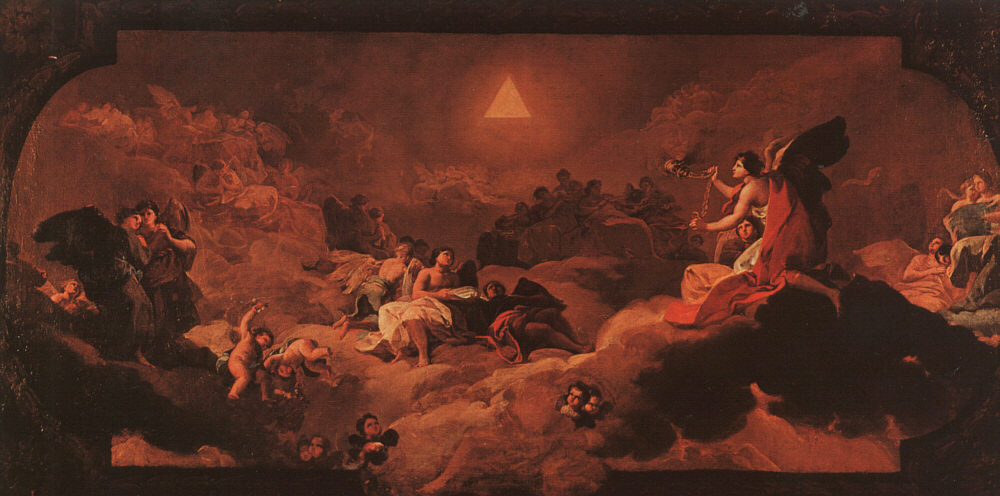
The Adoration of the Name of the Lord
Francisco Goya, 1772

Fideists like Ken Ham display, through their blockheaded refusal to countenance any possibility but one, not faith but the lack of it. The whole point of faith (as an act -- the content of faith is, of course, something else) is to hold fast to something, which isn't necessary if only that one thing even exists. To trust your spouse is one thing; to say that everybody is either lying, stupid, or crazy except your spouse, as a means of perpetuating your trust in your spouse, is ... well, something else.

And this, by the way, is why a Catholic need not and should not fear any of the traditional enemies and rivals of Christian faith. 'Christianity, if true, has nothing to fear from honest inquiry,' said Bishop Kallistos Ware. The advances of the sciences, claimants of supernatural or magical powers (whether false or true) from other religious traditions, corruption of every kind in the Church herself, the mere brute pain of life -- all these things are the perhaps which we, as Christians, ought to allow ourselves to be troubled by; they are the environment in which the word faith has meaning. And we can hardly invite those outside to a faith that we excuse ourselves from entering into, in its twilit glory.

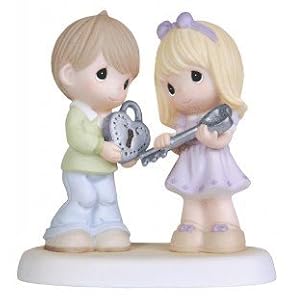
Evil and suffering are here particularly relevant -- especially when they are, or are caused by, the sins of Christians. And Christians have sinned a great deal; we have scandalized the earth; the fact that we are, for some people, a hissing and a byword, cannot be put down merely to the hatred of darkness for light. Shutting one's eyes to evil and suffering, or giving non-answers like 'It's always darkest before dawn' (which didn't work out so neatly for, say, the victims of Auschwitz-Birkenau or the Japanese who survived Nagasaki only to die of radiation poisoning), is a false move -- and, when you come to think of it, an insulting one. For it implies that horrible things do not matter. The militant atheist who refuses to believe in a God who would allow such things to happen, and the hyper-Calvinist devil-worshipper who believes God would cause men to do these things and then damn them for it, both take such offenses more seriously than the cloying, Precious-Moments-y whitewasher who can say God never closes a door without opening my mouth from the comfort of an overstuffed armchair.


Look at these dipshits.

Anyway. The point is, when we speak of faith, we are, obviously, not speaking of reason; nor, as the Church has vehemently argued for centuries, of irrationality. (It has been drily pointed out before now that there is nothing specially rational about dismissing all forms of knowledge except reason, especially since reason does not clearly prompt us to do so.) Neither are we speaking of certainty, of 'blind faith' so-called, any more than we are speaking of a mere 'Well, maybe this whole Christianity thing is true' when we sing the Pange Lingua during the Maundy Thursday procession. What we are speaking of is a personal decision of trust; one that is, necessarily, prefaced by getting to know this Person well enough to decide whether we shall trust Him. And this getting-to-know will naturally take a multitude of forms -- that's to be expected when you are, according to the premise, getting to know the author and fountain of Being -- including reason.

My own reversion to belief was of exactly this kind. I had tensed myself up to maintain the blind fideism I absorbed as a child, afraid to be honest with myself, fearing the consequences of thinking things for no reason except that I thought they were true; and finally, my intellect caught up to me. I just couldn't sustain the covert dishonesty any more. Fideism snapped, and faith now had a chance. And, increasingly, since that time, I've been coming to understanding the tension in which faith exists -- a different kind of tension from the kind I had been using to try and sustain my fideism.

There is no way to prove this: nevertheless, my belief is that, if Christians are willing to experience in ourselves this sacred tension between uncertainty and conviction, our perhaps not can indeed communicate with the perhaps of the non-Christian. It may even be, within the natural exchange and substitution of the coinherence of mankind, the supernatural coinherence can be invoked, and God can make us who know faith to be faithlessness for the unfaithful, and thus communicate faith to those who could not or would not take it for themselves.


*Introduction to Christianity, pp. 46-47, 56-57.

Saturday, February 21, 2015

Pope Francis the Clear

Tomorrow being the Feast of the Chair of Peter, I wanted to do a piece on the papacy, as I have before. This is the patronal feast of the Ordinariate to which I belong, and a very ancient festival in the Church's calendar.* It's also rather special to me personally. It was precisely Catholicism, rather than Orthodoxy, to which I converted, and one of my chief reasons was being persuaded that the Catholic doctrine of St. Peter's office and successors was the correct one.


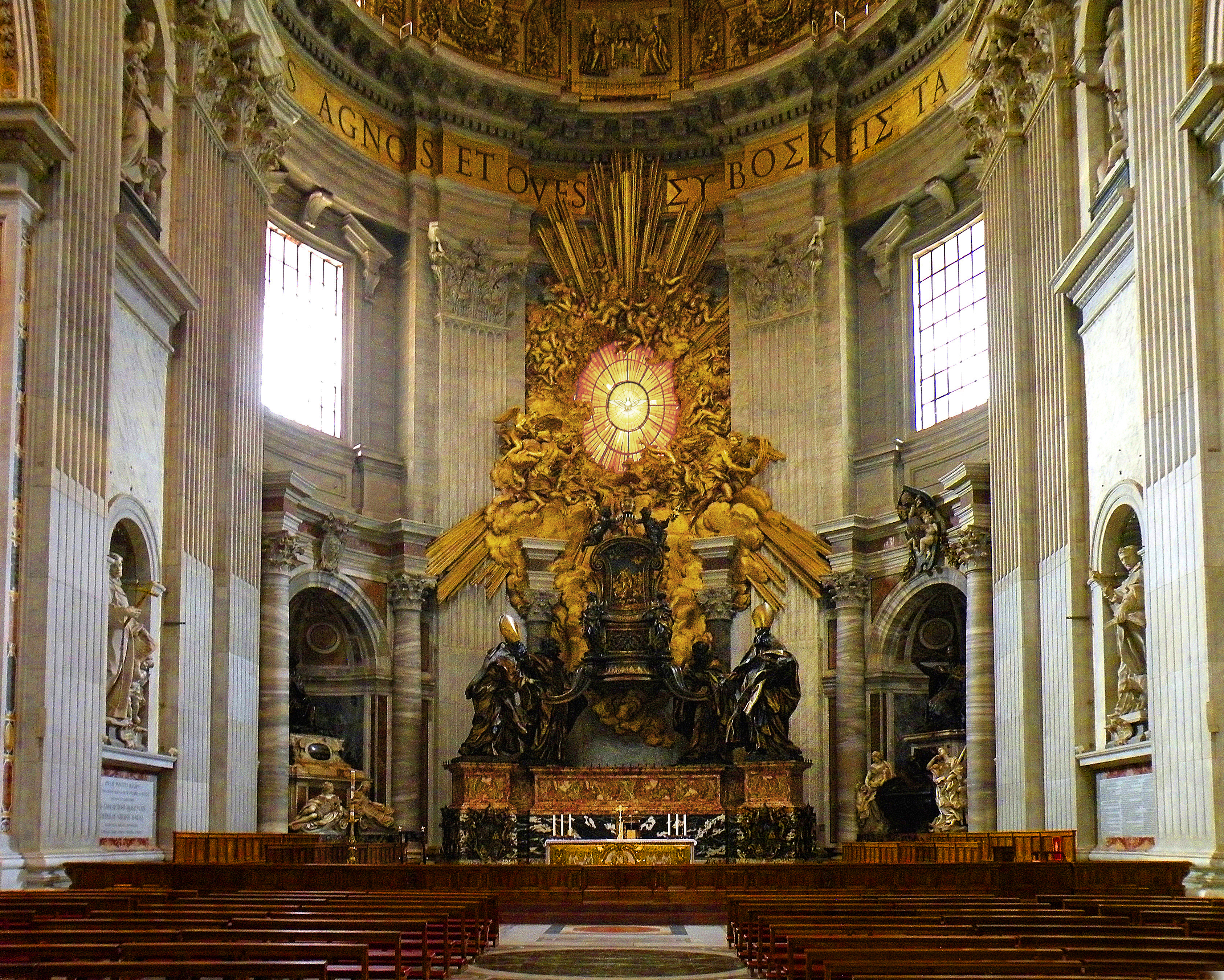
The Chair of Saint Peter, Bernini, 1647-1653, in the Basilica of Saint Peter in Rome.

I have, too, long been particularly fond of St. Peter the man. His combination of humility, profound holiness, zeal, and incredible bumbling is both endearing and reassuring; and I feel that Christ's choice of him to lead the Church after His departure -- over the mystical John, the brilliant Paul, or even (significant omission) His sinless Mother -- is emblematic of His whole recklessly adoring attitude towards humanity.

But I was talking about the papacy, and at present, that means Pope Francis. Since his accession two years ago, and especially during the session of the Synod on the Family late last year, many traditional Catholics have expressed discomfort with and even disapproval of His Holiness. Few (few at any rate that I've encountered) have charged with him heresy; many have charged him with carelessness, stupidity, and oversimplification. The sentiment of these remarks seems to be that, in phrasing things as simply and indulgently as he does, he is giving a false impression of Catholic Christianity to the world at large, and even making people feel that they can behave however they please and God will still love them.


The horror.

Well, I'll admit that, while my reverence for the Petrine Throne is unabated, Pope Francis is not my sort of man the way Pope Benedict was my sort of man. And yes, there are times when I miss Pope Benedict: though he was the victim of appalling slanders in the media, and was already a weary and self-effacing man at his own accession, he was an exact and wise theologian, and possessed of a spirit of immense charity and grace that shines brilliantly forth in his sermons and books. I've been rereading his Introduction to Christianity of late, in which he gives a more illuminating treatment of the Trinity than I've read anywhere else, and was particularly struck by this passage:
In the six principles [he has just explained] we have identified the elementary particles, so to speak, of Christianity, but must there not exist behind these one single, simple center? Such a center does exist, and I think we can say, after all that we have said and without any danger of using a mere sentimental phrase, that the six principles finally coalesce into the one principle of love. Let us be blunt, even at the risk of being misunderstood: the true Christian is not the denominational party member but he who through being a Christian has become truly human; not he who slavishly observes a system of norms, thinking as he does so only of himself, but he who has become freed to simple human goodness.**
Let us be blunt, even at the risk of being misunderstood. I have a shrewd suspicion that it is this principle voiced by Pope Benedict that is the real animating force of the pastoral style that has characterized Pope Francis, and that has so upset many traditional Catholics. For he has shown no special regard for the shibboleths that mark out self-professed paragons of orthodoxy in the American Church, and has freely asserted things that sound like concessions to to the secular left, until suddenly one remembers that he is restating the long-standing teaching of the Church, which diverges from the concerns of Caesar (liberal or conservative) in several important respects.

A lot of Catholics have complained of Pope Francis that he is careless in his way of expressing things and doesn't take proper account of the media's distortions -- that, if he would only be more theologically exact in speaking to journalists and so forth, these misunderstandings of Catholic doctrine by the public wouldn't arise. You'll notice how well that worked out for Bl. Paul VI and St. John Paul II and Benedict XVI. For that matter, truly, has there ever been an age in which people in general, even practicing Catholics, didn't misconstrue the Church's teaching? Mediaeval peasants, the children of the "ages of faith," sometimes sacrilegiously abstracted the Host and used it to make a poultice to apply to the wounds of their livestock; King Oswiu of Northumbria ruled in favor of Rome at the Synod of Whitby out of fear that St. Peter would use the keys to literally lock him out of heaven (or so it's been said); the famous Clovis, while being instructed for Baptism, on hearing of the arrest and torment of Christ, burst out angrily, "Oh, if I had been there with my Franks!" Doctrinal misunderstandings aren't a question of one Pope versus another, and they will never go away: it's human nature. Put not thy trust in principles, nor in any brainchild of man.

Besides that, we are maybe apt to forget in this country that we aren't a large or necessarily a very important segment of the Catholic Church. Taken together with Canada, we're only a little over 15% of the Church's worldwide membership, while Latin America, from which His Holiness hails, provides a solid third of our numbers. If he does not cater specially to our socio-religious concerns, I think that's to be expected.


Pictured: not the capital of Christendom.

Turning back to the matter of the media, Pope Francis has certainly made an impression on them. He's a winsome man, and has been a correspondingly popular pontiff -- the admiration he has commanded from those outside the Catholic Church has been much remarked upon, and even his solidly Catholic stances on questions like abortion and gay marriage have been absolved and indulged by the populace; after all, one must not be unjust, bigoted, or even like this Pharisee.

I confess, I wonder a little whether this popularity hasn't been a spur of some of the dissatisfaction with Pope Francis among conservative Catholics. There's a faint suggestion of the elder brother in it. They have been faithful, they have been creedally exact, they have tithed and fasted and said the Rosary and written their blogs defending Benedict and Burke, and no one has cared. But now here comes this Argentine prelate, his head probably filled with Marxist ideas and talking about nothing but love, even for atheists and homosexuals and adulterers, and people cheer and celebrate and praise him to the skies. It's enough to make somebody jealous.

I don't want to be harsh or unfair. A few close friends of mine have been perturbed by this or that remark or decision made by Pope Francis, and I certainly don't propose to read hearts. But I don't think it either unfair or harsh to plead for people to examine their consciences, and ask themselves whether it is really they who know how best to shepherd the Church. Admittedly Popes make many mistakes; but if dear Peter, the impetuous, shuffling, apostate saint, was unable to ruin the Church, I do not think that anybody can. It may be worthwhile to trust that Jesus will guide (and, if necessary, contain) His Vicar.

And the truth is, I think, Pope Francis' methods are not only licit, but downright cunning. Remember, the reason doctrine is important is that it expresses Divine truth; it is communication of that truth that matters. If you deliver a theologically correct message that nobody understands or takes to heart, you might as well have stood up there farting loudly for ten minutes for all the good it's going to do (though at least people would get a laugh out of that). Pope Francis has chosen, it seems, to focus on getting the point across over being, I'll be blunt, pedantic. And love is the point: God is love. Truth itself is of no value apart from Him -- Christ is the Truth, but Christ does only the will of the Father. Let us be blunt, even at the risk of being misunderstood. Which, let us not forget, He often was. 


Complete with ensuing hijinks.

That's the New Evangelization: taking the same substance that Christianity has always consisted in, and making it comprehensible to a people who are mentally quite different from the ones who formulated the theology; people to whom key terms like necessary and disordered and perfect mean something entirely unlike what they mean to a trained theologian.

And in communicating the core reality that those words were originally chosen to designate, yes, some of the details are going to get lost. But, as I said above, the details have been lost in any case, and that isn't actually a cause for great alarm -- not because the details don't matter (they do), but because He for whose sake they matter has them in hand, and what Pope Francis is trying to do is put them in in touch with Him. If he succeeds, the details will come. If he doesn't, having the details right won't matter.

Lastly, I would beg my Catholic brethren who so openly criticize His Holiness to take thought for the scandal they may be giving. I don't mean only the intrinsic scandal of open insolence toward the appointed ministers of the gospel, though that is worth taking into account. I made a flippant reference to people praising themselves for not being like Pharisees above, but of course, people do really do that. Suppose they learn by your example to associate contempt for the Pope with devout Catholicism. Will that prompt them to become Catholics who despise the Vicar of Christ, or is it likelier that they will remain mere fans of Pope Francis who won't seriously consider becoming Catholics? And really, when you come to think of how few of his critics have held the office of the papacy themselves, well gosh, it begins to look like talking authoritatively about something one may not understand as well as one thinks.


*One of two ancient celebrations of the Petrine Throne, in fact -- the other was suppressed in 1960 by Pope St. John XXIII. The two celebrations commemorated St. Peter's episcopacy at Antioch, after his departure from Jerusalem but before his arrival in Rome, and his rule of the church at Rome itself (which ended in his martyrdom, reputedly on the same day as St. Paul, in 64, the tenth year of the reign of Nero). St. John XXIII suppressed several feast days that were in substance duplicates, and, interestingly, the commemoration he chose to suppress was that of St. Peter's Roman throne; February 22nd was traditionally observed in honor of his rule at Antioch. It now commemorates the mystery of the Vicariate of Christ as a whole.

**Pope Benedict XVI (written as Joseph Ratzinger, before his elevation to the Cardinalate), Introduction to Christianity, p. 270.

Thursday, September 4, 2014

A Case for the Catholic Faith, Part I: Go


I've been wanting for a while now to set forth an answer to the question, "Why be a Catholic in the first place?" Partly because I have a difficult time answering that question. I find that faith, for me, is more and more precisely faith, and not simply the consequence of a chain of reasoning with a small and simple step of trust at the end of it. That's not to say I've started to find my faith irrational; not in the least; but, in the face of the uncertainties and still more the suffering that faith can involve us in, the nature of the problem has changed.

O Lord, thou hast deceived me, and I was deceived, begins the lesson from the Eleventh Sunday After Trinity.* Not the kind of language we are used to hearing in the Scriptures. But it is by no means absent, as a glance at the weeping prophet, or Job, or Ecclesiastes would tell us: and I think our approach to the Scriptures, and correspondingly to God, is rather deficient within the Church. I think that is also one of the reasons our apologetics are often so utterly ineffective. Being religious, we want the sort of God that appeals to and makes sense to a religious person -- a tidy, predictable God, whom we can control through right thought and right behavior -- in a sense, a moralist magician's deity. God can use anything, even religion; but religion itself is not God. The worship of holiness rather than of God is without doubt the deadliest of all spiritual poisons, something I know only too well from worshipping holiness, treating the means to God as an end in itself.


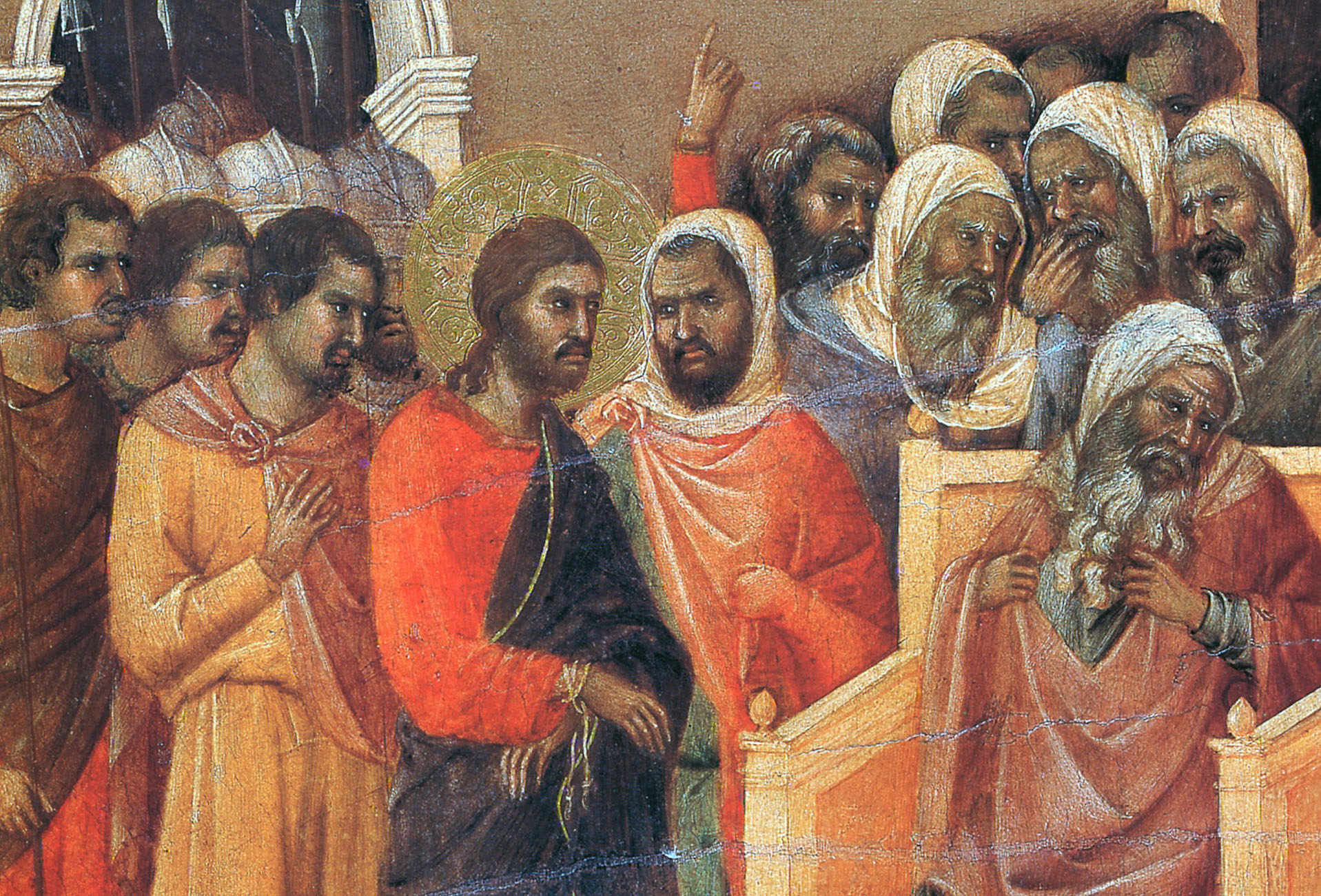
Caiaphas, being the high priest that year, said unto them, Ye know nothing at all, nor 
consider that it is expedient that one man should die for the people ... And this spake 
he not of himself: but being high priest that year, he prophesied ... -- John 11.xlix-l
Christ Before Caiaphas, Duccio, 1308-1311

The thing is, God made man in His own image, and human life is the product of man. The Sabbath was made for man, not man for the Sabbath; or, to apply the maxim to the present discussion, it is religion which serves the needs of man, not man who serves religion. Now, one of the needs of man is precisely for real contact with a real God. But humanity is a much messier affair than most religious people tend to be comfortable with, and our account of reality -- or, translated into philosophic terms, our apologetics and theology -- has to do justice to that, or it isn't worth much.

So, in writing such a defense (or explanation) of Catholicism, I'd like to avoid a few things that, I feel, are characteristic errors and even sins on the part of Catholic apologists. For instance:

1. I'm not going to explain away the sins of the Church. I do think that the Catholic Church gets a much worse rap than she deserves, partly because of the extreme ignorance of history that our culture gets from many sources, and not least from history classes. But when factual corrections and social context and the like have done all they can -- and they can do something -- the brute fact remains that Christians, sometimes at the highest levels of the Church, have done some unambiguously horrible, indefensible things. I don't propose for one moment to justify any of that by a shabby, triumphalistic revision of Catholic history. That is at least as wrong and irrational as the radical, anti-Christian revision of history that makes the Church guilty of every bad thing that has happened in the West since Constantine, if not more so.


All the same, though, fun fact: Galileo was never condemned for heresy, and the reason 
he was tried had as much to do with the fact that he was kind of an asshole as it did with his 
scientific assertions. He was still treated unfairly, but there's no time to explain that now.
Galileo Before the Holy Office, Joseph Nicolas Robert-Fleury, 19th cent.

To put the same thing another way, I do propose to explain Catholicism, which I hope will in itself explain why someone would believe it; but I don't know that there is any explanation for Catholics. Certainly there is no more defense for Catholics than there is for anybody else.

2. I'm not going to decline the philosophical problems that Christianity creates. In The Problem of Pain, C. S. Lewis noted with great intelligence that Christianity (and indeed most forms of benevolent theism) creates the problem of pain rather than solving it. If there were no God, or if God did not care about us or had no power to help us, then the problems of suffering and of evil would not exist: they would be one hundred percent explicable in terms of the stated premises. It's when we posit an almighty, omniscient, and loving God that these things become mysterious. They are not, perhaps, more agonizing on that account; but the agony they have anyway is quite enough to be getting on with, to put it mildly. And the simplistic answer that "It'll all be set right in the end" is, frankly, insulting. I think that is what Charles Williams was getting at when he wrote, "Most Christian answers to agnosticism seem not to begin to understand the agnosticism; they seem to invoke the compassion of God. In Kierkegaard one gets the sense that God does not understand that kind of compassion."

That's not to say that I have satisfying answers for all, or indeed any, of the philosophical problems that Christianity involves us -- me -- in. I believe it for other reasons. And of course, the problem of pain is only one among those problems. But if I haven't got an answer, I'm going to man up and say so, and say why I believe anyway; and the answer will not just be "Because," even if the answer is "I don't know." No one can make the smallest progress in the mind or in life without starting with honesty.

3. I'm not going to mock non-Catholic belief systems, especially atheism. There are admittedly atheists whose case for atheism, in my opinion, betrays an extremely shallow understanding of Christianity and even of logic -- Richard Dawkins springs to mind: expert though he may be in biology, I've yet to encounter an argument of his against theism that I found in the least compelling. The New Atheists in general seem, from my admittedly limited reading, to be of the same cast.** But, on the other hand, the atheists I've actually met have tended to be not only much pleasanter people than Dawkins, but not infrequently have had better reasons for being atheists; and some whom I have not met, like Penn Jillette or Camille Paglia, have been respectable and respectful thinkers whose atheism I correspondingly respect, though obviously I think they're quite wrong. Poking fun at another belief system can of course be done good-naturedly; but I don't feel I see that very often from Catholic apologists, whereas I do feel I see an awful lot of mere sneering. I don't think this is wise, or fair, or loving. Nor, it must be said, is it the example set by the authors I most respect, such as Pope Benedict XVI, whose writings display an abiding respect for atheism in particular (along with categorical disagreement).

Moreover, I feel that such sneering misses the real quality of atheism at its best. I've frequently found it to be of a high moral tone -- sometimes higher than the Christian faith it has rejected, and sometimes it has rejected that Christian faith precisely on serious moral and intellectual grounds (despite the continual, slanderous assumption that atheists can have no basis for behaving morally, and therefore don't). And still more than that, there can be a romance, even a heroism, in the defiance it often embodies. Far from being mere teenage contrariness, I think that, in that atheism which refuses to believe in a God that could allow the evil we see in the world, we see something more like this:


I don't think that the real God is like the Rhino, of course. But if I did, I can only hope I'd have the nerve to talk that way.

And that is something that many of the greatest apologists understood. Many people are so taken with the arguments of Lewis or Chesterton or Pascal or Aquinas against atheism, that they fail to notice that these were men to whom atheism was not merely a childish rebellion against obvious good sense, but a serious intellectual possibility worth answering seriously. Failure to appreciate atheism this way does not indicate superiority or spiritual depth. It is a weakness. If you can contemplate the evil in the world without understanding why someone would want to be an atheist, then frankly, you may be a heartless dick.

So what exactly do I propose to do? Well, I'm going to set out why I personally became a Christian and ultimately a Catholic, and why I have remained one, from an intellectual perspective. I'm explaining it intellectually because that is the dimension that's influenced me the most; but I don't imagine that that will be decisive for more than a very small minority of people, because only a very small minority make their decisions in a predominantly intellectual way. That's actually a good thing, because humans aren't and weren't meant to be brains-in-a-vat.*** Angels are pure intellect, or so most Catholics believe, but men are not: we are incarnate creatures, with bodies and emotions and all the messy trappings and entanglements that those imply. Nonetheless, one element of the human experience is precisely intellectual, and, since I feel most equipped to address that element, I'll do so.


In doing so, I'm going to be taking a few things for granted. If you, dear reader, do not take these things for granted, well, I really haven't the first idea what to say to you: you're welcome to read the series anyway, naturally, but I expect it'll come across as a sort of philosophical objet d'art, rather than a set of persuasive essays. Anyhow, my assumptions -- things that I don't propose at any point to support, but will simply start with them in play -- are these:

1. I assume that logic is reliable. I assume this because you literally cannot think without it. If A = A is not always true, then fuck all.

Now, this is not the same thing as saying that common sense is reliable. Common sense may be defined as the things we expect based on logic and experience, and it's fine as far as it goes, but it isn't synonymous with the law of non-contradiction. For example, some people make much of the fact that light sometimes behaves like a particle and sometimes like a wave, saying that this is a contradiction in reality. The only thing to be said in reply is No, no it isn't. It's very unexpected and unlike other things, and that, while inconvenient and kind of freaky, is fine. But stuff we don't expect or understand is not in violation of the law of non-contradiction, which is what I mean by logic. The fact that it may defy our intellectual ego is neither here nor there.

2. I assume that the senses are basically reliable. Not absolutely so, obviously; but here again, if we didn't make this assumption, we could not function in the world. A corollary of these two assumptions is the assumption that scientific observation is basically reliable as far as it goes, though I don't know that I'll be referring to that thesis all that much -- my own analysis of Christianity is primarily philosophical, psychological, and historical.


Science!

3. I assume that history can, to some extent, be discovered. Another way of phrasing this would be that I don't believe that mankind in general has been suffering from a massive compulsion to lie for the last few thousand years. A lot of the arguments against Christianity that I've encountered, especially those opposing Catholicism (from both Protestant and non-Christian sources), seem to rely on the premise that lots of people lied about things for approximately no reason in particular, for centuries. This is not technically impossible, but I don't propose to spend any time dismantling it. That may make me naive, but I haven't the energy to be otherwise if that is the case.

This is not to say that I trust everything I read. I have read too much history to trust history textbooks, for example. That's part of why I have posited, here, that history is discoverable rather than known: making allowances not only for those periods and places for which we have no records, but for the fact that people do sometimes tell lies and make mistakes.


Some mistakes being worse than others.

So, that's basically what I plan to do: go from the ground up, be as fair-minded as I can, and lay out exactly what Catholics think as accessibly as possible. I am coming from a specifically Anglo-Roman perspective of the Catholic faith, and doubtless won't do full justice to the East, but I will do my best not to present things in exclusionarily Roman, still less post-Anglican, terms. I may also continue explaining why I don't use this or that argument, or do so differently, mostly because I want to do justice to unbelief -- partly because of my own experience of it, and partly in imitation of the honesty of Pope Benedict in his Introduction to Christianity. If this is about finding truth, rather than just winning, then doing justice is the first necessity.

Here goes!


*Both the lectionary and the numbering of Sundays in the Anglican Use are different from those in the standard form of the Roman Rite. The lesson is the technical name for the first reading.

**Other examples would be Sam Harris and Christopher Hitchens.

***I figure this is the proper pluralization of brain-in-a-vat. I suppose it's a little odd to imagine several brains all suspended in one large vat, but then again I suppose it's no odder than imagining one brain suspended in a vat (because, really, why?). In any case, brain-in-a-vats sounded stupid, and brains-in-vats has a dissatisfying rhythm to me.

Saturday, August 30, 2014

Three English Martyrs

I'm a member of the Ordinariate of the Chair of Peter, which is the American group for Episcopal/Anglican Christians who want to be reconciled with the Catholic Church, while retaining their distinctive heritage. You may have heard of (or noticed in my Warning Labels on the right) the Anglican Use; basically the same thing.* It was founded by Pope Benedict a few years ago, and includes Ordinariates in Great Britain, North America, and Australia: Our Lady of Walsingham, the Chair of Peter, and Our Lady of the Southern Cross, respectively. An Ordinariate is a little bit like a diocese, in that our Ordinary is our chief authority, and also a little like a rite, in that our liturgical, historical, and spiritual distinctives are, uh, distinctive -- we have our own character. (In terms of jurisdiction, we're part of the Roman Rite, which makes up the majority of the Catholic Church in this country, though our Mass is significantly different from the norm of the Roman Rite.)


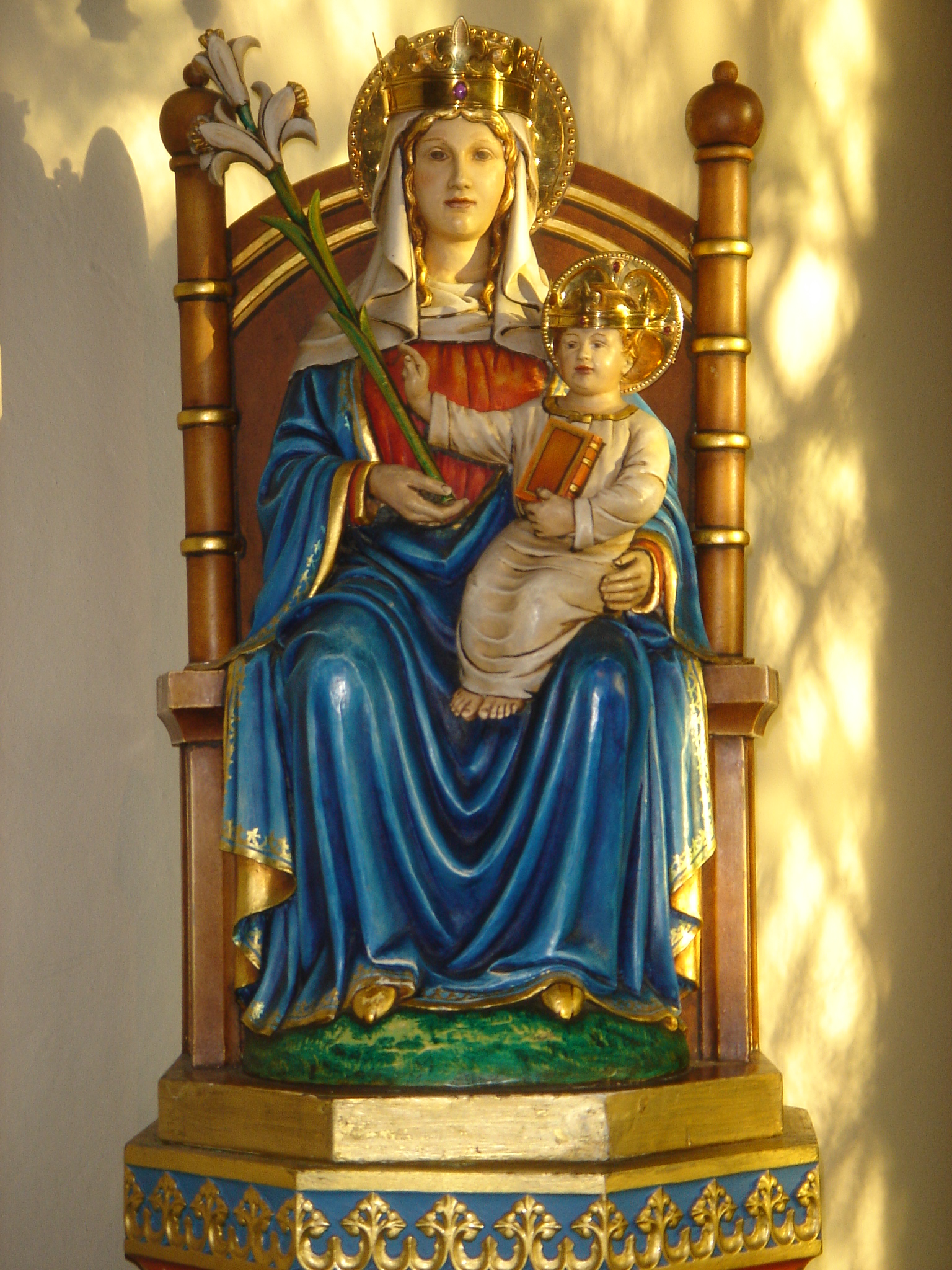
Our Lady of Walsingham, one of most important shrines to the Virgin in England
from 1061 until 1538, when it was looted and burned under Henry VIII.

Today is a memorial in the Ordinariate (though not on the standard Roman calendar) dedicated to three sainted martyrs under Queen Elizabeth I: Margaret Clitherow, Margaret Ward, and Anne Line.

Saint Margaret Clitherow was a convert to Catholicism at the age of eighteen in 1574. She concealed priests in her house (a practice which her husband permitted despite his remaining a Protestant; one of his brothers was a Catholic cleric). 


However, in 1586, the hiding places were found out, and Margaret was taken to be tried. She refused to plead, and the practice at the time in these situations was to force the defendant to plea by crushing them with stones until they did so. She remained steadfast in her refusal to plead -- innocent would mean she had not hidden the priests, and guilty would mean she admitted herself in the wrong for doing it -- and was ultimately crushed to death (rather like Giles Corey, who was impressive enough to make a Cracked list by so doing). The day of her death was both the Solemnity of the Annunciation (March 25th) and, it so happened that year, Good Friday. The Queen, on hearing of the matter, wrote a letter to York, the home of the Clitherows, expressing her horror at their actions.

Saint Margaret Ward (whose family may have been recusants**) was a servant to an aristocratic family living in London around the same time. She heard of the maltreatment of an imprisoned Catholic priest, Fr. Richard Watson, and obtained permission to visit him; eventually, in 1588, she was able to smuggle some rope to him, and he escaped.


As his only visitor, she was arrested, and tortured by being kept in iron, hung by her hands, and flogged, but Margaret persistently refused to say anything about Fr. Watson's whereabouts. At her trial, she frankly admitted what she had done and rejoiced in it. She was offered a pardon if she would attend a Protestant service, but refused to do so, and was hanged on this day in that year.

Saint Anne Line was another convert to the Catholic faith: the daughter of a Puritan, she was disinherited for her decision. Her husband, Roger Line, was first imprisoned and then exiled for his own conversion. Anne was put in charge of a house for priests by its founder, an imprisoned Jesuit, and people gathered there to hear Mass.


In 1601, on Candlemas***, her operation was discovered due to the large crowd that came to celebrate the feast. Despite the fact that her health was so bad she had to be carried into the courtroom, she boldly defended her actions at her trial; before she was hanged, she declared to the crowd, "I am sentenced to die for harboring a Catholic priest, and so far I am from repenting for having done so, that I wish, with all my soul, that where I have entertained one, I could have entertained a thousand."

All three were canonized by Pope Paul VI, and are the only women among the Forty Martyrs of England and Wales (commemorated as a group on May 4th). Their memorial is, to my mind, particularly poignant now, while the Islamic State is exiling and murdering Christians in northern Iraq for no offense except their faith. That is exactly what happened to these three. Not one of them was accused of anything that could rightly be called criminal: they had done no harm to their neighbors, nor encouraged others to do so; indeed, because of their assistance in protecting priests and giving them means to escape imprisonment, it may be justly said that they were injured for objecting to injury rather than for inflicting it.

I have no idea what to do as far as opposing the IS goes, except to pray. Even as a pacifist I am inclined to despise the useless waffling of the government on the subject -- not because I want the state to resort to violence in defending the Christians there (I don't), but because I want them to do something rather than nothing. And who knows, perhaps some even among our officials are praying. But -- and although it is certainly not an answer to unjust suffering -- I take some small encouragement from the bravery of these women, who helped keep the Catholic faith alive during a time of senseless brutality, and recollect Tertullian's dictum: Sanguis martyrum semen Ecclesiae, "The blood of the martyrs is the seed of the Church." When two thousand years of persecutions, here and there, there and here, have not managed to exterminate Christianity, the tactics of the IS do begin to look a bit pigheaded.****

Saints Margaret Clitherow, Anne Line, and Margaret Ward, pray for us.


*Basically. However, the Anglican Use is actually older than the Ordinariates -- it originated under St. John Paul II in 1980, as a pastoral accommodation for Episcopal communities that were joining the Catholic Church but wished to keep their clergy, some of whom, being married, would not normally have been eligible for Holy Orders in the Roman Rite. These communities, though they kept their own way of doing a lot of things, were received into full communion with Rome and incorporated into the local diocese (or so I understand). When the Ordinariates, which are relatively independent structures, came into being, some of the pre-existing Anglican Use parishes joined, while others remained attached to their local dioceses.

**Recusancy was a legal term, referring to refusal to attend Anglican services, which were mandated by law, beginning during the reign of Elizabeth I and lasting until their repeal in 1650 under Oliver Cromwell. Penalties for recusancy could include fines, confiscation of property, and even imprisonment; nonetheless, there were many Catholic recusants in England and Wales during this time, including a great number of families of the nobility -- notably the Howards, whose scion Catherine became the fifth wife (or at any rate consort) of Henry VIII, and the Mores, the family of the martyred Thomas. Yorkshire, from which St. Margaret Clitherow came, was one major center of underground Catholicism during the Tudor and Stuart eras.

***Candlemas is the Anglican name for the Feast of the Presentation, so called because it was on this feast that candles were traditionally blessed for church use. It has been preserved in the Anglican Use.

****To say nothing of being inconsistent with the Quran. The IS, or ISIS (the Islamic State in Iraq and Syria), has drawn fire from fellow Moslems of various traditions and ethnicities for precisely this reason. It is true that historical Moslem practice has accorded a second-class status, called dhimma, to non-Moslems living in Moslem countries -- which is perhaps not so very unlike the effects of anti-Semitism in Mediaeval Christendom, but that need not detain us for now -- but the Quran explicitly states that there is to be "no compulsion in religion" (Sura 2), and a hadith of the Prophet himself states that "Whoever killed a Mu'ahid [i.e., one granted a pledge of protection by Moslems, such as the tradition of dhimma grants] shall not smell the fragrance of Paradise though its fragrance can be smelt at a distance of forty years of traveling."

Sunday, August 17, 2014

Five Quick Takes

I.

I am feeling tired and lazy, so, even though it's been more than a week since I wrote a real post, I'm going to also not write a real post right now. You're welcome.

In the spirit of not doing things, or at any rate of not having ideas, I have been thinking hard about what content to make as a special thank-you for my Patreon sponsors, and frankly I'm stumped. About the only idea I've had thus far is to video some kind of pencil-mounted-puppet show -- thus demonstrating that a preoccupation with puppets is not the exclusive preserve of left-wing liturgical nutjobs, but in fact a temptation common to all wicked men. If you have any suggestions, patrons, I welcome them; otherwise, you're probably getting a puppet show.


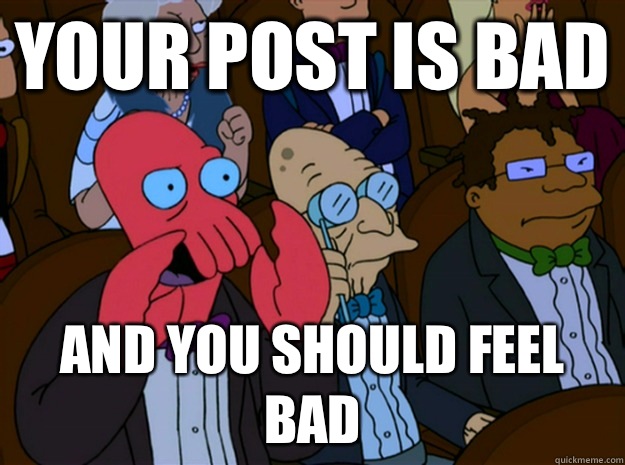
Why yes, I did discover this Zoidberg meme years behind the rest of the internet.

+     +     +

II.

I am rereading Pope Benedict XVI's Introduction to Christianity, and I just can't do justice to it. The first time I read it, my reaction was primarily, I have read A Thing written by A German Academic Theologian, followed by finding something that seemed more accessible, like theoretical astrophysics. The second time, it clicked, and I loved it. And this third time, it's speaking to me even more deeply. His grasp, and vivid communication, of the act of faith -- the act of entrusting oneself to the invisible -- is helping me through a very strange and difficult period with my own faith right now, if only because it makes the difficulty less strange. Entrusting yourself to anyone or anything is, after all, a risky business, and, like any coward, I don't like it. But, like it or not, it is a problem posed to us not only by Christianity specially, but by simply being a human. To quote His Holiness (from pp. 55-57):
God has come so near to us that we can kill him and that he thereby, so it seems, ceases to be God for us. Thus today we stand somewhat baffled before this Christian "revelation" and wonder, especially when we compare it with the religiosity of Asia, whether it would not have been much simpler to believe in the Mysterious Eternal, entrusting ourselves to it in longing thought; whether God would not have done better, so to speak, to leave us at an infinite distance ... 
[I]s it still permissible to believe? Have we not a duty to break with the dream and to face reality? The Christian of today must ask himself this question; he is not at liberty to remain satisfied with finding out that ... an interpretation of Christianity can still be found that no longer offends anybody. When some theologian explains that "the resurrection of the dead" simply means that one must cheerfully set about the work of the future afresh every day, offense is certainly avoided. But are we then really still being honest? ... Let us be quite plain about it: An "interpreted" Christianity of this kind that has lost all contact with reality implies a loss of sincerity in dealing with the questions of the non-Christian, whose "perhaps not" should worry us as seriously as we want the Christian "perhaps" to worry him. 
If we try like this to accept the interrogation of the other side as the everlasting self-questioning of our own being, which cannot be reduced to a treatise and afterward laid aside, then, on the other hand, we shall have the right to observe that here a counterquestion arises. We are inclined today as a matter of course to suppose that only what is palpably present, what is "demonstrable," is truly real. But is it really permissible to do this? ... [O]r is ascertaining perhaps only one particular method of making contact with reality, one that can by no means comprehend the whole of reality and that even leads to falsification of the truth and of human existence if we assume that it is the only definitive method?
+     +     +

III.

Please, nobody tell me why Fifty Shades of Grey is popular. I am begging you.

Though I guess, if we're lucky, we might get one of these out of it:


+     +     +

IV.

The terrible thing about being a writer, at any rate of fiction, is that you have to make things up. Of ideas, Douglas Adams said something like, "You can't go and rave it up in a field whenever you need one, so you just have to sit there and think of the little bastards. And if you can't think of them you just have to sit there."

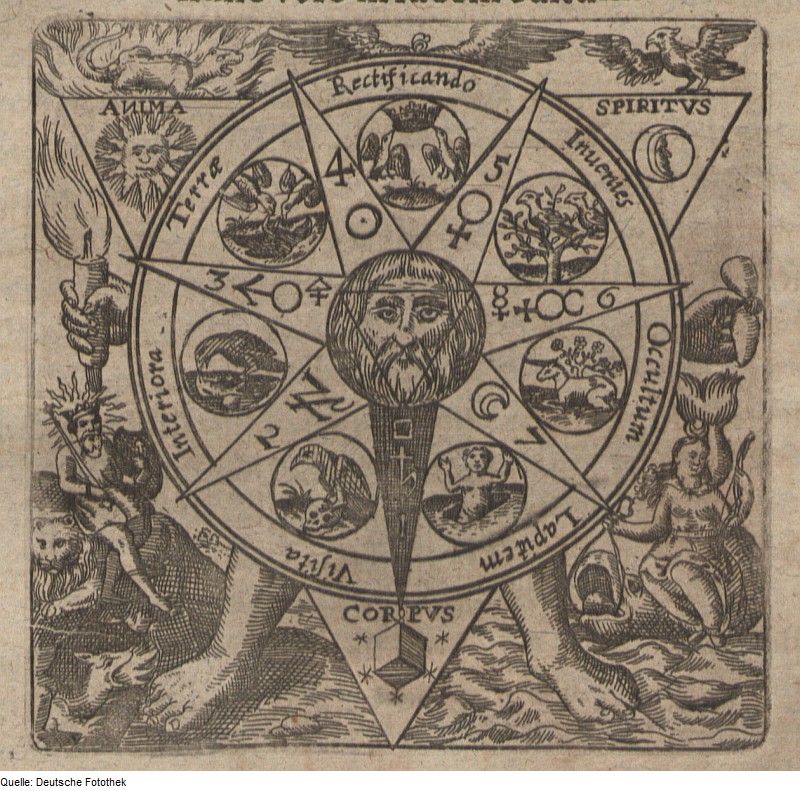
I'm running into precisely this problem with the second installment of a three-part (of course) story that I'm working on, about Victorian vampires (sure) as understood through the lenses of Catholic theology (lolwut?) and esoteric alchemical symbolism (I give up). I have the characters, and about enough plot to sustain perhaps six chapters of actual action, which would be fine if the previous installment weren't something more like twenty chapters.


However hard it may be to believe, this is not only confusing when you don't understand it, it's also boring when you do.

So I have to find a way of making a whole bunch more things happen, and worse, I have to find a way that isn't cheating -- not just throwing arbitrary difficulties at my characters, but actually structuring the story so that it produces a plot that, well, takes more time.

I may have had a point when I started this take, but apparently it was not a very compelling one.

Which may not bode well for the story. Oh dear.

+     +     +

V.


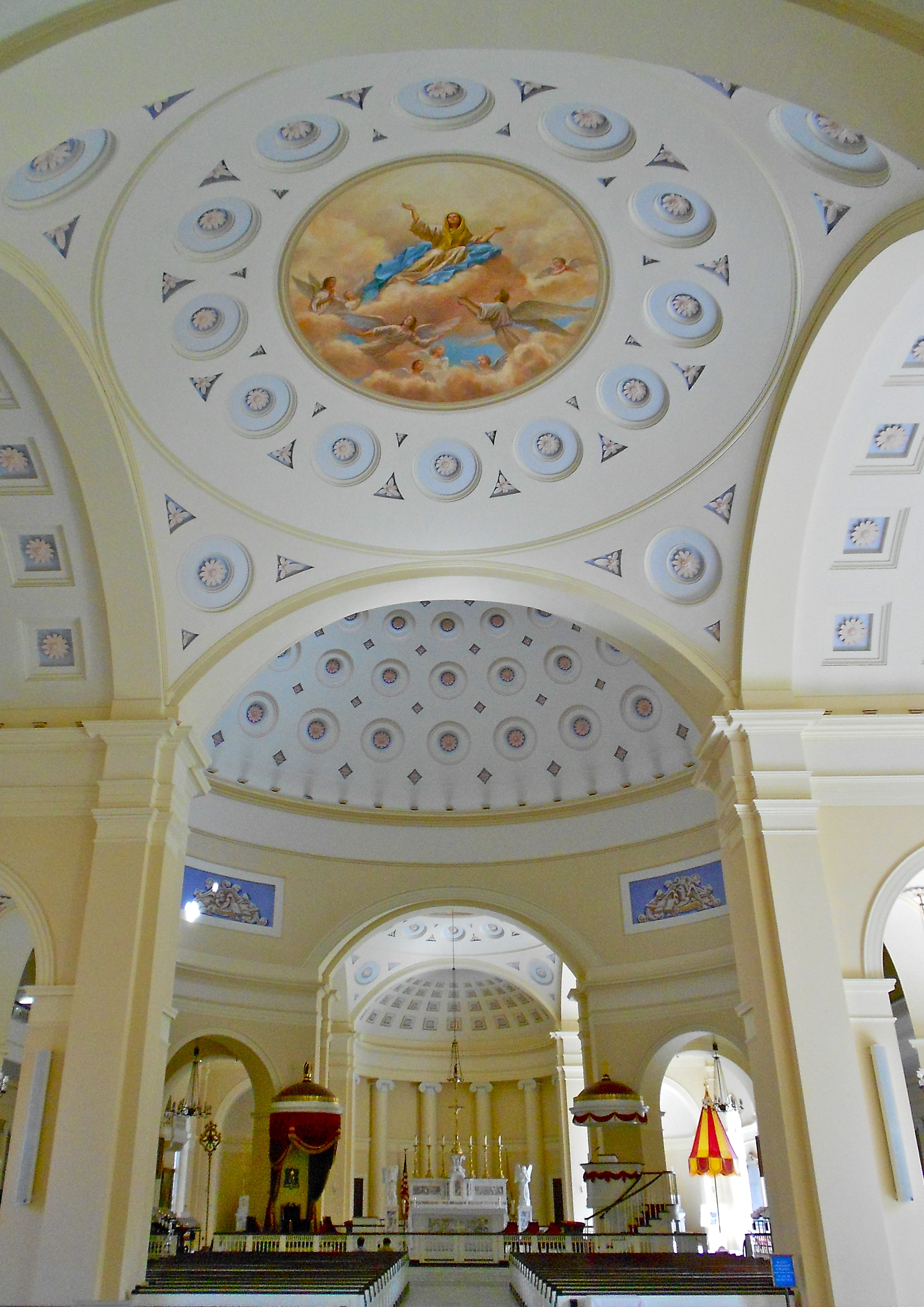
After a Mass at the Basilica of the Assumption a week or two ago -- it's only a few blocks from my house, so I go there fairly regularly -- I spoke with the priest, asking him to pray for me because I was having (and continue to have) difficulty in discerning my vocation. He told me that that was related to not knowing myself adequately, and I have to admit that that makes a good deal of sense. Of course, being an introvert with a tendency to obsess over identity, I always feel that way, but it seems like it's actually objectively true here in particular. I think one of the tough things about vocations (and, coincidentally, something I don't consistently encounter when I read or hear encouragements to consider priestly and religious vocations) is that they grow from within: they are not arbitrary impositions on God's part, but flowerings of the inner character that He implanted within us in making us.

That's not to say that they develop perfectly and with no input from our own free will. Our free will is as organic as our inner character. But I suspect that one thing that makes discernment harder than it needs to be, though it will always be hard, is the tendency to think of it as trying to discover a secret God is keeping from us, rather than of trying to discover our natural place -- natural to us because He crafted our nature for that place, and vice versa.

The other thing that makes it hard is our hard hearts. That is, not just sins, but our tendency to sin, our tendency to divert our attention from God to anything else, or even to nothing at all. The fact that we are naturally drawn to God as creatures made in His image does not wholly counteract that. Earlier today, my roommate was trying to reattach the cover on his wing mirror, which had been knocked off, and gotten slightly warped in the process. Try as he might, it wouldn't quite fit in the way it was supposed to, even though it had of course been constructed for the specific purpose of fitting there. Human brokenness is like that. My brokenness is like that.

Saturday, April 12, 2014

Holy Week 2014: Liturgies and Meditations

Tomorrow is Palm Sunday, the first day of Holy Week, which is the climax of the liturgical year. I'm planning not to write much from tomorrow until the end of the Octave of Easter (which in most Roman Rite churches is observed as Divine Mercy Sunday; it is also known as Low Sunday, probably in comparison to the spiritual height represented by Easter Sunday itself, and as St. Thomas Sunday). But I wanted to write a few things here about the fascinating character of Holy Week; I've included some meditative readings as well.

Also, if you're within driving distance of Baltimore, I've included the address and service times of my parish, which is an Anglican Use church, an unusual subset of Catholicism with a liturgical style that I cherish.

816 North Eutaw Street, Baltimore (parking in the neighboring lot at the corner of Martin Luther King Jr. Boulevard and Madison Street, or on the streetside)

Palm Sunday: Masses at 8 am and 10 am
Spy Wednesday: Tenebrae prayer service at 7 pm
Maundy Thursday: Mass at 7 pm, followed by Eucharistic watch until midnight
Good Friday: liturgy at 12 noon
Holy Saturday: Easter Vigil at 9 pm
Easter Sunday: Masses at 8 am and 10 am


Palm Sunday

This day is named for the palm branches with which the people of Jerusalem greeted Jesus, when He entered the city before Passover the year that He was crucified. It is traditional to begin the Mass this day with a procession, starting somewhere outside the church, carrying palm leaves (which are later collected and burned to produce the ashes used in Ash Wednesday liturgies, so that every paschal cycle is organically connected to the last). This is one of the few events that both the Synoptic Gospels and John report, John's emphases being usually so different from the other authors. The prophecy from Zechariah alluded to by Matthew, Luke, and John, which Jesus obviously had in mind in choosing to ride into Jerusalem on a donkey's foal, does represent a victorious king, entering the royal city in triumph over the nations that were hostile to Israel; the disappointed expectations aroused in the populace by this symbolism may have been part of why they so easily turned on Jesus when He was arrested and brought before Pilate, as is recounted in the Passion narrative (read or sung in differing parts by the celebrant, appointed lectors or cantors, and the congregation as a whole) that forms the Gospel reading for Palm Sunday.

In both John and Luke, within the immediate context of the triumphal entry, Jesus refers to His imminent death; in Luke, He begins to weep over Jerusalem as they approach the city from Bethany, and in John, He uses the famous lapidary that a seed must fall into the ground and die to bear fruit -- then going on in a favorite Johannine theme to say, I, if I be lifted up from the earth, will draw all men unto me, identifying the Cross itself with His exaltation. That exaltation continues, of course, in the Resurrection, the Ascension, and the sending down of the Holy Ghost at Pentecost, but John consistently casts the Cross in the light of the first part of His glorification (an idea very much preserved in the Christian East, where the Christus Victor motif is far more pronounced than in most Western images of the Passion, which tend to emphasize the anguish). This to-us-strange concept of the Cross, especially when viewed together with Jesus' voluble grief over the city that would murder Him, brings me to the meditation I've selected for Palm Sunday.
The Church can reasonably be justified therefore if she turns the most merciful face or aspect towards men; but it is certainly the most merciful aspect that she does turn. ... A man simply taking the words of the story as they stand would form quite another impression; an impression full of mystery and possibly of inconsistency; but certainly not merely an impression of mildness. It would be intensely interesting; but part of the interest would consist in leaving a good deal to be guessed at or explained. It is full of sudden gestures evidently significant except that we hardly know what they signify; of enigmatic silences; of ironical replies. The outbreaks of wrath, like storms above our atmosphere, do not seem to break out exactly where we should expect them, but to follow some higher weather-chart of their own. ... Relatively speaking, it is the Gospel that has the mysticism and the Church that has the rationalism. As I should put it, of course, it is the Gospel that is the riddle and the Church that is the answer. But whatever the answer, the Gospel as it stands is almost a book of riddles. -- G. K. Chesterton, The Everlasting Man, pp. 188, 190
Fig Monday

This day is named for a passage in the Gospels that we often seem to forget:
And on the morrow, when they were come from Bethany, he was hungry: and seeing a fig tree afar off having leaves, he came, if haply he might find any thing thereon: and when he came to it, he found nothing but leaves, for the time of figs was not yet. And Jesus answered and said unto it, No man eat fruit of thee hereafter forever. And his disciples heard it. And they come to Jerusalem: and Jesus went into the temple, and began to cast out them that sold and bought in the temple ... And when even was come, he went out of the city. And in the morning, as they passed by, they saw the fig tree dried up from the roots. And Peter calling to remembrance saith unto him, Master, behold, the fig tree which thou cursedst is withered away. And Jesus answering saith unto them, Have faith in God. -- Mark 11.12-15a, 19-22
There follows the lesson of having the "faith that can move mountains" to which we are so accustomed from Sunday school and refrigerator magnets, but, uh, holy crap, Jesus. You blasted a fig tree because it didn't have the snack you wanted? That's kind of terrifying.

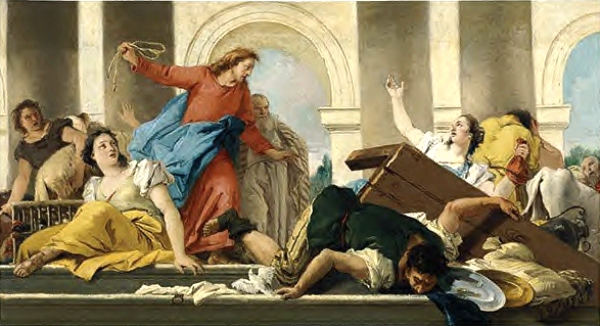
I for one don't propose even to try to plumb the spiritual significance of this, Jesus' sole miracle of destruction (unless one gives credence to some of the infancy gospels, popular Christian literature that was not considered Scripture partly because they were too late to be of apostolic authorship and partly because they were ravingly insane). I would say two things that may cast some light on it, though. The first is that this passage from Mark, which here likely represents the history chronologically (Matthew liked arranging things by topic, and Luke doesn't mention the blasting of the fig tree), sandwiches the famous cleansing of the Temple in between the pronouncement of the curse and the Apostles noticing its effects. One of the prophets' favorite metaphors for Israel was that it was God's garden or field; the parable of the vineyard's tenants that follows within eight verses of the close of the fig tree passage in Mark suggests that this may have been an enacted parable about the unfruitfulness and consequent spiritual death of the Jewish religious establishment, represented by the Sadducees and Pharisees who would shortly crucify Him.


The other thing is, strictly speaking, not something that I would say, but the meditation I've chosen.
"For He visits the sins of the fathers upon the children unto the third and fourth generation of them that hate Him, and shows mercy unto thousands of them that love Him and keep His commandments." Here is a statement of fact, observed by the Jews and noted as such. From its phrasing it might appear an arbitrary expression of personal feeling. But today, we understand more about the mechanism of the universe, and are able to reinterpret the pronouncement by the "laws" of heredity and environment. Defy the commandments of the natural law, and the race will perish in a few generations; co-operate with them, and the race will flourish for ages to come. ... Scattered about the New Testament are other statements concerning the moral law, many of which bear a similar air of being arbitrary, harsh or paradoxical: "Whosoever will save his life shall lose it"; "to him that hath shall be given, but from him that hath not shall be taken away even that which he hath"; "it must needs be that offenses come, but woe unto that man by whom the offense cometh" ... We may hear a saying such as these a thousand times, and find nothing in it but mystification and unreason; the thousand-and-first time, it falls into our recollection pat upon some vital experience, and we suddenly know it to be a statement of inexorable fact. ... The cursing of the barren fig-tree looks like an outburst of irrational bad temper, "for it was not yet the time for figs"; till some desperate crisis confronts us with the challenge of that acted parable and we know that we must perform impossibilities or perish. -- Dorothy Sayers, The Mind of the Maker, pp. 12-13
Temple Tuesday

This name commemorates the time spent by Jesus teaching in the Temple during Holy Week. The exact chronology of the week is a matter of considerable scholarly debate, but, if we take the liturgical structure as being as close to what actually happened as makes no difference (and there is actually a scholarly case to be made for doing so), then Sunday, Monday, and Tuesday were spent teaching in the Temple. This Tuesday would likely have been when Jesus delivered the Seven Woes to the scribes and Pharisees in Matthew 23. This would also, taking our theoretical schedule in combination with Matthew 26.1-2, be the day on the evening of which Jesus pronounced the Olivet Discourse, in which He predicted the destruction of the Temple and His own return, and told several frightening parables of the Second Coming: those of the Flood, the master and his servants, the wise and foolish virgins, the talents, and the sheep and the goats.

For the meditation, I have chosen something peculiarly Anglican in character. In the 1662 version of the Book of Common Prayer, there is a service specially designed for Ash Wednesday called A Commination, Or Denouncing of God's Anger and Judgments Against Sinners, which itself refers to the ancient custom -- which ceased in the Catholic Church when the Irish introduced the idea of private Confession and penances, thanks be to God! -- of imposing public penance upon those Christians who sinned, because the primitive Church was way hardcore. It is, of course, easy to slide into a judgmental attitude if we think too exclusively of the wrath of God; but it is profitable to consider it at times -- more as it relates to ourselves than to other people, since we cannot repent of other people's sins -- and, particularly, to note that it is always related by the Church's doctrine to repentance rather than treated in isolation. I have therefore put here some of the closing prayers from the Commination for reflection.
O Lord, we beseech thee, mercifully hear our prayers, and spare all those who confess their sins unto thee; that they, whose consciences by sin are accused, by thy merciful pardon may be absolved; through Christ our Lord. Amen.
O most mighty God, and merciful Father, who hast compassion upon all men, and hatest nothing that thou hast made; who wouldest not the death of a sinner, but that he should rather turn from his sin, and be saved: Mercifully forgive us our trespasses; receive and comfort us, who are grieved and wearied with the burden of our sins. Thy property is always to have mercy; to thee only it appertaineth to forgive sins. Spare us therefore, good Lord, spare thy people, whom thou hast redeemed; enter not into judgment with thy servants, who are vile earth, and miserable sinners; but so turn thine anger from us, who meekly acknowledge our vileness, and truly repent us of our faults, and so make haste to help us in this world, that we may ever live with thee in the world to come; through Jesus Christ our Lord. Amen.
Spy Wednesday

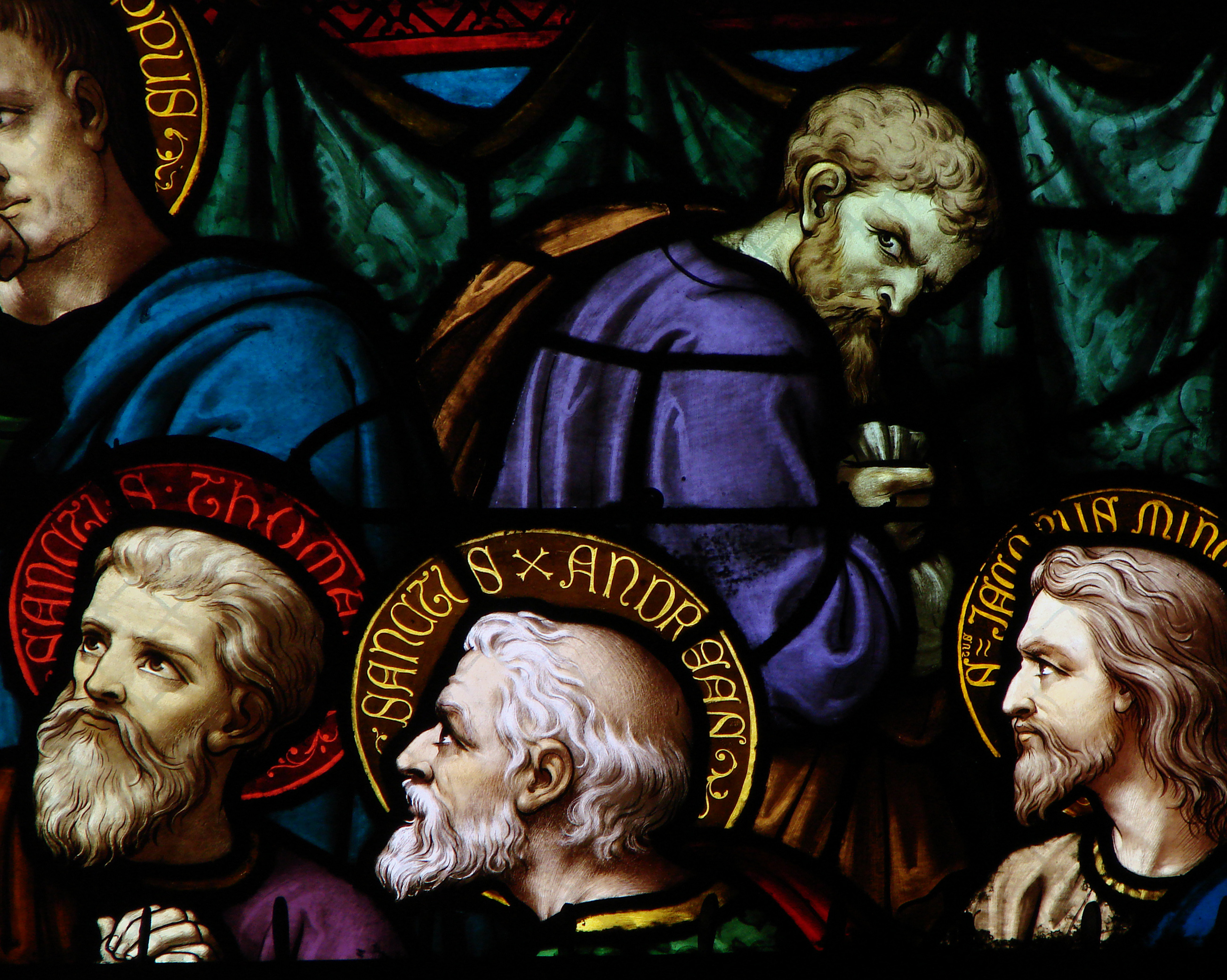
This name refers to Judas Iscariot. Two possible etymologies have been put forward for the name Iscariot: one derives it from the Latin sicarius, a small type of dagger, and would suggest that he, like St. Simon the Zealot (not to be confused with St. Peter, whose given name was also Simon), had revolutionary leanings. The other, which I find more plausible on linguistic grounds, is that it represents a Greek transliteration of the Hebrew-Aramaic phrase ish Kerioth -- "the man from Kerioth," Kerioth being a city in Judaea. This, if true, would probably make Judas the only disciple who came from Judaea proper; the rest were Galileans, like Christ Himself.

Jesus' own treatment of Judas Iscariot is mysterious, by our standards, though it is very characteristic of Him. Though one could hardly ever foresee anything Jesus would do, one can see what He did do and think instantly, "Of course. He would do that." He specifically chose him as one of the Twelve, though He knew he would betray Him, and when the Last Supper was celebrated, He told Judas to do what he had to do quickly. It has even been suggested that Christ's dipping the bread and handing it to Judas was not only an inconspicuous way of answering St. John's question, but also a way of showing peculiar regard to the recipient -- a final expression of His special love for Judas before the betrayal was finally enacted.

It is customary to present a form of the Office of Readings (traditionally prayed by some monastic orders in the wee hours of the morning) on the night of Spy Wednesday; this form of the office is called Tenebrae, a Latin word meaning shadows. It's a spooky kind of service, and full of symbolic foreshadowings of the approaching death of Christ. It traditionally closes with the loud slamming shut of a Bible (or a similar sound), commemorating the closing of the tomb.

The meditation I have chosen is from Murder In the Cathedral, T. S. Eliot's magnificent play about the martyrdom of St. Thomas Becket, who was killed by knights loyal to King Henry II of England in 1170 for obstructing the king's attempts to interfere with the Church's self-governance. The priests of the church attempted to bar the doors to prevent the knights from getting in, but Becket refused to allow this. Eliot gave him the following speech:
You think me reckless, desperate and mad.
You argue by results, as this world does,
To settle if an act be good or bad.
For every sin and every act
Consequence of good and evil can be shown.
And as in time results of many deeds are blended,
So good and evil in the end become confounded.
It is not in time that my death shall be known;
It is out of time that my decision is taken
If you call that decision
To which my whole being gives entire consent.
I give my life
To the Law of God above the Law of Man.
Unbar the door! unbar the door!
We are not here to triumph by fighting, by stratagem, or by resistance,
Not to fight with beasts as men. We have fought the beast
And have conquered. We have only to conquer
Now, by suffering. This is the easier victory.
Now is the triumph of the Cross, now
Open the door! I command it. OPEN THE DOOR!

Maundy Thursday

The word maundy comes from the Latin phrase Mandatum novum do vobis, "A new command I give unto you." This command, to love one another, is the expression of the whole ethos of the New Covenant, as surely as the Ten Commandments were the expression of the covenant forged through Moses between Israel and God. The orders for the sacrifice which the Apostles were to perform thereafter had already been laid down ("This is My blood of the covenant ... Do this in remembrance of Me"), and the Sacrifice which would ratify its own representation, a representation that conveys what it symbolizes by being the reality it symbolizes, was about to take place. In the meantime, the new morality, and the spiritual grace that would effect it, were explained.

The Maundy Thursday liturgy forms the first part of the Triduum (or "Three-Day Thing"). It is customary to open this liturgy, like all Masses, with the sign of the Cross, but not to close with it as is usual, because the Triduum is treated by Roman Catholics as a single liturgy -- beginning on Thursday, continuing through Good Friday, and concluding with the anticipatory Easter Vigil on Saturday, which does at last conclude with the sign of the Cross. Liturgically, it has an oddly two-sided character: on the one hand, it is the beginning of the great exaltation of Jesus and is the time when the Blessed Sacrament was instituted, and in honor of these things the Gloria, which has not been sung throughout Lent, is again used in the Mass here; but at the same time, it is the very brim of the chalice of anguish of the Passion -- and this is anticipated during the Communion rite, in which the customary ringing of bells in honor of Christ in the Host is eliminated in favor of a crotalus, a wooden "clapper" that at once marks and subdues the elevations.

Maundy Thursday Masses end in a procession: the Host is removed from the Tabernacle, where it is kept all year, and taken to what's called an Altar of Repose; this is done in a procession, joined by the whole congregation, commemorating the passing of Christ and the remaining eleven disciples out to the garden of Gethsemane the night before the Passion began, in which the self-gift preached by Christ in the washing of the disciples' feet was preached to the uttermost in His death.
We live in the sphere of death; we can reach out in thought into the sphere of the Resurrection, try to make approximations. But it remains something different that we never quite comprehend. This is because of the boundary of death, which closes us in and within which we live. But we can try to make approximations. One of these becomes apparent when we reflect that in the language of the Bible the word "body" -- "This is my Body" -- does not mean just a body, in contradistinction to the spirit, for instance. Body, in the language of the Bible, denotes rather the whole person, in whom body and spirit are indivisibly one. "This is my Body" therefore means: This is my whole person, existent in bodily form. What the nature of this person is, however, we learn from what is said next: "which is given up for you." That means: This person is: existing-for-others. It is in its most intimate being a sharing with others. -- Pope Benedict XVI, God Is Near Us: The Eucharist, the Heart of Life, p. 79

Good Friday

The events of Good Friday hardly need elucidation. The liturgy is again unusual: it is the only day in the year when no Mass is said (a Mass proper requires a consecration of the Eucharist, and Good Friday liturgies use Hosts consecrated in excess on Maundy Thursday and reserved for the purpose), and there is no Sacrament reserved in the Tabernacle.

I've chosen an unusually long meditation, partly because I have so little to say here, and partly because Chesterton's words (taken again from The Everlasting Man, pp. 210-212) are so powerful.

In this story of Good Friday it is the best things in the world that are at their worst. That is what really shows us the world at its worst. It was, for instance, the priests of a true monotheism and the soldiers of an international civilization. ... So in that drama which decided the whole fate of antiquity, one of the central figures is fixed in what seems the reverse of his true role. Rome was almost another name for responsibility. Yet he stands forever as a sort of rocking statue of the irresponsible. Man could do no more. Even the practical had become the impracticable. Standing between the pillars of his own judgment seat, a Roman had washed his hands of the world.
There too were the priests of that pure and original truth that was behind all the mythologies like the sky behind the clouds. It was the most important truth in the world; and even that could not save the world. ... The Jewish priests had guarded it jealously in the good and the bad sense. As savage heroes might have kept the sun in a box, they kept the Everlasting in a tabernacle. They were proud that they alone could look upon the blinding sun of a single deity; and they did not know that they themselves had gone blind. ...
And as it was with these powers that were good, or at least had once been good, so it was with that element which was perhaps the best, or which Christ himself seems certainly to have felt as the best. The poor to whom he preached the good news, the common people who heard him gladly, the populace that had made so many popular heroes and demigods in the old pagan world, showed also the weaknesses that were dissolving the world. ... We have noted it already as the neglect of the individual, even of the individual voting the condemnation and still more of the individual condemned. It was the soul of the hive; a heathen thing. The cry of this spirit was heard also in that hour, 'It is well that one man die for the people.' ... The mob went along with the Sadducees and the Pharisees, the philosophers and the moralists. It went along with the imperial magistrates and the sacred priests, the scribes and the soldiers, that the one universal human spirit might suffer a universal condemnation; that there might be one deep, unanimous chorus of approval and harmony when Man was rejected of men.
There were solitudes beyond were none shall follow. There were secrets in the inmost and invisible part of that drama that have no symbol in human speech; or in any severance of a man from men. Nor is it easy for any words less stark and single-minded than those of the naked narrative even to hint at the horror of exaltation that lifted itself above the hill. ... And if there be any sound that can produce a silence, we may surely be silent about the end and the extremity; when a cry was driven out of the darkness in words dreadfully distinct and dreadfully unintelligible, which man shall never understand in all the eternity they have purchased for him; and for one annihilating instant an abyss that is not for our thoughts had opened even in the unity of the absolute; and God had been forsaken of God.
Holy Saturday

In a sense there is no Holy Saturday liturgy, strictly speaking. The liturgy that does take place, as the sun sets and the next day begins by Biblical reckoning, does not memorialize the time spent by Christ in the tomb, but begins the season of Easter. The peculiar character of Holy Saturday as such would, I suppose, be the Harrowing of Hell, a favorite subject of Mediaeval artists, but I know of no liturgical commemoration of it.


Here at the Vigil, at last, the time of the Resurrection begins, supreme among the mysteries. The singing of the Alleluia is reinstituted before the reading or intoning of the Gospel, and the splendor of the celebration is throughout the greatest of the liturgical year. It is also traditionally at the Easter Vigil that new converts are received into the Church; I was received into full communion at the Vigil at the Catholic Student Center of the University of Maryland in 2008. The Easter Candle, symbol of the light of Christ, is dipped into the font (where Baptisms are performed), uniting the image of illumination with the image of life. The Litany of the Saints is chanted: the Resurrection broke the boundary between the living and the dead, and, though we often ask them for their prayers, we place special emphasis here upon the coinherence of the living and the dead. And after everything is completed and our fast is changed to a feast, there is also a special hymn to the Mother of God, sung only during Eastertide:

Regina caeli, laetare, Alleluia!
Quia quem meruisti portare, Alleluia!
Resurrexit, sicut dixit, Alleluia!
Ora pro nobis Deum, Alleluia!

O Queen of Heaven, rejoice, Alleluia!
For He whom thou wast found worthy to bear, Alleluia!
Hath risen as He said, Alleluia!
Pray for us to God, Alleluia!


Easter Sunday

This is the day when Jesus began appearing after His Resurrection: first to St. Mary Magdalene, and then -- well, actually, then it's kind of hard to work out. If you were trying to remember the death and totally unexpected reversal of death of your most intimate teacher, thirty years later, you'd probably find it hard to straighten out the details, too. But it seems that the next people to see Him were the women who had remained at the tomb when the Magdalene went to tell the disciples what had happened, after which He also appeared to her; and then, the same day, Simon Peter and Cleopas (the husband of one of the unreasonably large multitude of Marys in the Bible) encountered Him on their way to Emmaus, a town about seven miles outside of Jerusalem, and when they recognized Him and He promptly vanished, they rushed back to Jerusalem to tell the others. And then Christ appeared to the ten disciples who were gathered in a house together -- St. Thomas being absent -- and then again, one week later, this time including Thomas, and indeed singling him out for what looks like a good-natured and really rather funny remonstrance.

The almost chaotic appearance of the texts of the Gospels relative to one another makes perfect sense, given the emotional roller-coaster the witnesses were being put through. (Thomas Cahill, a historian with an imaginative streak, picks up the traditional iconography of St. Peter being white-haired, and implies in his book Desire of the Everlasting Hills that the saint's hair did indeed go white due to the extreme shock of the Passion and the Resurrection together.) It also fits rather neatly with the liturgical custom of regarding the whole Octave of Easter, i.e. the eight days from Easter Sunday to the next Sunday inclusive, as a single "day." The Octave, recalling the Resurrection, is made an image of eternity, and specially of the eternal fact that Jesus is alive.

Call me a nerd if you like (it's not like you'll be wrong), but one of the passages in literature that reminds me so forcibly of this that I can't help crying when I read it, is actually from J. R. R. Tolkien's more obscure and difficult work The Silmarillion. Near its close, when Morgoth (an evil power more ancient and terrifying even than Sauron, and who was originally Sauron's master) had dominated all of Middle-earth, enslaving Elves and Men alike, a mariner named Earendil -- himself half-Elf and half-Man (in fact, the father of Elrond) -- took it upon himself to sail to the land of the Valar.


The Valar were godlike or angelic spirits, who had refused to aid the Elves in their war against Morgoth because the Elves had begun it with a murderous rebellion in the very land of the Valar, slaying their own kin; Earendil had no idea whether his plea on behalf of Middle-earth would be accepted, and doubted that he could even reach the land of the Valar, protected by deceitful enchantments; but reach it he did, guided by a magical gem that he kept with him, which had been filled with a light created by the Valar themselves, and of which the Sun and the Moon were in fact inferior copies. And when Earendil got there, he met no one: the city in which the faithful of the Elves lived was empty.
[A]nd his heart was heavy, for he feared that some evil had come even to the Blessed Realm. He walked in the deserted ways of Tirion, and the dust upon his raiment and his shoes was a dust of diamonds, and he shone and glistened as he climbed the long white stairs. And he called aloud in many tongues, both of Elves and Men, but there was none to answer him. Therefore he turned back at last towards the sea; but even as he took the shoreward road one stood upon the hill and called to him in a great voice, crying:
'Hail Earendil, of mariners most renowned, the looked for that cometh at unawares, the longed for that cometh beyond hope! Hail Earendil, bearer of light before the Sun and Moon! Splendor of the Children of Earth, star in the darkness, jewel in the sunset, radiant in the morning!'