Collect

Collect for the Fourth Sunday after Trinity

O God, the protector of all that trust in thee, without whom nothing is strong, nothing is holy: increase and multiply upon us thy mercy; that, thou being our ruler and guide, we may so pass through things temporal, that we finally lose not the things eternal; grant this, O heavenly Father, for the sake of Jesus Christ thy Son our Lord, who liveth and reigneth with thee, in the unity of the Holy Spirit, ever one God, world without end. Amen.

Sunday, June 30, 2013

Why Not Ex-Gay?, Part II: Trojan Security

A few weeks ago, after work, I was sitting in my car about to leave the parking lot, when I noticed a truck a few spots away. It belonged to a company called something like "Trojan Security."

That's really the name you went with, guys?

Well, never mind. I've discussed what problems I at any rate had, and have, with ex-gay theory. But of course it's easy enough to reject something because of apparent theoretical problems, and then discover later, to one's embarrassment perhaps, that such problems had been foreseen and adjusted for. Even, sometimes, that there was more in the original theory than there had seemed at first or second glance. And I've admitted already that my involvement in the ex-gay world was minimal. Did this better-than-first-impressions thing prove to be the case with ex-gay theory?

The Short Answer

No.

The Somewhat Longer Answer

It must be admitted that -- for some people and to some extent -- sexuality is fluid. This works both ways,* of course: people who spent decades with a predominantly gay disposition may find themselves attracted to someone of the opposite sex, but equally, a straight person may find themselves unexpectedly interested sexually in someone of the same sex. Attraction is complex, involving such a multitude of biological, psychological, and personal factors, that I suspect there are barely rules of thumb to it, and certainly not the essentialist categories or unwavering boundaries suggested by both some schools of queer advocacy and many versions of the ex-gay movement. (I'm happy to say, though, that recognition of sexual fluidity is now more "in" than it used to be.) David Morrison in Beyond Gay recounts a definite -- and unsought -- shift, if not into heterosexuality, at any rate into some degree of bisexuality, after his conversion to Catholicism, while conversely, I've spoken to a man who was married to a woman and had never been interested in other men until, in his late thirties, he fell in love with a male acquaintance. And there are also cases of what the Gay Christian Network terms "mixed orientation marriages," in which -- for any one of a variety of reasons, from dishonesty to wanting children to being in love with a quite unexpected person -- a queer person chooses to enter a heterosexual marriage; and sometimes those don't work, and sometimes they do (Melinda Selmys and Josh Weed, whose blogs are on the right, are good examples of people who are entirely honest about being lesbian or gay, but who happened to fall in love with a member of the opposite sex nevertheless). For this and other reasons, I'm hesitant to categorically deny that anybody has ever experienced any change in orientation while involved in an ex-gay group.

However. To say that sexuality is fluid is not the same thing as saying that it is alterable by effort on our part. This distinction may seem like a pedantic one, but it's not -- no more than the distinction between growing taller and trying to make yourself taller by pulling on the top of your head is a pedantic one. Even supposing that a person is telling the truth about their own change of orientation, it wouldn't follow automatically that the ex-gay ministry was the cause, because correlation does not equal causation.
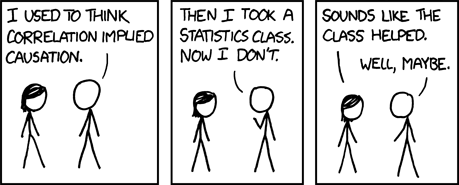
Thank you to Randall Munroe, author of xkcd.

I would in any case have a hunch that something as profoundly intimate as sexuality is not very amenable to being changed from without by effort; many things about us have to change from within if they are going to change at all, and they may not be going to change in the first place. But it is in some ways easy to excuse someone who has confused natural sexual fluidity with the results of a deliberate effort to change one's sexual orientation.

The Hollow Horse

What is harder to excuse -- though it can be forgiven, which involves acknowledging the reality of the evil being forgiven -- is the complex and, seemingly, mendacious approach to orientation change that most if not all ex-gay groups have peddled, and, in the case of NARTH or the Restored Hope Network, continue to peddle.

The beginning of it, for me anyway, lies in the language. Nearly all ex-gay groups encourage their members to immediately desist from calling themselves gay, explaining that that isn't their identity. Well, we knew that already, actually, but yes, there can definitely be some over-emphasis on it (especially when someone first comes out -- not unlike the overzealous, naive, slightly embarrassing convert to Christianity that many of us have known), so okay. But many ex-gay groups also give the impression of regarding the "change" in question as being accomplished simply by this thinking differently about oneself, and that any continuing same-sex desires can be dismissed as "residual." Gayness is defined, not simply as feeling attraction to the same sex, but as acting on it. Which means that making an effort to stop, and mentally recategorizing oneself, are enough to qualify as an ex-gay.

Well, fine; think of yourself however you please. Truly. The thing is, what people are hearing is that their homoerotic feelings will go away and be replaced with opposite-sex attractions. Do ex-gay ministries not know that? It beggars belief. To insist that the term gay includes same-sex sexual activity is a qualifier that only Christians, and not all of them, insert into the meaning of the term; most people simply don't mean that. To use that more restricted definition of a common term, instead of, say, talking about learning to lead a chaste lifestyle -- language that is equally available -- is either horribly stupid or grossly disingenuous. (On the credit side, it did give us the agonizing first five and a half minutes of this.)**

A ten-year-old could probably have spotted the difficulty about getting a bunch of gay men together and telling them to be manly at each other instead of thinking about sex.*** Anybody at all can spot what did in fact happen next. Not every ministry and not every minister was fraudulent, of course; some people received help that they badly needed, as to a limited extent I did; and even of those figures in ex-gay ministries who fell down on the job, I tend to think that most of the time it was a response to a starved need for truthfulness, intimacy and support, rather than deliberate and malignant deceit and self-indulgence. Often, at least, and at first. But as Alan Chambers admitted in his mea culpa, good intentions don't mean much when people have been hurt. And people have been hurt.

Families have been hurt by the imposition of the reparative drive theory onto people whose personal histories simply didn't read that way. Men determined to be freed of their homoerotic desires have convinced themselves, whether it was true or not, that their fathers had been cold and distant and their mothers intrusive and smothering; and parents equally have been not only allowed but encouraged to blame themselves for their child's orientation. People have been hurt by being pressured into marriages that came to pieces when one or both parties discovered that getting married does not in itself produce the kind of bond that ought, rather, to lead to marriage, and that being attracted to people other than your spouse does not go away just because you have a sexual outlet -- especially if that sexual outlet is literally different in kind from what your appetites are tugging you towards. Adolescents just discovering homoerotic desires have been frightened and damaged, not only by being promised a change in orientation that the promisers had no power to deliver on, but by being, at times, subjected to cruel and barbaric attempts at "curing" them. At other times, the treatments were less tragic only by being more grotesquely comical; as when some ex-gay orgs would use "Balls Back," a (supposedly) therapeutic technique (recounted on Warren Throckmorton's blog), because there's nothing gay about breaking through a chain of men to grab symbolic testicles and suck the juice out of them, no sir.

Painful hilarity aside, the sometimes ghastly consequences of the movement are not even my fundamental reason for objecting to ex-gay therapies -- that fundamental reason, I intend to discuss in my next. But the consequences are, to put it mildly, grave, persistent, and conspicuous, and are a major source of scandal. Chambers, who is perhaps in a better position to know than anyone, said frankly that of all the LGBT people he knew or read of involved in Exodus, less than one percent experienced a substantial change in attraction. Gary Cooper and Michael Bussee had discovered the same thing three years after Exodus was founded, and left the program, and their wives, for one another. I'm sorry, but it doesn't take a Cassandra to see that that horse is full of Trojans.****

(Okay, so actually the horse was full of Greeks. But frankly, that only reinforces the point.)

*Feel free to insert your own bisexuality joke here.
**This is one of several reasons I have for insistently using the term gay to describe myself, rather than adopting the more PC-for-Catholics moniker same-sex attracted. There are other considerations at work, and of course gay is not a 100% satisfying word either. I don't think there is one, and I tend to doubt that there can be (though, for the celibate among us, Joshua Gonnerman's phrase "virgin queen" comes close). But gay is the closest thing to standard currency that our culture has, at present, and self-control -- even perfect self-control -- is not the same thing as an altered sexual orientation.
***Feel free to insert your own "Don't think about pink elephants" joke here.
****You wipe that smirk off your face right now, young man.

Thursday, June 27, 2013

Reblog: Cracked.com

I tried to channel Allie Brosh of Hyperbole and a Half and be a responsible adult and put myself on an update schedule for the blog. Instead, I've chosen to channel Allie Brosh of Hyperbole and a Half and update when the fit takes me, especially in view of the unexpectedly massive pull of my post on DOMA. Since I haven't yet made time to continue my series on ex-gay stuff, please enjoy this post from cracked.com, 5 Priests Who Turned Badass When Things Got Critical.

Wednesday, June 26, 2013

A Gay Catholic's Thoughts on the DOMA Ruling

Love your enemies, bless those who curse you, do good to those who hate you, and pray for those who spitefully use you and persecute you. -- Jesus of Nazareth

Ugh, fine, I'll talk about it. I had originally determined to say as little as possible on the DOMA/Prop. 8 ruling, but my Twitter and Facebook are awash in triumphalism from my gay friends, paranoia from traditionalist Christians, and mutual hatred from all. My views are not a secret, yet I don't relish them, and discussing them now will convince nobody. But I'd like to address both my progressive and my traditional readers, gay and straight, Christian and secularist, and beg for a better mode of discourse.

First of all, fellow Christians:

1. This ruling has not in fact removed any of your liberties. The Supreme Court has not declared not supporting gay marriage illegal; it has not even declared not supporting gay marriage unhip. Could it eventually introduce legal penalties for those who decline to recognize same-sex unions? Yes. But let's keep our hair on and take things one at a time. In particular, let's wait until we've actually, you know, suffered something, before crying out that we are a persecuted minority: Nazi America (only this time with The Gays) is not sending Christians to concentration camps. The only person who stands to be embarrassed by you losing your temper is you.

2. The Supreme Court has not ruled on, cannot rule on, and has no interest in ruling on, the sacrament of marriage. What it has ruled on is marriage as a civil institution. Now, you might argue, as the Catholic Church does, that marriage as a civil institution predates any state and that no state has the authority to recognize same-sex unions as marriages per se, on the basis of natural law. Go ahead and argue that by all means; call the ruling wrong if that is what you think; but don't make the DOMA ruling out to be some sort of persecution -- not even if it makes persecution in the future more possible; distinctions are important.

3. Keep in mind that whatever you say in public -- and the Internet does count -- can be heard by gay people. This is partly because it's public. It is also partly because your church has gay people in it. Even if you don't know them, even if you don't know who they are, they're there. This is not a reason to pretend that you don't hold the convictions you hold, but it is a reason to stop and think about how you say things, and where your heart is in saying them.

4. Many of the rights secured by marriage -- such as the right to visit loved ones in the hospital, the right to stay in the country, and a host of others -- are things that Christians really have no need to oppose for gay couples. I certainly don't, and I see no reason to; indeed, opposition to them seems pretty cruel. On the other hand, a lot of opponents of gay marriage have not thought the matter through, and don't realize these obstructions are in place; but it's the sort of thing you ought to realize before opening your mouth. If you oppose gay marriage but support those rights being extended to gay couples, say so out loud. It won't go without saying, not even if you think it should.

5. Realize that, historically, the churches have connived in the redefinition of marriage. The understanding of marriage as a solemnization of two people's love for one another, rather than for procreation -- which is the basis of the case in favor of gay marriage -- is something originally introduced, promoted, and believed by Christians, and that without Biblical backing. Jesus never addressed gay marriage, since it wasn't a current issue then and there, but He had some choice remarks to make about divorce which plenty of Catholics and Protestants prefer not to think about, or try to establish as legal norms. Blaming the redefinition of marriage on the LGBT movement is shabby scapegoating.

6. There is a scene in the movie A Man For All Seasons, about the martyrdom of St. Thomas More, in which a witness recounts a conversation he had with the saint while he was imprisoned in the Tower:
"I said, 'Suppose there were an Act of Parliament that I, Richard Rich, were to be king. Would you then take me for king?' 'That I would,' he said, 'for then you would be king.' Then he said, 'But I will put you a higher case. Suppose there were an Act of Parliament that God should not be God.'"
God is still God. And He will continue to be even if the evil American police state makes you gay marry on your lawn tomorrow.

7. If your politics, or, God forbid, your faith, make you despise someone for not sharing them, you're Jesus-ing wrong.

Equally, fellow LGBTQs:

1. You won; a mazeltov is in order. Unless you are, uh, one of the many LGBTQ people who doesn't support gay marriage. You should know better than anybody else that ideology does not always line up with personal disposition as we'd expect; keep in mind that there is diversity within the gay world on this topic -- as there is diversity in the Christian world. It is a disservice to everyone concerned, and, I'd argue, especially to those who are in the sometimes awkward position of being queer Christians, to turn this into a war between Christendom and glistendom.

2. Calling people bigots for the views they hold is not worth your energy. It isn't an argument, for one thing; for another, if you're right, the only result it has upon a bigot is to make them mad or disdainful (or both). Since the fight on this subject is supposed to be to defend love, that doesn't seem like a very consistent tack. And if they actually have a reason for what they think, it just makes you look bad.

3. If you are having a serious discussion with someone who opposes gay marriage, you have every right to demand that they examine both their own hearts and your arguments; but it's not fair to make such a demand if you aren't willing to do the same. Arguments that amount to "But gay stuff is icky!" can of course be treated with the contempt they deserve -- though I'd add that treating an argument with contempt is not the same as treating a person with contempt -- but there are arguments, notably those of natural law, that are not based on homophobia, and even not based necessarily on the premise that queer sex and relationships are wrong. (There are also arguments that, while perhaps not intrinsically irrational, rely on a confusion of the authorities of the state and the church; I am fiercely opposed to any such confusion, but that is a debate that has to be had on its own grounds, and has a wider application than this.)

4. For those of you who are also Christians: if your politics, or, God forbid, your faith, make you despise someone who doesn't share them -- especially if that person is a fellow believer -- you're Jesus-ing wrong.

Monday, June 24, 2013

Why Not Ex-Gay?, Part I: Swiss Cheese Theory

I am writing, for the first time, from what will (probably) be my new home in Baltimore. There are no curtains and no AC, and the carpet is a study in hideousness. There is a certain ascetic pleasure to it, I have to admit. (Does it still count as asceticism if you enjoy it, I wonder?)

I've been toying with the idea of a post on ex-gay stuff for a while, and the recent closure of Exodus International, along with a handful of personal conversations, have decided me on doing so. (The post might have been earlier, and better, if I hadn't gotten caught up in reading delightful articles about social awkwardness while I should have been typing.)

It's been the default response of American churches (those that embrace a traditional sexual ethic, anyway) more or less since Stonewall. Attempts at curing homosexuality are older than Exodus or any other ex-gay ministry; psychiatric experiments on gays were a common feature of the awkward beginnings of modern psychology. The shift away from the "cure" mindset among Christians will be slow, challenging, and uneven, and not everybody will make it at the same pace or for the same reasons. Nor will everybody go an equal distance: there are, after all, churches that currently bless same-sex unions, and then there's Westboro Baptist, and everything in between. There's no reason to suppose that diversity will cease. But I tend to agree with this excellent post from Brent Bailey that (to oversimplify) the center of gravity will shift, and that that's a good thing.

I actually didn't get that deeply involved in ex-gay culture, though I am in many ways a textbook example of the things it purports to cure. Many friends and acquaintances of mine have been deeply involved, and profoundly scarred by their experiences with it; others I know have come out unchanged, negatively or positively; and still others have taken something valuable away from it. I therefore have to temper what would otherwise be a pretty categorically negative series with some reservations. But I still definitely don't endorse ex-gay thought or practice, and it bears saying why.

My Experience As an Ex-Gay

I said I didn't get deeply involved, and I didn't: I was in ex-gay counseling for about two years, and ultimately believed I had changed from homosexual to heterosexual. But, though I dabbled on the fringes -- attending lectures and reading a book on the subject, here and there -- I never joined any of the groups.

This was partly out of nerves; if I went to one, I might meet a nice guy, and we might like each other, and we might fall in love and destroy each other's lives. But there was more to it than that (and the prospect of falling in love was something I was ambivalent about anyway, not merely scared of).

The thesis upon which ex-gay theory is based is one of family dynamics. The notion is that homosexuality is caused, in men, by overidentification with the mother, and a corresponding lack of identification with the father, usually attributed to an overbearing mother and an emotionally distant father (what I call "farther and smother"). This unmet need for male affirmation and affection then got sexualized at puberty, possibly with strengthening factors in same-sex peer rejection, sexual abuse, experimentation, and the like, and ultimately a generally homosexual disposition would form.

This certainly described my own experience. And so I did my best to reconnect with my father, under my therapist's guidance (a project that began going much better, as it happens, after I accepted myself as a gay man, several years after dumping reorientation attempts). And I concentrated on working up what flickers of attraction to women I had, and building solid, non-sexual friendships with male peers. (Not that they felt like peers; I usually feel about five years younger than I actually am, and being around people who are chronologically the same age as I am is intimidating.) And it didn't do me much harm. I even had an episode where, after a particular prayer, I was attracted to women and not men for about two months or so. Well, that technically means it worked, right?

... And As an Ex-Ex-Gay

And after that short period of heteroerotic attractions -- which I'm now inclined to attribute to hysteria, not miracle -- my desires changed back.

What troubled me more, though, and had been troubling me from the beginning, was the theory. "Farther and smother" always seemed to be an explanation that did not explain. First of all, why were these unmet needs "sexualized at puberty"? Everyone has injuries and unmet needs going back to childhood, and it doesn't turn the majority of us into sexual minorities or anything else, save perhaps that collection of neuroses that is called being a grown-up. And even supposing that such familial psychodynamics could produce homoerotic desires, why would they additionally crowd out the normal desire of a man for a woman? Or, conversely, if homosexuality was caused by a distant father, did that mean straight men needed to have distant mothers to develop into heterosexuals? Presumably a child who was well-loved by both parents would go on to become asexual.

And the ex-gay attempts at explaining lesbianism were an embarrassment. The distant-father narrative was also used for that, somewhat confusingly; especially in conjunction with the possibility of a father abusing a daughter, or abusing her mother, thus producing a distrust of masculinity and/or a contempt of femininity. The former would lead to avoiding men, the latter to failing to identify as a woman. Or overidentification with the father was also possible, leading to a masculinization of the girl's psyche, which could also make her a lesbian. In other words, a connection to her father that was too weak or too strong could result in lesbianism; apparently virtually anything could cause lesbianism. And there remained the bald assertion that these problems somehow got tangled up in sex during puberty -- an assertion backed by no evidence, no clear reason; just a claim, "This is what happens." Trying to accept that unbacked claim was, for me, like trying to live in a house made of Swiss cheese.

Further, plenty of heterosexual men I knew had exactly the family dynamic described by ex-gay theorists, and going gay had plainly never crossed their minds. Conversely, I knew, or read about, men and women like myself, whose families had completely different patterns. (Justin Lee is an excellent example of a gay man whose familial and social patterns should, on ex-gay theory, have made him as straight as anybody.) And I couldn't help noticing that a lot of their examples of what would constitute a distant father, an overbearing mother, peer rejection, and so forth were so mundane that what they really suggested (if anything) was that they affected a given boy because he was already different, inside, and therefore received these things differently.*

My school trained me well in logic, and such things as demanding proof of first premises, considering alternate hypotheses, never suppressing evidence, and avoiding false links between correlation and causation, were ingrained in me. And ex-gay theory quite simply didn't ring true.

I don't regret the counseling I went through: I've suffered from depression since I was a small child; I had terrible relationships with both my parents, which their unexpected and unwelcome discovery of my being gay hadn't helped; I related terribly to my peers; I needed counseling. But it didn't do what it claimed for itself, and the professionals behind it acted unprofessionally in failing to think their theories through adequately, or to examine their results with scientific rigor.

Besides, with me, they lucked out: I was too stubborn to swallow their theory whole (I'd sooner be told what to do than what to think), and therefore escaped the worst of the guilt, shame, and confusion stemming from failed attempts at reorientation. Other people have been scarred for life by their involvement; some entered marriages which ultimately traumatized themselves, their spouses, their children; and there have been some who, having tried and failed to become heterosexuals, have gone on to try and succeed at becoming dead. Not. Bloody. Worth. It.

In short: the theory didn't make sense, and the results didn't last, so I didn't stay.

*This isn't to say that plenty of queer people haven't experienced horrible rejection at the hands of their families or of peers, before coming out of the closet as well as after. But some haven't, and the desperation to find some traumatic "root cause" of homosexuality has led in some cases to vague, insignificant, or irrelevant things being attributed as the cause. Lee himself gives the example, in his book, of an ex-gay theorist insisting that his alopecia -- which never deeply bothered him to begin with -- was the original psychic wound that led him to be attracted to men.

Thursday, June 20, 2013

News: Alan Chambers Apologizes to Gay Community

Alan Chambers, the head of Exodus International, the largest single ex-gay organization in the world, issued a public apology to the LGBTQ world last night.

I am overjoyed by this. Other figures once prominent in the ex-gay world (like John Paulk) have issued apologies on their own behalf, but this is, I believe, the first time that the current head of a group like this has had the honesty, the humility, and the bravery to make such a statement. I find it a beautiful witness to Christian faith -- confession of sin and asking forgiveness are kind of the M.O. of Christianity, after all -- and I very much hope that this will be a part of repairing what has been a bitter, hurt-filled relationship between the churches and the queer world, not only here in North America but all over the world.

And he's putting his money where his mouth is. Not only has Chambers apologized; Exodus is shutting down. You can read their statement here.

Thank you, Mr. Chambers. I know that many in the gay world, Christian and otherwise, will throw this apology in your face; and I know that many Christians will castigate you for this. I'd like to say, as a gay man, that I am moved by your apology and grateful for it, and that I forgive any pain you may have caused me and the ones I love; and I'd like to say, as a Christian, that I respect and applaud the strength it took to confess so publicly -- it displays a justice, humility, and conviction that I aspire to in my own life -- and that I believe this act can be a channel of the grace of God.

Some highlights of the apology for me:

"It is strange to be someone who has both been hurt by the church's treatment of the LGBT community, and also to be someone who must apologize for being part of the very system of ignorance that perpetuated that hurt. Today it is as if I've just woken up to a greater sense of how painful it is to be a sinner in the hands of an angry church. ...

"I imagine it to be very much like a man I recently heard speak at a conference I attended, Father Elias Chacour, the Melkite Catholic Archbishop of Israel. He is an Arab Christian, Palestinian by birth, and a citizen of Israel. Talk about a walking contradiction. ...

"Never in a million years would I intentionally hurt another person. Yet, here I sit having hurt so many by failing to acknowledge the pain some affiliated with Exodus International caused, and by failing to share the whole truth about my own story. My good intentions matter very little and fail to diminish the pain and hurt others have experienced on my watch. The good that we have done at Exodus is overshadowed by all of this.

"Friends and critics alike have said that it's not enough to simply change our message or website. I agree. I cannot simply move on and pretend that I have always been the friend that I long to be today. I understand why I am distrusted and why Exodus is hated.

"Please know that I am deeply sorry. I am sorry for the pain and hurt many of you have experienced. I am sorry that some of you spent years working through the shame and guilt you felt when your attractions didn't change. I am sorry we promoted sexual orientation change efforts and reparative theories about sexual orientation that stigmatized parents. I am sorry that there were times I didn't stand up to people publicly 'on my side' who called you names like sodomite -- or worse. I am sorry that I, knowing some of you so well, failed to share publicly that the gay and lesbian people I know were every bit as capable of being amazing parents as the straight people I know. I am sorry that when I celebrated a person coming to Christ and surrendering their sexuality to Him that I callously celebrated the end of relationships that broke your heart. I am sorry that I have communicated that you and your families are less than me and mine.

"More than anything, I am sorry that so many have interpreted this religious rejection by Christians as God's rejection. I am profoundly sorry that many have walked away from their faith and that some have chosen to end their lives. For the rest of my life I will proclaim nothing but the whole truth of the Gospel, one of grace, mercy and open invitation to all to enter into an inseverable relationship with almighty God.

"I cannot apologize for my deeply held biblical beliefs about the boundaries I see in scripture surrounding sex, but I will exercise my beliefs with great care and respect for those who do not share them. ... My beliefs about these things will never again interfere with God's command to love my neighbor as I love myself."

"You have never been my enemy. I am very sorry that I have been yours."

(The full text is here.)