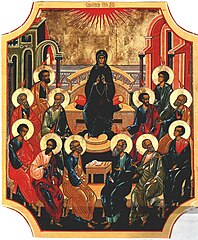
Collect

Collect for the Fourth Sunday after Trinity

O God, the protector of all that trust in thee, without whom nothing is strong, nothing is holy: increase and multiply upon us thy mercy; that, thou being our ruler and guide, we may so pass through things temporal, that we finally lose not the things eternal; grant this, O heavenly Father, for the sake of Jesus Christ thy Son our Lord, who liveth and reigneth with thee, in the unity of the Holy Spirit, ever one God, world without end. Amen.

Monday, October 9, 2017

Why I Am Not a Capitalist

This post wasn't planned. Actually it started out as a Facebook comment, replying to a reply to a reply to a Chesterton quote I'd retweeted: It cannot be too often repeated that what destroyed the Family in the modern world was Capitalism. As I was writing, and citing absurdly long, and still lengthening, passages from Chesterton's essays on Distributivism, I realized that trying to summarize this in a Facebook comment was a useless endeavor, so I decided to turn it into a Google doc. Then I realized that, since this is one of my major and animating political concerns, the blog seemed like the right place to put it. And, well, the rest is history.


I take Capitalism (at its purest) to mean the view that: first, the only persons who are or can be concerned with any transaction are the parties transacting (i.e., no others can justly have any say in the matter, even if it affects them in some immediately practical way); second, that the only quality that makes a transaction fair is the mutual willingness of the parties to engage in it (e.g., a just price means nothing more nor less nor other than a price that a purchaser consents to pay the seller, and a just wage means simply and solely the wage an employee consents to take from an employer—regardless of the thing sold, the work done, or any constraining factors on the choice). While I don’t think this view irrational, I do think it fundamentally incompatible with Catholicism in certain important ways: the Church teaches that the goods of creation were made for mankind as a whole, the universal destination of goods (cf. the Catechism of the Catholic Church §§2402ff.), hence also her persistent teaching that we have a duty to give to the poor, as a matter of justice and not only of charity (cf. Quadragesimo Anno, especially §§3-5). Accordingly, she has also taught that the good of people in general, and not only of the parties of a transaction, must be considered by the parties to any transaction, and that there is such a thing as an unjust price, notably (but not only) in the context of monopolies whether legal or effectual, and an unjust wage.


The best material of Chesterton’s that I'm acquainted with on the subject can be found in What's Wrong With the World and The Well and the Shallows. Obviously I can't quote entire essays here, but some salient passages:


Now Marx had no more philosophy than Macaulay. The Marxians have therefore no more philosophy than the Manchester School [a group of economists drawing on Adam Smith, and favoring laissez-faire and government non-intervention in trade]. ... A Philosophy begins with Being; with the end and value of a living thing; and it is manifest that a materialism that only considers economic ethics, cannot cover the question at all. If the problem of happiness were so solved by economic comfort, the classes who are now comfortable would be happy, which is absurd. —Well, pp. 97-98


This hints at my own discomfort with Capitalism, at least with all the versions of it I've encountered and been able to understand (including the Austrian ones): they in all cases seem, and in some cases explicitly profess, to divorce economics from ethics and both from the purpose and dignity of man—or at most to locate man's dignity in his capacity for economic choice, which I utterly reject no matter how broadly economic choice is defined. For in that case, those who are powerless to choose, like the unborn, the mentally ill or handicapped, and the vegetative, are accordingly robbed of their humanity, as we have seen with a horribly compelling historical logic here in the West where Capitalism has enjoyed most of its explicit triumphs. (The fact that certain prominent Capitalist theorists, including Ludwig von Mises and Ayn Rand—pace Deirdre McCloskey—have expressed the view that Capitalism and Christianity are essentially incompatible is, for me, a mere footnote beside that.) Any economic system that does not begin with the dignity and happiness of man as such, questions in my view inseparable from his purpose, are inherently suspect; and that accordingly requires situating economics firmly within the discipline of ethics.


I believe the divorce of economics from ethics that (as far as I can tell) Capitalism has effected as a historical fact, whether it’s intrinsic to Capitalism or not, is responsible for our incredible wastefulness in the modern era. Yes, an increased population plays a part in pollution, but pollution isn’t the only effect of wastefulness—I think our respect for good craftsmanship has plummeted as well, because, while craftsmanship makes some money, advertising makes far more. When the idea of real, objective worth is banished from things, and profit substituted for it, the decay eventually begins to show in the things themselves; for when an evil spirit hears its name, it comes.


Perhaps the shortest statement of it is in the fable of the man who sold razors, and afterwards explained to an indignant customer, with simple dignity, that he had never said the razors would shave. When asked if they were not made to shave, he replied that they were made to sell. That is A Short History of Trade and Industry During the Nineteenth and Early Twentieth Centuries. … It is not true that a man whose apple-tree is loaded with apples will suffer from a want of apples; though he may indulge in a waste of apples. But if he never looks upon apples as things to eat, but only as things to sell … if he produces as many apples as he imagines the whole world wants, with the hope of capturing the trade of the whole world—then he will be either successful or unsuccessful in competing with the man next door, who also wants the whole world’s trade to himself. Between them, they will produce so many apples that apples in the market will be about as valuable as pebbles on the beach. Thus each of them will find he has very little money in his pocket, with which to go and buy fresh pears … At the root of all apple-trees and apple-growing, it is really as simple as that.


Of course I do not mean that the practice is at present simple; for no practical problem is simple … But the principle is simple; and the only way to proceed through a complex situation is to start with the right first principle. … When God looked on created things and saw that they were good, it meant that they were good in themselves and as they stood; but by the modern mercantile idea, God would only have looked at them and seen that they were The Goods. … Nobody in his five wits proposes that there should be no trade and no traders. Nevertheless, it is important to remember, as a matter of mere logic, that there might conceivably be great wealth, even if there were no trade and no traders. —Ibid., pp. 165-168



Turning from this back to the original context of the quote about Capitalism destroying the family, Chesterton proceeds to say:


No doubt it might have been Communism, if Communism had ever had a chance, outside that semi-Mongolian wilderness where it actually flourishes. But so far as we are concerned, what has broken up households, and encourages divorces, and has treated the old domestic virtues with more and more open contempt, is the epoch and power of Capitalism. It is Capitalism that has forced a moral feud and a commercial competition between the sexes; that has destroyed the influence of the parent in favor of the influence of the employer; that has driven men from their homes to look for jobs; that has forced them to live near their factories or their firms instead of near their families; and, above all, that has encouraged, for commercial reasons, a parade of publicity and garish novelty, which is in its nature the death of all that was called dignity and modesty by our mothers and fathers. It is not the Bolshevist but the Boss, the publicity man, the salesman and the commercial advertiser who have, like a rush and riot of barbarians, thrown down and trampled underfoot the ancient Roman statue of Verecundia [goddess of modesty]. … It is done, for instance, by perpetually guying the old Victorian virtues or limitations which, as they are no longer there, are not likely to retaliate. It is done more by pictures than by printed words … Then they balance these things by photographs of the Modern Girl at various stages of the nudist movement; and trust that anything so obviously vulgar is bound to be popular. For the rest, the Modern Girl is floated on a sea of sentimental sloppiness; a continuous gush about her frankness and freshness, the perfect naturalness of her painted face or the unprecedented courage of her having no children. … When I see the Family sinking in these swamps of amorphous amorous futility, I feel inclined to say, ‘Give me the Communists.’ Better Bolshevist battles and the Brave New World than the ancient house of man rotted away silently by such worms of secret sensuality and individual appetite. —Ibid., pp. 112-113


Here of course he is speaking of the social alterations which, in this country, we associate more with the Sexual Revolution of the 60s than with the Roaring 20s (rightly or not). But the fact remains that promiscuity is naturally antithetical to the family, and also extremely profitable, both because sex sells products (whether they have anything to do with sex or not) and because industries like abortion and the contraceptive trade depend primarily, though not solely, on fornication and adultery to exist. And all this is without touching the matter of divorce lawyers profiting from the destruction of the family, which according to our Lord is also making money from adultery.


But there is another side to this, another way in which Chesterton considered Capitalism inimical to the family—not in the sense that all families would be destroyed by it, but that it allowed the family to mount no defense of itself against the crushing power of money.


I have said that the strong centers of modern English property must swiftly or slowly be broken up … There are two ways in which it could be done, a cold administration by quite detached officials, which is called Collectivism, or a personal distribution, so as to produce what is called Peasant Proprietorship. I think the latter solution finer and more fully human … I will end with one plain parable, which is none the worse for being also a fact.


A little while ago certain doctors and other persons permitted by modern law to dictate to their shabbier fellow-citizens, sent out an order that all little girls should have their hair cut short. I mean, of course, all little girls whose parents were poor. … Now, the case for this particular interference was this, that the poor are pressed down from above into such stinking and suffocating underworlds of squalor, that poor people must not be allowed to have hair, because in their case it must mean lice in the hair. Therefore, the doctors propose to abolish the hair. It never seems to have occurred to them to abolish the lice.


… It is obvious to any Christian man (that is, to any man with a free soul) that any coercion applied to a cabman’s daughter ought, if possible, to be applied to a Cabinet Minister’s daughter. I will not ask why the doctors do not, as a matter of fact, apply their rule to a Cabinet Minister’s daughter. I will not ask, because I know. They do not because they dare not. … Their argument would be that the disease is more likely to be in the hair of poor people than of rich. And why? Because the poor children are forced (against all the instincts of the highly domestic working classes) to crowd together in close rooms under a wildly inefficient system of public instruction; and because in one out of the forty children there may be offense. And why? Because the poor man is so ground down by the great rents of the great ground landlords that his wife often has to work as well as he. Therefore she has no time to look after the children; therefore one in forty of them is dirty. Because the workingman has these two persons on top of him, the landlord sitting (literally) on his stomach, and the schoolmaster sitting (literally) on his head, the workingman must allow his little girl’s hair, first to be neglected from poverty, next to be poisoned by promiscuity, and finally to be abolished by hygiene. He, perhaps, was proud of his little girl’s hair. But he does not count. … It never seems to strike these people that the lesson of lice in the slums is the wrongness of slums, not the wrongness of hair. —What’s Wrong, pp. 191-193


I think that Capitalism perpetuates this kind of problem by its nature. Now, we may not have exactly the same problem, in this country and at this time; for one thing, our hours are shorter and our wages higher—by legal mandate, mandates obtained by political pressure and conscientious outcry, not by businessmen looking to profit. That isn’t to say that shortening hours and raising wages should or could be done indefinitely, which would be ridiculous. But consider: if the landlord can maximize his profit by renting to the poor who can afford nothing better than a slum, what is to prevent his doing so, if economics is divorced from human dignity and made to concern only human choice? if how he treats his tenants is immaterial, so long as (in both senses) they suffer such treatment? If the employer can maximize his profit by paying the poor so little that they can neither save anything up nor afford to miss their inadequate paychecks, and by working them such barbarous hours that they are too exhausted either to look for a more human employer at the same level nor acquire the skills or education to seek work at a different level, what’s to stop the employer? And what, in an economic theory where consent is the only rule and constraint barely exists (since, after all, you are technically free to abandon everything and become homeless rather than consent), is to stop any number of employers, or all of them, from maintaining a stranglehold on the disadvantaged? And what, pray tell, is all that going to do to the family?


Geopoliticus Child Watching the Birth of the New Man, Salvador Dali, 1943

I cannot forbear to conclude with Chesterton’s own conclusion of What’s Wrong, for its sheer rhetorical beauty.


I begin with a little girl’s hair. That I know is a good thing at any rate. Whatever else is evil, the pride of a good mother in the beauty of her daughter is good. … If other things are against it, other things must go down. If landlords and laws and sciences are against it, landlords and laws and sciences must go down. With the red hair of one she-urchin in the gutter I will set fire to all modern civilization. Because a girl should have long hair, she should have clean hair; because she should have clean hair, she should not have an unclean home; because she should have a clean home, she should have a free and leisured mother; because she should have a free mother, she should not have an usurious landlord; because there should not be an usurious landlord, there should be a redistribution of property; because there should be a redistribution of property, there shall be a revolution. That little urchin with the gold-red hair, whom I have just watched toddling past my house, she shall not be lopped and lamed and altered; her hair shall not be cut short like a convict’s; no, all the kingdoms of the earth shall be hacked about and mutilated to suit her. —Ibid., pp. 193-194

Thursday, October 5, 2017

The Courtesy of Deep Heaven, Part IV: Introduction to Hierarchy

Wars were at end; the king’s friend stood
at the king’s side; Lancelot’s lion
had roared in the pattern the king’s mind cherished,
in charges completing the strategy of Arthur;
the king’s brain working in Lancelot’s blood.

Presaging intelligence of time climbed,
Merlin climbed, through the dome of Stephen,
over chimneys and churches …

Merlin beheld
the beasts of Broceliande, the fish of Nimue,
hierarchic, republican, the glory of Logres,
patterns of the Logos in the depth of the sun.

Taliessin in the crowd beheld the compelled brutes,
wildness formalized, images of mathematics,
star and moon, dolphin and pelican,
lion and leopard, changing their measure.

—Charles Williams, Taliessin Through Logres, ‘The Crowning of Arthur’

✠     ✠     ✠

In my first post of this series, I identified both hierarchy and republic as qualities that define courtesy: a simultaneous acceptance of equal worth and diverse purpose. The Western mind, since the eighteenth century or so, has found it extremely difficult to hold both of these values at once—not without reason, given the tyrannies perpetrated by many hierarchs and the rarer, but equally if not more horrifying, tyrannies perpetrated by many republics. Nevertheless, the average postmodern American is generally willing to treat it as self-evident that all people have equal worth,1 so I want to begin by explaining hierarchy a little.


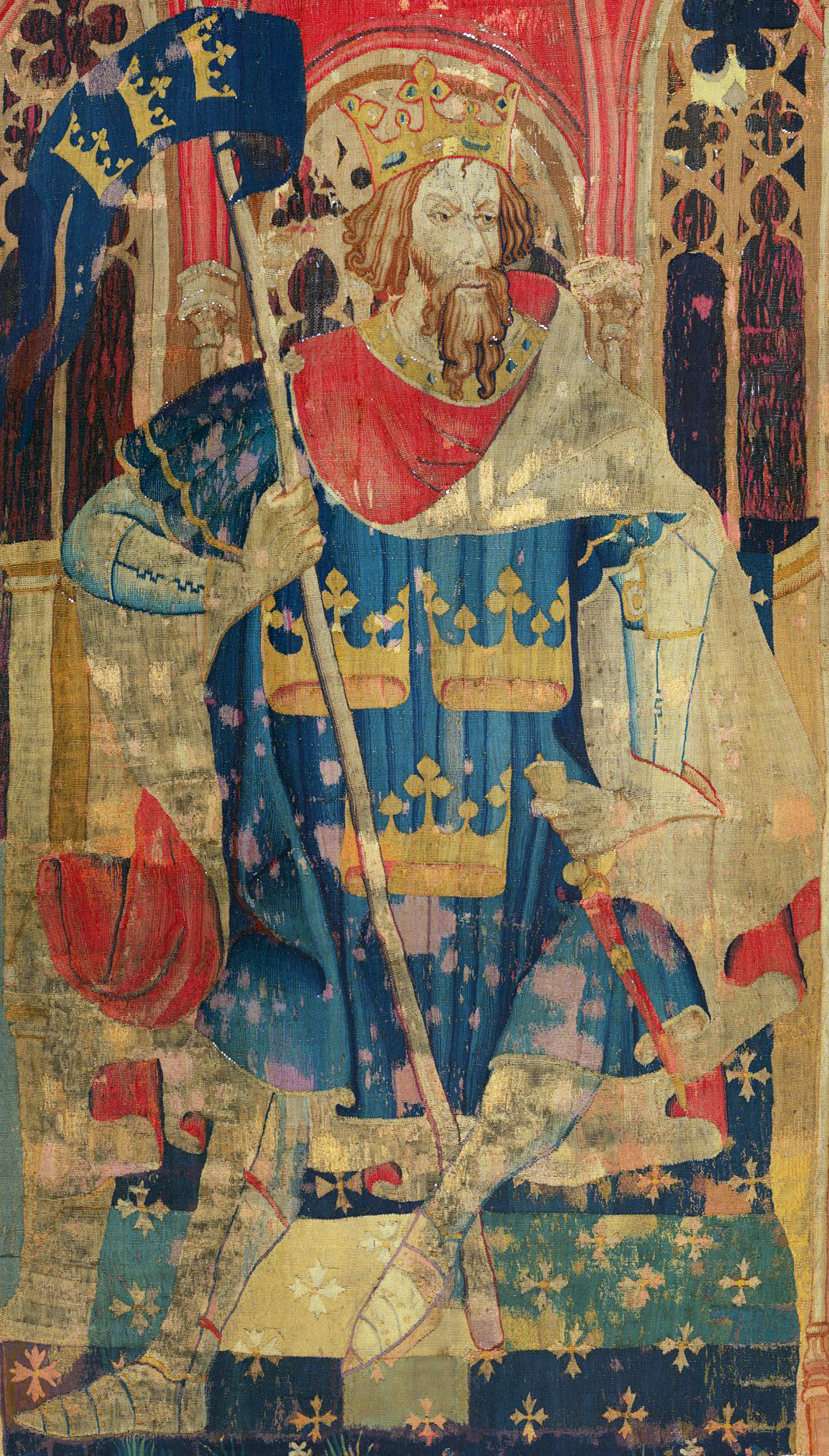
Image of Arthur from the 'Christian Heroes Tapestry' (ca. 1385)

More exactly, I want to let C. S. Lewis explain it. His Introduction to ‘Paradise Lost’ is such a fine work of literary criticism that I’ve read it at least a dozen times, despite never having finished Milton’s actual epic. Lewis (who had) spends a chapter in his Introduction going over what hierarchy meant to our ancestors, and its importance not only in the civil sphere, but cosmically.

According to this conception degrees of value are objectively present in the universe. Everything except God has some natural superior; everything except unformed matter has some natural inferior. The goodness, happiness, and dignity of every being consists in obeying its natural superior and ruling its natural inferiors. When it fails in either part of this twofold task we have disease or monstrosity in the scheme of things until the peccant being is either destroyed or corrected. One or the other it will certainly be; for by stepping out of its place in the system (whether it step up like a rebellious angel or down like an uxorious husband) it has made the very nature of things its enemy. … Aristotle tells us that to rule and to be ruled are things according to Nature. … We must not, however, suppose that the rule of master over slave or soul over body is the only kind of rule: there are as many kinds of rule as there are kinds of superiority and inferiority. Thus a man should rule his slaves despotically, his children monarchically, and his wife politically; soul should be the despot of body, but reason the constitutional king of passion (Politics 1, 5, 12). The justice or injustice of any source of rule depends entirely on the nature of the parties, not in the least on any social contract. … The difference between a king and a tyrant does not turn exclusively on the fact that one rules mildly and the other harshly. A king is one who rules over his real, natural inferiors. He who rules permanently … over his natural equals is a tyrant, even (presumably) if he rules well. … Order can be destroyed in two ways: (1) By ruling or obeying natural equals, that is by Tyranny or Servility. (2) By failing to obey a natural superior or to rule a natural inferior—that is, by Rebellion or Remissness.2 And these, whether they are monstrosities of equal guilt or no, are equally monstrosities. … Even a modern man might obey the law and refuse to obey a gangster for one and the same reason.

The references here to Aristotle’s views are primarily political in nature; but the grand synthesis of the West, the model of the universe pertaining to all fields of knowledge that was perfected and used throughout the Mediæval era and the Renaissance, considered all of reality, visible and invisible, essentially hierarchical. This isn’t to say that they considered the political hierarchy an aspect of the cosmic—some did, such as those who professed the Divine Right of Kings; but this was far less common than most people suppose, and (especially in the Middle Ages) the educated were likelier to consider the social order an image of cosmic hierarchy than a part of it.

What surprised me when I first read Lewis’ treatment of the subject was the ‘negative’ reason our ancestors set forth for embracing hierarchy.


Line drawing by Gustave Doré, illustration for Paradise Lost

The greatest statement of the Hierarchical conception in its double reference to civil and cosmic life is, perhaps, the speech of Ulysses in Shakespeare’s Troilus. … If you take ‘Degree’ away ‘each thing meets in mere oppugnancy,’ ‘strength’ will be lord, everything will ‘include itself in power.’ In other words, the modern idea that we can choose between Hierarchy and equality is, for Shakespeare’s Ulysses, mere moonshine. The real alternative is tyranny; if you will not have authority you will find yourself obeying brute force.

The reasonableness of this view is probably obvious. When James Madison famously wrote that faction-prone democracies have in general been as short in their lives as they have been violent in their deaths, he was touching on the same principle. But the negative reason takes second place to the positive, which will strike many readers as strange—though lovers of Baroque music for its mathematical perfection will probably grasp it more easily. That positive reason is that hierarchy is beautiful, or at the least, it can be.

[Milton] pictures the life of beatitude as one of order—an intricate dance, so intricate that it seems irregular precisely when its regularity is most elaborate.3 He pictures his whole universe as a universe of degrees … He delights in the ceremonious interchange of unequal courtesies, with condescension (a beautiful word which we have spoiled) on the one side and reverence on the other. He shows us the Father ‘with rayes direct’ shining full on the Son, and the Son ‘o’er his scepter bowing’ as He rose … Almost everything one knows about Milton … makes it certain that Hierarchy will appeal to his imagination as well as to his conscience, will perhaps reach his conscience chiefly through his imagination. He is a neat, dainty man, ‘the lady of Christ’s’4; a fastidious man, pacing in trim gardens. He is a grammarian, a swordsman, a musician with a predilection for the fugue. Everything that he greatly cares about demands order, proportion, measure, and control. … The heavenly frolic arises from an orchestra which is in tune; the rules of courtesy make perfect ease and freedom possible between those who obey them. Without sin, the universe is a Solemn Game: and there is no good game without rules.5 … Unless we bear this in mind we shall not understand either the Comus or Paradise Lost, either the Faerie Queene or the Arcadia, or the Divine Comedy itself. We shall be in constant danger of supposing that the poet was inculcating a rule when in fact he was enamored of a perfection.

This is not to say that there was no place for the untamed, wild, Gothic varieties of beauty in that hierarchical age. The elusive, deliciously eerie quality of some Mediæval tales (Sir Gawayn and the Grene Knyght being a prime example) had no rival until the dawn of the Romantics, who specifically professed to take their cues from the Middle Ages.6 Frankly, I think the hierarchical and rational worldview supports enclaves of Gothicism more easily than the reverse: for, even in an essentially ordered universe, it’s very easy to imagine unexplored and mysterious realms within it that human beings can’t control, whereas a universe that is fundamentally chaotic and dark tends to hollow out any temporary order that is erected within it.


The Last Redoubt (from the novel The Night Land by William Hope Hodgson) by Jeremiah Humphries, ca. 2010

But I digress. The point here is that hierarchy, as an aspect of courtesy, is—well really it almost is courtesy. Gracious, sincere, unpatronizing generosity from someone in a position to extend it is beautiful; cheerful, unselfconscious, dignified acceptance of someone else’s generosity is beautiful; mutual delight in one another’s excellences is supremely beautiful. A person may dislike being treated with unique honor out of humility, but if so, they are probably to that extent still paying attention to themselves; a humility profounder still accepts honor from others because it is insulting to refuse a gift. That’s part of why false modesty is so annoying.

This also hints at how hierarchy and republic, inequality and equality, are combined in the spirit of courtesy: namely, that the work of others, whether as inferiors or as superiors, is worth accepting because their functions are just as dignified as ours, and we ought to allow them their place. Downton Abbey struck this chord magnificently in the Earl’s gentle rebuke to Cousin Matthew for refusing the services of a valet, when he says, ‘We all have different parts to play, and we must all be allowed to play them.’ But to do justice to the double character of courtesy, the commingling of hierarchy and republic, I’ll need another post.

✠     ✠     ✠

1Which is not to say that they apply this principle very consistently.
2Remissness here should be understood more or less as ‘abdication.’
3Anybody who’s studied fractals will probably get this part. If you haven’t, just google fractals and spend a few minutes looking at pictures of them. It’s trippy.
4I.e., Christ’s College in the University of Cambridge.
5Not even Calvinball, which forbids its players from either questioning the masks or doing things the same way twice.
6Unless one counts the witchcraft hysteria of the sixteenth and seventeenth centuries as being, unintentionally and among other things, an expression of this same æsthetic impulse.

Monday, September 25, 2017

Thoughts on the Correctio Filialis

But I saw not synne, for I beleve it hath no manner of substance ne no party of being, ne it myght not be knowin, but by the peyne that it is cause of; and thus peyne—it is somethyng, as to my syte, for a tyme, for it purgith and makyth us to knowen our selfe and askyn mercy. For the passion of our Lord is comforte to us agens al this, and so is His blissid will. And for the tender love that our good Lord hath to all that shal be save, He comfortith redyly and swetely, menyng thus: It is sothe that synne is cause of all this peyne, but al shal be wele, and al shall be wele, and all manner of thing shal be wele. These words were seyd full tenderly, shewying no manner of blame to me ne to non that shall be safe. Than it were a gret unkindness to blame or wonder on God for my synne, sythen He blamyth not me for synne. And in these same words I saw a mervelous, hey privitye hid in God, which privity He shall openly make knowen to us in Hevyn, in which knowyng we shal verily see the cause why He suffrid synne to come, in which syte we shall endlesly joyen in our Lord God.1

—Lady Julian of Norwich, Revelation of Love, Thirteenth Shewing

✠     ✠     ✠


As of this past Saturday, sixty-two Catholics have signed the Correctio Filialis de Hæresibus Propagatis address to His Holiness Francis, the Bishop of Rome. In English, the document’s title is A Filial Correction Concerning Propagated Heresies. Among others, the signatories include Bishop Fellay, head of the Society of St Pius X or SSPX—a traditionalist group whose founder, Archbishop Marcel Lefebvre, incurred excommunication upon himself in 1988 for consecrating four bishops without the lawfully required permission, and in fact against the express wish and personal appeal, of the then Pope, St John Paul II. (It’s no secret that I take an extremely dim view of any and all persons who consider themselves to be literally more Catholic than the Pope.)

Nevertheless there can be valid grounds on which to rebuke even a Pope, especially since the conditions of his infallibility are actually fairly restricted. And such rebuke has precedent. Indeed, we have precedent in the first century, when St Paul took St Peter publicly to task for waffling on the discipline of the Judaizers. So it is worthwhile going through the Filialis and judging it on its merits.2

It’s a respectable enough document. It refrains from personal attacks against any person; it distinguishes with appropriate care between consequence and cause; it explicitly states that it makes no judgment about motives and degrees of culpability; and it does, as the title implies, remain filial, stating and restating the Catholic doctrine of the Holy See and asking for the Pope’s blessing at the conclusion. One of my perennial complaints about traditionalists is their readiness to condemn and to place their understanding of dogma ahead of the professed definer of that dogma, i.e. the Church defined by her communion with the Roman Pontiff, and the Filialis (as far as I can tell) avoids these flaws well, which is refreshing and laudable.


The authors assert that Pope Francis, by a combination of acts, words, and omissions, has in effect though not explicitly promoted seven heretical ideas (the text in the Filialis is in Latin, but the authors have also translated them into English):

1. A justified person has not the strength with God’s grace to carry out the objective demands of the divine law; or, God’s grace does not invariably and of its nature produce conversion from all serious sin.
2. Christians who have obtained a civil divorce and have contract a civil marriage with some other person, who live more uxorio3 with their civil partner, and who remain in this state with full knowledge of the nature of their act and full consent of the will, are not necessarily in a state of mortal sin.
3. A Christian can have full knowledge of a divine law and voluntarily choose to break it in a serious matter, but not be in a state of mortal sin as a result.
4. A person is able, while he obeys a divine prohibition, to sin against God by that very act of obedience.
5. Conscience can rightly judge that sexual acts between persons who have contracted a civil marriage, although one or both of them is sacramentally married to another, can sometimes be morally right or even commanded by God.
6. Moral principles contained in divine revelation and natural law do not include negative prohibitions that absolutely forbid particular kinds of action.
7. Our Lord wills that the Church abandon her perennial discipline of refusing the Eucharist and absolution to the divorced and remarried who do not express contrition for their state of life and a firm purpose of amendment.4

Now, as far as 2, 3, 4, and 5 are concerned, I’m bold to say that His Holiness would indeed deny those propositions. Amoris Lætitia emphasizes, repeatedly, that a revision of disciplinary practice is not a question of altering or concealing the Church’s perennial teaching, but of adapting it to particular circumstances, and of realizing that the best a person can manage may not rise to Christian perfection. The phrasing of 2 and 3 illustrates the distinction nicely: if I’m reading Amoris correctly, it’s precisely the ‘full consent of the will’ question that’s at stake, because human frailty interferes with our freedom even after baptism. That’s part of what venial sin means.

Proposition 4 is slightly ticklish, in that, while obeying a divine prohibition is of course not wrong, a person could be so entrenched in sin in some other way that this obedience could be vitiated. I've met people whose commitment to chastity I didn't doubt, but whose bitter, mean-spirited self-righteousness was so unpleasant that I think they'd have sinned less by taking a lover than by being so continually nasty. Given that the great focus of the encyclical was precisely on adapting doctrine to individuals, I think that matters. And that's the whole point of the 'law of gradualness': people can't do everything at once, and Christ does not send people away because of that.

Turning to the rest, I am not altogether sure what denying proposition 1 is supposed to mean, in the light of saints like Augustine and Paul. I don't mean this as a sarcastic remark; I mean I am genuinely unsure.

For that which I do I allow not: for what I would, that I do not; but what I hate, that do I. If then I do that which I would not, I consent unto the law that it is good. Now then it is no more I that do it, but sin that dwelleth in me. For I know that in me (that is, in my flesh) dwelleth no good thing: for to will is present with me; but how to perform that which is good I find not. I find then a law, that, when I would do good, evil is present with me. For I delight in the law of God after the inward man: but I see another law in my members, warring against the law of my mind, and bringing me into captivity to the law of sin which is in my members.5


That is, of course, not the whole story. But it is part of the story, and whenever we speak of grace making us strong to obey, we have to mean it in a way that’s compatible with, well, Scripture. We don’t believe in Calvinist impotence,6 but we don’t believe in Pelagian or Semi-Pelagian mastery, either.7

Similarly, denying propositions 3 and 6 has to be done in a way consistent with Scripture. It’s interesting to me that, when the Pharisees took Jesus to task for not preventing his disciples from picking grain on the Sabbath, rather than pointing out that their rule was kind of made up (a way-past-the-goal-post extension of not working on the Sabbath, since picking grain was like doing the work of a reaper), Our Lord instead appealed to another, more direct transgression of the law:

And he said unto them, Have ye never read what David did, when he had need, and was an hungred, he, and they that were with him? How he went into the house of God in the days of Abiathar the high priest, and did eat the shewbread, which is not lawful to eat but for the priests, and gave also to them which were with him? And he said unto them, The sabbath was made for man, and not man for the sabbath: therefore the Son of man is Lord also of the sabbath.8

An even more shocking example, which I’ve often cited here as one of the hard texts of the Bible, is Elisha’s pardoning Naaman for not only past but future idolatry in II Kings 5. These are not general pretexts to violate the laws regulating sacred things (for which, in differing ways, Uzzah and the eight martyrs of II Maccabees 7 died), nor to worship other gods even in pretense. Still less does this amount to the power to change divine law. The point is that the application of divine law to concrete situations is in the hands of Christ—and, accordingly, of his Vicar.

Which casts its own light on proposition 7. I don’t think that Amoris Lætitia says or implies that absolution and consequent communion should or can be granted to those who aren’t repentant; that would make a nonsense of the former, and a sacrilege of the latter, and would have to operate on the assumption that Amoris be read without the whole prior context of Catholic theology and canon law. But as I pointed out above, full consent can be a subtle question, and it’s no insult to divine grace to say so. Yes, God could dispense maximal grace to everybody; but we know, since only one person was immaculately conceived, that he doesn’t. Presumably he has a reason. Certainly we don’t know what it is. And also certainly we must deal with the flaws and weaknesses of mankind as they—and we—are, not only as we logically could be.


All this being said, I do hope that His Holiness replies to the Filialis. The way the criticisms of Amoris Lætitia, loyal and otherwise, are piling up strains the unity of the Church, and the fundamental task of the Holy See is to guard that unity. Pope Francis may be right, but the authors of the Filialis are correct enough to point out that it doesn’t follow that he is wise, and I admit to some worry: not about his teaching but about how he teaches it, and not because of its effect on those outside the Church (who will take anything and run with it) but about the possible mutiny of those within her (who will also take anything and run with it, even though they have a special reason not to, and far more damage comes of such behavior).

Still, eleven out of twelve apostles fell down on the job when their Master was arrested. And that turned out okay.

✠     ✠     ✠

1‘But I did not see sin, for I believe it has no kind of reality nor any part in existence; nor could it be known except by the pain it causes. And this pain—it is something, as I see, for a while, for it purifies and makes us know ourselves and ask for mercy. For the suffering of our Lord is strength for us against all this, which is His blessed will. And, for the tender love that our good Lord has to all that will be saved, He strengthens us readily and sweetly, saying: It is true that sin causes all this pain; but all will be well, and all will be well, and every kind of thing will be well. These words were said very tenderly, showing no kind of blame to me, nor to anyone that will be saved. So it would be a great ingratitude to blame or be shocked at God for my sin, seeing that He does not blame me for sin. And in these same words, ah, I saw an astonishing secret hid in God, a secret that He will openly make known to us in Heaven; by knowing it, we will truly see the cause for which He allowed sin to come, and by seeing that we will rejoice endlessly in our Lord God.’ Personally I prefer the passage in Middle English, and it is of course mostly comprehensible, but there’s just enough semantic drift to deceive the unwary reader, which makes the modern revision worthwhile.
2For those interested, the full text can be found here.
3A technical phrase in Catholic moral theology, meaning ‘in the manner of husband and wife,’ i.e. engaging in sexual relations. This is contrasted with couples who live ‘as brother and sister.’
4I have edited these propositions slightly for length, though I believe I have preserved their meaning intact.
5Romans 7.15-19, 21-23.
6I.e., Catholics don’t believe that even after being baptized, we can do nothing good: we believe that Christ’s life is infused into us, not merely drawn across us. Whether and to what extent Calvinists really believe in such spiritual impotence is a difficult question to answer, even as a former Calvinist; I never felt I got a very consistent account of it.
7Pelagianism was a fifth-century heresy which asserted that divine grace, while helpful to final salvation, was merely helpful, not absolutely necessary, and that original sin was nothing more than a bad example set by our predecessors (as distinct from a flawed moral outfit we’re born with). After some controversy, it was condemned at the Synod of Carthage in 418, and this condemnation was ratified at the ecumenical Council of Ephesus in 431. Semi-Pelagianism, while agreeing that divine grace was necessary for Christian growth, asserted that men could prepare themselves for and make the initial act of faith on their own resources. This too was condemned at the Synod of Carthage, and again at the Second Council of Orange in 529.
8Mark 2.25-28.