Collect

Collect for the Fourth Sunday after Trinity

O God, the protector of all that trust in thee, without whom nothing is strong, nothing is holy: increase and multiply upon us thy mercy; that, thou being our ruler and guide, we may so pass through things temporal, that we finally lose not the things eternal; grant this, O heavenly Father, for the sake of Jesus Christ thy Son our Lord, who liveth and reigneth with thee, in the unity of the Holy Spirit, ever one God, world without end. Amen.

Saturday, January 31, 2015

Kintsukuroi, Part III: Guydentity Crisis

Over the past decade, I've heard the word identity about enough times that at this point, every time I hear it, I feel like renouncing pacifism and beating the speaker to death with a shovel.* Unfortunately they don't let you do that, I've found.

One of the reasons the word causes such difficulties is that it means different things to different people, and even, at times, different things to the same person. Substituting a phrase like "This is who I am" reveals something of the problem: who I am in what sense? Ontologically? Emotionally? By conviction? By upbringing?

Catholic sources (with the exception of heretical ones like Dignity) have for the most part avoided and discouraged any use of LGBT language. A lot of people ascribe this to groundless homophobia, but I don't. The stated concern in the relevant documents published by the Church is of people reducing themselves to their homosexuality by identifying as gay; and, while I don't believe that that problem is nearly as prevalent as many of the Catholic authors and priests I've interacted with have supposed, it bears saying that the problem would be worthy of their attitude if it were. And after all, some of us do reduce ourselves to our sexuality, and it isn't a pretty or dignified sight. Seeing a grown man flirting like a high school sophomore, because he's stuck in the mindset that his worth depends on the rapidly decreasing number of fucks he can score, is deeply pathetic.


Desperation doesn't look good on anybody.

But this isn't a peculiarly a problem of the LGBT community. It's a general problem of American society -- in my experience, even when I was a gay activist, it was no more prevalent among us than among anybody else -- and narrowing our attention to queer-identifying people is in my opinion extremely unhelpful. In addition to creating a double standard between homosexual and heterosexual people (which, to do them justice, some Catholic authors have begun to pay attention to), it feeds into an unfair and frankly very damaging stereotype of gay people: namely, that gay sexuality is solely about having sex, that any notion of gay identity is constructed entirely around sex, and that any and all people who identify as gay (or whatever) are, in a more or less clinical degree, obsessed with sex.

I don't think that any of this is true, and I think that a gay identity, properly understood, is as capable of "baptism" as any other element of a culture. Now, it's that properly understood that is the linchpin of all this, so I'm going to take a moment and explain it.

One strategy taken by much of the LGBT community in the fight for gay rights has been to insist on homosexuality as immutable and inborn. The equivalence often drawn between sexual orientation and race or ethnicity is the result: if gay people are members of a natural minority, the reasoning goes, then they are entitled to the same legal protections that are rightly given to other minorities. In some circles the argument is carried further, asserting a metaphysical or transcendental difference between gay people and straight people -- Matthew Vines, for instance, in his viral video on the subject, states that while for most men an help meet for him is a woman, for a gay man a suitable companion can be found only in another gay man, which at least suggests that the difference between gay and straight is a difference of being rather than of quality.


Adam and Eve, Jan Mabuse, ca. 1510
Nice 'fro, Father Adam.

I don't take this view -- partly because the only difference of being among humans that the Church recognizes (to my knowledge) is that between women and men; partly because the highly variegated history of homoeroticism, and the existence of sexual fluidity in some people, suggest otherwise; partly because gay essentialism looks to me like a bald assertion, and certainly an indemonstrable one. It isn't the universal orthodoxy within the LGBT community that people outside that community often suppose, either, but that need not detain us.

However, I do take the view that another definition of the word identity can be meaningfully, and usefully, applied to LGBT experience. It is the definition we use when we say things like "I am a Catholic," "I am an American," "I am a barista," and so forth. It is the sense of self, the collection of experiences, feelings, and ideas that make us who we are in a psychological rather than an ontological way. Identity, in this sense, is a statement of what is most deeply important to us, that through which we relate to others and to ourselves and to God. It isn't necessarily inborn or immutable, but it can't just be changed at will, either; nor should it.

The Catechism has the following to say about sexuality:
"When God created man, he made him the in the likeness of God. Male and female he created them, and he blessed them and named them Man when they were created." Sexuality affects all aspects of the human person in the unity of his body and soul. It especially concerns affectivity, the capacity to love and to procreate, and in a more general way the aptitude for forming bonds of communion with others. ... Chastity means the successful integration of sexuality ... and thus the inner unity of man in his bodily and spiritual being. Sexuality, in which man's belonging to the bodily and biological world is expressed, becomes personal and truly human when it is integrated into the relationship of one person to another, in the complete and lifelong mutual gift of a man and a woman.**
On the face of it, this would appear to exclude any fully Christian expression of sexuality other than marriage, which the Church obviously doesn't maintain. Sexual integration is as necessary for a celibate life as any other, if not more so. But what are its implications for homosexuality?

To start with, sexuality here is more than just the desire for sex and reproduction -- that desire doesn't exist in isolation, and it doesn't seem relevant to our general tendency to form relationships with people, either. Sexuality includes the desire for sex, but (as far as my understanding goes) it encompasses the whole embodied-ness of human love in its various forms, some of which involve having sex and some of which don't. That this is called sexuality is, I think, due to the fact that being a man or a woman is one of the chief defining features of our embodied-ness.***


And where does being gay lie in all this? Well, I think one of the key points is that being a gay man (for example) can't be reduced to wanting to boink other dudes, for the same reason that being a straight man can't be reduced to wanting to sleep with women. There's a whole world of feelings and experiences that goes with it -- a world that differs from man to man, as much as one man does from another, but in any case a real one that should be respected. The experience of embodied-ness and relationship for a gay man need not be all that different from the experienced embodied-ness and relationships of a heterosexual, though it appears to me that they generally are; the point is that these things make a profound contribution to our sense of self, and, in that specific sense, to our identity.

But doesn't this construct an identity -- in however limited a sense -- around sin? Let's parse that a little.


To begin with, a sin is always a choice; sexual orientation is a disposition, i.e., part of the raw material out of which we make choices. Even when our dispositions are bad or undesirable, they aren't sins per se.

Second, unless you displace everything else in order to make more room for your sexual orientation (which strikes me as a pointless, weird thing to do), just to acknowledge that you happen to be gay doesn't mean you're building your whole sense of self around it. People sometimes do, of course; but I think the only response to that is to encourage prudence and balance, not to do away with the idea of sexual orientation as such. Sexual orientation is admittedly a construct, but it sums up what is, for a lot of us, a vast area of shared experience in terms of relationship, self-image, and so forth, that isn't easy to state concisely any other way. And because the stuff it's tied into is so deeply important to the human person -- as the text from the Catechism suggests, with its references to affectivity and to the general capacity for forming relationships -- I think we need a way of talking about it.

Lastly, I rather think that the advice "Don't identify with your sin," in this and many other contexts, is not altogether satisfactory in the first place. It is quite true that this can impose false mental limits and inhibit growth. But then, so can an insistence on a theology of victory that makes inadequate room for human frailty, and for being honest about that frailty. St Paul was not confined by his past as a religious terrorist, but he positively went out of his way to bring it up, to embarrass himself with his weaknesses and flaws; or rather, to boast of them.
There was given to me a thorn in the flesh, the messenger of Satan to buffet me, lest I should be exalted above measure. For this thing I besought the Lord thrice, that it might depart from me. And he said unto me, "My grace is sufficient for thee: for my strength is made perfect in weakness." Most gladly therefore will I rather glory in my infirmities, that the power of Christ may rest upon me.
Japanese pottery has a technique called kintsugi or kintsukuroi, for which I've named this series. If a ceramic vessel, like a tea bowl, is broken, rather than throwing it out or repairing it invisibly, the cracks are mended in a way that draws attention to and beautifies the damage -- for instance, with gold or silver seams.


This is part of a larger Japanese aesthetic philosophy called wabi-sabi, in which the history and imperfections of an object are embraced as part of it. This may sound very strange to Western, classically-formed ears; but I believe that it is, fundamentally, hardly different from the triumphant lines of the Exsultet: O truly necessary sin of Adam, destroyed completely by the Death of Christ! O happy fault that earned for us so great, so glorious a Redeemer!

This is a hard saying, and not many can accept it. In this, and indeed in most things, it's far easier to join with those who would reject imperfection -- whether by trying to do away with it or by pretending that it doesn't matter. The mental and spiritual balance required to achieve kintsukuroi of the soul is a delicate thing, and I for one am no master at it; but I believe that this, rather than either getting a new bowl or saying that a broken bowl isn't broken, is the task at hand.


**Catechism of the Catholic Church, paras. 2331-2332, 2337, italics original.

***In saying this, I don't mean to ignore the difficult and subtle questions that attend intersex people or trans issues. I take the integral significance of sex to the person to be a starting point, from which we may seek to address these matters, not a pretext to pretend that they are unreal or unimportant. However, it's both off-topic and quite beyond my competence to do so here.


Sunday, January 25, 2015

Kintsukuroi, Part II: God Loves You, But

Jesus attempted this same trick. He made the prohibitions on lust more strict, and yet welcomed and succored prostitutes and adulteresses. 
Part of how He squared this circle was by prohibiting judgment. Spending your time imagining what those hand-holding guys might be doing is itself immoral. Acting to stigmatize and humiliate them is itself immoral. This obviously makes building a nice Christian society really hard. The tools of shame and social pressures which all societies use to maintain their boundaries suddenly become moral problems, not solutions. Abuse of power comes into focus and we start to see how the tools by which societies maintain order in fact create their own chaos: pharisaism is a state of disorder in the soul ... 
+     +     + 

What, exactly, causes homosexuality?* To say the answer to this question has been a bone of contention between the traditional and the progressive worlds (within and outside the churches) would be a massive understatement. It has been a bone of contention, snapped over as if by wolves fighting for the end of a carcass, cast about like a diviner's rod to discover secrets past and present, crusaded for like the relic of a saint.

On the one side, we have the conservatives and traditionalists, those who assert firmly that homosexuality is a product of upbringing. A distant or rejecting father, combined with a domineering or intrusive mother, results in the young boy identifying with the feminine rather than the masculine, and seeking, after puberty has transmogrified his father-wound from an affective to a sexual longing, to obtain from men in bed what his father never gave him at home. I call this theory "farther and smother."

On the other side, we have the liberals and progressives, who insisted far in advance of the evidence that homosexuality was genetic, or at least biological in nature. People were born gay -- ten percent of them, in fact! -- and it was therefore cruel to demand that they live out of accord with their very nature. On the contrary, society should treat differences in sexual orientation exactly like it treats differences in race, and for the same reason.

And which side am I on?


Nobody's, of course. Even if for no other reason, I have more invested in frustrating my readership than that.

As I've talked about a couple of times before, the reparative drive theory never satisfied me in the first place; it didn't fit the data (which resulted in some ex-gay theorists trying to force every gay person's experience to fit the theory, sometimes with comical or tragic results**), and even when it did fit the data for a particular person I didn't see how it explained anything -- I mean, by the same logic, you could ascribe male heterosexuality to a mother-wound, or assert that a child who is wisely loved by both parents will grow up with no libido at all.

But the view of the enlightened progressive wasn't much of an improvement. Though the slowly amassing evidence did and does support a biological component in the genesis of attraction, it clearly couldn't be as simple as genes -- the notorious twin studies might show that twins were disproportionately likely to share an orientation, but they did also show that orientations weren't always identical even when twins were.

And anyway, it seemed to me to be missing the point: the fact that something was biological (or at any rate un-chosen) had no bearing on whether it was a good thing; all kinds of traits, good and bad and indifferent, had been found to have partly biological causes at least some of the time. If homosexuality were wholly a question of nature, and not at all of nurture, that would still not settle the question of whether it was the sort of nature we disliked and perhaps tried to fix (like cripplingly poor eyesight), or liked and tried to enhance (like athletic talent), or merely giggled at and moved on with our lives (like a sixth toe). And considering that we don't always react well to people who are at a genetic disadvantage, as the horrifying statistics on children aborted after a Down Syndrome diagnosis suggest, I'm not at all sure it would be to the advantage of the LGBT community to prove that homosexuality was entirely biological in the first place.

Which brings up one of the fundamental problems that I find I have with ex-gay therapies (and also with progressivist theology, but that isn't the point of this series). They seem, often, to rest on an unspoken belief that we can't love people who are broken.


Of course, no Christian would ever say that.*** Not in so many words. The lie, often unrecognized in our own minds, masquerades in a thousand glittering images: as that, because true love wants what is best for the beloved, it tries to improve the beloved; or that, because true love does not want to encourage the beloved in sin, it cannot appear to approve of sin by associating with it. The phrases sound so devout, and conceal their spiritual egotism with such a seductive appearance of compassion and purity, as to deceive the very elect.

But make no mistake. It is precisely a seduction that is being attempted in these phrases; I know only too much about seduction to mistake it. The desire to give, and to the real benefit of the recipient, is not an incorruptible desire, and mixes very gently and quietly with the desire to control. It is seldom a realistic concern about scandal that keeps people from pursuing sinners into gay bars: it is more commonly a fear of getting dirt on one's own lily-white hands. For this little hand is lily-white, after all, sweet with all the perfumes of Arabia, and there is no spot in it.


I'm inclined to think that this is part and parcel of a strategy that many conservative-traditional-orthodox Christians, Catholic and Protestant, have been taking toward society for the last fifty years; a misguided strategy. Believing, truly enough, that our Lord wishes us to transfigure the culture we live in, they have attempted to effect such a transfiguration by false and artificial means -- by a pragmatically, if not doctrinally, Pelagian effort to impose good behavior from without, through laws and social pressures, in the hope that this will somehow bring about a revival of Christian spiritual power and cultural ascendancy.
King is forgotten, when another shall come:
Saint and Martyr rule from the tomb.
Think, Thomas, think of enemies dismayed,
Creeping in penance, frightened of a shade;
Think of pilgrims standing in line
Before the glittering jeweled shrine,
From generation to generation
Bending the knee in supplication,
Think of the miracles, by God's grace,
And think of your enemies, in another place. 
-- T. S. Eliot, "Fourth Tempter," Murder In the Cathedral, p. 38
That isn't how it works. The only way to bring a holy society into existence is through conversion to love; and we can convert no one. The most we can do is ask God to convert our own hearts (our own sins being the only ones we can repent of). In living out that conversion, perhaps our lives will inspire our neighbors to make the same request of God, and if that happens enough, then yes, it will in fact improve society. But improving society is not the goal of conversion, and an attempted conversion for which the improvement of society is the motive force is doomed to wither, for the same reason that the marriage of man to a millionaire for her money is doomed to wither: the essential point of the operation has been missed.

Making a good society is a good thing; but natural and supernatural good must not be confused, and the natural good cannot woo or seduce the supernatural into approaching. Indeed -- as we ought to have remembered from the terrible lesson of the Pharisees and the prostitutes -- good people are typically harder to reach than bad ones.


Domenico Tintoretto, The Penitent Magdalene, 1598

I wouldn't like to tar the whole ex-gay movement, present or past, with this brush; there were charitable desires, too. They even did some real good for some people, and I don't begrudge anybody that. But I believe that the total message of orientation change (intended or not) was false and pernicious, and that it fed into, rather than counteracting, the lie that plagues the minds of so many gay Christians, and indeed so many people of every kind: that God withholds love from people who aren't good enough. And that's exactly what thousands of us took away from our experiences with ex-gay therapies and fellowships -- that we were broken, and that if we didn't get fixed, God would throw us on the trash heap. We got "God loves you, but".

Does that prove orientation change is a worthless idea? Not necessarily. There will be grave failures in any ministry; Caiaphas the High Priest was instrumental in Deicide.

But personally, I do feel that its wholesale rejection by the APA, and its repudiation from prominent former exponents, including Alan Chambers, is proof enough to be going on with that ex-gay therapies can be safely taken off our list of solutions. And then we can get on with loving the people whom God has actually set before us, instead of the ones we expected or wanted; it is more humane, for it is more divine.


*Before anybody gets their jockstrap in a twist, allow me to be perfectly clear: by "homosexuality" I mean in most of my writing, and here in particular, the phenomenon of being attracted to one's own sex. No behavior is implied, and no exclusivity or fixity of attraction is insisted on. I admit both bisexuality and sexual fluidity, though they are of limited relevance to what I'm talking about here. (This, although as far as I can tell it's the commonest use of the word, is not the definition employed in the relevant paragraphs of the Catechism of the Catholic Church, which has been a source of great misunderstanding.)

**An example of comical results can be found in Justin Lee's book Torn, where he speaks of an ex-gay minister trying desperately to find something to attribute Lee's homosexuality to in his happy childhood, and finally determining that his alopecia was the trauma that made him turn gay. A not-so-funny instance of this kind of attempt to force the facts to fit the theory can be found in the lives of many gay men and their families, who persuaded themselves (sometimes in the teeth of their lived experience) that the father had been cold or passive and the mother had been controlling or smothering. Stephen Long's open letter to the ex-gay community deals with such an instance.

***Unless the Christian in question were also a true Scotsman.

Wednesday, January 21, 2015

Kintsukuroi, Part I: Out of Egypt

Ex-gay ideas -- explicit and implicit -- have outlived the collapse of Exodus International. Given that, as a Catholic, I believe gay sex is wrong, why haven't I taken the ex-gay road?

Well, the answer is in part that I did. It turned out, as far as I could see, to be a cul-de-sac. So, I turned around and looked for another road.

The series that follows will, basically, consist in my explaining why and how I came to these conclusions. Welcome to kintsukuroi.


+     +     +

"I'm straight," I told my counselor.* I was grinning and laughing.

He laughed too. "What, you think I'm not good at what I do?"

I had been in ex-gay counseling for two years. My counselor had established a rapport with me through months of effort, he had gotten me to open up about the rape I had suffered, he had forced me to talk to my dad about it before I was even sort of ready, he had conducted a deliverance session to rid me of any evil spirits that might be obstructing my progress, he had yelled at me for keeping secrets after he found out about the later rapes. Now, as I believed, all the work had finally borne fruit. I could have all the things I'd wanted; I could be normal, and happy, and get married one day, and raise a family.

My counselor used to say that he liked me enough to hope he never saw me again. I wonder whether he's ever seen any of the gay men he counseled again.


At the time, I thought it was, in the most literal sense of the words, an answer to prayer. The idea of living with being gay was something I simply wasn't willing to contemplate (not intellectually, anyway, and I didn't quite admit to myself that I could be okay with it in any other way). I'd been trying to find a way out of homosexuality since I was thirteen. I realized back then that I was gay only because I did an internet search for, well, exactly what you'd think a thirteen-year-old gay boy would do an internet search for. I had never, until that moment, articulated to myself what it was I wanted to see, and do; I was shocked by my own compulsive passion. I lay awake for I don't know how long afterward, reciting hymns to myself, praying, crying. I didn't want this.

And it wasn't because I'd been told I would go to hell or anything like that. The Calvinist tradition, in which I was raised and of which I was still a part at the time, has many flaws; but threatening people with hell over any one kind of sin or problem is not as a rule among them. They tended, definitely in theory and pretty often in fact, to be treated as strictly equal. I wanted to be straight because who wouldn't want to be straight? I thrived on being different, but not that different, and certainly not the kind of different that threatened my ability to have a family, which I wanted (and want) so badly; still less, the kind of different that threatened my religious ego. That I happened to be gay was just one of the problems a person could have: a nasty one, yes, but a solvable one. And God would solve it. I just had to obey.

My het phase lasted for a couple of months, I think. I wasn't riotous with lust for women or anything, but I'd be a little interested, sometimes, and I did stop noticing guys for a while. My friends were overjoyed for me. After their months, and my years, of anguish, of not daring to hope, the fight had concluded -- and in victory.

I didn't pay much attention when the feelings started to come back a little bit. I'd be attracted to a guy I saw at the gym, or get turned on by a shirtless dude in a movie, and I'd think, Oh, it's the memory, it's the force of habit, it's to be expected. It'll go away. And it would go away; and then come back. My occasional attractions to women also went away, and didn't so much come back. Before long, I was back to where I'd begun.


I will employ literally any excuse to use this picture

It so happened that I was no longer seeing that counselor, or any counselor, by then. I mean, it had worked, right? Why bother? (I learned later that there were other complications, but "What for?" was pretty much my outlook at the time.)

I had no idea how common my story was. I'd never been directly involved with Exodus International, or any of its affiliated groups, despite efforts to get connected through my church; I didn't know who John Paulk or Michael Bussee were; the public confiteors of people like John Smid, Warren Throckmorton, and Robert Spitzer hadn't happened yet. I knew that, with this as with anything, there were ex-gay groups that had gone decidedly off the rails (which is partly a manifestation of a larger problem with trendy and expensive "troubled teen" programs, so named because "effectively lobotomizing a teenager for aggravating you" doesn't sound as good), but I took them to be outliers. I had sort of vaguely assumed that, one way or another, the Christian tradition had always had some sort of means of turning gay people into straight people, and the reason I hadn't heard of it or come across it in my reading was just a result of chance and inexperience. The idea that ex-gay therapies could be a very new thing, without proven success and with questionable theological and scientific grounding, simply hadn't entered my mind.

But I had my own reasons for becoming disillusioned with the ex-gay movement.


Now with Vitamin Q. No wait! The opposite of that!

To begin with, the fact that I had "gone straight" -- an experience I'm now more inclined to put down to hysterical autosuggestion than to miracle -- and yet reverted, although no aspect of my life had changed either before my heterosexual phase, or during it, or for a long time thereafter, did not look to me like very good evidence for the assertions of ex-gay theorists. I knew that some other people professed a complete or at any rate substantial change of orientation, but even as naive as I was then, I could see both that they might not be being quite truthful (whether with others or themselves), and that something being possible for one person didn't automatically mean it was possible for another.

There was also the fact that, though I had sort of gone along with them for the sake of my counseling, I was never totally sold on the doctrinaire assertions of my counselor, Exodus (as it then existed), NARTH, and co., that homosexuality had no biological element and was always caused by having a distant father and an overbearing mother, leading to a deficit in male affection that was sexualized at puberty (often with male peer rejection and/or homosexual experimentation or abuse thrown in for good measure). The obvious problems that I saw with this started with the fact that there were plenty of straight dudes who had exactly the same sort of childhood I did, or one that -- on these premises -- ought to have made them even gayer than me, who just weren't. Conversely, though the kind of childhood the theory described did seem to match plenty of gay men, there were some it didn't match, too. Nor did it have anything like an adequate explanation of lesbianism: for some reason, both a distant or abusive father and an overbearing, masculinizing father were viewed as possible sources of homosexuality in women, and the possibilities went on multiplying until it seemed to amount to little more than "Having human parents may cause lesbianism." (Which, while strictly true, could be criticized as a somewhat nugatory contribution to the discussion.)

So the data didn't really seem to line up with the theory, and for that matter there seemed sometimes to be hardly any cohesive theory for the data to test. But more significantly, the explanation it claimed to offer for homosexuality didn't seem to me like it explained anything. A deficit of male attention, I could understand. But why, and how, should that be "sexualized at puberty"? Of course, we are familiar with the slutty-girl-has-daddy-issues stereotype; but surely, even to the extent that that corresponds to any reality, it represents only one way of dealing with daddy issues.

Okay, so maybe some guys deal with their own daddy issues by turning gay, even though some of them don't. Didn't that fact suggest, or at the least make room for, the possibility that there was (biologically or not) something within the men in question that caused them to react in one way versus another? Some sort of inner difference, rather than one imposed by upbringing? And for that matter, wasn't it also possible that ex-gay theorists were seeing causation where there was only correlation? noticing that lots of gay men have bad relationships with their fathers,** and failing to realize that this could as much be a consequence of the sons being gay as a cause of it?


Much later, when I had long forsaken ex-gay thought, I couldn't help but notice that my decision to leave it was confirmed and re-confirmed. For instance, if the root problem lay in feeling rejected by my father and my peers, then repairing my relationship with my father and making solid male friends ought to have helped me to at least move into some degree of bisexuality. But I noticed that, when I finally accepted that I was gay a few years ago, my relationship with my dad markedly improved -- because I was far more capable of emotional authenticity when I stopped trying to force my psyche into a mold that would, supposedly, result in my feeling this way and not that. And if anything, the support of my close friends (who are, by the way, nearly all straight) has helped me make peace with my orientation, not change it.

Returning to my original exodus from ex-gay, the hostility to any explanation that was at least partially biological was off-putting and nonsensical to me. After all, heterosexual desire was, in a fashion, genetic. Was it so impossible to suppose the same thing about other desires? And sexuality might not be a solely animal phenomenon in human beings, but it clearly had an animal dimension; and, if evolutionary biology were true, then the presence of homosexuality in animals suggested that the animal side of us rational animals might easily contain that element, too.

And then there was the Scriptural problem. I did feel, the more I analyzed the language and the history and the culture, that the traditional interpretation of the clobber passages*** was correct about the specific question of whether it was morally okay to have gay sex. But what I didn't see anywhere in the Bible was any indication that gay people should expect their orientation to change, either by effort or miracle. This was, of course, because, while the notion of preferences most certainly existed in the ancient world, the idea of sexual orientation wasn't really current, so that the idea of orientation change wasn't really current, either.

But suppose, with Scripture and tradition, that homosexuality is bad. Could God alter it by miracle? Yes, as He could alter, say, leprosy by miracle. Yet -- there were many lepers in Israel in the time of the prophet Elisha, and none of them was cleansed, but only Naaman the Syrian. For all the lepers Christ cured, how many were left with leprosy? For all the blind men who could see after they met Him, how many blind men were still blind at the Ascension? The natural methods (i.e., psychoanalysis and effort) didn't seem to work, or not in any lasting way, at least not for me -- and, as I found out later, for most of us. And the only supernatural methods are prayer and sacraments, or else witchcraft: there is no middle way, and neither prayer nor sacrament (nor, come to that, witchcraft) can force God to grant any miracle, however impassioned and indeed however worthy our desire may be.


This is ridiculous. Avada Kedavra wasn't even explained until Book 4, which is here conspicuous by its absence.

In short, none of the ex-gay stuff seemed to be adding up, in theory or in practice; and if there's one thing I hate, it's feeling that I've been lied to. And I did feel that way. At thirteen, I'd discovered that I was into guys, not girls, and shortly thereafter had pursued treatment that billed itself as change. God knows I needed therapy, and to some extent profited by it; and, also, at seventeen, I identified as straight. And at eighteen, I identified as gay again, for the same reasons as before.

I certainly wanted a spouse and a family; there was no question of hostility to reproduction (which many Catholics seem to attribute to LGBT culture, a phenomenon that baffles me, since to date I have met exactly one gay man who exhibits any such trait). But the kind of spouse I wanted was a husband. Harp if you will on the metaphysical impossibility involved: I am a Catholic, and I know it well. Yet I know of no other way of articulating the desire, and I didn't, and don't, know what to do with it.

But a desire isn't the same thing as a decision. Desire is, rather, a sort of raw material, upon which we make decisions. To be continued.


*Who shall remain nameless. I don't think that receiving hate mail will do either him or the senders any good.

**[citation needed] But in all seriousness, the anecdotal evidence I'm familiar with does seem to support the idea that gay men and their fathers often aren't close. However, I'm not well acquainted with academic and rigorous experimental studies of the subject, and even my anecdotal evidence tends to be of a very specific subset of LGBT-identifying individuals, namely my gay friends, who (like me) have almost all come from white, middle class, evangelical, Republican backgrounds. That's a lot of extra factors to sift through, and the only control group for anecdotes is other anecdotes.

***For those not familiar, these are the passages that have traditionally been referenced for the Christian belief that homosexual sex is wrong, so nicknamed because some of us have been treated more than a little harshly on their account. They are: Genesis 19.1-29, vv.4-11 particularly; Leviticus 18.22 and 20.13; Romans 1.24-27; I Corinthians 6.9-11; and I Timothy 1.8-11. My own opinion is that Genesis 19, the passage about Sodom and Gomorrah's destruction, is muddied with other questions (like gang rape, which is wrong in heterosexual contexts too) -- to say nothing of the fact that, when Scripture refers to the sin of Sodom later on, it explains what it has in mind quite differently (cf. Ezekiel 16.44-58) -- and is therefore useless as an interpretive tool, but that the other texts are applicable in varying degrees.

Thursday, January 15, 2015

Requiem

It seems that the culture war has outdone itself. According to these articles, a church in Colorado recently canceled a lesbian woman's funeral on the day it was supposed to be performed, leaving her loved ones to find a new venue.


The church reportedly objected to the presence, in the memorial video, of footage of the deceased (Vanessa Collier) proposing to her wife and kissing her.* The deceased's family wouldn't alter the video, and, fifteen minutes after the memorial service was scheduled to start, the church announced that the funeral would have to be moved owing to technical difficulties. I suppose that might be true, though I admit I'm finding it extremely difficult to give New Hope Ministries the benefit of the doubt here. To try and do so, I'm going to observe here that this may or may not be exactly what it looks like, and proceed to talk about what it seems to be, while acknowledging that I can't read hearts and know only what I've read about it online.

This, fellow Christians, this is what we're talking about when we talk about Christian homophobia. There are certainly queer-identifying people who will brand any and all disagreement with themselves as homophobic,** and that isn't fair. But refusing to bury someone? The Pharisees didn't pull that shit with Jesus. A funeral is not an endorsement of a person's whole life, nor even of all their beliefs. It's a funeral; that is, one of the classical works of mercy.

The Catholic Church has for centuries used the teaching device of the Corporal and Spiritual Works of Mercy. They are derived partly from the terrifying parable of the sheep and the goats in Matthew 25. They are:

Corporal
1. To feed the hungry
2. To give drink to the thirsty
3. To clothe the naked
4. To harbor the harborless (or to shelter the homeless)
5. To visit the sick
6. To ransom the captive (or to visit the imprisoned)
7. To bury the dead

Spiritual
1. To instruct the ignorant
2. To counsel the doubtful
3. To rebuke the sinner
4. To bear wrongs patiently
5. To forgive offenses willingly
6. To comfort the afflicted
7. To pray for the living and the dead

Now obviously some of these are rather specialized. It isn't everyone who has, or can raise, the resources to ransom the captive; to instruct the ignorant requires that we ourselves not be among said ignorant; to comfort the afflicted may depend on personal intimacy with them, and even at times on a kind of pastoral expertise that we may not possess; and to rebuke the sinner is perhaps the most difficult of all these -- most difficult, that is, to do with a genuine spirit of mercy -- and I personally think that it demands of us a sense that the rebuke is also for ourselves if it is to avoid corruption.

But burying the dead is not one of these. If it comes to it, all it requires is good will and a shovel. And churches, in the western world anyway, are not generally reduced to such bitter and wholesome circumstances.

I'm not saying that everyone has a right to be buried by any church they approach, either. But on the pastor's own showing, he knew Mrs Collier personally, and knew that she was not only a lesbian but a partnered one, with children no less. That he and his church don't approve of homosexual relations is perfectly within their rights, but performing a funeral for a lesbian, as far as I can see, doesn't imply anything about that one way or the other. If the memorial video had contained, say, lesbian porn, I could understand the objection, but so far as I've read it didn't; and it seems to me that both charity and decency should have moved New Hope to keep the commitment they had already made (and had already accepted money for -- though the ministry says that that has since been returned).


Bisexual author Eliel Cruz tweeted about this, asking friends and allies to process this with him, and challenging us all to ask ourselves what we can do about this. Some responses to the first, which show a side of the problem of scandal rarely acknowledged by some Christians, included:
This story makes me feel like a second class citizen with no safe place outside an explicitly affirming congregation/church. -- Anonymous 
Even in the grave, they'd rather we stayed in the closet. -- Lindsey and Sarah 
I feel worthless. That's it. I feel worthless ... Dehumanized. The image comes to mind of HIV/AIDS patients being put into trash bags for fear of contagion. -- Eliel Cruz
And, saddest of all:
It reassures me that I made the right decision in leaving the church. -- Kelsey Lela
This is the cost of this kind of behavior. Christian brethren, my queer brethren and I (believing, unbelieving, anti-believing, incapable any longer of believing) are the cost. And my queer brethren and I are human beings, not a cost-benefit ratio.

And what is it that we can do? Well, let's begin by hopping back to those works of mercy above. First we can bear wrongs patiently and forgive offenses willingly. To what purpose? Well, first of all:
I say more: the just man justices;
Keeps grace: that keeps all his goings graces;
Acts in God's eye what in God's eye he is:
Christ. For Christ plays in ten thousand places,
Lovely in limbs, and lovely in eyes not his,
To the Father through the features of men's faces.***
To be the love of Christ that we want the world to possess is an admirable and adequate reason to be possessed by the love of Christ. And if we really want the world to be fully of love and compassion, we must be consistent and begin with offering our own hearts and wills up to God.


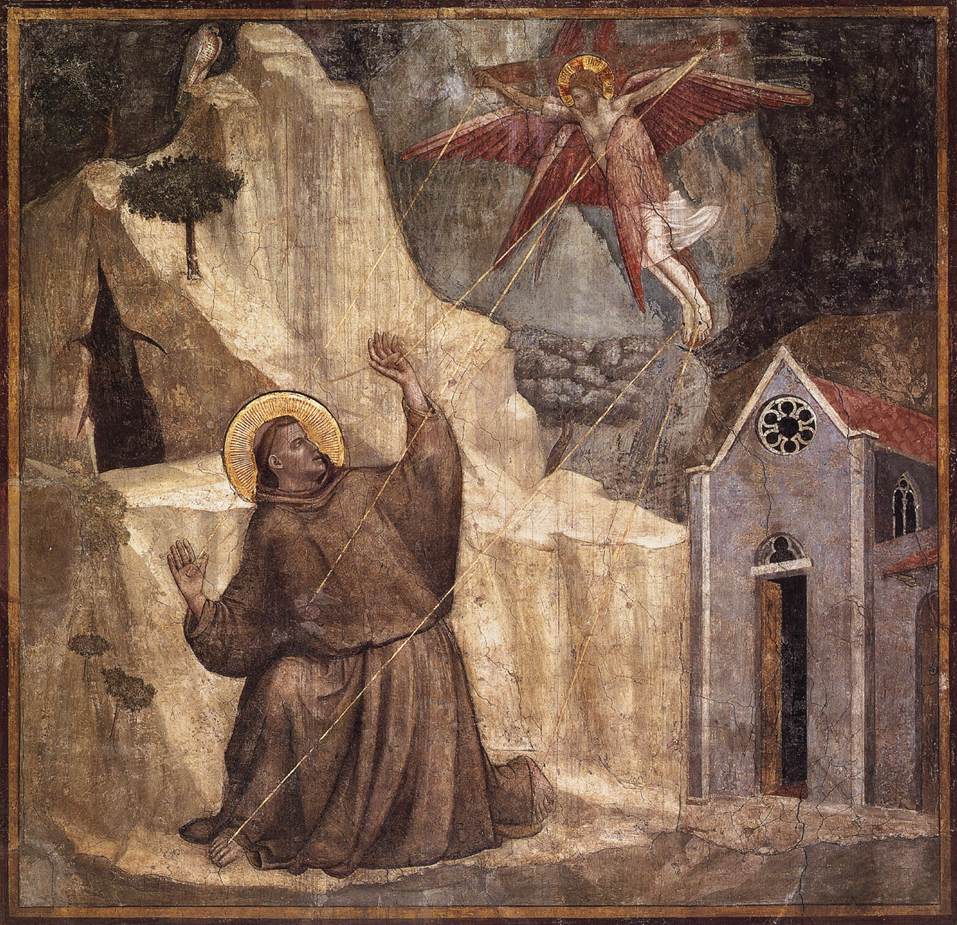
Saint Francis Receiving the Stigmata, Giotto, ca. 1320

If it be answered that the people concerned don't deserve forgiveness, well, I would point out as I did above that even now, I don't think we technically know what or how much they did wrong. And that does matter. But it isn't the point, because the brute fact is that nobody deserves forgiveness. That is what forgiveness means.**** And if it be pointed out that the command Love thy enemy applies to our own enemies rather than other people's, then it is worth asking on what basis we propose to hate anybody. For we only hate people when we regard them either as our own enemies in point of fact, or as our own enemies by proxy through identifying with someone we love. And whether in the normal way or by proxy -- that is, through the Coinherence -- they are made proper objects of forgiveness by our decision to regard them as enemies.

And what then? Well, for the vast majority of us, living outside Colorado, there is little we can do from a pragmatic point of view. But we can practice the seventh of the spiritual works of mercy. We can pray for the living (for the repentance of the offending ministers, and for the consolation of those whose grief was thus outraged) and the dead (for the repose of Vanessa Collier's soul).


Requiem aeternam dona eae, Domine: et lux perpetua luceat eae.
Rest eternal grant unto her, O Lord: and let light perpetual shine upon her.

I've got to say, one thing that has impressed me about the LGBT community since I became, however ambiguously, a part of it, was the astonishing number of us for whom patience, compassion, and forgiveness, even towards bitter enemies, is a normal and natural thing. There are loud, obnoxious, and deeply hateful specimens among us -- the reverse side of Westboro Baptist Church, if you will -- and that is to be expected; it's to be expected, too, that they should get more media attention (both mainstream and specifically Christian) than their holier counterparts. But time and time again, I have seen queer people, some of them Christian and some not, rise to the occasion of mercy magnificently. I hope we see that again here -- I think I've seen bits of it already. And I hope it bears fruit.


* In saying "her wife," I am not disclaiming the Catholic teaching about marriage. If my protestation, derived from St. Teresa, is held an inadequate profession of orthodoxy, then I specifically affirm here that I receive the Church's teaching about the sacrament of Marriage in all docility and affirm it entirely, up to and including the political belief that natural, and therefore civil, marriage is properly between one man and one woman only. However, neither charity nor good manners seems to me to smile on putting scare quotes on the relational identifiers of a deceased woman and her grieving loved ones; and in any case, I've never heard of anybody being persuaded of orthodoxy by someone else's terminological pedantry.

**Indeed, the first of the two articles I've linked appears to be guilty of this, conflating the disruption of funeral observances in this case, and in Tampa last year, with the rather different difficulty of a woman being refused Communion at her mother's funeral in 2012 in the D.C. area. I call this a rather different difficulty because, on the one hand, nobody has the right to receive Communion -- even to those who are eligible to receive it, it comes as a gift, by nature, and not something that can be demanded on the ground of any justice, and a gift that the Church which stewards it is occasionally obligated to refuse to people -- but on the other hand, Cardinal Wuerl appears to have said that the priest acted out of accord with the disciplinary policies of the Archdiocese.

***From Gerard Manley Hopkins' sonnet As Kingfishers Catch Fire.

****The clip, unfortunately, does not contain a correct understanding of what the word Purgatory means; but since Joss Whedon's theology is not particularly technical I think we can leave that to one side for the moment.

Monday, January 12, 2015

Five Quick Takes

I.

I got to spend this past weekend up in Worcester, Massachusetts, with my friend Joseph Prever, erstwhile author of the outstanding Steve Gershom blog. We met two or three years ago through reading each others' work and, more importantly, a shared love of Strong Bad.


He has gone into a sort of retirement from blogging, though he is currently working on the possibility of getting a Courage chapter started in Worcester. He is also making some nifty electronica, complete with YouTube channel.

While I was up there, we went out to visit Plymouth, which I'd never been to before (actually I'd never been anywhere in Massachusetts before). My mother is distantly descended from the Mayflower Pilgrims -- though, come to think of it, is anybody today closely descended from them? -- and specifically from Elder William Brewster, their pastor. I sometimes amuse myself with wondering what he would think of me -- and I suspect that, out of being Catholic, gay, a pacifist, and an anarchist, he'd probably object most strongly to the first, given that he and his left the Church of England and indeed the country of England because it was too papist. I'd hoped to find the old Brewster house if it were still standing; as far as we could tell, it wasn't, but we did manage to find Plymouth Rock, which turned out to be a lot more difficult than we anticipated, because apparently most people don't choose to visit Plymouth or its rock in the horrible January freeze, so a lot of the tourist stuff was shut down.

+     +     +

II.

Speaking of gay Christian authors, there's been some good stuff lately. Eve Tushnet (who is going to be talking about her new book, Gay and Catholic, at the Catholic Information Center in DC tomorrow night at 6) posted this piece on her ever-excellent Patheos blog, of which the following is a selection:
I did a long, fascinating interview ... in which the interviewer is a secular progressive. He found aspects of my book intriguing, but at one point he said, "Look, I need to push back on you a bit here. You talk a lot about the need for churches to change and become more accepting and welcoming of gay people. And you want to reduce stigma against not only gay people, but same-sex affection ... But can you really reconcile reduction of stigma with upholding Catholic morality? ..." 
... Jesus attempted this same trick. He made the prohibitions on lust more strict, and yet welcomed and succored prostitutes and adulteresses. 
Part of how He squared this circle was by prohibiting judgment. Spending your time imagining what those hand-holding guys might be doing is itself immoral. Acting to stigmatize and humiliate them is itself immoral. This obviously makes building a nice Christian society really hard. The tools of shame and social pressures which all societies use to maintain their boundaries suddenly become moral problems, not solutions.
It's extremely hard to bring together an elevated and exacting moral idealism, such as Christianity demands, with grace, humility, and patience attitude for those who don't live up to that idealism, such as Christianity demands. To adapt a phrase from Charles Williams, it's really hard to combine sanctity with sanity: one of the things that made the saints saintly being that they perceived the difficulty of the problem, and solved it correctly.

There is also this piece from Seth Crocker, author of Building Bridges in War Zones, dealing a little with his own coming out experience -- not so much to others, as to himself -- and interactions with ex-gay thought. I've read a hundred stories like it, but he's a good writer, and I was touched by it all over again when I read it.

And Melinda Selmys posted this at Spiritual Friendship a couple of weeks ago, dealing with the saddening and media-prominent suicide of Leelah Alcorn, a transgender teenager. I don't at all know where to stand on trans issues; and I am the more reluctant to form an opinion, between the (so far) silence of the Church on the subject and the fact that, not being trans myself, there will always be a sense in which I don't know what I'm talking about and a sense in which I don't have to deal with the consequences of anything I think. But I do think that compassion, and still more respect, for trans people in our society is seriously lacking, and that wants correcting regardless of what doctrine of gender and body we espouse. A clearer knowledge of trans issues, and most especially listening to what trans people have to say about themselves, is to my mind a vital first step in this.


With a curious persistence and frequency, I've been meeting more transgender and otherwise genderqueer people lately, and I want to do more learning, praying, and thinking about these issues. For now, I'm content to state my ignorance frankly (since "The conviction of wisdom is the plague of man"), and to wait for greater light.

+     +     +

III.

Ongoing apologies to my Patreon sponsors, for whom I think I've posted one reward so far? Which means I owe you, like, three? I feel really bad. I'll try to do ... something. I don't even know what.

Also, thank you to my Patreon sponsors! I'm touched by the support you guys give me, especially since blogging has turned out to be suspiciously similar to working on a few occasions, with the exception that jobs have an inscrutable tendency to make you put on pants.

+     +     +

IV.

I participated, almost three months ago now, in a -- well, I don't know what to call it. Forum? Discussion ... community? A something. Anyway, it's called Oriented to Love and it's extremely difficult to explain in words what goes on there (though Sarah of A Queer Calling, whom I rode up with, did a good job of it here.) It was a group of twelve Christians, no two people having the same combination of theological views, sexual orientation, and relationship status. Though there were one or two things that made me uncomfortable, none of them had anything to do with interacting with people I disagreed with. The amount of respect and even affection that we displayed to one another, as almost total strangers, was startling and beautiful to me. I've thought about writing a post about it, although I can't think of much to say except "I liked this, it was super cool!" which is hard to make into blog post length unless you start messing with the font size. It is worth noting that it's an ongoing event; they have two or three a year, so at any given moment they're probably accepting applications.


The thing that was, I think, so powerful about it was not simply that we weren't concerned to persuade one another of our views. The mere absence of theology, or of anything (other than sin), doesn't in my opinion possess that kind of power; and it must be said, too, that no Christian life could be conducted without a modicum of theology, because applying one's intelligence to life is part of what makes you keep being alive -- as much in the spiritual realm as anywhere else -- and, in the last resort, is all theology means.

But I digress. I think the thing that was so powerful there was that each one of us was concerned with a rather different problem, which I think could be fairly summed up as follows: From where I am, how can I best love and understand people who aren't where I am? And, insofar as the Body of Christ (to say nothing of the Church and the World) interacts primarily with people who are different, there's a sense in which I think what we were doing was opening ourselves to one of the basic and elemental modes in which supernatural love has to exist.

+     +     +

V.


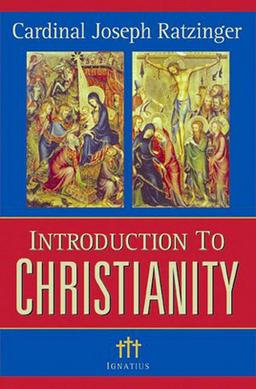
I've been rereading Introduction to Christianity by Pope Benedict XVI, and his brilliance is just magnificent. I've been lingering particularly over his treatment of the Trinity, which he illuminates with a wisdom whose like I've never seen. It's also reminded me how funny it is that people think of him as this brutal Grand Inquisitor type, when he has things like this to say:
Every one of the main basic concepts in the doctrine of the Trinity was condemned at one time or another; they were all adopted only after the frustration of a condemnation; they are all accepted only inasmuch as they are at the same time branded as unusable ... 
[E]very heresy is at the same time a cipher for an abiding truth, a cipher we must now preserve with other simultaneously valid statements, separated from which it produces a false impression. In other words, all these statements are not so much gravestones as the bricks of a cathedral, which are, of course, only useful when they do not remain alone but are inserted into something bigger, just as even the positively accepted formulas are valid only if they are at the same time aware of their own inadequacy. 
... The physicist is becoming increasingly aware today [in 1969] that we cannot embrace given realities -- the structure of light, for example ... -- in one form of experiment and so in one form of statement; that, on the contrary, from different sides we glimpse different aspects, which cannot be traced back to each other. We have to take the two together -- say, the structure of particle and wave -- without being able to find a comprehensive explanation ... 
[I]t remains an exciting simile for the actualitas divina, for the fact that God is absolutely "in act" [and not "in potency"], and for the idea that the densest being -- God -- can subsist only in a multitude of relations [i.e., the Trinity], which are not substances but simply "waves," and therein form a perfect unity and also fullness of being. 
-- Pp. 172-175
This is only a small glimpse of His Holiness' genius. And it is of course no threat to orthodoxy -- not because he was the Pope (which, when he wrote this book, he wasn't), but because orthodoxy, while mistress of its own sphere, has nevertheless a finite sphere; she expresses the truth as best as it can be expressed in terms of the human mind, and admitting the intrinsic limitations of that mind is therefore no insult to her. It is the perennial problem of how we can know anything without knowing everything: regarding which the Catholic Church has always steadfastly maintained that we, and even she, do not know everything, but nevertheless she and we can and do know something. I don't think it's entirely a coincidence that Pope Benedict has a longstanding interest in the work of Dante, since the point of the Divine Comedy is very largely that Beatrice was not God, but that she was Beatrice; that she was not everything, but she was something.


"Then you are Somebody, sir?"
"I am."